Taylor Sheridan has become one of Hollywood’s most recognizable storytellers, thanks to a string of acclaimed crime dramas and modern Westerns. Having begun his career as an actor, Sheridan reinvented himself as a writer and director whose stories reshaped modern Westerns. His projects are now known for sharp dialogue, emotional tension, and characters who rarely fit into simple definitions of good or evil. This reputation makes one early credit especially surprising.
Released in 2011, Vile arrived years before Taylor Sheridan became one of Hollywood’s most respected storytellers. The psychological horror movie received poor reviews from critics and never gained the lasting attention of his later work. Even so, it remains an important chapter in his career because it marks the beginning of his journey. Looking back today, Vile feels less like the start of a familiar path and more like an unusual detour that makes everything Sheridan created afterward even more fascinating.
Vile Belongs to a Genre Taylor Sheridan Never Returned To
By the time Taylor Sheridan became a household name, audiences knew exactly what to expect from his work. His stories usually take place in harsh environments where flawed people face impossible choices. Whether set along the U.S.-Mexico border, on Native American reservations, or in the mountains of Montana, his projects are rooted in realism and emotional conflict.
Vile is the complete opposite. The film follows a group of strangers who wake up imprisoned inside a remote house. They soon discover they must inflict pain on one another to collect a mysterious substance released through suffering. Unless they gather enough of it before time runs out, none of them will survive.
The premise places Vile alongside the wave of psychological horror films that gained popularity after the success of movies like Saw and Cube. Instead of exploring social issues or regional culture, it focuses on survival inside a confined setting. Sheridan never directed another feature built around this kind of horror concept, making Vile stand apart from everything else attached to his name.

Vile Lacks the Themes That Later Defined His Career
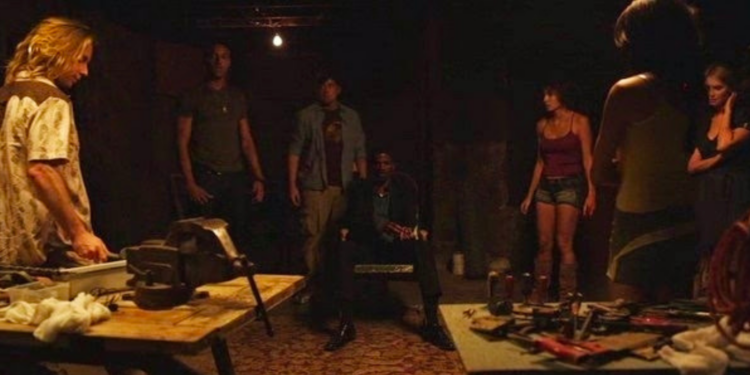
Taylor Sheridan’s later films rarely rely on shocking violence for its own sake. Violence is usually a consequence of difficult decisions, personal responsibility, or systemic failure. Characters suffer because of the world they live in rather than because a story demands another gruesome scene. This approach is difficult to find in Vile. The movie is driven primarily by its central survival game. While it raises questions about human morality under extreme pressure, those ideas never receive the same depth Sheridan would later bring to his screenplays.
The characters serve the premise more than they drive it, leaving little room for the layered relationships that became one of his greatest strengths. Compare that with films like Hell or High Water or Wind River, where every act of violence carries emotional weight and lasting consequences. While those stories linger because the people feel authentic, Vile rarely reaches that level of emotional investment.
Vile Lacks the Expansive World of Taylor Sheridan’s Later Stories
One of the defining qualities of Sheridan’s later work is its sense of place. The deserts of Texas, the snowy wilderness of Wyoming, and the sprawling ranches of Montana become characters in their own right. His locations shape the people who inhabit them and influence every major decision they make. Vile has almost none of that.
Most of the film’s 88-minute runtime unfolds inside a single house, creating an intentionally claustrophobic atmosphere. While the setting suits the story, it lacks the visual identity audiences now associate with Sheridan’s projects. There are no sweeping landscapes, no communities worth protecting, and no larger world waiting beyond the walls. Considering how important location became throughout his career, Vile almost feels as if it were directed by someone else.
Vile’s Critical Reception Stands in Sharp Contrast to His Later Work

When Vile premiered, critics largely dismissed it as another entry in the post-Saw wave of horror films. Many reviews criticized its familiar concept and uneven execution. Although the movie earned a modest return ($45 million) compared to its reported production budget ($11 million), Vile never developed the kind of reputation that encourages widespread rediscovery.
However, Sheridan’s career changed dramatically just a few years later. His screenplay for Sicario immediately attracted attention for its tense storytelling and moral complexity. It was followed by Hell or High Water, which earned Academy Award nominations, including one for Best Original Screenplay. Wind River further established him as a filmmaker capable of balancing suspense with emotionally rich storytelling.
His move into television cemented his reputation even further. TV series like Yellowstone, 1883, 1923, Mayor of Kingstown, Tulsa King, and Landman transformed him into one of the industry’s most influential creators. Viewed through that lens, Vile becomes a fascinating reminder that successful careers rarely begin with instant acclaim.
How Vile Foreshadowed Taylor Sheridan’s Later Success
Despite its shortcomings, Vile isn’t completely disconnected from Taylor Sheridan’s later work. The film places ordinary people under extraordinary pressure and asks how far they will go to survive. Moral compromise, desperation, and impossible choices would all become recurring ideas throughout his later screenplays. The difference is that Sheridan eventually found richer settings and stronger characters to explore those themes.
Sheridan’s greatest growth came from shifting the focus away from elaborate horror concepts and toward human behavior. Instead of trapping people inside deadly games, he began placing them inside believable worlds where every decision carried real emotional consequences. The change reshaped his entire career.
Why Vile Still Matters Today
Vile is unlikely to rank among Taylor Sheridan’s essential works, and even longtime fans may find it difficult to reconcile with the writer and director he eventually became. Yet dismissing it entirely means overlooking an important piece of his creative evolution. Every filmmaker has a starting point, and not every debut captures the voice that later defines a career. In Sheridan’s case, Vile represents experimentation before he discovered the storytelling style that would make him one of Hollywood’s most recognizable creative voices.
For audiences who know him only through Yellowstone or his acclaimed films, watching Vile can be a surprising experience. It reveals a filmmaker still searching for his identity, years before he found it in modern Westerns, crime dramas, and character-driven thrillers. The contrast is exactly what makes Vile such an intriguing entry in Taylor Sheridan’s filmography. It doesn’t resemble the work that followed, but it makes Taylor Sheridan’s transformation all the more remarkable.
 Follow Us