There was a time when the idea of government surveillance sounded like something the minds of paranoid people cooked up rather than something hotly debated on the evening news. Hollywood promptly changed that with deeply realistic thrillers about wiretaps, hidden cameras, and shady agencies. Suddenly, people were checking their smoke detectors and fire alarms for hidden mics and all kinds of surveillance gear with a fervor that suggested there might be more to the idea of government surveillance than meets the eye.
These five movies aren’t just action flicks. They serve up five different flavors of fear, starting with a Watergate-era character study and ending with a modern biopic about a real-life whistleblower. They all hit the nerve, though. Each one makes the viewer wonder if the “help” our government often promises is actually just a leash.
5. Blow Out (1981)
The main character of Blow Out is Jack Terry (John Travolta), a sound guy for cheap horror movies. One night, he’s out recording the sound of nature when he accidentally records the audio of a car plunging into a river. What seemed like a routine car crash turned out to be a political hit, and Jack’s mic caught the whole thing. The rest of the movie is him obsessively listening to that audio and trying to crack the case. Travolta’s performance impressed both casual and critical observers, including Quentin Tarantino, who cast him in Pulp Fiction decades later for that.
Director Brian De Palma borrowed so heavily from Michelangelo Antonioni‘s Blow-Up and Francis Ford Coppola’s The Conversation that critics still argue about whether it’s homage or theft. But either way, it works. The grimy Philadelphia setting is also a nice alternative to the DC and Langley settings the others on this list chose. Pauline Kael raved about the movie when it came out, even though audiences took years to catch on to what she was raving about. And the ending? Still one of the saddest in movie history. De Palma refused to change it even though pretty much everyone wanted him to. That rigid choice is exactly why it still hits hard decades later.
4. Snowden (2016)
Every other movie on this list is fiction. Snowden isn’t. And that’s why it hit harder than usual. Oliver Stone, the guy who turned JFK into a three-hour conspiracy fever dream, dials the theatrics way down here mainly because the real story already sounds wild enough. Joseph Gordon-Levitt plays Edward Snowden like a man who genuinely believed in his country before he found out what it was really doing.
The movie compresses the boring stuff, like the hours of copying files, into a five-minute heist sequence. Smart move. No one wants to watch someone slowly use a USB drive. The focus instead is on the tense stuff, like the meeting with journalists Laura Poitras (played by Melissa Leo), Glenn Greenwald (played by Zachary Quinto), and Ewen MacAskill (played by Tom Wilkinson) to drop the files. Gordon-Levitt actually flew to Russia to meet the real Snowden. He even donated his entire paycheck for the movie to the ACLU. By the end, when the real Snowden shows up on screen, it plays less like a script and more like a warning most people ignored in real life.
3. Enemy of the State (1998)
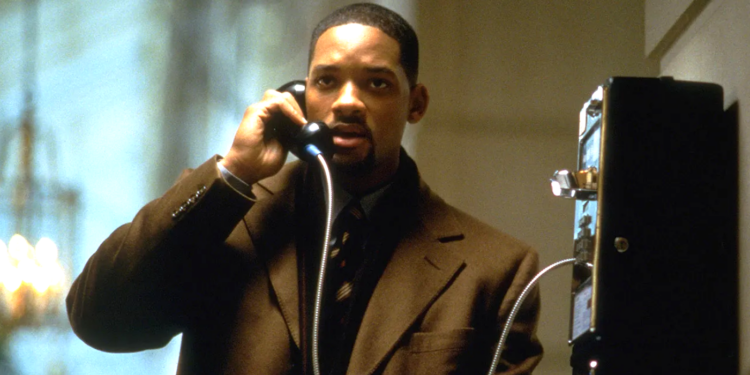
Enemy of the State predicted exactly what Snowden would tell us two decades later. It just had more car chases and none of the Russian asylum drama. Will Smith plays a labor lawyer who accidentally gets his hands on a tape that spills the beans on a dirty politician. Within hours, the government erases his entire life, starting with his bank account. It’s a nightmare scenario, but director Tony Scott makes it feel like a joyride.
Gene Hackman shows up as a grouchy old spy, which is a perfect call back to a movie we’ll talk about very soon. Back in 1998, the idea of tracking someone through their phone sounded like a well-written sci-fi script. It’s also worth remembering that this was Smith at his most vulnerable on screen up to that point. That’s a rare register for an actor who’d spent the decade playing invincible. That vulnerability is what makes the paranoia land so well.
2. Brazil (1985)
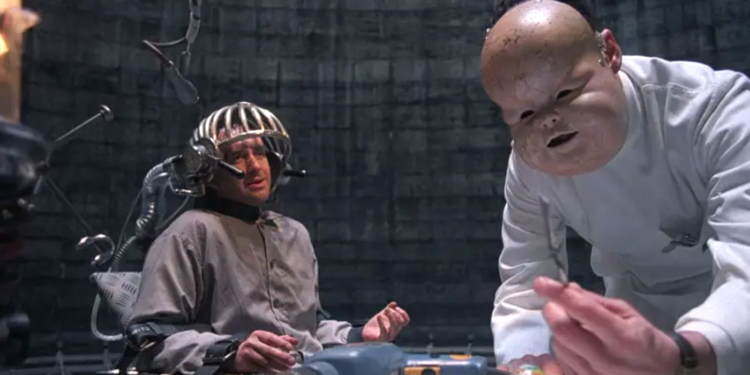
Take the fear of the government and add a generous spoonful of absurdity. That’s Brazil. Forget wiretaps and guns. In Terry Gilliam‘s dystopia, the biggest weapon is a bureaucratic typo that gets an innocent plumber mistaken for a terrorist and tortured to death. This movie is a comedy that makes the viewer want to cry. Universal Studios obviously didn’t like the ending because they thought it was too dark. So studio chief Sid Sheinberg quietly prepped a 94-minute cut that cut the misery and bolted on a tidy happy ending. Gilliam would have none of it, though, and refused to let it anywhere near theaters.
In fact, that butchered version was never released. It only turned up on syndicated TV under the fitting nickname Love Conquers All. The fight he had with the studio was basically his plot playing out in real life, with Gilliam playing the part of the little guy fighting a huge machine that doesn’t care about what he wants.
1. The Conversation (1974)
This is the one that started it all. Every director on this list owes Francis Ford Coppola a drink because they were all inspired by The Conversation. Between making the Godfather movies, he decided to write a story about a guy who’s always listening but never hears himself. Gene Hackman plays Harry Caul, a lonely, awkward surveillance expert who’s hired to record a conversation between a young couple in a crowded park. He gets the tape, and the more he listens to it, the more he believes someone’s going to die because of it.
The sound designer Walter Murch deserves a statue for the work he did on this movie. The audio mixes the music in a way that makes the viewer feel as trapped as Harry does. Also, it came out just as the Watergate scandal was exploding, even though Coppola started writing the script for the film in the 1960s. Pure coincidence? Maybe. Terrible timing for the country? Certainly. Perfect timing for the movie? Absolutely.
Read Next: 5 Hidden Gem Thrillers From the 1990s
 Follow Us