Mercury Rising exists in a particular tier of late-90s action thrillers that seem to have slipped through the cracks. These movies aren’t typically bad, so they don’t fall into the cult realm. However, they aren’t celebrated enough to be remembered fondly.
Despite being led by Bruce Willis at the peak of his fame, Mercury Rising largely became forgotten by the masses. Today, it’s relegated to the odd stint on a streaming platform. However, this tense thriller has more heart than people realize. Here’s why you need to check out this underrated gem.
A Bruce Willis Performance That Goes Deeper Than ‘Die Hard’ Mode
When most people think of Bruce Willis, they tend to separate his framework into two categories. You’ve got the wisecracking action hero of the Die Hard franchise, and the brooding, world-weary presence of films like The Sixth Sense and Unbreakable. Mercury Rising gave him the chance to serve up something much rarer – a performance that plants itself quietly but seamlessly between those two poles.
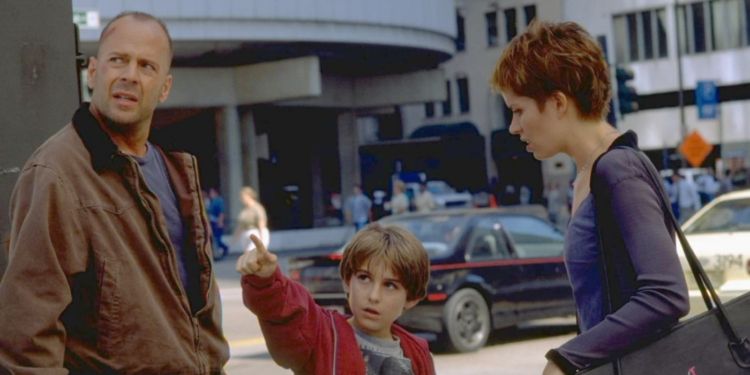
In Harold Becker‘s movie, Willis plays Art Jeffries, an outcasted FBI agent who is reassigned to desk duty after a botched undercover operation. From the film’s opening frame, it’s clear he’s playing a man carrying genuine psychological weight. There’s no one-liner swagger here, no smirk. Just a tired, guilt-ridden agent who stumbles into something far bigger than he imagine would be possible. The plot follows Jeffries as he protects an autistic child who becomes a target for death when he accidentally cracks a top secret government code.
What makes the performance resonate so much is how Willis handles the relationship between Jeffries and Simon, a nine-year-old autistic boy played with remarkable sensitivity by Miko Hughes. Willis never belittles the subject matter or dismisses his interactions with Hughes as merely story devices. Rather than being sentimental, he offers a warmth and patience that feels earned. As we watch a bruised, cynical man slowly open himself up to protect a child who trusts no one, we see Willis deliver a rendition that is genuinely moving. It’s the kind of quiet, character-driven work that tends to get overlooked in blockbuster-era careers.

Mercury Rising Feels More Relevant Today Than Ever
On the surface, you could walk into this movie thinking it’s another Bruce Willis action thriller solely about revenge or justice. However, at its core, Mercury Rising is a film about the vulnerability of the individual against the powerful machinery of the state. After Simon cracks the code, instead of simply acknowledging the security breach and rectifying it in house, the NSA takes the simplest solution and sets out to eliminate him. It’s a premise that sounds too crazy to be true, and more like a twisted paranoid fantasy, but this taut thriller treats it with enough procedural grounding to make it feel plausible. While it may have missed the mark with audiences in 1998, today, it lands with uneasy familiarity in the current environment of institutional opacity, government overreach, and data surveillance.
The film also handles Simon’s autism with more care than audiences might expect from a 1998 action thriller. Rather than using his neurodivergence purely as a plot device, the screenplay takes time to show the world from Simon’s perspective – chaotic, overwhelming, full of noise and incomprehensible social signals. The fact that the government views his extraordinary mind as a threat to be neutralized rather than a gift to be understood gives the story a moral edge that lingers long after the credits roll.
It’s Not Just Bruce Willis Who Shines
If Willis’s performance is the heart of Mercury Rising, then Alec Baldwin‘s portrayal of NSA Deputy Director Nicholas Kudrow is the film’s ice-cold spine. By this point, audiences already knew he could play a sleazy antagonist with ease, but this time he was portraying an utter psychopath hiding behind a suit and badge. Baldwin plays Kudrow not as a cartoonish megalomaniac but as something far more chilling – a true believer. He’s an immoral man who has convinced himself that ordering the death of a child is simply the rational cost of protecting national security.
Yet the true supporting star in this vehicle is Miko Hughes. Although he has disappeared from Hollywood for the most part, this role proved that he could have built a massive career as an actor if he chose to do so. To prepare for his role, Hughes spent time at a school for autistic children. He was then tutored for six weeks by Bennett Leventhal, the head of the child psychiatry department at the University of Chicago.
Read Next: Bruce Willis Young: Photos Of Him Through The Years
 Follow Us