Every year, the Academy Awards celebrate the film industry’s most critically adored masterpieces. Over the last few decades, more and more box office juggernauts have made their way in too. When a film achieves both of these things, it’s almost certain it will land a few nods.
But sometimes, the Academy defies all logic. Every now and then, a critically panned movie shocks the industry and reminds us that the voters at the Academy have highly unpredictable tastes. On top of this, a fair few box office bombs have managed to secure nominations, and in some cases, even win. So, here are five disastrous movies that somehow landed Oscar nominations.
5. Norbit (2007)
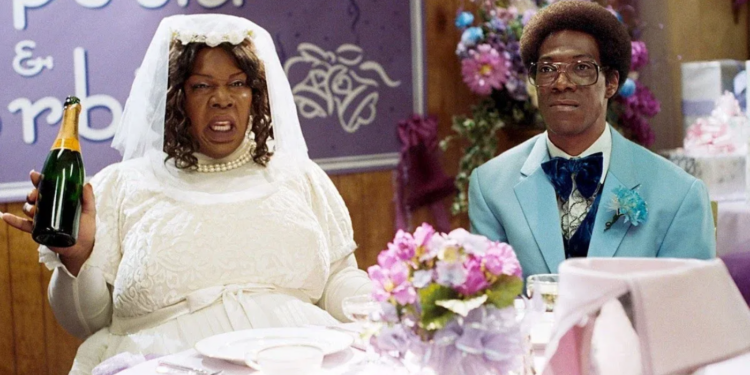
Throughout the 80s and 90s, Eddie Murphy was one of the biggest box office stars. Bursting onto the scene as a teenager, he was quickly sharing the screen with Hollywood giants, often twice his age and tenure. Although his multiple character work in The Nutty Professor and its sequel was a smash hit with audiences, critics certainly didn’t dig it. Then in 2007, he unleashed Norbit, and this time, neither critics or comedy movie fanatics could get behind it.
Although people did flock to the theaters to watch it, many left feeling like they had been robbed of 100 minutes of their life. They expected a Nutty Professor-style romp, but they got a lazy, mean-spirited movie that relied on crude humor and lacked any heart. Yet, this disastrous film made its way to the Oscars, landing a nomination for Best Achievement in Makeup. At the Razzies, the film walked away with three unflattering trophies, including Worst Actor for Murphy, a far cry from his Oscar nomination the year before for Dreamgirls.

4. Pearl Harbor (2001)
Michael Bay is renowned for delivering massive spectacles. However, he has never reached the same critical approval level of his peers like James Cameron and Christopher Nolan, who also deliver gargantuan blockbuster films. The difference is, Bay often chooses style over substance. So, while Pearl Harbor was another massive movie (about an important time in history), its downfall was way bigger than its delivery.
The first thing to note is that this was far from a box office failure, grossing roughly $450 million worldwide against a production budget of about $140 million. But it wasn’t really casual moviegoers who had a problem. The film was smashed with backlash from critics and historians for its heavy focus on a fictional love triangle, historical inaccuracies, and melodramatic dialogue. Much like James Cameron successfully did with Titanic, Bay attempted to splice a sweeping romance into a real-world tragedy, but the gamble did not pay off and the romance trivialized a defining event by turning a national tragedy into a glossy backdrop for a soap opera. Although it failed to win over audiences’ hearts, the film’s technical grandeur could not be ignored by the Academy. It won in the Best Sound Editing category, and bagged nods for Best Sound, Best Visual Effects, and Best Music, Original Song.
3. Extremely Loud & Incredibly Close (2011)
Where Pearl Harbor was a box office powerhouse that stumbled critically, Stephen Daldry’s Extremely Loud & Incredibly Close stands as one of the most polarizing and financially underwhelming films to ever gatecrash the Best Picture category. On the tin, this feels like instant Oscar bait; a star-studded cast led by Tom Hanks, a powerful story that would normally resonate, wrapped up in an epic style of storytelling. However, the post-9/11 drama sputtered at the box office, grossing just $55.2 million worldwide and failing to recoup its production and heavy award-campaign costs.
Although designed to tug on the heart strings, this film drew fierce backlash from critics who dismissed it as an emotionally manipulative picture that shamelessly exploited a national tragedy through a contrived, sentimental narrative. Despite sitting at a thoroughly rotten 45% on Rotten Tomatoes, the film shocked the industry by capitalizing on an expanded Best Picture field and an aggressive push by producer Scott Rudin. It secured two nominations at the 84th Academy Awards in 2012: a controversial nod for Best Picture but a well-deserved recognition for industry veteran Max von Sydow as Best Supporting Actor.
2. Babylon (2022)
Some directors can pull off 3-hour long epics with ease, making their art run so smoothly that it doesn’t even feel long. Unfortunately, Babylon proved that Damien Chazelle does not fit into this realm of filmmakers. Give him a tight and tense story to work with like Whiplash and he shines, but the main issue people had with this film was with its length. Clocking in at a staggering 189 minutes, the film follows the chaotic rise and fall of several ambitious individuals – including an aging silent film star, a wild starlet, and a young assistant – navigating the decadent, depraved transition from silent films to talkies in late 1920s Hollywood.
Instead of an immersive historical epic, audiences were met with an overwhelming sensory overload of vulgarity, bodily fluids, and relentless cacophony that many found utterly exhausting rather than engaging. This polarizing execution proved fatal at the box office. Despite its massive star power (with the likes of Brad Pitt and Margot Robbie), and a production budget of roughly $80 million, it crashed and burned, grossing just $63 million worldwide and losing the studio millions. Yet, while the film’s structural messiness alienated viewers, its lavish craftsmanship still managed to seduce the Academy, securing three nominations at the 95th Academy Awards in 2023: Best Achievement in Production Design, Best Achievement in Music Written for Motion Pictures (Original Score), and Best Achievement in Costume Design.
1. Emilia Pérez (2024)

Here’s a movie that made so many people sit up and ask “what went so wrong?”. Again, another movie that on paper screams “triumph”, but wound up being an absolute mess. To many, Jacques Audiard’s Emilia Pérez highlights what happens when Hollywood’s earnest desire for inclusivity blinds voters to staggering cultural tone-deafness. Directed by a French filmmaker who admitted to doing minimal research, shot largely on French soundstages, and utilizing a mostly non-Mexican lead cast, the film drew powerful criticisms and widespread dislike from critics in Mexico who panned it as a crude, misleading “narco-opera” that minimized actual cartel violence.
To make matters worse, the narrative attempts the highly questionable feat of redeeming a mass-murdering cartel boss through a gender transition, an angle that even drew criticism from trans advocates for treating a deeply personal human experience as a superficial get-out-of-jail-free card for heinous crimes. Yet, miraculously, the film became the ultimate paradox of the 2025 awards season, leading the 97th Academy Awards with a historic 13 nominations – including Best Picture, Best International Feature Film, and a history-making Best Actress nod for Karla Sofía Gascón.
Read Next: Here’s Why Marty Supreme Went Home Empty Handed at the Oscars
 Follow Us