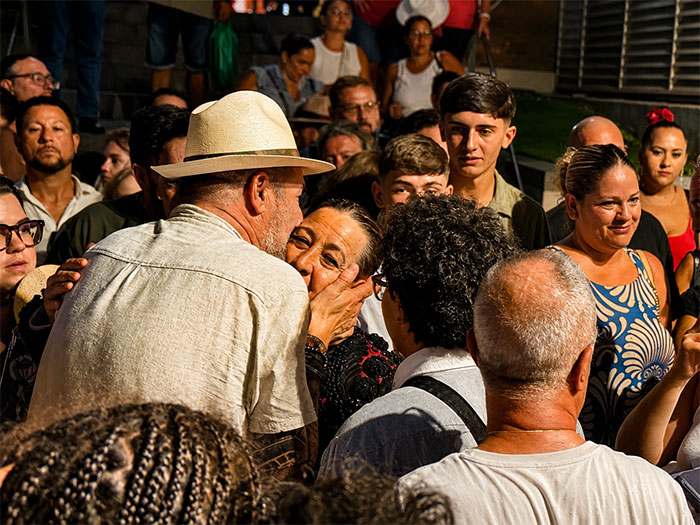
The woman to my left is wearing a mantilla and has the posture of someone who was born sitting in a cathedral. The man to my right has a cigar and an almost intimidating confidence. The crowd filling the Plaza de Toros La Malagueta on the third night of the Feria de Málaga is dressed as if it is another day at Wimbledon, just with fans instead of Pim’s in their hands. I have seen more hooligans at a Watford home game than I am seeing here at what is supposed to be Spain’s most barbaric tradition. What is going on?
I should tell you that several of my friends, when I mentioned I was going to a bullfight, didn’t react in horror as I anticipated. They imagined something between a rodeo and a circus, dangerous but essentially non-lethal, high on bravado and low on consequence. Nobody had told them about the blood. Six bulls per night, every night of the Feria, dispatched with varying degrees of ceremony and skill in front of a crowd that knows the difference between a good fight and a poor one and is not shy about communicating its verdict. Six bulls is, for the mathematically curious, enough beef to supply the entire arena with Big Macs.
I am an animal lover. I am also a person who had jamón for breakfast, jamón for lunch, and was planning jamón for dinner. When in Spain! I had assumed these two facts about myself could coexist indefinitely without creating a philosophical crisis. The Plaza de Toros La Malagueta is not a place where comfortable contradictions survive the evening.
I want to be clear that I am not here to tell you what to think about bullfighting. I am a visitor in a country that has been sophisticated, warm, and generous to me in every conceivable way, and it is not my place to arrive at someone else’s centuries-old tradition and immediately start issuing verdicts. But where does one draw the line between tourism and tradition? And is bullfighting still thriving, and we choose not to talk about it, because boycotting would mean no more Benidorm summers?
Louise Pieterse
The ritual begins
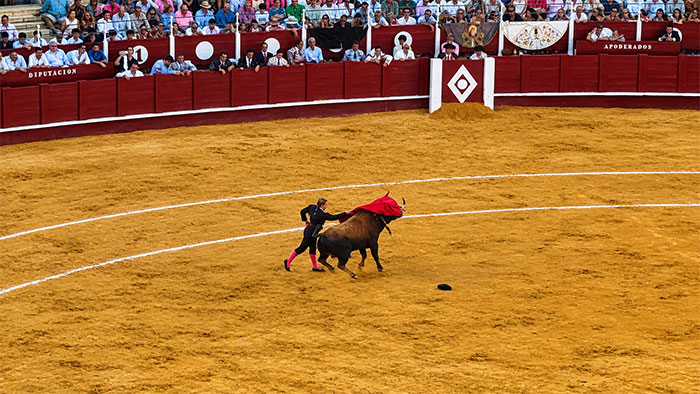
The corrida de toros follows a structure so precise it is like a liturgy. Each fight is divided into three acts called tercios, each with its own rules, its own cast, and its own emotional register. In the first, the picadores enter on horseback and weaken the bull’s neck muscles with lances. Emotional conundrum nr. 1. Just hours before, I was scared out of my wits by a gigantic police horse who was getting unruly, yet here, the powerful beast was blindfolded and completely oblivious to what was to come: 1,500 pounds of force and horns.
In the second act, the banderilleros (the matador’s team if you will) place pairs of decorated barbed sticks into the bull’s shoulders, further weakening the muscles and lowering his head for the final act. By the time the matador enters for the third tercio, the bull has been fighting for approximately fifteen minutes against multiple opponents, has sustained significant blood loss, and is operating at a fraction of his original capacity.

Louise Pieterse
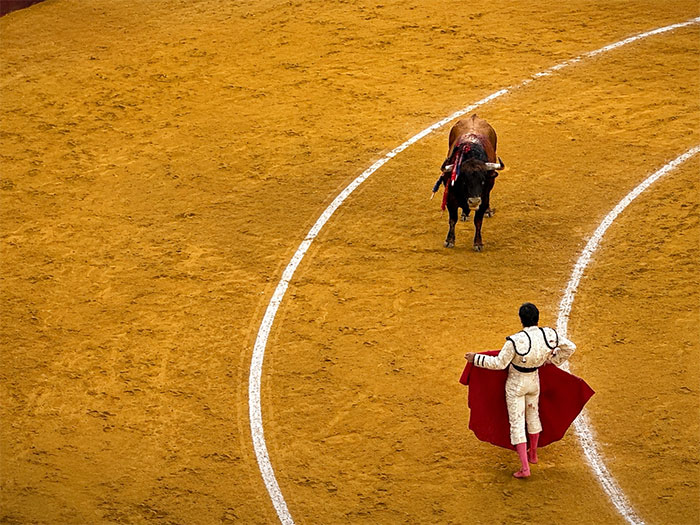
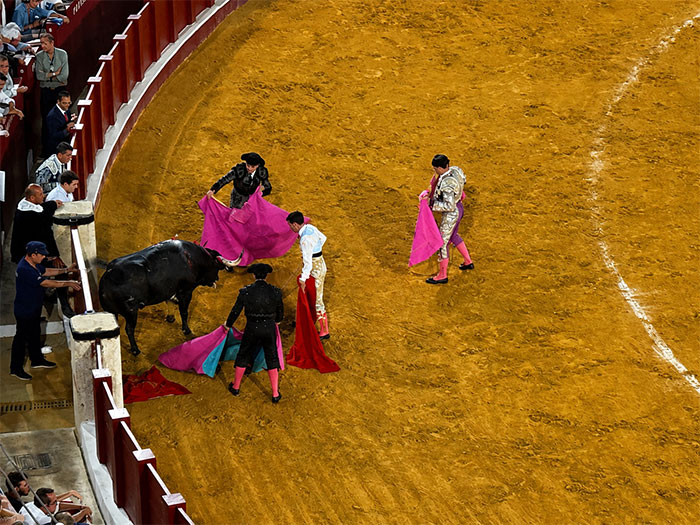
At one point during the evening, a sword became lodged awkwardly and ended up knotted in the bull’s tail, briefly and accidentally arming him. For a few seconds, the situation had potential. Then a sea of magenta capes descended, and the advantage was neutralised before he could do anything interesting with it. Bring back gladiator rules, I thought. One man, one bull, no support staff. Then the man will surely lose, and we will have a more honest conversation about what this actually is.
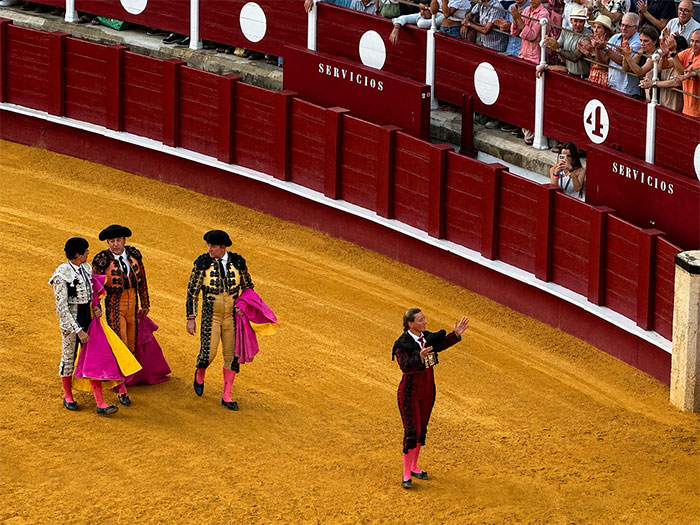
The matador who kicked off the evening was 51-year-old María Paz Vega. Yes, a woman. At 51, she moved with more grace and command than any of the men of the evening, and she was going to make sure the last fight of her career would be one to remember. The crowd adored her. And I can see why.
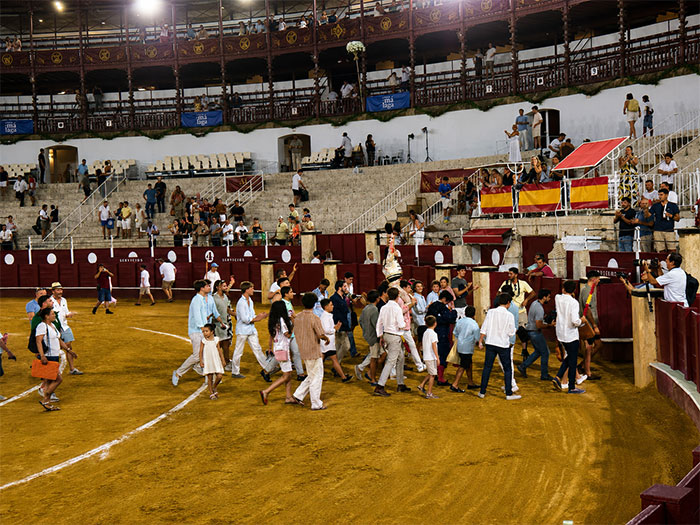
Once all the bloodshed was done, children carried the final matador out on their shoulders to the streets, a hero’s exit, backstage scenes resembling a dressing room after a championship final, embraces and photographs and passion that runs deep.
Louise Pieterse
Where did the discomfort lie?
I want to be honest about where my discomfort settled, because it was not exactly where I expected it to. The killing itself, which I had anticipated would be the defining moment of horror, was somehow not the thing that stayed with me. It was the ritual humiliation that preceded it. The bull enters the arena at full power and full dignity, and the entire structure of the corrida is designed to systematically dismantle both, through blood loss and confusion and the relentless taunting of the capes, until the animal that walked in is not the animal that is dispatched. The ear is cut and presented to the matador as a trophy. The body is dragged out by horses. The sand is raked. The next bull enters.
There is an argument, made by people far more qualified than me, that the toro bravo, the breed raised specifically for the corrida, lives a better life than most animals destined for human consumption. The dehesa, the ancient woodland pasture system on which these bulls are raised across Andalusia and Extremadura, is one of the richest semi-natural habitats in Europe, home to Iberian lynx, black storks, and imperial eagles alongside the fighting bulls.
Michael Kovnick, who has operated cultural tours across southern Europe for twenty years, sheds more light on the matter. “The toro bravo is a very distinct line, and the dehesa it’s raised on is one of the richest man-made habitats in Europe.” The bull has four or five years of exceptional pasture before the fight. The chicken in the supermarket had considerably less.
I know this. I held it in my head alongside everything else and found that it helped, partially, and then stopped helping at the moment the ear came off.
Louise Pieterse
Where This All Began
Bullfighting as a formal spectacle dates to 18th-century Spain, though the relationship between Iberian culture and the fighting bull stretches back considerably further. The earliest recorded bullfights were equestrian affairs, a pursuit of the nobility conducted on horseback, with the mounted rider doing most of the work and the man on foot playing a supporting role.
It was not until the early 1700s that Francisco Romero of Ronda, a city in the mountains above Málaga, introduced the muleta, the red cape used in the final act, and established the basic structure of the modern corrida. His grandson Pedro Romero went further, codifying the passes and techniques that matadors still use today, fighting an estimated 5,600 bulls over his career without sustaining a single serious injury.
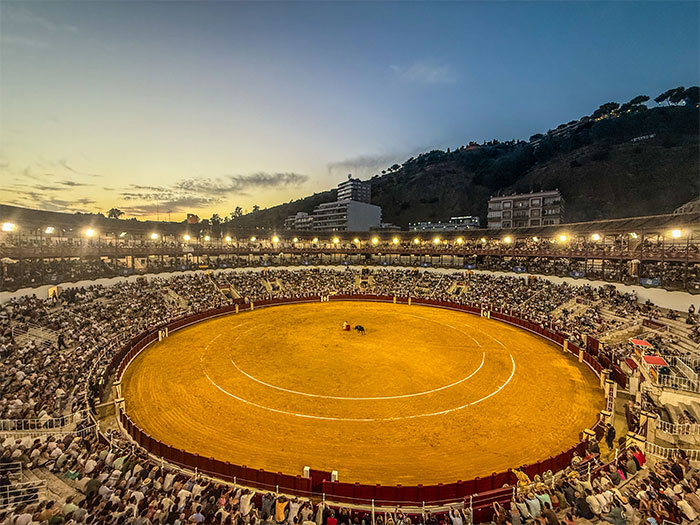
The Plaza de Toros La Malagueta opened in 1876, making it one of the oldest surviving bullrings in Spain. It has watched the tradition evolve, contract, and become contested from a ringside seat for nearly 150 years. The sand in the centre has been raked between fights for longer than most countries have had functioning democracies.
Louise Pieterse
So, who still watches this anyway?
The idea that bullfighting survives on tourist revenue is one of those assumptions that dissolves on contact with an actual bullfight. The tourists are there, corralled into the sunny bleachers on the cheap tickets, squinting and fanning themselves with their programmes. Many of them did not make it past the first fight. The seats that emptied first were not the Spanish ones.
The people who stayed, who knew when to applaud and when to jeer, and waved their little white handkerchiefs, were locals. Feria de Málaga is not a tourist event with a Spanish backdrop. It is a Spanish event that tourists are permitted to observe from the sunny side. “Tourism is not what keeps this alive. It is kept alive mostly by public money and heritage status. The tourism base for it has been falling for years,” says Kovnick. When his company surveyed potential clients about adding bullfighting to their itineraries, not only was nobody interested, several said they wanted nothing to do with it.
Christian Petzold, Spain travel expert at TheTeamTrip, makes the point that deserves more airtime in this conversation: “It is possible to separate the preservation of history and cultural heritage related to bullfighting from the preservation of the act of bullfighting.” La Malagueta itself partially reopened as a cultural centre in 2020, with exhibition halls, conference space, a restaurant, and concert programming. The corrida occupies only a handful of dates on the calendar. The architecture, the history, the extraordinary engineering of the building- none of that requires a bull to be killed inside it to remain meaningful.
Louise Pieterse
There is still one question I can’t answer
Bullfighting is legal in Spain, though the Canary Islands banned it in 1991 and Catalonia followed in 2010 before the Spanish Constitutional Court partially overturned that ban in 2016, ruling it part of national cultural heritage. It is also legal in Portugal, where the bull is not killed in the ring, in parts of southern France, and across much of Latin America. The global picture is not one of a tradition in confident expansion. It is one of a tradition in careful, contested, generational retreat, market forces and shifting public opinion doing the work that legislation has struggled to complete.
Young Spaniards attend the Feria de Málaga and carry matadors on their shoulders. Young Spaniards also, in increasing numbers, have no interest in the corrida and find the debate about it exhausting. The tradition is not as unified or as monolithic as its defenders sometimes suggest, nor is the opposition as culturally ignorant as its supporters sometimes imply. It is a conversation Spain is having with itself, in its own time, on its own terms, and a visitor from elsewhere sitting in the sunny bleachers with a programa she cannot fully read is perhaps not the most important voice in that conversation.
What I can tell you is what the woman in the mantilla looked like when the matador performed a particularly extraordinary pass, and the sound the crowd made, and the way the evening light fell across the sand, and the fact that I have never been so simultaneously moved and troubled by a single experience in a very long life of travelling to places that have challenged my assumptions about how the world works and what I am permitted to feel about it.
I ate artichokes on the way home.
Louise Pieterse
 Follow Us