History classes in school primarily tackle significant events in a particular country or the life stories of renowned figures throughout time. And because there is so much ground to cover, it would be impossible to learn all about them.
That’s where social media pages like Historyfeels come in. With compelling photos and equally captivating backstories about pop culture icons, everyday people, and powerful moments that left a mark over time, these posts may enliven you, especially if you consider yourself a history buff.
You likely won’t often see many of these tidbits of information discussed in classrooms. Scroll through and maybe learn something new today.
#1
This image is possible because of NASA’s Mars surface missions, specifically the rovers and landers equipped with high-resolution cameras designed to document the planet’s environment.
Spacecraft such as Spirit, Opportunity, Curiosity, and Perseverance carry panoramic and mast-mounted imaging systems that capture the Martian landscape throughout the day, including sunrise and sunset.
Unlike Earth, sunsets on Mars appear blue near the Sun rather than red. This happens because the planet’s thin atmosphere is filled with fine dust particles. During the day, the dust scatters red light across the sky, giving Mars its familiar butterscotch color. At sunset, however, the dust allows blue wavelengths to pass through more directly toward the observer, creating a cool blue halo around the setting Sun.
These images are transmitted millions of miles back to Earth via orbiters acting as communication relays. Each photo is processed and color-balanced to match how the scene would appear to the human eye, allowing us to experience a Martian evening from another world.
Additional fact: A Martian day, called a sol, lasts 24 hours and 39 minutes, meaning sunsets there come about 40 minutes later each Earth day.

Image source: historyfeels
#2
On March 1, 1982, the Soviet spacecraft Venera 13 landed on the fiery surface of Venus and sent back the clearest images we’ve ever received from that hellish world. In about 127 minutes, it captured panoramas revealing cracked rocks and a mustard-yellow sky before succumbing to crushing pressure and staggering heat of around 457°C (855°F). These images remain humanity’s only direct glimpse of Venus’s surface.
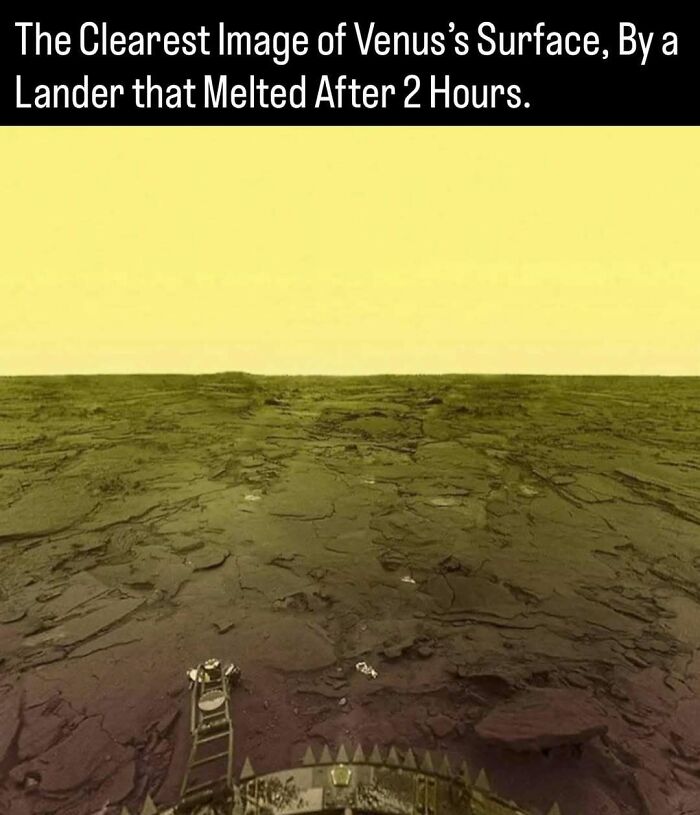
Image source: historyfeels
#3
This comparison exposes in my opinion how distorted our sense of modern time has become. Thriller was released in 1982, a year that still feels recent to many people who lived through it, yet it now sits more than four decades in the past.
When the album debuted, the Second World War was closer in time than the present day is now. The world that produced Thriller existed without the internet, without smartphones, without digital streaming, and without the constant acceleration that defines contemporary culture.
The album itself became a temporal anchor. Its sound, visuals, and choreography were replayed so relentlessly that they never seemed to age. Music videos ran on loop. Radio kept it alive. Later, streaming froze it in a permanent present. As a result, Thriller feels less like an artifact and more like a shared memory that never stopped happening.

Image source: historyfeels
As interesting as history is, there are people who have no interest in learning about past events and notable people who shaped the world. But is there an importance to studying history? George Mason University professor Dr. Peter Stearns answered this question in an essay he wrote.
#4
In 1957, the fashion world was shaken by the suddenpassing of Christian Dior, the man who had redefined postwar style with his groundbreaking “New Look.” Among the mourners was a young Yves Saint Laurent, only 21 years old, who had been working as Dior’s assistant.
This photograph captures him outside the funeral, leaning against a wall in quiet contemplation. Just days earlier, he had been unexpectedly named Dior’s successor, a decision that placed immense responsibility on his young shoulders. The atmosphere in Paris was heavy with grief, and Saint Laurent’s solemn posture reflected both the loss of his mentor and the weight of his new role.
Within months, he would debut his first collection for the house, proving that Dior’s faith in him was not misplaced. Yet in this moment, he was simply a young man mourning the end of an era while standing on the threshold of fashion history.
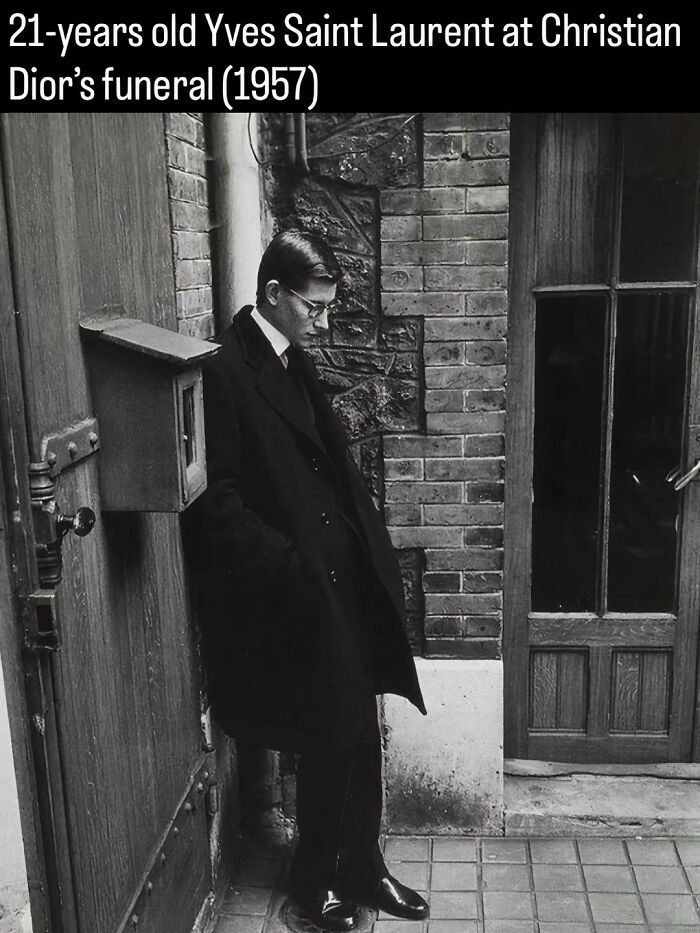
Image source: historyfeels
#5
The Choluteca Bridge, also known as the “Bridge to Nowhere,” became a global symbol of resilience, misfortune, and adaptation. Built in 1998 with Japanese engineering, the bridge was designed to withstand the strongest storms and stand for decades as a vital connection for Honduras. Ironically, when Hurricane Mitch swept across Central America later that same year, it devastated infrastructure, displaced over a million people, and caused massive loss of life. Yet the bridge itself remained intact, virtually undamaged by the storm. The catch was that Mitch had changed the course of the Choluteca River entirely. Instead of flowing beneath the bridge, the river carved out a new path beside it, leaving the impressive structure suspended over dry ground.

Image source: historyfeels
#6
In September 1787, just before the signing of the U.S. Constitution, George Washington attended a farewell gathering in Philadelphia with fellow delegates of the Constitutional Convention.
With only 55 men in attendance, the tally reveals a feast of indulgence: dozens of bottles of fortified Madeira wine and claret, substantial amounts of whiskey, porter, and cider, along with large bowls of communal punch. Adjusted for inflation they all ran up a 15k bar tab. This type send-off was not unusual for the era.
Alcohol was a central feature of 18th-century social and political life, often consumed at levels that would astonish modern observers (or maybe not depending on who’s reading). Taverns and banquets were places where ideas were debated, alliances forged, and trust built, fueling not only camaraderie but the revolutionary spirit itself.
Fun Fact: Madeira wine was George Washington’s personal favorite, and he often ordered it by the cask.
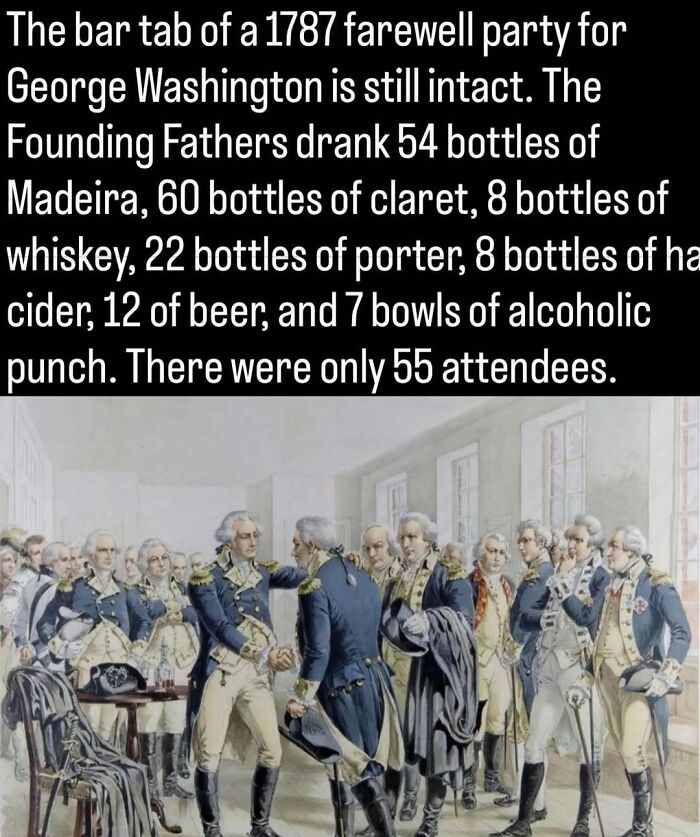
Image source: historyfeels
Apart from helping us understand people and societies, Dr. Stearns mentioned how studying history contributes to moral understanding.
“Studying the stories of individuals and situations in the past allows a student of history to test his or her own moral sense, to hone it against some of the real complexities individuals have faced in difficult settings,” he wrote.
#7
Beneath the modern streets of Verona lies a hidden Roman world dating back over 2,000 years. Founded as a Roman colony in the 1st century BC, Verona was strategically placed along the Via Postumia, a major road linking the Alps to the heart of Italy. The ruins beneath the city still preserve stretches of Roman roads, mosaics, and the foundations of ancient homes, silently reminding visitors that today’s bustling town rests on layers of history. Verona was once home to nearly 25,000 Roman citizens and even boasted its own amphitheater, the Verona Arena, which still stands today and continues to host concerts and opera performances, making it one of the oldest venues in the world still in use. Walking the streets above, few realize they are treading atop the remnants of temples, shops, and baths that once flourished here.
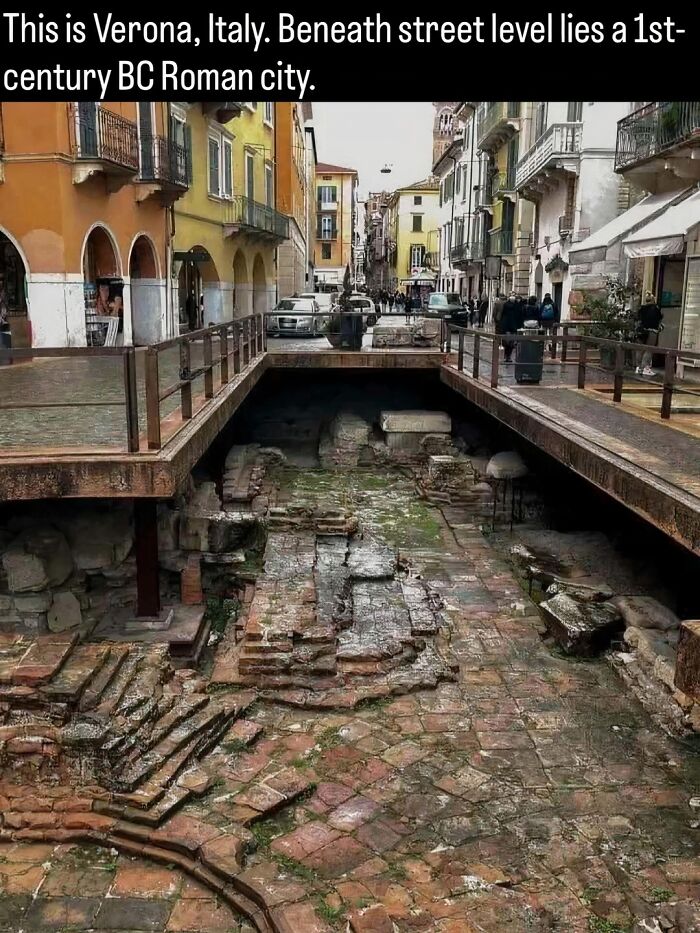
Image source: historyfeels
#8
At first, the staff dismissed it as coincidence. But after it happened again and again (over 20 times) they couldn’t ignore the pattern. Oscar, it seemed, had a gift. He could sense death before it arrived. Soon, whenever Oscar chose to stay beside someone, the nurses would call the family. They had learned to trust the silent warning of a cat who never meowed, never stirred, only stayed. Some believe he detected the scent of biochemical changes as life faded. Others say he simply knew. Oscar went on to predict over 100 cases, offering quiet companionship at the edge of life, right up until his own in 2022.
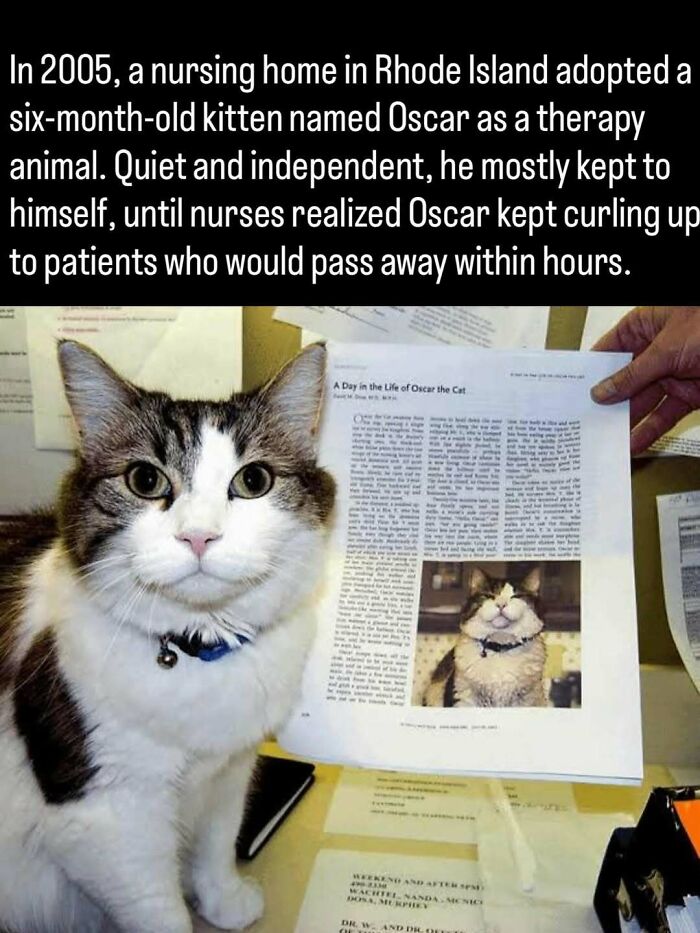
Image source: historyfeels
#9
In fact, there were so many lots that some blocks had more parking spaces than the buildings had workers, earning the city the unofficial nickname “The Concrete Prairie.”
This image captures a surreal urban landscape, towering office buildings rising from a desert of concrete, where cars far outnumbered pedestrians.
At the time, Houston’s rapid expansion and car-centric culture meant city planning heavily prioritized vehicle access over walkability or public transit.
The result was a downtown core where blocks that could have held parks, housing, or storefronts were instead flattened for parking. It reflected the era’s philosophy: growth at all costs, with little concern for urban density or mixed-use development.
Though it gave downtown workers easy parking, it left the area feeling lifeless after hours. Today, many of those lots have since been developed into residential towers, green spaces, and cultural centers, but this photo remains a powerful snapshot of how dramatically Houston has transformed.

Image source: historyfeels
Dr. Stearns also wrote about how studying history provides identity. As he pointed out, much of the published historical data provides evidence of how families, groups, institutions, and even entire countries were formed and evolved.
“Merely defining the group in the present pales against the possibility of forming an identity based on a rich past,” Dr. Stearns noted.
#10
This photograph captures a moment heavy with the weight of twentieth-century authoritarianism. Taken in Madrid during the funeral of General Francisco Franco in 1975, it shows Chile’s military ruler Augusto Pinochet sitting beside Imelda Marcos, the glamorous yet controversial First Lady of the Philippines.
The event symbolized the passing of an era, one in which anti-communism and military power often justified iron-fisted rule. The event marked Spain’s transition toward democracy, but for Pinochet and Marcos, it underscored their own tightening grip on nations still under martial law.
Their contrasting appearances, Pinochet austere in military gray, Imelda regal in black, illustrate how style and power intertwined in the spectacle of dictatorship. Behind the ceremony, global politics were shifting: the Cold War was softening, and the alliances between these regimes were being tested by growing dissent and economic strain.
Additional Fact: Imelda Marcos, still alive at 96 years old, remains a controversial figure in the Philippines. The former First Lady and wife of dictator Ferdinand Marcos, she became infamous for her extravagant lifestyle amid widespread poverty and political repression during her husband’s rule. Her name really became synonymous with excess after the 1986 revolution that ousted the Marcos regime, when investigators discovered more than 2,700 pairs of designer shoes, along with jewelry, artwork, and luxury properties around the world—all allegedly purchased with public funds.
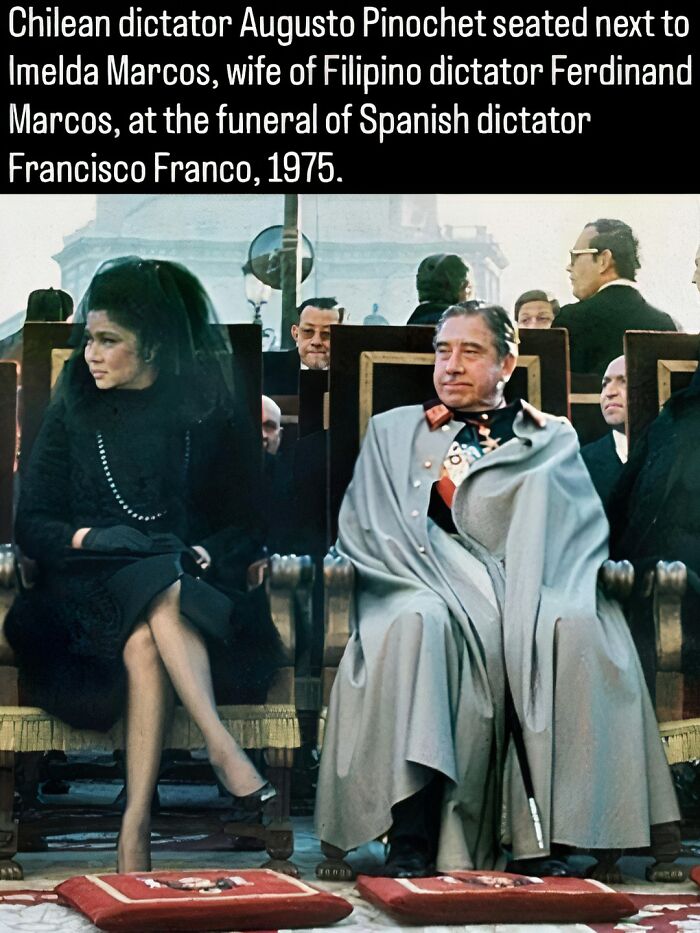
Image source: historyfeels
#11
Tombili, the famously laid-back stray cat of Istanbul, became a local legend thanks to her signature pose: reclining on a sidewalk step, one paw draped casually over the curb, watching the world go by. Photos of Tombili’s relaxed posture went viral, and she quickly became a beloved internet icon representing the easygoing spirit of Istanbul’s street cats.
When Tombili passed away in 2016, the loss was felt deeply by residents of her neighborhood and fans around the world. Locals started a petition calling for a statue to honor her memory, gathering thousands of signatures. In October of that year, a bronze sculpture was unveiled in her favorite spot, capturing her famous lounging position. The statue became an instant landmark, a gathering point for visitors who stopped to take photos and leave flowers.
Tombili’s story reflects Istanbul’s unique relationship with its stray animals. Rather than being ignored, many cats in the city are fed, cared for, and even celebrated by the community.
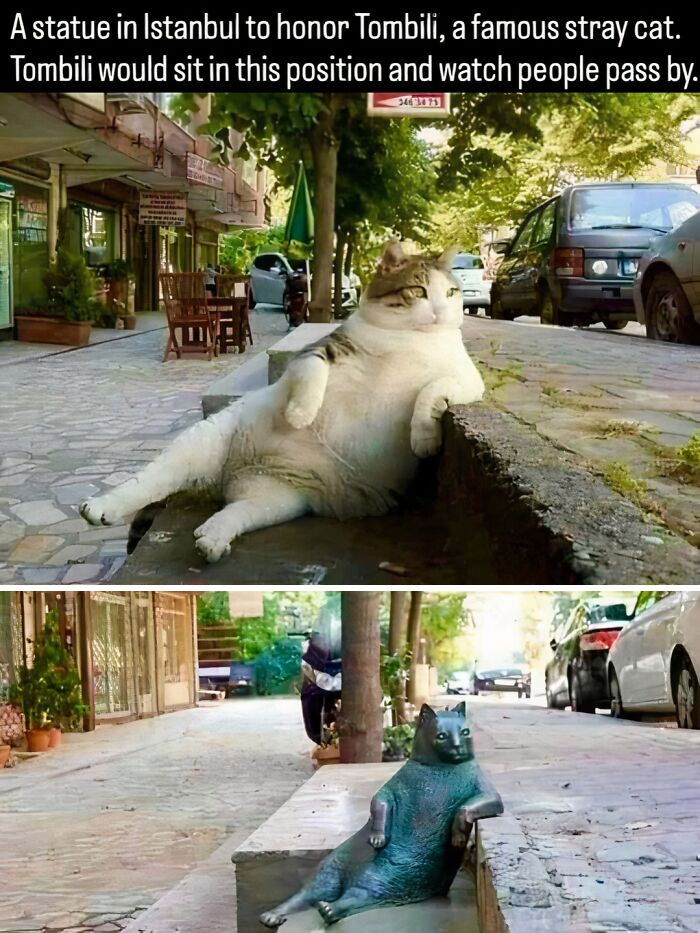
Image source: historyfeels
#12
Photo by Frank Grant. This photograph from 1965 captures the essence of mid-20th-century motoring in North America. The scene, showing a packed highway during rush hour, is filled with an incredible variety of cars, buses, and trucks, all made of heavy steel and painted in bold, distinctive colors. It was a time before plastic trim, lightweight materials, and aerodynamic designs dominated the automotive industry.
The vehicles seen here reflect an era when American car culture was at its height. Families prized their big, chrome-covered sedans; pickup trucks were becoming staples of suburban life; and buses and delivery trucks symbolized the growing reach of urban and commercial infrastructure. Each car had its own unique look, often easily distinguishable from the next—something that stands in stark contrast to the more uniform designs of many modern vehicles.
The mid-1960s was also a time of immense growth for highways, with the U.S. interstate system expanding rapidly after its creation in the 1950s. As suburbs flourished, daily commuting became a central part of American life. This photo freezes one such moment in time, an everyday rush hour that now feels like a colorful snapshot of a bygone era, when cars were heavier, louder, and proudly built to last.
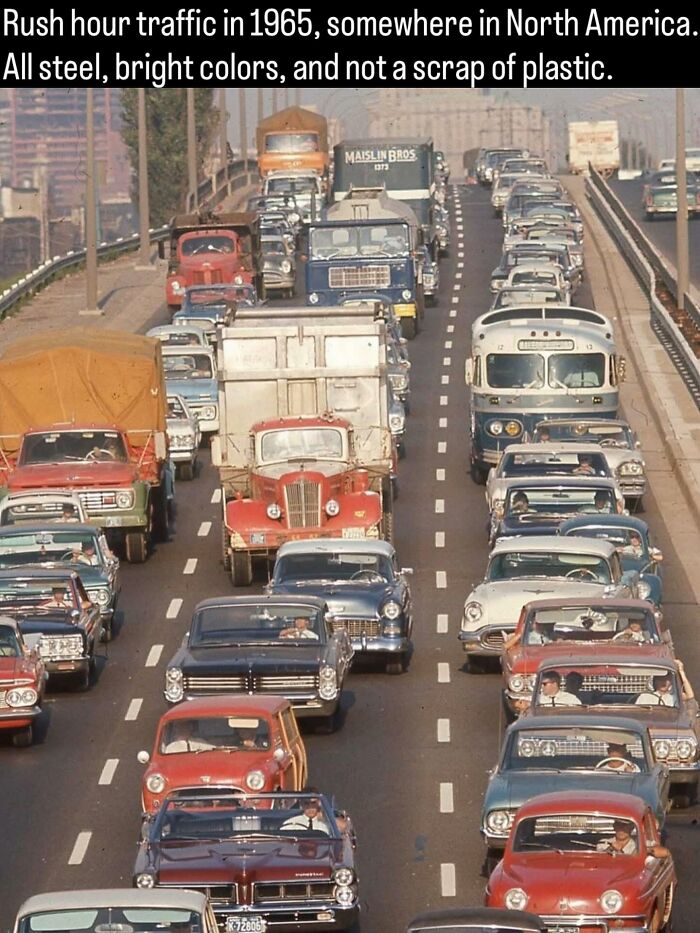
Image source: historyfeels
Historian and lecturer Prof. Penelope J. Corfield also shared her insights on the importance of learning about significant moments of the past. As she wrote, “All people are living histories.”
“Understanding the linkages between past and present is absolutely basic for a good understanding of the condition of being human,” Prof. Corfield added.
#13
Originally captured in 1826 by French inventor Joseph Nicéphore Niépce, the image is titled ‘View from the Window at Le Gras’. It depicts the view from Niépce’s estate in Saint-Loup-de-Varennes, France, showing rooftops, a barn, and the distant horizon. The photograph was made using a process called heliography, in which a polished pewter plate was coated with bitumen of Judea, a light-sensitive substance that hardened when exposed to sunlight.
Niépce’s exposure lasted nearly eight hours, meaning sunlight illuminated both sides of the buildings during the day, giving the image its strange, dreamlike quality. The result was grainy and ghostly, but revolutionary. For the first time in history, light itself had been permanently captured on a surface, marking the birth of photography.
The version seen here has been digitally restored and enhanced with AI, offering a glimpse of what Niépce may have seen nearly 200 years ago. While some purists debate the ethics of AI restoration, it undeniably helps modern audiences appreciate the scale of his achievement and the clarity of his vision.
Added Fact: Niépce’s original plate still survives today and is housed at the University of Texas at Austin’s Harry Ransom Center, preserved as the world’s earliest surviving photograph.
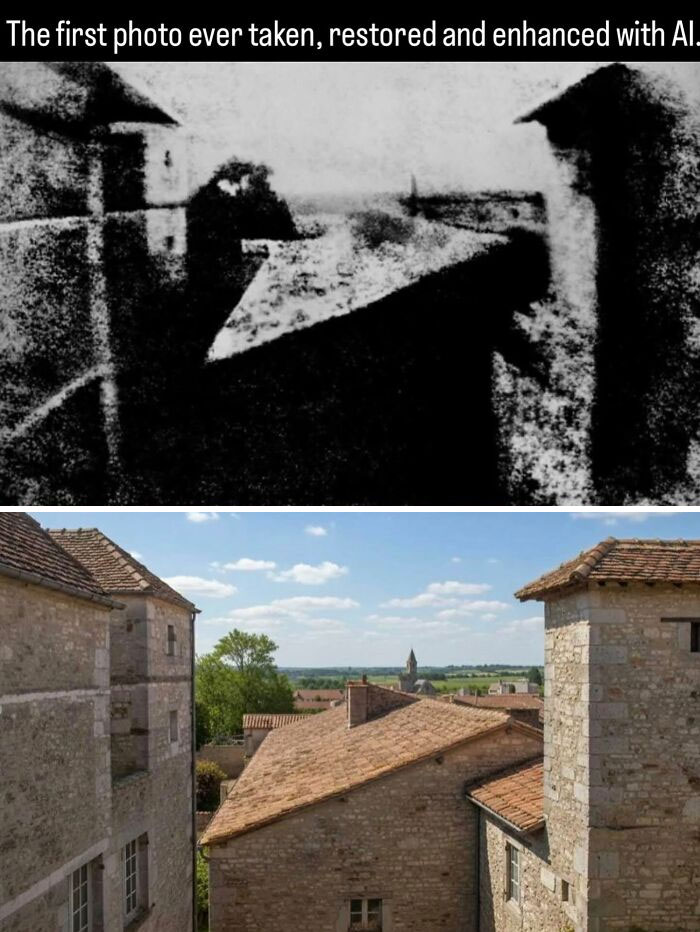
Image source: historyfeels
#14
Fifty years after the Battle of Gettysburg (one of the bloodiest encounters of the American Civil War) veterans from both the Union and Confederate armies gathered once more on the same fields where they had once fought to the death.
The 1913 Gettysburg Reunion, also called the “Great Reunion,” brought together more than 50,000 aging soldiers in what was billed as a celebration of national reconciliation.
In this photograph, former enemies clasp hands across a symbolic line that had once divided the nation. The men’s faces show the passage of half a century — beards white, postures bent — yet their meeting was heavy with memory. Many of them had stood in those very fields as young men, amid cannon smoke and cries of the wounded.
The reunion was organized by both Northern and Southern veterans’ associations and funded in part by Congress. Though framed as unity and forgiveness, the event also reflected the complexities of American memory: a nation eager to heal, but not yet ready to confront the deeper injustices that had caused the war in the first place.
Added Fact: President Woodrow Wilson, the only U.S. president born in the Confederacy, attended the reunion and called it “a day of peace and brotherhood,” though African American veterans were largely excluded from the event’s commemorations.
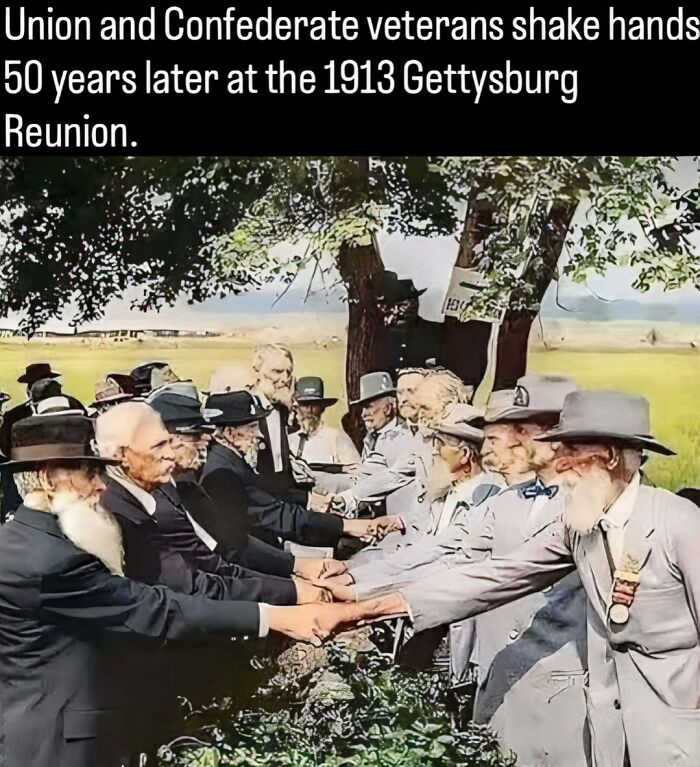
Image source: historyfeels
#15
The land where the University of Montana stands today, in Missoula’s Clark Fork Valley, was long home to Indigenous peoples before the campus was established in 1893. For thousands of years, the area was part of the traditional homelands of the Salish (Séliš), Pend d’Oreille (Ql̓ispé), and Kootenai (Ksanka) peoples. The valley was valued for its abundant resources, seasonal camps, and its location along important travel and trade routes through the Northern Rockies. In 1855, the Treaty of Hellgate, negotiated under pressure from the United States government, led to the cession of millions of acres of tribal land. Most members of the Salish and Pend d’Oreille were later relocated to the Flathead Reservation north of Missoula, though the cultural and historical connection to the valley remains strong. Added fact: Missoula’s name comes from a Salish word meaning “place of cold water,” referencing the nearby Clark Fork River.
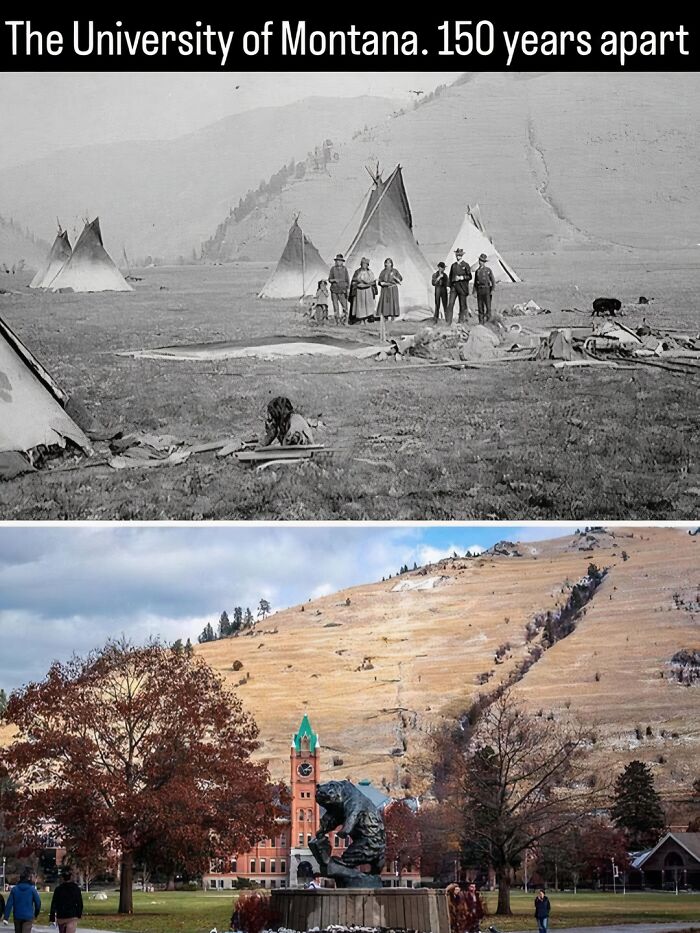
Image source: historyfeels
Prof. Corfield ended her piece by stating that the question shouldn’t be, “Why is history relevant?” Instead, it should be, “Given that all people are living histories, how can we all best learn about the long-unfolding human story in which all participate?”
#16
It depicts the American delegation, John Jay, John Adams, Benjamin Franklin, Henry Laurens, and William Temple Franklin, gathered in Paris to negotiate peace terms. However, the British representatives, led by Richard Oswald, refused to pose, embarrassed by the defeat. As a result, the right half of the canvas remains blank. The treaty, signed on September 3, 1783, officially recognized American independence and ceded territory east of the Mississippi River to the United States. West, a respected painter in both Britain and America, never completed the piece, leaving it a symbolic reminder of the tension and imbalance that lingered even in peacetime.
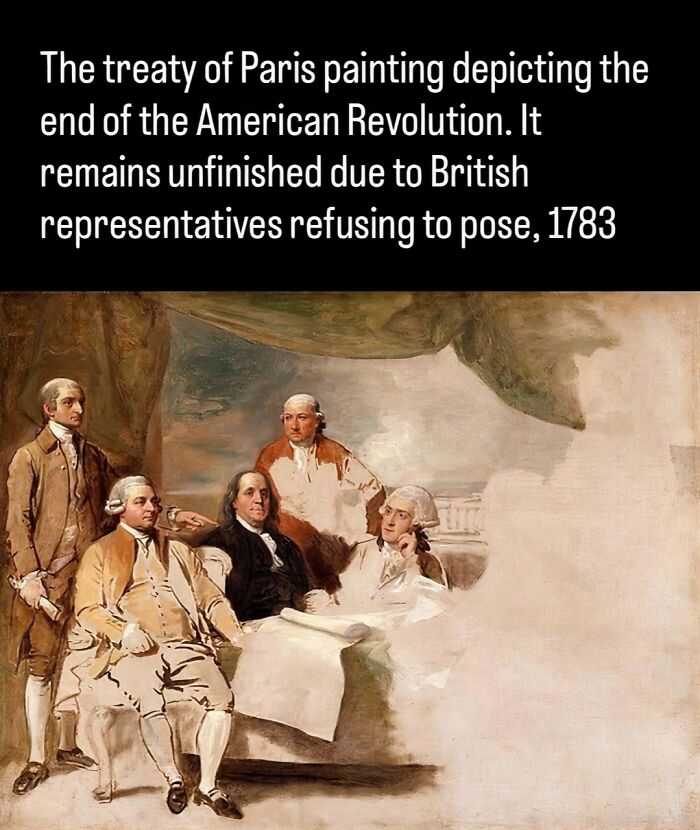
Image source: historyfeels
#17
The Graveyard of an empire. Each red icon marks the resting place of a sunken Japanese warship from World War II, revealing the staggering scale of Japan’s naval losses. By the end of the war, the Imperial Japanese Navy had lost over 700 major vessels, including 11 battleships, 25 aircraft carriers, and over 180 destroyers and submarines.
Many of these ships were sunk in legendary battles like Midway, where four Japanese aircraft carriers were lost in a single day, crippling Japan’s offensive power. Others fell during the Battle of Leyte Gulf, the largest naval battle in history, where Japan launched its last desperate gambit to hold the Philippines and lost decisively.
But not all ships were lost in battle. Many were sunk while evacuating troops, transporting supplies, or simply ambushed by U.S. submarines, which decimated Japanese shipping lanes. In fact, American submarines were responsible for sinking over 60% of Japanese merchant shipping, effectively choking the empire’s wartime logistics.
Fun facts:
• The battleship Yamato, the largest ever built, was sunk in 1945 with over 3,000 crew onboard, during a one-way suicide mission to defend Okinawa.
• Some ships sunk near Micronesia and Palau have become popular dive sites, like Truk Lagoon, often called the “Japanese Pearl Harbor.”
• Many sunken wrecks remain undiscovered, hidden deep beneath the Pacific, preserved in eerie silence.

Image source: historyfeels
#18
In September 1776, John Adams and Benjamin Franklin traveled together to Staten Island as part of a failed peace delegation with Britain during the early stages of the American Revolution. On their journey, the two men stopped at a small New Jersey inn that had only one available room, and one bed. Adams, a New England lawyer known for his rigid habits, was forced to share it with Franklin, who was nearly 30 years his senior and famous for his unorthodox views on health and comfort.
According to Adams’ diary, the night quickly turned into a debate. Franklin insisted the window stay open to allow “fresh air,” arguing that night air was not dangerous, as many people then believed. Adams, adhering to the common 18th-century fear of “miasmas” or bad air causing illness, wanted it shut tight. Franklin, a lifelong advocate of ventilation, lectured Adams on his “theory of colds” until Adams finally gave in and let him keep it open.
Their conversation reflected more than just a clash of personalities, it revealed a genuine scientific divide of the era. Franklin’s writings on fresh air, exercise, and hygiene were decades ahead of their time, anticipating germ theory and public health reforms that wouldn’t emerge until the 19th century.
Added fact: Benjamin Franklin later published essays promoting the benefits of cool, circulating air and even described his habit of “air baths”; sitting naked in front of an open window each morning to improve health and mood, a practice that baffled his more prudish peers.
Historydictionary:
Miasma theory – The pre-germ-theory belief that diseases like cholera or the plague were spread by “bad air” arising from decaying matter.

Image source: historyfeels
#19
Known for his quick wit and charisma on worksites, Hogan was far from the global fame he’d later achieve. At the time, he was just another Aussie tradesman climbing steel beams high above the harbor. But it was during this period that he began jokingly submitting comedic sketches to a local TV talent show, applying as a “tap-dancing knife thrower” on New Faces, which unexpectedly launched his TV career. Within a decade, he became a household name in Australia. By 1986, he would star as the rugged, knife-wielding Mick “Crocodile” Dundee, an international blockbuster that turned him into a cultural icon. Fun fact: he of course helped market Australia to the world starring in a tourism campaign that invited Americans to visit Australia, telling them he’d “slip an extra shrimp on the barbie.”
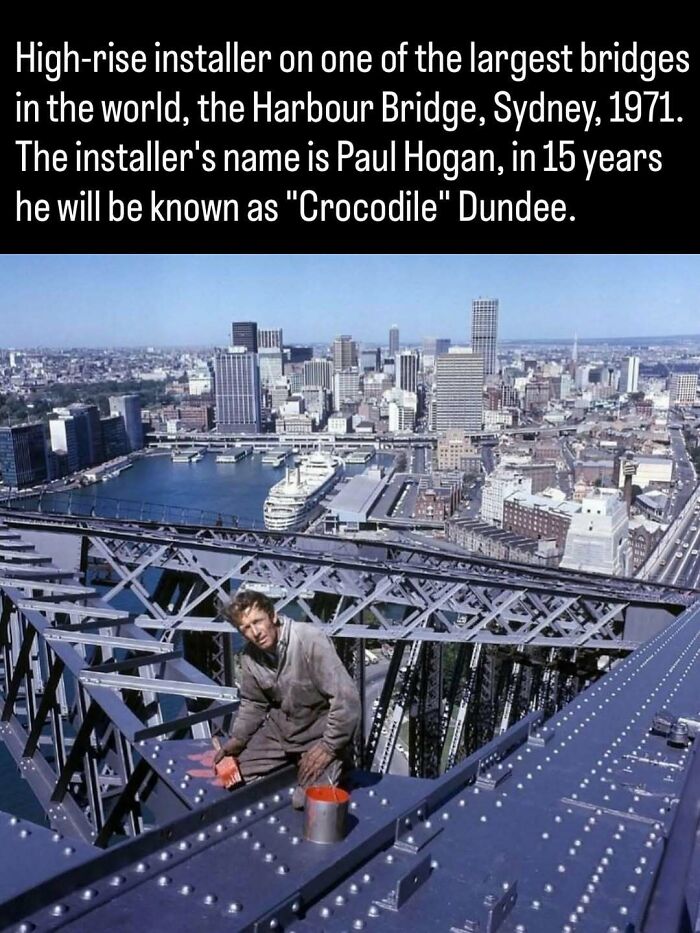
Image source: historyfeels
#20
The two fishermen in Northern Ireland made the discovery while fishing in Lough Neagh, the largest freshwater lake in the British Isles. Tangled in their nets was a massive skull and antlers measuring nearly six feet across. At first glance, it appeared to be a giant deer, but experts quickly identified it as belonging to the extinct Megaloceros giganteus, better known as the Irish Elk. Despite its name, the Irish Elk was not exclusive to Ireland, nor was it a true elk. It was one of the largest deer species to ever walk the Earth, standing up to 7 feet tall at the shoulders, with antlers that could span over 12 feet. These animals thrived during the Ice Age across much of Europe and Asia before going extinct around 10,000 years ago, likely due to a combination of climate change and human hunting pressure. The specimen recovered from Lough Neagh was dated to more than 10,500 years old, remarkably preserved in the lake’s cold, oxygen-poor waters. Discoveries like this help scientists piece together the ecosystems of the late Pleistocene and give us a glimpse into the sheer scale of prehistoric wildlife. Fun fact: Despite their massive antlers, studies suggest Irish Elk were surprisingly efficient runners, adapted to open grasslands where speed and size provided protection.
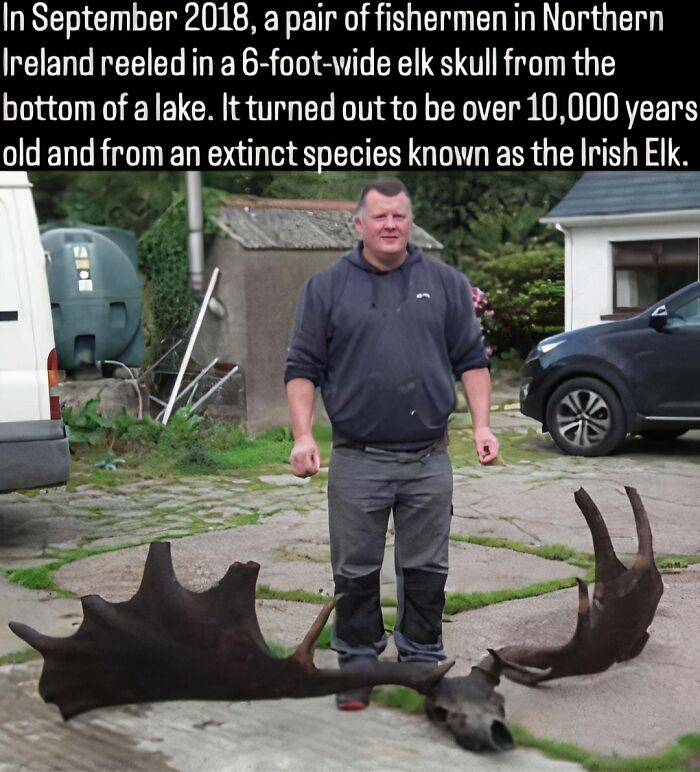
Image source: historyfeels
#21
Around 1910, labor was relatively inexpensive and materials like solid brass or bronze were standard. Decorative hardware could be cast, engraved, and hand-finished without dramatically increasing the final cost.
The shift away from craftsmanship comes down largely to speed and economics. Today, labor is the most expensive part of manufacturing. To keep prices low, companies rely on automation, simplified designs, and lightweight materials like zinc alloys or plated metals.
Mass production favors speed, uniformity, and efficiency, leaving little room for ornamentation. When the world dressed ordinary things in elegance, 1910.
Consumer habits have changed as well. Homes are remodeled more frequently, styles change faster, and many products are expected to be affordable and replaceable rather than permanent.
The craftsmanship itself has not disappeared. It has simply moved into the luxury market. Hand-finished, solid metal hardware is still made today, but instead of being the standard, it now comes at a premium price.
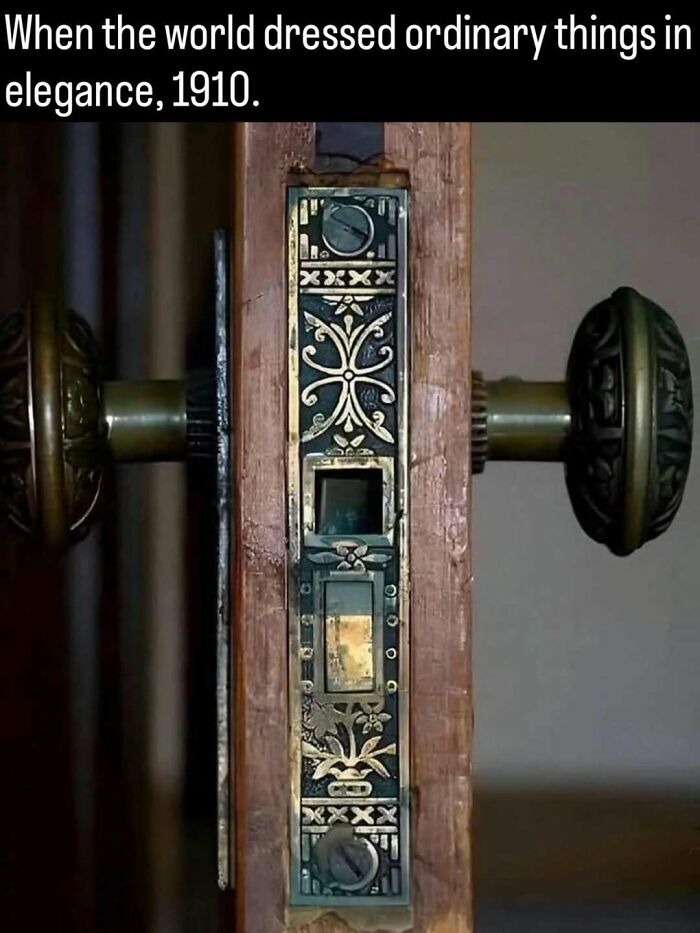
Image source: historyfeels
#22
This was two weeks before the country’s transfer of power from Bush to Obama. Bush, a Republican, and Obama, a Democrat, met privately for about 30 minutes ahead of the wider gathering. Then former Presidents Jimmy Carter and Bill Clinton, both Democrats, and Republican George H.W. Bush, the current president’s father, met Bush and Obama in the Oval Office for a photo session with journalists. It was the first such gathering of former U.S. heads of state at the White House in 27 years. “I want to thank the president-elect for joining the ex-presidents for lunch,” the younger Bush told Obama, who stood next to him, nodding. “One message that I have and I think we all share is that we want you to succeed. Whether we’re Democrat or Republican, we care deeply about this country,” Bush said.
Image source: historyfeels
#23
Here is the Math: The United States was founded on July 4, 1776. From that date to January 27, 2026, the nation has existed for 91,152 days. Joe Biden was born on November 20, 1942. From his birth to January 27, 2026, he has lived 30,384 days. When you divide those numbers: 30,384 ÷ 91,152 = 0.3333 In other words, Joe Biden has been alive for exactly one third of the United States’ existence. Biden entered national politics at an unusually young age, becoming one of the youngest U.S. senators ever elected when he won a Delaware Senate seat in 1972 at just 29 years old. Added fact: Biden is the only U.S. president whose lifespan overlaps with nearly every major geopolitical era of the modern United States, from World War II to the AI age.
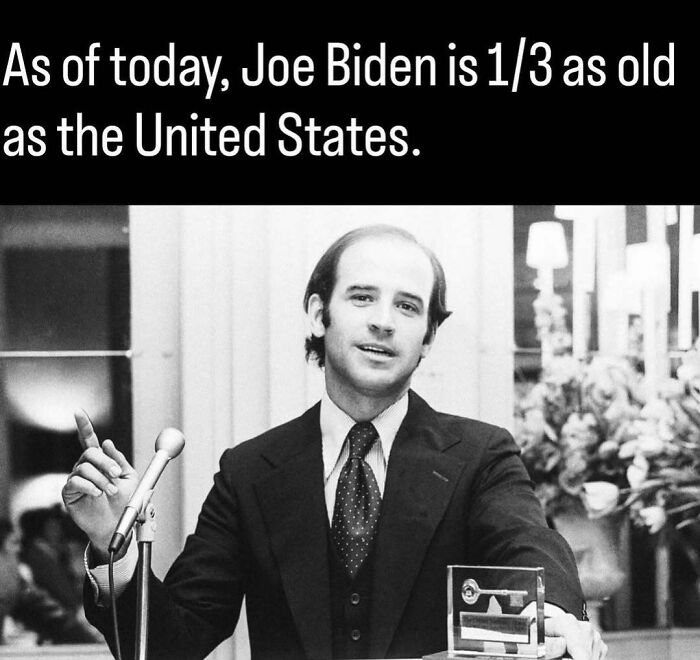
Image source: historyfeels
#24
Dewey family cat, who died in 1910, and meant enough to his owner to be honored with a gravestone that stands today over 113 years later. It reads: “He was only a cat but he was human enough to be a great comfort in hours of loneliness and pain”
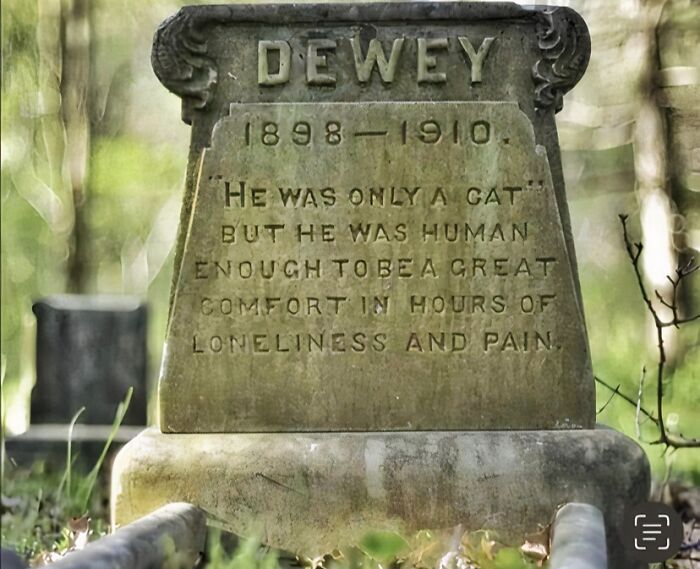
Image source: historyfeels
#25
Cliff Young was sixty one years old when he showed up to the start of Australia’s Westfield Sydney to Melbourne Ultramarathon wearing loose overalls and rubber work boots. The race was nearly six hundred miles long and normally attempted only by elite endurance runners who trained for years. Cliff was a potato farmer who spent his days chasing sheep on foot across thousands of acres. He believed that was enough preparation.
The other runners assumed he would collapse within hours. Cliff did not know that competitors typically ran eighteen hours and then slept six. So he simply jogged through the night with his awkward shuffle, moving slowly but never stopping. While the frontrunners slept, Cliff kept gliding forward mile after mile until he found himself in the lead. Crowds began gathering along the route, cheering for the quiet farmer in his mud stained boots.
After five days, fifteen hours, and four minutes, Cliff crossed the finish line first. He had shattered the previous course record by almost two days and won by ten full hours. When he learned there was prize money, he immediately gave it all away to the other runners, saying they had worked just as hard.
Cliff Young became an unlikely national hero, not because he was the fastest, but because he was the only one stubborn enough to never stop moving.
Additional fact: Cliff’s unique running style became known as the “Young Shuffle” and modern ultramarathoners still study it today because it conserves energy and reduces muscle fatigue.

Image source: historyfeels
#26
In 1904, Elizabeth Magie patented “The Landlord’s Game” the original version of what we now know as Monopoly. Her goal wasn’t entertainment. It was education. Magie designed the game to highlight the dangers of wealth inequality and unchecked capitalism, showing how landlords could bankrupt tenants while enriching themselves.
She pitched the game to Parker Brothers but was told it was too complex. Decades later, Charles Darrow discovered her idea, made a few changes, and sold it to Parker Brothers as his own invention.
He became the first millionaire game designer. Magie, despite holding the original patent, received just $500 and no credit.
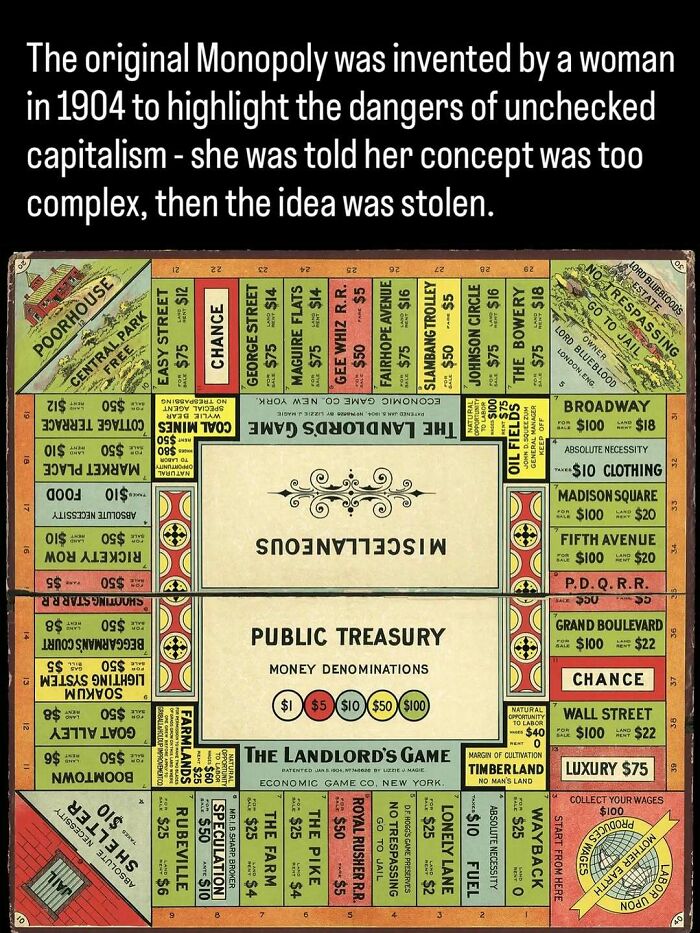
Image source: historyfeels
#27
James Cameron’s Titanic (1997) made history in more ways than one. Beyond its record-breaking box office run and 11 Oscar wins, it also became the first film to earn Academy Award nominations for two different actors playing the same role.
Kate Winslet was nominated for Best Actress for her portrayal of young Rose DeWitt Bukater, while Gloria Stuart, who played the older Rose recounting the story decades later, was nominated for Best Supporting Actress.
It highlighted the film’s unique storytelling structure, bridging past and present through Rose’s memories. Winslet was only 22 at the time, one of the youngest Best Actress nominees ever, while Stuart, at 87, became the oldest acting nominee in Oscar history.
Fun Fact: The other time it’s happened? Also Kate Winslet… Her and Judi Dench both received Oscar nominations for playing novelist Iris Murdoch in the 2001 film Iris.

Image source: historyfeels
#28
The only confirmed record located was a Veterans Legacy Memorial page for Schmuck. According to the listing, he passed away in 2007, meaning he obviously survived the war.
The page also showed that he was awarded the Purple Heart, a decoration given to service members wounded or killed as a result of enemy action.
The 173rd Airborne earned the nickname “The Sky Soldiers” and made the only U.S. combat parachute jump of the Vietnam War during Operation Junction City in 1967. It was a massive airborne attack involving nearly 1,000 paratroopers, the largest U.S. airborne operation since World War II. A first combat jump wasn’t symbolic, it meant descending into contested jungle terrain, often under the threat of small-arms fire, landing with 60–100 pounds of gear, and moving immediately into operations.
Note: The average U.S. infantryman in Vietnam was just 22 years old. More than 2.7 million Americans served in the war; over 58,000 perished. In 1967 alone, U.S. troop strength in Vietnam surged past 485,000 as combat operations intensified.
Added fact: The 173rd Airborne Brigade earned 14 campaign streamers in Vietnam and was awarded a Presidential Unit Citation for extraordinary heroism in combat.

Image source: historyfeels
#29
As the Supreme Commander of Allied Forces during World War II, Dwight D. Eisenhower bore immense responsibility for the success of the D-Day landings on June 6, 1944. Operation Overlord, as it was formally known, was the largest amphibious invasion in history and a turning point in the war. Yet behind the triumph was staggering loss: thousands of Allied soldiers lost their lives or were wounded storming the beaches of Normandy. Eisenhower personally wrote a note before the invasion, prepared to take full blame if the landings failed, an indication of the heavy weight he carried.
By 1952, Eisenhower was running for president, but moments like this speech to veterans showed he was not just a general or politician; he was a man deeply scarred by the human cost of war. Breaking down before an audience of those who had fought under his command, Eisenhower’s tears revealed the lasting emotional burden of having sent so many young men into battle.
His grief was a reminder that leaders, even those celebrated for victory, never escape the memories of sacrifice. For Eisenhower, D-Day remained both his greatest achievement and his greatest sorrow, a moment forever etched in his conscience.
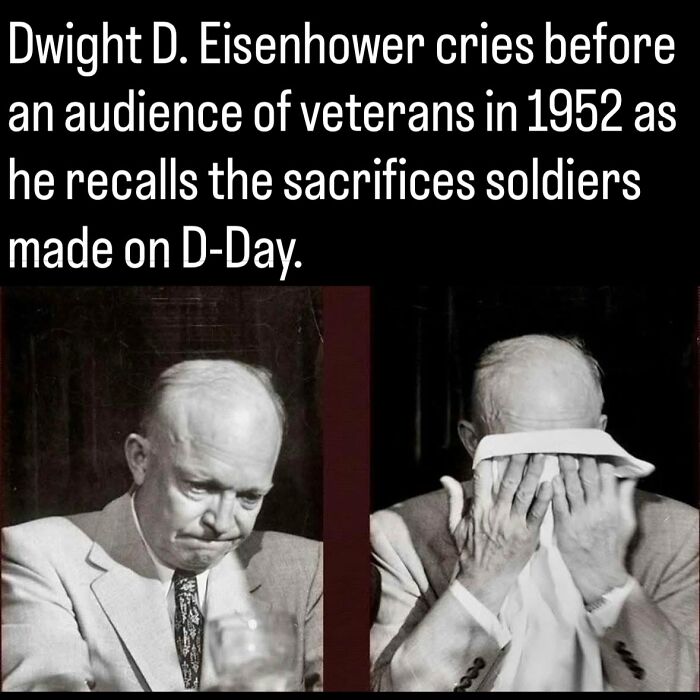
Image source: historyfeels
#30
Jólakötturinn, or the Icelandic Christmas Cat, a figure from Icelandic folklore that dates back several centuries.
According to tradition, the Jólakötturinn is a massive supernatural cat that roams the countryside during winter, especially around Christmas Eve. Those who had not received or earned new clothes were said to be at risk of being eaten by the cat.
This legend was closely tied to Iceland’s harsh climate and agrarian economy.
Before industrialization, survival depended on processing wool before winter arrived. Families worked together to shear sheep, spin yarn, and weave clothing before the cold set in. New clothes were not a luxury but proof that a household had prepared properly for winter.
Children and laborers who completed their work on time were rewarded with new garments, often socks or mittens. Those who were lazy or failed to contribute were warned that the Christmas Cat would find them. Over time, the story became a cultural tool to reinforce diligence, responsibility, and preparation in a land where winter could be deadly.
The Jólakötturinn also became linked to Grýla, a troll-like figure from medieval folklore, and her sons, the Yule Cat’s human counterparts in mischief and punishment. While the legend sounds fantastical, its purpose was practical: to ensure survival through discipline and communal effort in one of Europe’s most unforgiving environments.
Added fact: The Jólakötturinn was popularized internationally in the 20th century through Icelandic poetry and later depicted as a towering black cat in public art installations across Reykjavík during the Christmas season.
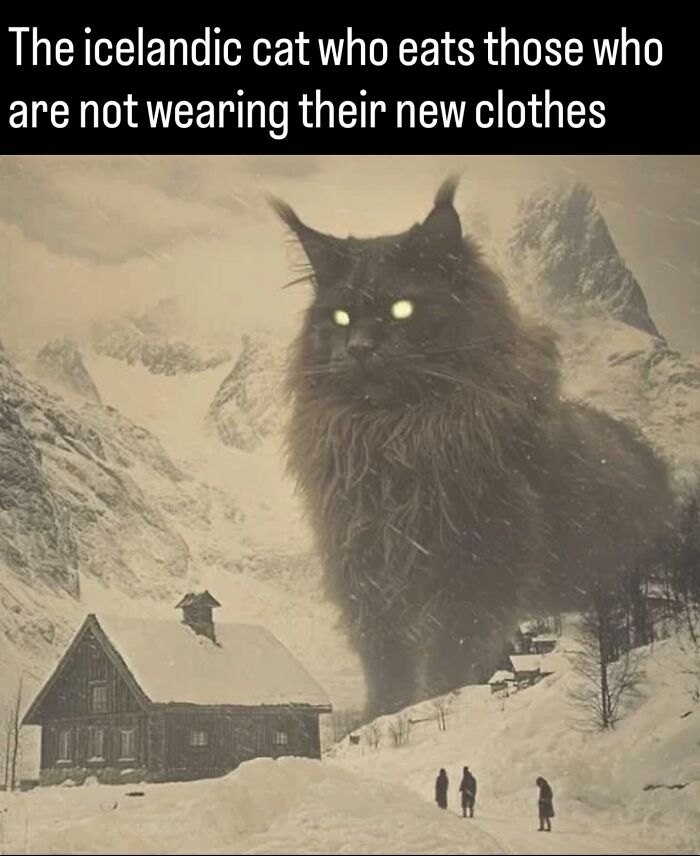
Image source: historyfeels
#31
In the span of just 44 days in 1991, rock history was rewritten. Between August and September, a wave of genre-defining albums was released that reshaped the sound of the decade. Metallica’s self-titled “Black Album,” Pearl Jam’s Ten, Guns N’ Roses’ Use Your Illusion I & II, Red Hot Chili Peppers’ Blood Sugar Sex Magik, Soundgarden’s Badmotorfinger, and Nirvana’s Nevermind all dropped in quick succession. Each album brought something different — from Metallica’s heavy polish to Nirvana’s raw grunge energy. Nevermind, in particular, would soon knock Michael Jackson off the top of the charts and become a symbol of a cultural shift. It wasn’t just a hot streak, it was a revolution in real time. These releases didn’t just dominate the airwaves, they marked the dawn of alternative rock’s mainstream takeover. Looking back, it’s hard to believe this explosion of legendary music happened in just over a month.

Image source: historyfeels
#32
This 1968 photo shows Võ Thị Thắng, a 21-year-old member of the Viet Cong, smiling moments after being sentenced to 20 years of hard labor by the South Vietnamese government.
Captured during a failed attack in Saigon, Võ was brought to trial where she famously told the judge, “Twenty years? Your government won’t last that long.” Her defiant smile became a powerful symbol of resistance in North Vietnam, and the photo was widely circulated as propaganda.
Despite the sentence, her prediction proved accurate, the South Vietnamese government fell in 1975, just seven years later. Võ Thị Thắng was released after the war ended and went on to serve in Vietnam’s National Assembly and in various government roles.
Fun fact: In post-war Vietnam, she became so admired that the image of her smiling in court was printed on posters, stamps, and even textbooks.

Image source: historyfeels
#33
The gift was sent at a time when the Choctaw people themselves were enduring tremendous hardship, having recently been displaced from their ancestral lands and suffering from hunger and disease. News of the Irish famine reached them through newspapers and word of mouth, and their empathy for another people in distress spurred the extraordinary act of generosity. The funds were sent to Ireland through a relief organization known as the General Irish Relief Committee in New York, which was coordinating donations from the United States. From there, the money was transferred across the Atlantic to aid food and supply efforts for those suffering in the Great Famine. In 2017, the town of Midleton, County Cork, unveiled the “Kindred Spirits” monument to honor the Choctaw’s compassion. The stainless-steel sculpture, designed by artist Alex Pentek, features nine large feathers arranged in a circular shape, symbolizing an empty bowl filled with hope and solidarity.
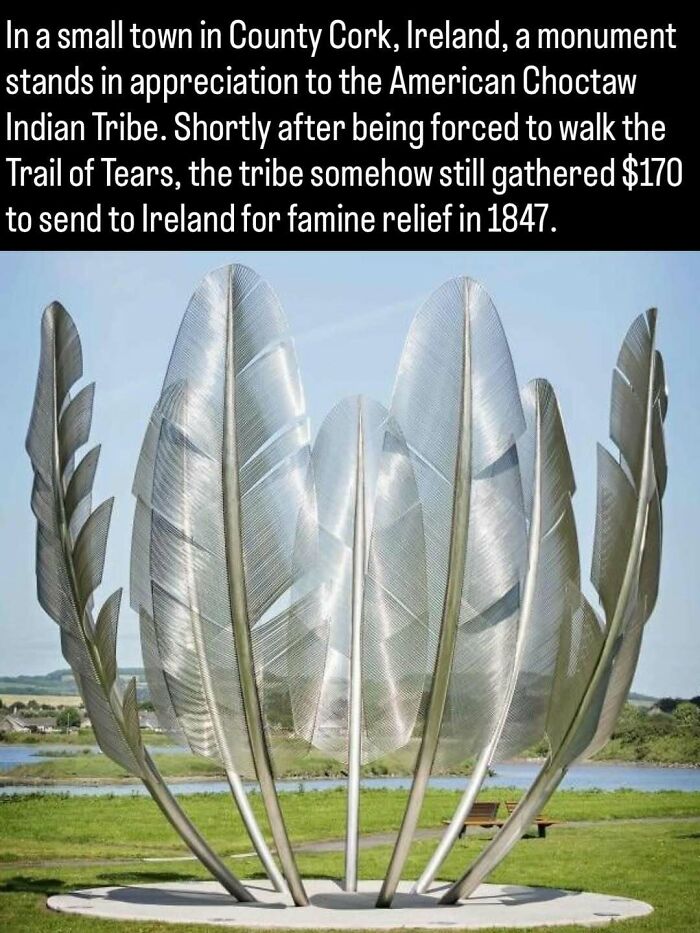
Image source: historyfeels
#34
Each section of the structure reflects the city’s past rulers, stacked atop one another like sediment through time. At its base are stones from the Roman Empire, which first established Byzantium as a significant outpost. Emperor Constantine renamed the city Nova Roma, but it was popularly known as Constantinople, “City of Constantine.” Above that lies brickwork from the Byzantine Empire, which made Constantinople its glittering capital for over a thousand years. The Hagia Sophia, built in 537 AD, was the world’s largest cathedral for nearly a thousand years and featured a massive dome that seemed to float on light. Then come the architectural touches of the Ottoman Empire, which conquered the city in 1453 and ruled until the early 20th century. After taking the city, Sultan Mehmed II turned the Hagia Sophia into a mosque and renamed Constantinople Istanbul. Finally, crowning the top is the Republican era of modern Turkey, established in 1923. Under Mustafa Kemal Atatürk, Turkey adopted sweeping reforms—like switching from the Arabic to Latin alphabet in just one year.
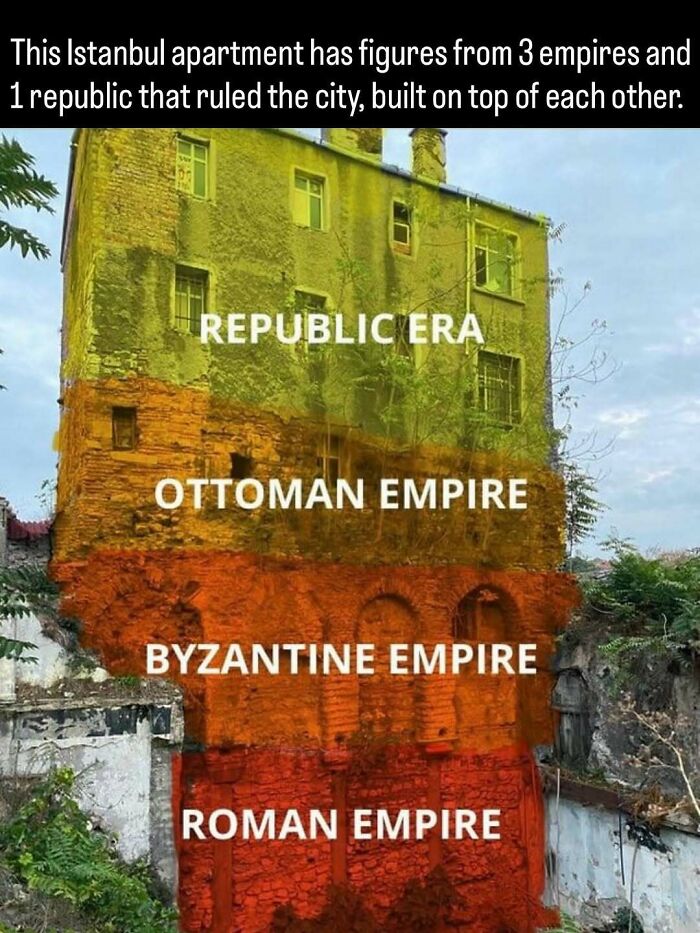
Image source: historyfeels
#35
In 1982, Canadian historian Robert A. Wardhaugh sat down to begin a Dungeons & Dragons campaign with friends. What started as a hobby soon became a lifelong commitment. Over four decades later, that same campaign is still running, making it the longest continuous D&D game in the world. Wardhaugh has built an expansive fantasy universe that stretches far beyond the typical tabletop experience. His basement is now filled with massive hand-built landscapes, intricate miniatures, and elaborate storylines that his players navigate. The game has evolved into a living history, with characters and families spanning generations, and events that ripple across decades of storytelling. Unlike a traditional campaign that might last weeks or months, Wardhaugh’s game has no end in sight. Players come and go, but the world continues, shaped by decisions made decades ago as well as those made today. For Wardhaugh, it’s more than just a pastime, its an art from that has lasted longer than many real-world nations.
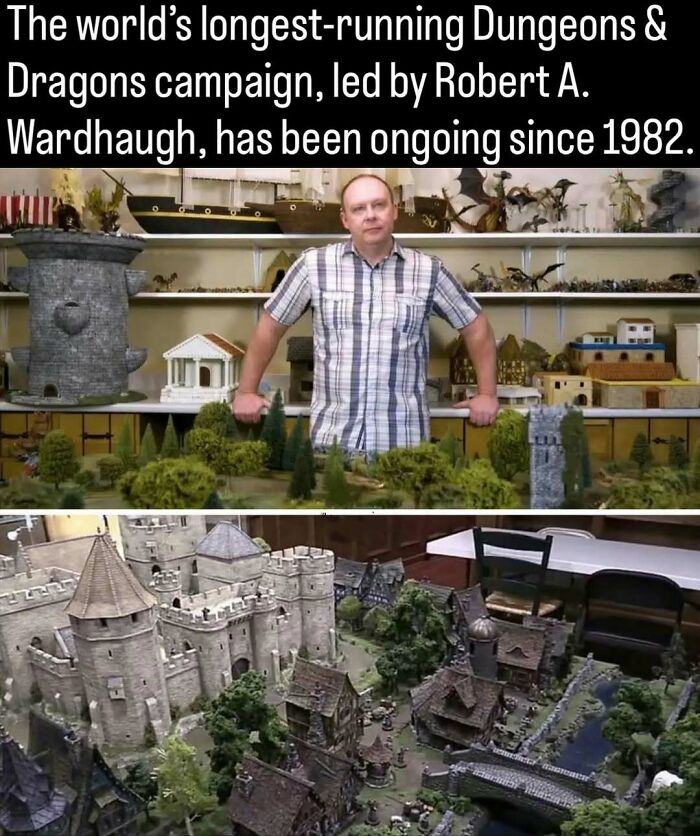
Image source: historyfeels
#36
In the early hours of April 15, 1912, as the Titanic’s fate became clear, first-class passenger Benjamin Guggenheim refused to save himself. Instead of boarding a lifeboat, the American millionaire returned to his cabin, changed into evening clothes, and placed a rose in his buttonhole. “We’ve dressed up in our best,” he reportedly told a steward, “and are prepared to go down like gentlemen.” According to steward Henry Etches, Guggenheim asked that a message be delivered to his wife: “Tell her I played the game straight to the end and that my last thoughts are of her and our girls.” Later retellings have attributed an even more dramatic line to him, claiming he insisted that no woman would be left aboard because of his cowardice. Guggenheim and his valet were last seen on the ship’s deck, standing calmly as the Titanic slipped beneath the Atlantic.
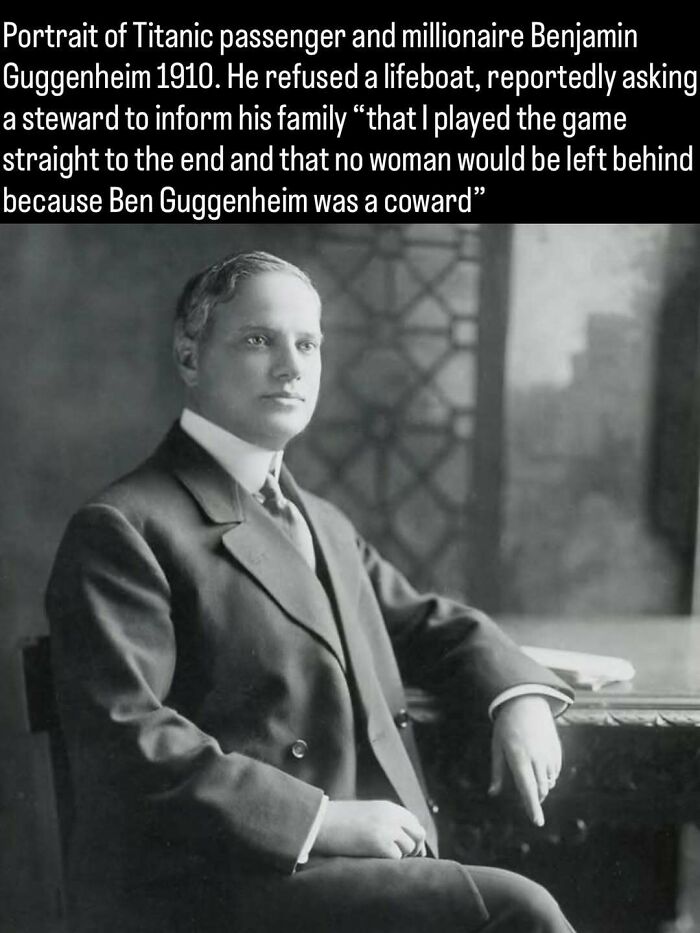
Image source: historyfeels
#37
Over the years, Americans have proposed some unusual constitutional amendments, many of which never made it past Congress. In 1810, the Titles of Nobility Amendment would have stripped U.S. citizenship from anyone who accepted a foreign title. In 1861, the Corwin Amendment tried to make slavery permanently legal, a last-ditch effort to prevent the Civil War. Others were more eccentric: an 1878 proposal sought to replace the presidency with an “Executive Council of Three,” while in 1893 another would have renamed the country the United States of Earth. In 1933, one amendment aimed to cap personal wealth at $1 million; another in 1938 sought to ban drunkenness nationwide. Some came close to reality, like the 1924 Child Labor Amendment or the still-pending Equal Rights Amendment. Which ones should have passed?

Image source: historyfeels
#38
Gigli was a successful American photographer, he is most known however for this photo and had this to say about it in 2013.
“It was the summer of 1960, and one morning I glanced out of the window of my studio in Manhattan and noticed that a row of brownstones opposite were being prepared for demolition. Looking at the design of the empty windows, an idea struck me: put a woman wearing colourful clothes in each of the openings.
I sent over someone from my staff to talk to the demolition supervisor. He agreed to let us go ahead – provided we used his wife in the photograph. We could shoot the next day during their lunch hour, he said. After that, the building would be gone.
So, with 24 hours to pull it off, we called up all our contacts to find models and locate a Rolls-Royce to sit on the sidewalk in front. I had a good reputation, as I was working for Time and Life magazines, so it was quite easy to convince people.
There were models, socialites, my wife (second floor, far right), the supervisor’s wife (third floor, third from left), all wearing their best dresses [see footnote]. I moved them around to spread out the colours and told them to pose as if they were giving someone a kiss. As I was photographing, I noticed some of them were on the windowsills. As these were made of cement and sometimes break off, I shouted at them through a bullhorn to stay within the frames.
The noon sun was overhead and the light shone between the streets. Miraculously, the police didn’t come by and stop us – and, within an hour, I’d got my shot.
I have a big print of it up on my wall. I still smile whenever I look at it, even after all these years. Not bad.”
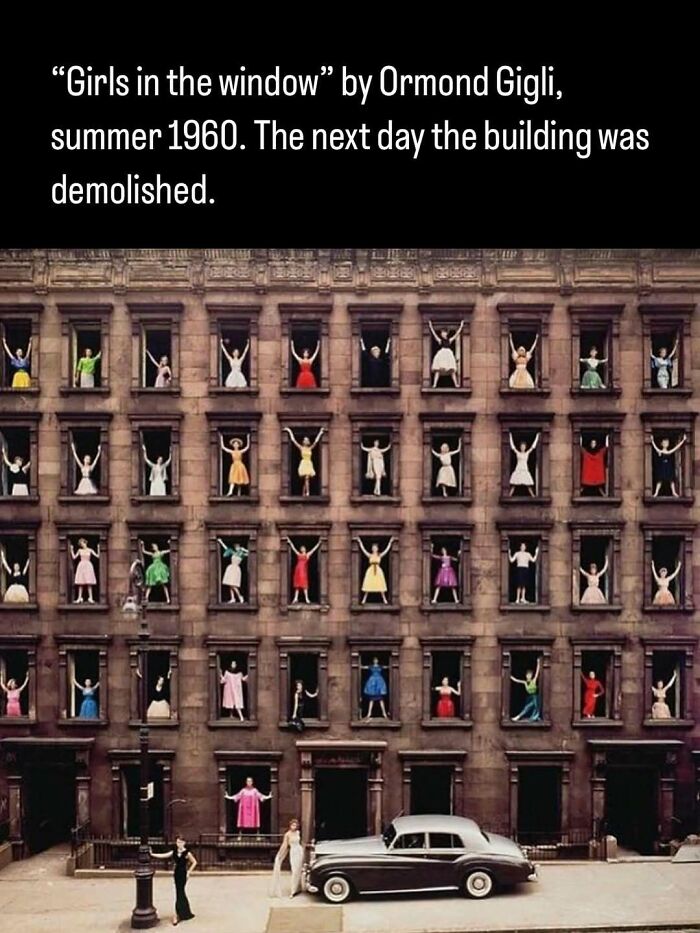
Image source: historyfeels
#39
In the 12th and 13th centuries, the Italian city of Bologna was home to an astonishing 180 towers, earning it the nickname “the city of towers.” These structures weren’t just for defense, they were symbols of wealth and power. Noble families competed to build the tallest and most imposing towers, turning the medieval skyline into a vertical battlefield of status. Today, only about 20 of these towers survive, the most iconic being Asinelli Tower, which still rises to 97 meters (318 feet), making it the tallest leaning medieval tower in the world. Beside it stands the shorter Garisenda Tower, famously referenced by Dante in The Divine Comedy. These towers served multiple roles: fortresses, status symbols, and even places of refuge during family feuds or political unrest. Though time and urban development erased most of them, the surviving towers remain some of the most striking architectural relics of medieval Europe.
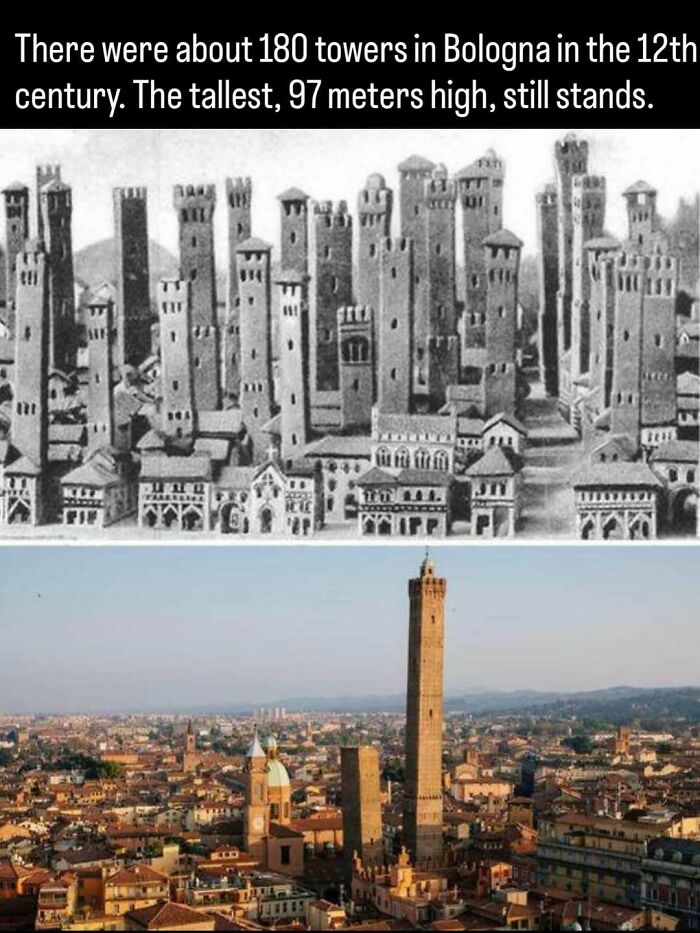
Image source: historyfeels
#40
Meet Socks, the First Cat of the United States during the Clinton administration. This tuxedo cat was adopted by Chelsea Clinton in Little Rock, Arkansas, and quickly became a beloved member of the First Family. Socks often appeared in official White House photos and even received fan mail from children around the world. This photo, showing him at the White House press briefing podium, became an instant classic. During his time in the White House, Socks helped promote literacy, visited schools, and appeared on the White House website. His fame even inspired a children’s book titled Dear Socks, Dear Buddy. In an era before Instagram pets, Socks was arguably America’s first viral cat.
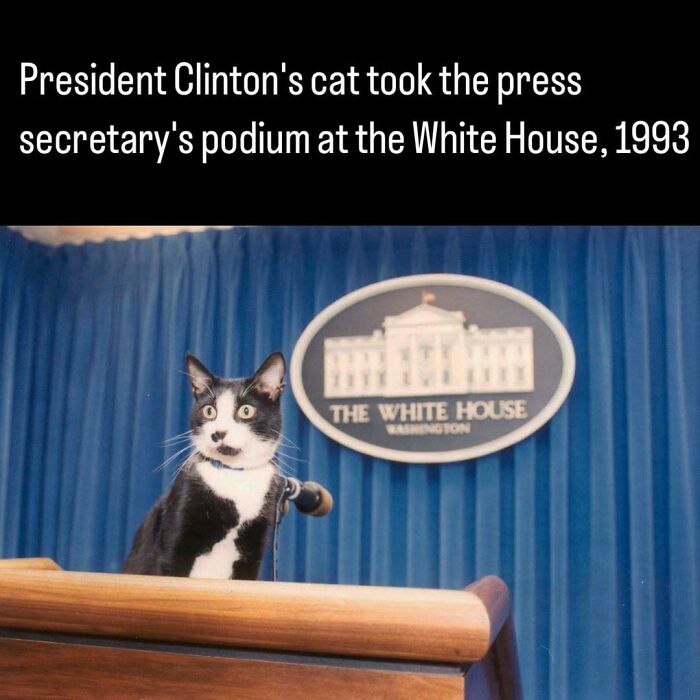
Image source: historyfeels
#41
English settler Thomas Austin released just 24 European rabbits into the wild on his property in Victoria, Australia. He saw it as a harmless attempt to recreate the sport hunting he had enjoyed back home. But this decision would become one of the most devastating ecological mistakes in history. With no natural predators, abundant food, and ideal breeding conditions, the rabbit population exploded. Within a matter of decades, millions of rabbits were ravaging crops, stripping vegetation, and outcompeting native species. By the 1920s, it’s estimated that the population had skyrocketed to 10 billion rabbits. The government scrambled to control the infestation, building a rabbit-proof fence over 2,000 miles long and introducing diseases like myxomatosis in the 1950s. While efforts slowed their growth, rabbits remain a serious agricultural and environmental threat in Australia to this day. All from a decision that seemed harmless — just two dozen rabbits and an open gate.
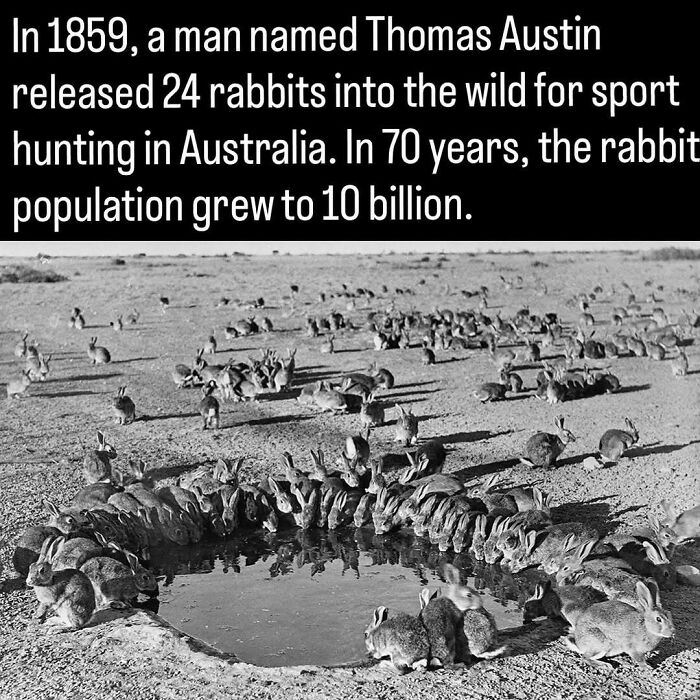
Image source: historyfeels
#42
The Parthenon, standing atop the Acropolis in Athens since 447 BC, has endured more than two millennia of war, earthquakes, looting, and environmental decay. For the last two centuries, restoration has been an almost continuous process. Since the early 1800s, scaffolding has been a familiar sight around the temple as teams of architects, engineers, and conservators worked to repair structural damage, replace corroded metal clamps, and realign marble blocks that had shifted over time.
This moment, with the Parthenon fully free of scaffolding, marks a rare pause in that ongoing preservation. It offers an unobstructed view of one of humanity’s most iconic structures exactly as it stood under the ancient Athenian sun. Visitors can now walk around the entire perimeter and see the harmony of Doric columns and precise geometry that defined Greek architectural perfection.
The Parthenon was originally dedicated to Athena Parthenos, the city’s patron goddess, and once housed a 40-foot gold and ivory statue of her. Though time has stripped away its sculptures and color, the temple remains a symbol of democracy and cultural endurance.
Added Fact: The Parthenon’s restoration project, managed by the Acropolis Restoration Service since 1975, has been one of the longest and most meticulous architectural conservation efforts in the world, involving more than 2,000 marble fragments carefully repositioned using modern technology.
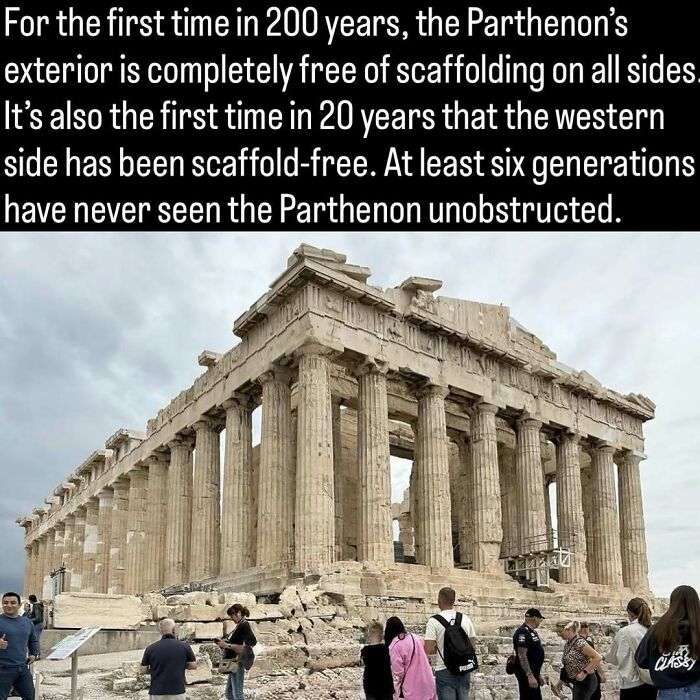
Image source: historyfeels
#43
In Bacoli, Italy, a town resting on the ancient ruins of the Roman Empire’s seaside villas, there grows one of the strangest natural wonders in Europe: the upside-down fig tree. Suspended from the ceiling of an old Roman structure, the tree defies all expectation by growing downwards, its roots anchored into cracks of stone while its branches and fruit spill toward the ground below. Local legend says no one remembers exactly how the tree came to be lodged there. Some believe a bird may have dropped a seed into a crevice centuries ago, where it took root against all odds. Others see it as a symbol of resilience, life finding a way in even the most improbable conditions. Despite the lack of soil or traditional nourishment, the tree thrives, producing figs year after year as if mocking the laws of nature. Bacoli itself is steeped in history, once a retreat for Roman elites and generals, its ruins scattered with aqueducts, amphitheaters, and mosaics.
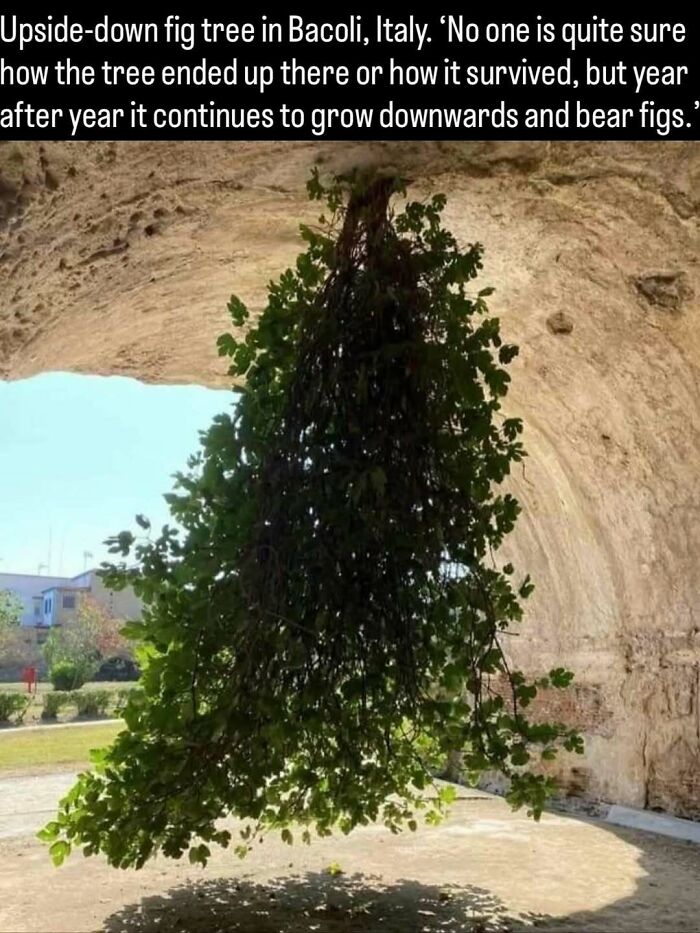
Image source: historyfeels
#44
This image shows the Palazzo Braschi in Rome during the height of Benito Mussolini’s fascist regime in the 1930s. Draped across the building is a massive propaganda display featuring a giant sculpted face of Mussolini and the word “SÌ” (“YES” in Italian) repeated in bold letters. The display was part of a referendum campaign in 1934 where Italians were asked to approve Mussolini’s one-party rule. Voters were presented with a single ballot question, a “yes” vote was effectively a pledge of loyalty to the regime. According to official records, the result was overwhelmingly in favor, though historians widely regard it as a sham election in a climate of fear and repression. The sheer scale of the display symbolizes the cult of personality Mussolini built around himself, one of the defining features of 20th-century totalitarianism.
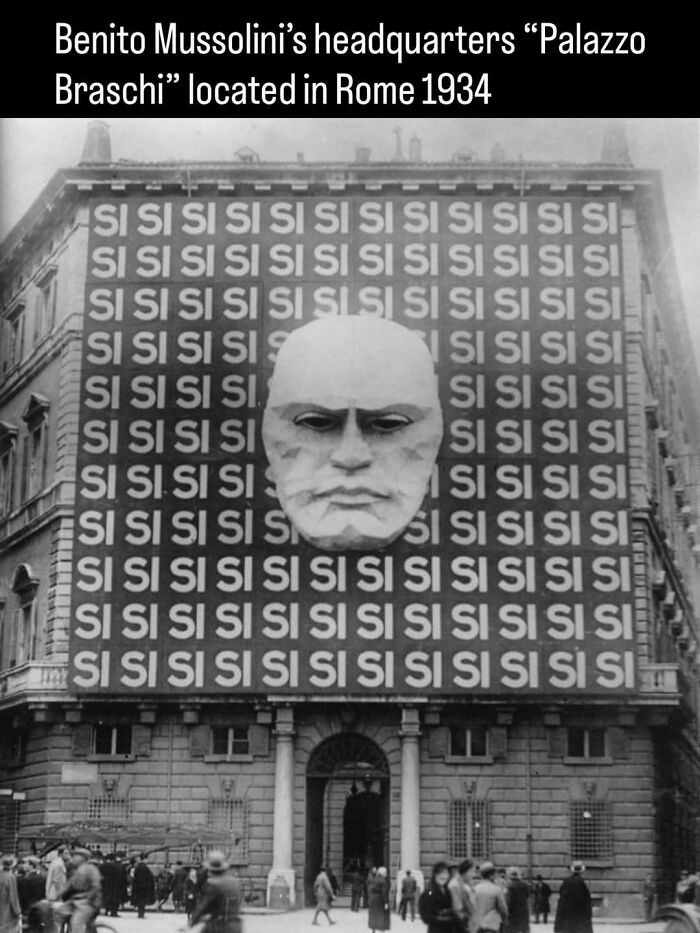
Image source: historyfeels
#45
The portrait on the left is one of the most recognizable images of Thomas Jefferson, painted around 1800 by Rembrandt Peale. It shows Jefferson as he wished to be seen at the beginning of the new century, a thoughtful statesman whose writing and ideas helped shape the early United States. Peale’s smooth technique and quiet lighting present Jefferson as a figure of calm confidence during a formative moment for the young nation.
Placed alongside the modern photograph of Shannon LaNier, a sixth great grandson of Jefferson through Sally Hemings, the image takes on an added layer of historical depth. LaNier’s portrait connects the eighteenth century directly to the present day, reminding viewers that the people who shaped the early republic left behind families whose stories continue into the modern era.
Jefferson’s life, like the life of the nation he helped guide, contained many complexities. He spoke often about liberty and individual rights, yet also lived within a system that relied on the labor of enslaved people. His world was shaped by contradictions that were common in the founding generation, and those tensions are part of what makes his legacy so studied today.
Added Fact
In 1998 a DNA study provided strong evidence linking the Jefferson family line to the Hemings family line, a finding that encouraged historians and institutions such as Monticello to expand their research and interpretation to include the full Jefferson household and the lives of the people who lived there.
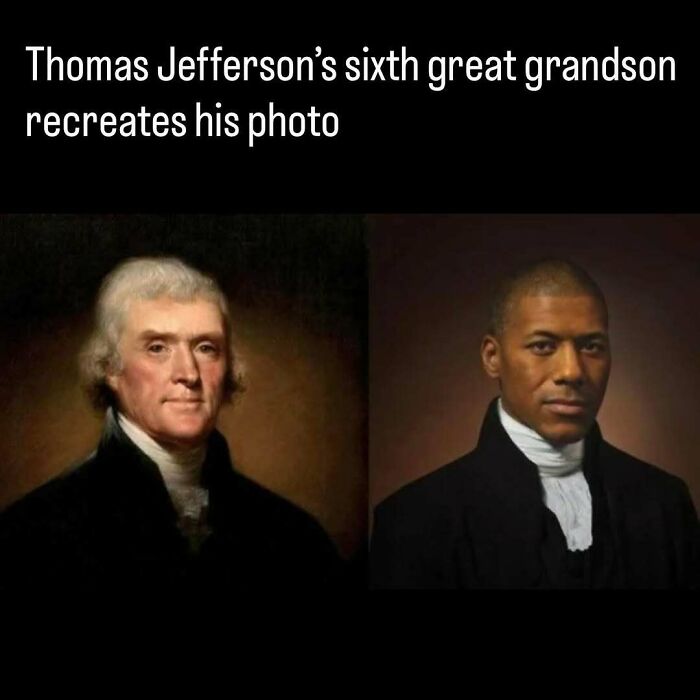
Image source: historyfeels
#46
This photo captures a worn-down street in New York City in 1984, taken from the on-ramp of the Brooklyn Bridge facing south on Water Street. At the time, this area was close to the financial district but still carried the grit of pre-redevelopment Manhattan. The sign on the right advertises a record storage company, using the old phone number format where the first two digits were letters (“BO”), and the dash at the end indicated multiple lines before call waiting became standard. No area code appears, since all five boroughs shared 212 until 718 was introduced later in 1984. The building under construction in the background is One Seaport Plaza, now a well-known downtown landmark. Many of the foreground buildings still exist, including the Peck Slip School. The analytics show the number one city of historyfeels followers is New York City so New Yorkers please feel free to add additional context..
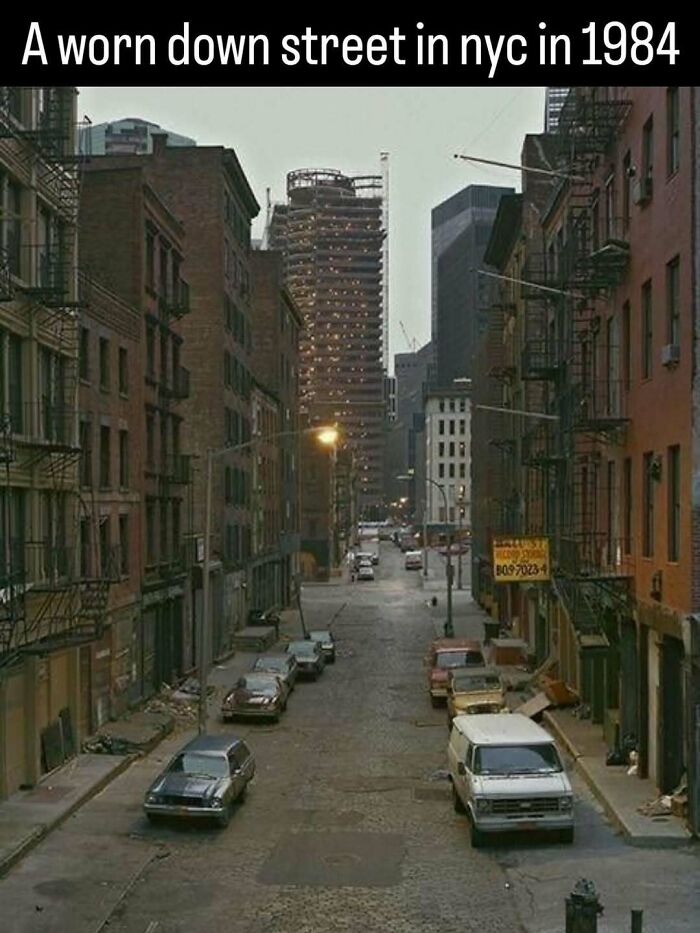
Image source: historyfeels
#47
In May 1986, a 19-year-old Kurt Cobain was arrested in his hometown of Aberdeen, Washington, for spray-painting graffiti on public property. Among his tags was the provocative phrase “God is gay,” alongside other rebellious slogans that reflected both his disdain for authority and his desire to challenge societal norms. Cobain, who would later become the frontman of Nirvana and a voice of a generation, was already displaying the anti-establishment tendencies and raw honesty that would define his music. The arrest led to a mugshot that has since become a piece of rock history. Cobain was charged with vandalism and briefly jailed before being released. His punishment was relatively minor, he paid a small fine and was placed on probation.
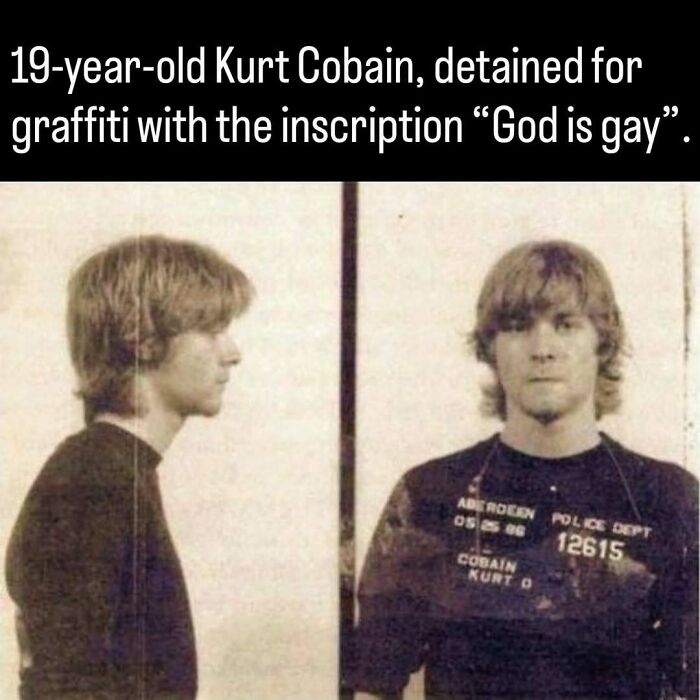
Image source: historyfeels
#48
The astronomer was Clifford Stoll, then 36 years old and working at the Lawrence Berkeley National Laboratory in California. Stoll had been reassigned from pure astronomy work to manage computers when he noticed something odd: a 75-cent discrepancy in accounting records for computer time. Most people might have written it off as a minor clerical error, but Stoll’s scientific instincts told him to investigate.
Over the next ten months, Stoll meticulously traced the anomaly through the lab’s computer systems. What he discovered was far bigger than a billing error, it was a hacker from West Germany who had broken into U.S. computer networks. The intruder was not just snooping for fun; he was stealing classified military information and selling it to the KGB, the Soviet Union’s intelligence agency during the Cold War.
Stoll used creative methods to track the hacker. In one famous example, he set up “digital honey pots”, fake files filled with enticing but meaningless military data, to monitor the intruder’s activity. He also coordinated with the FBI, CIA, and even German authorities, though at first, few officials took him seriously. Eventually, his persistence paid off: authorities arrested Markus Hess, the hacker, in West Germany.
This case became one of the earliest and most famous examples of cyber-espionage. It highlighted how vulnerable computer systems had become in the digital age, especially with sensitive defense information stored online.
Stoll later documented the entire experience in his bestselling book, The Cuckoo’s Egg (1989), which remains a classic in both cybersecurity and true-crime literature. His story demonstrated how even a tiny irregularity, just 75 cents, could unravel a global espionage plot. It’s the small details.
Fun Fact: To keep himself awake during the long nights of hacker tracking, Stoll would run around the lab’s hallways balancing on the walls and juggling. His eccentric energy became just as famous as the investigation itself.

Image source: historyfeels
#49
The photo was taken by Roland Reed, an American artist and photographer, who was part of an early 20th century group of photographers of Native Americans known as ‘pictorialists’. This photo is titled ‘The Eagle’. The picture was featured on the inside jacket of the book Alone with the Past: The life and photographic art of Roland W. Reed. The Blackfoot were a confederacy of Plains tribes whose territory once stretched across present-day Montana and Alberta. They were known for their warrior culture, complex spiritual beliefs, and deep relationship with the land and considered the mountains and plains sacred.
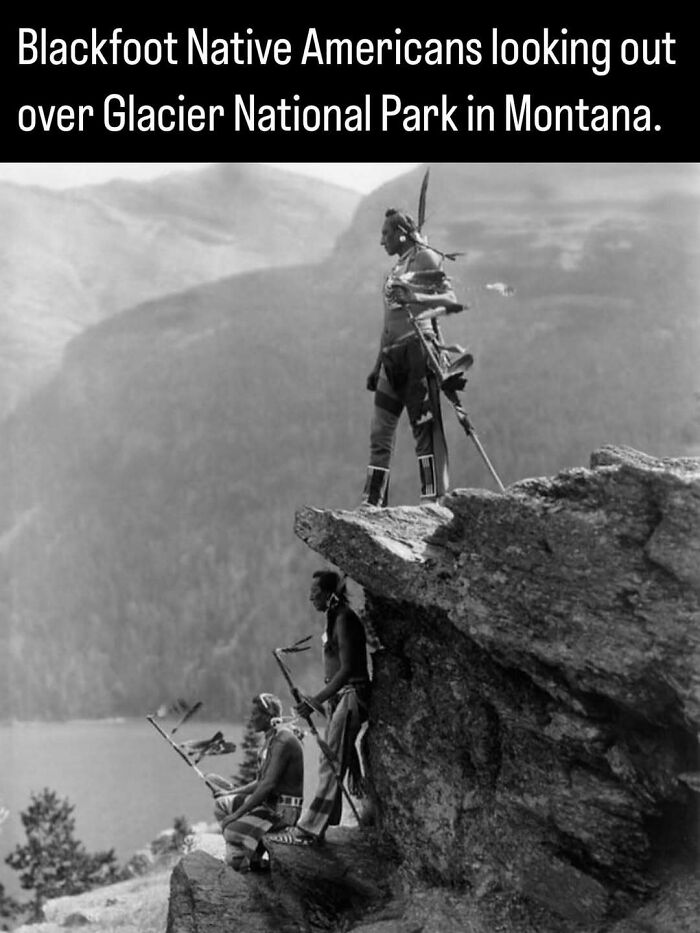
Image source: historyfeels
#50
Discovered in the ancient city of Antioch, in modern-day Turkey, this 2,400-year-old mosaic offers a surprisingly timeless message. It features a skeleton lounging with a cup of wine, bread, and an amphora of what was likely meant to represent more wine, accompanied by a Greek inscription that reads: “ΕΥΦΡΟΣΥΝΟΣ”, translated as “Be cheerful. Enjoy your life.” This mosaic is a vivid example of the ancient concept of memento mori, a reminder of mortality meant to inspire people to live fully while they can. Far from gloomy, the reclining skeleton appears relaxed and festive, suggesting that the ancients embraced not just the inevitability of death, but the importance of joy and indulgence along the way.
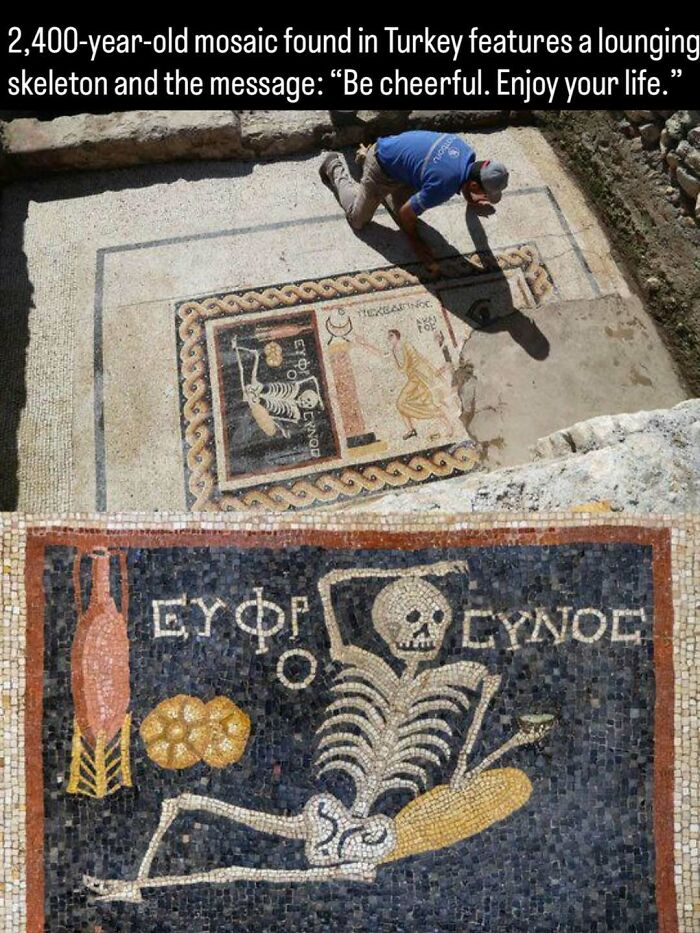
Image source: historyfeels
#51
This grocery store sits inside Diocletian’s Palace, a Roman imperial complex built in the 3rd century AD in what is now Split, Croatia. Once the lavish retirement home of Emperor Diocletian, the sprawling palace complex is now fully integrated into the city, complete with shops, homes, restaurants, and even modern supermarkets. Here, ancient stone columns, arches, and Roman foundations stand alongside modern food displays and coolers, creating a striking visual blend of antiquity and everyday life. In some parts of the store, glass floor panels reveal preserved Roman ruins just beneath shoppers’ feet. Fun fact: Diocletian’s Palace is one of the best-preserved Roman structures in the world and is a UNESCO World Heritage Site. Locals have been living and working within its ancient walls continuously for over 1,700 years, making it one of the only “living” Roman palaces in existence. Bonus fun fact: The palace’s underground vaults were used as a filming location for Daenerys Targaryen’s throne room in Meereen in Game of Thrones.
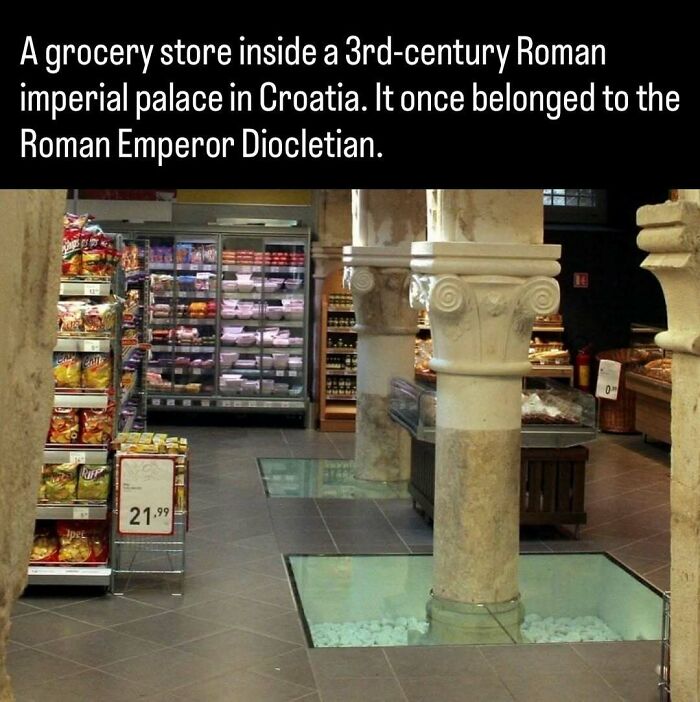
Image source: historyfeels
 Follow Us