It is never too late to learn something new. When it comes down to it, we’re all incredibly curious about the world. But among all the responsibilities, stress, and constant rushing around, some of us temporarily forget it. Often, all it takes is just one truly intriguing and unexpected nugget of information to make you crave more knowledge.
If you’re in the mood to expand your mind, we’ve got you covered. We are featuring some of the most interesting and unusual world, science, history, and entertainment facts and photos to reframe how you perceive the past, as shared on the popular ‘Lost In Time History’ Instagram account. Got your notepad ready? Let’s go.
#1
To become one of the Pope’s personal bodyguards, you must meet some surprisingly strict requirements. Members of the Vatican’s Swiss Guard must be Swiss men, practising Catholics, unmarried when recruited, aged between 19 and 30, and at least 174 cm (5’8½”) tall. They must also have completed Swiss military training.
Their colourful uniforms are just as unusual. Each is handmade from 154 individual pieces of fabric, taking around 39 hours to assemble. Despite their Renaissance appearance, the uniforms were actually redesigned in 1914, and contrary to popular belief, they weren’t designed by Michelangelo.
The Swiss Guard has protected popes since 1506. In 1527, during the Sack of Rome, 147 guards lost their lives defending Pope Clement VII, while 42 others helped him escape through a secret passageway. Today, the guards still carry traditional weapons during ceremonies, but are also trained in modern firearms and self-defence
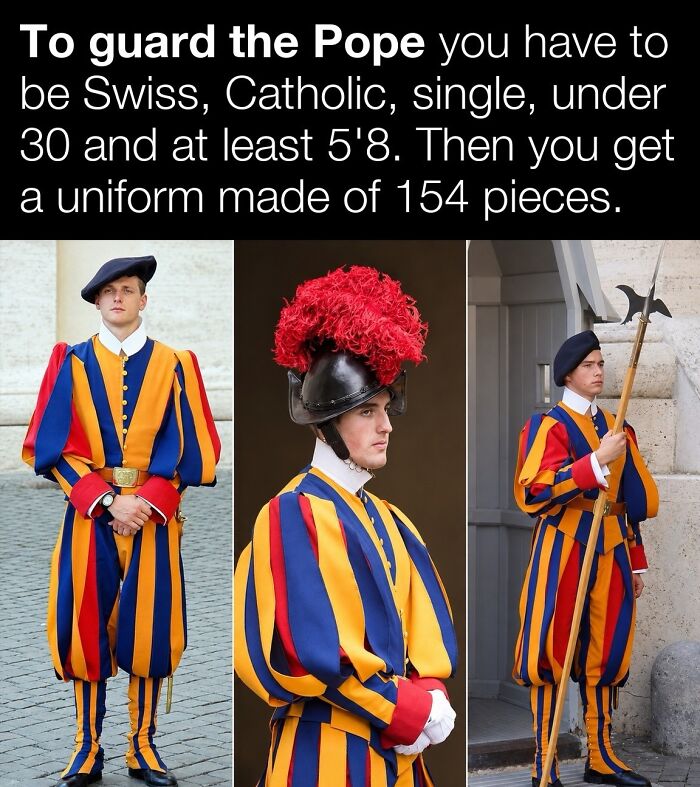
Image source: lostintimehistory

#2
Some of the biggest scenes in the original Star Wars trilogy were not enormous sets at all. Parts of the worlds behind the actors were painted completely by hand onto sheets of glass, then carefully combined with real footage to make them appear enormous.
One famous example is the Rebel hangar in The Empire Strikes Back. Only part of what audiences saw was physically there. Artists at Industrial Light & Magic painted much of the enormous surrounding hangar, while similar techniques helped create Cloud City and other locations. Some paintings even contained tiny people, spaceships and lights that viewers naturally assumed were real.
Everything had to line up perfectly. Artists matched the perspective, lighting and scale of the real footage so it was difficult to see where the physical set ended and the painting began. It meant some of the most expensive-looking environments in 1970s and 1980s Star Wars were essentially actors standing in relatively small sets surrounded by carefully positioned artwork.
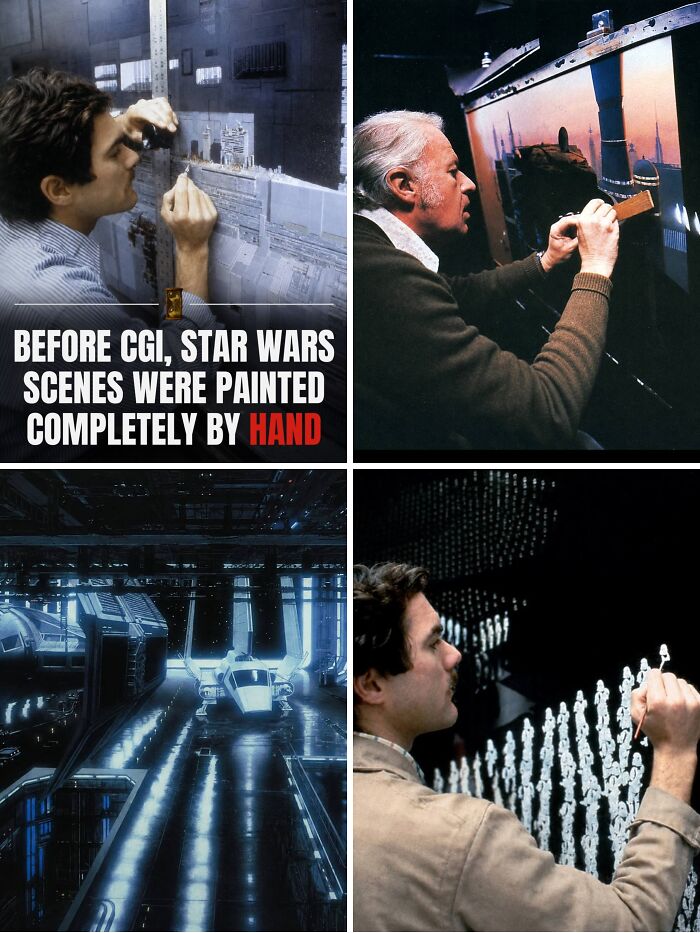
Image source: lostintimehistory
#3
For more than 20 years, Canadian photographer François Brunelle has tracked down complete strangers who look so similar they could be twins. He photographs the pairs together for his project I’m Not a Look-Alike! — despite them having no known family connection.
The idea partly began because people kept telling Brunelle that he looked like Mr Bean. Curious about how two unrelated people could share the same face, he began searching around the world for other “doubles”, sometimes photographing people meeting their lookalike for the first time.
The project eventually became useful to scientists too. Researchers studied 32 pairs photographed by Brunelle and found that the strongest lookalikes often shared genetic similarities despite being unrelated — helping explain why your near-double really could be somewhere out there.
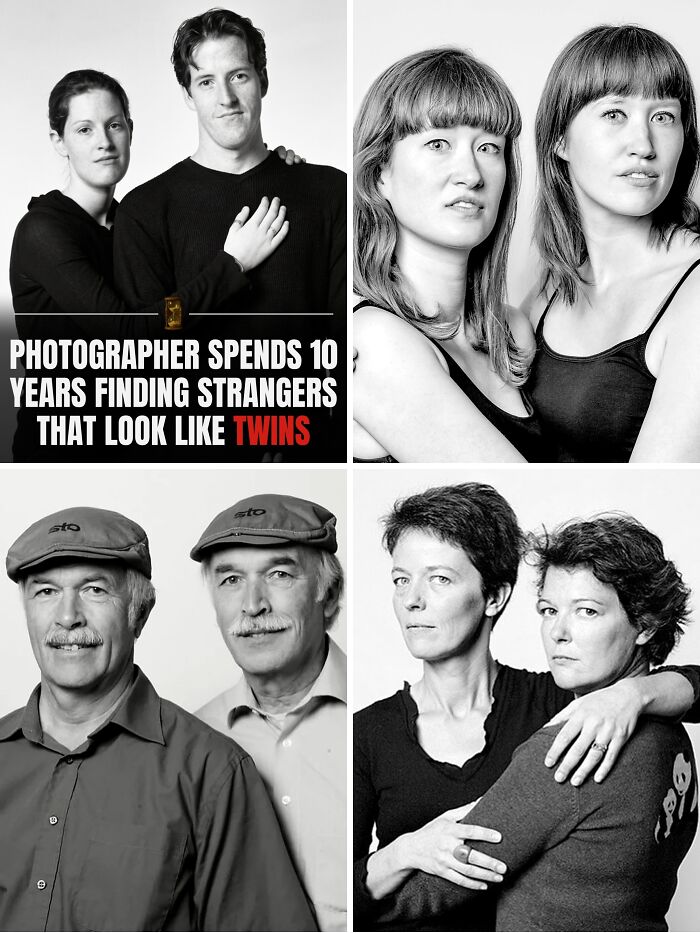
Image source: lostintimehistory
Staying curious and constantly learning new things keeps your mind active. Not only that, but researching various topics and staying up to date on the latest developments makes you better able to understand the world you live in.
In a nutshell, knowledge is powerful because it lets you understand trends and make better decisions. But when you’re neck-deep in adult responsibilities and beyond anxious, stressed, and exhausted, all of that is easier said than done. So, you need to embody a slightly different strategy when it comes to curiosity.
For instance, you can try an incremental approach that won’t cost you much effort but helps build healthy cognitive habits.
#4
In Mandarin Chinese, the word for owl is 猫头鹰 (māo tóu yīng), which literally translates to “cat-headed eagle”. When you compare an owl and a cat side by side, the name starts to make perfect sense.
The first character, 猫, means “cat”, 头 means “head”, and 鹰 means “eagle” or “hawk”. The name comes from the owl’s surprisingly cat-like appearance, particularly its rounded face, large forward-facing eyes and the pointed feather tufts found on some species.
Interestingly, those tufts aren’t actually ears. They’re simply feathers that help owls communicate and blend into their surroundings. Their real ears are hidden beneath the feathers on the sides of their heads. Owls also share another characteristic with cats: both are skilled at hunting in low light.
Chinese has another amusing expression, 夜猫子 (yè māo zi), meaning “night cat”. It’s commonly used to describe someone who stays awake late into the night, just like the English expression “night owl”
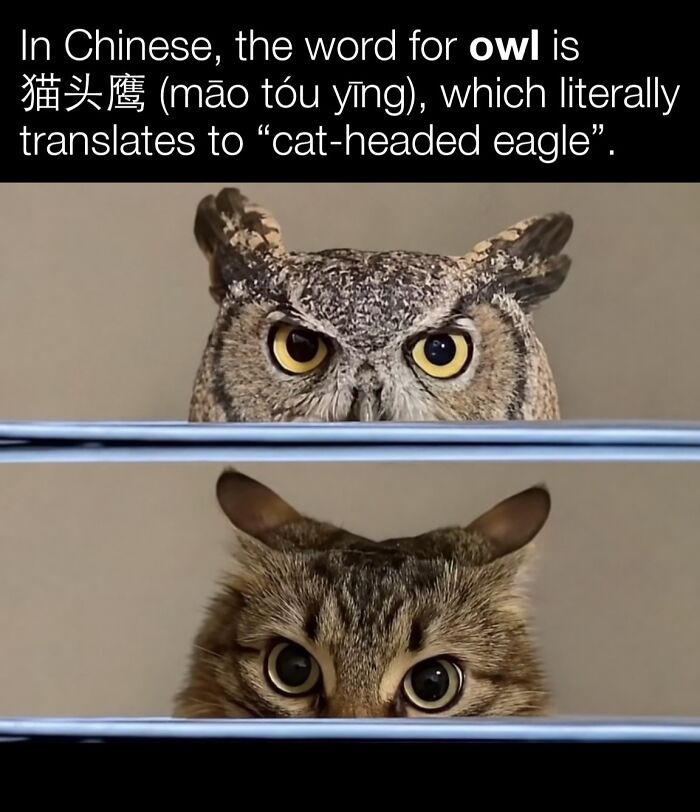
Image source: lostintimehistory
#5
These real photos of a jaguar diving underwater for food were taken by photographer Herbert van der Beek during a day spent photographing a jaguar at Zoo de Bordeaux Pessac in France. Because seeing a jaguar hunt underwater in the wild is extremely difficult, van der Beek set out specifically to capture what the animal looked like once it disappeared beneath the surface.
The resulting series shows the jaguar completely submerged, eyes open and body stretched forward as it goes after food underwater. Van der Beek said what struck him most was how powerful and agile the cat still looked beneath the surface, rather than clumsy or slowed down.
The photos later spread widely online because they show a side of jaguars most people never see. Jaguars are unusually strong swimmers for big cats and will willingly enter rivers and wetlands to hunt or cross between areas.
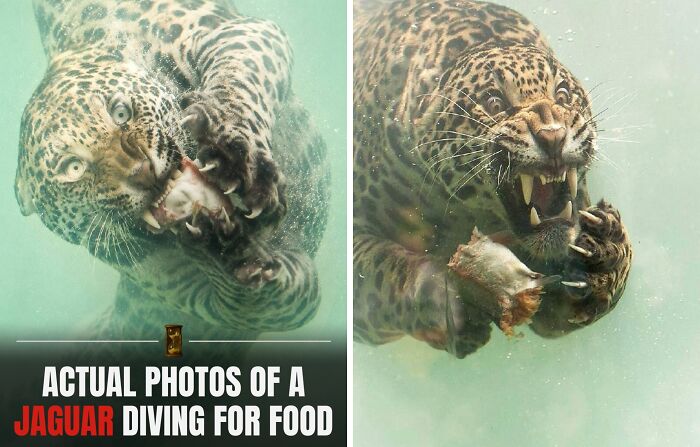
Image source: lostintimehistory
#6
In Ghana, some funerals use “fantasy coffins” shaped around a person’s life, work, or interests rather than simple wooden boxes. The tradition is especially linked to the Ga people around Accra, where coffins can be made as fish for fishermen, cocoa pods for farmers, cameras for photographers, planes for people who loved travel, or even giant shoes, cars, animals, and mobile phones.
The modern version of the tradition is often linked to carpenter Seth Kane Kwei in the 1950s, whose workshop in Teshie became famous for creating these highly detailed custom coffins. The tradition later became internationally known, with Ghanaian fantasy coffins displayed in museums and galleries around the world.
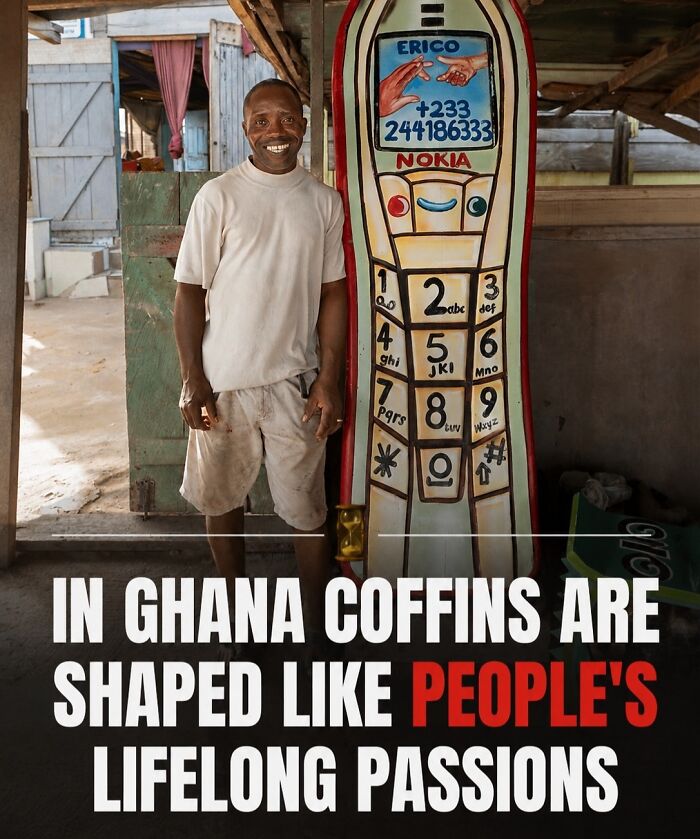
Image source: lostintimehistory
According to Jeff Wetzler, Ed.D., who has researched learning and human potential, your brain “shifts into protection mode” when you perceive social, emotional, or status-related threats. Your attention narrows, and you are less likely to prioritize exploration and learning.
So, if you want to retain access to curiosity, you ought to start by “deliberately inserting very small, psychologically realistic moments of curiosity into situations where our minds would otherwise snap to judgment, defensiveness, or disengagement.”
#7
Devil’s horns at sunrise.
For a few moments, light, atmosphere and a partial solar eclipse combined to make the Sun appear as two glowing horns rising from the horizon.
The strange shape is caused by the Etruscan Vase effect, a mirage created when layers of air at different temperatures bend the Sun’s light near the horizon. Combined with the eclipse covering the centre of the Sun, the distortion produced this almost mythological-looking sunrise.
Photo by @eliaschasiotis
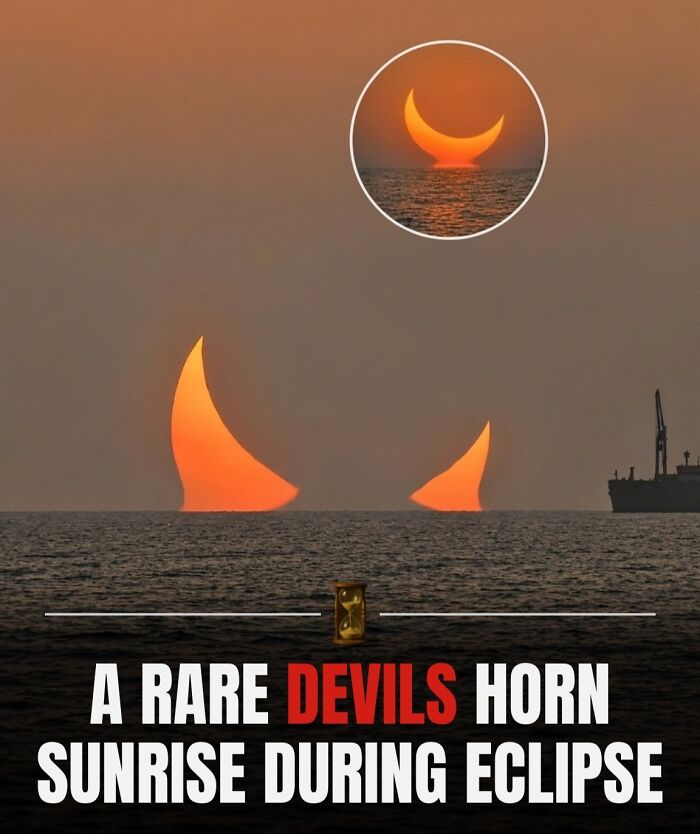
Image source: lostintimehistory
#8
In the early 1980s, American artist and inventor Pippa Garner created the “Half-Suit”, a business suit designed to keep the formal appearance of traditional office clothing while exposing the entire stomach.
Garner’s idea was that most of a suit’s professional appearance came from the collar, tie and lapels. By cutting away the rest of the jacket and shirt, a businessman could supposedly stay smartly dressed while enjoying the comfort of having his torso exposed.
In 1982, Garner even appeared on The Tonight Show Starring Johnny Carson wearing the Half-Suit, presenting it alongside other ridiculous inventions, including high-heeled roller skates, a two-person baseball cap and an umbrella made from a palm leaf.
The Half-Suit was part of Garner’s wider collection of deliberately impractical inventions, which poked fun at consumer culture and the endless search for new products to make everyday life easier
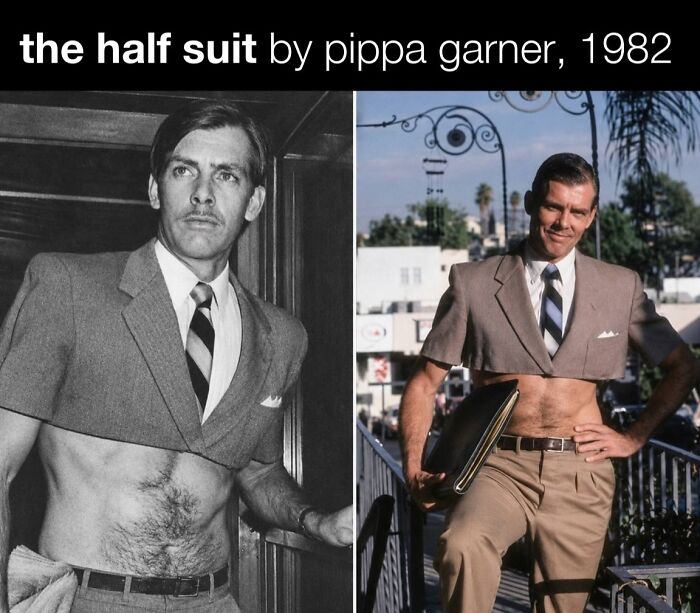
Image source: lostintimehistory
#9
When Jim Henson, the creator of the Muppets, passed away on May 16, 1990, Disney artists created this touching illustration of Mickey Mouse comforting a grieving Kermit the Frog. Henson was just 53 when he d**d unexpectedly from a severe bacterial infection, leaving behind characters that had entertained millions of children around the world.
The drawing was created by Disney Imagineers Joe Lanzisero and Tim Kirk and appeared in the summer 1990 edition of WD Eye, Disney’s internal employee magazine. At the time, Henson had been working closely with Disney on new Muppet projects, including MuppetVision 3D, which became one of his final productions. The two companies were also negotiating a deal to bring the Muppets into the Disney family.
Remarkably, Disney didn’t actually acquire Kermit and the other classic Muppets until 2004, fourteen years after Henson’s passing. His daughter Lisa later explained that her father had believed Disney would be the perfect home for his creations. The illustration remains a particularly touching tribute, showing one of the world’s most recognisable characters comforting another after the loss of the man who brought him to life.
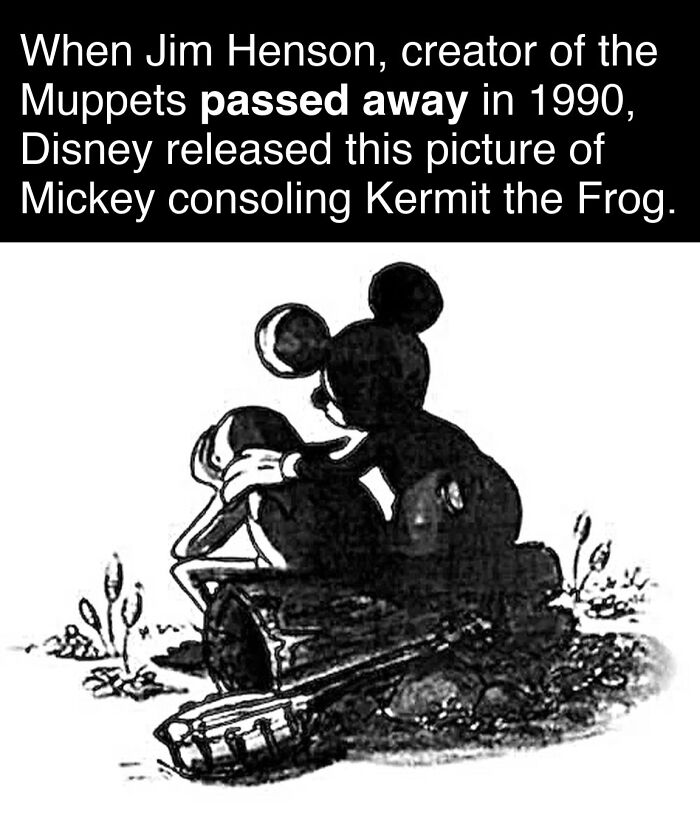
Image source: lostintimehistory
Wetzler shares a few examples of practically embracing these small moments of daily curiosity:
- Examine and question one assumption that you treat as a fact right now
- Ask yourself what else could alternatively be going on
- Read, listen to, or speak with one person outside your usual bubble
- Empathize with another person’s internal experience even if you don’t agree with them
- Get curious when you feel frustrated or defensive and examine what your emotions are telling you
- Name the fear that is shutting down your curiosity
- Ask someone you trust what questions you might be overlooking
- Ask questions you don’t already know the answer to, in order to think differently
#10
In July 1951, LIFE magazine photographer Allan Grant captured a rather unusual sight in Hollywood, California: a two-year-old ginger tabby named Nipper happily eating corn on the cob from a specially designed wooden stand.
According to contemporary newspaper reports, Nipper had been obsessed with corn since he was a kitten, eating approximately two entire cobs every day. His owner, Dorothy Brinn, even built him a custom wooden holder so he could enjoy his favourite snack without having to hold it himself. And apparently, Nipper was quite particular about his food, preferring his corn served with butter.
Despite his unusual eating habits, Nipper was otherwise a perfectly ordinary house cat. Brinn described him as “just a cat”, with no special pedigree or remarkable background beyond his extraordinary enthusiasm for corn.
The photographs were taken as part of an unpublished LIFE photo essay, but Nipper’s peculiar eating habits had already attracted newspaper attention across America. Decades later, his photographs remain an amusing reminder that cats have always had their own strange personalities and preferences.
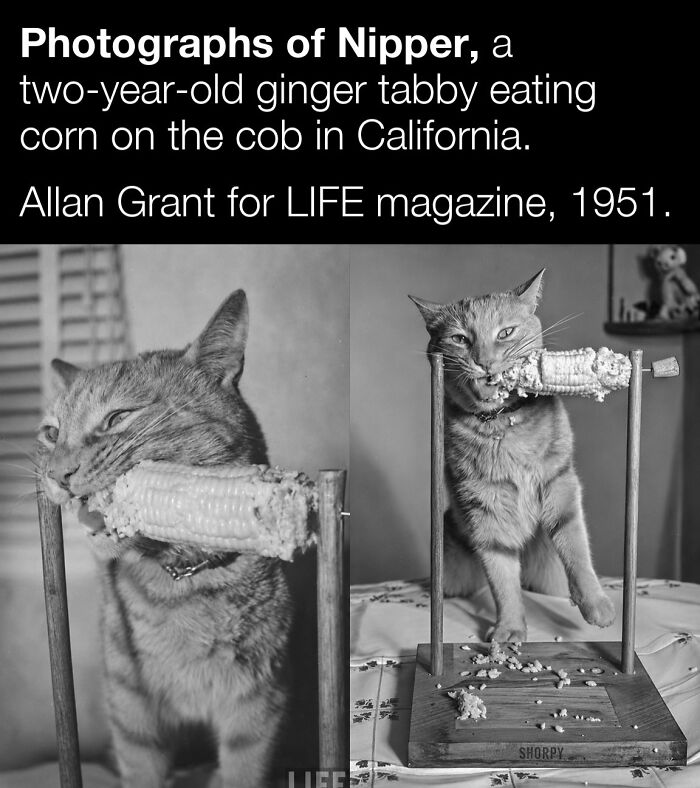
Image source: lostintimehistory
#11
The tiny animal in these photos is a pudu, one of the smallest deer on Earth. The northern pudu is especially tiny, commonly standing only around 32 to 35 cm tall at the shoulder and weighing roughly 3.3 to 6 kg. That means a fully grown deer can be about the size of a small dog.
Pudus are native to South America, where they live among thick forests and mountain vegetation. Their compact bodies and short legs make it easier to slip through dense undergrowth, while young pudus are born with pale spots that help them blend into their surroundings.
Males even grow miniature antlers, sometimes only a few centimetres long. Despite their tiny appearance, pudus can run quickly, jump onto fallen logs and move surprisingly well through difficult terrain. The popular description of them being “four apples tall” is only a playful comparison, but it is surprisingly close to showing just how small these deer really are.
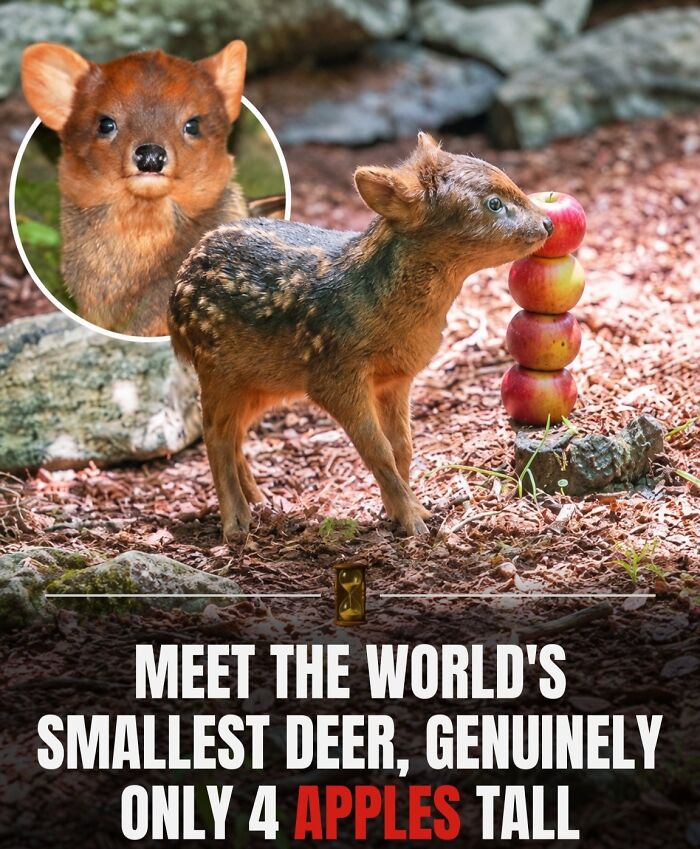
Image source: lostintimehistory
#12
New Zealand sea lions are unusual because some females travel inland through forests instead of staying on beaches. They have been found resting under trees, crossing roads and appearing kilometres from the sea.
This behaviour is part of their return to areas they historically used before disappearing from much of mainland New Zealand. Some females now give birth and raise pups inland, using forests as sheltered places away from busy beaches

Image source: lostintimehistory
The expert emphasizes how curiosity depends on your body feeling steady enough to explore. It is not just a mindset. So, if you’re feeling stressed, focus on regulating your nervous system:
- Take slow, deep breaths
- Unclench your jaw
- Drop your shoulders
“Slow breathing activates the parasympathetic nervous system, lowering physiological threat responses,” Wetzler notes.
#13
Three newborn sons were waiting behind the nursery window when 27-year-old Arris Poulos posed for this photograph in New York in 1946. As the nurses held up the babies, Dr Carl Strauss supplied a steadying hand for their father’s dramatic reaction.
His wife, Nora, had given birth to the boys at Lutheran Hospital that April. Named Tommy, Thenny and George, they attracted newspaper coverage that followed the family well beyond their first appearance at the nursery window.
Pregnancy ultrasound scans were still years away. The pioneering Glasgow research that helped establish obstetric ultrasound was published in 1958, although doctors already had other methods of recognising multiple pregnancies.
The photograph’s original newspaper caption described Arris as “feigning shock”, but the practical challenge of bringing home three babies was real enough. Later coverage showed him washing bottles and carrying the boys together, while Nora used an enormous pram she called her “jeep”. Their fifth birthday even brought a party with three other sets of triplets

Image source: lostintimehistory
#14
A man and his dog at Grand Central Terminal, New York City, 1943.
The photograph captures an ordinary moment during an extraordinary year. By 1943, the United States was deep into World War II, and Grand Central had become a major crossroads for servicemen, commuters and families travelling across the country.
Wartime rail travel was so heavily used that passengers were encouraged to cancel unwanted reservations immediately, as an unused seat could mean a serviceman on leave having to wait for another train. Against that backdrop, a simple photograph of a man travelling with his dog becomes a small glimpse of everyday American life continuing during the war.
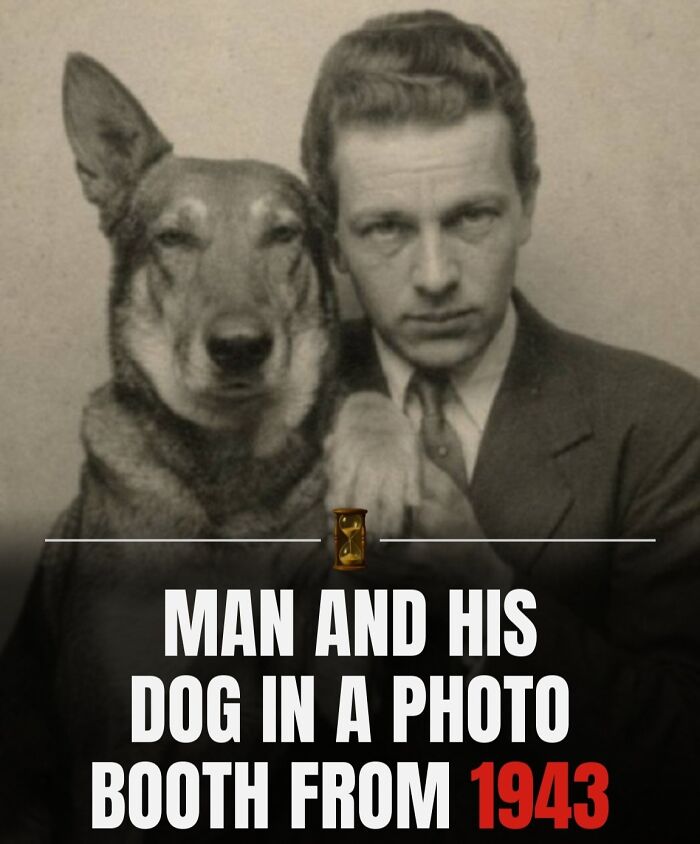
Image source: lostintimehistory
#15
Every movement in Disney’s hand-drawn films had to be drawn by hand, with major productions requiring well over a million individual drawings. Animators often filmed themselves acting out scenes first so they could study real movement frame by frame before putting pencil to paper.
For Bambi, Walt Disney brought live deer into the studio so artists could closely study how they walked, ran, and interacted. That attention to detail helped make Bambi’s movements some of the most realistic ever seen in animation and raised the standard for animated films.
When making Lady and the Tramp, Disney artists visited real Italian restaurants to sketch table settings, kitchens, and the way spaghetti was served. They even studied how dogs naturally ate pasta so the famous spaghetti scene between Lady and Tramp would feel believable, creating one of the most iconic moments in animation history
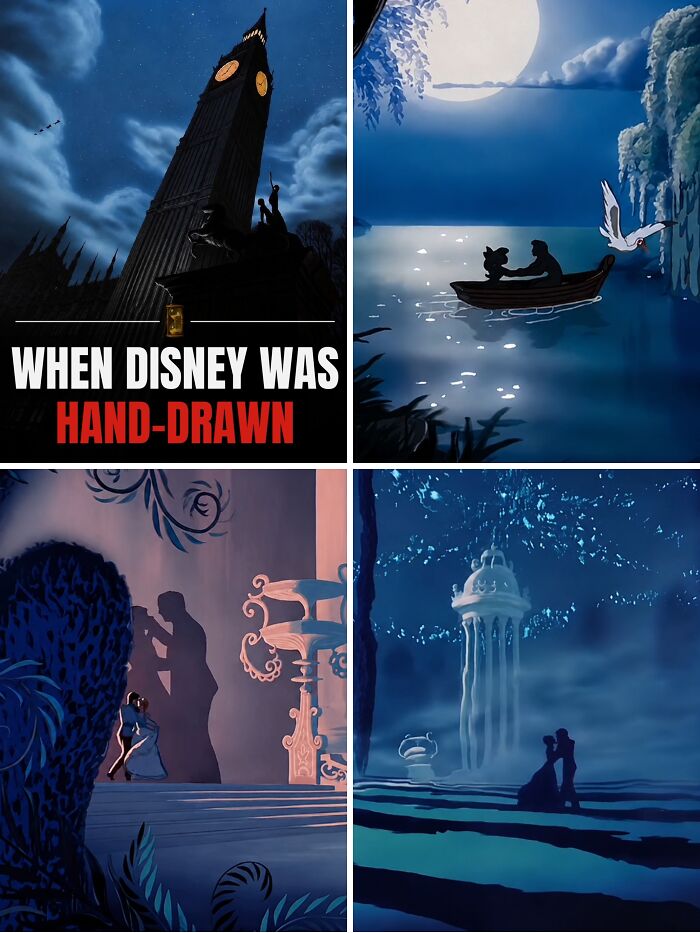
Image source: lostintimehistory
The ‘Lost In Time History’ project, whose curator started it in late 2021, has a massive online following.
At the time of writing, the account boasts a whopping 1.7 million Instagram followers, all fired up to constantly learn new things about the world.
There’s a good mix of different topics to cater to a very wide audience.
#16
In 2009, artist Hank Schmidt in der Beek hiked into the Austrian Alps with photographer Fabian Schubert planning to paint the landscape. But standing in front of mountains far bigger than anything he could fit on a canvas, he changed the idea completely and painted the pattern of his own shirt instead.
That joke became an ongoing series called Und im Sommer tu ich malen. Since then, the pair have travelled to locations once painted by artists including Monet, Cézanne, van Gogh and Caspar David Friedrich. Schubert photographs the famous view while Schmidt in der Beek sits in front of it, calmly ignoring the scenery and painting whatever shirt he happened to wear that day.
Art by @hankschmidtinderbeek
Photo by Fabian Schubert
Credit @editiontaube
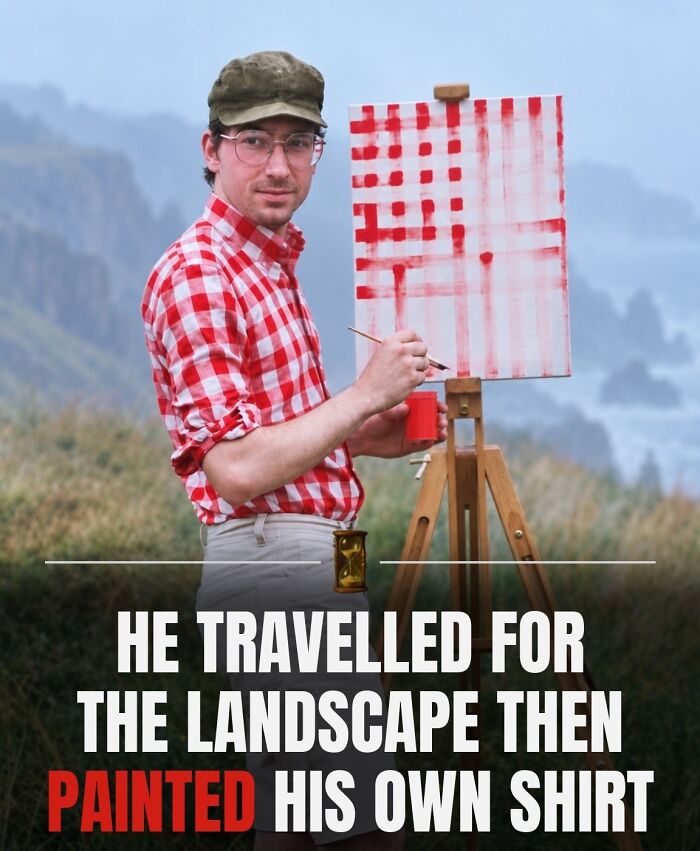
Image source: lostintimehistory
#17
On December 14, 2012, President Barack Obama stood in the White House briefing room and tried to explain something that felt impossible to put into words. The Sandy Hook tragedy had just taken the lives of 20 children and 6 adults, and for a moment the most powerful man in the world simply stopped. His voice tightened as he read their names, his eyes fixed downward, pausing mid-sentence as the weight of it broke through the usual discipline of public speech. He had delivered countless addresses, but this one didn’t stay polished—grief kept slipping through.
On September 14, 2001, George W. Bush arrived at Ground Zero in New York and climbed onto a crushed fire truck with a bullhorn in his hand. The air still burned with smoke, and families were still searching for names in the dust. When the crowd began chanting “USA,” he tried to respond—but his voice cracked into something raw and unpresidential. “I can hear you,” he said, then paused, visibly holding himself together as the moment turned from leadership into shared mourning in front of millions watching live.
In 2015, Joe Biden stood before cameras again and again speaking about loss—his son Beau, fallen service members, and families he had met in hospital rooms he would never forget. But one moment cut through the rest: his voice breaking as he talked about grief that doesn’t “ever go away,” staring down at his notes as if they weighed too much to lift. The vice president known for being talkative and warm suddenly couldn’t rush through the words, letting silence do what politics never could
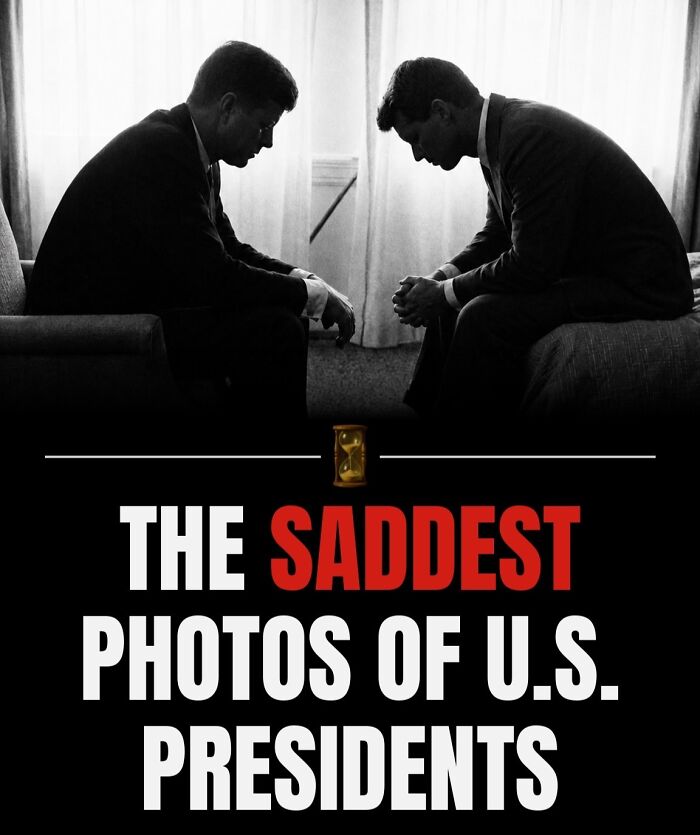
Image source: lostintimehistory
#18
In 1958, a 31-year-old David Attenborough was photographed introducing a nine-year-old Prince Charles, the future King Charles III, and his seven-year-old sister Princess Anne to a white cockatoo named Cocky.
The photograph was taken on April 28, 1958, during a visit to the BBC’s Lime Grove Studios in London. At the time, Attenborough was presenting Zoo Quest, a wildlife television series that took him to remote parts of the world. The cockatoo had been brought back from one of his expeditions, and the royal children were introduced to it after watching a BBC children’s programme.
Remarkably, Attenborough is now 100 years old, having celebrated his centenary in May 2026. His broadcasting career has spanned more than seven decades, from the early days of black-and-white television to the modern era of wildlife documentaries. The photograph captures just how extraordinary that span of time really is.
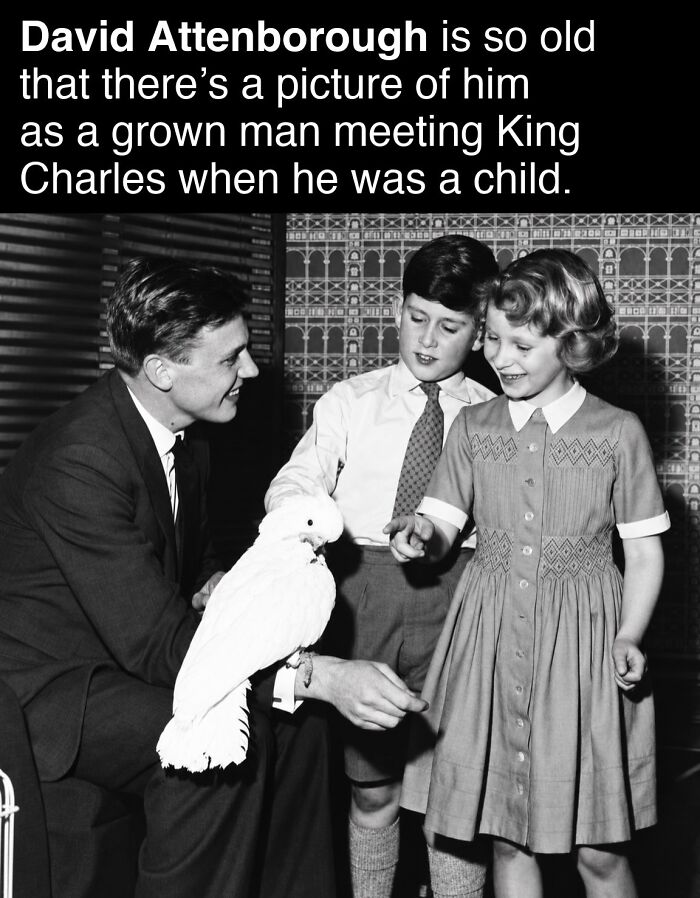
Image source: lostintimehistory
How do you stay curious no matter how many responsibilities and challenges you face in your day-to-day life? What topics are you most interested in learning more about, and why?
We’d love to hear your perspectives and insights, Pandas. Once you’ve read through these posts and upvoted the ones that intrigued you the most, join the conversation in the comments.
#19
Historical photos from inside and around the Twin Towers on September 11, 2001 remain some of the most important visual records of that day, preserving individual stories behind an event witnessed around the world.
One of the most famous shows Marcy Borders, the “Dust Lady.” The 28-year-old Bank of America employee had been working on the 81st floor of the North Tower when she began making her way down. After escaping, she was caught in the enormous dust cloud from the collapse of the South Tower and took shelter in a nearby building, where photographer Stan Honda captured the photograph that became known around the world.
Another remarkable photograph was actually taken inside the North Tower stairwell. It shows firefighter Mike Kehoe climbing upwards while office workers were heading down to escape. For days after the image circulated, many people assumed Kehoe had not made it out. He had survived, and soon returned to the site to search for six missing members of his fire company.
Thousands of professional and amateur photographs were ultimately preserved from September 11 and its aftermath. The Smithsonian alone collected more than 2,000 images from 25 photographers, creating a historical record that documents not only the scale of what happened, but the experiences of individual people who were there.

Image source: lostintimehistory
#20
Sometimes the most memorable photographs happen when perspective and timing briefly turn an ordinary scene into something completely different. A person steps into the perfect spot, the moon reaches one exact point in the sky, or a piece of everyday street furniture suddenly becomes part of the image.
In Lima, Peru, photographer Ricardo Cuba Zavala noticed a pair of huge golden wings behind an emergency scene in 2016 and waited until a firefighter climbed into exactly the right position, making the wings appear to belong to him. In Rio de Janeiro, Leonardo Sens spent three years working out another much harder alignment. From around 11 kilometres away, he finally captured the full moon directly above Christ the Redeemer’s outstretched arms in June 2023, creating the illusion that the statue was holding it.
A similarly strange effect can be found in Konan, Japan. The 18 metre Great Buddha of Hotei, which has stood there since 1954, sits behind a railway crossing. From one precise viewpoint, two red signal lights overlap with the statue’s eyes and make it look as though the Buddha is wearing glowing sunglasses. In each case, the photograph works because several completely separate elements briefly come together in one perfect frame
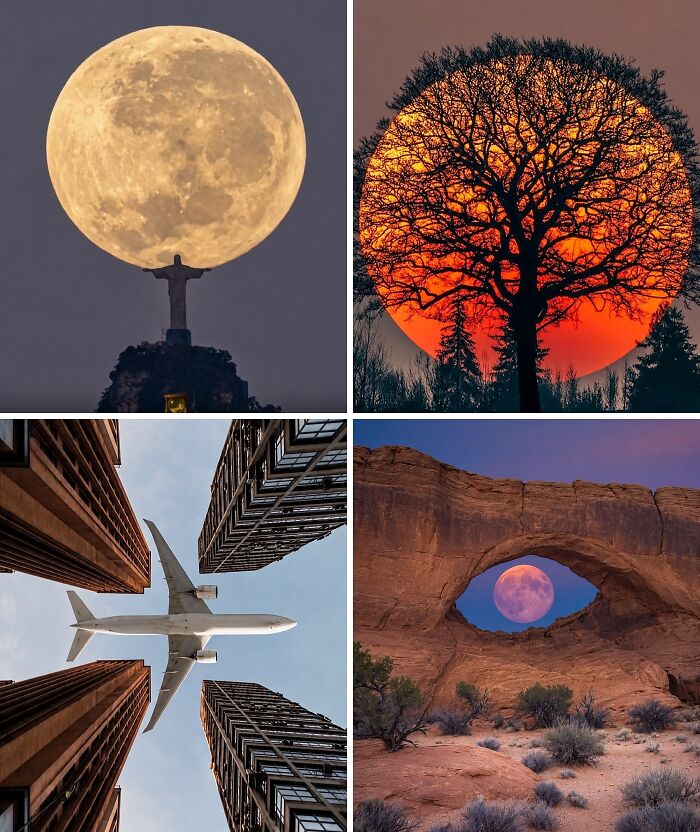
Image source: lostintimehistory
#21
A Facebook community called “People Who Sort of Look Like Adam Sandler but Aren’t Adam Sandler” collects photographs of ordinary people who bear a strange resemblance to the actor. Members submit strangers, relatives and even old family photographs, with some looking almost identical to Sandler and others only sharing his expression, hairstyle or relaxed clothing.
The page became popular in 2019 and attracted more than 200,000 followers, proving that there are far more accidental Adam Sandler lookalikes than anyone expected. The funniest posts are often the least obvious, showing people who somehow look like him despite having completely different ages or backgrounds.

Image source: lostintimehistory
#22
Several beloved actors from Home Alone are no longer with us, but their performances remain part of Christmas for millions. Catherine O’Hara, who played Kevin’s determined mother Kate, passed away in January 2026 aged 71. She left behind her husband Bo Welch, their two sons and a five-decade career that stretched from SCTV and Beetlejuice to her award-winning role as Moira Rose in Schitt’s Creek.
Brenda Fricker, remembered as the lonely Pigeon Lady who forms an unlikely friendship with Kevin in Home Alone 2, passed away in Dublin in July 2026 aged 81. She was also the first Irish woman to win an Academy Award, and colleagues remembered her as an irreplaceable performer whose warmth reached audiences around the world.
John Candy appeared for only a few minutes as Gus Polinski, but turned the kindly polka musician into one of the original film’s most loved characters. He passed away in 1994 aged just 43, leaving behind his wife Rosemary, their two children and films still watched by new generations. Friends and co-stars continued to remember him for his generosity and the kindness he showed both on and off screen.
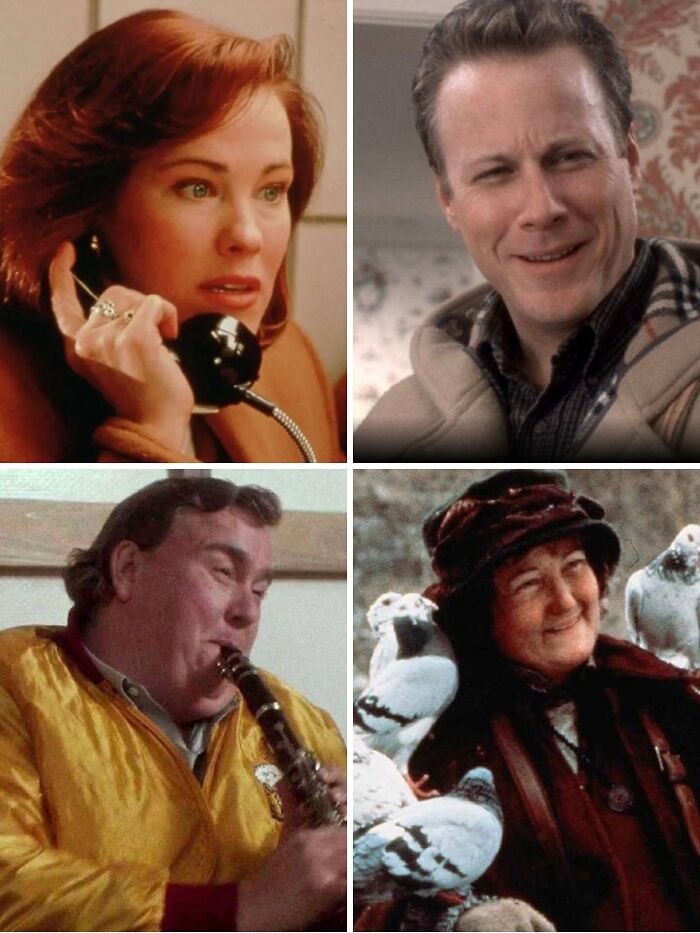
Image source: lostintimehistory
#23
In 1973, Japanese photographer Masahisa Fukase began photographing his wife, Yoko Wanibe, from their Tokyo apartment window as she left for work. In the early images she smiles, waves and performs for his camera, sometimes posing with umbrellas, costumes or exaggerated gestures. The photographs became the series From Window.
As the series continued, Yoko appeared increasingly distant in some of the photographs, leading viewers to describe it as Fukase accidentally capturing his wife falling out of love with him. That interpretation cannot be proven from facial expressions alone, but their marriage did end in 1976 after 12 years. Fukase later created his bleak series Ravens in the period following their separation.
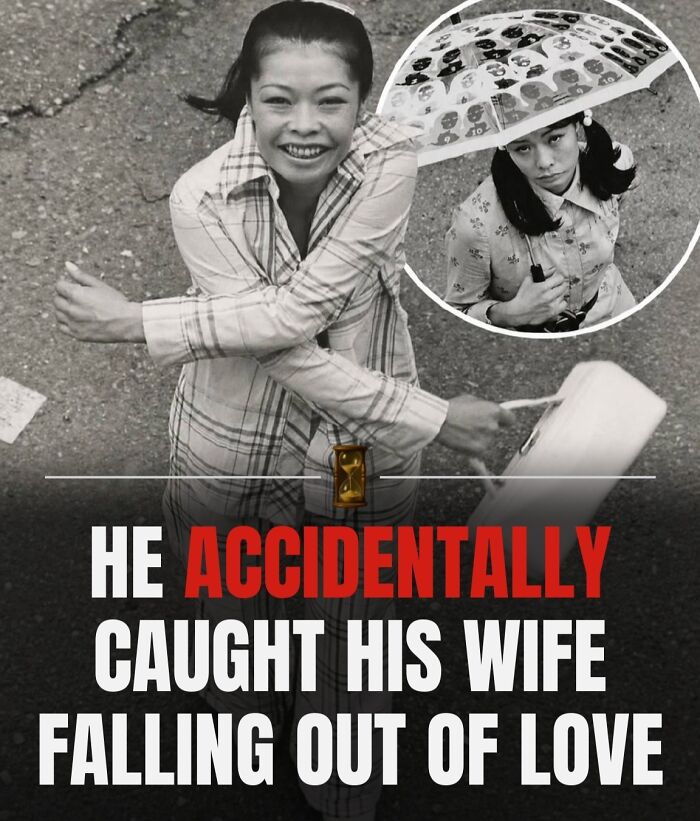
Image source: lostintimehistory
#24
For nearly a decade during the 1970s and 1980s, Chris Porsz spent his lunch breaks photographing everyday people on the streets of Peterborough, England. He captured ordinary moments—a couple holding hands, teenagers laughing, children playing, workers heading home—without knowing who most of them were. Decades later, he began an extraordinary project to track down the same people and recreate the photographs in exactly the same locations, often more than 30 or 40 years after the originals were taken.
Finding them became a story in itself. Using local newspapers, social media, and word of mouth, Porsz located hundreds of his original subjects, many of whom had completely forgotten the photographs existed. Some arrived with spouses, children, or even grandchildren who weren’t in the original image, while others recreated the same pose, hairstyle, or expression they had decades earlier. The before-and-after portraits became a striking record of how time changes people while familiar places often remain recognisable.
The project was published in books including Reunions and New Reunions, with many of the recreated images going viral around the world. Together, the photographs don’t just show people growing older—they capture friendships that lasted, relationships that endured, and moments that would otherwise have been lost forever, all recreated in the exact spot where they first happened.
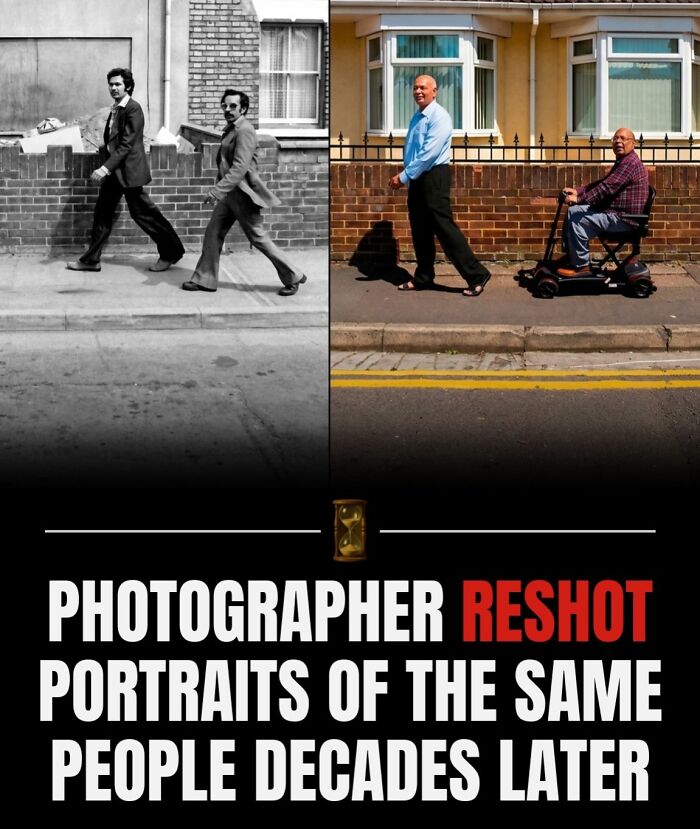
Image source: lostintimehistory
#25
Across the former Soviet Union, ordinary roadside bus stops were often built like miniature works of art. Some resembled spaceships, seashells or concrete sculptures, while others were covered in colourful mosaics showing local landscapes, animals and traditions. Because these small structures attracted less official attention than major buildings, designers were often able to experiment more freely.
Many stood alone beside remote roads in places such as Kazakhstan, Armenia, Ukraine and Uzbekistan, making their elaborate designs seem even more unexpected. No single style was used across the Soviet Union, so each region created shelters that reflected its own culture and surroundings.
Canadian photographer Christopher Herwig first noticed them during a long-distance cycling trip in 2002. He later travelled more than 50,000 kilometres across the former Soviet republics documenting hundreds of these unusual structures before more were altered, abandoned or lost.
Credit: @herwig_photo @soviet_busstops.
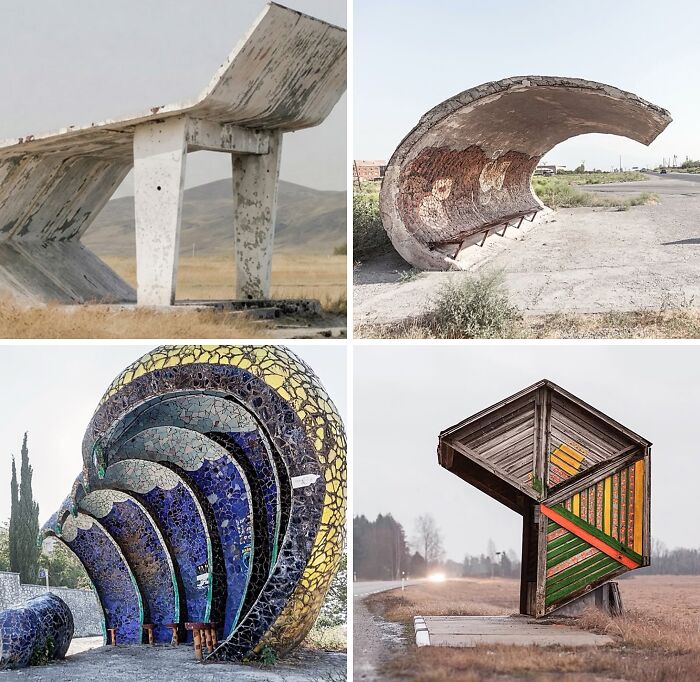
Image source: lostintimehistory
#26
Michael Jackson had a famously difficult relationship with his father, Joe Jackson, who managed the Jackson 5 when Michael was still a child. Michael later said his father was extremely strict during rehearsals and that simply seeing him could make him frightened. Despite their enormous success, Michael said those childhood experiences stayed with him throughout his life.
One detail Michael repeatedly spoke about was his appearance. He said his father would tease him about the size of his nose and call him “big nose” and “ugly.” Michael later described becoming deeply self-conscious about his face as a teenager, saying he would sometimes avoid looking at people because he believed he was unattractive.
Their relationship remained complicated as Michael grew older. He credited his father’s discipline with helping make the Jackson 5 successful, while also openly discussing how unhappy parts of his childhood had been. Joe later disputed some of Michael’s descriptions of his parenting, leaving very different accounts of what life inside the Jackson family had actually been like

Image source: lostintimehistory
#27
Despite painting more than 35 self-portraits, Vincent van Gogh (1853–1890) has only one widely accepted surviving photographic portrait. It was taken in January 1873, when he was just 19 years old, long before he became one of history’s most famous artists.
At the time, Van Gogh was working for an art dealership in The Hague, Netherlands. He had yet to begin his career as a painter, which only started several years later. In fact, almost all of the paintings that made him famous were created during the final decade of his life.
For decades, historians believed a second photograph showed Van Gogh as a 13-year-old boy. However, in 2018, researchers at the Van Gogh Museum discovered that it actually depicted his younger brother Theo. Van Gogh himself disliked being photographed, believing paintings captured people more meaningfully than photographs

Image source: lostintimehistory
#28
In 1960, Anita Ekberg was one of the most photographed women in the world. Fresh off La Dolce Vita, where she played a movie star surrounded by photographers, she soon found herself living the same story in real life.
After being followed through Rome and all the way back to her villa, Ekberg confronted the paparazzi waiting outside her home. She returned barefoot with a bow and arrows, reportedly demanding their photographs before the confrontation escalated.
The resulting images became an extraordinary document of the era that helped create modern paparazzi culture. The celebrity was supposed to be the prey, but this time, she fought back.
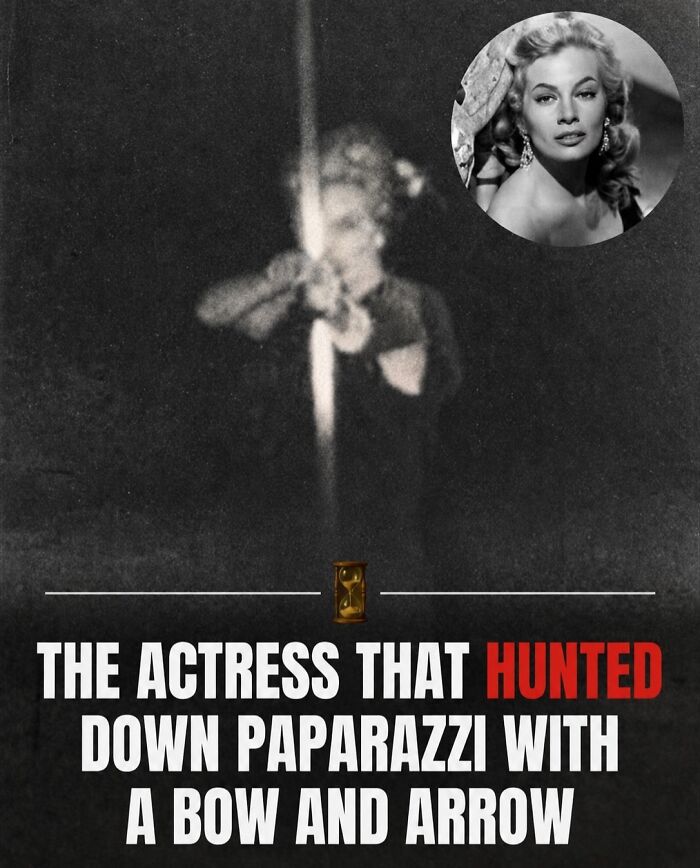
Image source: lostintimehistory
#29
He gave up sculpture after losing his wife. Then his children convinced him to return for one final piece.
William Wetmore Story (1819–1895) had been married to Emelyn Eldredge Story for more than 50 years when she passed away in January 1894. He was completely overwhelmed by the loss and stopped working. In a letter, he described Emelyn as his life, his joy and the person who had supported him in everything. His children eventually persuaded him that the most fitting memorial would be something created by his own hands.
Story returned to his studio in Rome and carved The Angel of Grief Weeping Over the Dismantled Altar of Life. Instead of showing a proud angel standing over the tomb, he created one almost collapsing onto it, with drooping wings, a hidden face and flowers falling from its hand. Story said the figure represented “utter abandonment,” making the sculpture feel less like a traditional monument and more like his own grief turned into marble.
It became the last major sculpture of his life. Story passed away the following year in 1895 and was buried beside Emelyn beneath the same angel he had carved for her. More than 130 years later, The Angel of Grief still stands in Rome’s Non-Catholic Cemetery and has become one of the most copied memorial sculptures in the world
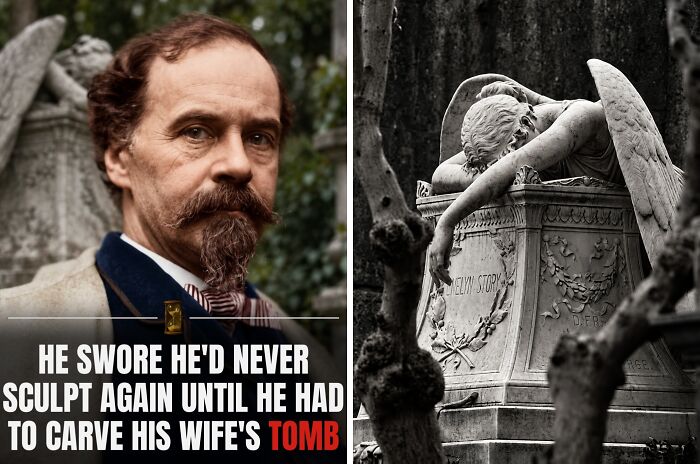
Image source: lostintimehistory
#30
Before becoming some of the most powerful people in the world, the last nine US presidents were ordinary children growing up in very different circumstances. Their childhoods span half a century, from Gerald Ford, born in 1913, to Barack Obama, born in 1961.
Interestingly, Gerald Ford wasn’t even born with that name. His original name was Leslie L***h King Jr., which was later changed following his mother’s remarriage. Jimmy Carter grew up on a Georgia peanut farm without electricity or indoor plumbing, while Ronald Reagan spent his teenage summers working as a lifeguard in Illinois, reportedly saving 77 people from drowning.
Bill Clinton’s father passed away in a car accident three months before he was born. Joe Biden struggled with a childhood stutter and practised speaking in front of a mirror to overcome it. Barack Obama spent several years growing up in Indonesia, while Donald Trump was raised in Queens, New York, before attending a military academy at just 13.
The collection also includes George H. W. Bush and his son George W. Bush, who grew up in Connecticut and Texas respectively. Together, these nine individuals have occupied the White House for more than five decades, with Trump becoming only the second president in American history to serve two non-consecutive terms.
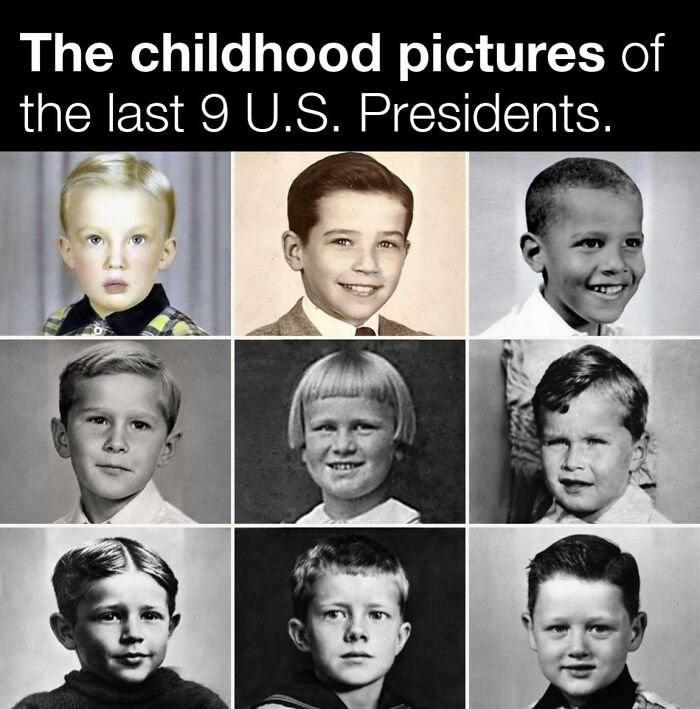
Image source: lostintimehistory
#31
On 6 October 2024, underwater photographer Rachel Moore captured an extraordinary close-up photograph of a humpback whale’s eye while swimming near the island of Mo’orea in French Polynesia.
The whale was a young female, estimated to be three or four years old, whom Moore affectionately named “Sweet Girl”. The two had first encountered each other the previous day, spending around ten minutes face to face in the water. When they met again, the curious whale approached Moore and positioned her enormous eye just inches from the camera.
For approximately five minutes, they maintained eye contact as the whale slowly moved around her. At one point, Sweet Girl rolled upside down, allowing the sunlight to illuminate her eye and reveal its remarkable blue colouring. Moore captured the moment using a Sony Alpha 1 camera, later explaining that the photograph required very little editing.
Sadly, just four days after the photograph was taken, Sweet Girl passed away following a collision with a fast-moving vessel near Tahiti. Moore subsequently used the image to raise awareness about the dangers posed by shipping traffic and to campaign for reduced vessel speeds during whale season
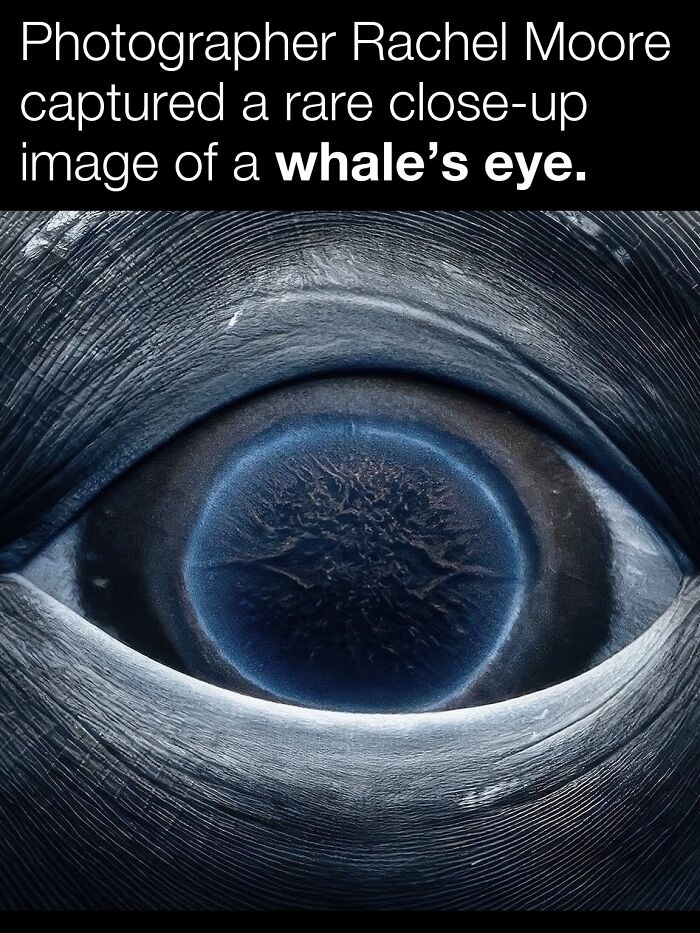
Image source: lostintimehistory
#32
In January 2015, a 68-year-old British man named Stan Beaton was brought to tears after hearing his late wife’s voice for the first time in weeks, thanks to the extraordinary efforts of 11 telecommunications engineers.
Stan’s wife, Ruby, had passed away from cancer in 2003, but he had preserved a recording of her voice on their home telephone’s answering service. Whenever he felt lonely or upset, he would listen to her familiar voice for comfort. He even refused to change telephone providers for over a decade because he feared losing the recording.
However, in December 2014, technical work by Virgin Media accidentally erased the message. Stan was devastated, believing he would never hear Ruby’s voice again. After learning about his situation, the company assembled a team of 11 engineers who spent three days searching through their systems to recover it. One executive described the task as being like searching for a needle in a haystack.
Remarkably, they succeeded. BBC Radio Leeds captured the emotional moment Stan heard the recording again, leaving him wiping away tears. He described it as a wonderful sound he had thought was lost forever. Virgin Media also arranged to provide him with a CD copy, ensuring he could keep the recording safely

Image source: lostintimehistory
#33
In the early 2000s, Saudi Arabia became famous for an underground driving culture known as hajwalah or tafheet. Young drivers would take ordinary cars onto wide highways, build up enormous speed and suddenly swing them from side to side while crowds watched from the roadside. The practice had existed since at least the late 1970s, but became especially visible as home videos, internet forums and later YouTube spread the footage far beyond Saudi Arabia.
Part of what made hajwalah so unusual was that many cars were not specially built drift cars. Drivers often used normal sedans and relied on long, wide roads around cities such as Riyadh to perform the slides. By the 2000s, the scene had developed its own famous drivers, videos and fan culture, turning something illegal into a recognisable youth subculture.
Authorities eventually introduced much tougher penalties and pushed drifting towards controlled tracks instead of public roads. What remains are thousands of photographs and low-quality videos from a period when Saudi Arabia had one of the strangest underground car cultures in the world.

Image source: lostintimehistory
#34
Tigers might look bright orange to humans, but to many of the animals they hunt, their fur appears much closer to green, allowing them to blend surprisingly well into the surrounding forest.
The reason comes down to how different animals see colour. Humans are trichromats, meaning our eyes have three types of colour-sensitive receptors that allow us to distinguish between red, green and blue. Deer and wild boars, two common prey animals for tigers, are dichromats, possessing only two types. This makes it much harder for them to distinguish orange from green.
In 2019, researchers at the University of Bristol investigated this phenomenon and found that a tiger’s orange coat provides remarkably effective camouflage when viewed through a dichromat’s visual system. The black stripes also help break up its outline among trees, grass and shadows, making it even harder to spot.
Interestingly, tigers cannot simply evolve green fur because mammals lack the biological mechanisms needed to produce green pigments in their hair. Fortunately for tigers, their orange colouring works remarkably well against the animals they’re trying to catch.
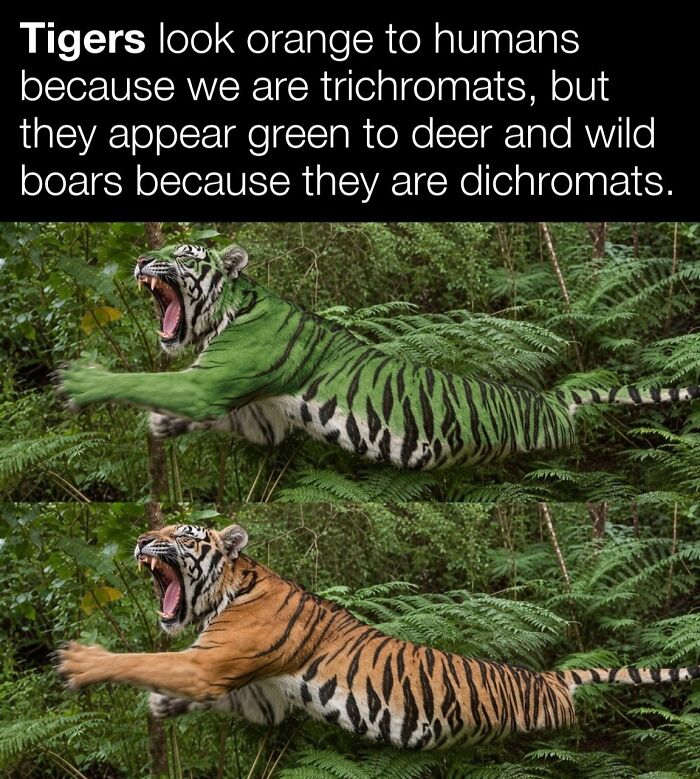
Image source: lostintimehistory
#35
Japanese immigration to Mexico began in 1897, when a group of settlers arrived in the southern state of Chiapas. Over the following decades, thousands more arrived, building farms, businesses and communities that combined Japanese traditions with Mexican culture.
One of these immigrants was Tsutomu Kasuga, pictured on the right, who arrived from Japan in 1930, aged just 20. He initially worked on a ranch before opening a successful shop with his wife, Mitsuko Osaka. However, during World War II, the Mexican government ordered Japanese families to relocate to Mexico City and Guadalajara. Despite local authorities defending the Kasuga family, they were forced to leave their home and business behind.
After relocating to Mexico City, Tsutomu supported his family by selling fruit and vegetables before rebuilding his business. His son, Carlos Kasuga Osaka, later became one of Mexico’s most successful Japanese-Mexican businessmen, helping establish Yakult Mexico and supporting Japanese cultural and educational institutions. Remarkably, his family’s business even helped manufacture the enormous Olympic rings released during the opening ceremony of the 1968 Mexico City Olympics.
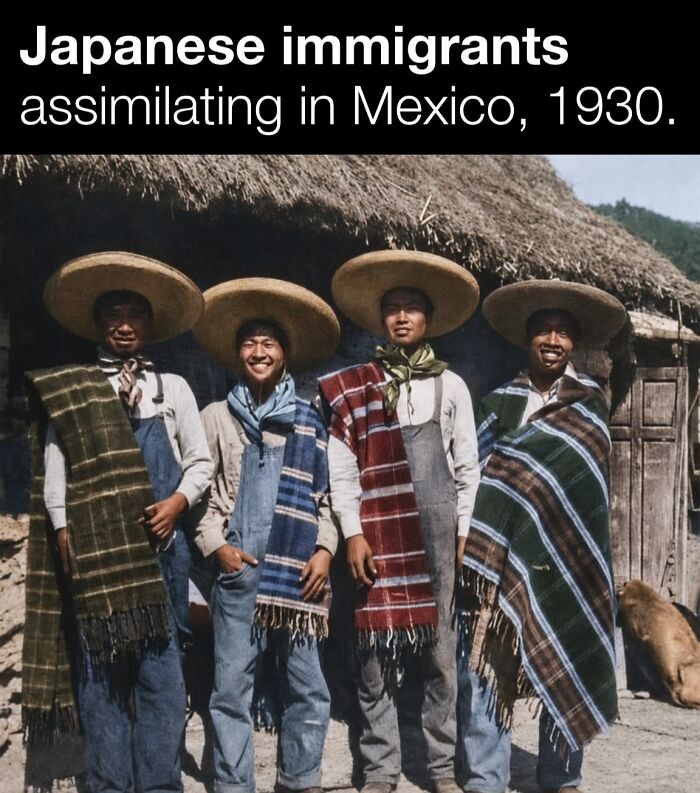
Image source: lostintimehistory
#36
How much of someone’s face can you change before you stop recognising them? Illustrator Connie Kang puts that idea to the test by transforming famous celebrities into completely different animals, yet somehow leaving just enough of each person behind that many are still instantly recognisable.
Kang had already become known for doing the opposite, studying photographs of animals and turning them into human characters. She looks beyond the animal itself, using its expression, posture, colours and personality to inspire everything from clothing to body language. Then a friend suggested she reverse the idea and turn celebrities into animals instead.
That is where these portraits become especially clever. A familiar sideways glance might become the eyes of a cat, someone’s posture can survive in an entirely different body, while hairstyles, outfits and expressions provide tiny clues to who you are looking at. Even after the human face disappears beneath fur, feathers and whiskers, your brain can often recognise the celebrity almost immediately.
Art by Connie Kang @kangyannan
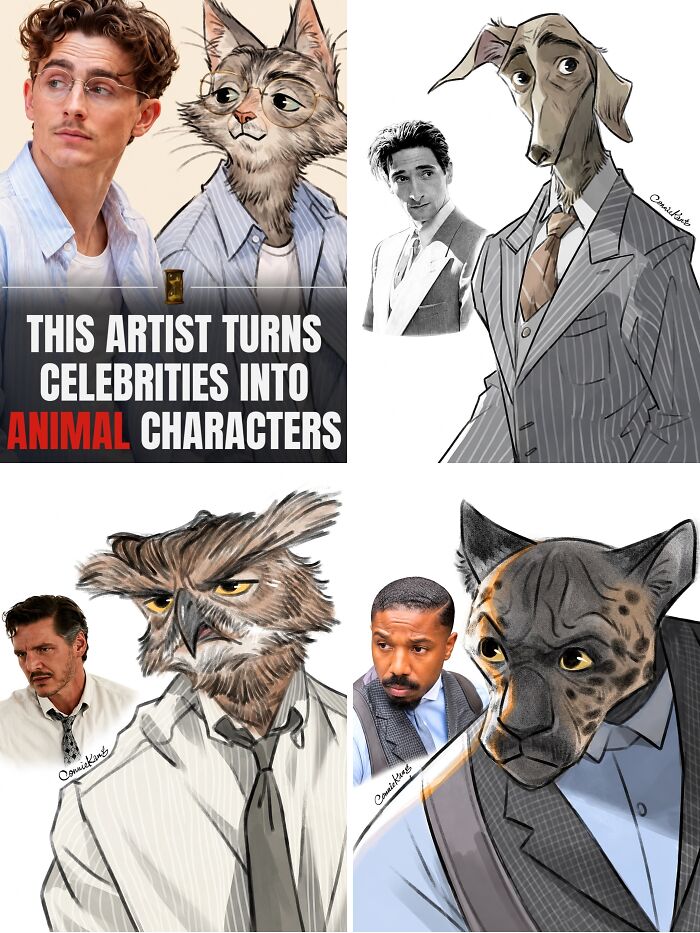
Image source: lostintimehistory
#37
In 2023, the story of Callixte Nzamwita, a 71-year-old man from Rwanda who claimed to have lived in isolation for 55 years because of his extreme fear of women, went viral. According to Nzamwita, he began avoiding women at just 16 years old and eventually built a wooden fence around his home to prevent anyone from approaching him.
Nzamwita lives in a small, one-room house where he spends most of his time alone. In an interview with Afrimax TV, he explained that being around women made him extremely frightened. His reported condition has been compared to gynophobia, an intense fear of women, although there is no publicly confirmed medical diagnosis.
Remarkably, despite his fear, women in his local community have helped him survive for decades. Neighbours explained that they regularly bring him food and other essentials, leaving them inside his fenced property without approaching him directly. His unusual living arrangements attracted international attention after his interview circulated online.
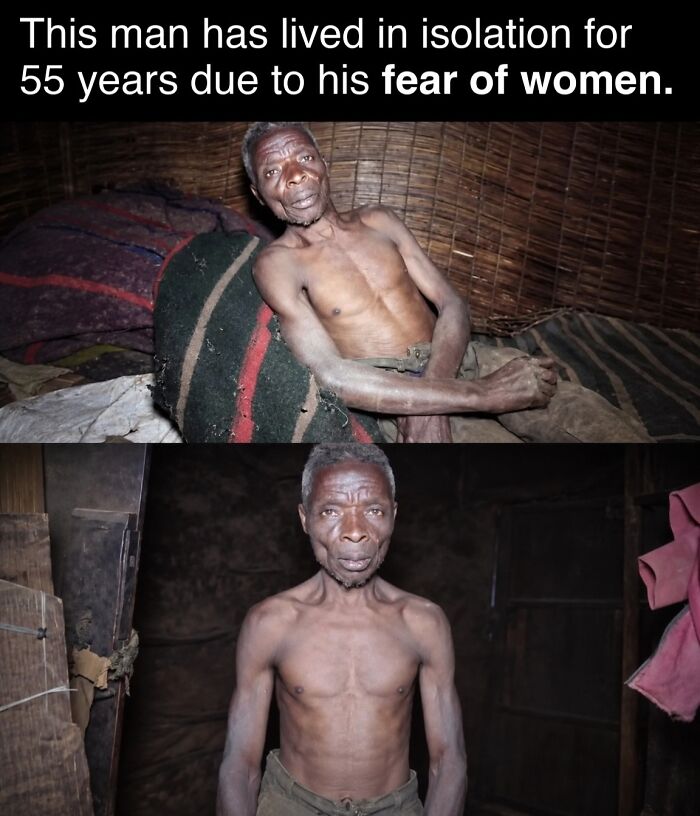
Image source: lostintimehistory
#38
The most iconic cheeks in jazz belonged to Dizzy Gillespie. When he played the trumpet, his cheeks ballooned to an extraordinary size because of his unique technique and decades of powerful playing. Doctors later studied his facial muscles, finding they had stretched so much that they behaved differently from almost any other trumpet player’s. Combined with his famously bent trumpet, his appearance became one of the most recognisable images in music history.
One of the biggest names in jazz, Louis Armstrong, was given his first trumpet while living in a juvenile detention home after being arrested at the age of 11 for firing his stepfather’s pistol into the air on New Year’s Eve. It was there that he joined the home’s band, discovered his talent for music, and began the journey that would eventually make him one of the most influential musicians of the 20th century.

Image source: lostintimehistory
#39
Some of cinema’s most memorable shots were shaped by paintings made decades or even centuries earlier. Sometimes the connection was deliberate, while other examples are striking visual parallels created through the same pose, lighting or composition.
A few are especially direct. Django’s bright blue suit was based on Thomas Gainsborough’s The Blue Boy after costume designer Sharen Davis slipped the painting into Quentin Tarantino’s research book. Shirley: Visions of Reality goes even further, building its story around 13 recreated Edward Hopper paintings. In Akira Kurosawa’s Dreams, the main character actually walks through the landscapes of Vincent van Gogh, with Martin Scorsese appearing as Van Gogh himself.
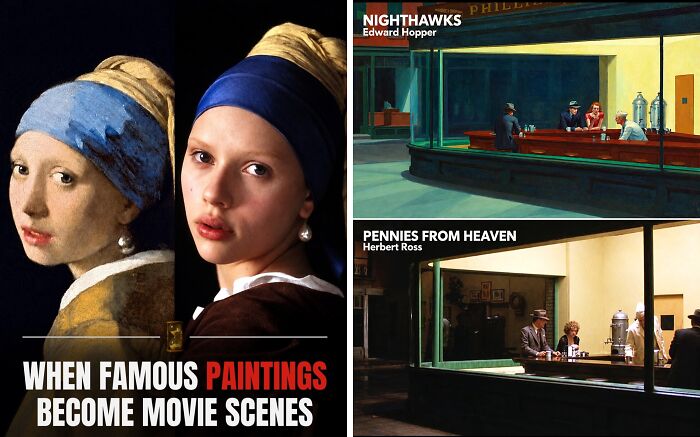
Image source: lostintimehistory
#40
In 1551, the Ottoman scientist Taqi al-Din described a device that functioned as an early steam turbine, more than two centuries before the Industrial Revolution.
His design used a small boiler to produce steam. The steam was directed through a narrow nozzle onto the blades of a wheel, causing it to spin. That wheel was mechanically connected to a roasting spit, allowing meat to rotate over a fire without anyone having to turn it by hand.
What makes the invention remarkable is its practical use of thermal energy to create rotational mechanical energy. Rather than treating steam as a curiosity or using it only in a simple experiment, Taqi al-Din applied it to an everyday task: automating the preparation of food.
The device was described in his book The Sublime Methods of Spiritual Machines, which also covered water-raising machines, clocks and other mechanical systems.
Taqi al-Din’s steam-powered spit formed part of a broader tradition of Ottoman engineering. He also designed astronomical instruments and mechanical clocks, and later became the Ottoman sultan’s chief astronomer. In 1577, he established an observatory in Istanbul, where he used advanced instruments to improve astronomical observations.
Follow @lostintimehistory for more!
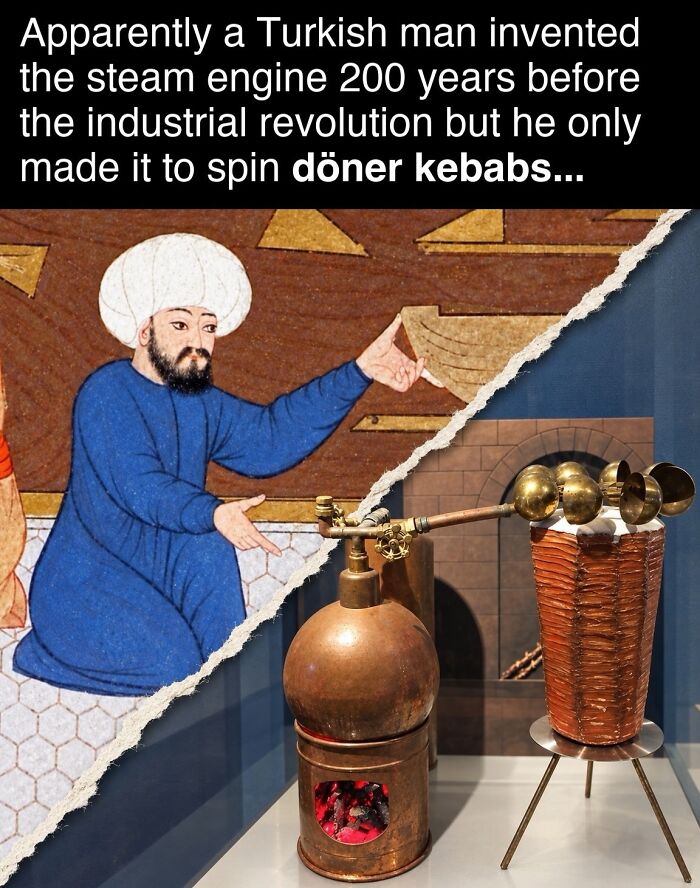
Image source: lostintimehistory
#41
French anime artist Thomas Romain spent years designing worlds for series including Space Dandy, Basquash! and Aria, but some of his strangest characters began with drawings made by his own children. One day, a sketch by one of his sons caught his attention so strongly that he decided to redraw it professionally without changing the original idea.
That became the Father & Sons Design Workshop. His sons invent creatures, robots and characters with almost no restrictions, then Romain turns their rough drawings into detailed anime designs. The two boys even developed completely different styles: one was heavily inspired by video games, while the younger often turned everyday objects like clocks, boomerangs and plants into characters.
What started as something they did together at home eventually grew into books, videos and a huge online audience. Romain has said the project also helped encourage his sons to keep drawing, with his eldest becoming interested in animation himself. A professional career built around designing imaginary worlds ended up giving him some of its best ideas from the two people drawing beside him at home.
Credit: @thomasintokyo
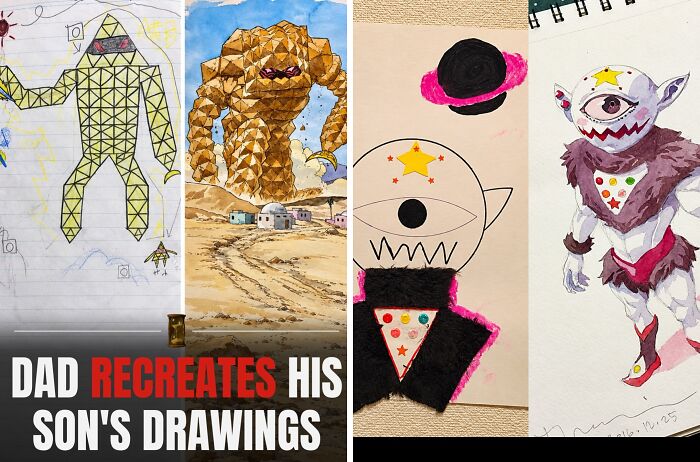
Image source: lostintimehistory
#42
These two birds look like they belong to completely different worlds, yet they’re actually members of the same family. The razorbill (left) and crested auklet (right) both belong to the Alcidae family, a group of seabirds that also includes puffins.
The razorbill lives in the North Atlantic, where its sleek black-and-white feathers, sharp beak and distinctive white facial markings give it a rather intimidating appearance. It spends much of its life at sea, using its wings to propel itself underwater while hunting small fish.
The crested auklet, meanwhile, lives in the North Pacific and looks considerably more unusual. Its bright orange beak, pale eyes and ridiculous forward-curling hairstyle are all part of its breeding-season appearance. The longer feather crests are particularly important during courtship, helping birds attract potential partners.
Even stranger, crested auklets naturally produce a scent resembling tangerines. During courtship, pairs rub against each other’s scented feathers, apparently using smell as part of their social interactions. Once the breeding season ends, their bright beaks become duller, their crests shrink and their white facial plumes disappear.
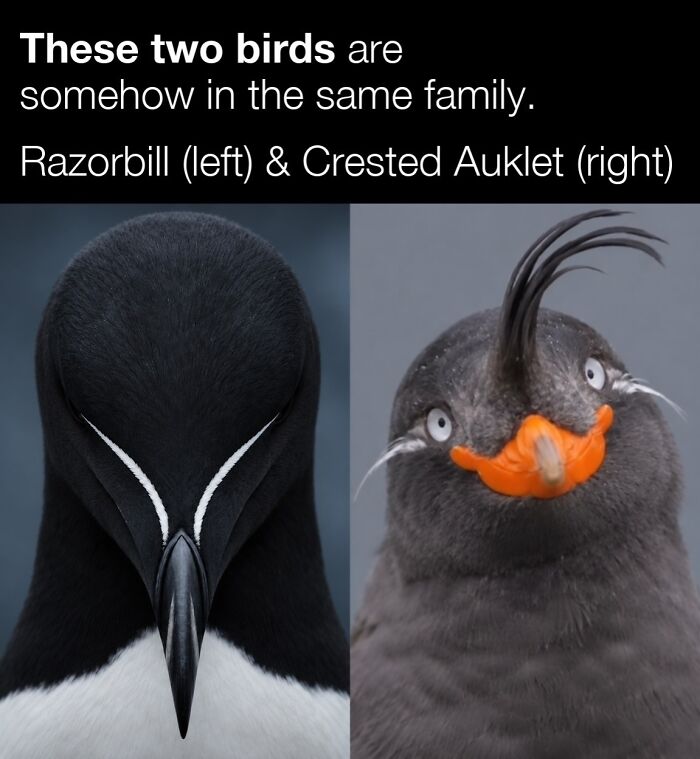
Image source: lostintimehistory
#43
On June 15, 2025, wildlife photographer Sha Lu captured an extraordinary photograph in Mountain View, California, showing a white-tailed kite flying through the air with a vole clutched in its talons. Remarkably, the tiny rodent appeared to be staring directly into the camera with a look of absolute terror.
The photograph was taken as an adult kite prepared to pass its prey to one of its offspring in mid-air. Lu had spent years photographing these food exchanges, but initially thought he had missed the perfect shot because the bird was facing away from him.
It was only when reviewing the photographs afterwards that he noticed the vole’s unforgettable expression. The image quickly went viral, with people comparing it to a scene straight out of an animated film.
Sha Lu (@shaluwtk)
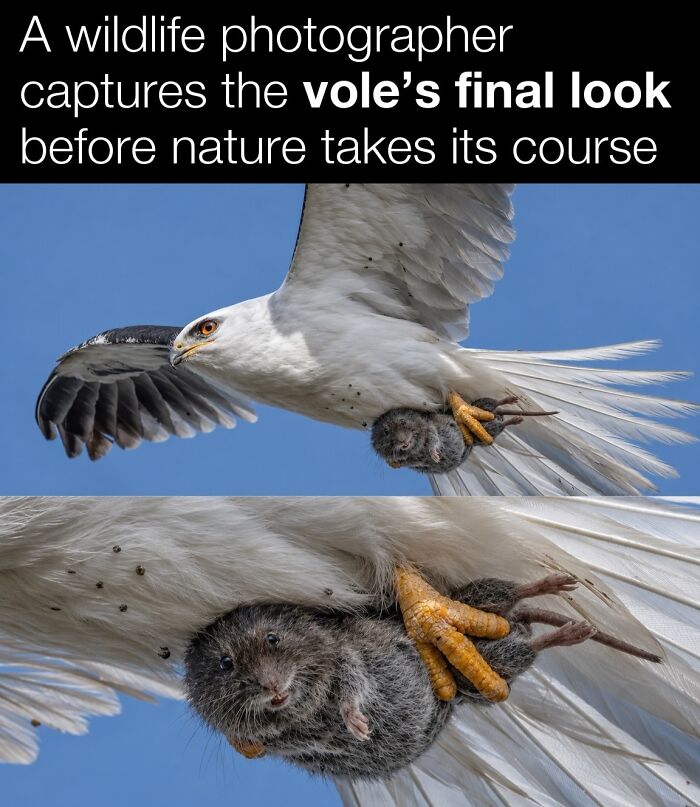
Image source: lostintimehistory
#44
Most people see shapes in clouds for a few seconds before they disappear. Artist Vorja Sánchez takes those imagined creatures and makes them visible.
While walking through forests and landscapes, Sánchez photographs moments when clouds, mist, trees and water seem to suggest something alive. He then draws directly over the photograph, following shapes that were already there. A curling cloud becomes the body of a serpent, mist develops eyes and limbs, and an ordinary landscape suddenly appears to contain enormous spirits hiding in plain sight.
The series is fittingly called Interventions. Sánchez has explained that he tries to find the soul of each landscape rather than simply placing a creature into it. That is what makes the images so convincing. Look back at the original photograph and the monster suddenly feels as though it had been hiding there all along, waiting for someone to notice it.
Artist: @vorjailustracion
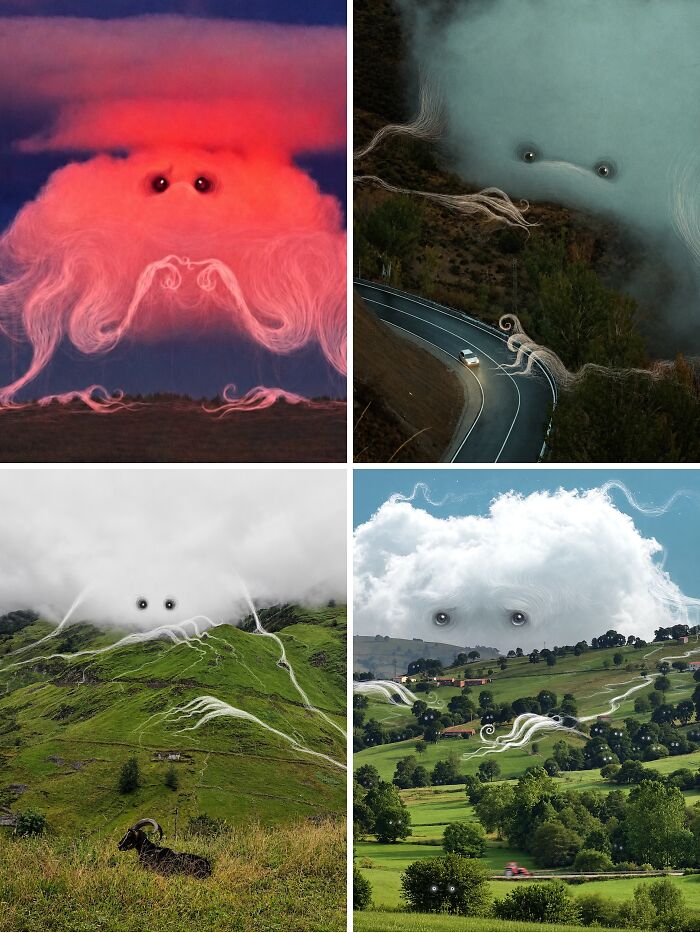
Image source: lostintimehistory
#45
During the Second World War, some women in occupied France formed relationships with German soldiers, and private photographs captured women posing in borrowed military uniforms. Oversized jackets, caps and boots became part of these personal snapshots taken during the occupation.
German forces occupied Paris in June 1940, beginning four years in which military personnel became part of everyday life across the city. Relationships developed under very different circumstances, from personal attachments to arrangements shaped by money, food shortages and the unequal power of occupation.
After liberation, women accused of relationships with Germans could face public punishment. Historians estimate that around 20,000 French women had their heads shaved during the purges of 1944–45, often without a trial.
Some were targeted for romantic relationships, while others were accused over different connections, including work undertaken for the occupying forces. These punishments became some of the most photographed scenes of the liberation, with women paraded through streets before crowds
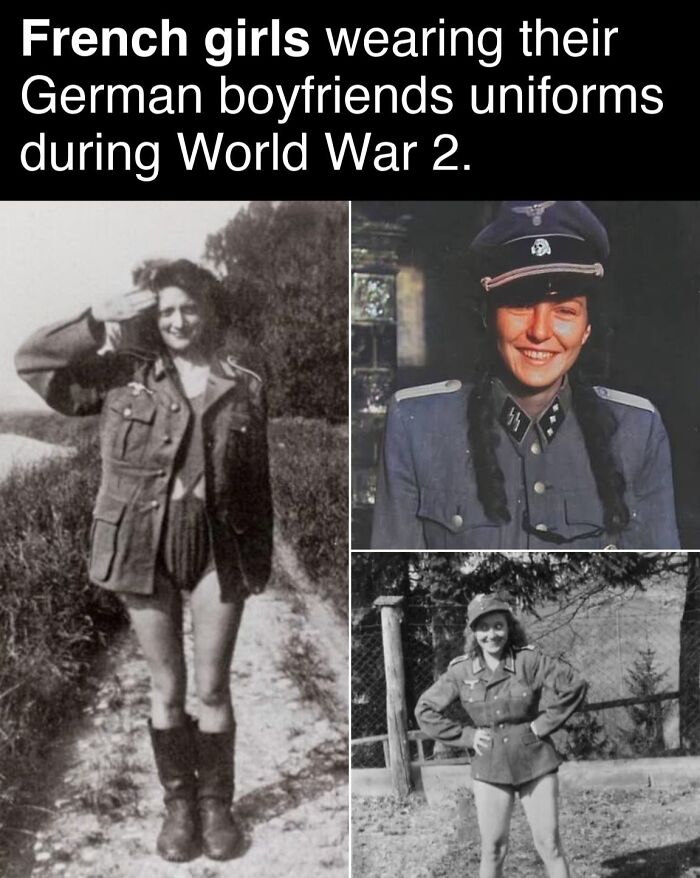
Image source: lostintimehistory
#46
“Oko” by Marko Popadić shows a butterfly inside the empty eye socket of a human skull. Its wing marking aligns so perfectly with the cavity that it creates the eerie illusion of an eyeball staring back at the viewer.
Created using coloured infrared photography, the image brings together two powerful symbols: a skull representing mortality and a butterfly representing rebirth and transformation. Their contrast makes it feel as though life has briefly returned to the skull.
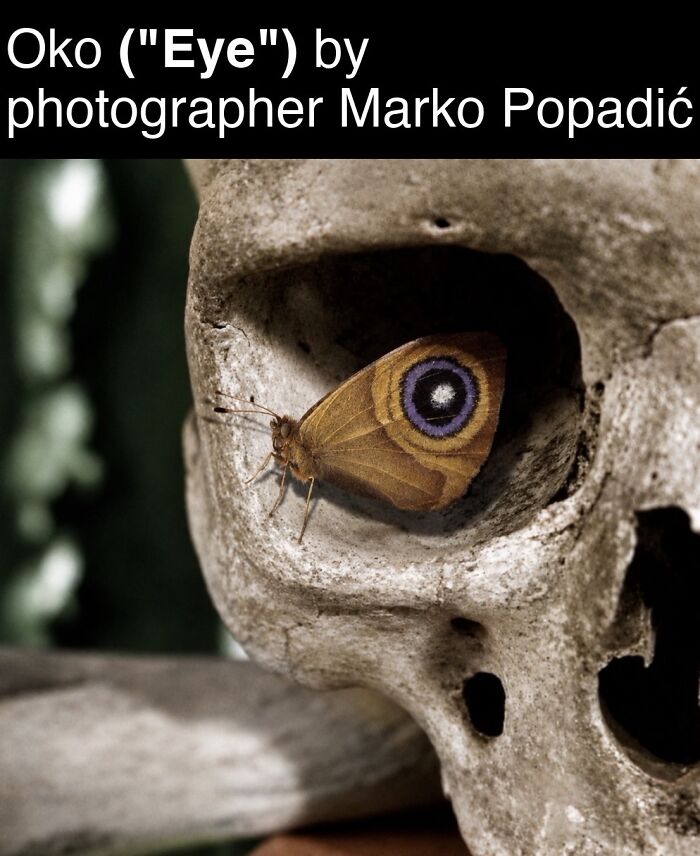
Image source: lostintimehistory
#47
Laetitia Ky is an Ivorian artist who transforms her own hair into striking sculptures using braids, wire and careful shaping. Her creations can form people, animals, symbols and entire scenes, often exploring African culture, identity, feminism and freedom.
The idea began after Ky discovered old photographs of African women wearing elaborate pre-colonial hairstyles. She realised many of these styles had once carried deep meaning but had been largely forgotten or overlooked.
Across different African societies, hairstyles could reveal someone’s age, marital status, social position, ethnicity or beliefs. Ky reimagines that history in a modern way, turning her own hair into a living form of art that connects the present with the past.
Artist: @lae
Follow @lostintimehistory for more!
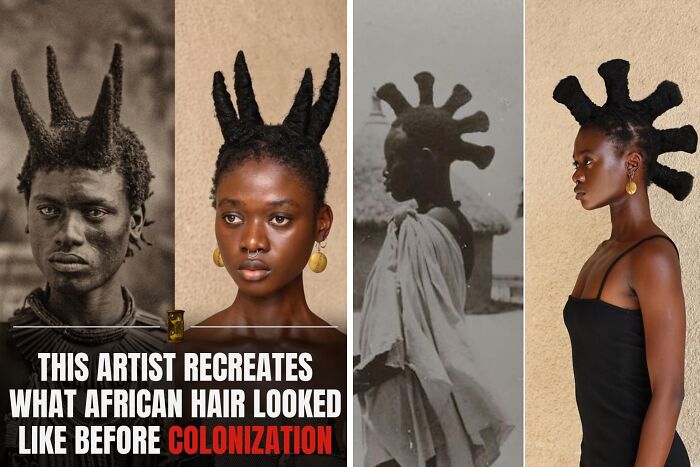
Image source: lostintimehistory
#48
When the FBI hired a hitman to do its dirty work
In 1966, the FBI was struggling to break the Klan’s grip on Mississippi. Civil rights leaders were being violently targeted, yet every legal attempt to catch those responsible had failed.
One of the victims was Vernon Dahmer, a farmer and NAACP leader who allowed Black residents to register to vote at his store. After Klansmen firebombed his home during the night, Dahmer lost his life and investigators were left with no solid leads.
With nowhere else to turn, the FBI reportedly tried something far more unconventional.
They called Gregory Scarpa, an infamous Colombo family hitman who had secretly worked as an FBI informant since 1962. Known as the “Grim Reaper,” Scarpa claimed he had stopped counting his victims after 50.
Scarpa was flown to Mississippi and briefed on the case. He reportedly entered a Klansman’s TV shop, bought a television and asked the man to help load it. Scarpa then took him into the woods.
Weeks later, the Klansman signed a 22-page confession that finally broke the case open.
The story has now inspired the film By Any Means, arriving September 4 and starring Mark Wahlberg as Gregory Scarpa alongside Yahya Abdul-Mateen II as the FBI agent partnered with him.

Image source: lostintimehistory
#49
TIME’s famous “World’s Most Interesting Magazine” campaign began in 1996 with a brilliantly simple idea. Its instantly recognisable red cover border was reduced to a small box and placed around one revealing detail in a photograph—suggesting that even the smallest part of an image could contain an entire story.
More than 50 different adverts were eventually created. After Mike Tyson bit Evander Holyfield’s ear during their infamous 1997 rematch, TIME needed only to frame Holyfield’s ear for viewers to understand the reference. Another advert highlighted the gorilla that protected a three-year-old boy after he fell into its enclosure, presenting the remarkable moment as proof that the world could still surprise and inspire us.
Perhaps the campaign’s cleverest advert appeared during the Monica Lewinsky scandal. Rather than explaining the controversy, TIME simply placed its red frame around Bill Clinton visibly sweating. The audience already knew the story; the photograph only had to capture the pressure surrounding it.

Image source: lostintimehistory
#50
Robert De Niro’s changing appearance over the decades is a striking example of how our ears continue to get larger as we age, even after the rest of our body has stopped growing.
In 1995, a study published in the British Medical Journal examined the ears of 206 people aged between 30 and 93. Researchers discovered that ear length increased by an average of 0.22 millimetres per year. That might sound tiny, but over 50 years, it adds up to approximately 1.1 centimetres.
The change happens partly because the cartilage and surrounding tissues gradually lose their elasticity as we age. Gravity also stretches the earlobes over time, while changes in facial fat can make the ears appear even more prominent. Unlike most parts of the body, these changes can continue well into old age.
Interestingly, a larger study published in 2007, involving 1,353 people, confirmed that ears tend to become longer and wider with age, although the exact rate varies between individuals.
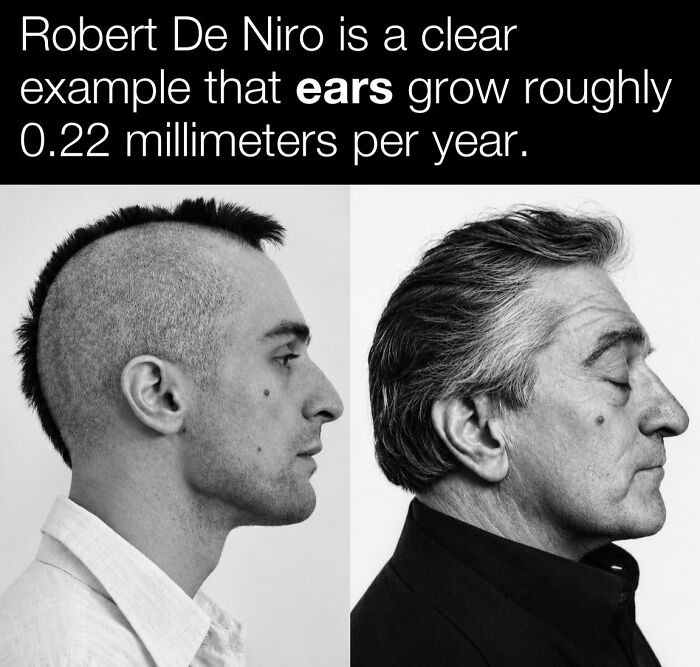
Image source: lostintimehistory
#51
Steve Greig never expected that the passing of his beloved dog, Wolfgang, would completely change his life. After struggling with grief for months, he decided the best way to honour his companion was to visit a local shelter and ask for the dog nobody else wanted. Shelter staff introduced him to Eeyore, a 12-year-old Chihuahua with a heart murmur and four bad knees—an elderly dog who had little chance of being adopted.
Bringing Eeyore home became the start of something much bigger. Steve began adopting senior dogs with medical conditions and disabilities that were often overlooked in shelters, saying each one deserved to spend its final years in a loving home. Over time, his family grew to include not only elderly dogs, but also rescued cats, a pig named Bikini, a turkey named Cranberry, and other animals, each with their own special needs and daily routines.
Today, Steve’s home has become a sanctuary for animals that many people would have passed by. He prepares individual meals, medications, and care plans every day, and whenever one of his rescued dogs passes away, he honours them by giving another overlooked animal the same second chance. His story has inspired millions of people around the world to see senior pets not as the ones left behind, but as companions still full of love to give.
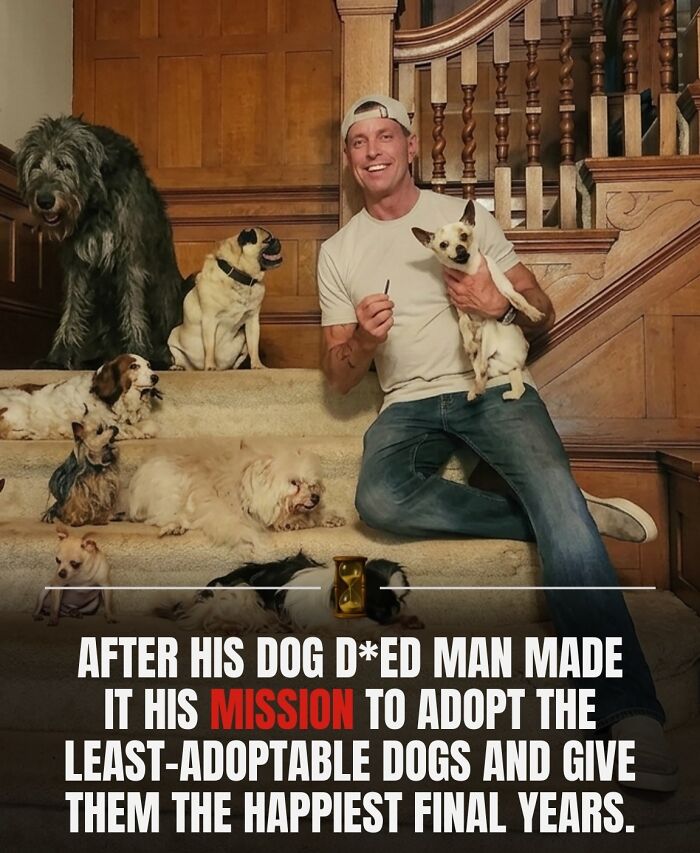
Image source: lostintimehistory
#52
Around the turn of the 20th century, artists were fascinated by what everyday life might look like in the future. One of the most imaginative collections was the French En L’An 2000 series, which pictured people living beneath giant glass domes on the Moon, entire cities protected by enormous transparent shields, and families making face-to-face calls through wall-mounted screens decades before television—or even video calling—existed. Many of the illustrations were created as postcards for the 1900 Paris Exposition, offering a surprisingly optimistic vision of the centuries ahead.
Other predictions imagined technology transforming daily life in unexpected ways. One 1910 illustration showed schoolchildren wearing helmets while books were fed into a machine that supposedly transferred knowledge directly into their brains. Another imagined personal air conditioning units people could carry onto trains, while engineers were pictured preserving food indefinitely using massive electrical discharges instead of refrigerators. Although none of these inventions appeared exactly as imagined, they reflected a growing belief that science would solve almost every problem.
Transportation was perhaps where imaginations ran wildest. Artists drew tiny single-person bubble cars replacing traditional automobiles, enormous flying boats carrying entire floating hotels across oceans, highways lined with rolling spherical homes, and cities linked by layers of elevated skywalks and monorails. More than a century later, many of those predictions never arrived—but they remain a fascinating glimpse into how previous generations imagined the future we would eventually live in.
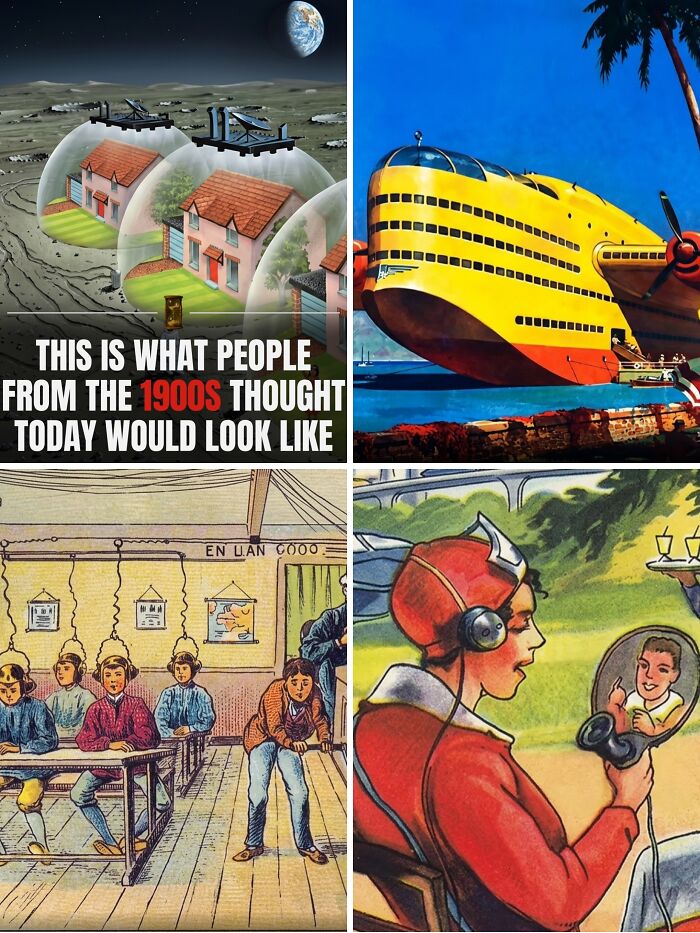
Image source: lostintimehistory
#53
Historic cities often treated everyday objects as works of art. Street clocks, fountains, bridges, doors and lamp posts were designed with detailed carvings, decorative metalwork and craftsmanship meant to last for generations.
Modern cities usually prioritise cost, safety, accessibility, durability and easy maintenance. That often creates cleaner, simpler designs that work efficiently but can feel less distinctive.
The best future cities may combine both approaches: modern function without losing the beauty and character that made older streets memorable
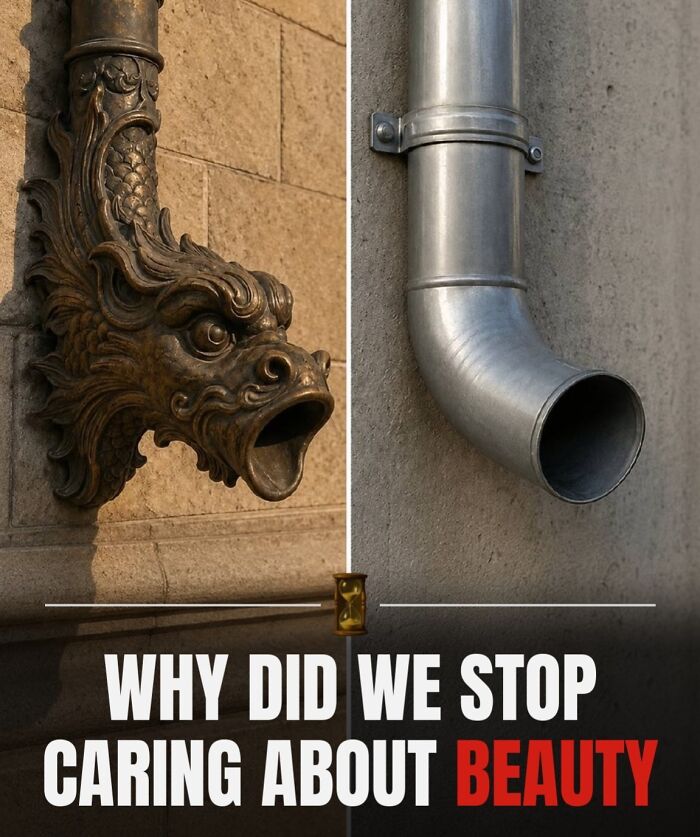
Image source: lostintimehistory
 Follow Us