The Federal Bureau of Investigation’s (FBI) newly released file on the infamous 1971 Northwest Orient Airlines Flight 305 hijacking reveals intriguing details about the perpetrator whom authorities were never able to catch.
The FBI refers to the case as one of its “greatest unsolved mysteries,” and the latest disclosure delves into one of the hundreds of suspects who could have posed as D.B. Cooper, the alias the hijacker used.
The suspect pursued by the FBI had significant flying experience, but those who knew him claimed he could not have committed the crime.
He received a $5,000 state grant in the late 1980s for an invention before passing away in 1989.
FBI files shed light on the pursuit of D.B. Cooper and the Maine native identified as a suspect
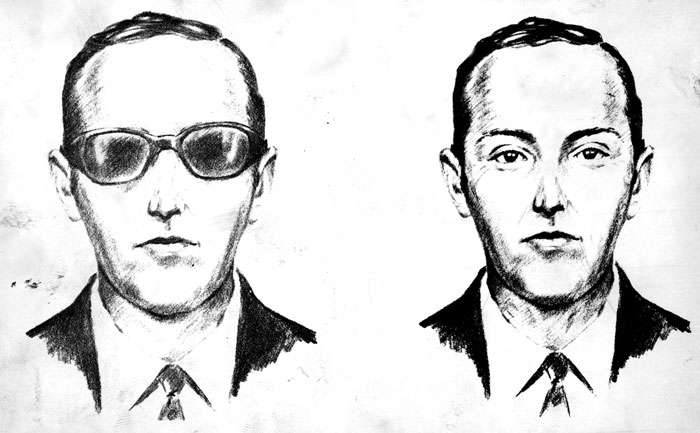
Image credits: FBI
Investigators spoke to a white male who was 5 feet 8 inches in height and weighed around 160 pounds, with graying brown hair and gray eyes, in 1972 to determine whether he was D.B. Cooper, the FBI files reveal.
The documents identify the figure as Raymond Sidney Russel, who also went by R. Sid Russell and Sid Russel. He was born in Maine in 1923.
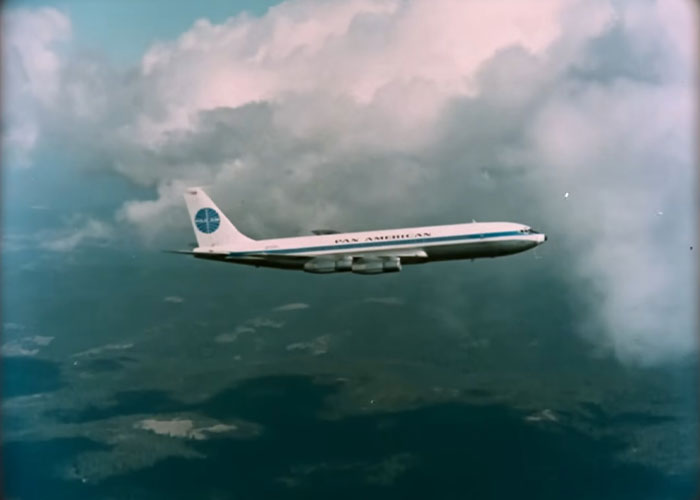
Image credits: Netflix
The files do not indicate how Russell caught the FBI’s attention, but they detail that he was an inspector for Boeing aircraft in 1947 and 1948, and that he used to fly with Flying Tiger Airlines out of Seattle until he quit in February 1963.
Russell also informed the FBI that he worked as an air traffic controller in Seattle for the Federal Aviation Administration, but said he had never been in a Boeing 727, the type of plane that was hijacked on its way from Portland, Oregon, to Seattle, Washington, thus denying his involvement in the incident.
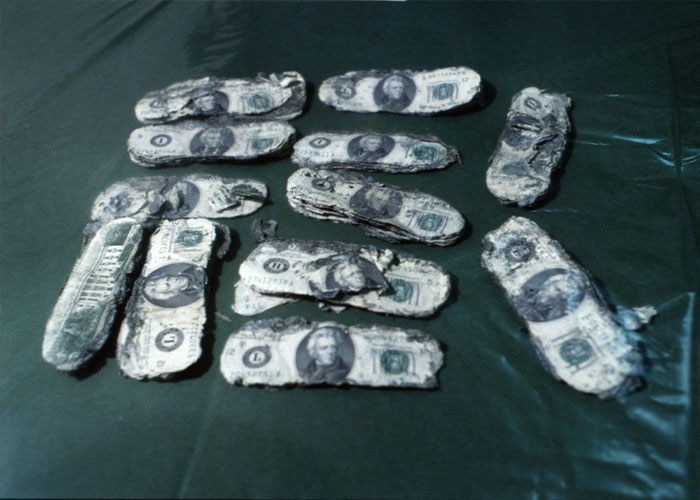
Image credits: Getty/Bettmann
Russell is noted in the files as a “top skier” and a former instructor of the sport, and he also had “alcoholism problems.”
Per FBI documents, a Russell acquaintance described him as a “nomad type who would take off at a moment’s notice to go anywhere.” However, they doubted he would have been involved in the plane hijacking, as he was a “very law-abiding” citizen.
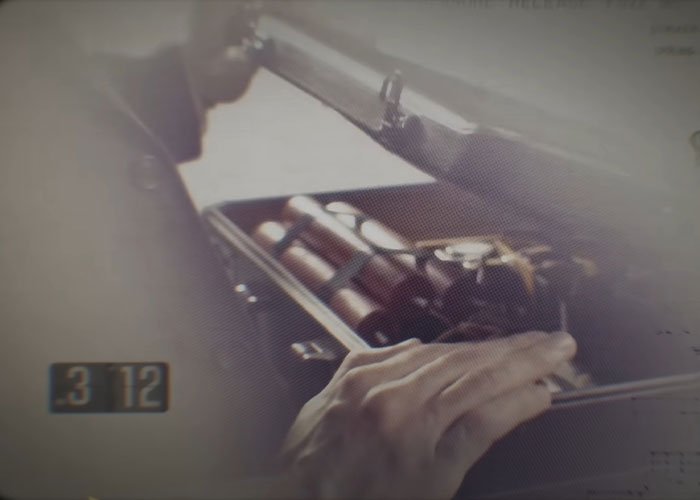
Image credits: Netflix
In a different interview with another Russell associate, FBI agents were told that while their suspect could “come up with the idea of hijacking a 727,” they could not “imagine him actually doing it.”
On a document dated November 1972, a handwritten note by the FBI read: “Eliminate Russell,” suggesting that the bureau dropped him as a suspect in the case.
Russell passed away years after his interview, but not before inventing a canoe portaging device with help from the local government.
The D.B. Cooper case has remained the only unsolved case of air piracy in U.S. commercial aviation history
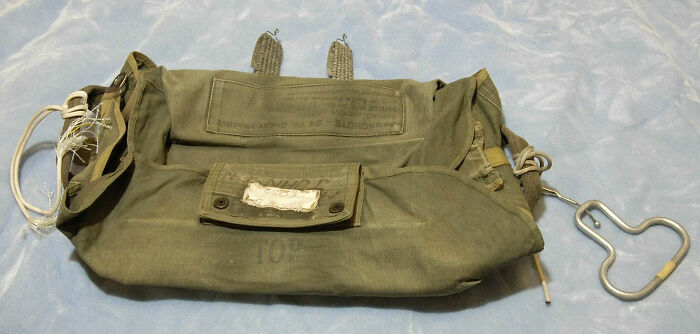
Image credits: FBI
D.B. Cooper bought a one-way ticket to Seattle on the day he executed the hijacking.
While the flight was waiting to take off, he reportedly ordered a drink, and after 3 p.m. local time, he handed a flight attendant a note stating he had explosives in his briefcase and that it would be best if she sat with him.
Once she sat down, Cooper showed her inside the case, which was laced with wires and red sticks, and told her to note down what he said.
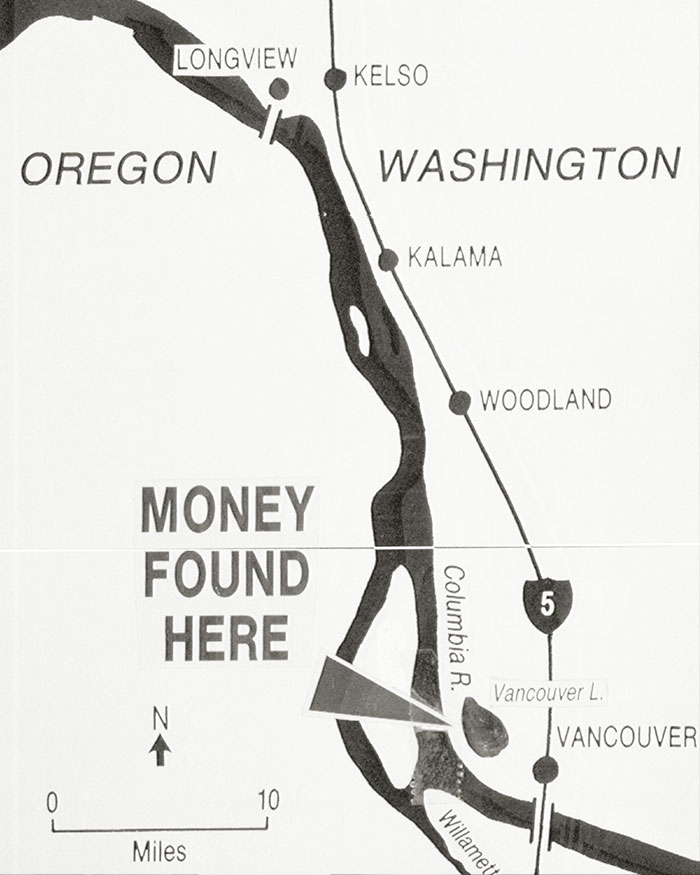
Image credits: Getty/Bettmann
The note, which, according to reports, detailed that Cooper wanted four parachutes and $200,000 in $20 bills — a sum equivalent to around $1.6 million today — was handed over to the pilot.
When the flight landed in Seattle, the hijacker let the 36 passengers off safely with his requests fulfilled. Keeping several crew members on board, the plane, under Cooper’s orders, then took off for Mexico City.
Somewhere between Seattle and Reno, Nevada, Cooper jumped out of the back of the plane with a parachute and the ransom money.
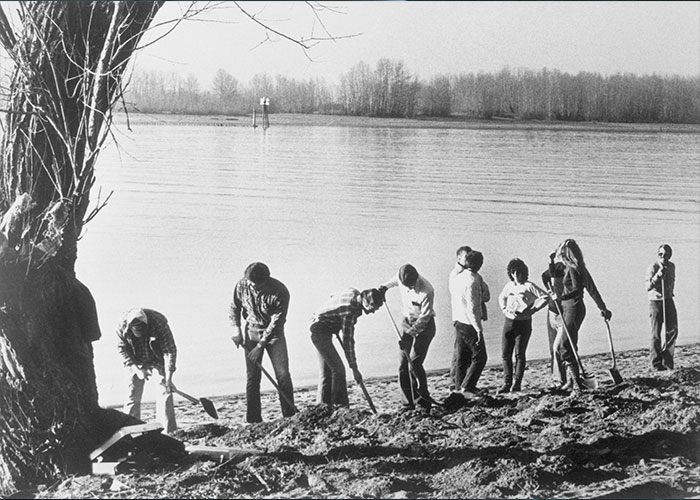
Image credits: Getty/Bettmann
Over the next two and a half decades, the FBI considered more than 800 suspects. The bureau ultimately suggested it could be that Cooper did not survive the landing.
In 1980, a young boy found a rotting package of $20 bills matching the ransom money’s serial numbers, along the Columbia River, marking the only physical evidence ever recovered in the case.
The lead, however, generated no new actionable information to identify Cooper, further fueling theories that he did not survive the jump.
Ryan Burns, a renowned analyst of the D.B. Cooper case, has reviewed the FBI’s latest release
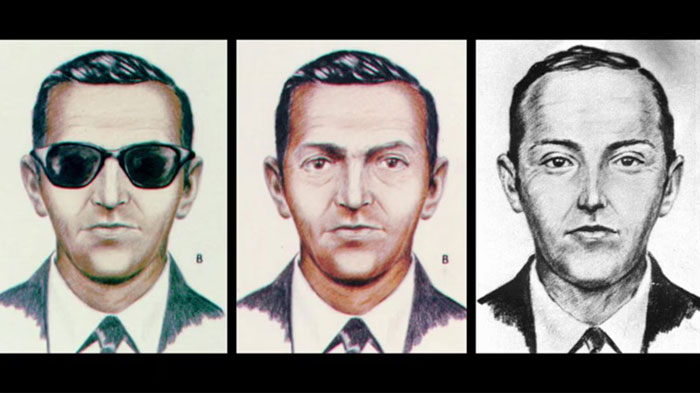
Image credits: FBI
Burns is a Mississippi-based criminal defense attorney who runs a YouTube channel called D.B. Cooper Sleuth.
“It’s kind of the coolest crime ever. This guy is wearing sunglasses, s**king cigarettes, and drinking bourbon in the back of a plane. And he got away with it,” Burns told the Portland Press Herald recently.
He said roughly two dozen people appear to have been investigated as seriously as Russell before stating that he does not believe Russell was the hijacker.
The expert based his theory on the differences between Russell’s physical characteristics and witness descriptions of Cooper.
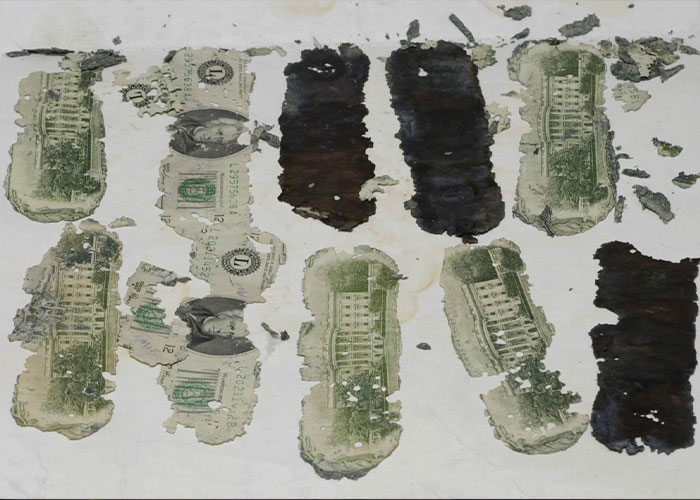
Image credits: https://www.fbi.gov/history/famous-cases/db-cooper-hijacking
He went on to note that, despite decades of investigation, he doubts the case will ever be solved. He, however, said that no one in this world “wants it solved more than I do, given all the effort I put into it.”
Burns, according to the outlet, plans to release his own book on the case and has interviewed several of the plane’s passengers for it.
“I think about this all the time,” a netizen said about the case











 Follow Us