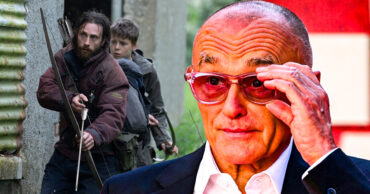
Many are speculating that One Battle After Another could earn Sean Penn his sixth Oscar nomination. Since 1995, the renowned thespian has been a favourite with the Academy, being nominated for both Best Actor and Best Supporting Actor. Two out of five times, he rose triumphant.
Across his time in the industry, he has proven to be one of the most diverse actors of his generation and perhaps of all time. Every nomination reflects this, with no role being like the last. So, let’s break down every Oscar-nominated Sean Penn movie, from lauded to legendary.
5. I Am Sam (2001)
I Am Sam may be the most challenging role Sean Penn has ever taken on. Playing the title character, Penn brings forth immense vulnerability, passion, resilience, and charm as the intellectually disabled man battling an unjust system. The plot centres on Sam as he fights for custody of his 7-year-old daughter Lucy, played by Dakota Fanning in a role that showcased her talent early on. However, the story is much more than your simple tale of a man trying to connect with his estranged offspring – it showcases a man fighting for his own rights and for those in a similar situation to himself.
Along the way, Sam teaches valuable life lessons to those he comes across, namely his cold-hearted lawyer. Although the film is engulfed with a heavy them that is utterly heart-wrenching, Penn uplifts the sombre tone with humour, often in unexpected places. I Am Sam was snubbed for the most part come awards season, however, Sean Penn landed a nomination for Best Actor at the Academy Awards.
4. Sweet and Lowdown (1999)
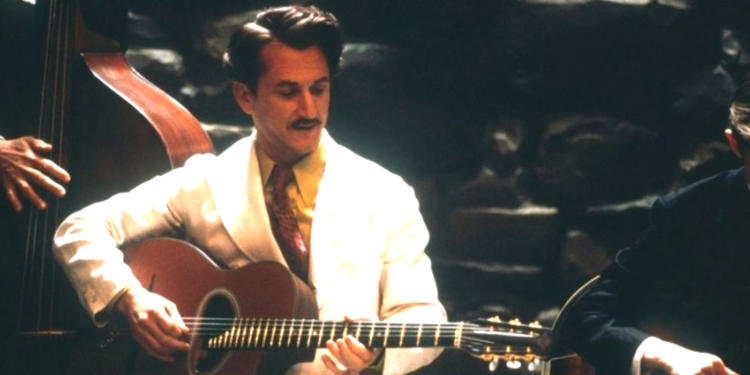
Written and directed by Woody Allen, Sweet and Lowdown is unique movie jam-packed with some of cinema’s most respected thespians. Sean Penn shares the screen with the likes of Uma Thurman, Samantha Morton, and Anthony LaPaglia to tell the tale of jazz guitarist Emmet Ray (Penn). Amongst such an impressive ensemble, Penn’s character occupies the very heart of the story, following his career in the early 30s as he squares off with gangsters and falls in love with a mute woman named Hattie (played by Samantha Morton).
At the time of its release, many struggled to get on board with Allen’s creative choice to shoot the movie like a documentary. However, once that aspect is established, the film begins to feel like a biopic about a real-life musician as opposed to a goofy mockumentary. For Penn, it’s a tour-de-force performance that sees him transcend from an obnoxious, self-centred man-child wrestling with dwindling fame, to a man reflecting on his past behaviours as Hattie opens up love in his heart. What makes their on-screen dynamic so sizzling is how without words coming out of Morton’s mouth, we feel the intense connection between them. With that said, it’s easy to see why they both landed Oscar nominations that year.
3. Milk (2008) – Winning Role

Milk serves as another tour-de-force performance from Sean Penn, as although he was surrounded by top-tier actors, he truly stole the show, leading to his second-ever Oscar win for Best Actor in a Leading Role. Gus Van Sant‘s moving biopic explores the complex life of American gay activist Harvey Milk (Penn), a man who fought for gay rights and was elected as California’s first openly gay official. Penn shared the screen with Josh Brolin, who also landed an Oscar nomination that year for Best Supporting Actor.
Milk is less a full-scale biopic and more a slice in time of the most important and now iconic period of Harvey’s Milk’s life. Once again, Penn cemented himself as one of the finest actors of his generation with a challenging role. Penn took a rather laid-back approach, never once trying to play a hero, but offered more of a nuanced portrayal of a man who many thought was troubled. Milk was far from a troubled human, he was a determined man who rose from a closeted homosexual to the leader of the LGBTQ+ rights movement. And Sean Penn’s chameleonic and deeply human embodiment captured this masterfully.
2. Dead Man Walking (1995)
By the time Dead Man Walking was released in 1995, Sean Penn had established himself as a rising star. However, this role let people know what he was really capable of, culminating in his first ever Oscar nomination. Although a supporting role, this really does feel like Penn’s vehicle. Penn plays Matthew Poncelet, a death row inmate convicted of rape and murder, who strikes up an unlikely relationship with Sister Helen Prejean (Susan Sarandon). The film follows their developing relationship in the days leading up to his execution, as Sister Helen becomes his spiritual advisor.
What makes the role so challenging is that Penn must make us see the humanity in someone who has committed monstrous acts, without ever asking us to excuse or forget what he’s done. In a shining example of sheer nuance from an actor, at first, Matthew is full of swagger and defiance. He’s a a racist, misogynistic man who deflects responsibility and clings to false bravado. Penn brings an unsettling authenticity to these early scenes, making Matthew genuinely difficult to sympathize with. But as Sister Helen’s compassion slowly penetrates his armor, we witness a gradual, painful transformation. Penn shows us the frightened, damaged person beneath the hardened exterior without sentimentalizing him.
1. Mystic River (2003) – Winning Role
Clint Eastwood is renowned (or perhaps infamous) for his strict rules on set of one take per scene. Reportedly, it is extremely rare that he lets an actor go for a second one. So, if you analyze Sean Penn’s emotional breakdown scene in 2003’s Mystic River, the fact that he likely did this in one take makes it all the more impressive. This isn’t to say his performance isn’t great in the entire movie, but this scene is perhaps the finest example of one particular sequence in a movie leading to a Best Actor win.
Mystic River tells the story of three childhood friends who lost touch only to be brought back together by the murder of one of their children. Penn plays Jimmy Markum, a reformed criminal dealing with immense grief after his daughter is slain. This brings him back into contact with his friend Sean (Kevin Bacon), who is now a police detective, and Dave (Tim Robbins), a depressed man on his own descent due to childhood trauma. Eastwood managed to illicit powerful performances from every lead in the film, with both Penn and Robbins going on to take home Oscars. But it is Penn who shines best as a man not only wrestling with grief, but also the battle of keeping his dark past and violent tendencies at bay as he tries to find his daughter’s killer.
Read Next: Every Oscar-Nominated Denzel Washington Role, Ranked
 Follow Us