Sydney Sweeney launched a lingerie line called Syrn (pronounced “siren,” because of course it is), and she would very much like you to know that she built it for women. “I wanted to build a lingerie brand that feels like it understands women instead of talking at them,” she told Elle. It is a noble ambition. It is also the most optimistic sentence uttered in the celebrity fashion industrial complex in quite some time.
The line launched with two of its four planned collections, Seductress and Romantic, with Playful and Comfy presumably arriving whenever the brand figured out that women occasionally leave the bedroom. Scaachi Koul reviewed the pieces for Slate and found them perfectly adequate: they fit, they’re reasonably priced at $89 a piece, and they’re about as revolutionary as a cheese sandwich. Fine. Fine is fine. But fine is not the conversation.
The conversation is this: Sydney Sweeney has spent the better part of six years becoming one of the most recognisable women in Hollywood almost entirely on the strength of male attention. Her bathwater soap sold out in hours. Her American Eagle ad broke the internet. Donald Trump praised her publicly, which is a five-alarm warning in its own right. She has a net favourability rating of +22 according to YouGov, higher, deliciously, than the sitting President of the United States.
And yet. Men are 35 points more likely than women to view her favourably. Conservatives love her. Her lingerie line is backed in part by a Coatue tech fund with Jeff Bezos among its investors. So when Sydney Sweeney looks directly into the camera and says she built Syrn for women, who, exactly, is she talking to?

Image credits: syrn / syrn.com
The Art of Performing Intimacy
Log on to the Syrn website, and you will be greeted not by a brand speaking to you as a consumer, but as a confidante. Products are listed under the header “On Syd’s rack.” The page signs off with a handwritten note, “All yours, Love, Syd,” as though Sydney Sweeney personally folded your bralette, tucked it into tissue paper, and slipped a little note inside because she was thinking of you specifically.
It is, from a pure marketing standpoint, incredibly well executed. The intimacy is manufactured to a near-perfect temperature: warm enough to feel personal, vague enough to mean nothing. Brands have been doing this for decades, constructing the illusion of friendship to lower your defences and raise your likelihood of purchase. What makes it interesting here is the question of which audience this particular performance of closeness is designed for.
Because here is the thing about the “Love, Syd” energy: it works on people who already feel like they know her. Who feel a personal, almost proprietary connection to her. Who have, perhaps, followed her career with the kind of dedicated attention that leads a person to buy a soap made with a celebrity’s bathwater, which, let us be honest, was a product for exactly one demographic, and that demographic does not typically shop for lingerie.

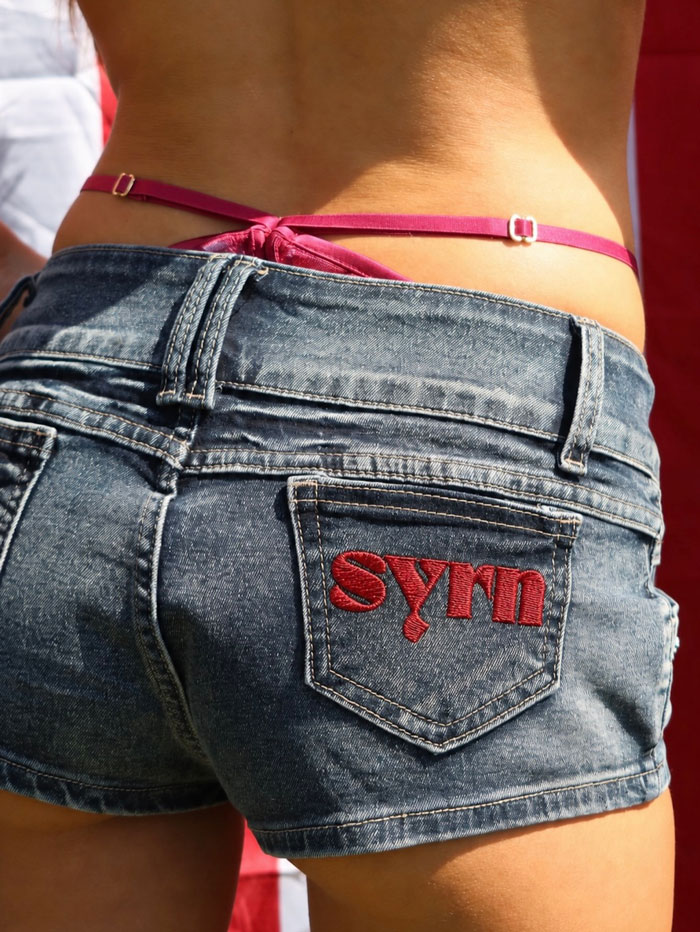
Image credits: syrn / Instagram
What The Numbers Actually Say
YouGov’s polling data on Sydney Sweeney is slightly fascinating but mostly confirming what was already obvious. 35% of Americans hold a favourable opinion of her. 13% hold an unfavourable one. A full 53% have no strong opinion either way, which, in the attention economy, is arguably the most damning statistic of all. But the breakdown is where it gets truly illuminating.
Men view her favourably at a net rating of +35. Women? +10. Among moderates, the gender split is even starker: +34 for men, +6 for women. Conservative men, predictably, are her most devoted demographic at +48 net favourability.
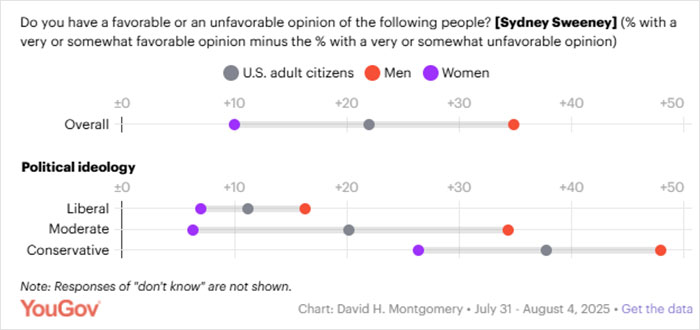
Image credits: YouGov
Translate this into lingerie customers, and what you have is a brand built on a female-identifying product, marketed in female-coded language, sitting atop a fanbase that skews overwhelmingly male. This is not a moral failing. It is, however, a branding paradox of almost architectural proportions.
Compare this to the women who have genuinely cracked the celebrity intimates market. Rihanna built Savage x Fenty on radical inclusivity and a very specific kind of confident, unapologetic female energy. The brand looks exactly like what you’d expect Rihanna to wear in a music video, which is to say, it looks like power.

Image credits: savagexfenty / Instagram
Kim Kardashian’s SKIMS succeeds because it is selling a transformative fantasy; it is technical, sleek, and positioned as something a woman does for herself. Even Dita Von Teese’s line, smaller and more niche, has an unmistakable point of view: old Hollywood glamour filtered through a woman who has spent her entire career reclaiming the male gaze on her own terms.
Each of these women built their lines on a clear, coherent relationship with a female audience. Sweeney, conversely, as Koul noted in her Slate review, “has merely shown us boobs and asked us to fill in the blanks.”

Image credits: syrn / Instgaram
The Ethos Problem
This is, ultimately, Syrn’s central challenge, and it isn’t really about lace or sizing or price point. We will come back to the sizing, because starting at 30A and topping out at 42DDD/F when the average American bra size hovers around a D or DD is a choice that telegraphs something about who the brand is envisioning in the fitting room.
The problem is that Sydney Sweeney has not yet given her female audience a coherent sense of who she is or what she stands for, and in the absence of that, people fill the gap with whatever narrative is most readily available.
Right now the most available narrative is the one that was written largely by and for men: the blonde, the curves, the bathwater, the American Eagle jeans ad that half the internet decided was a eugenics dog whistle while the other half thought was clever. Only 12% of Americans found that ad offensive, incidentally, according to The Economist, but women were more than twice as likely as men to find it so. The audience divide is consistent and persistent.
When Cosmopolitan asked her about being dubbed “MAGA Barbie,” Sweeney responded: “I’ve never been here to talk about politics. I’ve always been here to make art.” It is a perfectly reasonable position, and also an almost total abdication of the kind of defined personal ethos that separates a celebrity brand from a celebrity brand that means something to women.
Sabrina Carpenter wears the same era’s worth of corsets and negligees, but Carpenter’s entire brand is built on irony as she sings about demanding the world’s best orgasm while draped in vintage lace. There is a wink. There is a point of view. There is a woman in on her own joke.
Syrn, for all its “Love, Syd” warmth, hasn’t found its wink yet.

Image credits: sydney_sweeney for American Eagle/ Instagram
The Bathwater Problem
To understand Syrn fully, you have to understand what came before it, and what it reveals about the machinery Sweeney has built her empire on. The Dr. Squatch bathwater soap was a product so brilliantly, cynically calibrated to its audience that it sold out immediately and hit reseller markets for hundreds of dollars.
It was not a women’s product wearing men’s clothing. It was nakedly, cheerfully, entirely for men who find Sweeney attractive. It was smart. It was funny. It worked because it was honest about exactly who it was speaking to and why.
Syrn is the opposite move: a women’s product that has not yet successfully shed the residue of that male-gaze economy. When you build a brand primarily on the attention of one audience and then try to pivot toward another, the original audience’s fingerprints tend to linger.
They show up in the investor list. They show up in the demographic polling. They show up, in a particularly unfortunate way, in the small silver SS charms fastened to the centre of the bras, an embellishment that she might have reconsidered given the recent press cycle.

Image credits: complex / Instagram
The Bigger Question
None of this makes Sydney Sweeney a bad person, a bad businesswoman, or even a bad designer of mid-priced lingerie. She is, by any reasonable measure, an extraordinarily successful young woman who has navigated a brutally difficult industry with considerable intelligence. She understood early that her cultural moment was finite and monetised it aggressively and cleverly. Her net worth reflects that. Good for her, truly.
But Syrn poses a question that goes beyond one celebrity’s brand strategy, and it is this: can a woman whose entire cultural identity was constructed by and for the male gaze successfully dismantle that architecture and build something new in its place? Can “Love, Syd” reach the women who have, so far, remained largely unconvinced?
The answer is almost certainly yes, but not like this. Not with SS charms and Jeff Bezos money and a sizing range that quietly excludes the average American body. Not with a marketing voice that performs female friendship while the data quietly confirms who is actually listening.
Sydney Sweeney is talented enough, and smart enough, to build a brand that women actually want to claim as their own. Syrn, in its current form, is not quite that brand. It is the very convincing outline of one, waiting for something real to fill it in.
The question is whether she’ll be the one to do it, or whether the men who built her platform will keep furnishing the walls.
Sweeny wrapped the Hollywood sign in lingerie, which might be the Gen Z answer to burning bras
 Follow Us