When one Reddit user recently reported opening a vial of gray-market injectable peptides and seeing “floaties” in the solution, another asked if they had paid for third-party testing.
“Nope,” came the reply. “Honestly, it’s just too expensive, going gray for the cost.”
When the responder pointed out that lower costs on the gray market should make testing more feasible, the OP’s retort captured the sharp end of a spirit that can be seen across a growing subculture around peptides – where risk-taking is normalized and injecting unapproved compounds without medical supervision is discussed as casually as if it were a skincare or supplement routine.
“Bro people do [hard drugs] bought off the streets with syringes they find on the ground,” the OP wrote. “I’m sure I’ll be fine.”
“I’m Sure I’ll Be Fine”
Such interactions can be found across Reddit forums, Discord groups, vendor sites and biohacking spaces, where people openly discuss buying peptides sold as “research chemicals” and often marked “not for human consumption.” Discussion includes calculating how to reconstitute them from the powders they arrive in and dose them, where to inject them, and which other compounds they can be combined with to expand and improve results – known as “stacking.”
In a post published in April, one Reddit user who describes themselves as “new to peptides” asked about stacking three compounds, before finishing their post with: “I am clueless when it comes to this stuff.” Two of three responses addressing the query essentially just tell the OP to look it up online.
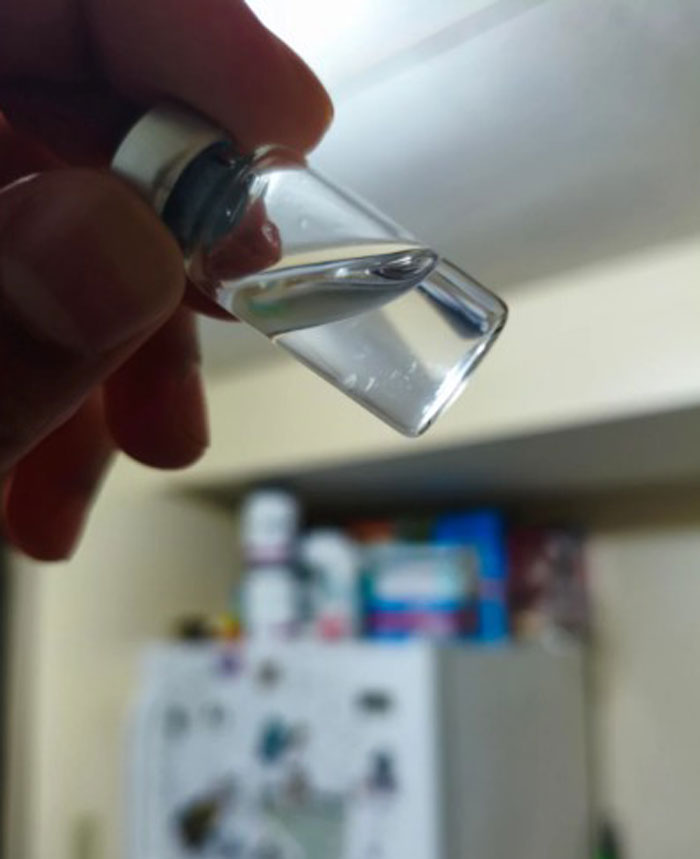
“Floaties” in a reconstituted peptide vial. Source: ButterMyNaan / Reddit
In comments on other posts, the advice that comes appears incredibly comprehensive and is often backed by references or testimonies, but is also regularly widely divergent or even conflicting. One recent Reddit post seeking advice on which peptide to use for reducing brain fog received a dozen distinct recommendations–begging the question of whether the OP decided to act on any of them and how they chose which one.
In another recent post, a user asks for advice on how to properly dose a subcutaneous injection of the so-called “Wolverine stack” – a combination of peptides BPC-157 and TB-500 intended to supercharge wound healing and injury recovery.
“I’ve seen online it’s like 500 mcg daily sub q [sic]. Is that a good starting dose? Should the first dose be less to assess tolerance? Also, what would that be in units on an insulin needle (27g)?” writes the OP.
Despite the serious nature of incorrect dosing, the post received a single relevant reply from a user sharing the dosage they apply to themselves–a dosage the OP appears to simply accept as correct for them, too.
This high-risk and poorly monitored approach to wellness is driven by broad motives, with a wide range of benefits attached to different peptides. In addition, they include greater training intensity, improved mood, better skin or hair, boosted libido, and enhanced cognitive function.
The rapid popularization–and subsequent shortages–of some approved peptide-based drugs, including obesity and diabetes medications such as semaglutide and tirzepatide, helped push people to the gray market. There and in online forums, the same scientific language surrounding approved medicines such as those GLP-1 drugs is widely used to discuss other experimental compounds.
That includes the as-yet unapproved triple agonist weight loss drug retatrutide, referred to online as “reta,” which many netizens have sourced and started injecting. That is despite it still being in late-stage testing, with experts warning of the potential for significantly more severe side effects than the single- and dual-agonists currently on the market.

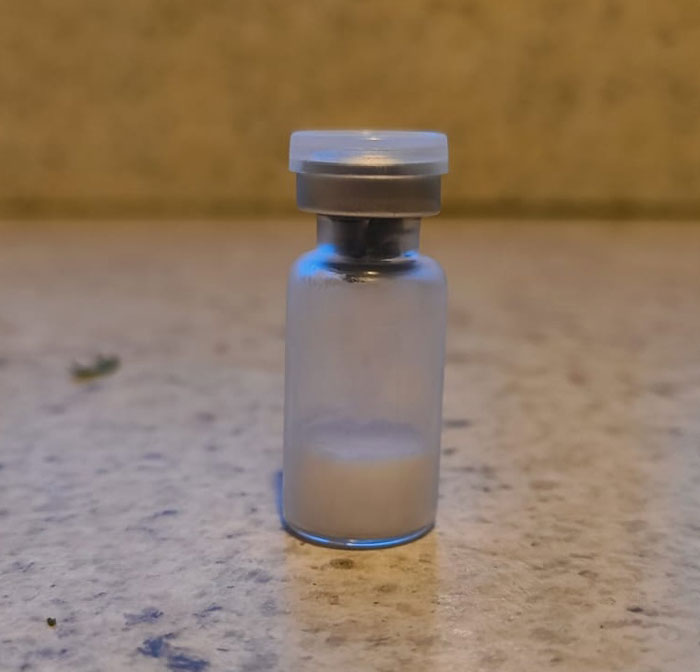
A vial of reconstituted reta Source: Supplied
For Professor Tim Caulfield, a health law and science policy expert who has written extensively about wellness misinformation, the peptide craze is indicative of how scientific excitement is converted into consumer faith.
“Those pushing peptides leverage the justified excitement and media coverage of efficacious peptides like the GLP-1s,” Caulfield said in an email exchange with Bored Panda. “They use science-y language and animal studies to legitimize claims.”
He has described this as “scienceploitation”: the use of real science, preliminary evidence or legitimate medical breakthroughs to sell claims that run far ahead of what is known.
The appeal is cultural as much as medical. Peptides have become major focuses of attention in longevity, biohacking and fitness circles, as well as the manosphere, where injecting them is celebrated and associated risks are often diminished, if mentioned.
Caulfield said some users are made to feel they are not simply buying an unproven injectable, but joining a team of people who are ahead of the curve. “Real men ‘optimize’ with peptides,” is the sort of message getting through, he said.

Professor Tim Caulfield Source: Wikipedia
That framing helps explain why labels such as “for research use only” or “not for human consumption” often fail to deter buyers. In peptide-focused corners of the internet, the inclusion of these disclaimers is treated as nothing more than legal hoop jumping, while community members talk of “researching” peptides in reference to injecting them to circumvent censors.
According to Dr. Timothy Piatkowski, whose research has examined enhancement-drug cultures and online self-experimentation, the gamble involved in peptide use is part of the appeal for many people.
“In these online ecosystems, risk is reframed as expertise,” he told Bored Panda in an email. “Being first to trial a compound generates social capital, credibility, and influence, especially when formal evidence is absent, and anecdote becomes the dominant currency of trust.”
That means early adopters become informal data sources, offering logs, dosing protocols, symptom reports, and reassurance to others, while building their own audience and clout within the community. It’s a world in which the absence of solid evidence creates a vacuum filled by peer testimony, as well as a consumer base for gray and black market suppliers to tap into.

A Reddit user provides their before-and-after on an enhanced Wolverine stack. Source: GiGiEats / Reddit
While such self-experimentation has long been seen in biohacking and bodybuilding communities, it has now bled into the much broader wellness community. According to Piatkowski, the language of “longevity” and “healing” has widened acceptance and use of unapproved compounds. “This shift normalizes injecting,” he wrote.
Risk taking and self-experimentation
For Lulu, a 51-year-old chemical engineer in Australia who spoke to Bored Panda about her peptide use on condition of anonymity, injecting these compounds is partly driven by frustration with the limits of what conventional medicine can offer, as she seeks to maintain athletic performance.
She began using injectable peptides after a knee injury, first using BPC-157 and TB-4 through a legitimate local compounding pharmacy. Later, after losing 15kg through exercise and consulting a clinician, she was prescribed tesamorelin – an FDA-approved peptide widely referred to as “tesa” that helps reduce visceral fat– and has since dropped a further 8kg.

Self-injection has become more widespread. Source: Getty Images
She says initially taking the legitimate route taught her enough to become confident about dosing and injecting, but it was also prohibitively expensive. “I didn’t want to keep paying 500 dollars (US$360) for a vial, being myself a chemical engineer,” she said.
After seeking out peptide communities online, Lulu found gray-market sources selling similar products at a fraction of the price. She says her current tesamorelin supply costs around a fifth of her legitimate supply. She was also surprised at how easy it was for her to dilute peptides in bacteriostatic water – a step gray market users have to complete to make them injectable – given her professional training.
From there, she moved deeper into the market, recently beginning with retatrutide, as well as SS-31, MOTS-c, and NAD+ – compounds that are variously believed to help with energy, neuroprotection, tissue regeneration, and inflammation. She also upgraded from BPC-157 and TB-4 to the GLOW stack, which also includes GHK-Cu – a compound believed to boost collagen synthesis, hair growth, and wound healing. She subsequently moved on to the KLOW stack, which adds KPV to the mixture, with the intention of additionally promoting gut and skin health, while further diminishing inflammation.
She says she goes to the gym five or six times a week, does intense cardio, and considers some of the compounds “game changers” that she expects to be taking for life.
But her account also captures the central tension of the peptide boom. She is educated, technically trained, and careful by the standards of many online users. Yet she still describes experimenting with multiple compounds, sourcing from the gray market, blending her own combinations, and managing side effects herself.
“Tesa has terrible side effects,” she said. “If combined with other peps it really increases your heart rate.”
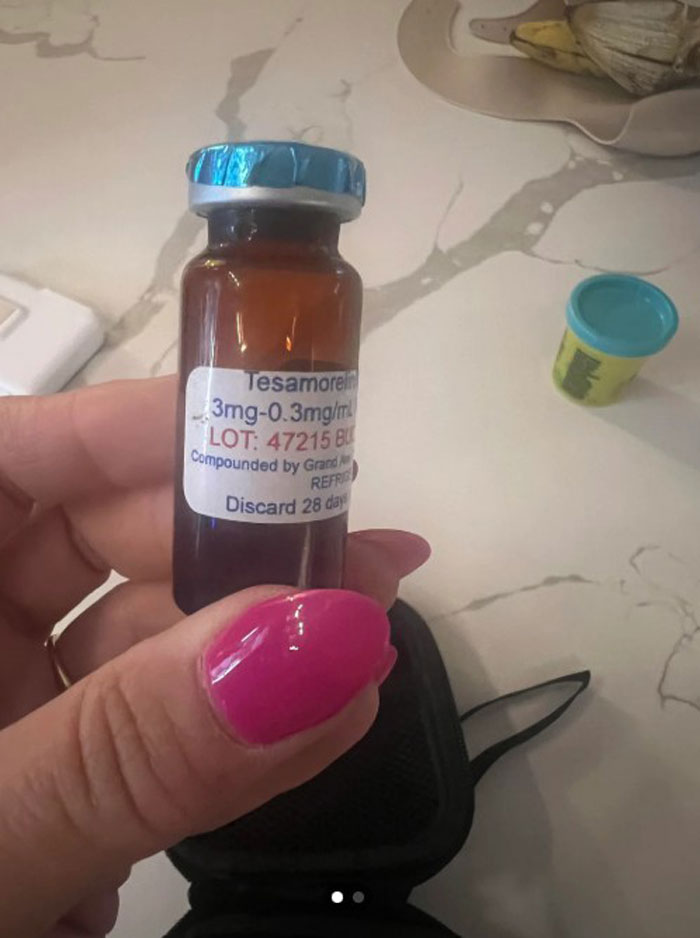
A Reddit user shows a vial of tesamorelin. Source: Reddit
She says her heart rate rose by 10 beats per minute while cycling tesamorelin. Her response was not to abandon the experimentation, but rather to adjust her protocol. It’s that sort of intrepid approach that experts warn about: users confidently sourcing compounds from “reliable” gray market sources and believing they can manage adverse outcomes without ongoing or proper medical supervision.
“Use often continues because perceived benefits — appearance, recovery, control over the body — are immediate and reinforced socially, while harms are uncertain, delayed, or normalized within peer networks,” Piatkowski said.
Game changer or modern snake oil?
The first dangers associated with peptides appear before a syringe is ever filled. According to Dr. C. Michael White, who has studied the online peptide market, the gray-market model exposes buyers to multiple layers of risk at once. They can be scammed, receive degraded products, get a different dose than promised, or inject something made without human-grade manufacturing standards.

Dr. C. Michael White Source: UConn
White said that widespread claims of 95 to 98% purity seen on vendor websites are often false. “You seldom receive the ‘purity’ you are promised,” he told Bored Panda.
Even where a product contains the stated compound, that does not mean it is sterile, stable, accurately dosed, or safe. Because many vendors claim their products are not for human consumption, they are not operating under the same standards and scrutiny as makers of medicines intended for people.
White said consumers should be concerned about heavy metal and microbial contamination, including bacteria, mold, and fungus. It’s a warning echoed by Piatkowski, who said the ROIDCheck project he founded identified toxic metals, including lead and arsenic, in enhancement drugs at levels beyond permissible daily limits for humans.

Dr. Timothy Piatkowski Source: LinkedIn
According to Dr. Timothy Mackey, who has tracked illegal online pharmacies, while disclaimers help vendors stay online, those same vendors are often participating in online communities and promoting the benefits of the products they are selling.
“Many of these vendors actively engage with online communities on different platforms about the use of their products for health purposes, including ‘wellness’ and biohacking communities,” he told Bored Panda.
As well as undermining the reliability of such forums, given the conflict of interest involved, that also underscores the legal gray area such vendors are working in–where the products state they are not for human consumption, but those selling or promoting them online freely discuss consumption.
White outlines the brutal asymmetry this creates: if a buyer is harmed, the seller may argue the product was never meant to be injected in the first place. Meanwhile, lack of accountability among influencers means they face few consequences from pushing substandard or fake products.
“If an influencer is the only person sharing this ‘secret’ miracle or hack, they are either ignorant or lying to you, and frequently both,” White said. “There are so many similarities between the peptide market and the ‘snake oil salesmen’ in the 1800s.”
The dosing problem
Even if the vial contains the right compound, in the right amount, without contamination, the gray-market peptide user still has to turn a powder into an injectable dose – and things often go wrong.
According to Dr. Joseph Lambson, director of the New Mexico Poison and Drug Information Center, many more calls involving GLP-1 products are about dosing mistakes than concerns over tainted products. “The majority of calls, it’s this unintentional therapeutic error,” he told Bored Panda.

Dr. Joseph Lambson Source: Supplied (Dr. Lambson’s office)
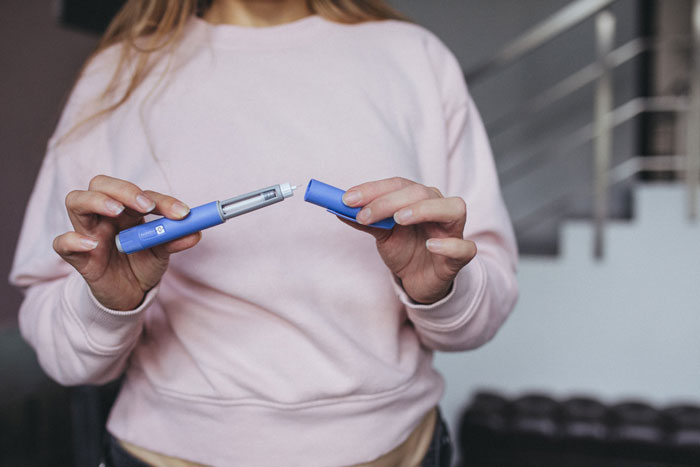
One of the issues people have when switching to the gray market to source GLP-1 compounds is that they now have to mix and dose the product themselves, having previously administered it with an easy-to-use prescription pen.
Lambson says prescription pens essentially act as a guardrail, guaranteeing an accurate and consistent dosage, while preventing individual dosing errors. When a person switches to vials, especially those bought online or supplied outside conventional medical care, they then need to calculate milligrams, milliliters, units and syringe markings from scratch.
Lambson said confusion can arise when syringe markings show units or milliliters, while dosing instructions refer to milligrams or other measurements. The result is often not a minor slip. “We see tenfold overdoses,” he said.
The consequences can be severe. With semaglutide-like drugs, Lambson said the most obvious effects are gastrointestinal: vomiting, diarrhea, loss of appetite and inability to keep food or fluids down. In a therapeutic setting, those effects may be monitored and managed. In a self-administered overdose, they can quickly become dangerous.
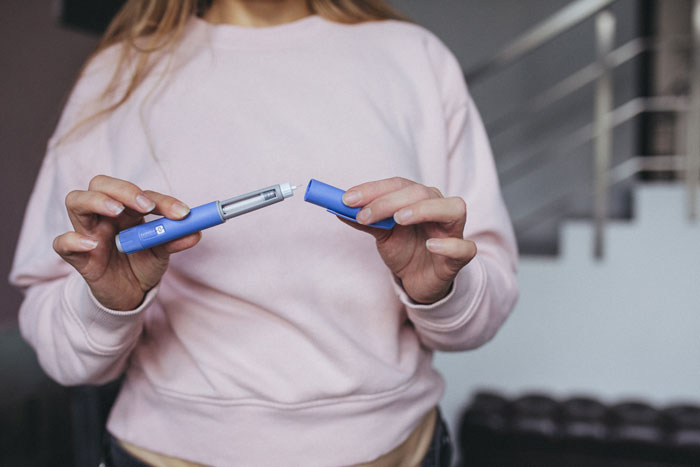 Prescription GLP-1 pens are easy to administer and provide a consistent dosage. Source: Getty
Patients who cannot eat or drink can develop dehydration, electrolyte disturbances and changes in the acid-base balance of their blood. Some may need hospital treatment with fluids, monitoring and electrolyte replacement. In severe cases, the effects can last more than a week.
It’s in that context that users seeking out and apparently accepting advice from anonymous strangers on dosing should be understood – a high-stakes gamble based on potentially questionable advice from someone with limited information about the person they are advising.
Harms that do not fit the data
Some of the most alarming peptide risks are among the hardest to quantify. Poison centers are built for acute events: someone injected too much, became violently ill, and needed immediate advice. Lambson was careful to point out that his center does not see the full picture of people who continue using despite side effects, develop longer-term problems, or quietly manage symptoms themselves.
That’s significant because the harms users commonly describe are not dramatic overdoses, but rather lingering, ambiguous and hard to prove. Online BPC-157 users have described anxiety, depression-like symptoms and anhedonia — the inability or reduced ability to feel pleasure. One user wrote that after a three-month BPC-157 cycle for a shoulder injury, they believed they had been “generally anhedonic” ever since and no longer experienced pleasure as they once did. Another replied that they had the same issue and that other experimental compounds only helped temporarily.

A Reddit user displays bruising they said came from injecting peptides. Source: Klookkkk / Reddit
Such testimony does not prove causation, but does point to a form of harm that can be life-altering without ever appearing as a poisoning statistic or being extremely evident to the outside observer that someone is suffering. According to Piatkowski, long-term endocrine disruption and potential proliferative risks, including tumor-growth pathways, remain “poorly understood and underappreciated.”
But that uncertainty does nothing to slow some users down. In one Reddit thread about whether BPC-157 and TB-500 could accelerate tumor growth, commenters dismissed doctors’ concerns as fearmongering or suggested mainstream medicine had financial reasons to discourage use.
White says he is especially concerned about stacking and combination products because each added compound multiplies the unknown.
“Not only is the science behind a single peptide poorly supported, but they are not studied together to see if there are important drug interactions,” he said.
For Mackey, the lack of clarity around the adverse-event profiles of different peptides is particularly concerning given how much more accepted self-experimentation is getting. He says the rise of “blockbuster drugs” that are now commonly used, such as GLP-1 medications, could be normalizing self-diagnosis and self-administration.

Dr. Timothy Mackey Source: LinkedIn
“This normalization means that consumers may view ‘personalized’ peptide products as legitimate forms of treatment when they are not intended for that manner and where there may be quality issues,” he said.
It is unquestionable that approved peptide-based medicines have the potential to be transformative to significant areas of conventional medicine once they have undergone proper testing. The growing institutional interest around them is demonstrated by the fact that the FDA is reportedly in the process of lifting restrictions on US pharmacies compounding 14 peptides that were banned in 2023 over lack of safety data.
But in the meantime, the risk profile remains high and, as White pointed out, consumers sourcing on the gray and black market have limited practical recourse to pursue vendors if they experience adverse effects.
“What these sellers are doing is selling experimental chemicals,” he said, “and expecting you to take on all the short- and long-term risks.”
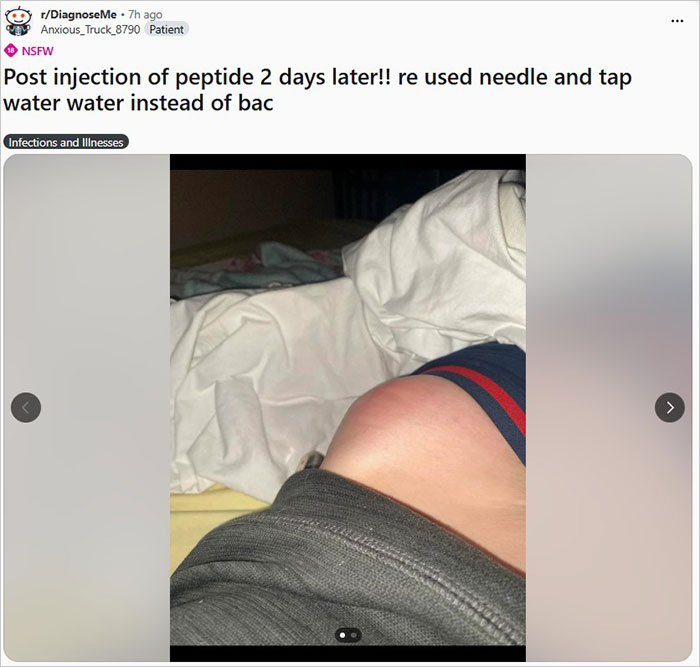
A Reddit user seeks advice on what could be a life-threatening infection. Source: Reddit
 Follow Us