KJ Apa has left fans stunned after revealing one of the darkest periods of his life, when he secretly battled bulimia behind closed doors while appearing perfectly healthy on camera.
The actor revealed that the relentless pressure to maintain an ultra-lean, muscular physique for his role as Archie Andrews in Riverdale pushed him into dangerous cycles of bingeing and purging.
Doctors tell Bored Panda that Apa’s experience reflects a reality many people never see, particularly among men, whose struggles are often overlooked, misunderstood, or diagnosed much later than women’s.
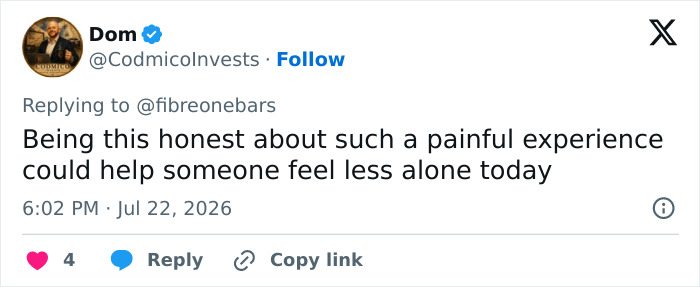
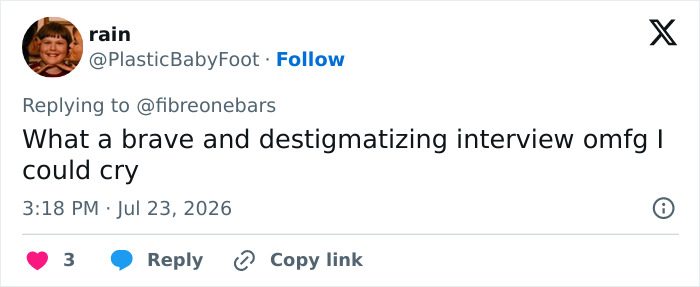
One viewer wrote, “The raw honesty about eating disorders like this is so important. Deglamorizing it and showing the real lows is huge.”
KJ Apa revealed he once urinated on a McDonald’s meal in a desperate attempt to stop himself from eating

Trigger warning: This article contains discussions of eating disorders, body image, and mental health. Reader discretion is advised.
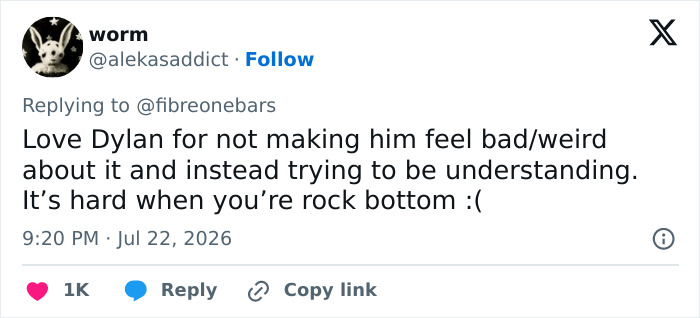
In July 2026, KJ Apa opened up about his years-long struggle with bulimia during an appearance on Dylan Sprouse and Brendan Columbus’ Wildmen podcast, revealing how the pressure to maintain a certain physique consumed his life both on and off set.
Apa admitted that whenever filming required him to get into shape, he slipped into what he described as “beast mode,” becoming completely fixated on food, his body, and his appearance.
One of the darkest moments came during the COVID-19 pandemic while he was quarantining in Vancouver.
Trying to lose weight quickly, he ordered a large McDonald’s meal before immediately panicking over the calories.

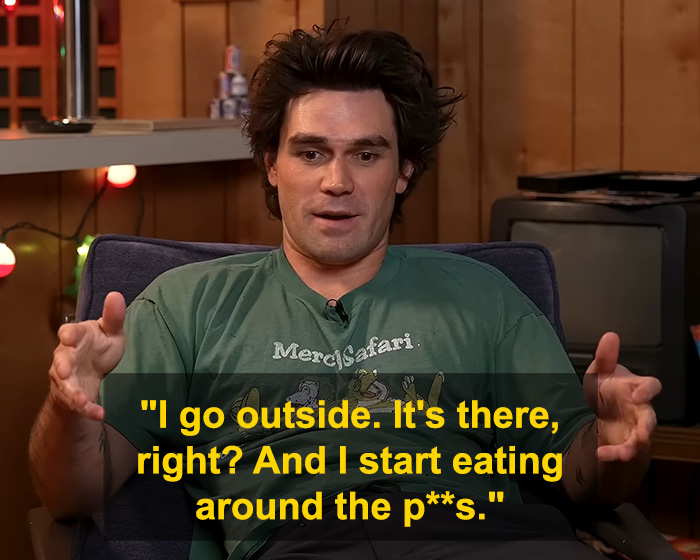
In a desperate attempt to stop himself from eating any more, he carried the food outside and urinated on it.
But after forcing himself to throw up what he had already eaten, the hunger quickly returned.
Apa said, “I go, throw up all the food that I ate… I go back outside about 20 minutes later after lying there in bed being like, ‘I’m hungry again, because all the food is now out of my body.’ I went downstairs, I go outside, and it’s there, right?”
“I start eating around the piss. I ate the rest of the food and left the soaking piss food there.”
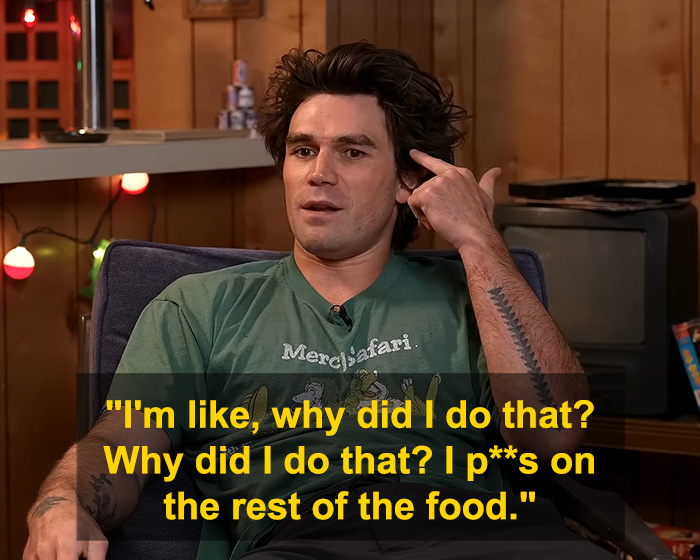

During the height of Riverdale, he would also secretly binge on doughnuts throughout the day before returning to his trailer to force himself to vomit.
He shared, “Anything that makes me feel good, I will abuse. It’s something that I’ve learned about myself. Even eating.”
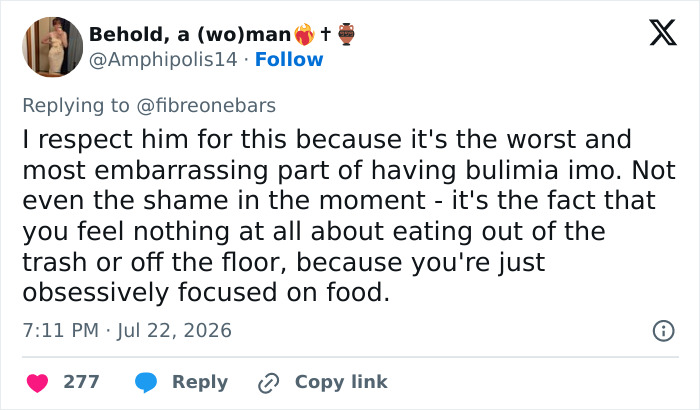
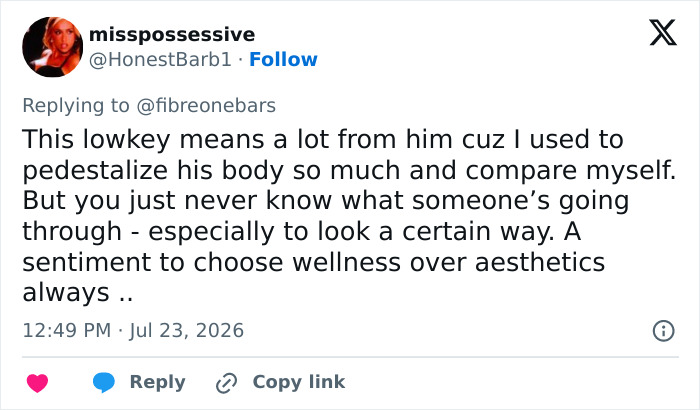
As clips of the interview circulated online, one commenter wrote, “The compulsion, and the extreme lengths people go to in secret.”
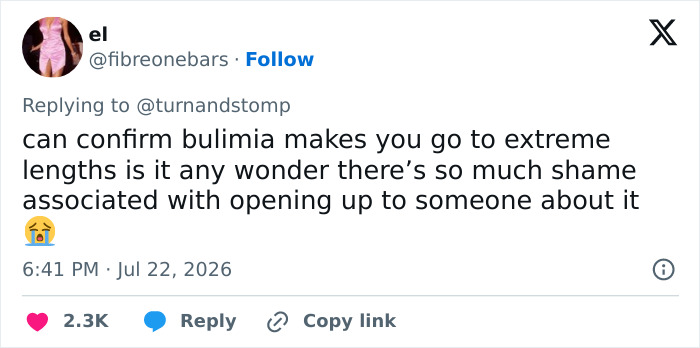
Another added, “Can confirm bulimia makes you go to extreme lengths. Is it any wonder there’s so much shame associated with opening up to someone about it?”
Doctors say many men silently struggle with similar conditions, but their symptoms often go unnoticed due to societal stigma

amazing studio/Adobe Stock (Not the actual photo)
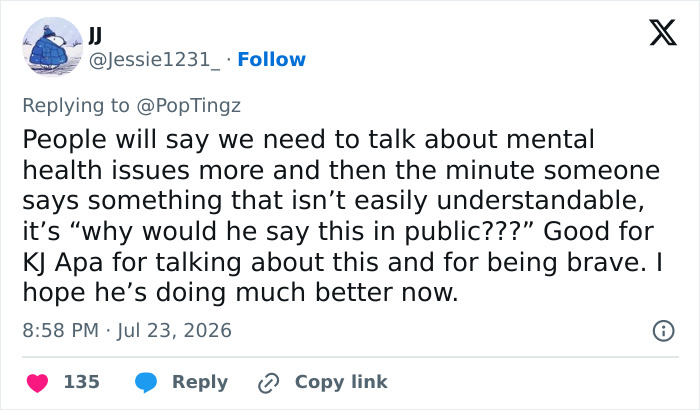
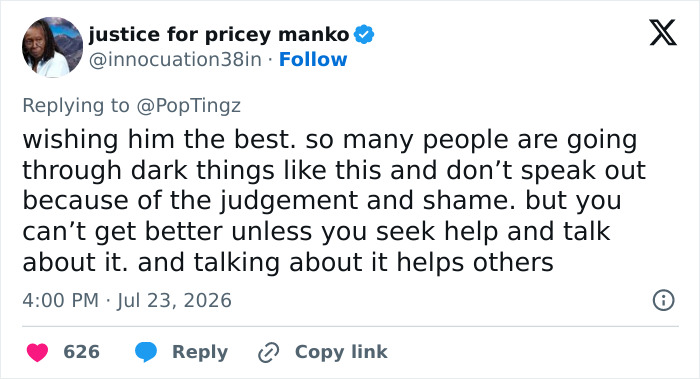
Many viewers also applauded him for helping challenge the stereotype.
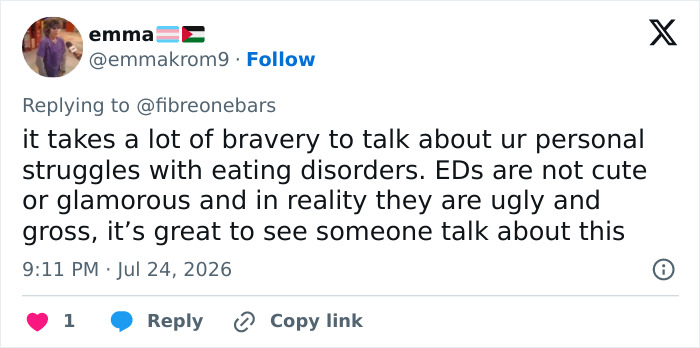
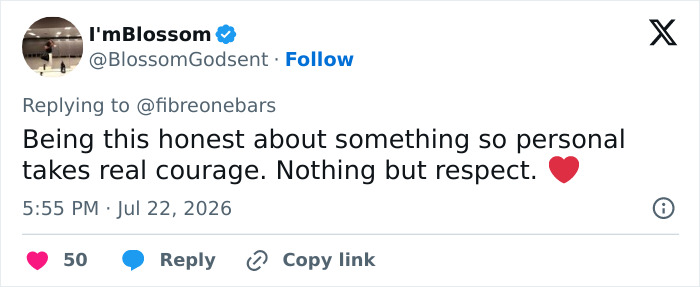
One person commented, “I respect him so much for openly talking about this, especially as a man. Being raw and honest about such a personal thing takes serious courage.”
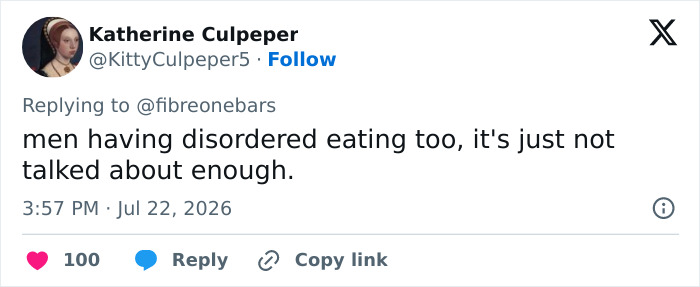
The raw confession also shed light on a reality that experts say remains widely misunderstood: eating disorders are not exclusively a women’s issue.
For decades, many people assumed that only a small fraction of men developed these conditions.
But Sandra Wartski, a Certified Eating Disorder Specialist (CEDS), told Bored Panda that more recent estimates suggest about one in four people living with an eating disorder are male, and even that figure may still underestimate the true number.

Nomad_Soul/Adobe Stock (Not the actual photo)
“For several decades, the percentage of men with EDs was assumed to be about 10%, but the more updated statistics suggest that about 25% of people with EDs are male-identifying,” she explained.
According to Wartski, many boys and men go undiagnosed because their symptoms look different.
Instead of chasing extreme thinness, many men become preoccupied with achieving a lean, muscular physique, often hiding harmful behaviors behind strict diets, excessive exercise, or “bulking” and “cutting” routines that appear socially acceptable.
Dr. Sal Raichbach, Chief Clinical Officer at The Haven Detox Group, said that misconception can delay recognition for years.

Pixel-Shot/Adobe Stock (Not the actual photo)

“Many men’s symptomatology may revolve around issues of muscularity, dietary rigidity, excessive levels of compulsive exercise, and obsessive thinking about the body instead of the typical focus on being thinner,” he explained.
“Men can find it difficult to recognize their own symptoms as related to an eating disorder due to societal portrayals of eating disorders as women’s illnesses.”
Sandra also explained that eating disorders are rarely just about food.
One expert said, “Men can find it difficult to recognize their own symptoms… due to societal portrayals of eating disorders”

andranik123/Adobe Stock (Not the actual photo)
She shared, “EDs are not just about the food and the behavior. There are generally many underlying complex, psychological issues that have likely been building and developing for quite some time.”
“Like seeing only the tip of an iceberg while knowing there is a wider base beneath, there is often a much broader and deeper perspective on most any human behavior.”
Dr. Raichbach shared a similar view, saying extreme behaviors such as binge eating, purging, or even retrieving discarded food are not unusual among people living with these conditions.

“Such behaviors reveal that people with eating disorders are highly preoccupied with food, training, and appearance,” he explained.
Rather than reacting with disgust, he encouraged people to ask, “What fear, shame, or need for control may drive this behavior?” instead of, “How could anyone do this?”
He added, “Disgust often pushes someone further into denial and hiding, whereas quiet curiosity facilitates clinicians’ and families’ understanding of the pattern, identification of medical risks, and connection to needed services.”

Netflix / Burns & Co. Entertainment
While Apa admitted that his struggle began while trying to achieve the lean, muscular physique expected of Archie, experts say the warning signs often appear long before behaviors become as extreme as his.
Sandra explained that the biggest red flags are not simply eating healthy or exercising regularly, but when those habits become rigid and all-consuming.
Experts warn that an obsession with the “perfect” physique can quietly take over someone’s life

“When there is a rigidity, obsessiveness, and non-compassionate approach to the habits or goals, this presents as a concern that the individual may be slipping into eating disorder territory,” she said.
Dr. Raichbach said the pursuit of fitness becomes dangerous when self-worth depends entirely on appearance.
“When food and exercise become vehicles for measuring one’s worth, rather than supporting overall health, the pressure to achieve or maintain a particular body shape or size can lead to unhealthy patterns.”

Vasyl/Adobe Stock (Not the actual photo)
He added that warning signs often include growing preoccupation with muscle definition, strict food rules, skipping meals, avoiding eating with others, secret eating, recurrent bingeing, purging, compulsive exercise, and intense distress after eating.
If left untreated, the consequences can affect nearly every organ in the body.
According to Wartski, “Many internal organs and body systems are affected with any type of eating disorder, and the longer an illness is in place, the more dangerous it is.”

Dr. Raichbach also warned that repeated binge-and-purge cycles can also lead to dehydration, dangerous electrolyte imbalances, severe acid reflux, chronic throat inflammation, intestinal irritation, and swelling of the salivary glands.
“The medical danger can be significant even if the person appears to be at a normal weight,” he said.
Research from the Harvard T.H. Chan School of Public Health estimates that about 9% of women and 4% of men will develop a clinically diagnosable extreme eating habit during their lifetime.
In the United States alone, that translates to roughly 10 million men among nearly 30 million lifetime cases.
Yet despite those numbers, the National Institutes of Health notes that men account for fewer than 10% of patients treated at specialized clinics.
Experts say that gap reflects how many men never seek help, fail to recognize their symptoms, or are never correctly referred for treatment.
“This is incredibly sad… You go to extreme lengths and there’s so much shame associated with opening up,” one netizen wrote












 Follow Us