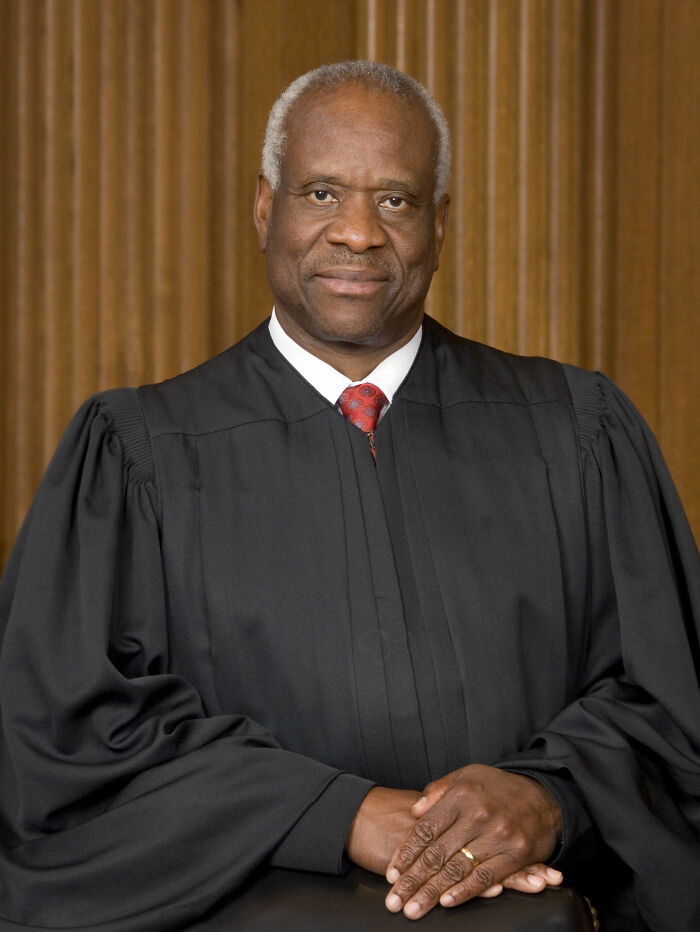
Image credits: Wikimedia Commons
Clarence Thomas
June 23, 1948
Pin Point, Georgia, US
78 Years Old
Cancer

Who Is Clarence Thomas?
Clarence Thomas is an American lawyer and jurist known for his long tenure and conservative jurisprudence on the Supreme Court. His judicial philosophy emphasizes originalism and textualism, shaping significant legal discourse.
He rose to national prominence with his contentious 1991 nomination to the Supreme Court, succeeding Thurgood Marshall. The confirmation hearings, marked by intense debate, solidified his place in public awareness.
Early Life and Education
Raised in Pin Point, Georgia, by his maternal grandparents, Myers and Christine Anderson, Clarence Thomas experienced a disciplined upbringing in a poor Gullah community. His grandfather, whom he called “Daddy,” was a crucial influence.
He attended segregated Catholic schools, including St. Benedict the Moor Grammar School and St. John Vianney Minor Seminary, initially intending to become a priest. Thomas later graduated from the College of the Holy Cross and earned a Juris Doctor from Yale Law School.
Notable Relationships
A string of high-profile moments has marked Clarence Thomas’s personal life, notably his marriage to Virginia Lamp Thomas since 1987. Earlier, he was married to Kathy Ambush, with whom he shared a son.
He remains married to Virginia Lamp Thomas, a conservative activist. Thomas shares one son, Jamal Adeen Thomas, from his previous marriage with Kathy Ambush.
Career Highlights
Clarence Thomas’s career is defined by his appointment as an Associate Justice of the Supreme Court in 1991, becoming the second African American to serve. He is the longest-serving current Justice, known for his conservative majority opinions in cases like New York State Rifle & Pistol Association, Inc. v. Bruen.
He published his best-selling memoir, My Grandfather’s Son, in 2007, reflecting on his challenging upbringing and personal journey. This literary work offered insights into the formative experiences that shaped his judicial philosophy.
Signature Quote
“I will prepare myself, and when the time comes, I will be ready.”
 Follow Us