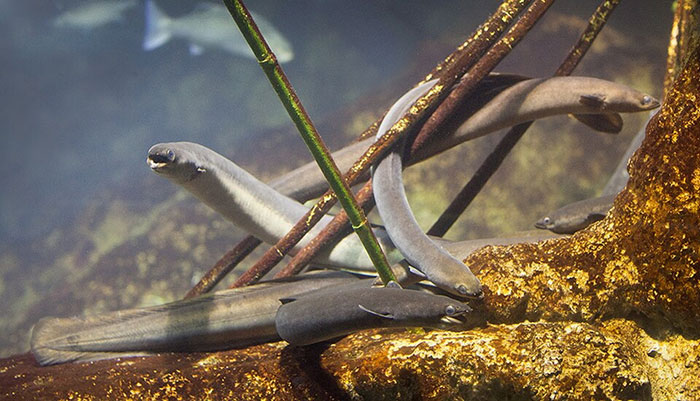
Somewhere in the rivers and lakes of Europe right now, there is an eel that has been sitting in the mud for twenty years, growing slowly, eating whatever comes close enough, and waiting for something. We do not know what eels think about, or even if they think, or really much about them at all beyond the basic biographical facts, which are already so strange that the thinking part barely matters.
What we do know is that at some point, this particular eel will stop eating, its eyes will double in size, its belly will turn silver, and it will begin a four thousand mile journey to a specific patch of ocean in the middle of the Atlantic that it has never visited, to do something it has never done, after which it will expire.
No scientist has ever followed one all the way there. No one has ever witnessed what happens when it arrives. The European eel, Anguilla anguilla, has been confusing people for so long and so comprehensively that it has accumulated a hall of fame of baffled experts. Starting with Aristotle, but by 350 BC, a lot of things were still confusing. Sigmund Freud spent way too much time dissecting eels in search of their testicles. He cut open hundreds of them, only to be outsmarted by an animal that only developed the apparatus on the way to its own funeral. Or so we assume.
The mystery of the eel is not simply that it is unusual. It is that somehow we still cannot answer the most basic questions about an animal that is this abundant. We have never seen them mate. We have never found their eggs in the wild. We cannot breed them in captivity. And every single one of them, from every river and lake across Europe and North America, makes the same impossible journey to the same patch of warm Atlantic water, navigating thousands of open ocean miles without a map, without prior experience, and without anyone having the faintest idea how.
The Sargasso Sea: where eels go to do the thing nobody has seen
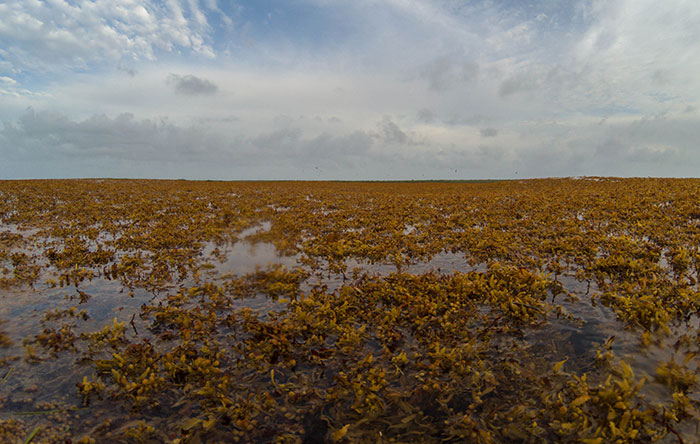
The Sargasso Sea is one of the stranger addresses on the planet. It is the only sea in the world defined not by land but by ocean currents, a vast rotating gyre in the North Atlantic roughly the size of the United States, warm, clear, and blanketed in floating seaweed. Christopher Columbus sailed through it in 1492 and thought he was close to land. Not even close, buddy. He was in the middle of the Atlantic, surrounded by seaweed, considerably more lost than he was prepared to admit.
This is where every European eel goes to reproduce and die. Every single one. An eel that hatched in a Danish river, or a Spanish lake, or a Scottish loch, or an Irish bog, will end its life in this specific patch of mid-Atlantic water, having made a journey of between four and six thousand kilometers through open ocean.

The Sargasso was first identified as the eel’s destination in the early twentieth century by Danish oceanographer Johannes Schmidt, who spent years trawling Atlantic waters and working backward from the size of the larvae he collected. The smaller the larva, the closer to the spawning ground. He followed them inward like a trail of breadcrumbs until the trail led to the Sargasso. It was elegant, determined science, and it answered exactly one question while opening forty more.
Because Schmidt never found the eggs. Nobody has ever found the eggs. Researchers have been going back to the Sargasso for a hundred years now, and the eels are simply not there when humans arrive to look at them. Only a few larvae have been collected. In 2022, a single silver eel was tracked to the outer edge of the Sargasso before its satellite tag went dark, which is the eel equivalent of a person walking into a room and closing the door. We know they go there. We know larvae come out. What happens in between remains, bafflingly, completely unobserved.
The life cycle of something that should not work
The eel’s biography is the kind of thing that sounds made up even after you have verified all the facts individually.
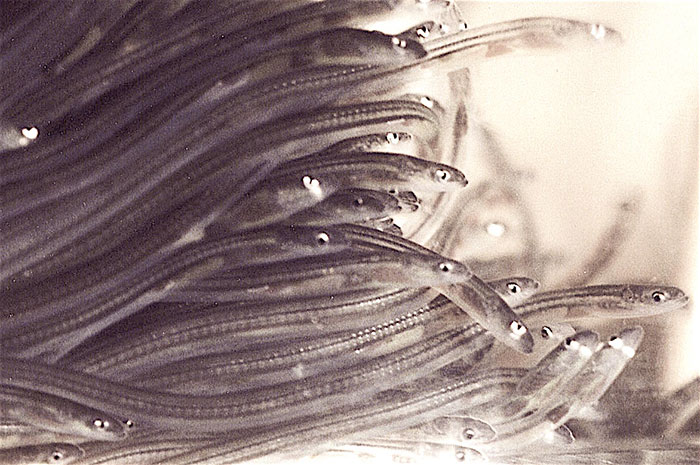
It begins in the Sargasso, with eggs that nobody has seen, hatching into larvae that look nothing like eels. The larval eel, called a leptocephalus, is flat, transparent, leaf-shaped, and so completely unlike its adult form that when scientists first collected them in the nineteenth century they classified them as an entirely different species.
The leptocephalus then drifts on ocean currents for somewhere between seven months and three years, crossing thousands of miles of open Atlantic without swimming, just riding the Gulf Stream toward Europe. It arrives at continental coastlines, transforms into something called a glass eel, a tasty snack for people on the Spanish North coast. Here it gradually turns yellow, settles into whatever freshwater habitat it finds, and begins the long waiting portion of its life, which can last anywhere from five to eighty years depending on conditions and what the eel feels like doing.
That means eels have later fertile windows than even Hugh Hefner. There can still be a virgin eel out there that has been around since before the Second World War, before television, before penicillin was widely available, sitting in the same stretch of mud and eating the same fish.
Then, triggered by something science has not pinned down with any confidence, the eel stops eating. Its digestive system begins to deteriorate because it will not be needing it again. Its eyes expand dramatically. Its coloring shifts from yellow to silver. It is, at this point, physically transforming into a migration machine, stripping away everything unnecessary and building everything required for a single enormous journey.
Its body reabsorbs its own gut. Its gonads, previously invisible, develop rapidly. Its metabolism reorganizes. And then it leaves, heading downstream, navigating to the coast, and then pointing itself southwest into the open Atlantic.
It does all of this having never done any of it before, guided by something- magnetic fields, celestial navigation, chemical gradients in the water, some combination of all three- that scientists have been arguing about for decades without resolution. The eel is not working from memory. It has no memory of the Sargasso. It was born there, but it has never been back. It is following something internal and inherited and entirely unexplained, moving through open ocean for months toward a place that exists inside it only as a direction.
Why we cannot just breed them and find out
One of the more straightforward ways to answer questions about animal reproduction is to breed the animal in captivity and watch what happens. This works for most things. For eels, it has proven, across decades of international scientific effort, to be essentially impossible.
Nobody has ever successfully bred a European eel from egg to adult in a laboratory setting. Researchers have managed, with considerable difficulty, to artificially stimulate eels into producing eggs and sperm, combine them, and get larvae to hatch. The larvae then die, typically within days, because nobody knows what they eat in the wild during the larval stage and everything tried in captivity has so far been wrong.
The eel larva, floating across the Atlantic on ocean currents in conditions scientists cannot replicate in a tank, is eating something, or absorbing something, or doing something metabolically that supports its development, and despite decades of effort that something remains unidentified.
This matters beyond academic curiosity. The European eel is critically endangered. Its population has declined by approximately 95% since the 1980s, driven by habitat loss, river barriers blocking migration routes, overfishing, climate change affecting ocean currents, and a parasitic swimbladder nematode introduced from Asia that has spread across European eel populations with considerable enthusiasm for its own survival at the expense of theirs.
The eel has been declining for forty years, and we cannot breed it in captivity to supplement wild populations because we cannot keep the larvae alive long enough to find out how. Japan has a related species, the Japanese eel, and has been pouring serious scientific resources into captive breeding for decades.
In 2010, researchers achieved the first complete life cycle in captivity. It required feeding the larvae a diet of shark egg powder, which is not something that exists in large quantities in the North Atlantic and raises its own logistical questions about conservation at scale. The European eel program has not yet achieved the same milestone. The eel has not cooperated.
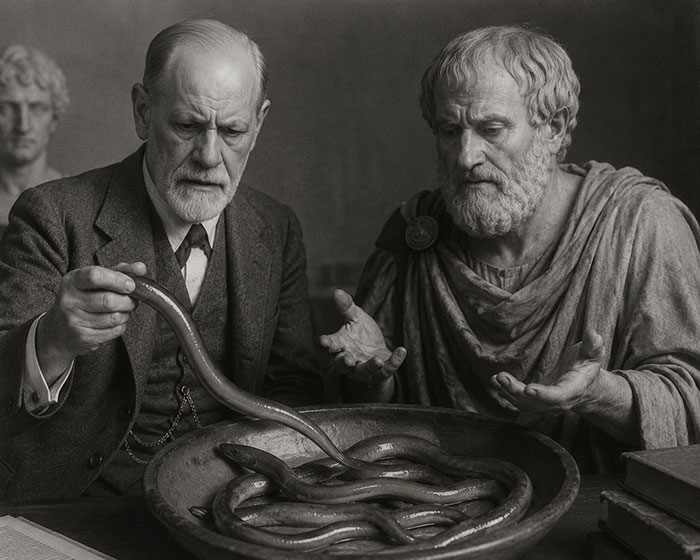
Aristotle’s mud theory was wrong but not as wrong as everything else people have believed
The history of eel science is a catalog of intelligent people arriving at confidently wrong conclusions and then being succeeded by other intelligent people who were also wrong, just differently.
Aristotle’s spontaneous generation from mud theory held surprising cultural staying power, persisting in various forms for nearly two thousand years. Pliny the Elder, working in the first century AD, proposed that eels reproduced by rubbing themselves against rocks, with the scrapings coming to life. This is wrong in every particular and also somehow more disturbing than the mud theory.
In the seventeenth century, the physician Jan Baptist van Helmont, a man who elsewhere in his career provided the first scientific description of gases, suggested that eels arose from May dew falling on riverbanks. He was not joking. Several centuries of naturalists believed that eels might be a form of beetle, or a relative of snakes, or something that grew from horsehair left in water, which was a belief persistent enough that horsehair was routinely left in water by people testing this theory, presumably for years at a time, waiting.
The reason all of these theories flourished for so long is that eels are genuinely, structurally resistant to observation. They are nocturnal. They live in mud. They travel thousands of miles to reproduce in water that is deep, warm, and located in the middle of the Atlantic Ocean. They do not perform their interesting biological activities anywhere convenient. They have organized their entire existence, whether intentionally or not, in a way that maximizes scientific inconvenience.
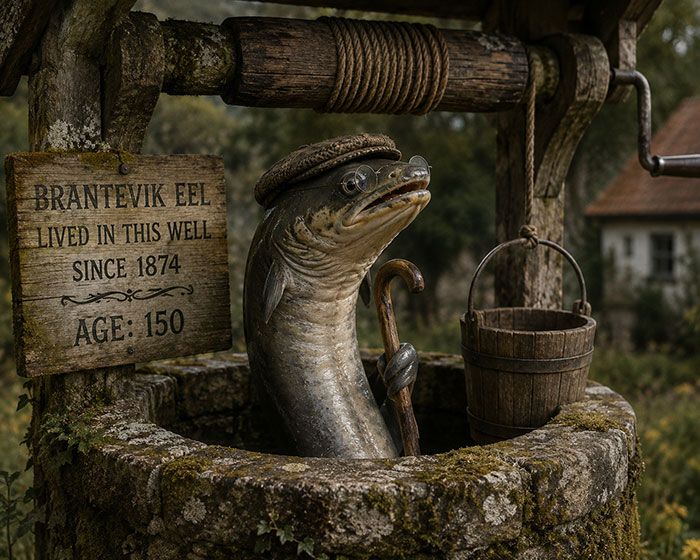
The eel that became famous for not dying
In 1859, a young eel was placed in a well in Brantevik, a small fishing village in southern Sweden. It was placed there by a local family to eat insects and keep the water clear, which eels will do and which was a common enough practice in rural European communities at the time. The eel, which the family named Åle, lived in that well for the next 155 years.
It outlasted the family members who put it there, their children, their grandchildren, and their great-grandchildren. It was still alive in 2014, by which point it had become something of a local institution and a minor international news story, when it died, possibly of old age, possibly of loneliness, probably of something completely unrelated to either.
Åle never made the journey to the Sargasso. It spent 155 years in a well in Sweden eating insects and being periodically examined by scientists who found the whole situation as inexplicable as everything else about eels. Whether it was incapable of migrating due to the enclosed environment, or simply chose not to, or whether something in its biology had shifted in a way that suppressed the migration impulse, nobody is entirely sure.
The eel in the well is not an outlier in terms of longevity; eels are known to live for decades in the wild and potentially much longer in conditions where migration is impossible. It is an outlier in terms of fame, which the eel itself seemed completely indifferent to.
Let’s be honest about what we know
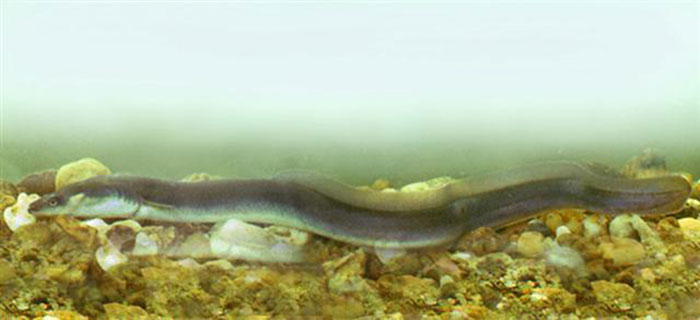
Here is the complete list of things science can say about the European eel with reasonable confidence. It hatches in the Sargasso Sea. It drifts to Europe as a larva. It lives in freshwater for years, possibly decades. At some point it transforms and migrates back to the Sargasso. It reproduces there and dies.
That is it. That is the whole list. Everything else- what it eats as a larva, exactly how it navigates, what triggers the migration, what happens in the Sargasso when it arrives, why its population has specific characteristics in different rivers, how it manages to synthesize reproductive organs from what is essentially a decommissioned digestive system- remains either unknown or contested or both.
The eel has been on this planet for forty million years. It survived whatever killed the dinosaurs. It survived every ice age, every mass extinction event, every significant geological and climatic upheaval of the last forty million years with apparently minimal adjustment required. It was here long before humans arrived to be confused by it, and it has managed four thousand-mile open ocean migrations for all of that time without anyone’s help, understanding, or observation.
It is also now critically endangered, largely because of things humans have built across its migration routes, in its habitat, and in the ocean it crosses. The animal that defeated Aristotle, defeated Freud, defeated a century of dedicated scientific inquiry, and sat in a Swedish well for 155 years eating insects, is losing to drainage infrastructure and river dams.
We have built civilizations, mapped genomes, landed machines on other planets, and we still cannot tell you what a baby eel eats for breakfast in the middle of the Atlantic. The eel is not a mystery we have failed to solve. It is a reminder that the natural world is under no obligation to make sense to us, and that forty million years of evidence suggests it never particularly intended to.
 Follow Us