Standing on a piece of wood laid across two overturned plastic crates, Colombian Senator Miguel Uribe Turbay was treading familiar political ground during a campaign trail visit to the middle-class neighborhood of Modelia in west Bogotá.
“Who are the ones with the guns? The criminals!” he declared from his makeshift soapbox in El Golfito park. It was shortly after 5 pm on that overcast first Saturday in June, and Uribe was promoting his bid to be presidential candidate for the right-wing Centro Democrático party in the 2026 election.
“Conclusion: we’re going to be very strict about issuing permits, but I do believe that law-abiding Colombians who feel the need to own a gun should be able to do so. In other words, carrying guns has to come back!”
Minutes later, he was shot in the back of the head by a 15-year-old armed with a Glock 9mm. A second and third shot struck him in the head and leg, among six heard ringing out on video from the scene. Two injuries to members of the public included a gunshot to the buttock and a bullet-grazed head, as the crowd scattered in a panicked frenzy.
“I Did It For The Money”
Amid the melee, the teenage gunman fled into nearby back streets, but was followed by Uribe’s security detail and shot in the leg during the pursuit. Security camera footage showed the boy limping badly and keeping weight off his left leg, while haphazardly aiming the pistol at half a dozen men close on his heels. “I did it for the money, for my family, sorry,” the adolescent reportedly shouted while trying to escape.
Eventually he was caught and incapacitated on a busy street corner. Face down on the ground, video shows him with a pistol-wielding man standing on the back of his left thigh. When asked who sent him, he can be heard saying. “It was the man from the olla,” the boy said, referring to a local drug-selling point. “I’ll say who it was; let me give up the numbers.”
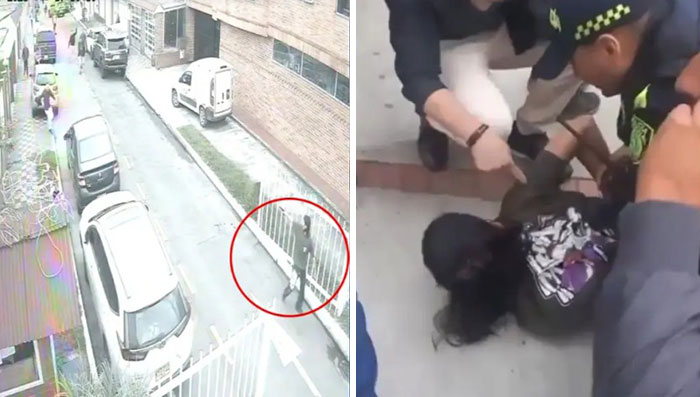
Stills from video show the boy aiming his pistol at those in pursuit and on the ground (Source: Blu Radio)
Uribe, meanwhile, was rushed to a nearby clinic before being transferred to the Fundación Santa Fe hospital in northern Bogotá. Once there, he remained in intensive care and underwent multiple surgeries over weeks. On August 11, 2025, little more than two months after the attack, Uribe passed away at the age of 39.
The young presidential hopeful’s death came just a week after his attacker had accepted charges of attempted aggravated homicide and illegal firearm possession. Being a minor, he faced a maximum sentence of eight years under Colombian law, but was ultimately handed a seven-year sentence that was later upheld by Bogotá’s Superior Court. While the reason for the reduction was not specified by authorities, criminal-law experts told El Tiempo that allowances are often made for the likes of accepting charges or cooperating with investigators.
Within a month of the shooting, four adults had been detained for involvement in the planning and logistics of the attack, and by October eight adults had been processed. They included Elder José Arteaga Hernández, alias “El Costeño,” the alleged coordinator; Katerine Andrea Martínez Martínez, alias “Gabriela,” who delivered the weapon to the shooter; Harold Daniel Barragán Ovalle, who helped select the teenager; and Jhorman David Mora Silva, alias “El Caleño,” who is accused of convincing him to do the job.

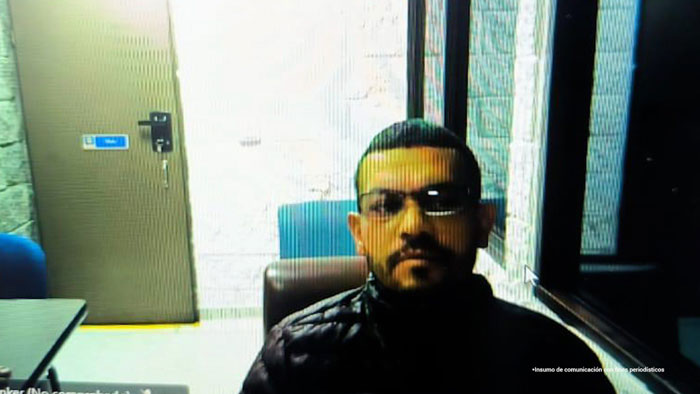
Arteaga appears via video link in an image shared by Colombian authorities (Source: Fiscalía / X)
In February, Martínez was sentenced to 21 years and 2 months in prison for her part in the plot, and in May, Barragán was sentenced to 21 years and 4 months for his role. The cases against Arteaga and Mora remain ongoing.
On March 24, Attorney General Luz Adriana Camargo announced arrest warrants against seven members of the Segunda Marquetalia, a dissident faction of the demobilized Revolutionary Armed Forces of Colombia (FARC) guerrilla group. Camargo said the group targeted Uribe for “political-instrumental reasons linked to his functions as a senator and candidate.”
Among the seven, Kendry Tellez Álvarez, alias “Yoko,” is accused of being the primary coordinator, who allegedly organized a 1 billion Colombian peso (US$250,000) payment for the hit during meetings held near the Venezuelan border.
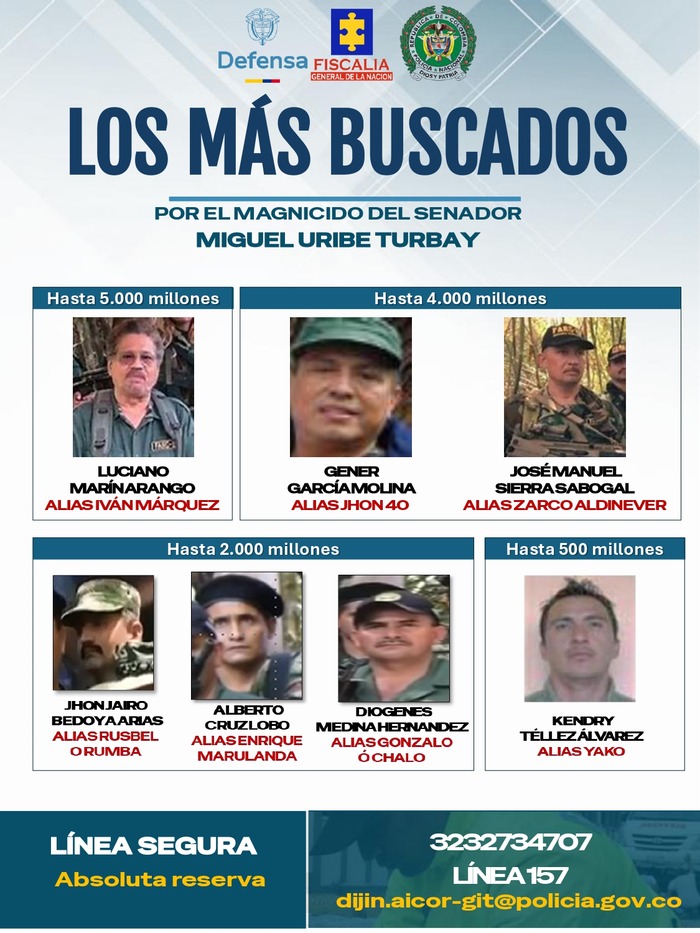
The seven wanted guerillas
A Seven-Year Sentence
The seven-year sanction handed to Uribe’s killer landed in a country with a long history of extreme political violence, but which hadn’t seen a presidential candidate assassinated in three decades.
For Uribe’s family and supporters, the fact the gunman would be free by his early twenties after committing such a brazen and socially destructive crime was inconceivable. Víctor Mosquera, the lawyer representing Uribe’s family, said the sentence showed that Colombia’s youth justice system (SRPA) was providing an incentive for criminal organizations to recruit children.
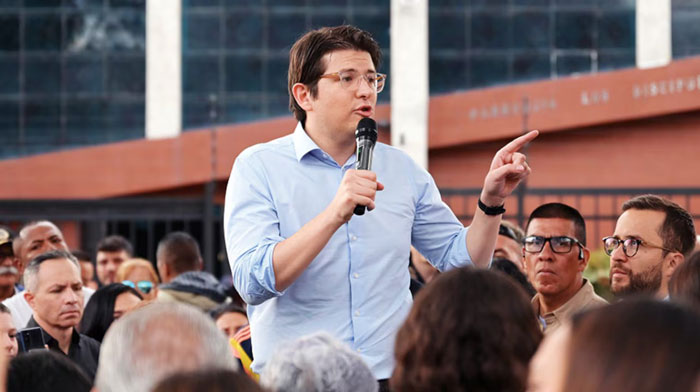
Miguel Uribe Turbay speaking at El Golfito Park (Source: Consejal Andrés Barrios)
Under Colombia’s juvenile justice framework, criminal responsibility is recognized at 14, and adolescents up to 17 are treated separately from adults. The system allows detention for serious crimes, but it is supposed to be designed around education, rehabilitation and reintegration. Even in the most serious cases, the maximum sanction is eight years.
That system is now central to the prosecution’s account of the murder.
At a hearing against Arteaga, prosecutors cited testimony from Martínez that he had asked whether she knew a minor who could commit a crime he was planning. He wanted someone preferably aged 14 or 15 years old, prosecutors said, “because that way he would not be tried as an adult, but would instead be handled under juvenile jurisdiction.”
The allegation of intentional age-based selection has not yet been established in a final judgment. But the case has given lawmakers a concrete example to back an argument promoted by hardliners for years: that criminal groups use minors because the law treats them more leniently.
Tried As Adults
Two days after the shooting, Liberal Party representative Piedad Correal Rubiano announced a bill to change the way Colombia punishes adolescents accused of serious crimes.
“No more homicides and terrorism committed by minors in this country!” Correal said during a session of the House of Representatives.
The bill proposes that minors aged 14 to 17 accused of a defined group of serious crimes face adult sentencing. Those crimes include intentional homicide, kidnapping, extortion, terrorism, sexual offenses and some firearms offenses, among others.

A still of the video shows the moment the teenager aimed the gun at Uribe (Source: By Viral / X)
Under the proposed legislation, underage offenders could face sentences of up to 60 years, and would be transferred from the youth justice program to the adult prison system to complete their sentences upon turning 18.
Article 44 of Colombia’s constitution explicitly acknowledges that the rights of children take precedence over the rights of all others, and the country processes offenders who committed crimes as minors through the SRPA, even if they are adults when they are captured.
That is in keeping with standards set out by the UN Committee on the Rights of the Child, whose General Comment No. 24 says child justice should apply to people who were under 18 at the time of the alleged offense. Colombia’s youth justice system also defines itself as pedagogical, restorative and differentiated from the adult system.
“Anyone who acts like an adult should be treated like an adult,” said Centro Democrático representative Óscar Villamizar Meneses, in a press release announcing his support for the legislation.
“A killer, even if he is a minor, cannot be free in just seven years. That is a mockery of Colombia. With this reform we seek equal sentences for adults and minors who commit atrocious crimes. Today many young people voluntarily enter criminal groups; they are paid sicarios and live from that.”
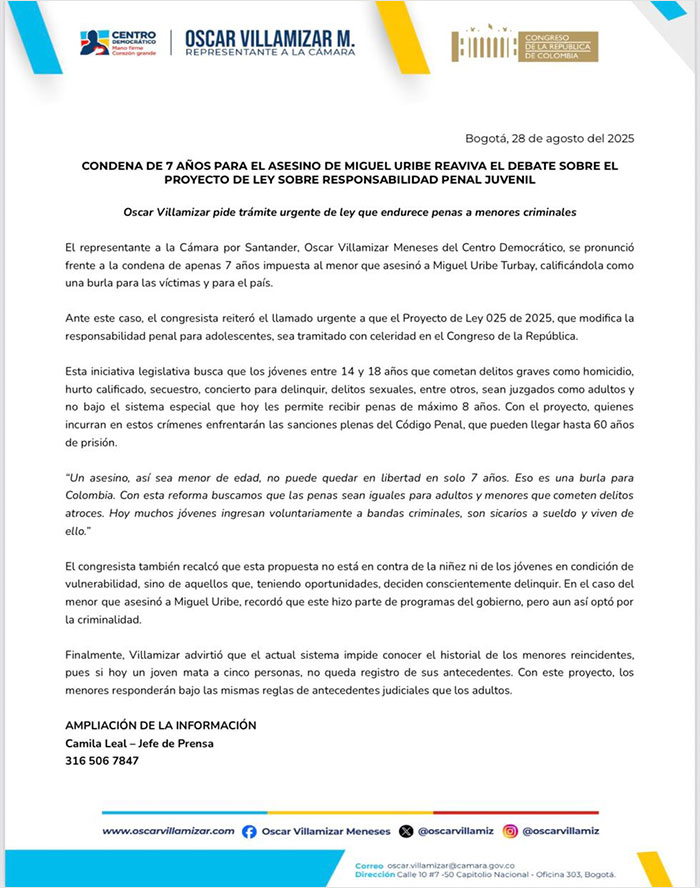
The statement from Óscar Villamizar Meneses
That argument is politically powerful in a country where contract killing – known as sicariato – accounts for a significant portion of total homicides. In Bogotá alone, sicariato cases rose 40% between 2023 and 2024 and account for almost half of murders in the capital. In the southwestern city of Cali, such killings represent more than 70% of total homicides.
High levels of impunity also feed into a widespread public lack of faith in the justice system. The World Justice Project ranks Colombia 120 out of 142 nations – below the likes of Zimbabwe, Iran, Sudan and Kyrgyzstan – for effectiveness, fairness and accessibility to criminal justice.
But observers say the proposed bill would redraw the line between adolescent and adult justice for an entire category of serious crimes, without addressing the underlying factors that make minors vulnerable to criminal recruitment.
“If we’re talking about a father who is absent, who abandons, who mistreats, who abuses, who rapes his son, who hits him—we have to intervene with both the father and the son. And generally, with the family,” said Magistrate Fernando Pareja Reinemer, who works on both 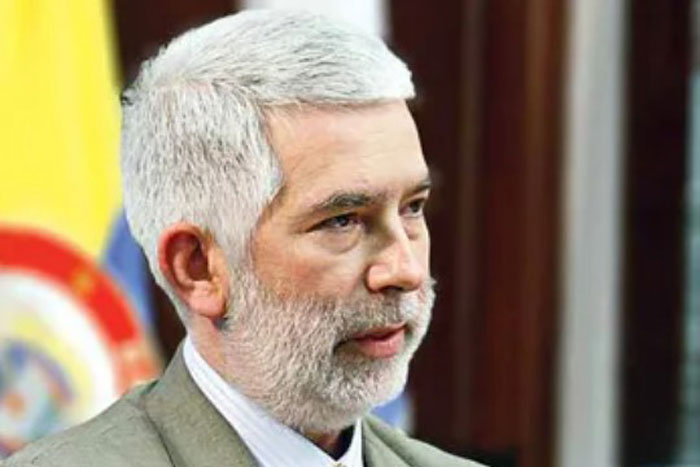
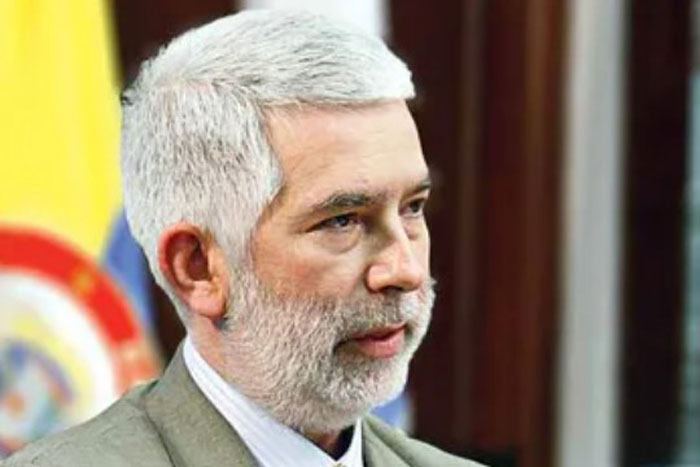
Magistrate Fernando Pareja Reinemer (Source: La Silla Vacia)
“You take a child to church, lock him in a display case, but when he comes out and goes back to his father, who hits and abuses him, it happens all over again. Because the system has no way of intervening,” he told Bored Panda, while speaking about the cycle of violence that helps lead many young people into crime.
The Reform That Disappeared
Before the attack on Uribe, Colombia was debating a different kind of youth justice reform. Three months earlier, the Ministry of Justice introduced proposed legislation that sought to strengthen restorative and therapeutic justice inside the SRPA.
The proposal was supported by Colombia’s family welfare agency (ICBF) and aimed at improving reintegration, reducing repeat offending and addressing problems such as substance use, family violence and mental health. It preserved the basic principle that adolescents should be treated differently from adults, even when they commit serious crimes.
A public hearing on the bill was held on May 29, where acting Justice Minister Ángela María Buitrago told senators the purpose was to make the youth system fulfill its “restorative, pedagogical, and protective” function.
Meanwhile, Jorge Enrique Vallejo, president of the Superior Council of the Judiciary, framed the legislation as a non-partisan attempt to meet “the real needs of the justice system for adolescents.”
Uribe was shot nine days later and, according to Dr Matthew Charles, an expert on child recruitment based at Bogota’s Rosario University, the ensuing public outcry helped derail the legislation.

Dr Matthew Charles (Source: Rosario University)
“Congress and even ICBF didn’t have the appetite to take on and kind of create this debate,” Charles told Bored Panda. “And so those reforms that really were trying to make the juvenile justice system even more restorative in its outlook were shelved.”
Within weeks, the public debate had moved from strengthening the restorative underpinnings of the youth justice system to imposing sentences of up to 60 years and eroding its division from the adult system.
Scrutinizing the narrative
According to Glaeldys González Calanche, a Bogotá-based analyst at International Crisis Group, the suggestion that lower sentences are a main driver of child recruitment is dubious.
“Children are recruited into armed and criminal groups for many reasons, not specifically because they face lighter criminal penalties than adults,” she told Bored Panda. “For these groups, children have become a commodity. They are essential to controlling territory, yet easily replaced.”
International Crisis Group has documented a rise in child recruitment as armed and criminal groups expanded into territories left unstable after a 2016 peace agreement between the Colombian government and the FARC.

Glaeldys González Calanche (Source: Glaeldys González Calanche / X)
“As the state struggled to fill the vacuum left by the demobilization of the former FARC, other armed and criminal groups expanded and competed violently for territory, making recruitment increasingly important to their growth and local control,” González Calanche said. “Today, all of Colombia’s major armed and criminal groups recruit children.”
Children can be used as lookouts, messengers, drug sellers, extortion collectors, weapons carriers or fighters. Some are sent into areas where adults are more likely to be recognized. Others are used because they attract less suspicion.
Charles also rejects the idea that youth sentencing is central to the calculations of criminal groups.
“I just don’t think they think that strategically,” he said. “I think they recruit kids because it’s easier for them. It’s cheaper. And I think strategically, kind of on the battlefield, especially in sicariato, people don’t expect to be killed by kids.”
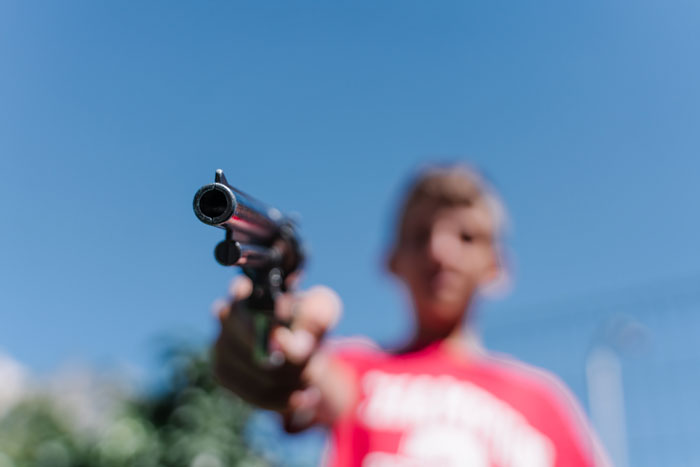
Children are regularly used to carry out contract killings (Source: Getty Images)
Charles said poverty and exposure to violence are among a complex array of factors that lead children to participate in crime, but those factors alone do not explain who joins and who does not.
“They perceive it as some kind of solution to the crisis that they are currently confronting,” he said. “Whether that crisis is socio-emotional, whether it’s domestic violence in the household, whether it’s poverty, you know, whatever it is, the armed group presents itself as a kind of solution in that moment.”
The children most vulnerable to recruitment may live in neighborhoods controlled by armed groups, have relatives or friends already involved, suffer ongoing violence in their lives, or perceive no realistic path into legal work or education. In such circumstances, joining a criminal group may feel like the best or only option available.
Urban Pipelines
The image of child recruitment in Colombia has long been that of a rural teenager taken from their home and sent into the mountains to live with an armed group. That still happens, but it is only part of the picture.
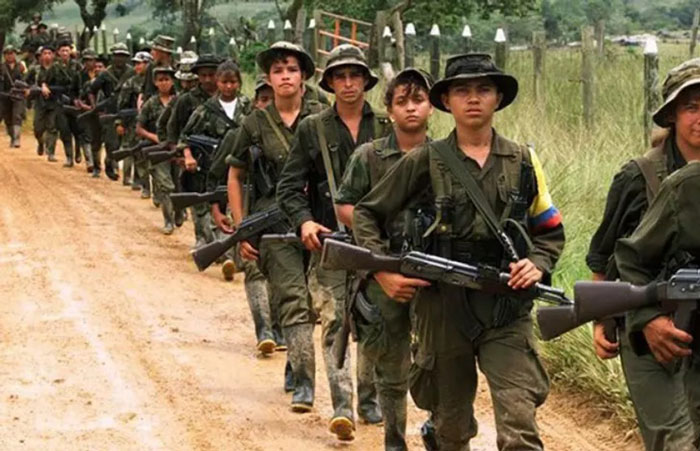
Young combatants in the since-demobilized FARC guerrilla group (Source: Prensa Rural)
Post-peace accord Colombia has seen a blurring of the line between armed conflict and organized crime. Urban gangs report to broader structures, and Children may begin in street-level roles and later be drawn into more serious violence.
In research published by the Colombian Organized Crime Observatory (OCCO), based at Rosario University, Charles and his colleagues identified children and adolescents involved in multiple roles within criminal and armed structures, including a specific sicariato line involving shooters, getaway riders, and weapons handlers.
The distinction between armed and criminal groups is significant because Colombia treats children differently, based on what type of structure they were recruited by. Those recruited by a recognized armed group will generally enter a rights-restoration process, while a child used by an urban criminal gang is likely to be processed according to the SRPA, even if the exploitation behind the crime is similar.
“What’s defining the response there is the classification of the armed group and not the rights of the child under the UN Charter, which is what the Constitution says should define the state response,” Charles said.
The Ombudsman’s Office of Colombia (Defensoría del Pueblo) has also described how criminal groups can use children without formally incorporating them into armed units. Rather than being taken away to live with a group, a child can remain in their home community while being used for surveillance, extortion, drug or weapons transport, or sicariato, making the exploitation harder for official systems to detect.
The Defensoría del Pueblo is Colombia’s Omubudsman (Image credit: Defensoría del Pueblo)
In its formal response to the legislation launched after the attack on Uribe, the Defensoría reported 1,332 cases of recruitment of children and adolescents between 2020 and September 2025. Recorded cases rose from 99 in 2020 to 621 in 2024.
The true number is almost certainly higher. Families may be afraid to report recruitment. Local officials may know children have been taken or used but be unable to formalize the complaint without an official report. In some communities, a criminal group may be the de facto authority.
In terms of the extent of child recruitment in urban crime, the National Criminal Policy Plan for 2021–2025 recorded 2,661 criminal complaints between 2016 and 2019 for the use of minors to commit crimes. The largest numbers in 2019 were in Bogotá (206 cases), Medellín (115), and Cali (96).
The Uribe case did not reveal a new phenomenon; it just made it impossible to ignore.
Punishing The Child
For Pareja, the danger in the current debate is that it turns children into the main object of punishment without adequately targeting the adults involved at different points of their trajectory into crime.
Under Colombian law, the use of minors to commit crimes already carries a prison sentence of up to 20 years, with higher penalties in aggravated circumstances. The problem, according to Pareja, is not the lack of adequate sentencing, but the enduring factors that make children susceptible to recruitment.
“In this context, for organized crime and criminal gangs, it is very easy to recruit those youngsters,” he said.
Pareja does not argue that adolescents who commit serious crimes should face no consequences. The question is what the state hopes to achieve by making children more punishable.
“When it is recognized that these adolescents, by being instrumentalized, are victims. It means punishing a victim for being a victim. It doesn’t make much sense,” he said.
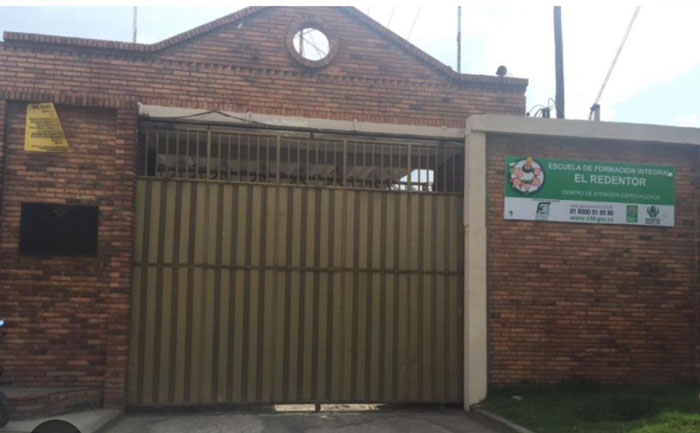
El Redentor is one of Bogotá’s youth detention facilities (Source: ICBF)
That argument is hardest to apply when recruited children commit heinous crimes, such as the attack on Uribe. But Pareja’s point is that the individual criminal act should not be separated from the social factors and structural violence that led to the minor committing it.
He described adolescents entering the justice system with histories of family violence, neglect, drug use, school exclusion, poverty and untreated psychological problems. Detention may remove them from the street, but it often does not change the conditions waiting for them outside.
“The causes of the crime are not addressed by the punishment. The sentence is an avenue that goes another way. It attends to other necessities,” he said, in reference to the need to sate public demand for justice.
The Defensoría reached a similar conclusion in its response to the bill. It said there is no evidence that adolescent offending is caused by low sanctions under the current system, nor that trying teenagers as adults would stop criminal groups from using them.
The Superior Council for Criminal Policy also opposed the proposal, saying it lacked empirical support and failed to respond to the social, cultural and educational needs of adolescents. The ICBF, meanwhile, warned that the bill would undermine the specialized treatment children are entitled to under Colombian and international law.
Those institutions are not defending the attack on Uribe. They are arguing that a law passed in reaction to it could harden punishment against children without weakening the adults who recruit them.
What The Case Shows
The Uribe case may prove that at least one criminal organizer saw value in a teenage shooter because of the sentencing regime of the juvenile justice system. That is the allegation made by the Attorney General’s office (Fiscalía), and it is central to the case against those accused of planning the assassination.
But it does not prove that shorter sentences are more of a motivation for armed and criminal groups to recruit children than the fact that they are cheap, replaceable, and less visible. Instead, experts point to a more basic problem: the failure of the state, families, and communities to protect children in the first place.
“Stronger prevention in high-risk areas, better investigations into recruitment networks, and more robust recovery and reintegration programs for children leaving armed groups are essential to address this growing problem,” González Calanche said.
While the teenager who killed Uribe received seven years, four adults convicted over roles in the plot have been handed prison sentences exceeding 20 years each, with ‘use of a minor to commit a crime’ among the charges accepted by three of them.
Meanwhile, as authorities seek to bring the alleged dissident commanders accused of ordering the assassination to justice, Colombia is left with a narrower question than the political debate suggests: whether subjecting children to harsher punishments will override the structural realities that lead them into crime, or make adults less likely to exploit them.
 Follow Us