“I’ve noticed my moods really change and I’ve had a lot of thoughts [of serious self harm],” one isotretinoin user wrote four months into treatment.
The drug was combating stubborn acne as it was supposed to: their skin had healed “a lot” and left them “so happy.” But that joy was offset by a surge of extremely dark ideas that left them hoping “to just hold on” and see out the treatment.
“I’m scared of my own thoughts and can’t help but think it’s related,” the user wrote in the r/Accutane subreddit – named after the discontinued brand that isotretinoin is most associated with.
The bleak ending of the post captures a trade-off widely described in online isotretinoin communities: months of harsh side effects in exchange for the chance of clear skin. It’s as if it’s left to teens to decide for themselves: what’s worse — the acne you’re getting bullied for, or the rap sheet of debilitating side effects the medicine brings?
Online forums have filled with users trading accounts of dark moods during treatment, and while the posts prove nothing on their own, they show why the debate has never gone away
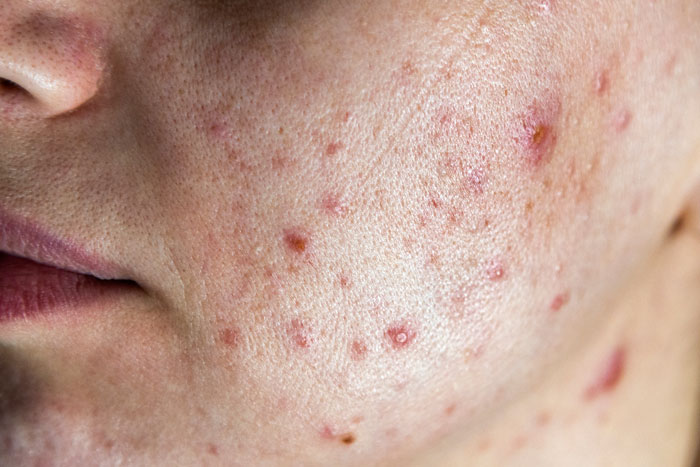
Image credits: khosrork / Magnific (not the actual photo)
In another Reddit thread, a user asked whether anyone else had experienced depression or suicidal thoughts while taking the drug. One commenter said acne itself was the reason they became depressed. Another said the opposite: severe depression and suicidal ideation appeared only after their acne had cleared, four months into treatment.
“The acne makes you depressed,” they wrote, “but the accutane [sic] makes it feel clinical and hormonal.”
A third user said isotretinoin had “brought back” depression after years of recovery. “It’s been 13 fucking days,” they wrote, “and i am more depressed then i [sic] have been in the past three years.”
Nothing in their life had changed except the medication, they said, before seeming to suggest they would to be discontinuing with the drug because of the side effects. “It’s not worth sacrificing my mental health,” they wrote
These posts do not prove isotretinoin caused anyone’s suicidal thoughts and many users describe pre-existing depression, severe acne, anxiety, other medications, or major life stressors. But the posts show why a debate has persisted around isotretinoin for decades.
For many patients, the drug clears acne after years of other failed treatments. But online forums have become meeting places of people dealing with side effects that many say are far more severe than they felt properly prepared for or warned about.

For many teenagers, isotretinoin can be life-changing, but reports of severe psychiatric side effects have kept the drug at the center of a decades-long debate
Image credits: magnific / Magnific (not the actual photo)
The drug’s ability to clear severe acne is widely recognized, even as debate over its possible mental health risks continues
Isotretinoin is one of dermatology’s most effective acne treatments, but it is usually reserved for severe cases, especially if there is a risk of permanent scarring. The drug was originally marketed by Roche as Accutane in the United States and approved in 1982 for severe recalcitrant nodular acne. Roche discontinued the branded product in 2009, but generic isotretinoin products remain widely available.
The drug’s physical risks have long been known. It can cause severe dryness, nosebleeds, joint pain, muscle aches and changes in blood tests. Its most serious established risk is birth defects if taken during pregnancy. In the United States, isotretinoin is controlled through iPLEDGE — a risk-management system built primarily to prevent fetal exposure.
But reports of psychiatric side effects have also followed the drug for decades. Cases of mood changes began appearing soon after isotretinoin entered the market, and by the late 1990s, U.S. labeling warned that Accutane may cause depression, psychosis and, rarely, suicidal ideation, suicide attempts and suicide.
The warning remains controversial because the evidence is conflicted. Some case reports, adverse-event data and biological studies point to rare severe psychiatric reactions. Large population studies, however, have generally not found that isotretinoin increases suicide or psychiatric disease risk across users as a whole.
That distinction is central to questions around Accutane’s risk profile, including whether it commonly makes users suicidal, if an unidentified subgroup of people is vulnerable to catastrophic psychiatric effects, and whether teenagers and parents are given a warning they can actually understand before treatment begins.

Image credits: garakta_studio / Magnific (not the actual photo)
Severe acne can devastate mental health on its own, making it difficult to separate the psychological effects of the condition from those of the treatment
The debate is difficult because severe acne can itself damage mental health. Teenagers with painful, visible or scarring acne may experience depression, anxiety, isolation, low self-esteem and suicidal thoughts before ever taking isotretinoin.
Dr. Adam Friedman, a dermatologist who has prescribed isotretinoin to patients with major depressive disorder and bipolar disorder, said that reality has to come first. “Leaving severe or scarring acne undertreated is not benign,” Friedman told Bored Panda. “For many patients, isotretinoin can be transformative medically and psychologically.”
That view is reflected in some significant research. A 2024 JAMA Dermatology meta-analysis found that, at a population level, isotretinoin users did not have an increased risk of suicide or psychiatric conditions, though the authors said clinicians should still monitor patients for mental distress. A 2019 BMJ Open meta-analysis found isotretinoin was associated with significantly improved depressive symptoms in acne patients.
For dermatologists, those findings are not incidental. If severe acne worsens mental health, then frightening patients away from a treatment that might be one of their only hopes can also cause harm.
One Reddit user who responded to questions from this reporter described that tradeoff clearly. Four months into a planned nine-month course, they said they had experienced joint pain, soreness, nosebleeds, depression, hair loss, brain fog, severe dryness and poor sleep. But they also said they were “so grateful” the drug existed.
“Even with all the terrible side effects I feel better than when I had acne all over my face,” the user wrote. They said they had not experienced suicidal thoughts, describing the depression as closer to low motivation, and said they felt able to recognize it. “I knew I felt depressed from the accutane [sic] so I didn’t let it get to me.”
Their account demonstrates why the warning issue is so complicated. Some patients may accept serious side effects because acne was worse. Others may stay on the medication even as psychiatric symptoms worsen because stopping feels like losing the only treatment that worked.
Friedman said he does not personally believe there is a causal relationship between isotretinoin and psychiatric disease. But he also said rare idiosyncratic psychiatric reactions may occur in susceptible people, which is why careful screening, informed consent and close follow-up remain important.
That is where the controversy begins.

Image credits: magnific / Magnific (not the actual photo)
Large studies have generally found no overall increase in psychiatric illness, but some researchers believe rare reactions can be devastating for vulnerable patients
Dr. Douglas Bremner, a psychiatrist and researcher who has studied isotretinoin and the brain, argues that population-level reassurance does not settle the question of rare reactions. He points to cases where patients worsened on isotretinoin, improved after stopping, and worsened again after.
“When someone gets better when they go off the drug and then worse when they go on it again, what is called challenge-dechallenge-rechallenge, that is considered proof of a causal relationship between a drug and a side effect,” Bremner told Bored Panda.
Bremner said there were 41 such cases reported by the FDA for isotretinoin, in situations where acne was unchanged or had likely improved, making acne severity a weaker explanation. “The risk is not necessarily common,” he said, “but when present can be catastrophic.”
Bremner’s earlier brain-imaging work found reduced function in the orbitofrontal cortex among acne patients treated with isotretinoin compared with those treated with antibiotics. The orbitofrontal cortex is involved in mood and emotion, and Bremner said previous work showed that function in that region can drop abruptly when people become acutely depressed.
That study does not prove isotretinoin causes suicide. But it is one reason some researchers say the psychiatric symptoms some users report cannot be dismissed as teenage distress, acne shame or coincidence alone.
Bremner also rejects the idea that large studies have found nothing. He pointed to research by Dr. Laurent Azoulay and colleagues that reported an increased risk of depression among isotretinoin users. While other large studies have been more reassuring about the risks, for Bremner, their findings only highlight the difficulty of trying to detect rare but severe reactions in a treatment population already at elevated psychiatric risk because of the psychological toll of the acne itself.

Image credits: goodn8 / Magnific (not the actual photo)
Researchers remain divided over the evidence, but some argue there are biological reasons why isotretinoin could affect the brain in susceptible people
According to Dr. Peter McCaffery, a University of Aberdeen researcher who has studied retinoic acid signaling in the central nervous system, the biological plausibility of the severe psychiatric side effects reported by some users begins with what isotretinoin is.
As a retinoid, isotretinoin is part of the vitamin A family. Vitamin A is used throughout the body, including in the skin. But the brain also has the molecular machinery to use retinoic acid. This “means that isotretinoin is very likely to affect the brain,” McCaffery said.
The brain is not uniformly dependent on retinoic acid signaling, he said. But some regions involved in cognition, including parts of the cortex and hippocampus, as well as the hypothalamus, do use this system. Changes there could plausibly affect processes related to mood.
McCaffery was careful not to overstate what animal and cellular models can show. Cells and animals can demonstrate that retinoic acid is used in the brain and that isotretinoin can alter neuronal function. They cannot fully model human depression, suicidality or adolescent emotion. Still, the evidence is strong enough to justify caution.
One possible vulnerability factor, he said, could be differences in how quickly people remove isotretinoin from the body, including through enzymes known as CYP26. Another is psychiatric vulnerability. Some studies exclude people with histories of psychiatric disorders or psychotropic medication use, which may make sense scientifically but could also remove the subgroup parents would most worry about.
McCaffery also said studies on isotretinoin and androgen levels are mixed, but generally suggest androgens may decrease, including dihydrotestosterone (DHT), the most active androgen. That could help explain why some online patient communities see overlap between persistent symptoms reported after isotretinoin and those reported after 5-alpha-reductase inhibitors such as finasteride, which lower DHT more directly.
Online, some sufferers refer to a broader cluster of persistent sexual, neurological, emotional and physical symptoms as “post-Accutane syndrome.” It is not a formally established diagnosis, and there is no single large advocacy organization around it. But the term has become common in online communities where users discuss symptoms they say continued after stopping isotretinoin.

Image credits: DC Studio / Magnific (not the actual photo)
The biggest disagreement is no longer whether psychiatric side effects have been reported, but whether patients are being warned in a way they can truly understand
In the United States, isotretinoin is already heavily regulated. But iPLEDGE was designed primarily to prevent pregnancy exposure, not to make psychiatric consent meaningful.
Psychiatric warnings exist and the drug label warns that isotretinoin may cause depression, psychosis, suicidal ideation, suicide attempts, suicide and aggressive or violent behavior. The problem, critics say, is that official warning language does not always translate into practical understanding.
Friedman said the iPLEDGE process can feel “administrative and compliance-driven rather than deeply educational,” with side-effect warnings coming among a deluge of other information. “The challenge is that informed consent is not the same as meaningful understanding” he said.
In Friedman’s view, the answer is not more barriers that could delay treatment or make families afraid of a drug that may help them. Instead, he said families need repeated, direct conversations about what to monitor: worsening mood, irritability, social withdrawal, sleep changes, anxiety, panic symptoms, declining school performance, appetite changes, hopelessness and any suicidal thoughts or behaviors.
The Reddit posts highlight the recurring patient dilemma that makes that practical guidance is important: when mood changes appear during isotretinoin treatment, users may not know whether to blame acne, the medication, pre-existing health problems or ordinary stress. Some may delay telling a doctor because the treatment is showing results.
For Dr. David Healy, a psychiatrist whose work has focused on how patient reports can surface persistent or unusual adverse effects that clinical trials and national monitoring systems may miss, the adverse-event monitoring system is “badly broken.” “Finding words that capture what a better system would like is more difficult,” he told Bored Panda.

Image credits: magnific / Magnific (not the actual photo)
Regulators continue updating safety guidance decades after isotretinoin reached the market, suggesting the conversation around patient warnings is still evolving
The United Kingdom has recently moved to strengthen isotretinoin safety measures. In January 2026, the Medicines and Healthcare products Regulatory Agency (MHRA) announced updated risk-minimization steps, including a revised Acknowledgement of Risk Form, a clinical audit and a patient information video to be viewed before treatment.
A spokesperson for the regulator told Bored Panda the changes followed advice from the Commission on Human Medicines after a review of existing safety measures. They said the MHRA continues to monitor isotretinoin through adverse drug reaction reports, clinical and epidemiological studies, medical literature, pharmaceutical companies, other regulators and morbidity and mortality databases.
While the UK changes do not necessarily prove earlier warnings were inadequate, they do show that, decades after isotretinoin became a mainstay of acne treatment, regulators are still revising how patients are told about risk.
For U.S. patients, that raises a narrower question than whether Accutane should have remained on the market. Are teenagers receiving warnings that are legally present but practically forgettable?

Image credits: gpointstudio / Magnific (not the actual photo)
Isotretinoin remains one of dermatology’s most potent tools, and for many people, it is the only treatment that works, or the only thing that can adequately prevent permanent scarring. Meanwhile, the evidence does not show that it commonly causes suicide or psychiatric disease across the whole population of users.
But “rare” is not the same as irrelevant.
For patients who say they developed sudden depression, panic, insomnia, brain fog, emotional blunting or suicidal thoughts during treatment, population-level reassurance can feel distant. Yet dermatologists say restricting access too much could also harm patients whose acne is causing serious distress.
That is the unresolved tension around isotretinoin. Not whether the drug should disappear from dermatology, but whether a treatment given to people at a vulnerable stage of life comes with warnings that adequately prepares patients and parents for what could go wrong.
 Follow Us