When Punch-Drunk Love was released in 2002, many viewers didn’t fully understand what they were watching. Certainly, no one picked up on the fact that it’s a film about mental health. Actually, most people walked out wondering, “What did we just watch?” or they didn’t walk in at all. The film barely broke even on its $25 million budget, mainly because most of the people who showed up hoping to see Adam Sandler pull off another Happy Gilmore goofball felt totally ripped off.
It’s taken a whole generation to figure out that Paul Anderson made a movie about how it actually feels to be a person who can’t get out of their own way. And that he absolutely nailed it. Simply put, Punch-Drunk Love predicted the Gen Z mental health crisis before Gen Z even knew they’d have one. Watching Sandler’s Barry Egan smash sliding glass doors at his sister’s birthday party and then quietly ask his brother-in-law for a therapist’s number felt funny and weird in 2002. But in this generation, it reads as painfully, uncomfortably on the nose.
Barry Egan Is Every Anxious, Lonely, Emotionally Overwhelmed Gen Z Person
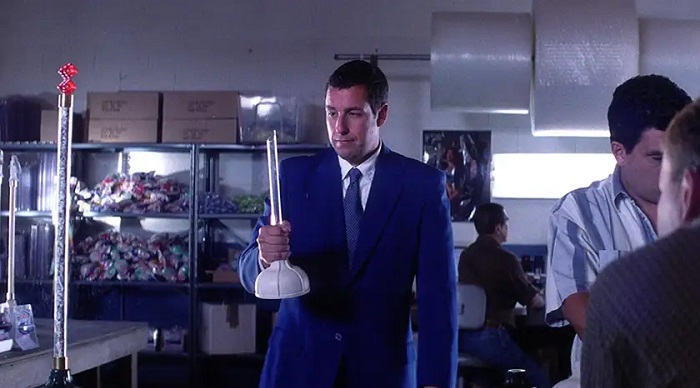
According to a recent nationwide poll, about 47% of Americans feel lonely on any given day. And about 60% of Gen Z have completely cut off a friend or loved one just to protect their peace. That’s Sandler’s Barry Egan in a nutshell. He runs a small business and has seven sisters whose idea of love is roasting him about being single at pretty much every family dinner. The not-so-peculiar thing about Barry’s loneliness isn’t the fact that he has no one. It’s the fact that he’s surrounded by people who don’t see him and constantly push his buttons until he snaps. And whenever he snaps, he breaks things.
Now, if that sounds familiar, it’s because it’s a common emotional response in this day and age. In Sandler’s earlier comedy roles in movies like Billy Madison and Happy Gilmore, those outbursts were funny, and the creators milked those laughs for all they were worth. But in Punch-Drunk Love, Anderson deliberately zooms in on the dark side. Barry can’t really say why he’s angry, but he feels everything at a very high level with no idea how to tone it down. Gen Z, the generation that learns therapy lingo from Instagram reels and TikTok clips, has now fully recognized it as “emotional flooding,” but for Barry, it was just another Tuesday.

Punch-Drunk Love Showed Us How Broken Systems Break People, Before We Had the Language For It
Punch-Drunk Love used Barry’s experience with mattress store owner Dean Trumbell (Philip Seymour Hoffman) to show how broken systems break people before anyone even had a name for it. In a bid to escape his life of loneliness, Barry decides to call a phone sex line, and because no one really taught him how dangerous it is to give his personal information to strangers, he does exactly that. And it cost him. Big time.
Dean uses that information to extort him and make his already miserable existence even more tragic. Dean sends four thugs to physically collect money from Barry. What’s worse is that he can’t confide in the people closest to him because they’ll just dismiss it as more Barry weirdness. Instead, he suffers in silence for a long time. Essentially, Barry got punished for reaching out. By Dean for seeing him as easy money. But mainly by his family, not because they built the trap, but they sure didn’t give him a map around it either.
In a way, Gen Z is struggling with the same thing as Barry, no thanks to social media companies. They design apps that give users the impression that everyone else is having fun without them. Ever notice how algorithms know exactly what makes each user anxious? It’s social engineering at its best. Then they sell the “cure,” which is basically more scrolling, more liking, and more feeling like real life isn’t worth living. So, while Barry had a phone scammer, Gen Z has an algorithm that never sleeps.
Why the Film’s Ending Feels Like the Most Honest Thing Ever Said About Mental Health
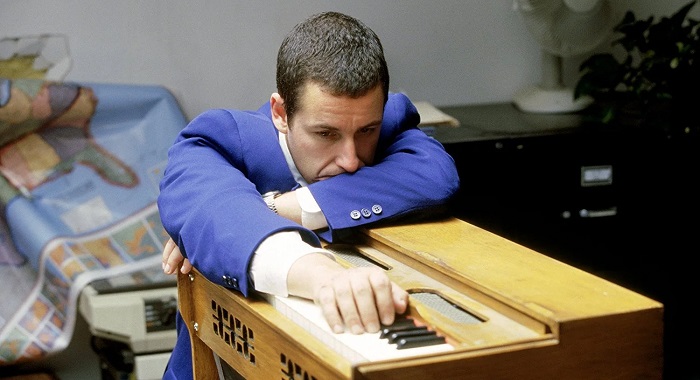
The ending of Punch-Drunk Love is arguably the most honest thing ever said about mental health in any movie about mental health. Nobody sits Barry down to fix him with a long speech about regulating his emotions or cutting down on doomscrolling. Instead, he arrives at his office in the morning to find that a harmonium had fallen off a truck and landed on the curb right outside his office. For some reason, he takes it inside, and when he plays it alone, it gives him a tiny slice of quiet.
His relationship with his girlfriend Lena (Emily Watson) is the same. She doesn’t come up with any 12-step program to fix Barry. She just chooses him and stays despite his flaws, even after he leaves her following an accident to take on the scammers. When he returns and apologizes for leaving, she just lets him know she wasn’t angry about the accident; she was angry that he left her alone at the hospital. In essence, that’s the movie right there: two messy people choosing each other anyway.
The final shot? Lena, with her arms wrapped around Barry, while he plays his harmonium. He’s not healed; he’s just held, and that’s the whole point. Gen Z’s mental health conversation finally landed on the same truth: healing doesn’t always look like healing. Sometimes it looks like finding one person who doesn’t run, and one dumb little thing that makes life feel okay.
A recent survey found that about 73% of people would rather ghost a friend than work through a hard conversation. It feels like everyone wants a clean, no-drama connection, which is nearly impossible. And Punch-Drunk Love drives home the fact that the mess is the point. If that’s not worth rewatching an Adam Sandler movie for, honestly, what is? Watch Punch-Drunk Love without the 2002 context clouding your judgment, and see if Barry Egan doesn’t feel like someone you know. He might even feel like you.
 Follow Us