Money matters are a touchy subject. It’s why you don’t talk about salaries outside of your significant other, and why rifts can easily trigger when there is cash involved in the conversation.
This is what happened between a group of colleagues when one employee set up a money pool to fund activities outside of work. One of his coworkers then asked for a cost breakdown, to which he responded with volatility and gaslighting.
To make matters worse, the woman who wanted to see where the money was going was also ostracized by the entire team.
Drama erupted among a group of employees after one of them set up a money pool

Image credits: prostooleh/Freepik (not the actual photo)

The rift arose after a woman asked for a cost breakdown, for which she was ostracized


Image credits: Super-Ad-2617
Shady behavior when handling money doesn’t always happen out of malicious intent
It’s understandable to fault the fund manager for his questionable actions. He’s handling his coworkers’ hard-earned money, and refusing to provide a cost breakdown will raise alarm bells.
However, his intentions may not necessarily be malicious right off the bat. According to REAP Financial CEO Chris Heerlein, one reason they behave in such a manner is the pressure of their obligation, compounded by possible status anxiety.
“The stress kicks in, and suddenly they’re acting funny. Nine out of ten, they have no intention to rip you off. They’re just panicking and not wanting everyone to know they’re broke,” Heerlein told Bored Panda.
Parikh Financial CFO and managing director Ravi Parikh says the lack of financial literacy could also be at play, along with communication issues. As he noted, people typically assume others would agree to certain expenses without confirming.
CPA Paul Carlson says it could also be a control issue. A person managing funds could have an “I’ll do it my way” approach, while forgetting that transparency matters when money and other people are involved. However, is automatic suspicion warranted?
“Healthy skepticism is fine, but don’t assume the worst without getting any answers,” Carlson noted, adding that someone refusing to show a cost breakdown is a signal to ask for more clarity, while assuring the person that you’re not assuming the worst, but instead, reiterating that you deserve to know.
What is the proper approach here? Parikh says it should be about empathy first.
“Instead of stating that something is drastically wrong, you can say that you noticed that the numbers don’t add up. Say that it can be a mistake or even a misunderstanding,” he advised.
Carlson shared a similar piece of advice, although he focused on the tone of the conversation. He emphasized neutrality and factuality without making accusations, and making the intention all about finding clarity.
“They’ll be more likely to cooperate when you frame the conversation as a shared responsibility,” he noted.
However, the woman in the story had to deal with getting piled on by her colleagues, which was unnecessary. She could bring up the matter with HR, who are better equipped to handle such issues and make final decisions.
The author provided more information about her story


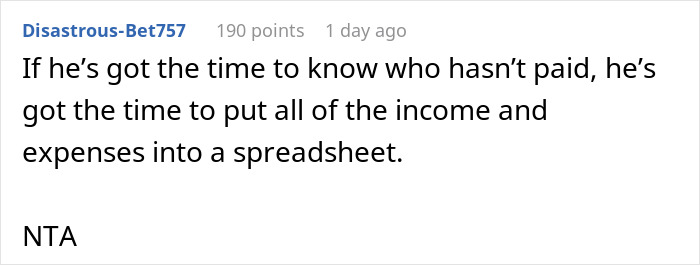
Many commenters thought her request was reasonable


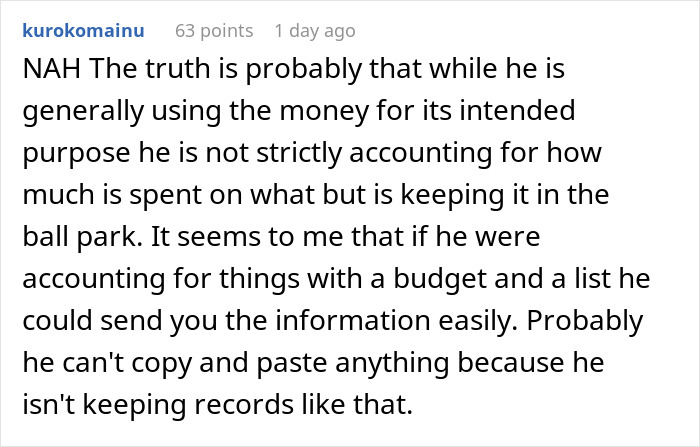


However, some people faulted her for supposedly causing drama


 Follow Us