Maddy Renne says she can eat bread, pasta, and gelato in Europe without the bloating she experiences back home in the U.S., and her before-and-after videos have left thousands wondering why.
The travel and wellness influencer believes the answer may be hiding in the food itself, arguing that the American diet leaves her “inflamed,” while European food makes her feel like her body is “finally functioning” as it should.
But experts told Bored Panda that the difference may have less to do with European ingredients than Maddy realizes, and that her dramatic transformation is more complicated than a simple “U.S. vs. Europe” food divide.
Maddy Renne says 14 days in Europe were enough to transform how her body felt

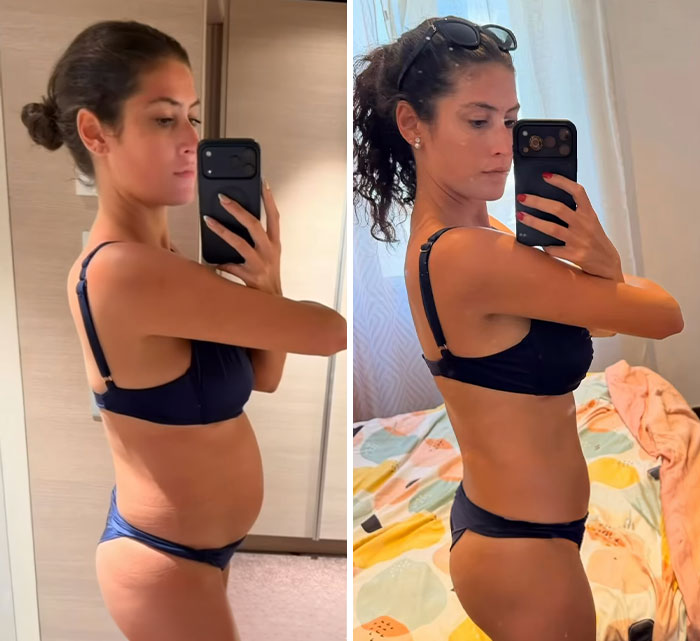
Renne’s European food experiment started with a striking observation: she seemed to look noticeably different after spending time in France and Italy.
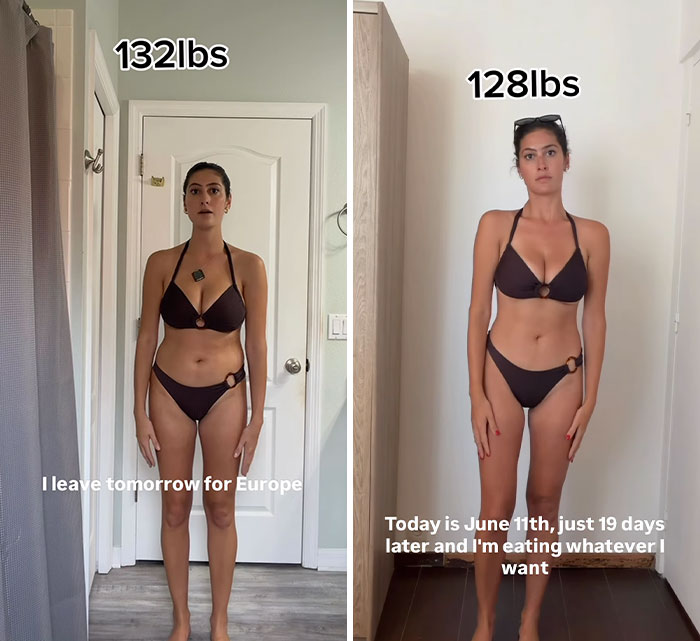
In one viral post, she compared clips taken just 19 days apart, claiming she ate more bread, pasta, and gelato in Europe than she normally would in the U.S., yet felt less bloated and watched her clothes fit differently.
“I’m eating more in Europe than I ever do back home in the U.S., yet my inflammation goes down, my clothes fit differently,” Maddy wrote in her post.



For someone who usually associates carbs with restriction, the experience was difficult to ignore.
She has since made the contrast a recurring part of her content, documenting European food, visiting farms, and searching for ways to recreate the ingredients and eating habits she believes make her feel better.
But Maddy’s biggest claim goes beyond simply feeling less bloated.
She believes the dramatic difference may be evidence that chronic inflammation is playing a much bigger role in how her body responds to food.

That’s where her viral transformation gets much more complicated.
What made Maddy’s experience particularly striking was that she wasn’t following the kind of restrictive diet many people associate with weight loss.
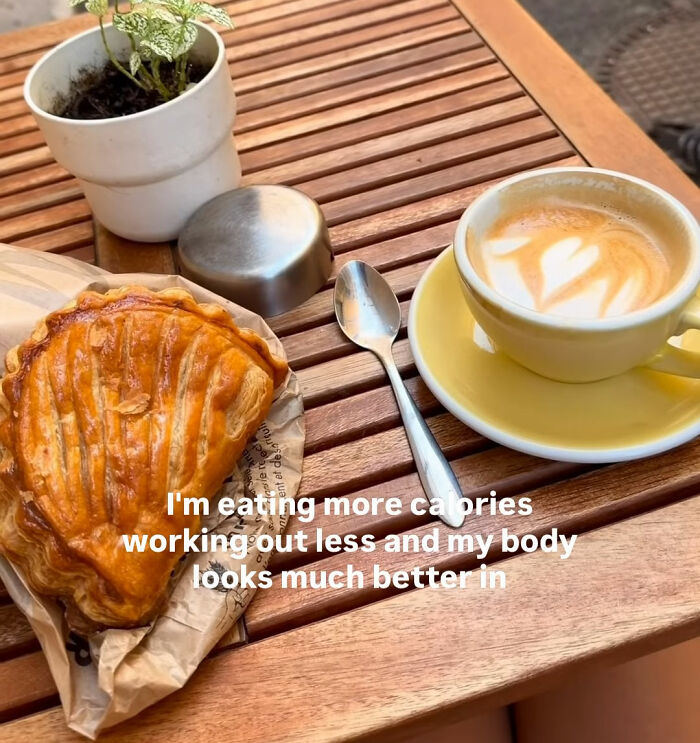
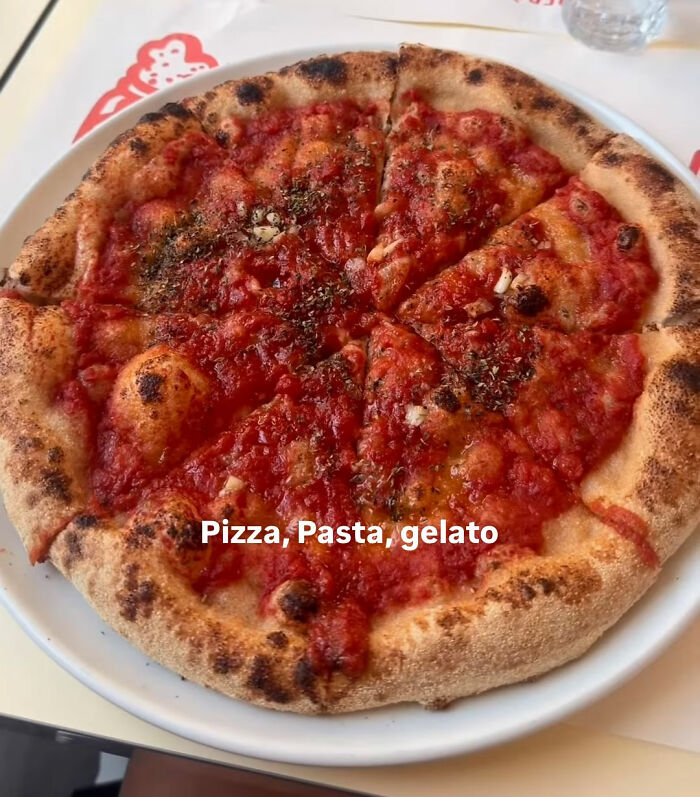
Instead, her European meals could include the very foods she often limited at home: bread, pasta, gelato and other carbohydrate-rich staples.
The bread-and-gelato paradox made Maddy question what she knew about food
Yet she said she felt better eating them abroad. That apparent contradiction became central to her message.
Maddy has argued that the problem may not be carbohydrates themselves, but the way food is produced and processed in the U.S.
Her content frequently focuses on finding less-processed ingredients, sourcing European imports, and understanding how food gets from farms to grocery-store shelves.


But dietitian Danielle E. Smiley, RDN, LDN, CD-N, cautioned against assuming that one ingredient was responsible for the transformation.
“The gelato doesn’t travel alone,” Smiley said. “The entire lifestyle surrounding the meal matters.”
Walking more, sitting less, eating smaller portions, taking longer to finish meals and experiencing less work-related stress can all change how the body feels, even when the food itself looks indulgent.
As Smiley put it, people “can return from vacation convinced that one ingredient changed their body when, in reality, they changed ten things at once.”
Maddy’s claims struck a nerve with viewers who said they had noticed something similar when traveling outside the U.S.
“This video is a clear representation of what Americanized food does to our bodies, no matter how clean we try to keep our diets,” one commenter wrote.
Fans claimed their own bloating and stomach problems disappeared after trips to Europe

Another viewer, who said they are from Spain, shared a particularly personal experience after spending 11 months in the U.S.
They claimed they continued eating a Mediterranean-style diet with plenty of vegetables and whole grains, yet developed persistent bloating, gastritis, and itchy rashes.
“Ever since I came back to Spain, I haven’t had any of those symptoms,” the commenter wrote.

“I have gluten sensitivity, and my doctor said I would be fine in France and Spain on vacay and indeed I was,” another person claimed. “I was eating all the breads and no bloating or stomach pains at all.”
Another commenter echoed the sentiment after returning from a European trip, writing that they could “truly taste/feel the difference” between American processed food and its European counterparts.
The comments weren’t proof that European food caused these experiences, but they showed why Maddy’s videos resonated so strongly with her viewers.

Maddy’s followers may have been quick to blame American food, but the reality is less straightforward than pitting the U.S. and Europe against each other on a health divide.
Dietitian Joanna Michalowska points to one important difference: ultra-processed foods account for around 58% of total energy intake in the U.S., while estimates across European countries range much more widely, from roughly 14% to 44%.
That matters because the issue may not be whether a person is eating bread or pasta, but what their overall diet looks like.
Maddy ate plenty of carbs in Europe, but experts say that’s not the whole story


A typical Western dietary pattern tends to include more ultra-processed foods, refined carbohydrates, added sugars, and processed meats, while providing fewer fruits, vegetables, legumes, and other fiber-rich foods.
“It’s more accurate to say that patterns of intake can drive inflammatory signaling rather than treating one ingredient as uniquely responsible,” explained Dr. Nicole Avena.
Diet can affect several systems at once, including digestion, blood-sugar regulation, fluid balance, and the gut microbiome.
A shift toward more whole foods and fewer ultra-processed foods can change fiber intake, gut fermentation, bowel regularity, and sodium consumption, all of which can affect how bloated or “puffy” someone feels.
The gut can also respond to changes in routine and food composition relatively quickly.
That may help explain why someone can notice less bloating within days or weeks without necessarily changing their underlying chronic inflammation.

Carbohydrates themselves are not automatically the problem, either.
Portion size, preparation, fiber content, and individual tolerance can all influence how someone responds to bread, pasta, and other carbohydrate-rich foods.
And that is where Maddy’s European experience gets interesting: she wasn’t simply eating different ingredients.
One expert said, “People sometimes return convinced that one ingredient changed their body when, in reality, they changed ten things”

Katrin Bolovtsova/Pexels (not the actual photo)
She may have been eating different portions, walking more, sitting less, and eating those foods as part of longer, more balanced meals.
That distinction is important when looking at Maddy’s experience.
Someone can eat a croissant in France and still have a diet that is relatively less processed overall.
Someone in the U.S. can also eat a Mediterranean-style diet without automatically experiencing the problems Maddy describes.

Ketut Subiyanto/Pexels (not the actual photo)
If carbohydrates were the obvious culprit, Maddy’s European experience would make little sense.
She was eating the very foods she had once been more cautious about, yet said she felt less bloated and more comfortable in her body.
The experts, however, don’t believe this necessarily means European carbs are somehow healthier.
“Carbohydrates themselves are not automatically the problem,” Michalowska explained.

Vicky T M/Pexels (not the actual photo)
She pointed to portion sizes, food preparation, fiber content, and individual tolerance as possible reasons two seemingly similar meals could feel very different.
A traditional European bread or pasta may also differ from a highly processed American product in its ingredients or fermentation process.
But that doesn’t mean everyone who reacts badly to bread in the U.S. is actually reacting to American wheat or additives.
Experts warn against calling a flatter stomach proof that inflammation is gone
Dr. Avena similarly emphasized that the quality, structure, and context of carbohydrates can matter more than simply counting grams.
There is another factor Maddy’s followers may not have considered: what happens around the meal.
Walking through a European city, eating slowly over a longer meal, and pairing carbohydrates with protein, fat, and vegetables can change digestion and energy expenditure.
A person may also snack less without consciously trying to eat less.

ArtHouse Studio/Pexels (not the actual photo)
As Smiley put it, someone might be “eating more pleasurably but less overall.”
So the mystery may not be why Maddy could eat gelato without consequences.
It may be everything else she was doing while eating it.
Maddy has described the difference between her U.S. and European appearances as evidence that her inflammation drops while traveling.
“A photograph cannot tell us someone’s inflammatory status,” Smiley said. “A flatter stomach or less-puffy face can certainly reflect a genuine change in how someone feels.”
“But bloating and water retention can shift rapidly because of sodium intake, hydration, carbohydrate intake, bowel movements, meal size, al**hol, physical activity and stress.”
Dr. Avena explained that gastrointestinal symptoms can change within days or weeks as gut motility, fermentation, fluid balance, and other short-term processes respond to changes in diet and routine.
Maddy has spent the past few months trying to bring Europe home, but nothing feels quite the same


That does not necessarily mean chronic inflammation has dramatically changed.
“Less bloating means less bloating; it doesn’t mean your arteries are calmer,” the expert noted.
Chronic inflammation refers to persistent, low-grade activation of the body’s inflammatory processes.
It cannot be diagnosed by looking at a before-and-after photo, and feeling less swollen isn’t enough to establish that it has disappeared.

1907663740/Pexels (not the actual photo)
That doesn’t make Maddy’s experience meaningless.
She may genuinely have felt better, experienced less bloating or retained less water while in Europe.
The U.S. and European Union do have different approaches to regulating certain additives, preservatives, and food ingredients.
But experts caution against turning those differences into a simple good-versus-bad story.
“I would not say that ingredients permitted in the U.S. are inherently more harmful or inflammatory than those used in Europe,” Michalowska said.
“Some ingredients are treated differently by U.S. and European regulators, but that does not automatically mean an ingredient permitted in one place is dangerous.”
Avena similarly argued that the overall dietary pattern matters more than blaming a single American ingredient.
The influencer may have changed her entire routine in Europe, not just her diet

That distinction could explain why Maddy’s efforts to recreate her European experience at home haven’t produced exactly the same result.
She may be changing the food on her plate, but she can’t easily recreate the streets she walks, the pace of her meals, the time away from work, or the entire environment surrounding those meals.
There is one detail that makes Maddy’s story particularly difficult to reduce to a food comparison: she was on vacation.

“Walking more may increase energy expenditure and support gastrointestinal motility,” Smiley explained, while vacation “can also mean more sleep, less rushing, and lower perceived stress.”
Maddy wasn’t conducting a controlled experiment in which she ate identical meals in two countries and changed only the ingredients.
She was living two completely different versions of her life.
And that may be why her final question is harder to answer than her videos make it seem: was Europe changing her diet, or was it changing her entire relationship with food?
For Avena, the more useful takeaway is to look at the entire dietary pattern: fewer ultra-processed foods, more fiber-rich whole foods, reasonable portions, and a healthier balance of nutrients.
Michalowska similarly emphasized that someone doesn’t need to eliminate carbohydrates to eat well.
“Bread, pasta, potatoes, fruit, and other carbohydrate-rich foods can all fit into a nutritious diet,” she said.
And Smiley perhaps summed up the debate best: “Do not mistake a visual change for a medical diagnosis.”
“I’m lactose intolerant here, but in Europe I’m completely fine, and I can eat anything!” one netizen wrote











 Follow Us