Experiences that bring you close to the end of your life are one of those topics that sit in the uncomfortable space between science and faith. They are too documented to dismiss entirely, too extraordinary to accept without question. Researchers estimate that somewhere between 10 and 20% of people who are clinically gone come back with some sort of account of what happens in the afterlife.
The accounts vary. But the emotions attached to them, like peace, light, and heightened senses, tend to follow a remarkably consistent pattern. Mike McKinsey is a construction superintendent from Chattanooga, Tennessee. His heart stopped for 45 minutes on an operating table and he came back with some very specific details.
What happen in the great beyond is anyone’s guess, but for one man, the guessing game is over
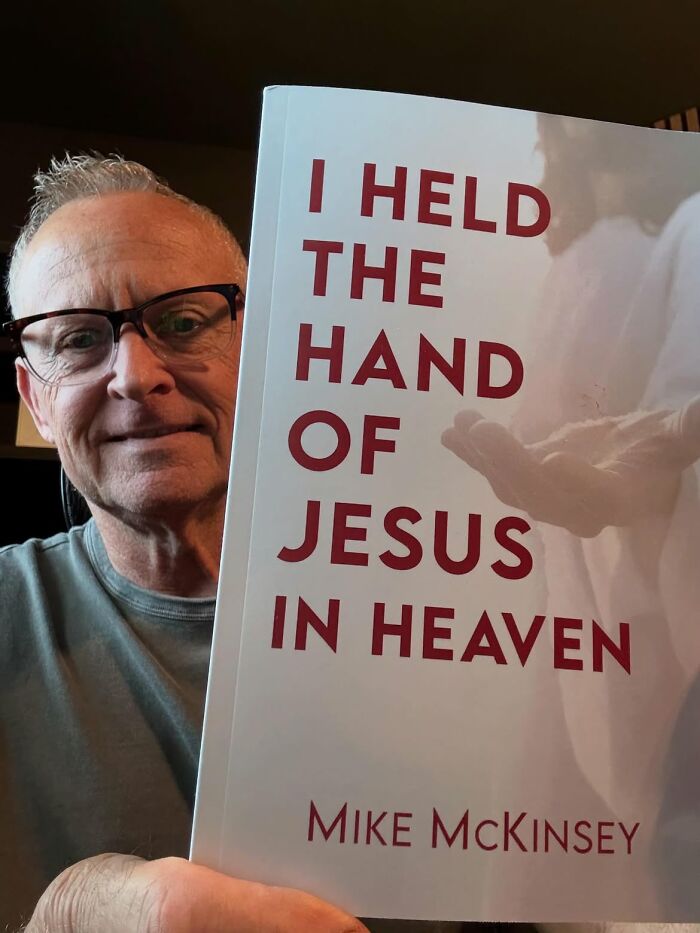
Image credits: mmckinsey22 / Instagram

Mike McKinsey landed on the operating table because of appendicitis, and even flatlined for close to an hour
Mike had just arrived at the venue of his son’s wedding rehearsal when he started feeling off. He put it down to the flu and pushed through, not wanting to put a dampener on his son’s big day. By the time he finally got to hospital, doctors suspected appendicitis. The test was simple enough, and Mike screamed in agony.
He was rushed into surgery immediately. But before the anaesthetic mask even went on, before any medication had been administered, Mike looked to his right. “Jesus walked through the surgical room doors,” he later said on a podcast that is completely dedicated to sharing afterlife accounts. What happened next took place during the 45 minutes in which Mike was, by medical record, no longer with us.

Image credits: Getty Images / Unsplash (not the actual photo)
He vividly recalls Jesus walking into the operating room and reaching out to take his hand
Speaking to UNILAD, Mike described Jesus walking in “as a physical person”. He was wearing a white robe, had darker skin than Mike had been shown in childhood depictions, a short dark brown beard, and dark wavy hair. “His eyes were a dark greenish blue,” Mike said. “Even though he looked different, I knew immediately that it was Jesus.”
“As he came closer to me, he held out his hand and said, ‘I want to answer your prayer.’ I was very confused and thought I must have [gone], but I took his hand.” The figure then led Mike to what he believes was heaven. And what followed was a highly specific, vivid, and detailed account of what the afterlife might look like.

Image credits: mmckinsey22 / Instagram
Mike also explained that Jesus had darker skin than he was led to believe, and he had short wavy hair, and blue/green eyes
Mike describes standing on a grassy hill, barefoot, surrounded by white blinding light. “I was standing on beautiful, lush green grass, a very dark green,” he recalled. “The blades of grass were perfectly manicured. My senses were heightened to the point that I could feel every blade of grass touching my feet. I even knew the exact number of blades of grass.”
The blinding light was then pulled back to reveal what lay beyond, a vast, breathtaking scene. He was standing on a hill covered in pastel flowers, swaying as though in a breeze despite there being no wind. Below the hill was an enormous city, partially obscured by a white curtain of fog, with rooftops and steeples poking through.
Image credits: Paul Zoetemeijer / Unsplash (not the actual photo)
He went on to describe fantastical scenes of what he thinks is heaven, with rolling green hills and pastel-hued skies
At the centre was a giant golden dome, surrounded by smaller domes and tall white steeples that he thought were church steeples, until he noticed they had no crosses on top, which he found strange. On the other side of the city rose a tall mountain covered in perfectly shaped trees with lacy needles, every detail visible despite the distance.
Above it all, a sky blazing with the most vivid colours he had ever seen; reds, oranges, purples and blues. “It was like a gorgeous sunset, but there was no sun,” he said. Then his eyes were drawn to something in the distance that looked, he said, like a giant pearl.

Image credits: Martha Dominguez de Gouveia / Unsplash (not the actual photo)
The whole experience has been documented in his book, and he shared his otherworldly experience on a dedicated podcast
Streaks of light moved across the sky like tubes, one of them hitting him directly in the head, not painfully, but warmly, filling him with what he described as a loving feeling. The lights turned into fireworks against the coloured sky. Overcome with emotion, Mike sank to his knees. The moment they touched the ground, he was back in the ICU.
Mike’s experience is extraordinary. It is also, according to researchers, not as unusual as you might think. Studies suggest that up to one in five people who are clinically flatlined for a period of time return with accounts of what they experienced on the other side. What science cannot currently explain is why.
Image credits: mmckinsey22 / Instagram
Scientists still can’t quite explain how or why this happens, but there is a long list of contributing factors that can create such a specific experience
The bright white light that features in almost every afterlife account is believed to be the visual cortex misfiring as oxygen supply to the brain drops. The overwhelming sense of peace and euphoria that accompanies these experiences has a chemical explanation too, the struggling brain releases a flood of neurochemicals and endorphins that block pain and generate feelings of deep calm.
The floating, out-of-body sensations that people describe? Those are thought to be the result of trauma disrupting the brain’s ability to process balance and touch, causing the sense of drifting free of the physical body. The personal details are where it gets more interesting. Researchers suggest the brain translates abstract, chaotic neural activity into familiar symbols and imagery it already has a framework for.
Image credits: Zachary Olson / Unsplash (not the actual photo)
Which would explain why Christians tend to see Jesus, why people from other faiths encounter figures from their own religious tradition, and why specific ancestors and loved ones show up so consistently. The brain is not receiving a broadcast from the afterlife, it is, in this theory, reaching into its own filing cabinet and constructing something recognisable from the chaos.
And the reason afterlife experiences feel so universal is simply that every human brain shares the same basic wiring. The hardware is identical. So the experience, broadly, looks the same. None of which, it should be said, definitively proves that what Mike saw was not real. Science can explain the mechanism; it just cannot explain the meaning.
Have you ever had an experience with life after the rainbow bridge? Share it with us in the comments!
Commenters still found some of this hard to believe, agreeing that at least it makes for a good story to tell around the dinner table

Image credits: www.facebook.com














 Follow Us