On July 30th, staff at the Mato Grosso state legislature in Cuiabá, Brazil, arrived for what was presumably a standard day of lawmaking to find the building had been invaded. This time it wasn’t January 6th-ers. It was a different kind of rodent. A group of profoundly unbothered capybaras had strolled in through the front door, surveyed the legislative chamber, and made themselves at home like many times before.
Staffer Nayara Bueno filmed the visit and attempted to redirect the animals back toward the park next door. “They show up here quite often,” she said, “so we’ve gotten used to seeing them.” The building sits right next to a park, which is a prime location for capybaras with political aspirations.
There is something about a capybara walking into a room full of politicians and simply existing there, calm, sociable, entirely indifferent to the weight of the occasion, that functions as an accidental piece of performance art. No agendas or press releases. Just one chilled dude going about it’s business with his cohorts. Politicians can take a page from their book.
It has only taken 9 million years, but this stress-free and unbothered creature has somehow become the most beloved animal on the internet. The question worth asking is not why the capybara keeps showing up in human spaces. It is why an 80-kilogram rodent with no social media strategy has managed to become the role model that an entire generation of burned-out humans did not know they were looking for.
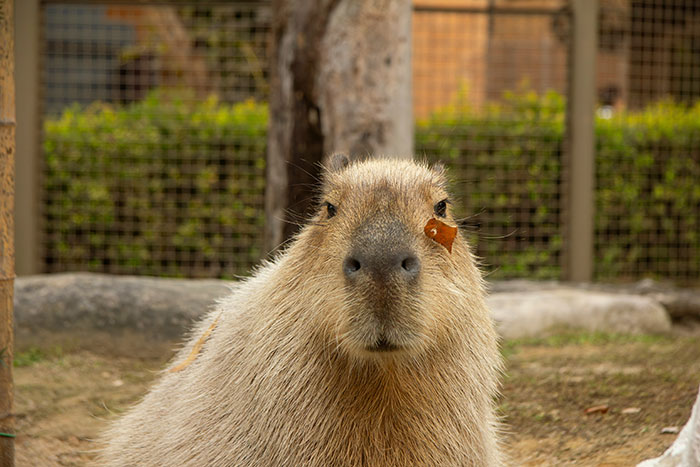
From the wetlands to the worldwide web
The capybara, Hydrochoerus hydrochaeris, is the world’s largest rodent, native to South America and built for a semi-aquatic life along rivers, lakes, and wetlands. Adults weigh up to 80 kilograms, move between water and land with easy confidence, live in social groups of ten to twenty individuals, and have, over several million years of evolution, developed what can only be described as an extraordinary talent for not being stressed about anything.
They have been in South America for a very long time, long enough that between the 16th and 18th centuries, Venezuelan clergy petitioned the Vatican to officially classify the capybara as a fish. Their argument was not entirely unreasonable: semi-aquatic, webbed feet, and apparently a flavour profile that could pass muster during Lent. Rome agreed and the classification stuck. Capybara remains a Lenten staple in Venezuela to this day, which means the internet’s most beloved symbol of unbothered serenity is also, theologically speaking, a fish you are permitted to eat on Good Friday.
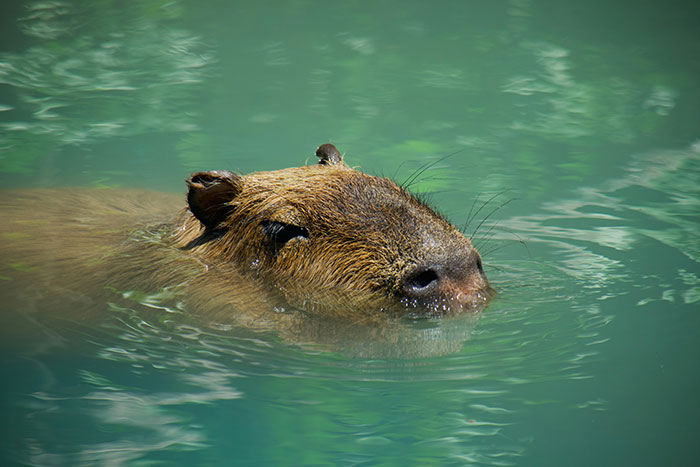
Before anyone confuses any of this with slowness, a capybara can reach approximately 35 kilometres per hour over short distances, which is roughly the speed of a horse at full gallop. And faster than you. They are also accomplished swimmers who can hold their breath for up to five minutes and will nap in water with just their nostrils above the surface.
They have one small assertion of ego worth mentioning. Males carry a scent gland on their nose called the morrillo, a dark raised bump used to mark territory. It is the capybara’s one concession to having opinions about its environment. It is, after all, just a boy capybara, standing in front of a girl capybara, asking her to respect his territory.

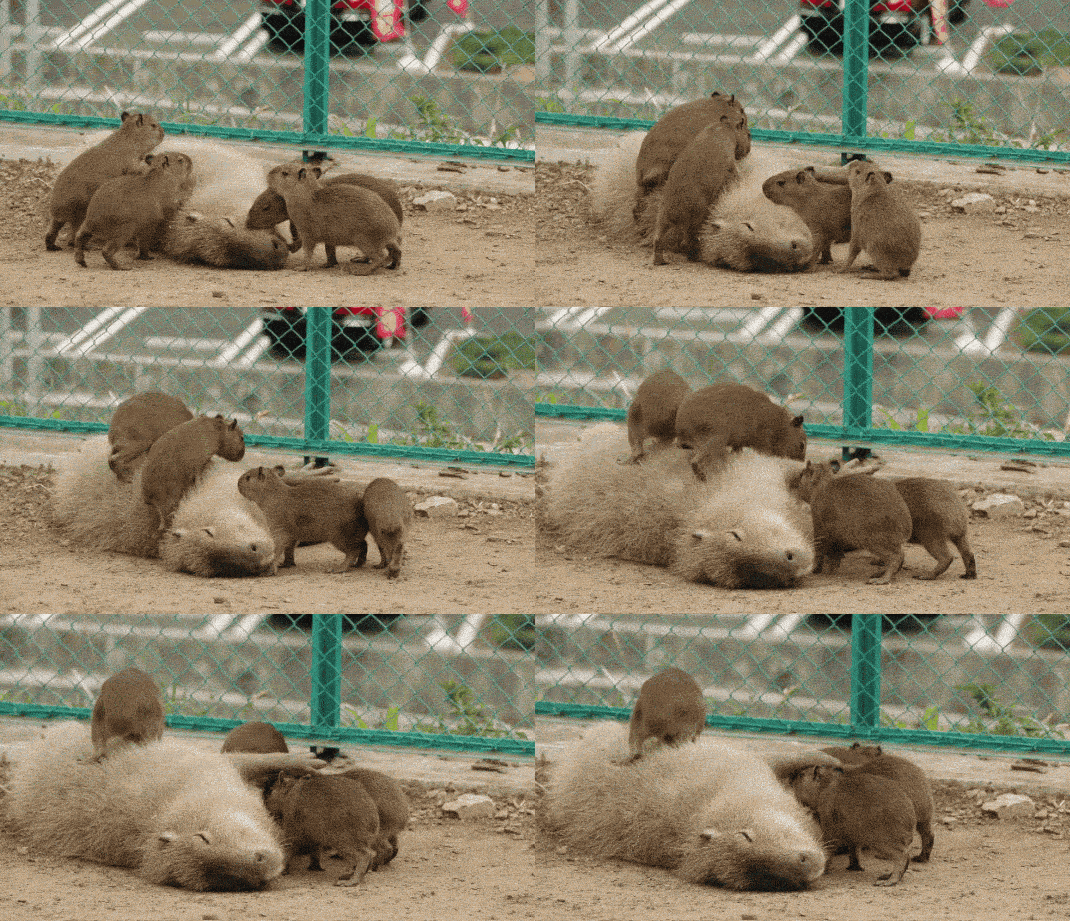
Everything else operates entirely without ego. Capybara groups also practice allonursing, meaning females will nurse pups that are not their own, with young raised collectively in a crèche arrangement that human parenting forums would describe as “the dream.” If you own a guinea pig, you already have a miniature version of all of this sitting in a cage in your living room, deeply underestimated.
So it is no wonder that TikTok and Instagram quickly filled with capybara content. Videos of capybaras sitting in hot springs in Japan, capybaras being groomed by birds, capybaras sharing a riverbank with caimans who could theoretically eat them but seem to have decided against it, capybaras sitting in fruit displays at markets while everyone around them loses their minds, and the capybaras themselves notice none of it.
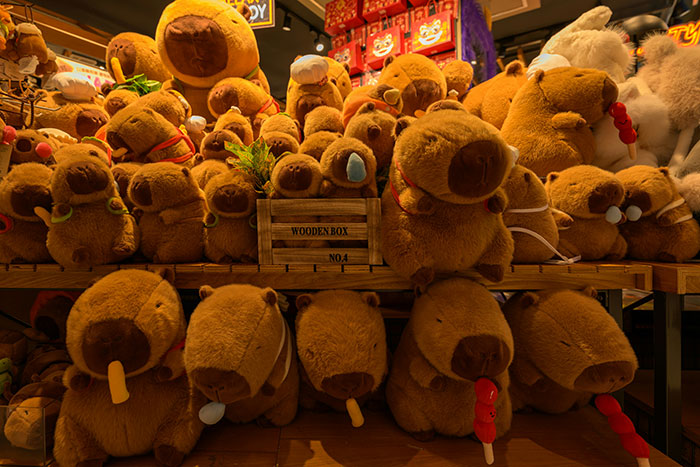
The hashtag #capybara has accumulated billions of views across platforms. Capybara plush toys became a commercial phenomenon. Capybara memes circulated in every language. A Brazilian rodent that most of the world had never thought about became, almost overnight, a global cultural figure, and the reason is not complicated.
The capybara represents something people in 2020, 2021, and every year since have been desperately seeking: visible, biological proof that it is possible to exist in a chaotic world without absorbing its chaos.
There is science behind not caring
The capybara’s famous serenity could look like a personality quirk but, like David Attenborough has taught us, nothing is accidental. It is the result of evolutionary and social conditions that researchers have been studying even more as the animal’s cultural profile has risen.
Capybaras are highly social animals, living in stable groups with established hierarchies and consistent social bonds. Research on social mammals consistently shows that stable social connection is one of the strongest predictors of reduced stress responses, and capybaras have built their entire existence around it. They groom each other. They sleep in contact. They alert each other to threats with a system of vocalisations that ranges from warning barks to the soft purring sounds they make during calm social interaction. They are securely attached, which in practice means they move through the world without the baseline anxiety of animals that face it alone.
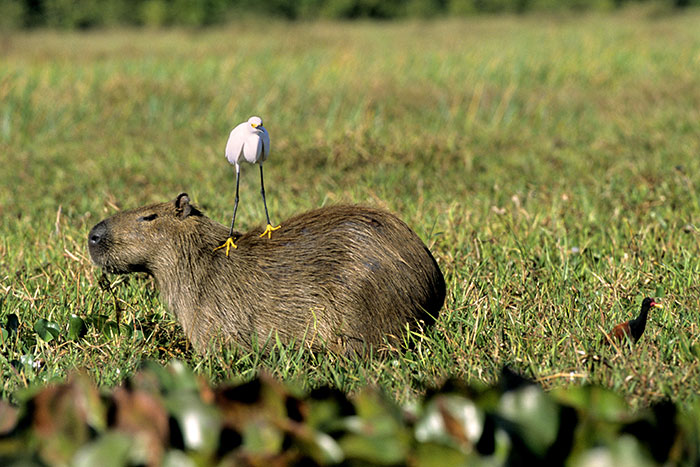
Their relationship with other species is the detail that has captured the internet and really puzzled researchers. Capybaras are documented coexisting with animals that should, by every predator-prey logic, be a problem. Caimans rest alongside them without incident. Birds land on their backs to eat parasites, and the capybaras submit to this without blinking. Dogs, cats, monkeys, ducks, and turtles have all been filmed in friendly proximity to capybaras in both wild and captive settings.
The leading explanation is that capybaras communicate almost no threat signal. They are not aggressive, not territorial in ways that provoke response, and not easily startled into the reactive behaviour that triggers defensive aggression in other animals. They have essentially opted out of the conflict economy, and other animals, sensing this, relax around them.
There is also the water. Capybaras are semi-aquatic and spend significant portions of their day submerged or partially submerged in water, which regulates their body temperature and appears to function as a consistent stress-reduction mechanism. Multiple studies on both humans and animals have found that proximity to and immersion in water reduces cortisol levels and activates the parasympathetic nervous system. We doubt that the capybara read these studies. They are simply going on vibes.
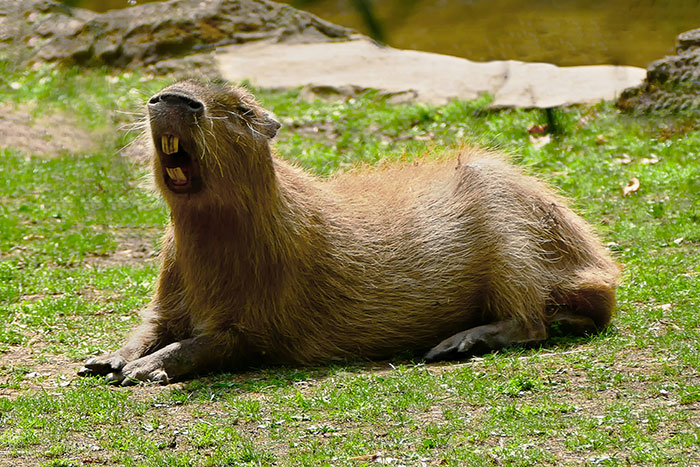
Why 2020 needed a child-sized chill rodent to keep us sane
The timing of the capybara’s internet ascent is not accidental. The animal went globally viral during a period of sustained global anxiety, when the world was locked indoors, the news was uniformly catastrophic, and the concept of unbothered ease had become something people could barely remember experiencing. The capybara arrived as the hero we so desperately needed.
Cultural researchers who study internet trends have noted that animals tend to achieve viral status when they embody something the human population is currently lacking. The dramatic rise of sloth content in the early 2010s coincided with the acceleration of hustle culture. The explosion of cat videos mapped onto a period of increasing social isolation.
The capybara moment maps onto collective burnout, the exhaustion of people who have been told for years that productivity, urgency, and constant responsiveness are virtues. We all watched a rodent in a hot spring and felt something move inside of us.
Because the Cappy does not optimise. It does not grind. It does not have a five-year plan or a morning routine or opinions about cold plunges. It wakes up, finds water, finds its group, eats grass, and approaches whatever arrives, including legislators, cameras, and caimans, with the same fundamental equanimity.
But don’t confuse any of this with laziness. Capybaras are alert, responsive animals with complex social lives and real environmental pressures. They simply do not catastrophize, and in a cultural moment defined by doom and gloom, that reads as enlightenment.
The Legislature is becoming its natural habitat
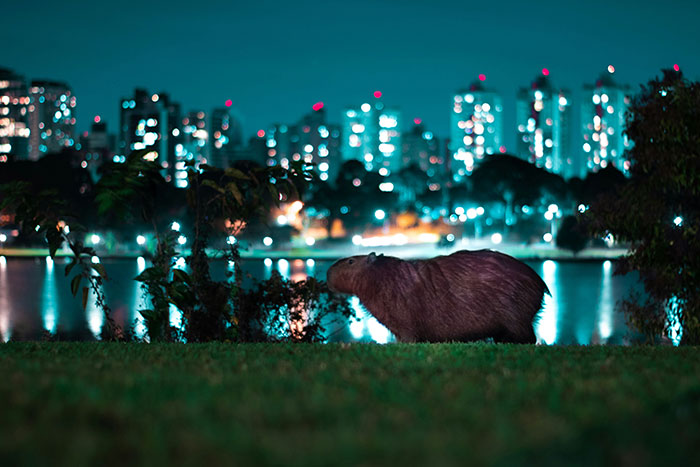
The Cuiabá incident is not the first time capybaras have wandered into spaces built for human institutional activity and found them entirely unremarkable. Capybara sightings in urban and suburban areas across Brazil have increased steadily as cities expand into their habitat, and the animals’ response to human infrastructure has been consistent: mild curiosity, brief investigation, continued unbotheredness. They have been photographed on golf courses, in shopping centre car parks, on university campuses, and grazing on the manicured lawns of gated communities whose residents have mixed feelings about it all.
São Paulo has a growing urban capybara population, particularly along the Tietê river corridor, and wildlife management officials have noted that the animals adapt to urban environments with what one researcher described as “remarkable flexibility.” They learn where food sources are, and they identify safe water access points. They establish social groups in parks and green spaces and don’t cause real damage or act aggressively. They simply move in and behave like a well-mannered guest.
They even seem to have built a functioning relationship at the Mato Grosso legislature. Something constructive to finally come out of a civil building. Despite humans constantly infringing on THEIR land, they make it work. Not that we expect them to, but we haven’t given them much choice. And unlike most animals that become extinct when we start planting palm oil and developing an appetite for their flesh, cappies are thriving. They are even classified as “Least Concern” on the IUCN Red List. A more appropriate classification has never existed.
A message from your friendly neighborhood capybara
The internet’s love for capybaras is easy to dismiss as another cycle of animal content, a temporary fixation that will be replaced by the next photogenic creature with good timing. But there is a staying power in capybara culture because we are now several years in, and it is still generating consistent engagement while everyone has already forgotten about Moo Deng.
People are drawn to the capybara because it has solved, through evolution and social structure, the problem that modern human life keeps failing to solve: how to be a social animal under pressure without being destroyed by it. The capybara is not a loner or stoic. It does not achieve its serenity by withdrawing from the world. It sits in the middle of everything, surrounded by its group, and remains fundamentally untroubled. It makes friends across species lines. It shares its space without apparent resentment. It walks into a legislature and sits down.
The politicians in Cuiabá could not remove the capybaras from the building because the capybaras were not doing anything wrong. They were actually conducting themselves better than the average legislative session. No damage, no disturbance, and they left when they were ready.
There is a version of governance that could look like that. Calm, sociable, unhurried, unbothered by the noise, focused on the immediate and the communal, unimpressed by its own importance. The capybara has been running this model for millions of years with lots of success. It is now up to us to take a page from their book.
 Follow Us