Many of us have had those mornings when you’re already running late for something important, and everything seems to go wrong at once. Maybe you spill your coffee, miss your ride, or hit every red light on the way out. And that slow build of frustration? It’s enough to ruin your entire day before it even properly begins.
That’s exactly what happened to one person, but in their case, their problem wasn’t bad luck. A woman had blocked their garage exit with her car and casually walked away. With no way out, the author decided to take matters into their own hands. Keep reading to see how her “just five minutes” turned into a lesson in karma.
Sometimes, people can be incredibly inconsiderate, especially when it comes to parking their vehicles and blocking others in
Yunus Tuğ / Unsplash (not the actual photo)

For instance, one person shared how they took petty revenge on a woman whose illegally parked car made them extremely late for class


ahmad shalbaf / Pexels (not the actual photo)

Vitaly Gariev / Pexels (not the actual photo)

Mâide Arslan / Pexels (not the actual photo)

Getty Images / Unsplash (not the actual photo)
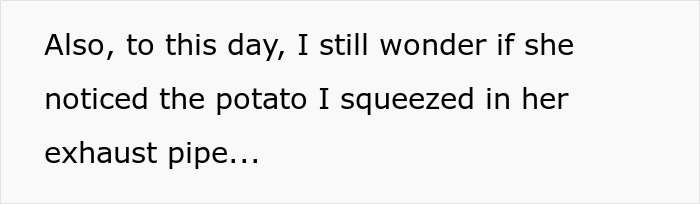
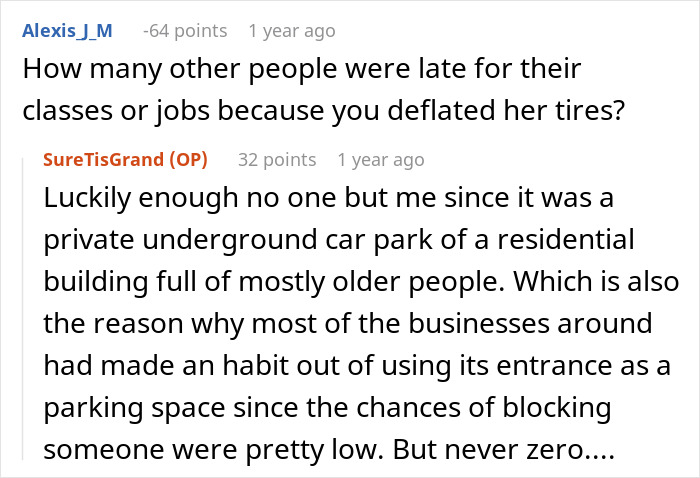
The author also provided more details about the incident








In NYC, higher-income individuals pay steeper fines for illegal parking violations
Living in a city definitely has its perks. You have restaurants, shops, and pretty much everything you need just around the corner. But owning a car? That’s a whole different story! Finding a gas station or repair shop is usually no big deal, but parking can quickly become a headache.
Between circling the block for ages, squeezing into ridiculously tight spaces, and worrying about parking tickets, it can test anyone’s patience. No wonder some drivers turn to handy parking aids, like backup cameras, parking sensors, and portable parking barriers, to make life a little easier. Still, when you live in a big city, even the fanciest gadgets can’t magically create a parking spot. And if there’s one place where finding one can feel like winning the lottery, it’s New York City!
In fact, parking violations in New York City come with a wide range of fines depending on the offense. Some of the steepest penalties reach $180 (plus an additional $30 New York State Criminal Justice surcharge) for illegally parking in spaces designated for people with disabilities. On the lower end, violations like speeding in a school zone or being caught on a red-light camera can cost around $50. However, most everyday parking tickets typically fall between $65 and $115, which still adds up quickly if you’re not careful.
What’s even more interesting is that the system itself has been questioned. Last year, the New York City Council introduced a proposal that could change how fines are issued altogether. The idea was to scale penalties based on a person’s income—meaning wealthier individuals would pay more for the same violation. As Antonya Jeffrey, state director of the Fines and Fees Justice Center, explained, “A $75 fine can mean going without really basic needs for one person and could just be a drop in the bucket for another.” It highlights how the same rule can affect people very differently.
Melisa Figueroa / Unsplash (not the actual photo)
And if you think NYC is tough, San Francisco takes things even further. According to the San Francisco Municipal Transportation Agency (SFMTA), parking violations there can get seriously expensive. Blocking wheelchair access can cost up to $400, misusing a disabled parking placard can lead to an $866 fine, and obstructing traffic without a permit can result in a staggering $1,000 penalty. In fact, most fines in the city already sit well above $100, making even minor mistakes costly.
But these high fines aren’t just about making money; they serve a larger purpose. As SFMTA Chief Spokesperson Erica Kato explained, “The purpose of parking citations is to discourage behaviors and actions that interfere with the goals of the SFMTA, such as reducing congestion, increasing pedestrian and bicyclist safety, and cleaning streets.” In other words, these penalties are designed to change behavior, not just punish it.
She further added, “Because San Francisco is a Transit-First city, and to encourage non-vehicle modes, the SFMTA set its vehicle fines higher than other cities that depend on cars as the primary form of transportation.” This reflects a bigger shift in how cities are thinking about mobility: less reliance on cars, more focus on shared and sustainable transport.
And it’s not just limited to the U.S.—cities across the globe are tightening rules around illegal parking, and for good reason. In the moment, it often feels harmless. You tell yourself, “It’s just two minutes,” or “I’ll be quick.” Maybe you’re running into a store, grabbing a takeaway, or making a short stop. But what feels like a small, harmless decision can quickly snowball into a much bigger problem. That one car, left in the wrong spot, can block visibility at intersections, force drivers to change lanes suddenly, or create blind spots that increase the risk of accidents.

Erik Mclean / Pexels (not the actual photo)
It’s crucial to park responsibly near hospitals, as even minor obstructions can delay emergency services and put lives at risk
In reality, illegal parking is the third leading cause of traffic congestion in the United States, contributing to nearly 47 million hours of delays every year. When cars are left in no-parking zones, double-parked, or blocking driveways, they disrupt the natural flow of traffic. This leads to longer commute times, increased fuel consumption, and heightened frustration for everyone on the road. For pedestrians and cyclists, the risks are even greater—improperly parked vehicles can push them into active traffic lanes, putting them directly in harm’s way.
The dangers become even more serious in high-priority areas. Parking illegally near hospitals can delay ambulances and emergency responders, where even a few seconds can make a critical difference. Around schools, it creates confusion and chaos during already busy hours, making it harder for children to safely cross streets or for parents to navigate drop-offs. Even in residential areas, blocked fire hydrants or narrow lanes can slow down emergency services when they’re needed most.
At its core, illegal parking isn’t just about breaking a rule—it’s about putting convenience over safety. A quick stop might save a minute for one person, but it can cost time, safety, and peace of mind for many others. Beyond hefty fines, it can also impact insurance claims. If your car is parked illegally and gets damaged, your claim may be denied or reduced. So while it might be tempting to take a shortcut, it often costs far more than it saves. A little patience, a bit of awareness, and a lot more consideration can make city life smoother for everyone.
In this particular case, the woman deliberately blocked the exit and showed no urgency to move, even after being asked multiple times. She dismissed the situation like it wasn’t a big deal, while others were left stuck, stressed, and losing valuable time. Behavior like this doesn’t just come off as inconsiderate; it disrupts everyone around and turns a simple situation into unnecessary chaos. What are your thoughts on people who park like this without a second thought? Have you ever dealt with someone who acted like the rules didn’t apply to them?
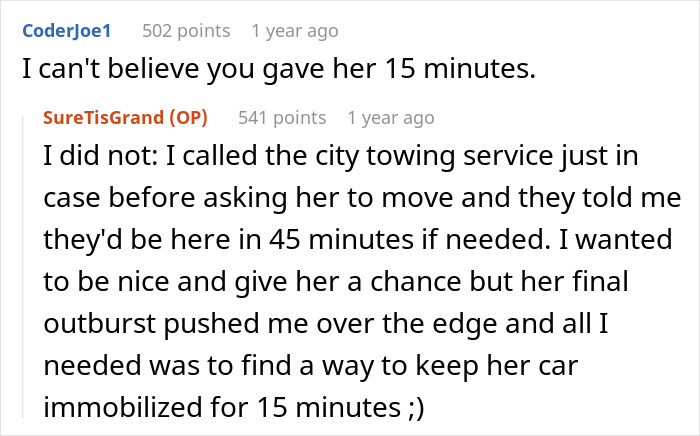
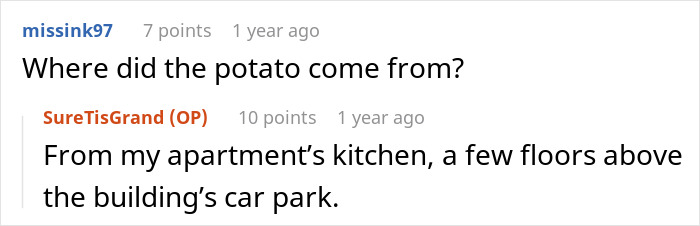
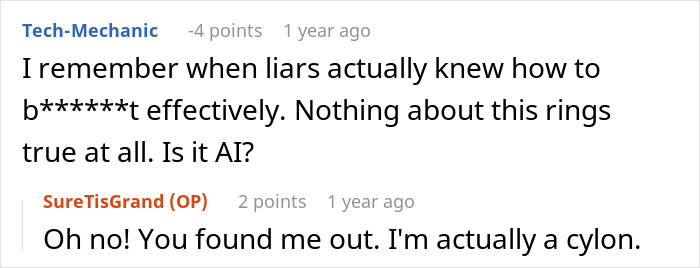
Readers were amused by the author’s decision to use a potato as part of their petty revenge




 Follow Us