Nuclear war has always existed in the background of modern life as the kind of threat that is too big to fully process, so most of us simply don’t. It lives in the same mental drawer as asteroid strikes and supervolcanoes, all theoretically possible, not something you can do much about, best not to think about before bed.
But with tensions escalating across the Middle East, America and Israel firing missiles at Iran, and the Taliban launching an incursion into nuclear-armed Pakistan, scientists have decided now is a good time to run the numbers. They did. The results are exactly as bleak as you would expect. Maybe bleaker.
The possibility of nuclear war is always looming, with someone always having their finger a little too close to a big red button
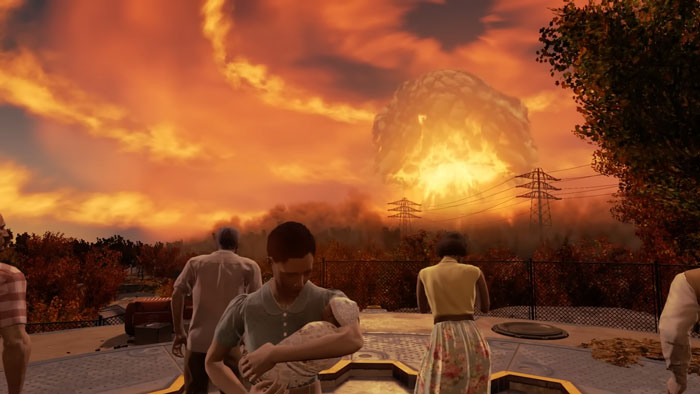
Image credits: Fallout 4 / Bethesda Games

And scientists have modelled what it would look like if that button were pressed, and the outcome is predictably grim
The Middle East is currently in one of its most volatile periods in recent memory, and the number of nuclear-armed players in or adjacent to the conflict is difficult to ignore. Israel, a nuclear power, has been firing at Tehran, striking the Iranian capital with a series of targeted rounds on military and nuclear sites. Iran has launched counteroffensives.
The UAE has been intercepting missiles heading toward Israel. Meanwhile, on a separate but equally alarming front, the Taliban in Afghanistan have launched an offensive on Pakistan, another country that has nuclear weapons. The United States, also a nuclear power, is involved.
At the same time, the world is sitting on approximately 12,000 nuclear warheads spread across nine countries, all of which are theoretically capable of being launched. None of this means nuclear war is imminent. But it does mean that the question of what actually happens if it occurs has moved from an abstract thought experiment to something considerably more present.
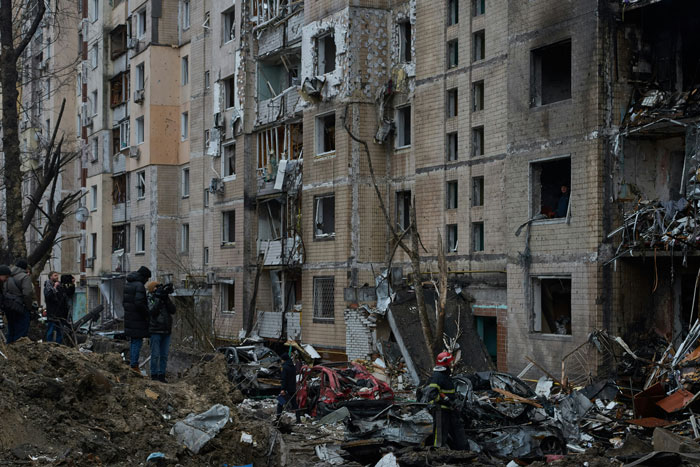
Image credits: Dmytro Tolokonov / Unsplash
Most of the world’s population would not survive the initial blasts, with many then succumbing to famine after that
The short version is not good. A study, published in the journal Nature, found that a full-scale nuclear war could wipe out approximately five billion people, which is around 60% of everyone currently alive on Earth. Armageddon expert Annie Jacobsen used scientific papers and defence experts to model exactly what would happen if the world’s 12,000 nuclear weapons were fired.
The initial blasts would wipe out hundreds of millions instantly. “Hundreds of millions of people [perish] in the fireballs, no question,” she said on The Diary of a CEO podcast. The fireballs themselves could reach temperatures of up to 100 million degrees Celsius. For context, the surface of the sun sits at around 5,500 degrees Celsius.
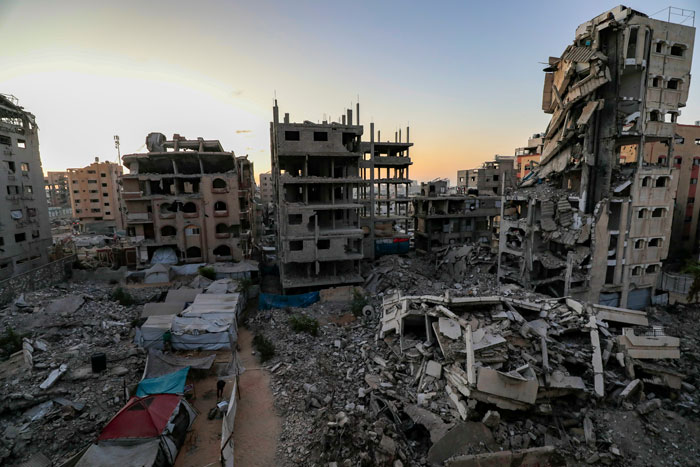
Image credits: Mohammed Ibrahim / Unsplash
Agriculture could not be sustained as radioactivity would destroy the ozone and make most of the world uninhabitable
But the immediate destruction is arguably not even the worst part. What follows is a nuclear winter, which is a prolonged period in which the smoke and debris thrown into the atmosphere by thousands of simultaneous explosions block out the sun, sending global temperatures plummeting and destroying agricultural systems worldwide.
“Places like Iowa and Ukraine would be just snow for 10 years,” Jacobsen explained. She added that when agriculture fails, people just can’t survive. The ozone layer, the thin band of gas that protects every living thing on Earth from the sun’s radiation, would be severely damaged. Around three billion people might survive the initial blasts. But survive is a generous word for what their lives would look like.
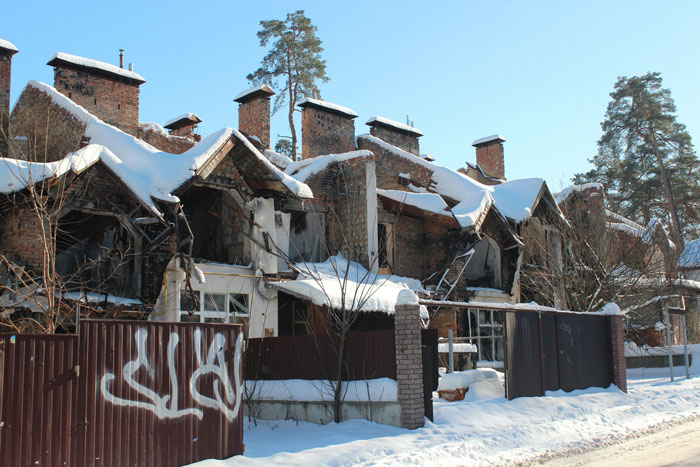
Image credits: Oleksandr Lisovskyi / Unsplash
As nuclear winter hits, scientists say only Australia and New Zealand could survive the effects, but life would be fundamentally changed
According to the study, only two countries would emerge from a nuclear war with any meaningful chance of sustaining life as we currently understand it: Australia and New Zealand. The reasoning comes down to geography, agriculture, and distance. Both countries sit in the Southern Hemisphere, far removed from the primary targets and population centres of a nuclear exchange.
Crucially, both countries sit far enough from the initial blast zones that the immediate fireballs and radiation would not reach them at the same intensity. And perhaps most importantly, both countries would still be able to grow food during a nuclear winter, when most of the rest of the world cannot.

Image credits: Getty Images / Unsplash
But even if those countries do not get his and manage to keep farming alive, many people will still be fighting for food and have to seek shelter underground, according to studies

Image credits: Mark Thomas / Pexels
That last point is the difference between survival and slow extinction. When the sun is blocked out and temperatures collapse, agricultural systems fail globally. Crops perish. Supply chains that were already destroyed by war collapse entirely. Famine becomes the primary concern for the billions who survived the initial blasts.
Australia and New Zealand, with their Southern Hemisphere climate, their relatively low population density, and their substantial agricultural land, are uniquely positioned to keep feeding people when everywhere else cannot. Life would still be unrecognisable with radiation, global instability, an influx of survivors from elsewhere, and a decade of disrupted weather patterns seeing to that.
But the lights would still be on. The crops would still grow. And of the roughly 195 countries currently on the map, those are the only two the science is willing to bet on.
Is the threat of nuclear war something that is on your mind, or can you casually keep on and carry on? Share your thoughts in the comments!
Watch the full interview here:
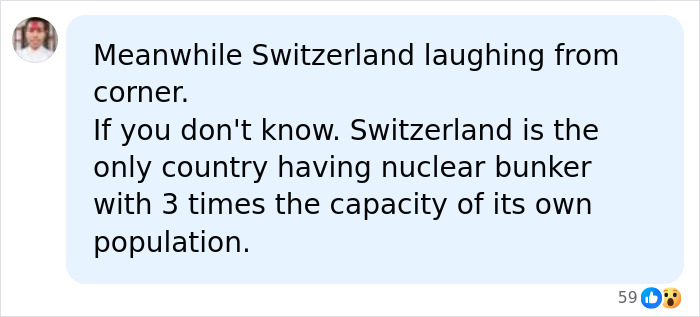
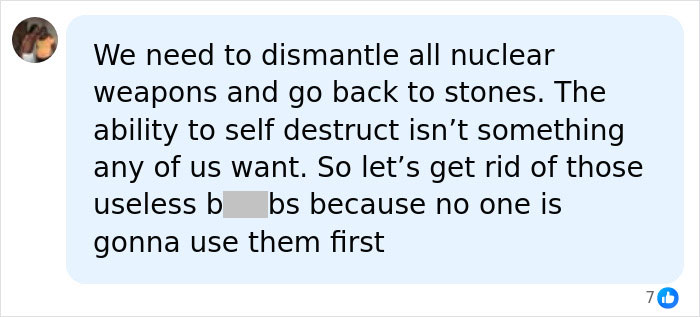
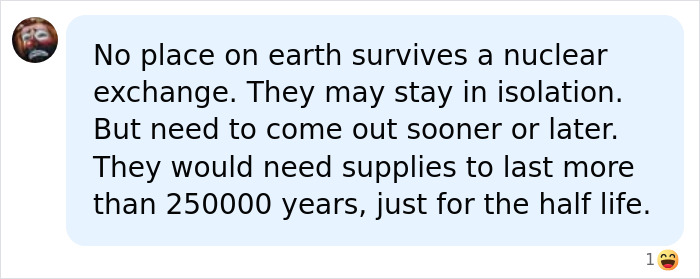
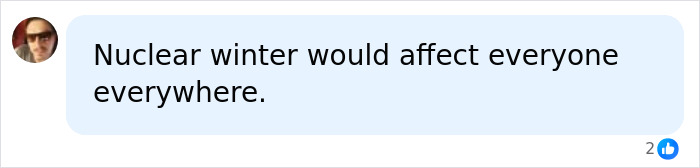
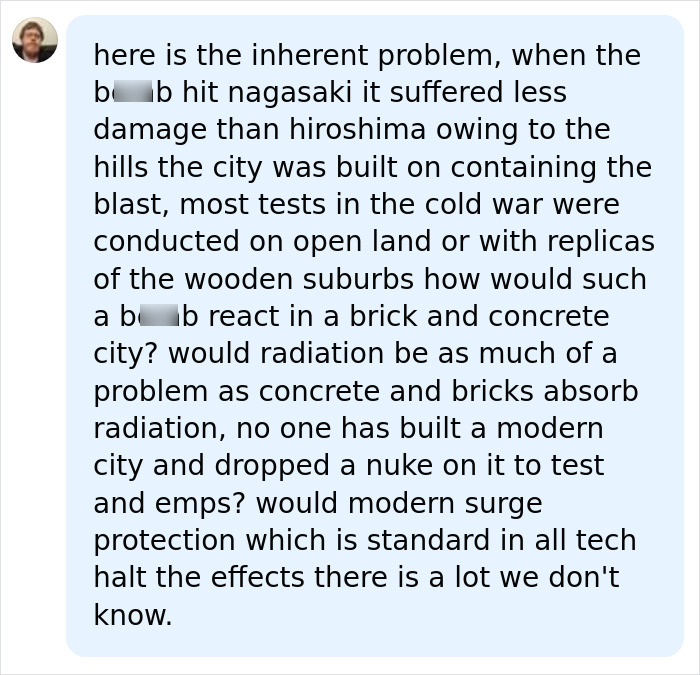
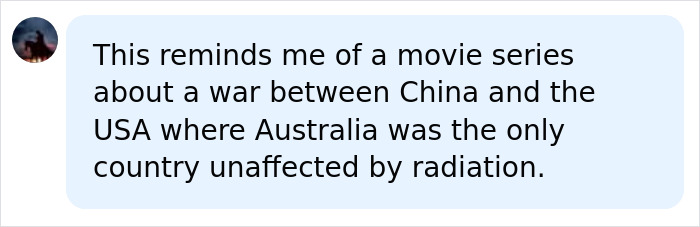
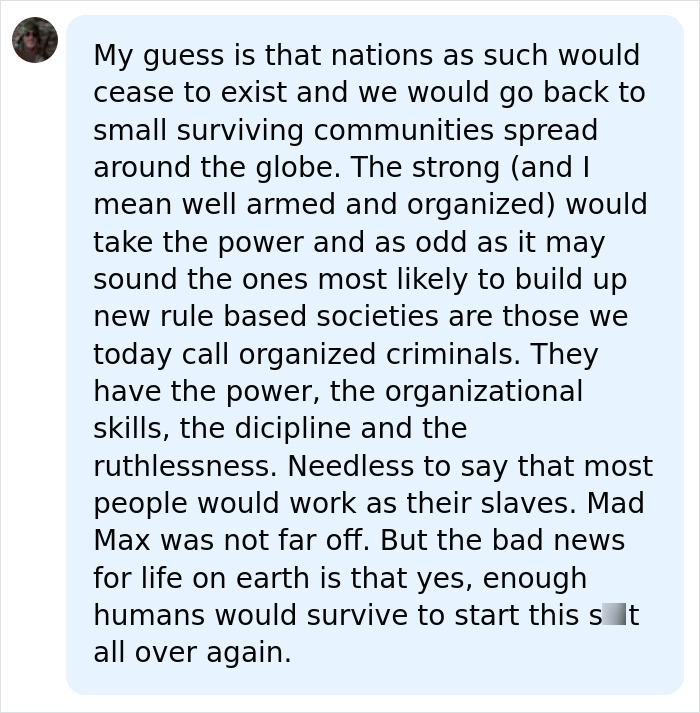
People in the comments were quick to add their two cents, some laughing from their homes in Australia, others saying we are all equally doomed








 Follow Us