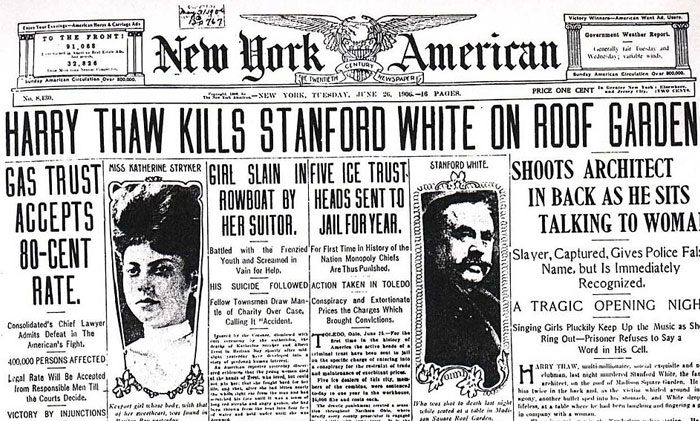
In June 1906, famed architect and socialite Stanford White was shot at Madison Square Garden by Harry Kendall Thaw, the heir to a Pittsburgh industrial fortune, who accused White of abusing his wife while she was a minor.
The first of two widely publicized trials of Thaw began in January 1907 and exposed a culture of corruption at the highest levels of society, including secret apartments where wealthy men entertained young women, who were often recruited through the entertainment industry and passed around elite social circles with little protection.
Court testimony centered on actress Evelyn Nesbit’s account of her relationship with White, which began when she was 15 and he was 46, including how he paid for her mother to travel out of town to leave her vulnerable to his abuse. The parallels with the Jeffrey Epstein case are striking, and experts argue they are structural.
In both eras, the exposure of a network of elites involved in systematic exploitation caused public outrage, but authorities took minimal action. After the trial of Thaw, media and public attention quickly focused on the so-called “white slavery” scare—the culmination of decades of social activism that sought to eliminate exploitation in major urban centers—while the men who ran the trade received little scrutiny.
The trial is reported on in the New York American newspaper
A Dark Culture Exposed
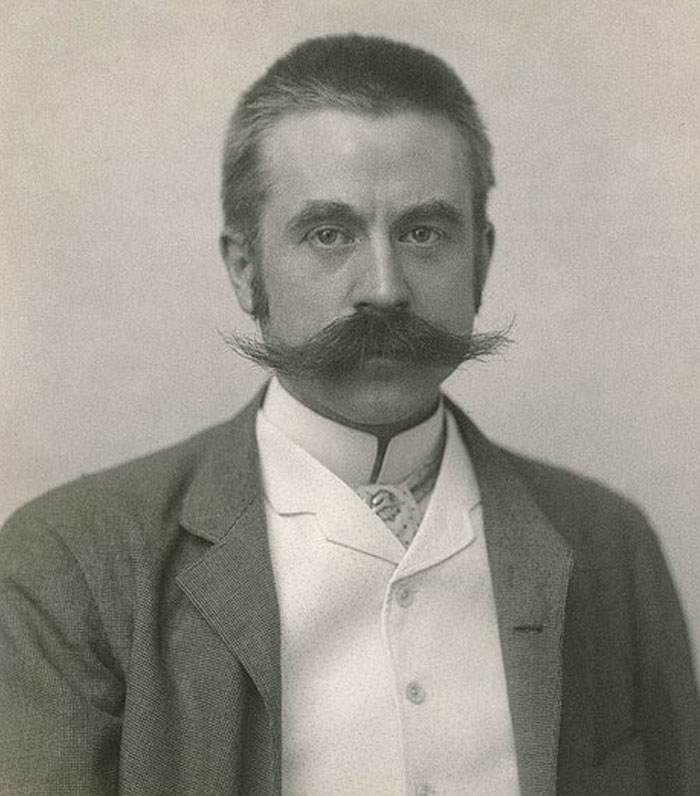
Stanford White was not just an architect; he was a social gatekeeper who designed the landmarks of the American elite, and his status allowed him to operate largely outside the purview of authorities. White cultivated contacts across social strata – artists, Wall Street, and high society – and historians have argued he used his access to recruit new victims, often working through existing girls to introduce him to others.
“He knew everyone,” says Mara Keire, a historian at Oxford University who has studied early-20th century anti-vice movements for decades. “He designed buildings for everyone.”
White also used his wealth to manage consequences: the architecture firm McKim, Mead & White has been described by historians as maintaining an effective slush fund to pay off victims and their families – a tactic similarly seen during the original investigations of Epstein in the mid-2000s.
Stanford White, Harry Kendall Thaw and Evelyn Nesbit

The tabloid press of the era, especially Town Topics, run by William d’Alton Mann, was notorious for extorting money from society elites to keep stories about them out of print and White was among the set who were targeted.
“People knew,” says Keire of elite sexual abuse at the time. “There was gossip, there was even blackmail.”
The press speculated about a “syndicate of vice” involving wealthy men who shared White’s predatory habits, and rumors swirled that he kept detailed records of his associates and the women they entertained. Many of his friends at the exclusive Union Club were believed to be implicated.
At least four were named in an investigation by the New York World in connection with White’s sex circle, according to Simon Baatz’s 2018 book about the case, The Girl on the Velvet Swing. They included financier Henry Poor, stockbroker and major shareholder in Southern Pacific Railroad Charles Macdonald, antiques dealer Thomas Clarke, and socialite James Lawrence Breese, who also reportedly took photos of many of the girls.
“White’s circle did not face any consequences. It was headline-grabbing, and yet there was no follow-up,” says Keire. “There were rumors of a wider circle, but there was no real attempt to pursue it.”
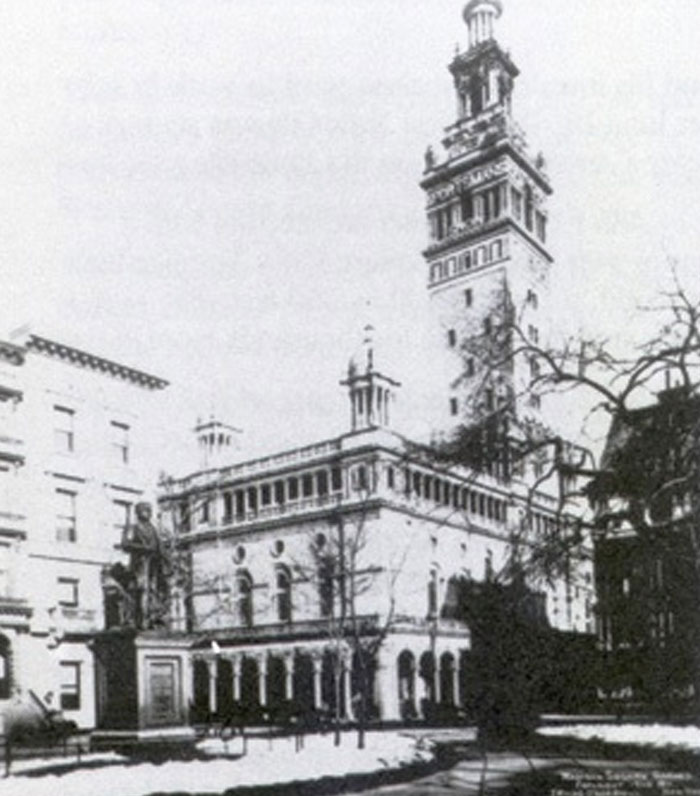
Madison Square Garden (1890), a building designed by Stanford White where he was also killed
After news of White’s murder spread, associates reportedly quickly went to his various apartments to destroy his papers. Thaw was ultimately found “not guilty by reason of insanity” in a second trial, after a hung jury in the first, and was released from a mental health facility in 1915.
Lead prosecutor William Travers Jerome’s inability to secure a strong verdict or bridge the gap between White’s murder and the network of abusers he belonged to meant they ultimately escaped consequences, while Jerome’s highly promising career stalled after the trials.
The “White Slavery” Scare
The phrase “white slavery”, used to describe sex trafficking, long predated the muckraking journalism of the early twentieth century. The term had roots in British abolitionist rhetoric and was taken up by reformers who drew deliberate parallels between the campaign against the Atlantic slave trade and the exploitation of women and girls.
Lisa Thompson, vice president of policy and research at World Without Exploitation, traces the organized movement back to Josephine Butler in Britain, who began her advocacy in the 1860s after encountering women forced into prostitution in London’s workhouses, and whose campaign to repeal the Contagious Diseases Acts—legislation that empowered police to perform forcible intimate examinations of women suspected of prostitution—became the foundation for an international anti-trafficking movement.
“This wasn’t hysteria,” Thompson says. “It was the result of decades of advocacy and investigation.” She objects to the “moral panic” framing because it implies the concerns were unfounded.
Lisa Thompson is VP of policy and research at World Without Exploitation

“The truth is in the middle,” she says. “It’s really happening, it’s really serious, and unfortunately some people run with information that isn’t well-documented, and then that snowballs.” What became known as the “white slavery scare” in the early 1900s was real exploitation being addressed by a genuine reform movement, albeit imperfectly, she says.
Keire agrees, and emphasizes the structural logic of that movement. Progressive reformers were not primarily focused on individual wrongdoers. “They were saying it’s not about individuals as such,” she says. “It is about the system and the structure. If we can close down the apparatus, if we can go after the people who are profiting, then we can bring it down to what they called an irreducible minimum.”
This framing, which used the language of monopoly and the “vice trust,” distinguished them from earlier moral reformers who focused on individual sin. The 1910 Mann Act, which targeted the interstate transport of women for “immoral purposes,” was the legislative product of this structural approach.
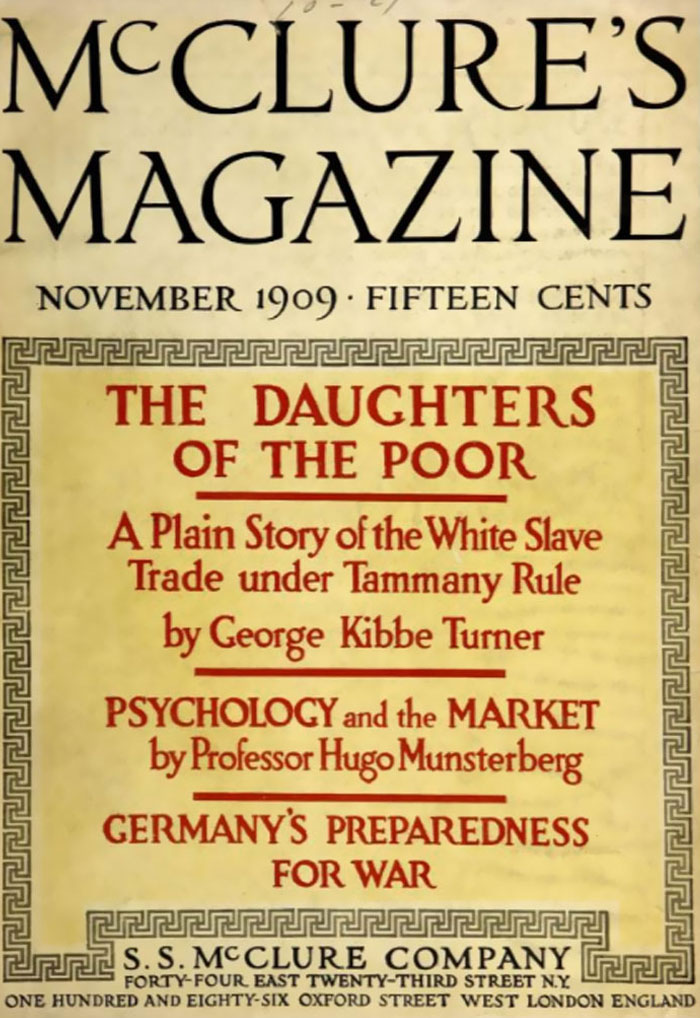
Yet the same movement also redirected public anger. Coverage like George Kibbe Turner’s 1907 piece for McClure’s Magazine on the Chicago sex trade depicted an industry run by immigrants, particularly Eastern European Jews, with little mention of the clientele. He subsequently wrote a similar expose of the sex trade in New York.
George Kibbe Turner’s expose of the New York sex trade for McClure’s Magazine
“They were going after landlords, pimps—people who were profiting,” Keire says. “But not the johns.”
The really wealthy, she notes, rarely needed commercial vice at all: they had mistresses, private apartments, and social circles within which exploitation was entirely insulated from commercial networks and therefore from the enforcement mechanisms the reformers were building.
The Structure Behind the “Scare”
Thompson argues that this gap between exposure and accountability, the pattern in which scandal produces prosecutions of facilitators while the powerful at the center escape, is not a historical accident but a structural feature of how exploitation at the elite level operates.
“The problem is not simply individual bad actors,” she says. “It is a system that depends on demand, on facilitators, and on those who profit from exploitation.” Focusing enforcement on the visible parts of that system leaves the demand side, the buyers driving the trade, largely untouched. “If there is demand, there will always be people who step into supply it,” she says.
The Epstein case illustrates how little this has changed. Thompson describes it as a decades-long coverup that has required relentless effort from survivors and investigative journalists to keep alive against sustained institutional resistance. What has shocked her most is the scale.
“The amount of political and financial power represented by these individuals rivals the GDP of some countries. That kind of money can buy a cover-up,” she says.
Epstein appears in a photo with billionaire Les Wexner

Keire also sees a direct parallel between the White and Epstein cases, noting how—be it through documents being destroyed or redactions to published materials—those implicated have been systematically protected. Even those whose names have circulated widely have generally escaped legal consequences so far.
In the US, she notes, accountability has been largely absent; in the UK and parts of Europe, there has been more movement. Meanwhile, the only person imprisoned in connection with Epstein’s operation remains a woman: Ghislaine Maxwell.
Thompson also points to the practical obstacles that limit how much of the full picture ever becomes public. Many survivors remain bound by non-disclosure agreements, while several that have come forward have reported a significant mental health toll from the ensuing global scrutiny.
“To come forward requires such an amount of resolve, and not everybody’s in a place in life where they can take that on,” she says.
The New Gilded Age
Both Keire and Thompson see the current moment as structurally analogous to the period that produced the Stanford White scandal, with Keire calling it “a new gilded age.” The progressive reforms that followed the excesses of the 1890s—civil service reform, antitrust legislation, the raising of the age of consent, the slow construction of a social welfare apparatus—represented an elite recognition that conspicuous wealth and unchecked exploitation produced dangerous instability.
Mara Keire is a historian at the University of Oxford

“You make things too hard for the middle class and the working class,” says Keire. “And you show your privilege so ostentatiously, and people get angry. Really angry.”
The lesson, she argues, has been forgotten. Reforms built up from the progressive era through the New Deal have been dismantled since the 1980s, leaving a concentration of wealth and power that looks much like the world in which Stanford White operated—in which certain men understand themselves to be beyond the reach of laws that apply to everyone else and institutions that should keep them in check fail to do so.
Thompson frames it in terms of what she calls a two-layer justice system: men without political and financial leverage sometimes pay a price, though often a low one. Those with it rarely do.
“It’s not just about the elite men,” she says. “It’s just that the elite men are able to get away with it. The spotlight gets shone on them sometimes. But it doesn’t stick.”
Jeffry Epstein poses with billionaire Richard Branson

What might make the present moment different, she suggests, is technology: the crowdsourcing of accountability, the mass scrutiny of released documents, the ability of survivors’ networks to organize across borders in ways that weren’t possible a century ago.
But as we navigate a new gilded age, the history of the White case serves as a warning: transparency is not the same as accountability.
 Follow Us