We all hit the same moments on repeat: a tense meeting, a sharp text, a conversation that’s drifting into conflict, your own nerves taking over at the worst time.
That’s why psychology tricks are so addictive. They give you one small move that changes what you do next, and that often changes what happens next.
This article breaks down 20 practical techniques you can use immediately in real-world situations, from staying calm under pressure to asking for something without triggering resistance.
Each one is explained in plain language with a quick example you can use. The point isn’t manipulation. It’s better self-control, clearer communication, and influence that doesn’t cross the line.
#1 Use A Bonus Rule That Makes The Hard Thing Easier
Most “motivation” tricks fail because they ask you to want the boring thing.
Temptation bundling flips that by attaching a treat to the task: you only get the “want” while you do the “should” like saving a favorite podcast for cleaning or only listening to a page-turner audiobook during workouts.
Management Science tested the idea by making addictive audiobooks available only at the gym, and people initially showed up more because the reward was built into the routine.
The easiest way to use it is to set one clear rule and make it as frictionless as possible.
If you need it to happen socially, rope someone in with a casual line: “Call me while I do my kitchen reset, it keeps me moving”

Image source: Furkan Elveren / Pexels
#2 Talk To Yourself Like You’re Someone Else
When you feel yourself getting pulled into a pointless spiral, switch to third-person self-talk.
Instead of “Why am I doing this?”, rephrase it as “Why is [your name] reacting this way?”
That tiny distance can take the sting out of the moment and make it easier to respond with control.
Psychology Today describes this self-distancing move as stepping into an outside-observer view, which can lower emotional intensity.
Scientific Reports also found that third-person self-talk helps people regulate emotion without needing a big mental push.
Try it right before you speak in a heated exchange: “What does [your name] need to say next in one calm sentence?”

Image source: Natalie Bond / Pexels
#3 Add A Speed Bump To The Habit You Want To Quit
If willpower keeps losing, commitment devices are a simple tactic: you set the rule in advance so the “wrong” choice becomes annoying or costly later.
The Journal of Medical Ethics describes them as voluntary setups where you deliberately make one option worse to help your future self stick to the plan, often by adding a financial stake or removing an easy escape route.
That “money on the line” version has real-world support. Asian CHI Symposium reporting on StickK found that people who used a financial stake succeeded more often than those who made the same goal with no money attached (79.1% vs 53.1%), because there’s a concrete consequence if you slip.
You can ask your friend to check up on you: “If I open social media before noon, I owe $10 to charity.” Keep the stakes realistic and don’t lock yourself into a goal that should change for good reasons.

Image source: Ono Kosuki / Pexels
#4 Stay Calm By Naming The Feeling Out Loud
When the moment starts to heat up, use this simple technique: name the emotion out loud in plain words.
Psychologists call it affect labeling, and it can be as basic as saying, ‘‘I’m getting frustrated’’ or ‘‘This is stressful.’’
In PLOS One experiments, labeling lowered distress in high-intensity negative situations (and could increase distress when the emotion was low-intensity), so save it for real spikes.
Naming the feeling shifts you from reacting to noticing, which makes the next move easier to choose. In a tense meeting, pause and say, ‘‘I’m feeling rushed, can we slow down and agree on the next step?’’
That small reset can change the tone without turning the moment into a therapy session.

Image source: Pressmaster / Pexels
#5 Pre-Write Your “If–then” Plan
If you want one of those tricks that actually work when things get hectic, write an if-then plan before you need it.
In psychology, this is known as implementation intentions. You pick a specific trigger and a specific response, so you don’t have to improvise under pressure: “If the meeting runs long, then I’ll ask for the next step in one sentence.”
A meta-analysis in Advances in Experimental Social Psychology reviewed 94 tests and found that these if–then plans reliably improve follow-through by making the cue easier to notice and the response more automatic.
Use it as a reset button: repeat your line once before you walk in, then say it calmly the second your trigger shows up.

Image source: cottonbro studio / Pexels
#6 Under Pressure, Use A Process Cue, Not A Goal Cue
Skip the big outcome pep talk and give yourself one process cue you can actually execute.
With process vs. outcome self-talk and matching visualization, you choose a controllable action line, then picture yourself doing it for 10 seconds.
Forbes draws a clear distinction between outcome-focused and process-focused self-talk, arguing that you should “pay attention to the behavior that will improve your performance,” and that imagery works the same way: “imagine the positive behavior,” not just the end result.
Before an interview, tell yourself, “Slow down and answer in three clear points,” then visualize your first sentence landing cleanly.

Image source: Ivan S / Pexels
#7 Give Yourself A Head Start So You Actually Finish
Give yourself a “started” feeling before you’ve even started.
The endowed progress effect is a simple reframing trick: instead of “0/10,” you set the same goal as “10 steps” but mark “2” as already done, so finishing feels closer and more urgent.
Journal of Consumer Research found that this kind of artificial head start increases persistence, boosts completion, and can even shorten the time it takes to finish.
Use it for habits or team follow-through: “We’re already two steps in because we picked the deadline and agreed on the format. Next step is drafting the first outline.”
Keep it transparent; the “head start” should reflect real progress or a deliberate motivation frame, not a fake scoreboard.

Image source: Jakub Zerdzicki / Pexels
#8 Ask For Advice Instead Of Feedback
Feedback can make people defensive, even when they mean well.
A smarter move is the advice-seeking effect: ask someone what they would do in your situation, and you’ll usually get clearer, more usable input than “What do you think of my work?”
In a CNBC interview, Wharton organizational psychologist Adam Grant says, “the best way to get people to coach you is, instead of asking for feedback, you seek advice,” and he points to research showing advice prompts more critical, actionable notes than feedback.
Try it with your boss or a teammate: “If you were trying to make this stronger by Friday, what would you change first?”

Image source: www.kaboompics.com / Pexels
#9 Want Someone To Act? Ask The Right Question
A well-placed question can do the pushing for you. The question–behavior effect taps into the fact that once a question is posed, people’s minds start working toward an answer, and that can make a next step feel more effective than a blunt command.
As Lindsey Godwin, Ph.D., puts it in Psychology Today, “Our brains are wired to seek answers to the questions we ask.”
So instead of “Please start,” try a question that forces a plan: “When are you going to begin, and what’s your first step?”
Use it to invite clarity, not to corner someone into a yes they don’t mean.

Image source: Yan Krukau / Pexels
#10 Try This Autonomy Phrase That Lowers Resistance
Lower the resistance before it shows up by naming the choice out loud.
The “but you are free…” technique is simple: you make your request, then add a line that makes autonomy explicit, which changes the tone from pressure to permission.
In Current Research in Social Psychology, adding “but you are free to accept or to refuse” increased compliance and even raised how much people gave compared to the same ask without the autonomy line.
Use it when you need to say something small but awkward: “Could you review this today? If not, no worries, just tell me what’s realistic.” It works best as genuine respect, not a scripted trick.

Image source: Katerina Holmes / Pexels
#11 A Small Imperfection Can Make You More Trustworthy
If you already come across as capable, a small, human slip can make you easier to attract people to because you suddenly look approachable, not “too perfect.” Psychologists refer to this as the pratfall effect.
In Psychonomic Science, a high-ability “quiz bowl” candidate who spilled coffee was liked more overall. The composite attraction score rose to 30.2, compared with 20.8 when no mistake happened. The same blunder hurt an average candidate, dropping the score to -2.5 from 17.8.
Here’s how it looks in the real world. You’re presenting, you flub one word, you correct it with relaxed facial expressions, and you keep going without making it a bigger moment than it is.
Coach and speaker Antoinette Griffin echoes the same idea in her YouTube talk, noting that small mistakes can read as “human,” not incompetent.

Image source: RDNE Stock project / Pexels
#12 Make People Co-Own The Outcome
Buy-in is easier to get when you stop handing people a finished plan and let them build a piece of it.
The IKEA effect is the bias where people value things more when they’ve put effort into making them, partly because it signals competence and creates pride of ownership.
Forbes explains that labor and personal investment can inflate perceived value and attachment.
Use it at work or at home by offering a real choice that shapes the result: “Pick the three criteria we’ll use, and I’ll draft the plan around them.”
Keep it fair. Don’t use “collaboration” as a trick when the decision is already made.

Image source: fauxels / Pexels
#13 Use “People Like You…” To Shift Behavior Subconsciously
If you want to shift behavior without sounding preachy, lean on descriptive norms and point to what people actually do.
Instead of “You should,” you say “Most people here do X,” which works because, in uncertain moments, we use the group as a shortcut for what’s normal.
A Journal of Consumer Research field experiment found that hotel guests were more likely to reuse towels when signs used a descriptive norm message like “the majority of guests reuse their towels,” beating the usual “help the environment” appeal, and it worked best when the norm matched the exact setting (“in this room”).
In everyday life, keep it honest and try it with your team: “Most of us drop updates before standup. Can you add yours too?”

Image source: Monstera Production / Pexels
#14 If It Feels Unfinished, Your Brain Won’t Let It Go
That nagging itch to finish the thing you started is called the Zeigarnik effect.
In Verywell Mind, psychology educator and author Kendra Cherry, MSEd, notes that we “remember tasks we haven’t finished better than those we have completed,” which is why half-done work and cliffhangers keep looping in your head.
To use it, don’t force motivation; just create closure. If a task is haunting you, write the next physical step, or “close” it mentally by defining one concrete finish line.
If you’re stuck, message a coworker and say, “I’m stuck on the last line.
Can you sanity-check this sentence so I can hit send?” Use the effect to unblock yourself, not to leave other people hanging on purpose.

Image source: DS stories / Pexels
#15 Use A Fresh Start Transition To Reset Your Routine
Pick a date that feels like a clean slate, then start there.
The fresh start effect is the idea that temporal landmarks like Mondays, the first of the month, or your birthday make change feel easier because they separate “old me” from “new me.”
In Management Science, researchers found that goal-focused actions tend to spike right after these calendar transitions.
Use it as one of those tricks to help you stop negotiating with yourself. On Sunday night, text a friend and say, “I’m restarting workouts Monday. Can we pick two days and lock them in?”
Let the date be a clean start, then commit to the first small step right away.
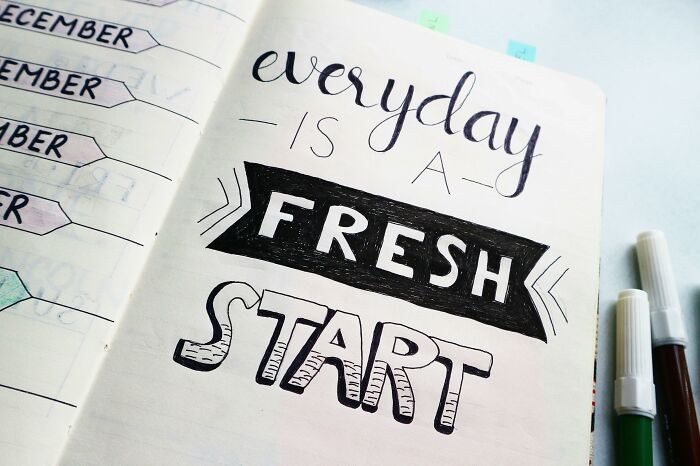
Image source: Bich Tran / Pexels
#16 Swap “I Can’t” For “I Don’t” And End The Argument
Do you ever feel yourself about to argue with your own impulse?
Try what’s called identity language and swap “I can’t” for “I don’t.” This shift turns a shaky restriction into a firm boundary, so you stop negotiating with yourself mid-moment.
In the Journal of Consumer Research, researchers found that framing refusal as “I don’t” can help people resist temptation and support goal-directed behavior, in part by increasing a sense of psychological empowerment.
Next time a friend pushes dessert, try: “No thanks, I don’t do sweets on weekdays.”

Image source: Andrea Piacquadio / Pexels
#17 Reframe The Meaning, Not The Facts
An insight you can borrow in the middle of a rough moment is cognitive reappraisal.
You keep the facts the same, but you change the meaning you attach to them so your body stops treating the situation like a threat.
Elizabeth Scott, PhD, explains on Verywell Mind that reframing changes how you experience stress because your stress response is often triggered by perceived stress.
Use it in conversation by swapping your internal label before you speak. If your manager says, “We need to redo this,” reframe it as “This is feedback I can use,” then reply,“ Got it. Which part needs the biggest fix first?”
Avoid excusing real problems and instead explore reframing as a way to stay clear-headed.

Image source: cottonbro studio / Pexels
#18 Zoom Out To Future You: Will This Matter In A Week?
Your brain loves to treat today’s stress like it’s permanent, so give it a longer timeline.
Temporal distancing is simply asking yourself how you’ll feel about this in a week, a month, or a year, then letting that future view guide your next move.
In Emotion, daily temporal distancing was linked with a healthier emotional pattern during stressful events, with people reporting lower negative emotion and higher positive emotion on days they used it more.
If your mood is spiraling after a sharp message, pause and think back to other “urgent” moments that faded fast, then reply with one calm sentence you’ll still respect next week.

Image source: Airam Dato-on / Pexels
#19 Before A Stressful Moment, Do A 2-Minute Values Reset
Right before an uncomfortable conversation, skip the pep talk and do a two-minute “values reset.” This self-affirmation move is one of those psychological tricks that steadies your ego so feedback doesn’t feel like an attack.
In a Science field experiment, brief value-focused writing improved longer-term academic outcomes, suggesting that a small reset can change how people perform under pressure.
On paper, write one value you care about (family, craft, honesty) and one sentence about why it matters, then walk into the room. In a tough check-in, that can sound like, “I care about doing good work, so I want to hear what needs to change and act on it.”
Don’t treat it as a hack to “win,” just a way to stay grounded and open.

Image source: Soufian Lafnesh / Pexels
#20 Need A Favor? Ask For A Small One First
Sometimes the fastest way to warm up a relationship is to ask for a small, easy favor, and psychology describes this as the Ben Franklin effect.
The idea is that helping you can make someone like you more afterward because their brain wants the favor to “make sense.”
On Forbes, psychologist Mark Travers, PhD, ties that shift to cognitive dissonance, where people adjust their attitude to match what they just did.
Keep it simple and specific so you’re not putting anyone on the spot. Psychology Today sums it up with the line that we “start liking the people we help,” which is exactly why a tiny request can open the door.
In a work chat, you might write, “Can you sanity-check this subject line?” Say thanks, move on, and don’t turn it into a manipulation tactic.

Image source: Mikhail Nilov / Pexels
FAQ
What are the four rules of psychology?
The four main goals, often called the “rules,” of psychology are to describe, explain, predict, and change behavior.
In plain terms, psychology aims to observe what’s happening, understand why it’s happening, anticipate what might happen next, and use that knowledge to help shift behavior in a healthier or more effective direction.
 Follow Us