Patrick Stewart’s passing at the age of 86 on October 28 left fans mourning the actor who brought Captain Jean-Luc Picard from Star Trek and Professor Charles Xavier from the X-Men films to life.
After his passing, more details about his final days emerged, including how his family said goodbye to him.
His d**th certificate revealed that his remains underwent a lesser-known process called water cremation, rather than traditional cremation using flames.
A simulation now shows how the unusual method works, from the moment a body is placed in a special chamber to what is eventually returned to the family.
Patrick Stewart’s remains underwent a process called water cremation

Jesse Grant/Getty Images for Paramount+
According to a d*ath certificate obtained by TMZ, Stewart’s remains were handled through a process known as alkaline hydrolysis, commonly called water cremation or aquamation.
The procedure took place on November 3, six days after the actor passed away on October 28 at his home in Los Angeles.
Unlike traditional cremation, which uses intense heat and flames, water cremation uses water, an alkaline chemical, and heat to break down the body’s soft tissues.
The Cremation Association of North America (CANA) describes the process as using “water, alkaline chemicals, heat, and sometimes pressure and agitation, to accelerate natural decomposition, leaving bone fragments and a neutral liquid called effluent.”
The association also explains that the process speeds up the natural decomposition that would happen during burial.
Stewart’s family has not publicly explained why they chose this method.

Water cremation is handled through a process known as alkaline hydrolysis
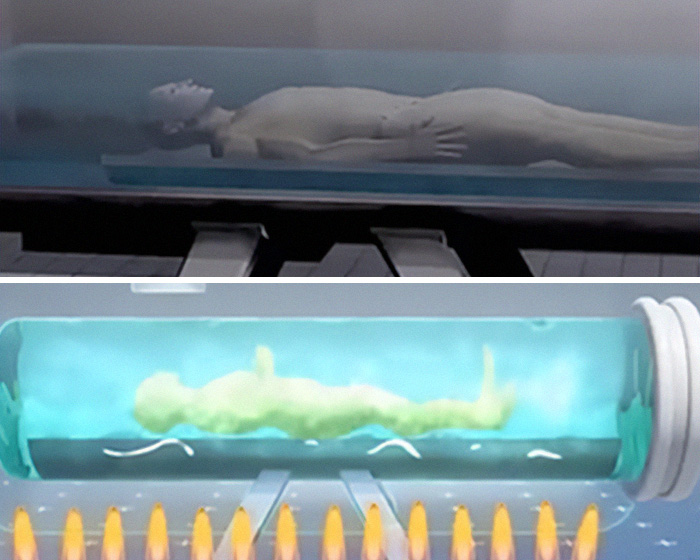
An animation Carl B shared on YouTube offers a closer look at what happens during water cremation.
The process begins with the deceased person’s body being placed inside a special, sealed metal chamber. The chamber is then filled with water and an alkaline chemical, such as potassium hydroxide, which helps break down the body’s soft tissues.
The mixture is heated and kept under controlled conditions. Some systems also use pressure or agitation to speed up the process.
The temperature and duration can vary depending on the equipment used. For example, a funeral home in Colorado described using a solution heated to around 300 degrees Fahrenheit. The process can take several hours.



As the process continues, the soft tissues break down and dissolve into the liquid. The bones remain inside the chamber.
Once the process is complete, the remaining bones are removed and dried. They are then processed into a fine powder, placed in an urn, and returned to the family, much like the ashes produced through traditional cremation.
According to a funeral chain, Dignity Memorial, the resulting remains are often finer and whiter than those produced by flame cremation.
It is treated and discharged through wastewater systems in accordance with local regulations. Some providers also offer families the option of receiving a portion of the liquid, which can be used to water a garden or tree.
Why do some families choose water cremation instead of the traditional cremation process?
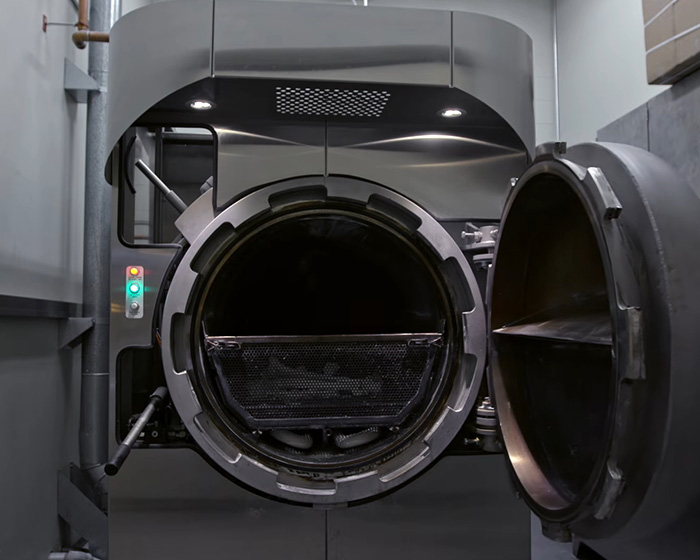
Water cremation is often described as an alternative to traditional cremation and burial, particularly by people looking for a method with a lower environmental impact.
Because it does not rely on flames or the extremely high temperatures used in conventional cremation, it generally consumes less energy.
Engineer Stan Hussey, who previously helped produce a water cremation machine, told Castanet News that he considered it a “much more pleasant” way to say goodbye to a loved one.
He also described the remains produced by the process, saying they were “pretty much pure white and very soft.”
However, water cremation does use a considerable amount of water. Dignity Memorial estimates that its process uses around 400 gallons per body, while the Colorado funeral home mentioned in a KJZZ report used approximately 300 gallons.
The method also has its critics.
In March 2023, a committee of US Catholic bishops argued that alkaline hydrolysis did not meet the Church’s requirements for respecting the bodies of the de*d. One concern was that much of the body becomes liquid that is eventually treated as wastewater.
Although water cremation is legal in several places, not every funeral home offers it

Jesse Grant/Getty Images for Paramount+


According to CANA’s March 2026 list, the process is permitted in 26 US states, including California, Colorado, Florida, Hawaii, Illinois, Minnesota, Oregon and Washington.
California, where Stewart passed away, legalized the procedure on July 1, 2020.
However, being legal in a state does not automatically mean that a provider offering the service is available nearby. CANA counts around 30 practitioners across the places where the method is permitted.
The equipment is also expensive. A Colorado funeral home told KJZZ that its water cremation machine cost around $250,000, compared with approximately $100,000 for a traditional flame crematory.
The cost can be higher than conventional cremation, too.
Dignity Memorial estimates that water cremation without a funeral service generally costs between $2,000 and $4,000, although prices depend on the location and other arrangements.
Patrick Stewart passed away after suffering from dementia

Stefanie Keenan/Getty Images for Peabody Awards
Stewart’s d*ath certificate listed cardiopulmonary arrest and a neurocognitive disorder with Lewy bodies as the causes of passing.
Lewy body dementia is a progressive condition that affects a person’s thinking, memory, movement, and ability to carry out everyday activities.
His longtime spokesperson, Kelly Bush Novak, had previously shared that the actor had experienced what she described as “a brief and poignant journey with Alzheimer’s disease and Lewy Body Dementia.”
The statement announcing his passing also offered a glimpse into his final days, describing how loved ones had surrounded him.
“He has been held in the warm embrace of family and friends, surrounded by live music, prayer, tears, laughter and the kind of profound emotion that only he could inspire after a lifetime of devotion to us all,” it read.
The statement continued, “We will forever cherish the peaceful ease and reflection on his face, an enduring reminder of his invincible grace.”
Stewart’s wife, singer-songwriter Sunny Ozell, also spoke about her loss two weeks after his passing.
In an Instagram post on November 11, she admitted that grief had been difficult to process but said she was grateful for the years they had shared.
“The grief continues to come in waves,” she wrote.
However, she also explained that they had been able to express their feelings to each other before his passing.
“We left nothing unsaid. He knew I loved him, and I know he loved me,” she added.
Ozell also reflected on their relationship, writing, “Patrick and I truly, authentically saw one another, and we amplified each other’s best qualities.”
The couple had shared nearly two decades after marrying in 2013.
Stewart was previously married to Sheila Falconer, with whom he had two children, Daniel and Sophie Alexandra. He was also married to Wendy Neuss between 2000 and 2003.
“I want to be out in a tree pod and planted,” shared one netizen





















 Follow Us