Even if you happened to hate history in school, there are always parts of it you haven’t heard that you might find fascinating. It just takes finding the right examples, because fiction doesn’t have a monopoly on good narratives.
So we’ve gathered some of the best posts and stories from the “History Unleashed” Facebook page, which is dedicated to sharing interesting pieces of history. Get comfortable as you scroll through, upvote your favorites and be sure to share your own examples below.
More info: Facebook
#1
His captors nicknamed him “The Incredibly Stupid One.”
That was exactly what Douglas Hegdahl wanted them to believe.
In April 1967, 19-year-old Navy seaman apprentice Douglas Hegdahl was serving aboard the USS Canberra off the coast of Vietnam when the blast from the ship’s guns knocked him overboard.
After spending hours alone in the water, he was picked up by North Vietnamese fishermen and eventually taken to a POW camp in Hanoi.
Hegdahl quickly realized that being underestimated could be useful.
He pretended that he couldn’t read or write and deliberately played the part of a simple, inexperienced young sailor.
His captors fell for it.
They nicknamed him “The Incredibly Stupid One” and allowed him considerably more freedom than many of the other prisoners.
But Hegdahl was paying attention.
Working with fellow POW Joe Crecca, he began memorizing information about the Americans being held prisoner.
Names. Ranks. Capture dates. Methods of capture. Personal details that could later help confirm their identities.
To keep the enormous list straight in his head, Hegdahl turned the information into a rhythm based on “Old MacDonald Had a Farm.”
By the time he was finished, he had memorized information on 256 American POWs.
He also reportedly used his increased freedom to sabotage five prison trucks by putting dirt in their fuel tanks.
In 1969, North Vietnam selected Hegdahl for early release as a propaganda gesture.
His fellow POWs normally refused early releases, insisting that prisoners should return in the order they had been captured.
But this time, senior prisoners ordered Hegdahl to go.
They knew what was inside his head.
On August 5, 1969, Hegdahl walked free.
His captors believed they were releasing an insignificant young sailor who knew little of value.
Instead, he returned home carrying one of the most valuable collections of information to leave the POW camps.
All of it memorized.
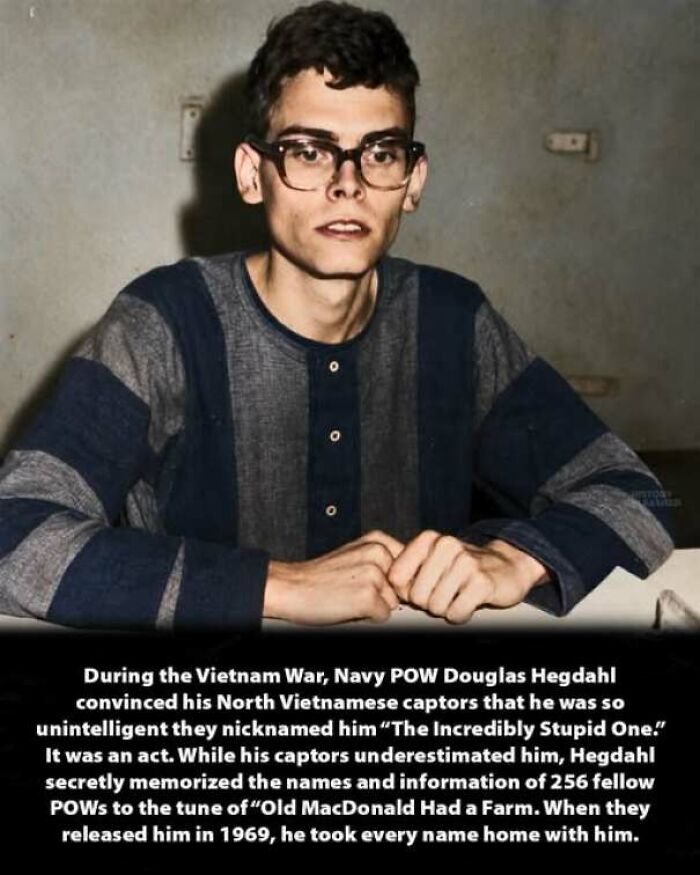
Image source: History Unleashed

#2
In 1969, aerospace engineer Judith Love Cohen went to the hospital to give birth. She brought her work with her.
Cohen had built an impressive career in an industry where female engineers were still extremely rare.
Among her most important projects was the Abort Guidance System used aboard the Apollo Lunar Module.
Then, on August 28, 1969, Cohen went into labor.
According to her son Neil Siegel, she took a computer printout of an engineering problem with her to the hospital.
She continued working on it there.
Before giving birth, Cohen called her boss and told him she had solved the problem.
Then she had her fourth child.
That baby was Jack Black.
Less than eight months later, an oxygen tank exploded aboard Apollo 13, crippling the spacecraft on its journey to the Moon.
The astronauts were forced to use their Lunar Module as a lifeboat, and the Abort Guidance System Cohen had helped develop played an important role in navigating the spacecraft during its journey home.
All three astronauts survived.
Cohen later considered her work on Apollo among the greatest accomplishments of her engineering career.
She went on to work on other major aerospace projects, including systems connected to the Hubble Space Telescope.
After retiring, she also became an author and publisher, producing children’s books intended to encourage girls to pursue careers in science and engineering.
So yes, Jack Black’s mother really was an aerospace engineer who helped develop technology that played a role in saving Apollo 13.
And apparently, even giving birth wasn’t enough to stop her from finishing an engineering problem.
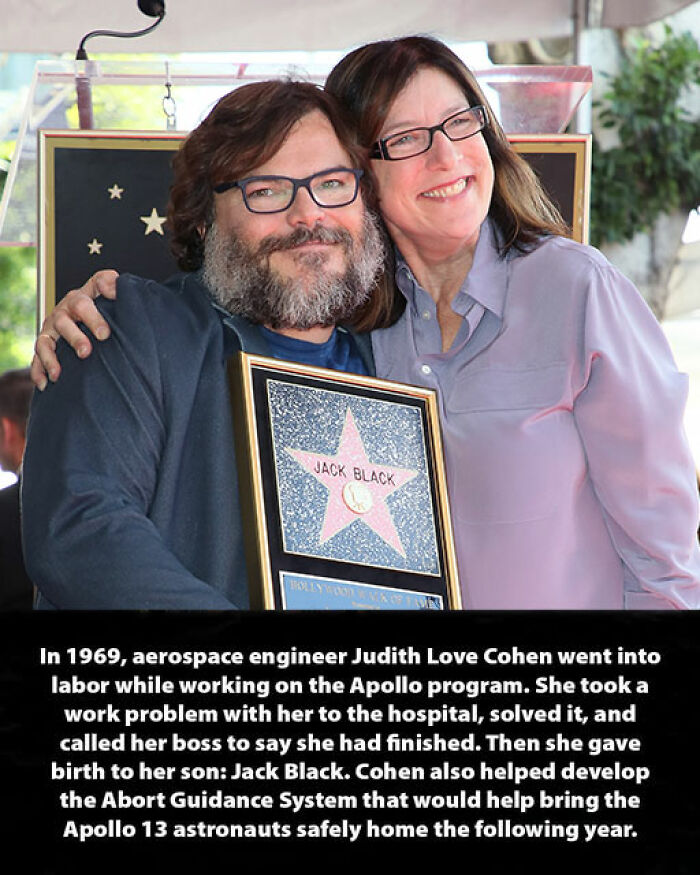
Image source: History Unleashed
#3
James Doohan wasn’t an engineer. But the engineer he played on television helped inspire a generation of real ones.
Beginning in 1966, Doohan played Montgomery “Scotty” Scott, chief engineer of the USS Enterprise on Star Trek. Whenever the ship was damaged, losing power or facing some seemingly impossible technical problem, Scotty was usually the man expected to solve it.
Decades later, Doohan discovered that his fictional engineer had influenced thousands of young viewers in the real world.
In February 1993, the Milwaukee School of Engineering awarded Doohan an honorary Doctor of Engineering degree. School officials credited his portrayal of Scotty with helping inspire generations of young people to pursue engineering.
Doohan later recalled that when students at the school were asked what had inspired them to enter the field, roughly half said Scotty had given them the idea.
He was thrilled.
Doohan said he heard similar stories from engineers across the country who had grown up watching Star Trek and decided they wanted to solve problems the way Scotty did.
For years, audiences watched a fictional engineer keep a fictional starship flying.
Some of the children watching grew up and became engineers themselves.
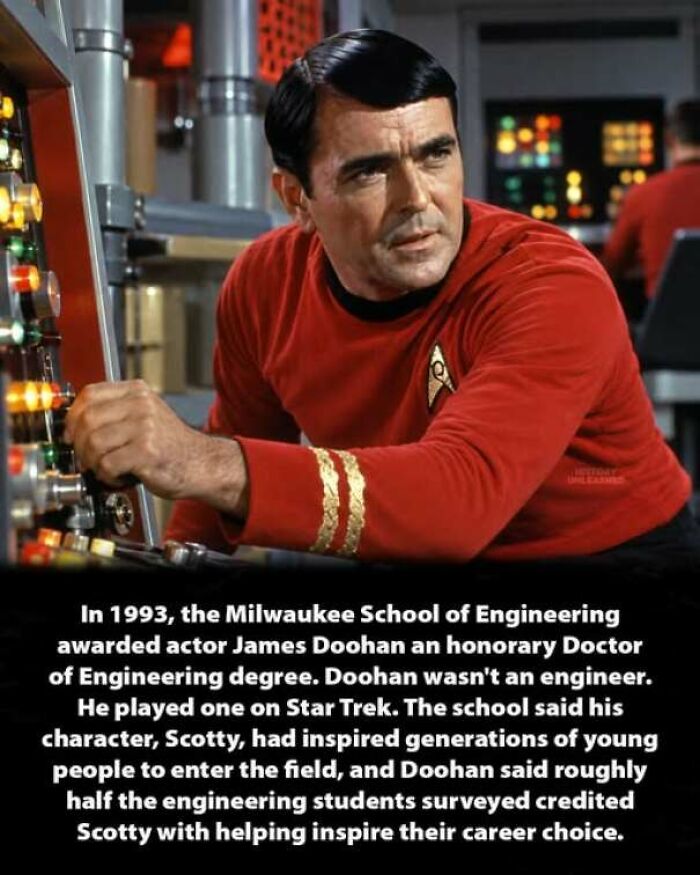
Image source: History Unleashed
Time is a slippery thing, and nothing proves it quite like the fact that Oxford University is older than the Aztec Empire. Teaching was already happening in Oxford by 1096, while the Aztec capital of Tenochtitlan was not founded until 1325, so students had been studying for more than two centuries before it existed.
By the middle of the 1200s, Oxford even had residence halls where those students could live. Smithsonian Magazine adds that the White House has now been standing longer than the Aztecs held their capital, which is the kind of detail that makes your brain wobble a little.
#4
One of Emperor Hirohito’s treasured possessions wasn’t an ancient artifact or an expensive piece of jewelry.
It was a Mickey Mouse watch.
In October 1975, the Japanese emperor and Empress Nagako visited the United States on a goodwill tour.
Their trip included a stop at Disneyland in California.
During the visit, Hirohito was presented with a Mickey Mouse wristwatch.
And apparently, he loved it.
The emperor continued wearing the watch after returning to Japan and was reportedly seen wearing it even during formal occasions.
Then, a few years later, Mickey stopped ticking.
According to TIME magazine, the malfunction caused enough concern inside the Imperial Household that palace officials sent the watch to Tokyo specialists familiar with American timepieces.
After examining the emperor’s treasured watch, they discovered the problem.
It needed a new battery.
Mickey was soon ticking again and returned to Hirohito’s wrist.
When Hirohito passed in 1989, contemporary reports claimed that the Mickey Mouse watch was among the personal possessions buried with him.
That final detail has never been officially confirmed. The Imperial Household Agency declined to reveal exactly which personal items were placed in his tomb.
But Hirohito’s affection for the Mickey Mouse watch itself is well documented.
For years, one of the world’s most formal monarchs could occasionally be seen wearing Mickey Mouse on his wrist.
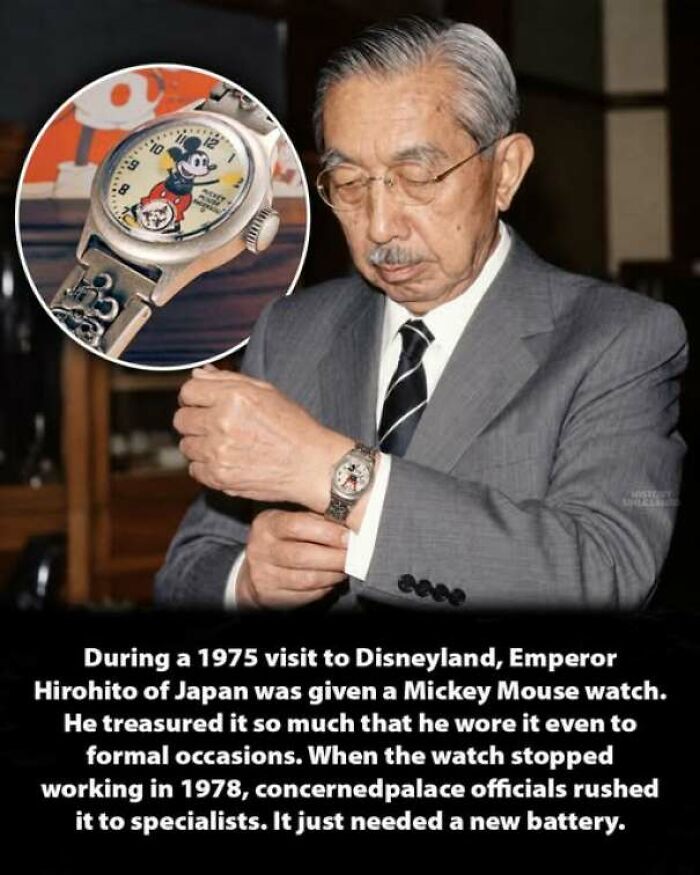
Image source: History Unleashed
#5
On July 22, 1941, someone filming a wedding in Amsterdam accidentally captured the only known surviving film footage of Anne Frank.
Anne was 12 years old and living with her family at Merwedeplein 37. Their next-door neighbor, Tiny Burger, was getting married, and an acquaintance had brought a 16mm camera to film the occasion.
As the bride and groom prepared to leave, the cameraman briefly turned toward the open windows of the surrounding apartments.
There, leaning out of a second-floor window to get a better look at the wedding, was Anne Frank.
She appears for only a few seconds. At the time, she was simply another neighborhood girl watching the excitement outside her home. No one filming the wedding could have known that those fleeting images would become historically significant.
Less than a year later, in July 1942, the Frank family went into hiding.
Today, the short wedding film contains the only known surviving moving images of Anne Frank.
The image shown here is a digital reconstruction based on a frame from that original 1941 footage.
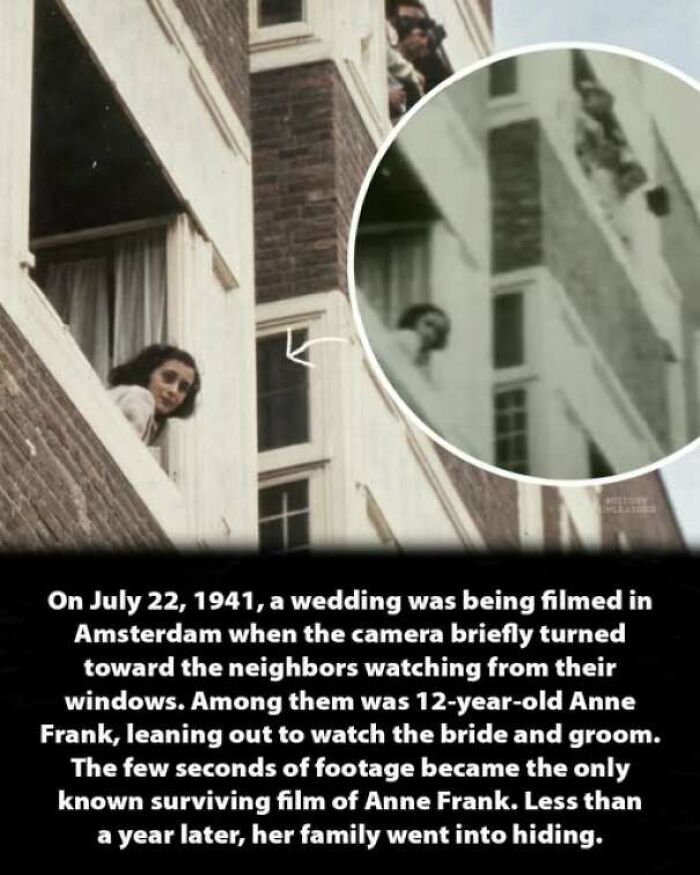
Image source: History Unleashed
#6
McDonald’s opened its first drive-through because of an unusual rule affecting soldiers at a nearby Army base.
In the early 1970s, McDonald’s still didn’t have drive-throughs, even though some competing fast-food restaurants already did.
That changed in Sierra Vista, Arizona, near Fort Huachuca.
The local McDonald’s was popular with soldiers stationed at the Army base, but there was a problem.
According to McDonald’s, soldiers wearing their fatigues were required to remain in their vehicles while off base.
That meant they couldn’t simply park, walk inside, and order food while dressed in uniform.
Franchisee David Rich came up with a solution.
He installed a sliding window in the restaurant wall that allowed soldiers to place and receive their orders without ever leaving their vehicles.
On January 24, 1975, the Sierra Vista restaurant opened what McDonald’s recognizes as the company’s first drive-through.
The idea quickly spread.
A feature originally adopted in response to soldiers from a nearby Army base would eventually become one of the defining features of McDonald’s restaurants around the world.
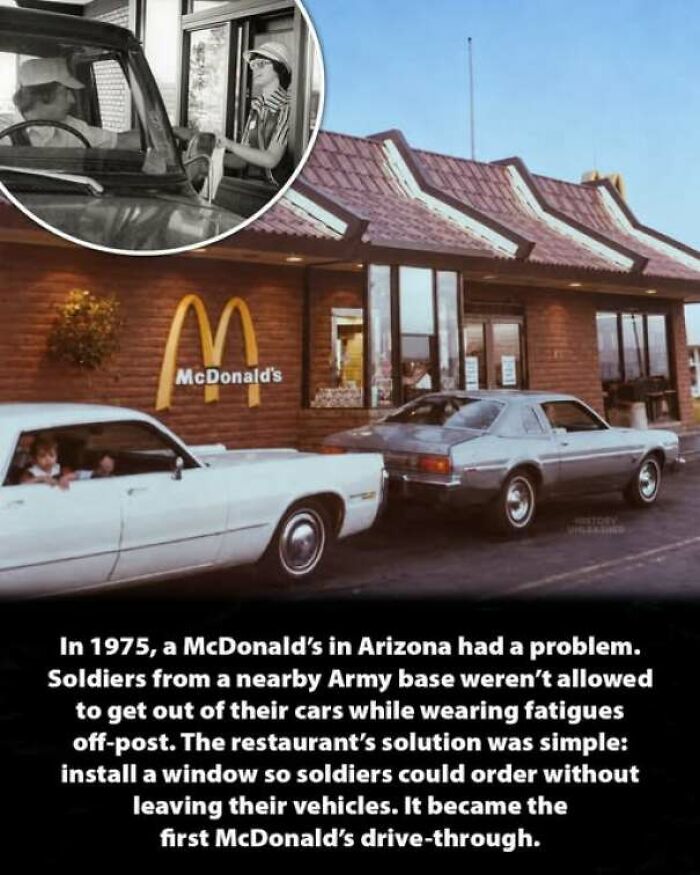
Image source: History Unleashed
Some conflicts are far less dignified. In 1932, Australia sent soldiers with machine guns to Western Australia to deal with thousands of emus that were trampling wheat farms, and the birds simply refused to play along. They split into small groups, scattered in every direction, and made the whole operation look so silly that the press cheerfully declared the emus the winners. The troops withdrew after a short campaign, and although the farmers asked for military help again in later years, the government said no.
#7
In the early 1900s, one of the most effective weapons a woman could carry was already holding her hat in place.
Women’s hats had become enormous and elaborate, and keeping them securely attached sometimes required hatpins approaching a foot in length.
They were essentially long, thin pieces of metal ending in a sharp point.
At the same time, growing numbers of women were traveling through American cities independently.
Street harassment was common.
Men who approached, grabbed or otherwise harassed women in public were often called “mashers.”
Women quickly discovered that the enormous pins holding their hats in place could serve another purpose.
Self-defense.
Newspapers began reporting incidents of women pulling out their hatpins when men refused to leave them alone.
In New York in 1903, Leoti Blaker was riding in a crowded stagecoach when a man sitting beside her repeatedly moved closer and eventually put his arm around her.
Blaker pulled out her nearly foot-long hatpin and drove it into his arm.
The man screamed and got off at the next stop.
Other stories followed.
The hatpin became so closely associated with women defending themselves that newspapers began warning of the “Hatpin Peril.”
Soon, authorities began worrying about the pins themselves.
In 1910, Chicago lawmakers debated restricting long hatpins in public.
Women were not amused.
During the debate, women’s club representative Nan Davis reportedly told officials:
“If the men of Chicago want to take the hatpins away from us, let them make the streets safe.”
Chicago passed its ordinance anyway.
Similar restrictions appeared in several other cities.
For a brief period in the early 20th century, an ordinary piece of women’s fashion had become something else entirely.
A means of self-defense.
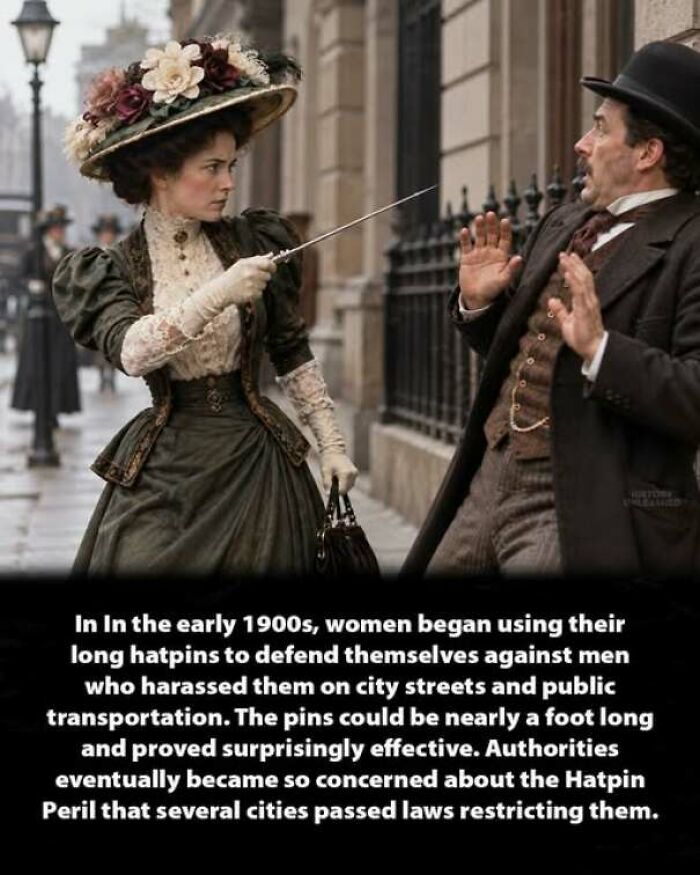
Image source: History Unleashed
#8
One of Abraham Lincoln’s most recognizable features may have been influenced by an 11-year-old girl.
In October 1860, Grace Bedell of Westfield, New York, saw a campaign portrait of presidential candidate Abraham Lincoln and decided he could improve his appearance.
So she wrote him a letter.
Grace told Lincoln that his face was “so thin” and suggested that he grow whiskers.
She also argued that women liked whiskers and might encourage their husbands to support him.
Four days later, Lincoln personally wrote back.
He wasn’t convinced.
Having never worn whiskers before, Lincoln wondered whether suddenly growing them would look like a “silly affectation.”
But about a month after receiving Grace’s letter, Lincoln began growing a beard.
After winning the election, the president-elect traveled through Westfield on his journey to Washington in February 1861.
By then, his beard was unmistakable.
Lincoln asked for Grace in the crowd, met her face to face and acknowledged that he had acted partly upon her suggestion.
The beard remained for the rest of his life and became part of one of the most recognizable faces in American history.
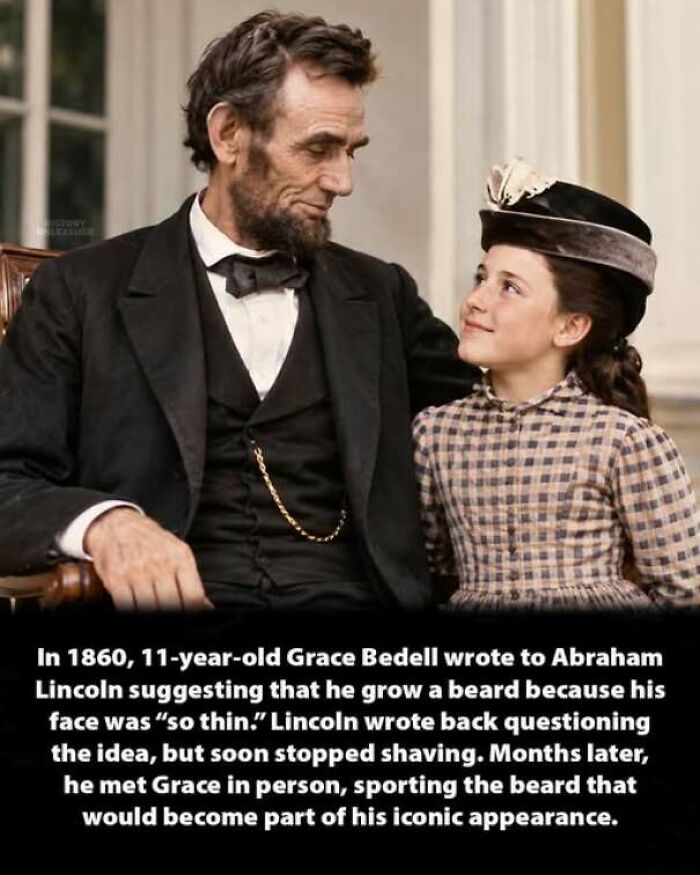
Image source: History Unleashed
#9
In 1910, Theodore Roosevelt became the first person who had served as President of the United States to fly in an airplane.
Roosevelt had left the White House the previous year.
On October 11, 1910, the 51-year-old former president was visiting Kinloch Field near St. Louis, Missouri, while campaigning for the state’s Republican Party.
Aviation was still remarkably new.
The Wright brothers had made their famous first powered flight less than seven years earlier.
At the field, pilot Arch Hoxsey invited Roosevelt to climb aboard his Wright biplane.
Roosevelt initially declined.
Then he changed his mind.
With Hoxsey at the controls and Roosevelt sitting beside him, the aircraft took off.
The flight lasted only about four minutes, but Hoxsey didn’t simply circle gently above the field.
According to the Smithsonian’s National Air and Space Museum, he put the aircraft through three steep dives with the former president aboard.
Roosevelt apparently loved it.
Asked afterward why he had suddenly decided to fly, he explained:
“You know I didn’t intend to do it, but when I saw the thing there, I could not resist it.”
The spontaneous decision made Theodore Roosevelt the first person who had served as U.S. president to experience powered airplane flight.
His successor, William Howard Taft, remained firmly on the ground.
It would not be until 1943 that Franklin D. Roosevelt became the first sitting U.S. president to travel by airplane while in office.
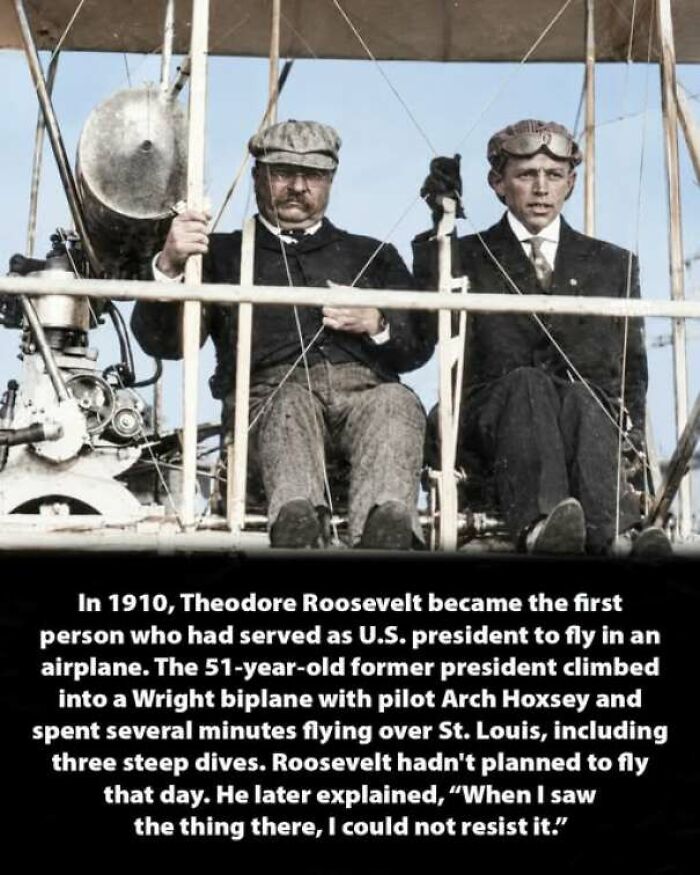
Image source: History Unleashed
Technology can start in humble places too. In 1991, a group of researchers at the University of Cambridge grew tired of trekking to a shared coffee pot only to find it empty, so they pointed a camera at it and sent the picture to their desktop computers. The image was grayscale and refreshed only a few times a minute, but it did the job.
#10
In 1903, President Theodore Roosevelt was traveling across the American West when a young girl in Kansas approached him with an unusual question: Would the president like a baby badger?
Roosevelt apparently thought she was joking.
He said yes.
The girl promptly presented him with an actual badger cub.
Roosevelt accepted the unexpected gift and named him Josiah, reportedly after the girl who had given him the animal. Josiah traveled with the presidential party before eventually joining the Roosevelt family’s extraordinary collection of animals.
The Roosevelts were already famous for keeping an assortment of pets. Their children cared for dogs, cats, guinea pigs, ponies, snakes, birds and numerous other animals during Roosevelt’s presidency.
Josiah apparently developed a personality of his own.
In a letter to his son Archie, Roosevelt described the young badger as “very friendly and affectionate.” Josiah enjoyed being held and would sometimes nip at people’s ankles when he wanted attention.
Eventually, the family decided the White House wasn’t the ideal permanent home for a growing badger. Josiah was given to the Bronx Zoo, where Roosevelt could still visit him.
It was perhaps the most Theodore Roosevelt outcome possible: someone jokingly offered the president a wild animal, and he actually took it home.
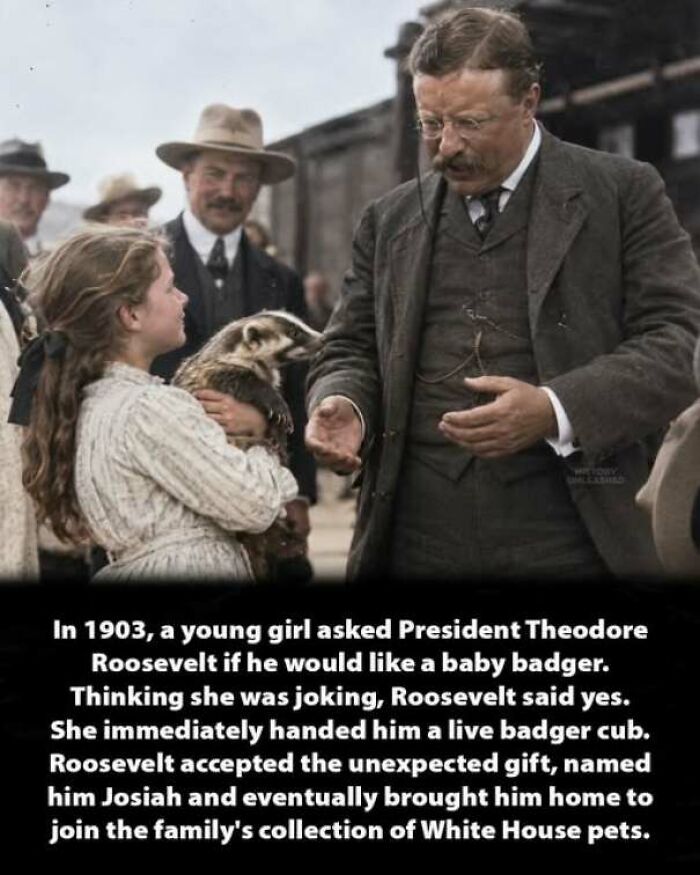
Image source: History Unleashed
#11
One of the earliest commercially successful rearview mirrors had a very different selling point: spotting the police.
Rearview mirrors weren’t entirely new by the 1920s. Drivers and inventors had experimented with them for years, and racer Ray Harroun famously mounted one on his car for the first Indianapolis 500 in 1911.
But in 1921, engineer Elmer Berger began selling an aftermarket automobile mirror with an unforgettable name:
The “Cop-Spotter.”
Rather than emphasizing road safety, the name advertised another advantage of being able to see behind your car: drivers could spot police approaching from the rear.
Berger’s adjustable plate-glass mirror measured roughly 3 by 7 inches, attached near the top of the windshield and sold for around $3.50.
Rearview mirrors would eventually become an essential piece of automotive safety equipment.
But one of the products that helped popularize them had a much more mischievous appeal.
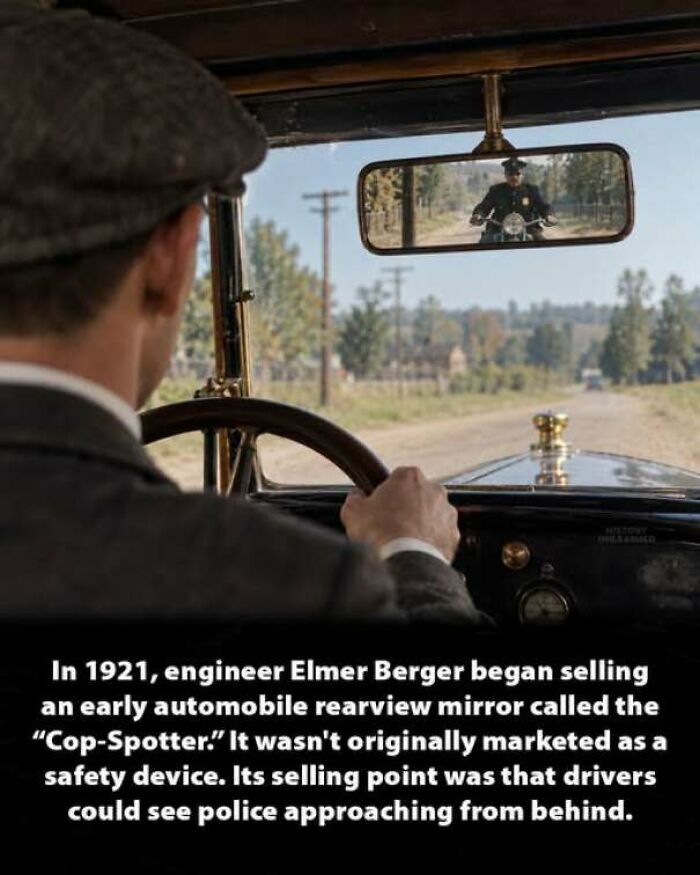
Image source: History Unleashed
#12
In 1942, 77 American military nurses became prisoners of war in the Philippines.
Every one of them survived.
The women, 66 Army nurses and 11 Navy nurses, had been stationed in the Philippines when Japan invaded shortly after the attack on Pearl Harbor.
As American and Filipino forces fought desperately to hold Bataan and Corregidor, the nurses worked under increasingly brutal conditions. Hospitals designed for roughly 1,000 patients became overwhelmed with thousands of wounded and sick men. Medical supplies dwindled while malaria, dysentery and other diseases spread.
When American forces surrendered in 1942, the nurses were captured.
But they didn’t stop being nurses.
The women were eventually imprisoned at camps including Santo Tomas and Los Baños. Surrounded by thousands of other prisoners and civilians, they organized themselves into regular nursing shifts and continued caring for the sick.
As the war dragged on, conditions deteriorated.
Food became desperately scarce. Disease spread. The nurses themselves grew weak from malnutrition, but they continued reporting for duty and caring for other prisoners.
Their leaders believed maintaining their nursing routine gave the women something enormously important in captivity: purpose.
For nearly three years, they kept going.
In February 1945, American and Filipino forces liberated the camps.
The nurses emerged sick, exhausted and severely underweight.
But when they were counted, something remarkable became clear.
All 77 had survived.
They became known as the Angels of Bataan and Corregidor.
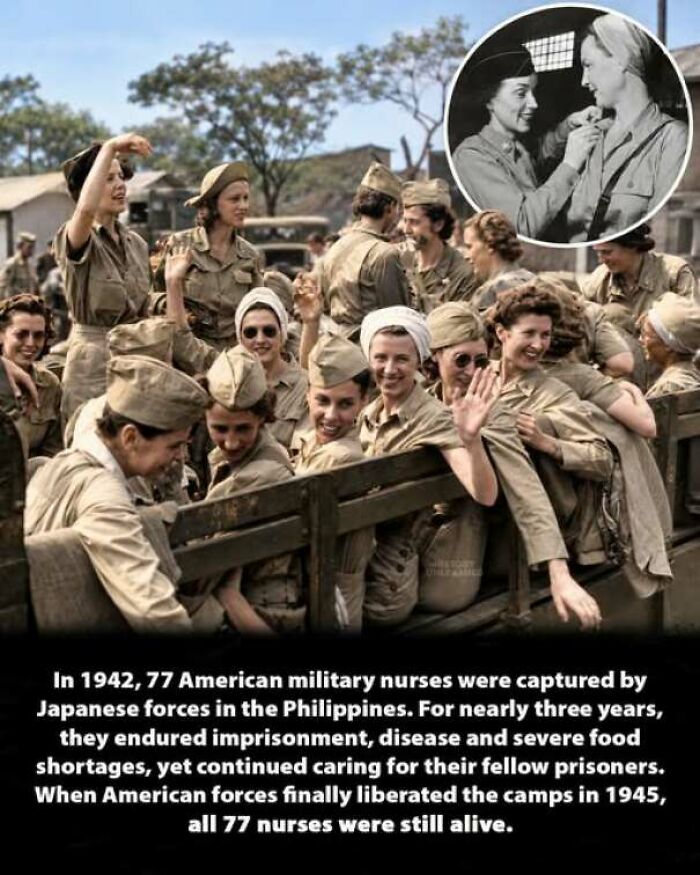
Image source: History Unleashed
Once it reached the web in 1993, the Trojan Room coffee pot became the first webcam, and one of its creators tells the whole tale on a Cambridge page that reads like a classic office story. When the lab moved in 2001, a coffee machine from the camera’s glory days even sold on eBay for £3,350.
#13
The lifeboat was designed to carry 12 people. Bernie Webber brought it home with 36 aboard. On February 18, 1952, the tanker SS Pendleton broke in half during a violent nor’easter off Cape Cod, leaving 33 men stranded aboard its stern section. The Coast Guard sent 24-year-old Bernie Webber and crewmen Andrew Fitzgerald, Richard Livesey and Ervin Maske to find them aboard CG-36500, a 36-foot wooden motor lifeboat. The conditions were almost unimaginable. Nearby vessels reported waves reaching 60 feet. Crossing the dangerous Chatham Bar, a massive wave smashed the lifeboat’s windshield and tore away its compass. Webber kept going. Somehow, in darkness and blowing snow, the four men found the broken tanker. Webber repeatedly maneuvered the tiny lifeboat alongside the towering wreck as the stranded sailors climbed down a Jacob’s ladder one at a time. Thirty-two of the 33 men were rescued. Now carrying 36 people on a boat designed for 12, Webber had to find his way back without a compass. Eventually, the crew spotted the small red light of a buoy marking the entrance to Chatham Harbor and followed it home. All four Coast Guardsmen were awarded the Gold Lifesaving Medal. Their mission is still remembered as one of the greatest small-boat rescues in U.S. Coast Guard history.
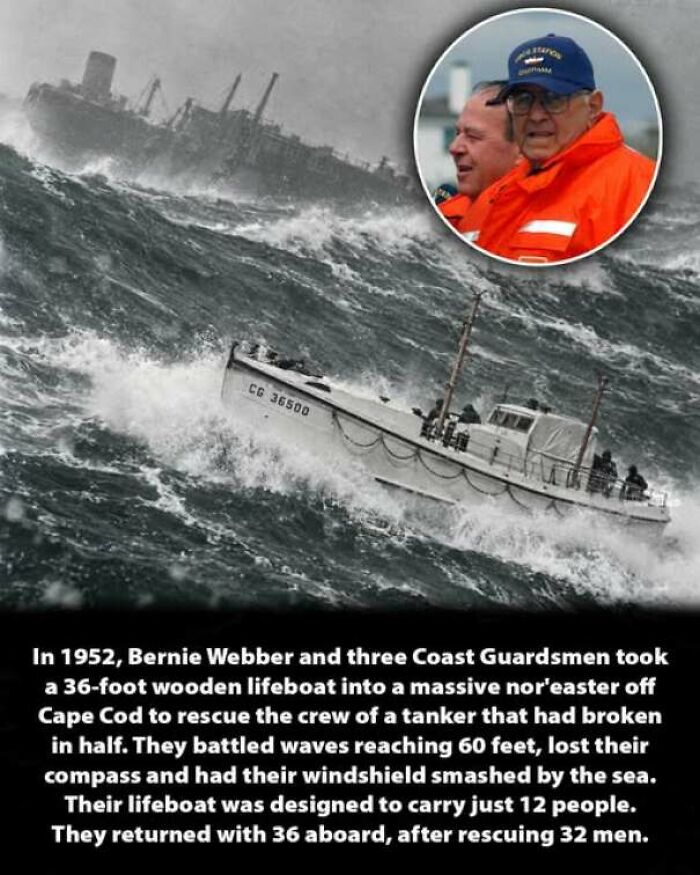
Image source: History Unleashed
#14
For 16 days after the attack on Pearl Harbor, three sailors appear to have remained alive inside the sunken USS West Virginia.
On December 7, 1941, Japanese aircraft attacked Pearl Harbor.
The battleship USS West Virginia was struck repeatedly before settling onto the bottom of the harbor.
More than 100 members of her crew passed away.
But for three sailors trapped deep inside the ship, December 7 was apparently not the end.
Months later, salvage crews began pumping water from the damaged battleship.
Inside an unflooded storeroom, workers discovered the bodies of three sailors.
The compartment told the story of what had happened.
The emergency rations had been consumed.
A manhole leading to freshwater tanks had been opened.
And nearby was a calendar.
Someone had marked an X across every date beginning on December 7.
The marks continued through December 8.
December 9.
December 10.
And onward.
The final X was placed on December 23, 1941.
Sixteen days after the attack.
The Navy’s official salvage report concluded that the evidence showed the men had remained alive for a considerable period after the ship sank.
The three sailors are generally identified as Ronald Endicott, Clifford Olds and Louis “Buddy” Costin.
They had apparently found themselves trapped inside one of the few spaces that remained dry, with emergency food and access to fresh water.
Eventually, however, the air inside the sealed compartment appears to have run out.
When USS West Virginia was finally refloated on May 17, 1942, the calendar remained behind as evidence of what the three sailors had endured beneath the decks of the battleship.
Its final mark was December 23.
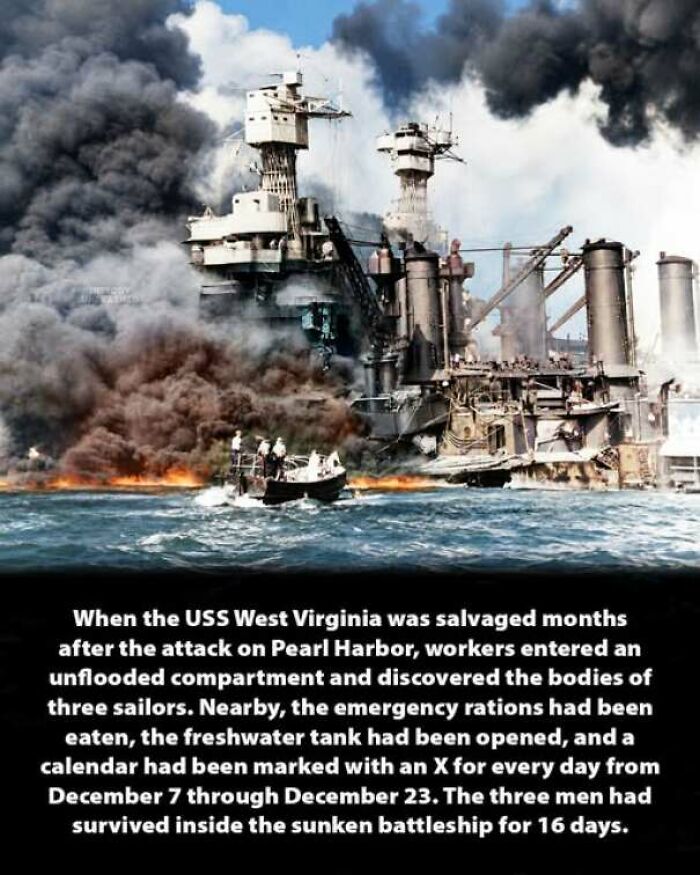
Image source: History Unleashed
#15
More than 10,000 years ago, someone carried a small child across a muddy landscape in what is now New Mexico. Their footprints survived to tell the story.
At White Sands National Park, researchers discovered an extraordinary human trackway stretching for nearly a mile across what was once the muddy shore of an ancient lake.
The footprints appear to have been made by an adolescent or small adult, likely female, traveling while carrying a child under the age of 3.
Researchers could even see evidence of the traveler shifting the child from one side of their body to the other.
At several points, tiny footprints appear beside the larger ones, suggesting the child was briefly placed on the ground before being picked up again.
Then something remarkable happened.
After the pair passed through, a Columbian mammoth and a giant ground sloth crossed their trail.
Several hours later, the same human traveler appears to have returned along the same route, this time without the child.
Altogether, the out-and-back journey created more than 1.5 kilometers of preserved tracks, making it the longest known Late Pleistocene human double trackway.
Thousands of years later, individual footprints still preserve moments from one person’s journey across an Ice Age landscape.
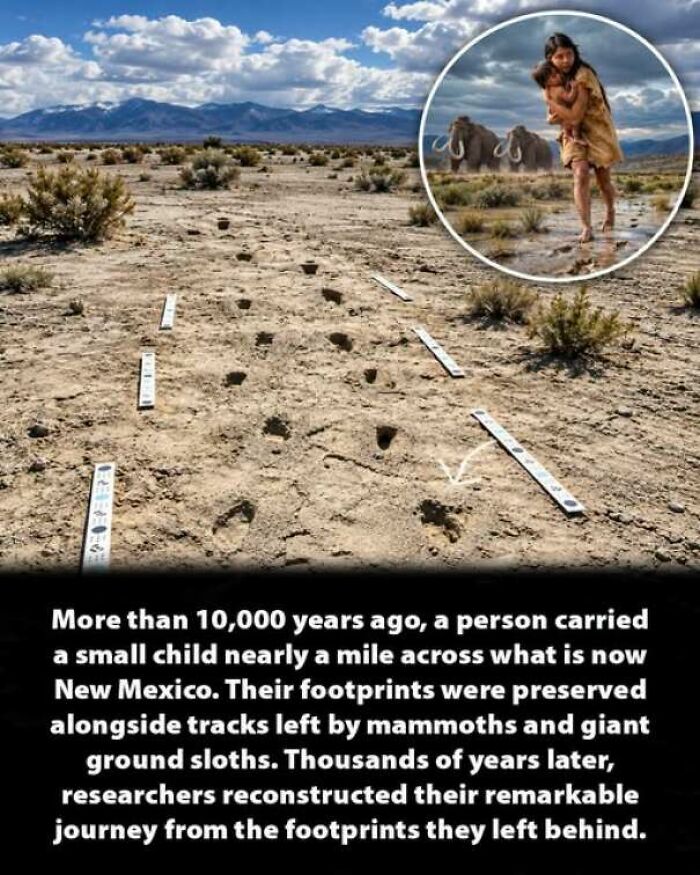
Image source: History Unleashed
Even the mightiest leaders can lose to something fluffy. In 1807, after signing a peace treaty with Russia, Napoleon decided to celebrate with a rabbit hunt, and his chief of staff arranged for hundreds of rabbits to be delivered.
#16
Before The Blues Brothers reached theaters in 1980, some exhibitors were convinced white audiences wouldn’t watch it.
The movie starred John Belushi and Dan Aykroyd, but its cast also featured an extraordinary collection of Black musical legends, including Aretha Franklin, James Brown, Ray Charles, Cab Calloway and John Lee Hooker.
According to director John Landis, that became an unexpected problem when Universal began trying to book the movie into theaters.
Landis recalled that many exhibitors viewed it as a “Black movie” and believed white audiences wouldn’t come to see it.
He said many prime theaters consequently refused to book the film.
One major theater owner told Landis that he would show the movie in Compton, but not in the prestigious theaters of Westwood, Los Angeles.
As a result, The Blues Brothers opened in just 594 theaters, far fewer than a major production would normally receive.
Audiences showed up anyway.
The movie earned more than $57 million at the domestic box office and became one of the highest-grossing films released that year.
Decades later, The Blues Brothers remains a comedy and musical classic.
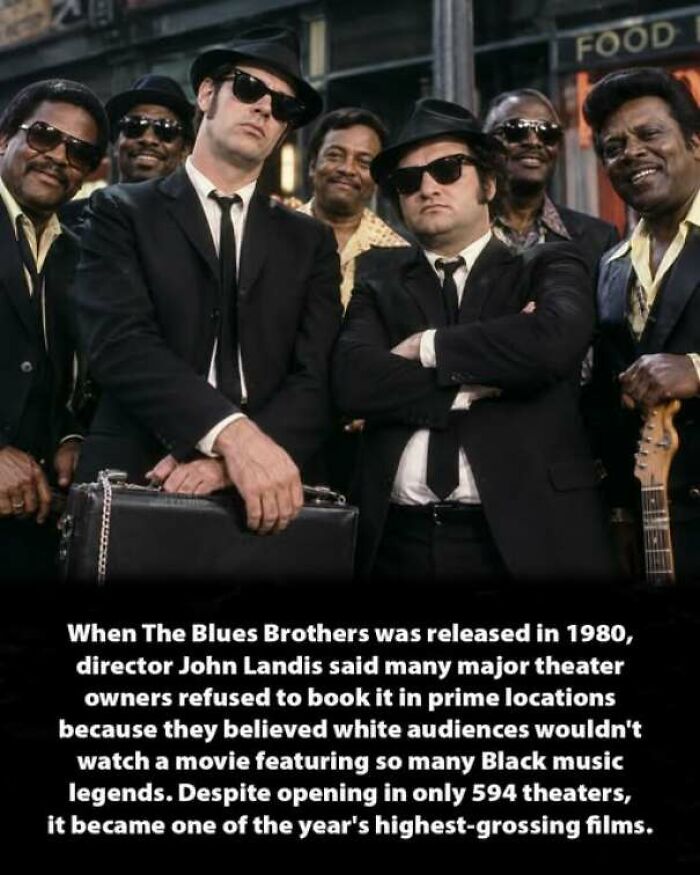
Image source: History Unleashed
#17
In 1918, former President Theodore Roosevelt argued that patriotism did not mean unquestioning loyalty to the president. Writing during World War I, Roosevelt defended the right of Americans to criticize their leaders, warning against the idea of standing by a president “right or wrong.”
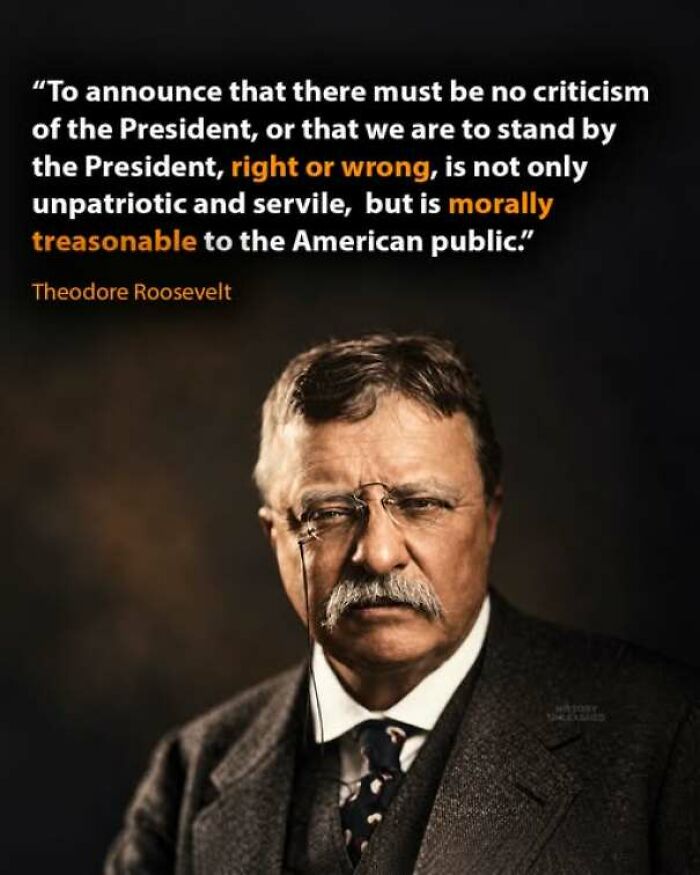
Image source: History Unleashed
#18
Thomas Jefferson liked pasta so much that he once drew detailed instructions explaining how a macaroni-making machine worked.
Jefferson developed a fascination with European food while serving as the American minister to France during the 1780s.
Pasta particularly caught his attention.
During his travels, Jefferson recorded detailed notes describing how macaroni was produced by forcing dough through holes in an iron plate.
He even drew a diagram of the machine used to make it.
In 1789, Jefferson asked his secretary, William Short, to obtain a “mould for making maccaroni” from Naples.
The machine was eventually shipped to America and later appeared among Jefferson’s household possessions at Monticello.
Jefferson also preserved a recipe for macaroni in his own handwriting, although historians believe it was likely dictated to him by one of the enslaved chefs who prepared his food.
One of the most important was James Hemings.
Jefferson had brought Hemings to France, where he received extensive training in French cuisine before returning to the United States.
Pasta dishes eventually became a regular part of Jefferson’s table.
In 1802, while Jefferson was president, Massachusetts congressman Manasseh Cutler attended a dinner at the President’s House.
Among the beef, turkey, mutton, ham, eggs and other dishes was something Cutler apparently found rather unusual.
He called it:
“A pie called macaroni.”
Cutler wasn’t particularly impressed.
But Jefferson continued eating and serving pasta for years afterward and even imported macaroni from Europe when he couldn’t obtain enough domestically.
Thomas Jefferson didn’t invent macaroni and cheese, nor was he the first person to bring pasta to America.
But his enthusiasm for European cuisine helped introduce dishes that were still novelties to many Americans of his era.
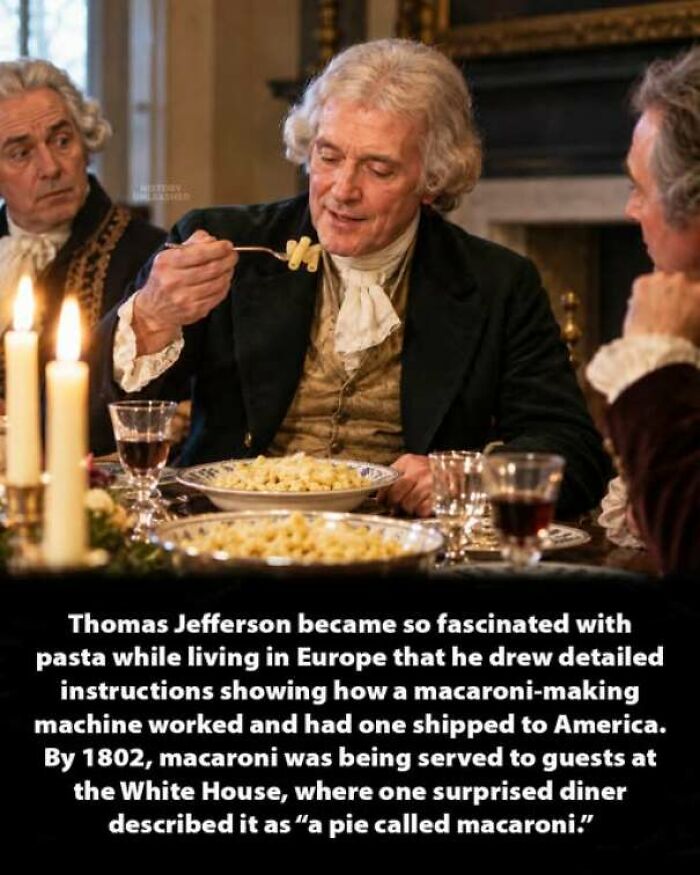
Image source: History Unleashed
The catch was that they were tame farm rabbits rather than wild ones, so instead of fleeing, they raced straight toward the emperor, apparently expecting dinner. According to a general’s memoir, which Mental Floss recounts, Napoleon ended up retreating to his carriage while the bunnies chased after him. The tale stayed quiet for decades, since that memoir was not published until 1895.
#19
In the middle of the Revolutionary War, George Washington returned his enemy’s lost dog.
On October 4, 1777, Washington’s Continental Army attacked British forces commanded by General Sir William Howe at the Battle of Germantown.
The Americans were ultimately forced to retreat.
But amid the confusion surrounding the battle, American soldiers came across a wandering dog.
The inscription on its collar revealed that it belonged to Howe, the British commander Washington had just fought.
Instead of keeping the dog, Washington arranged for it to be returned to the British.
Two days after the battle, he sent a short note across the lines:
“General Washington’s compliments to General Howe. He does himself the pleasure to return him a dog, which accidentally fell into his hands, and by the inscription on the Collar, appears to belong to General Howe.”
Even in the middle of a war, Washington made sure his enemy got his dog back.
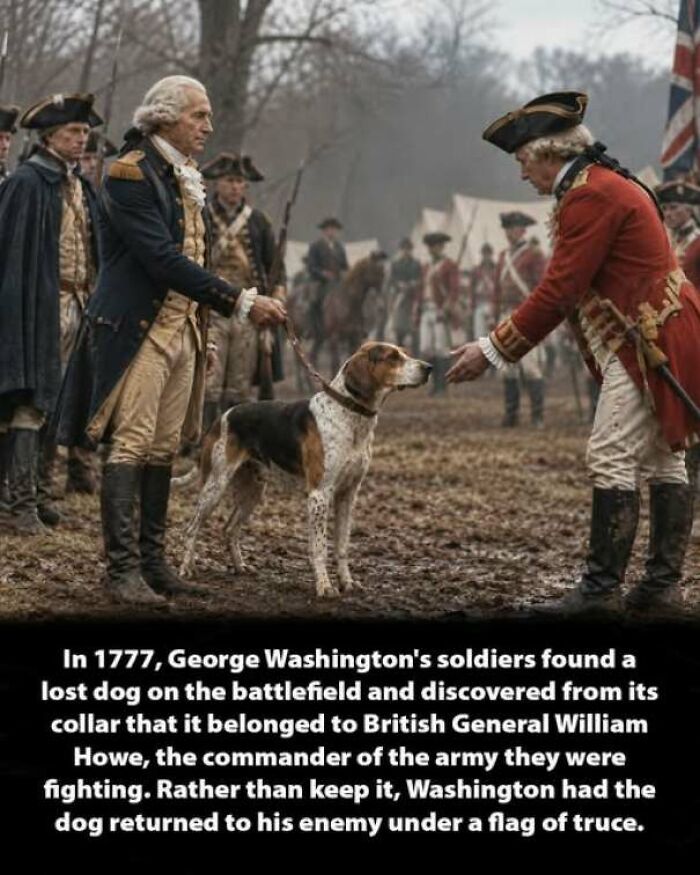
Image source: History Unleashed
#20
At age 100, Royce Williams finally received the Medal of Honor for a dogfight he had survived more than 73 years earlier.
On November 18, 1952, during the Korean War, Navy Lieutenant Royce Williams took off from the USS Oriskany in an F9F-5 Panther. His group soon encountered seven Soviet MiG-15 fighters. The Soviet jets were faster, more maneuverable, climbed faster and carried heavier weapons than the American Panthers.
After the engagement began, Williams’s wingman pursued a damaged MiG away from the fight. Williams suddenly found himself alone against six Soviet fighters.
For roughly 35 minutes, he fought them.
Williams constantly turned his Panther to prevent the MiGs from getting a clean shot while firing whenever one crossed his sights. He eventually exhausted all 760 rounds of his 20mm ammunition.
Then his own aircraft was hit. A 37mm cannon round tore a large hole near the wing root, while more than 250 pieces of shrapnel perforated the jet.
Williams somehow escaped into the clouds and headed back toward the Oriskany. His Panther was so badly damaged that he couldn’t slow to a normal landing speed, yet he managed to catch the carrier’s arresting wire and land safely.
For decades, important details of the battle remained classified because the United States had secretly confirmed that the attacking aircraft were Soviet jets operating from a Soviet base.
Later Russian records helped reveal the scale of what Williams had accomplished. The Navy now assesses that he destroyed at least three and probably four Soviet MiGs. His Medal of Honor citation officially credits him with destroying three and severely damaging a fourth.
Williams received the Silver Star in 1953. It was upgraded to the Navy Cross in 2023.
Then, on February 24, 2026, more than 73 years after the battle, 100-year-old Royce Williams was finally presented with the Medal of Honor.
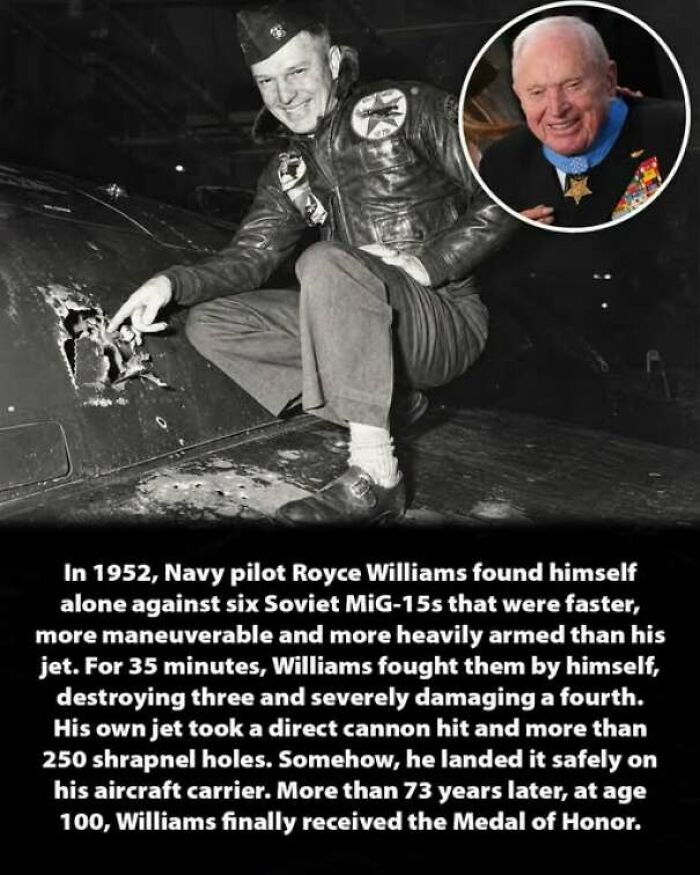
Image source: History Unleashed
#21
In 1918, Milton Hershey quietly gave away the fortune that could have made his descendants one of America’s wealthiest families. He had no descendants. Instead, he made thousands of children his heirs.
Milton and his wife Catherine “Kitty” Hershey had no children of their own. In 1909, they founded the Hershey Industrial School to provide a home and education for orphaned boys. After Kitty passed away in 1915, Hershey decided to secure the school’s future permanently.
On November 13, 1918, he quietly transferred his ownership of the Hershey Chocolate Company to the school’s trust. The stock was valued at roughly $60 million at the time, an extraordinary fortune. Hershey didn’t publicly announce what he had done. The gift remained largely unknown until 1923.
His generosity didn’t end there. During the Great Depression, Hershey launched an enormous construction campaign in his Pennsylvania company town, building a hotel, theater, sports arena and other projects while employing hundreds of workers.
According to a story preserved by the Hershey archives, when a foreman proudly told Hershey that two steam shovels could do the work of 40 men, Hershey replied, “Take them off. Hire forty men.”
Today, the school he and Kitty founded is the Milton Hershey School. More than 2,000 students attend, with housing, meals, clothing, health care, school supplies and education provided at no cost to qualifying families.
Hershey had once explained his decision simply: with no children of his own, he had decided to make orphaned boys his heirs.
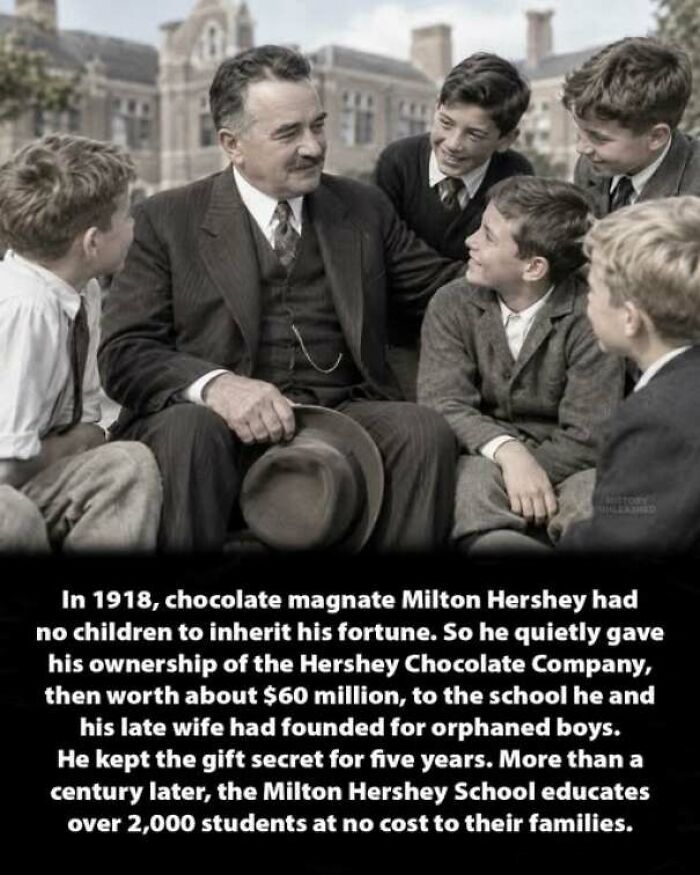
Image source: History Unleashed
London had its own unforgettable moment in the summer of 1858, when hot weather turned the River Thames into such a powerful stench that Parliament, which sits right on its banks, could barely get anything done, and Punch magazine had a field day drawing Father Thames as a grumpy old man.
#22
In 1951, Bing Crosby was refused a hotel room because he was wearing jeans. Levi’s responded by making him a tuxedo out of denim.
Crosby and a friend had been on a hunting trip in Canada when they arrived at a hotel in Vancouver dressed in denim.
The desk clerk didn’t recognize one of America’s most famous entertainers and initially refused to give them a room because their clothing wasn’t considered appropriate for the hotel.
Another employee eventually recognized Crosby, and the situation was resolved.
But word of the incident reached Levi Strauss & Co.
The company’s designers decided to make sure Crosby would never have the same problem again.
They created a custom tuxedo jacket from the same denim used for Levi’s jeans, complete with copper rivets and a corsage made from red Levi’s tabs.
Inside, they added a large leather label addressed to hotel staff declaring the denim appropriate for even the finest establishments.
Levi’s presented the tuxedo to Crosby later that year.
The story became closely associated with the denim-on-denim look eventually known as the “Canadian tuxedo.”
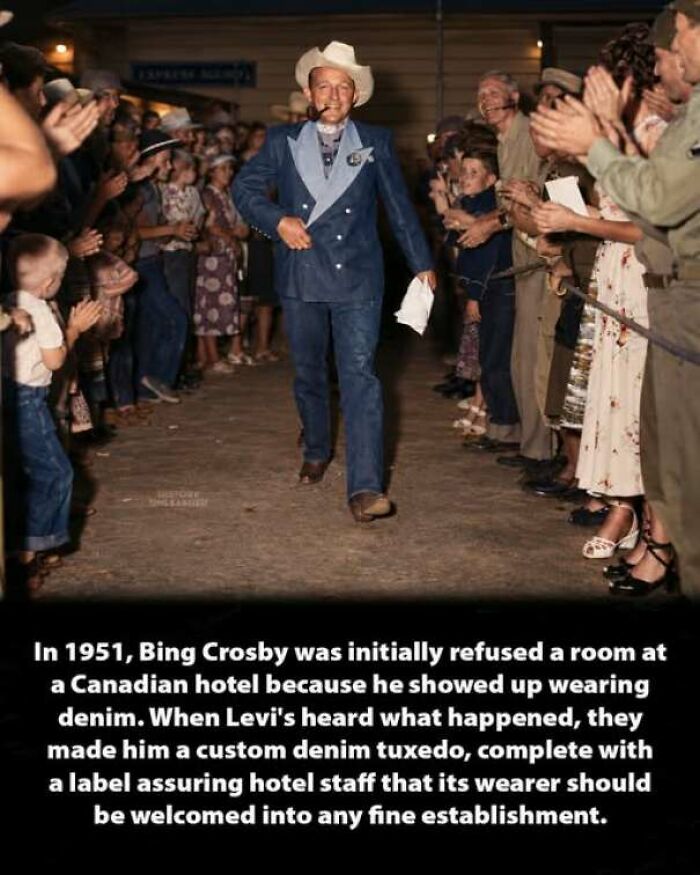
Image source: History Unleashed
#23
In 1965, 19-year-old Brian Robson couldn’t afford a plane ticket home to Wales. His solution was to mail himself there in a wooden crate.
Robson had moved from Wales to Australia, but quickly became homesick.
The problem was that he couldn’t afford the airfare back to Britain.
Inspired by an Australian athlete who had previously shipped himself across the world as freight, Robson came up with an extraordinary plan.
With the help of two friends, he climbed inside a wooden crate measuring roughly three feet in each direction.
He packed a small amount of water, a flashlight, pillows, a suitcase and an empty bottle.
Then his friends sealed the crate and sent him as air freight.
Robson expected the journey to London to take about 36 hours.
It didn’t.
A connecting flight was full, throwing his carefully planned route into chaos.
At one point, his crate was left upside down for roughly 22 hours.
Instead of traveling directly toward Britain, he was eventually placed aboard a Pan Am flight bound for Los Angeles.
Robson drifted in and out of consciousness during the ordeal.
By the time airport workers in Los Angeles discovered him, he had spent roughly 92 hours inside the box.
He was taken to a hospital, where he spent several days recovering.
Robson eventually made it back to Britain, although thankfully not inside the crate.
Decades later, he described the experience in a book appropriately titled The Crate Escape.
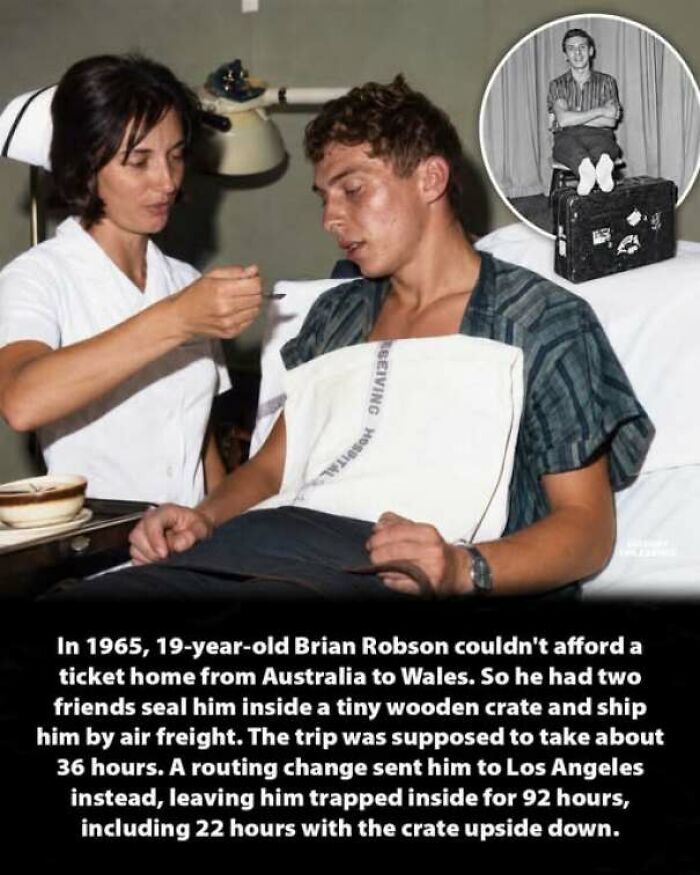
Image source: History Unleashed
#24
During the American Revolution, an ordinary clothesline reportedly became part of George Washington’s secret intelligence network.
Anna Strong lived in Setauket, New York, where members of the Culper Spy Ring secretly moved information about British forces out of occupied New York.
According to the traditional account, Strong developed an ingenious way to communicate without attracting attention.
She hung laundry outside her home.
A black petticoat on the clothesline signaled that Caleb Brewster, a Culper courier who traveled by whaleboat across Long Island Sound, had arrived.
But Abraham Woodhull, another member of the spy ring, still needed to know where to meet him.
Strong reportedly hung between one and six handkerchiefs beside the petticoat.
The number indicated which of six coves Brewster was using.
To anyone else, it looked like laundry drying in the wind.
To Washington’s spies, it was a coded message telling them exactly where their courier was waiting.
The story of Strong’s clothesline has been passed down through local and family tradition and is repeated by several historical institutions, although historians still debate how firmly the signaling system can be documented.
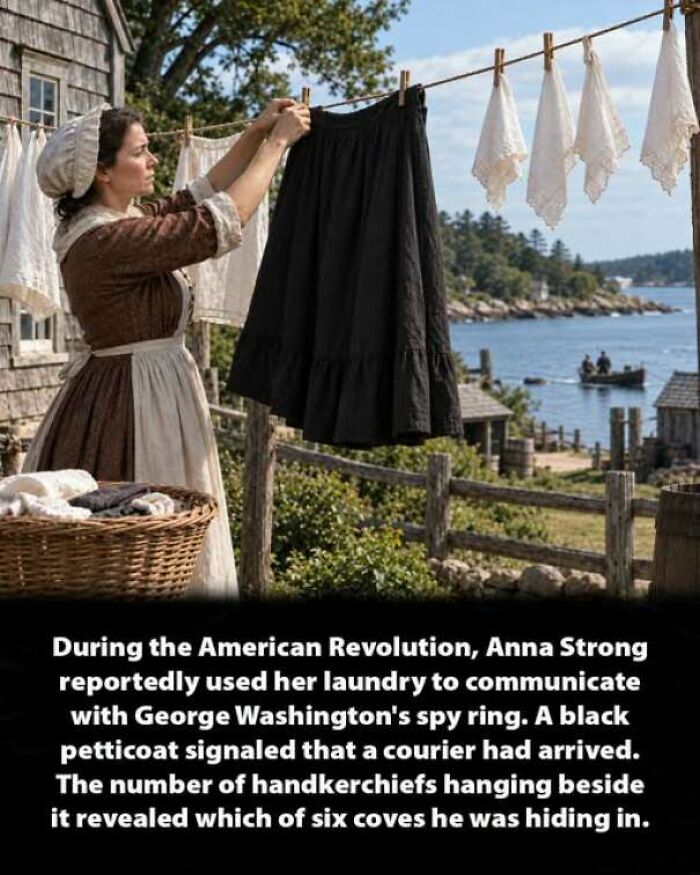
Image source: History Unleashed
Lawmakers soaked the curtains in chloride of lime to fight the smell, which did not work, but as Historic UK explains, the Great Stink finally pushed politicians to act. The fix was a massive sewer network designed by engineer Joseph Bazalgette, and much of it is still doing its job today.
#25
More than a decade after starring in Titanic, Leonardo DiCaprio and Kate Winslet helped the ship’s last living survivor pay for her nursing home care.
Millvina Dean was just nine weeks old when she boarded the Titanic with her parents and older brother in April 1912.
She was the youngest passenger aboard.
When the ship struck an iceberg, Millvina, her mother and her brother were placed into a lifeboat and survived.
Her father did not.
Millvina was too young to remember the disaster, but she would ultimately become its final living survivor.
Nearly a century later, however, she found herself struggling with the cost of nursing home care.
After breaking her hip, Millvina moved into a private nursing home. By 2008, she began selling possessions connected to the Titanic to help pay her bills.
Among them was a small suitcase that had been filled with donated clothing and given to her family after they survived the disaster.
In 2009, a campaign called the Millvina Fund was established to help cover the cost of her care.
Leonardo DiCaprio and Kate Winslet, whose performances in the 1997 film Titanic had made them international stars, contributed to the fund.
Director James Cameron also donated.
It was an extraordinary connection between the history and the movie it inspired.
The actors who became famous portraying fictional passengers aboard Titanic had helped care for the last surviving person who had actually been there.
Millvina Dean passed away on May 31, 2009.
She was 97 years old.
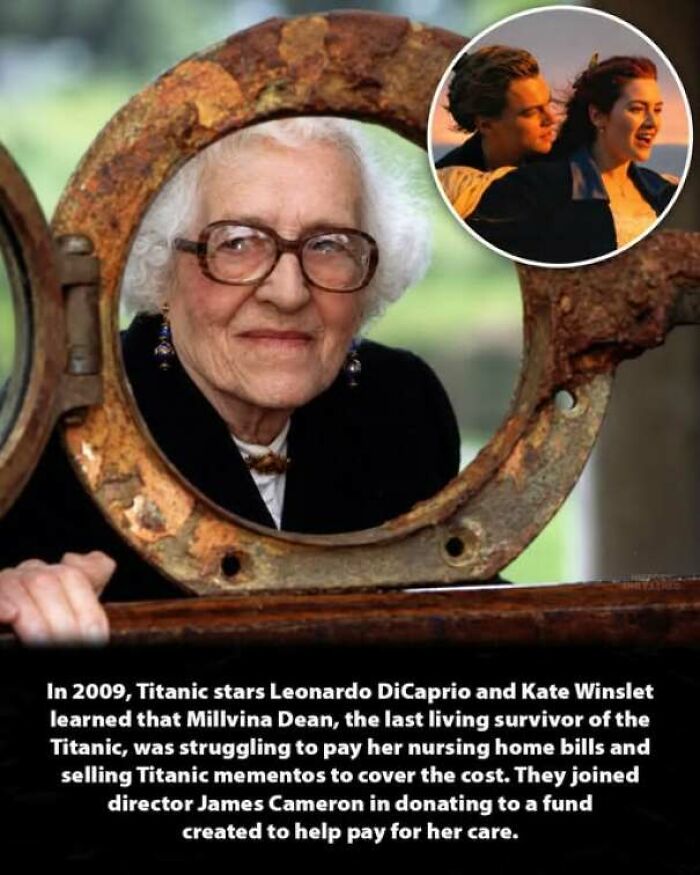
Image source: History Unleashed
#26
John F. Kennedy spent more than 16 years in the federal government without keeping his salary.
When Kennedy entered the House of Representatives in 1947, he began donating his government pay to charity.
He continued the practice throughout six years in the House, eight years in the Senate and his presidency.
Kennedy came from a wealthy family and did not depend on his government salary for his income.
When he became president in 1961, the job paid $100,000 a year.
Kennedy continued giving the money away.
In 1961, his partial-year presidential salary of about $94,600 was distributed among six charities. The following year, his entire $100,000 salary was again designated for charitable purposes.
Contemporary reports estimated that by the end of 1962, Kennedy had donated nearly $500,000 in government salaries since first entering Congress.
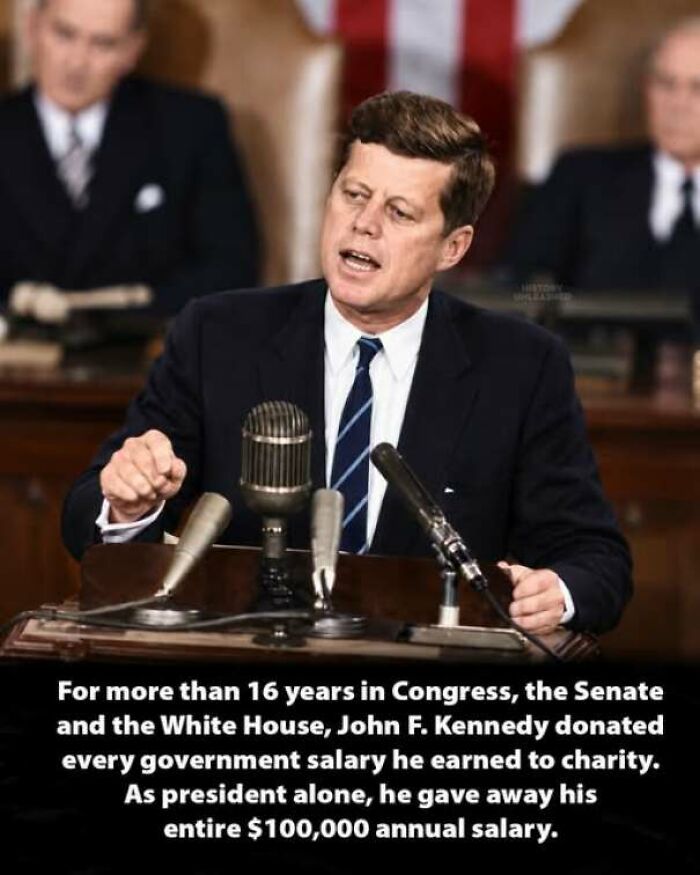
Image source: History Unleashed
#27
After 24 years working at Burger King, Usha Ram lost her job over roughly 50 cents worth of food. Then a judge heard what happened.
Ram had worked at Burger King restaurants around Vancouver, Canada, since 1989.
By 2013, she was 55 years old, working full-time as a cook and earning minimum wage.
She also had no formal disciplinary record.
On December 27, 2013, Ram realized she had forgotten her wallet and asked her manager if she could take some food home after her shift.
Ram believed she had been given permission to take a fish sandwich, fries and a drink.
Her manager remembered the conversation differently.
She said she had only given Ram permission to take the fish sandwich.
Ram left the restaurant with the full meal without paying.
Management considered the fries and drink theft.
After 24 years with the company, Ram was fired.
The value of the disputed food was tiny.
Taking Burger King’s employee discounts and food policies into account, the restaurant’s loss from the fries and drink amounted to roughly 50 cents.
Ram sued for wrongful dismissal.
In 2017, a British Columbia Supreme Court judge concluded there was no evidence that Ram had planned to steal the food or attempted to conceal what she had taken.
The judge also considered her 24 years of service and lack of formal disciplinary history, ruling that immediate dismissal was a disproportionate punishment.
Ram was awarded $21,000 in lost wages.
She received another $25,000 in aggravated damages.
Altogether, the misunderstanding over roughly 50 cents worth of food ended with a $46,000 judgment.
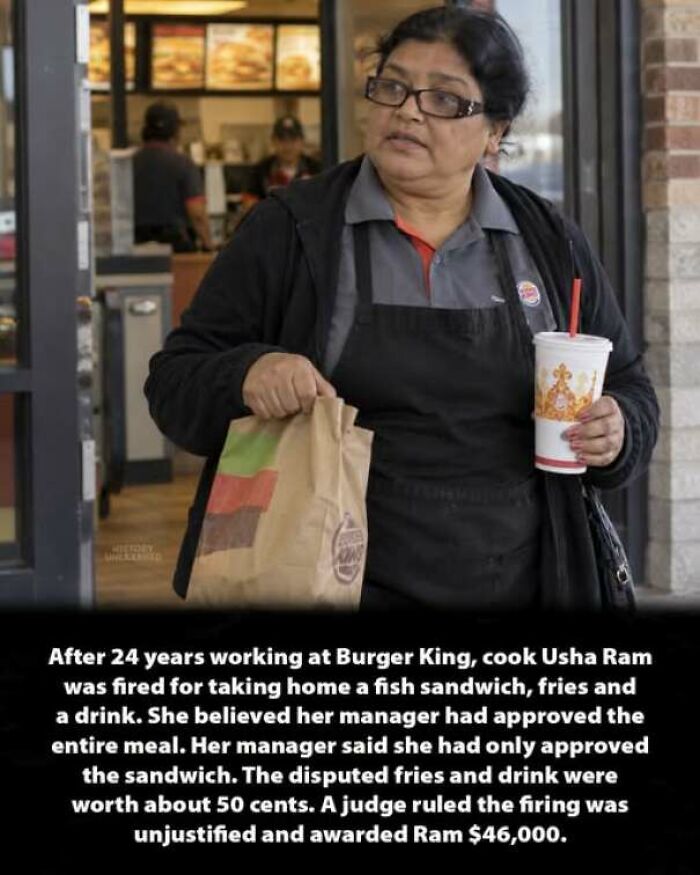
Image source: History Unleashed
Every now and then, an accident turns into science. In 1992, a cargo ship hit a storm in the North Pacific and lost a shipping container full of bath toys, sending 28,800 rubber ducks, turtles, beavers and frogs into the sea. Oceanographer Curtis Ebbesmeyer and a network of beachcombers tracked where the toys washed up, which turned out to be everywhere from Alaska to Scotland, and the Friendly Floatees, as they became known, taught researchers a great deal about how ocean currents move.
#28
On June 3, 1944, Maureen Flavin celebrated her 21st birthday by doing something she had done countless times before: checking the weather.
Maureen worked at the remote Blacksod weather station on Ireland’s Atlantic coast. Every hour, day and night, weather observations were recorded and sent to Dublin.
That morning, Maureen noticed something concerning. The barometer was falling rapidly, the wind was increasing and the weather was deteriorating.
She reported the readings as usual.
What Maureen didn’t know was that her information wasn’t stopping in Dublin. Although Ireland remained neutral during World War II, Irish weather observations were secretly being shared with Britain.
And just across the Irish Sea, Allied commanders were preparing for the largest amphibious invasion in history.
D-Day was originally planned for June 5.
Maureen’s observations from Blacksod provided crucial evidence that a storm was approaching. Allied meteorologist James Stagg used the incoming weather data to warn General Dwight D. Eisenhower that conditions on June 5 could be disastrous for the thousands of ships, aircraft and landing craft preparing to cross the English Channel.
Eisenhower postponed the invasion.
Then the weather changed again.
Observations from Blacksod showed atmospheric pressure beginning to rise as the front passed, helping forecasters identify a short window of improved conditions.
On June 6, 1944, Eisenhower gave the order.
More than 150,000 Allied troops landed in Normandy.
Maureen continued doing her job without knowing that the routine numbers she had recorded from a tiny weather station on Ireland’s western edge had helped influence one of the most consequential military decisions of World War II.
She wouldn’t learn the significance of her weather reports until years later.
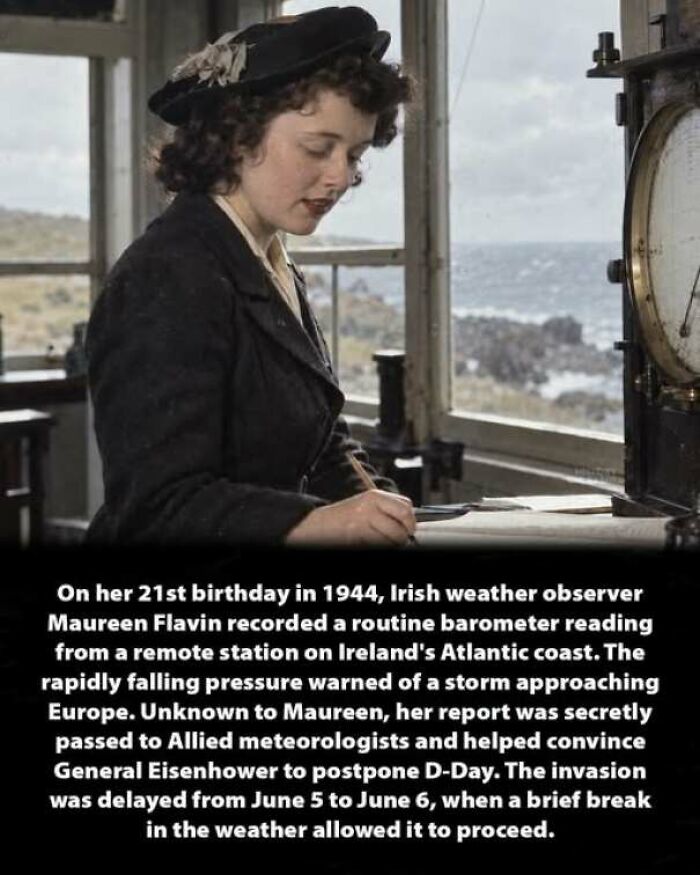
Image source: History Unleashed
#29
When the Black soldiers of the 369th Infantry Regiment arrived in France during World War I, the U.S. Army was reluctant to let them fight alongside white American troops.
So they were assigned to fight with the French instead.
The French Army equipped the men with French rifles, helmets and other gear and sent them into combat on the Western Front.
What followed became one of the most remarkable records of any American regiment in the war.
The men who became known as the Harlem Hellfighters spent 191 days in combat, longer than any other American regiment. They fought in major campaigns including the Meuse-Argonne offensive and earned a reputation for refusing to give ground.
According to U.S. Army histories, during their 191 days in combat the regiment never lost a trench and never had a soldier captured by the enemy.
France recognized their service by awarding the entire regiment the Croix de Guerre, while more than 170 individual members also received the French decoration.
One of the regiment’s most famous soldiers, Henry Johnson, fought off a German raiding party while wounded and prevented a fellow American soldier from being captured. France decorated Johnson for his bravery, but the United States did not award him the Medal of Honor until 2015, nearly a century later.
The Hellfighters also left their mark away from the battlefield. Their celebrated regimental band, led by James Reese Europe, helped introduce American jazz to audiences across France.
They had been sent to fight with another country’s army because of segregation at home.
They returned to the United States as one of the most celebrated American units of World War I.
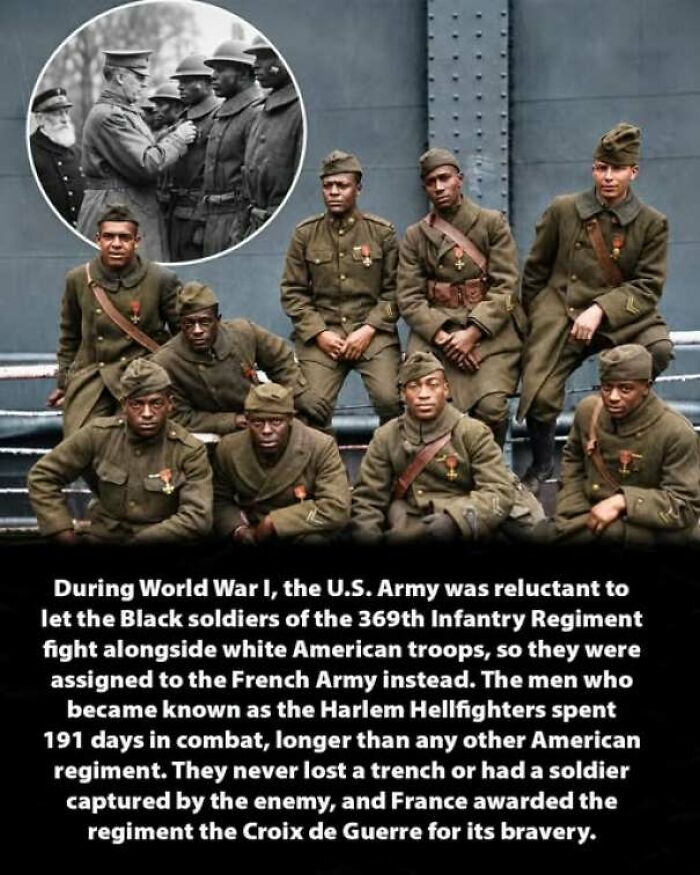
Image source: History Unleashed
#30
Abraham Lincoln was remarkably comfortable making himself the punchline.
Lincoln’s appearance was frequently mocked by political opponents and even commented upon by friends and contemporaries.
Rather than avoiding the subject, Lincoln often used self-deprecating humor to disarm people.
One of the most famous stories involves someone accusing him of being “two-faced.”
Lincoln reportedly responded:
“If I had another face, do you think I’d wear this one?”
The exact exchange is difficult to verify from Lincoln’s surviving writings, so historians generally treat it as an attributed anecdote rather than a firmly documented quotation.
But the joke certainly fits a well-documented part of Lincoln’s personality.
He frequently joked about his unusual appearance and once referred to his own “poor, lean, lank face.”
For Lincoln, humor wasn’t simply entertainment.
It was often a way to handle criticism, connect with people and occasionally turn an insult back on the person delivering it.
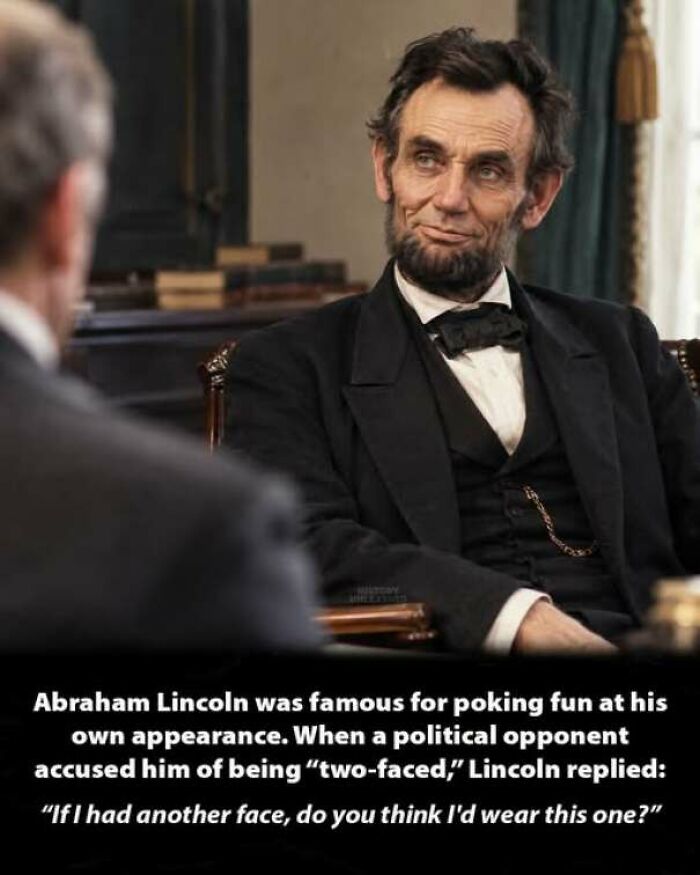
Image source: History Unleashed
Our final story belongs to Wojtek, a Syrian brown bear adopted as a cub by Polish soldiers during the Second World War. He reportedly helped carry heavy ammunition boxes, and he was officially enlisted as a private so he could travel with his unit, eventually earning a promotion to corporal. After the war he retired to Edinburgh Zoo, where he lived until 1963, and a bronze statue of him now stands in Princes Street Gardens. History is full of serious moments, but it clearly has a soft spot for the strange ones too.
#31
Jonathan the tortoise is believed to have hatched around 1832, making him at least 194 years old in 2026. His exact birthday is unknown, but when he arrived on the remote island of St. Helena in 1882, he was already fully mature and estimated to be at least 50 years old.
More than 140 years later, Jonathan still lives on the grounds of Plantation House, the residence of St. Helena’s governor. He is recognized as the oldest known living land animal and the oldest recorded turtle or tortoise in history. Remarkably, because his estimated age is conservative, Jonathan may actually be even older than 194.
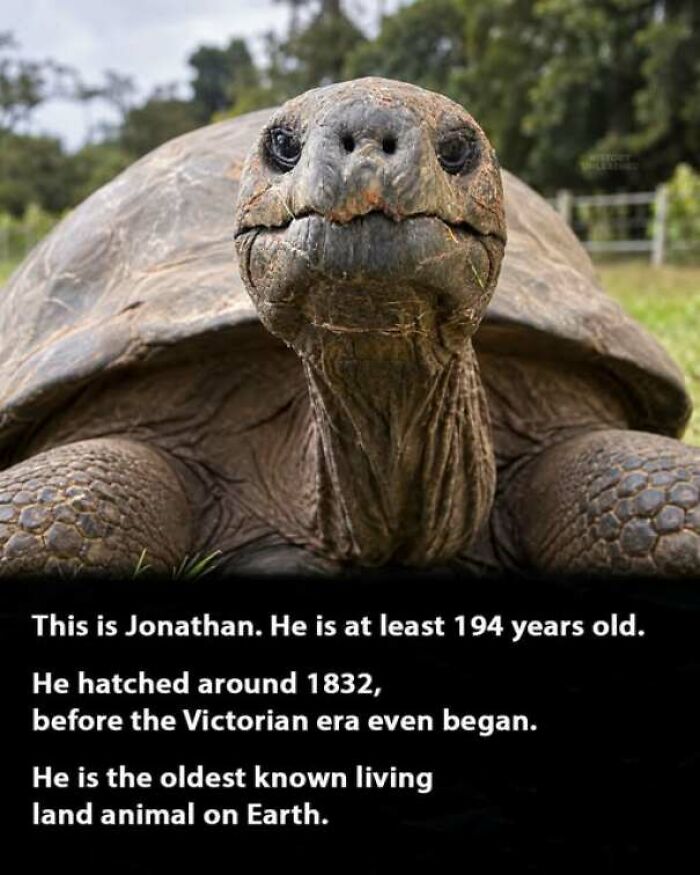
Image source: History Unleashed
#32
In 1961, a man paid $50 for an old wallpaper mural that was about to be destroyed with a Maryland house. Today, it covers the walls of one of the most historic rooms in the White House.
A demolition crew was preparing to tear down a century-old house in Thurmont, Maryland, when Peter Hill learned about the remarkable wallpaper hanging inside. Created in France in 1834, the panoramic mural was titled Views of North America and depicted scenes including Boston Harbor, West Point, Niagara Falls and New York.
Hill bought the entire set for just $50, with one condition: he had to remove it quickly before the house was demolished. Using a putty knife and razor blade, he carefully peeled the historic panels from the walls.
Hill contacted the Smithsonian Institution, where an expert recognized what he had found. At the time, First Lady Jacqueline Kennedy was leading an ambitious effort to restore the historic character of the White House.
In April 1961, Hill brought the wallpaper to the White House and showed it to Kennedy. She admired it, and Hill suggested that it would be perfect for the Diplomatic Reception Room.
The National Society of Interior Designers ultimately purchased the wallpaper from Hill for $12,500 and donated it to the White House. Artists repaired the damaged edges, and a team of specialists spent weeks installing it around the oval room.
More than six decades later, the $50 wallpaper rescued from a house awaiting demolition still covers the walls of the White House Diplomatic Reception Room.
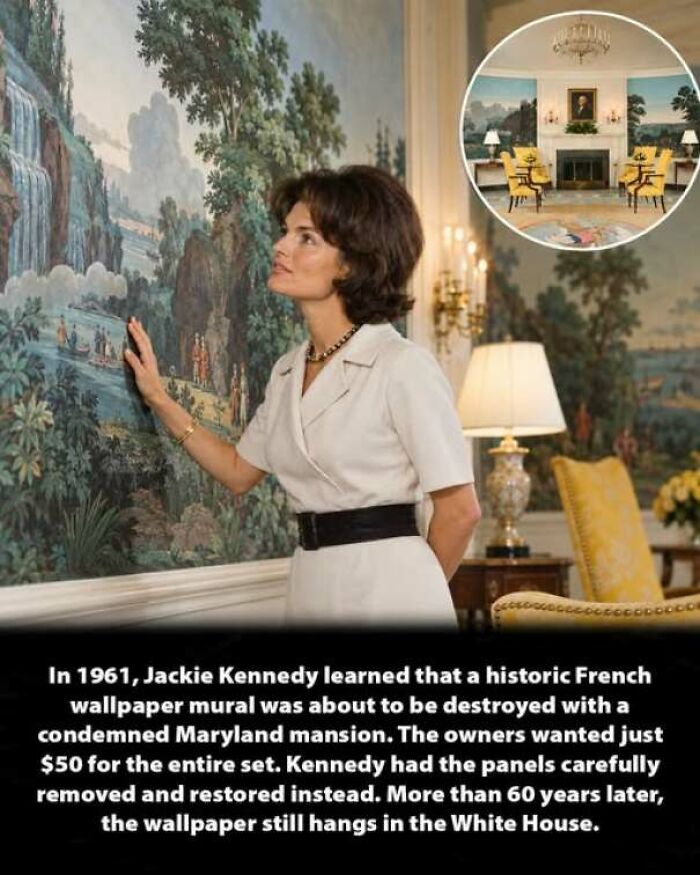
Image source: History Unleashed
#33
When German authorities searched a retiree’s home in 2015, they found something considerably larger than they expected in his basement: a 40-ton Panther tank from World War II.
The tank belonged to a 78-year-old collector living in Heikendorf, near Kiel in northern Germany. Authorities were investigating his collection of military equipment when they discovered the Panther stored beneath his home.
Getting it out was another problem entirely.
The German military was called in to help, and roughly 20 soldiers spent nearly nine hours extracting the enormous vehicle. Two military recovery vehicles were used to pull the tank from the property.
And according to the town’s mayor, the Panther hadn’t always stayed hidden underground.
During the particularly harsh winter of 1978–79, the owner reportedly drove it around the neighborhood in the snow. The mayor recalled that an elderly resident had even complained about the man driving around in a tank.
Authorities also seized other military items from the property, including an anti-aircraft gun and a torpedo.
The case eventually went to court over whether the collection violated Germany’s War Weapons Control Act. In 2021, the owner received a suspended sentence and was ordered to sell or donate the tank and anti-aircraft gun.
For decades, one German neighborhood apparently had a Panther tank sitting beneath an ordinary house.
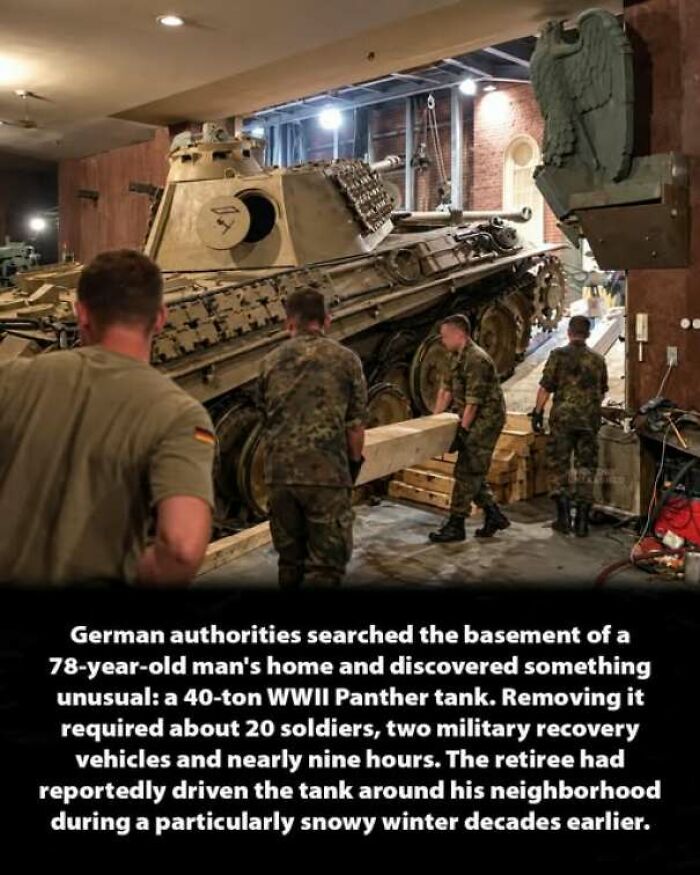
Image source: History Unleashed
#34
A stray dog wandered onto an Army training field in 1917. A year later, he was a decorated veteran of World War I.
Soldiers of the 102nd Infantry were training at Yale when the stray puppy appeared and befriended Private J. Robert Conroy.
They named him Stubby.
When the regiment was sent to France, Conroy smuggled Stubby aboard the troop ship.
Stubby eventually accompanied the soldiers into the trenches, where he proved to be much more than a mascot.
After surviving a gas attack himself, Stubby became extremely sensitive to the smell of poison gas. During a later attack, he ran through the trenches barking and waking sleeping soldiers before the gas reached them.
He also located wounded men on the battlefield and barked until medics arrived.
Late in the war, Stubby even helped capture a German soldier near the Allied trenches.
By the end of World War I, Stubby had participated in 17 battles and survived both gas exposure and shrapnel wounds.
He returned to the United States a national hero.
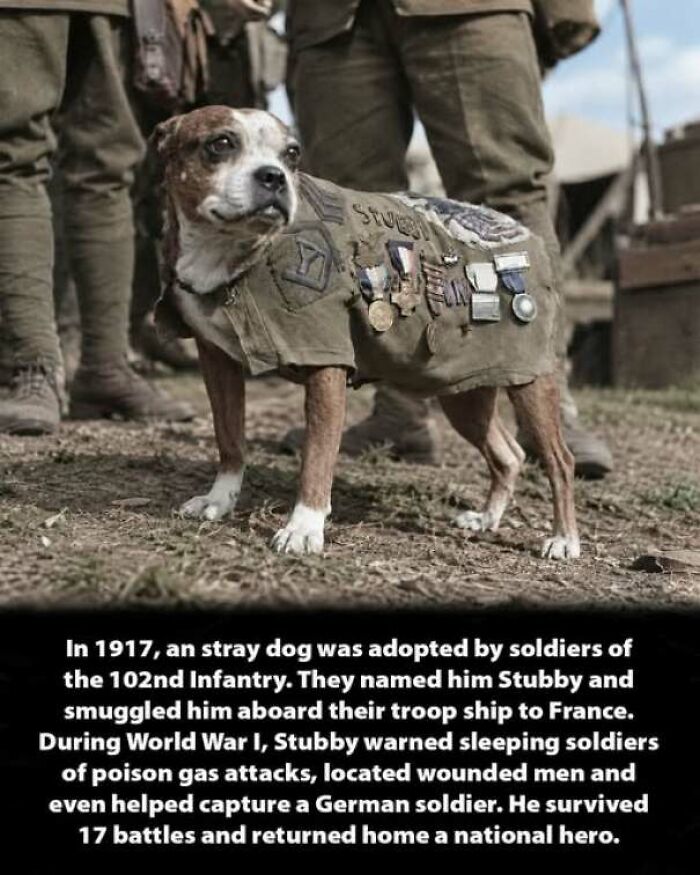
Image source: History Unleashed
#35
Margaret Mitchell began writing Gone with the Wind because her husband got tired of bringing her books from the library.
In 1926, Mitchell was recovering from an ankle injury that had left her largely confined to her Atlanta apartment.
Unable to continue her usual routine, she began reading.
A lot.
Her husband, John Marsh, repeatedly traveled to Atlanta’s Carnegie Library to bring home stacks of books for her.
Eventually, Mitchell had read her way through so much of the library that Marsh suggested a different solution.
Instead of reading another book, why didn’t she write one herself?
He brought her copy paper, and Mitchell began writing the next morning.
She started with the ending.
Over the next several years, Mitchell wrote chapters in no particular order, storing them in large manila envelopes around their apartment and largely keeping the project secret from friends.
The manuscript sat unfinished and unpublished for years.
Then, in 1935, Mitchell reluctantly allowed a visiting editor from Macmillan to take the manuscript.
After months of revisions, Gone with the Wind was published in June 1936.
It became a publishing phenomenon and won Mitchell the Pulitzer Prize for Fiction the following year.
Three years after the book appeared, its enormously successful film adaptation arrived in theaters.
And it all began while an injured Margaret Mitchell was running out of things to read.
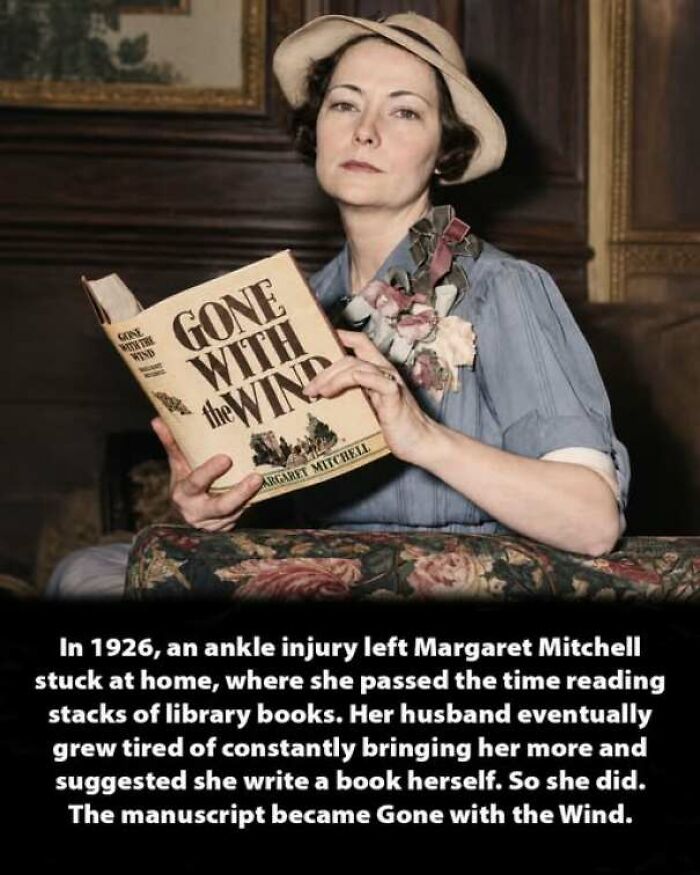
Image source: History Unleashed
#36
Germany has nearly twice as many castles, palaces and manor houses as the United States has McDonald’s restaurants.
Across Germany, roughly 25,000 castles, palaces and historic manor houses remain, ranging from medieval ruins to enormous royal residences.
One of the most remarkable is Eltz Castle.
Hidden in a wooded valley near Wierschem, the castle has remained in the possession of the same family since the 12th century.
The Eltz family is first documented there in 1157.
Over the following centuries, generations of the family expanded the castle while continuing to live within its walls.
Unlike many European castles, Eltz survived centuries of warfare without being destroyed.
Nearly 900 years after the family’s story there began, Eltz Castle remains in their hands.
Today, it is managed by the 34th generation of the Eltz family.
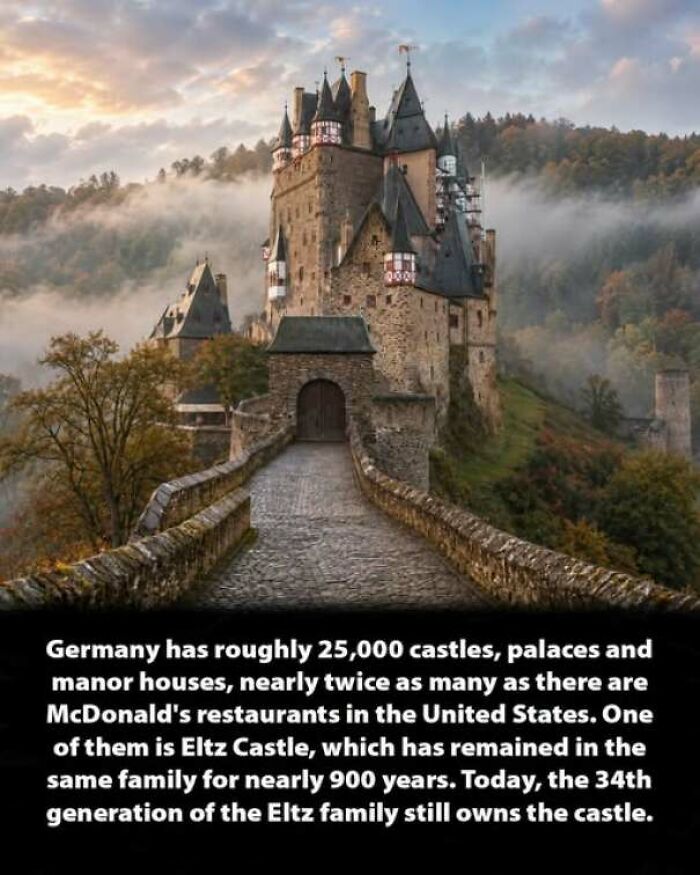
Image source: History Unleashed
#37
A 6.8 magnitude earthquake accidentally created a work of art in a tray of sand.
On February 28, 2001, the Nisqually earthquake shook Washington state for more than half a minute.
In Port Townsend, shop owner Jason Ward had a sand-tracing pendulum suspended over a tray of sand.
As the ground moved, the pendulum began tracing the earthquake’s vibrations.
When the shaking ended, Ward discovered that it had left behind an intricate pattern resembling a flower or rose.
Seismologists explained that the pattern had actually preserved different components of the earthquake’s motion.
The tighter flower-like pattern recorded higher-frequency waves that arrived earlier, while the larger outer oscillations reflected lower-frequency waves that arrived later.
The unusual recording became known as the “Earthquake Rose.”
Unfortunately, the original didn’t survive for long.
Before Ward could make a mold of it, his three-year-old son accidentally bumped the pendulum and erased the pattern.
Fortunately, photographs had already been taken.
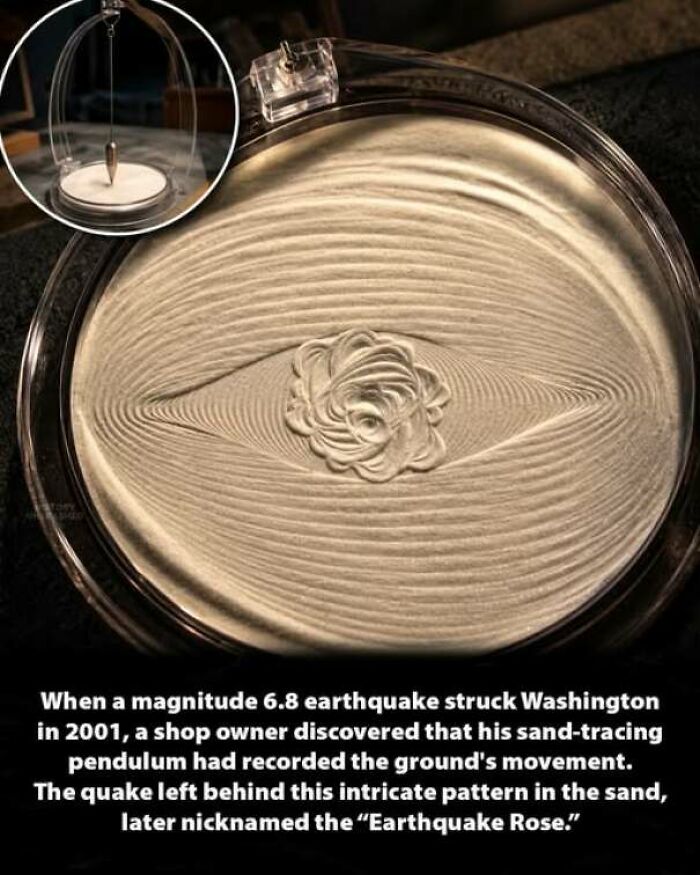
Image source: History Unleashed
#38
The Headless Horseman may have been inspired, at least partly, by real events during the American Revolution.
In 1820, Washington Irving published The Legend of Sleepy Hollow.
In the story, residents of Sleepy Hollow tell of a terrifying apparition riding through the countryside at night.
They say he is the ghost of a Hessian soldier who fought alongside the British during the American Revolution.
According to the legend, the soldier’s head had been taken off by a cannonball during battle.
It sounds like pure fiction.
But something remarkably similar really happened.
During the Revolutionary War, Hessian troops fought near Sleepy Hollow at the Battle of White Plains in 1776.
American Major General William Heath recorded an incident from the fighting in his journal.
On November 1, 1776, Heath wrote that American cannon fire had taken the head off a Hessian artilleryman.
The incident occurred only several miles from Sleepy Hollow.
Decades later, Irving would describe his fictional Headless Horseman as a Hessian soldier who had lost his head to a cannonball during the Revolutionary War.
Whether Irving knew about this particular soldier is impossible to prove.
Stories of headless riders had existed in European folklore long before The Legend of Sleepy Hollow, and Irving drew upon folklore, local history and his own imagination when creating the tale.
But the historical record confirms one eerie detail.
Not far from Sleepy Hollow, during the very war described in Irving’s story, a real Hessian soldier did lose his head to a cannonball.
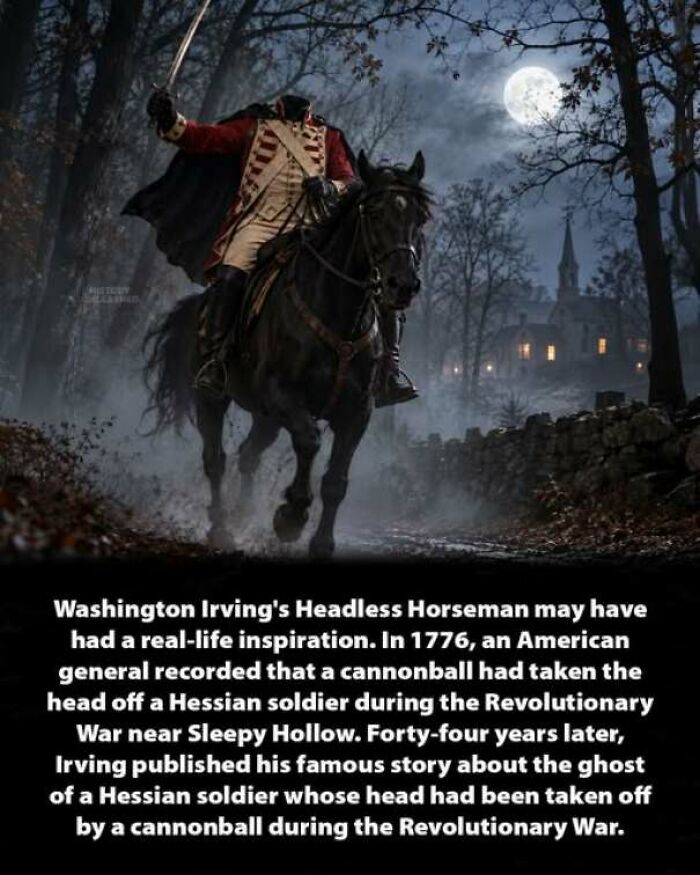
Image source: History Unleashed
#39
Some Greenland sharks swimming through the Arctic today may have been alive before the United States existed.
For years, scientists suspected that Greenland sharks lived extraordinarily long lives.
The animals grow incredibly slowly, inhabit the cold depths of the North Atlantic and Arctic oceans, and can reach more than 16 feet in length.
But determining their age presented a problem.
Unlike many fish, Greenland sharks don’t have the hard structures scientists normally use to count growth layers.
So researchers tried something different.
In a landmark 2016 study, scientists radiocarbon dated proteins found in the centers of the eye lenses of 28 female Greenland sharks.
The results were astonishing.
The largest shark was estimated to be approximately 392 years old.
There was considerable uncertainty in that number. Scientists calculated that the animal was likely somewhere between 272 and 512 years old.
But even the conservative estimates revealed something remarkable.
Greenland sharks are the longest-lived vertebrates known to science.
If the central estimate for that shark was close, it would have been born around the early 1600s.
It could have already been swimming through the North Atlantic when the Mayflower reached America in 1620.
It would have been more than 150 years old during the American Revolution.
And Greenland sharks themselves don’t appear to reach maturity until roughly 150 years of age.
Scientists still don’t know exactly how long the oldest members of the species can survive.
But somewhere in the cold, dark waters of the North Atlantic, there may be sharks alive today that have been swimming there for centuries.
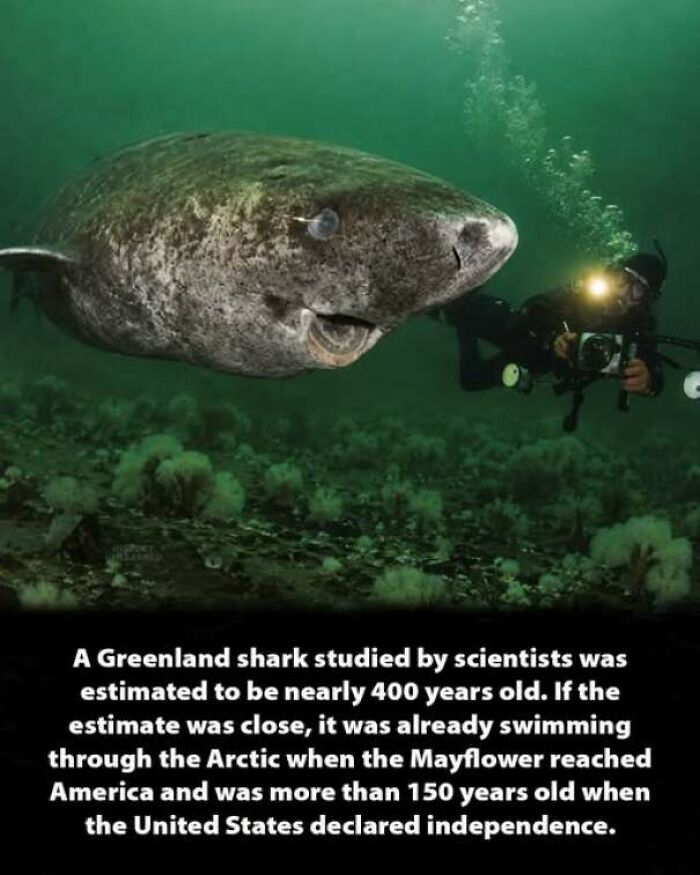
Image source: History Unleashed
#40
At 17,000 feet, the cockpit windscreen suddenly disappeared and the captain was pulled halfway out of the airplane.
On June 10, 1990, British Airways Flight 5390 departed Birmingham, England, carrying 81 passengers and six crew members on a flight to Málaga, Spain.
Everything appeared normal until the aircraft climbed through approximately 17,300 feet.
Suddenly, there was a loud bang.
The cockpit filled with condensation as the cabin rapidly decompressed.
The left windscreen had separated from the aircraft.
Captain Tim Lancaster was partially sucked through the opening.
Flight attendant Nigel Ogden, who had been near the cockpit, rushed forward and grabbed Lancaster around the waist.
He held on as the captain remained trapped partly outside the aircraft in the freezing, high-speed airflow.
Other members of the cabin crew soon helped restrain Lancaster while co-pilot Alastair Atchison took control of the aircraft.
Atchison began an emergency descent while struggling with the tremendous noise inside the damaged cockpit and difficulty communicating by radio.
The crew initially feared Lancaster was already d**d.
They held onto him anyway.
Atchison eventually diverted the aircraft to Southampton and landed safely.
There were no fatalities.
And remarkably, Tim Lancaster was alive.
He suffered fractures, frostbite and other injuries, but survived the ordeal.
Investigators eventually discovered that the windscreen had been replaced before the flight using incorrectly sized bolts. Many of the bolts securing it were slightly too small, allowing the windscreen to fail under the pressure difference as the aircraft climbed.
Lancaster later recovered and returned to flying.
A cockpit windscreen disappeared at more than 17,000 feet.
The captain went through it.
And everyone aboard survived.
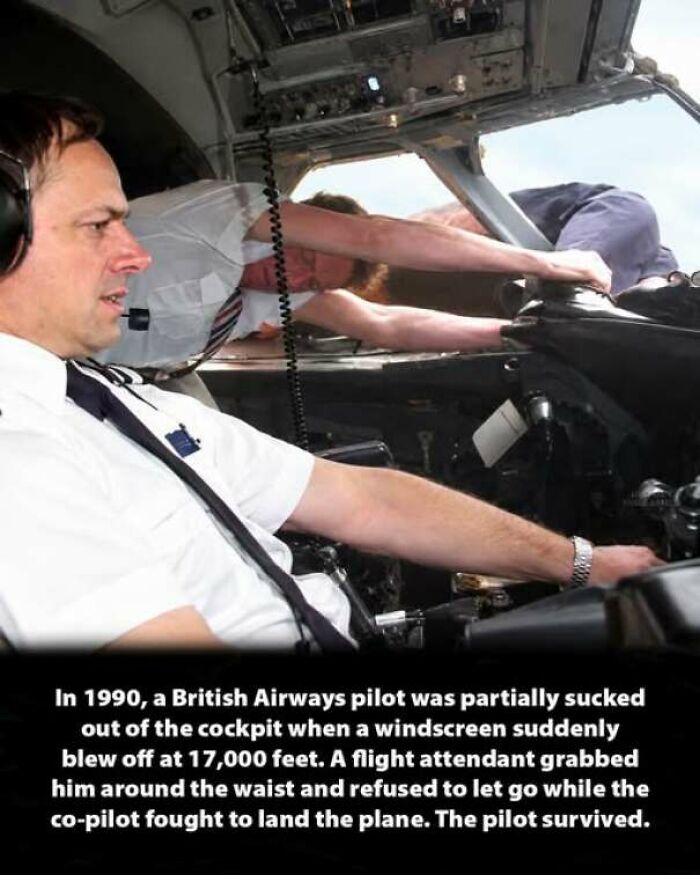
Image source: History Unleashed
#41
The night before the Challenger disaster, engineer Bob Ebeling went home convinced the shuttle was going to fail.
Ebeling worked for Morton Thiokol, the company responsible for Challenger’s solid rocket boosters.
On January 27, 1986, temperatures at the launch site were expected to fall unusually low.
Ebeling and several fellow engineers were deeply concerned about how the cold would affect the rubber O-rings that sealed joints in the boosters.
During a lengthy conference with NASA, Thiokol engineers initially recommended that Challenger not launch in the unusually cold conditions.
Management ultimately reversed that recommendation and approved the launch.
Ebeling went home devastated.
He told his wife, Darlene:
“It’s going to blow up.”
The following morning, Challenger lifted off.
Seventy-three seconds later, the shuttle broke apart, it took all seven crew members’ lives.
The investigation found that an O-ring in the right solid rocket booster had failed to seal properly in the unusually cold conditions.
Ebeling spent decades blaming himself for not doing more, despite having argued against the launch.
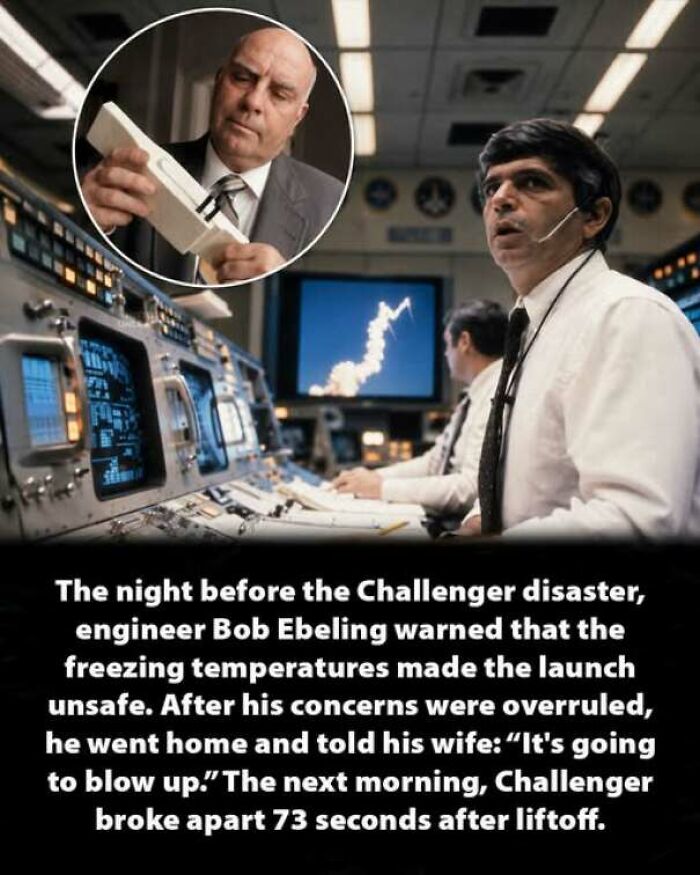
Image source: History Unleashed
#42
In 1970, the U.S. military paid qualifying service members an additional $65 a month for facing hostile fire. For a newly enlisted private, that was a substantial addition to his paycheck.
At the time, an E-1 with less than four months of service earned $133.20 per month in basic pay. After four months, his basic pay increased to $143.70.
Service members who qualified for hostile fire pay received another $65 per month. For a brand-new private, that could bring monthly military pay to about $198.20 before considering other allowances or special pays.
Hostile fire pay was intended to compensate personnel subjected to hostile fire, explosions of hostile mines or other qualifying dangers. During the Vietnam War, large numbers of American service members qualified.
The $65 payment may sound small today, but for a new private it was equivalent to nearly half his basic monthly salary.
It was an additional payment for one thing no ordinary paycheck could really compensate for: serving where the enemy was shooting back.
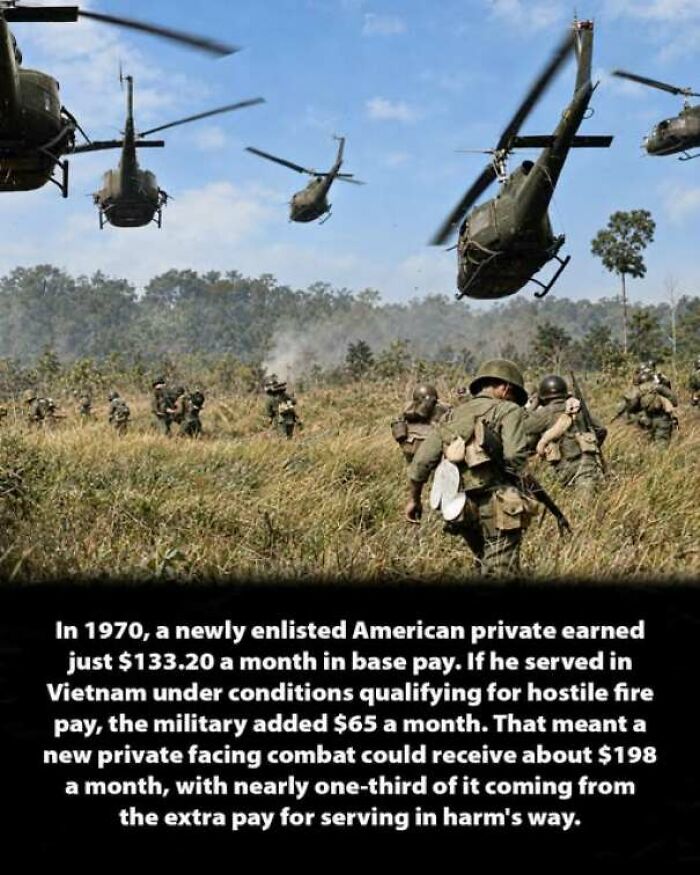
Image source: History Unleashed
#43
Winston Churchill didn’t just support sending women into Britain’s anti-aircraft units. His own 18-year-old daughter became one of them.
In 1941, Britain was struggling to find enough manpower for its enormous anti-aircraft defenses. General Frederick Pile, head of Anti-Aircraft Command, later recalled asking Churchill for thousands more men. Churchill refused and told him he would have to make greater use of women instead.
That same year, Churchill’s youngest daughter, Mary, joined the Auxiliary Territorial Service at age 18. She was assigned to mixed anti-aircraft batteries, where women worked alongside male soldiers operating the sophisticated equipment used to locate enemy aircraft and direct the guns defending Britain.
Mary wasn’t given a ceremonial position because she was the prime minister’s daughter. She trained and served with anti-aircraft units during the war, including batteries protecting London from German attacks. She eventually rose to the rank of Junior Commander, equivalent to an Army captain.
By the end of the war, the prime minister who had told his generals to use women in Britain’s defenses had watched his own daughter spend years serving among them.
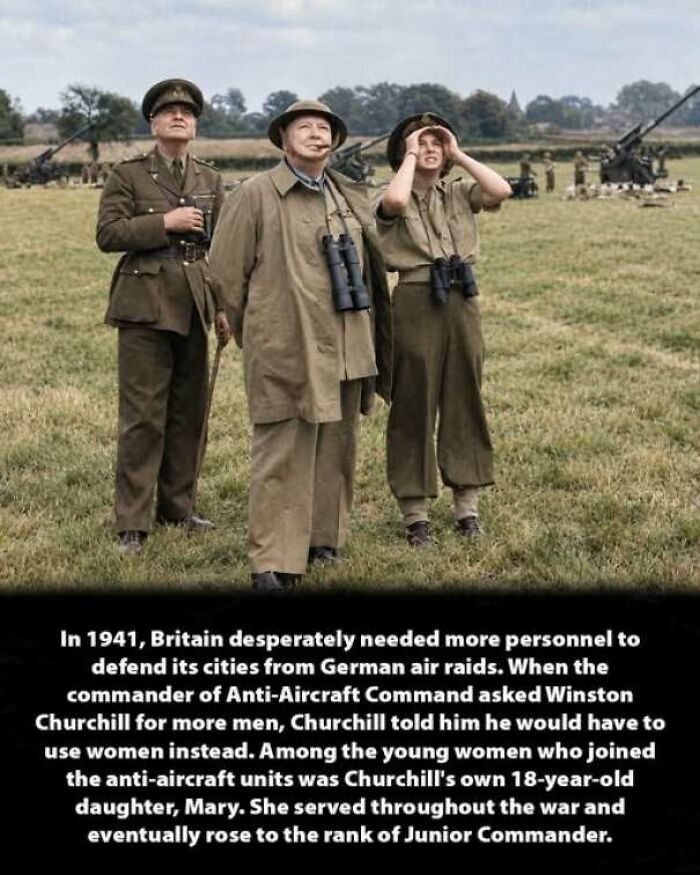
Image source: History Unleashed
#44
Thousands of people worked on the Manhattan Project without knowing what they were actually helping to build.
Mary Anne Bufard was one of them.
During World War II, Bufard worked in a laundry operation connected to the massive secret facilities at Oak Ridge, Tennessee.
Her job included one particularly strange task.
After workers’ uniforms had been washed, ironed and repaired, Bufard would hold each one up to a special instrument.
If the instrument began clicking, she sent the uniform back to be washed again.
Then she checked another.
And another.
She knew what she was supposed to do.
What she apparently wasn’t told was why.
The instrument was being used to detect radioactive contamination on the clothing.
Oak Ridge was one of the key sites of the Manhattan Project, the secret American effort to develop the atomic missile.
At its peak, tens of thousands of people worked and lived there. But information was deliberately compartmentalized. Workers were generally told only what they needed to know to perform their particular jobs.
Some operated enormous machines without knowing what the machines were producing.
Others handled materials without understanding how they fit into the larger project.
Bufard checked uniforms without knowing what the clicking instrument was actually detecting.
Signs around Oak Ridge constantly reminded workers not to discuss what they saw or did.
One famous message read:
“WHAT YOU SEE HERE
WHAT YOU DO HERE
WHAT YOU HEAR HERE
WHEN YOU LEAVE HERE
LET IT STAY HERE”
For many workers, it wasn’t until the atomic missile became public in August 1945 that they finally understood what their seemingly ordinary jobs had been part of.
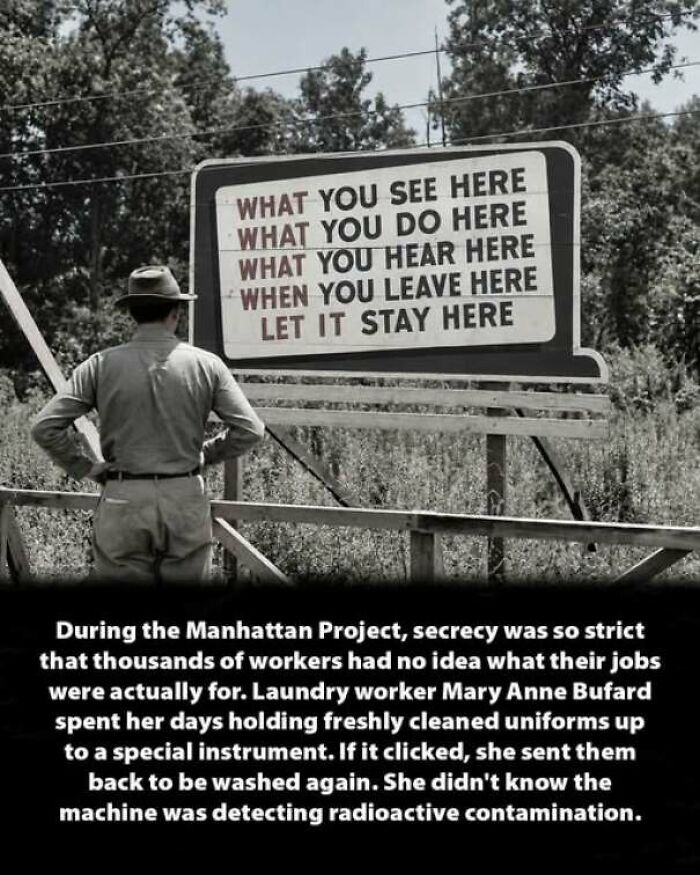
Image source: History Unleashed
#45
Every time you “boycott” something, you’re using the last name of a man who made an Irish community so angry that they collectively stopped dealing with him.
His name was Charles Cunningham Boycott.
In 1880, Boycott worked as a land agent for Lord Erne on an estate in County Mayo, Ireland.
It was a difficult year for local tenant farmers.
After a poor harvest, Lord Erne offered his tenants a 10% reduction in their rents.
The tenants wanted 25%.
When the larger reduction was refused, Boycott attempted to serve eviction notices on 11 tenants who had fallen behind.
Ireland was already in the middle of a growing movement for land reform.
Irish Land League leaders encouraged communities to fight back without resorting to violence.
Instead, they could simply refuse to have anything to do with the person they opposed.
The people around Boycott put that idea into practice.
His servants left.
Farm laborers refused to work his land.
Local tradespeople wouldn’t do business with him.
Shopkeepers refused to provide supplies.
Even getting his mail became difficult.
When harvest time arrived, Boycott couldn’t find local workers willing to bring in his crops.
Eventually, outside laborers had to be brought in under the protection of nearly 1,000 troops.
The operation reportedly cost around £10,000 to save crops worth only a fraction of that amount.
The confrontation attracted enormous attention in newspapers.
And people needed a word for what the community was doing.
According to contemporary accounts, local priest Father John O’Malley suggested using the land agent’s own name.
Instead of saying someone should be “ostracized,” they could simply say:
“Boycott him.”
The word spread remarkably quickly.
By the end of 1880, “boycott” was appearing in newspapers as both a noun and a verb.
More than 140 years later, Charles Boycott’s name is still used around the world for the very tactic once used against him.
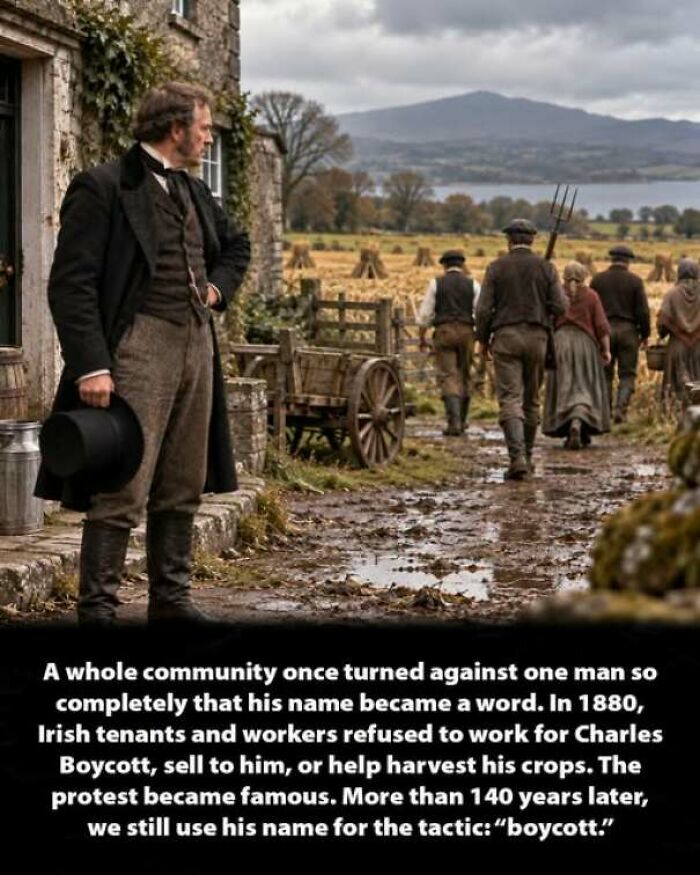
Image source: History Unleashed
#46
When Jimmy Carter left the White House, one of the causes he devoted himself to seemed almost impossible.
Eradicating a parasitic disease that infected millions of people every year.
Guinea worm disease is contracted primarily by drinking contaminated water. About a year later, a female worm can emerge painfully through the skin, sometimes reaching several feet in length. There is no vaccine to prevent the disease and no medicine that simply cures it.
In 1986, when the Carter Center began leading the international eradication campaign, an estimated 3.5 million people were infected every year across 21 countries in Africa and Asia.
The solution wasn’t a miracle medicine
Instead, Carter and an enormous network of governments, health organizations and local volunteers attacked the parasite’s life cycle.
Communities were taught to filter drinking water. Contaminated water sources were treated. People with emerging worms were kept from entering drinking water and spreading the parasite. Villages received safer sources of water, while volunteers tracked infections one by one.
Carter also used something unusual for a public health campaign: diplomacy.
In 1995, he helped negotiate a temporary ceasefire during Sudan’s civil war that allowed health workers to reach communities affected by Guinea worm and other diseases.
Slowly, the numbers collapsed.
From an estimated 3.5 million cases a year in 1986, the world fell below 100,000 by 2001.
By 2025, there were just 10 reported human cases worldwide.
A reduction of more than 99.99%.
Jimmy Carter once hoped he would live to see the last Guinea worm disappear.
He didn’t quite make it.
But the campaign he helped lead brought humanity extraordinarily close to eradicating an ancient disease without a vaccine or curative medicine.

Image source: History Unleashed
#47
The prison made famous by The Shawshank Redemption was once sold for just $1.
The Ohio State Reformatory in Mansfield opened in the late 1800s and operated as a prison until 1990, when it closed after years of deteriorating conditions. A few years later, filmmakers transformed portions of the abandoned complex into Shawshank State Penitentiary for the 1994 film The Shawshank Redemption. But the enormous historic building faced an uncertain future. Local preservationists formed the Mansfield Reformatory Preservation Society and fought to save it. In 2000, the State of Ohio transferred the building to the City of Mansfield, which sold it to the preservation group for just $1. Volunteers and preservationists then continued the enormous task of repairing and restoring the former prison. Today, the Ohio State Reformatory is a museum and tourist attraction where visitors can explore its history, walk through locations used in The Shawshank Redemption and tour its enormous cell blocks. The Reformatory has reported welcoming more than 120,000 visitors in a year. A building once facing demolition was given a second life for the price of a single dollar.
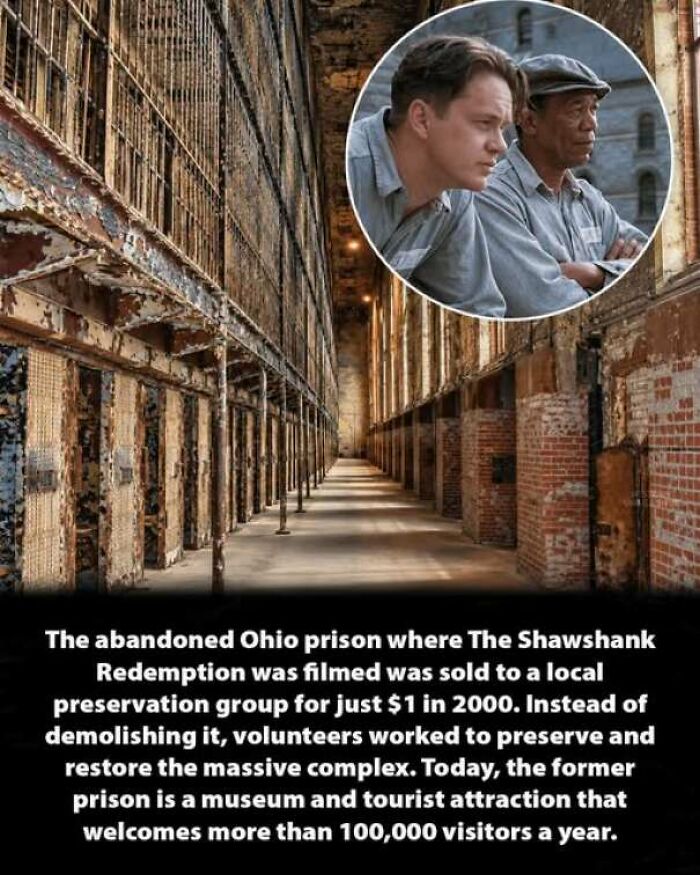
Image source: History Unleashed
#48
This is an X-ray Nikola Tesla took of his own foot in 1896.
X-rays had only recently been announced to the world.
German physicist Wilhelm Röntgen discovered them in 1895, but scientists and inventors quickly began experimenting with the mysterious new form of radiation.
Among them was Nikola Tesla.
Tesla developed his own experimental X-ray equipment, including a special vacuum tube powered using the high-voltage technology he had been developing.
He referred to the resulting X-ray photographs as “shadowgraphs.”
In 1896, Tesla produced this remarkable image of a human foot still inside its shoe.
The image is identified by the Nikola Tesla Museum as Tesla’s own foot.
You can clearly see the bones of his foot through the shoe, along with the metal components used in its construction.
Tesla produced the image using X-rays generated by his own vacuum tube from a distance of approximately eight feet.
His experiments weren’t limited to producing unusual photographs.
Tesla investigated how X-rays behaved, experimented with different equipment and even began recognizing the dangers associated with prolonged exposure to the radiation.
More than 130 years later, the original shadowgraph survives in the collection of the Nikola Tesla Museum.
An X-ray of Nikola Tesla.
Taken by Nikola Tesla.
Using equipment developed by Nikola Tesla.
In 1896.
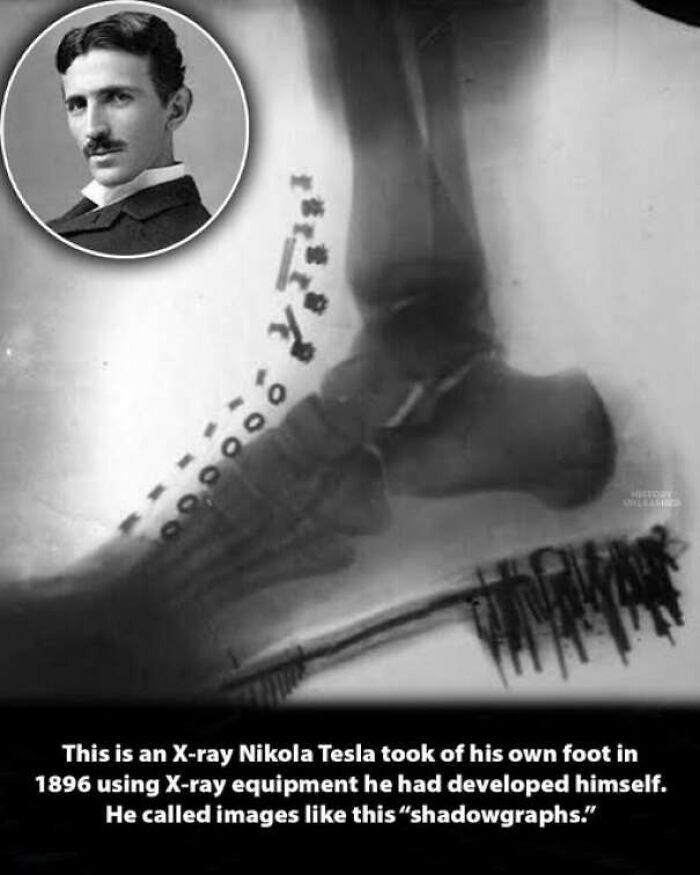
Image source: History Unleashed
#49
In 1968, a schoolteacher wrote Charles Schulz a letter that helped bring a new character into Peanuts.
Los Angeles teacher Harriet Glickman believed that adding a Black child to one of America’s most popular comic strips could have a positive influence on children.
She wrote Schulz and asked him to consider the idea.
Schulz was initially hesitant. He worried that introducing a Black character could appear patronizing.
Glickman continued corresponding with him and encouraged Black friends to share their thoughts with Schulz as well.
He eventually decided to move forward.
On July 31, 1968, Franklin made his first appearance in Peanuts, simply meeting Charlie Brown at the beach.
Although much of the response was positive, Schulz also received angry criticism. He later described it as some of the strongest criticism he could remember.
When objections arose over Franklin being shown alongside white children at school, Schulz refused to change how he portrayed him.
He later recalled telling his syndicate:
“Either you print it just the way I draw it or I quit.”
Franklin remained part of the Peanuts world for the rest of Schulz’s career.
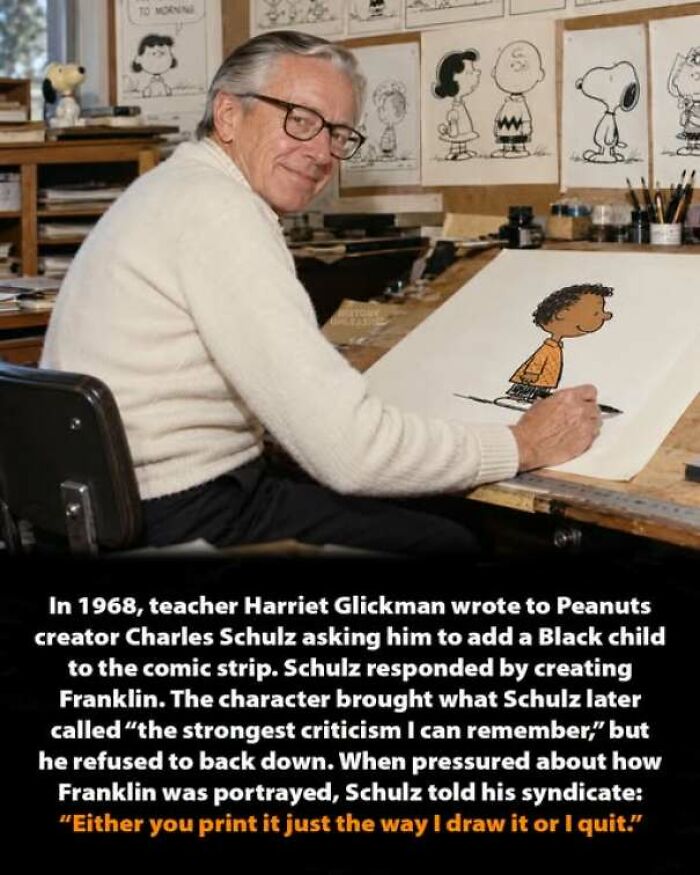
Image source: History Unleashed
#50
In 2014, a billionaire spent millions on a Nobel Prize medal just so he could give it back to the man who sold it.
James Watson had received the 1962 Nobel Prize in Physiology or Medicine alongside Francis Crick and Maurice Wilkins for their work concerning the molecular structure of DNA.
More than 50 years later, Watson decided to auction his gold Nobel medal.
The sale made him the first living Nobel laureate to put his medal up for auction.
At Christie’s in New York, bidding climbed to $4.1 million, with the final price reaching $4.757 million after the buyer’s premium.
The winning bidder was later revealed to be billionaire Alisher Usmanov.
But Usmanov hadn’t bought the medal because he wanted to keep it.
Days after the auction, he announced that he intended to return the medal to Watson, while allowing the scientist to keep the proceeds from its sale.
Usmanov said he believed the medal should remain with the person who had earned it and wanted the money he spent to support scientific research.
Watson got his Nobel medal back.
And the millions from its sale remained available for the causes he wanted to support.
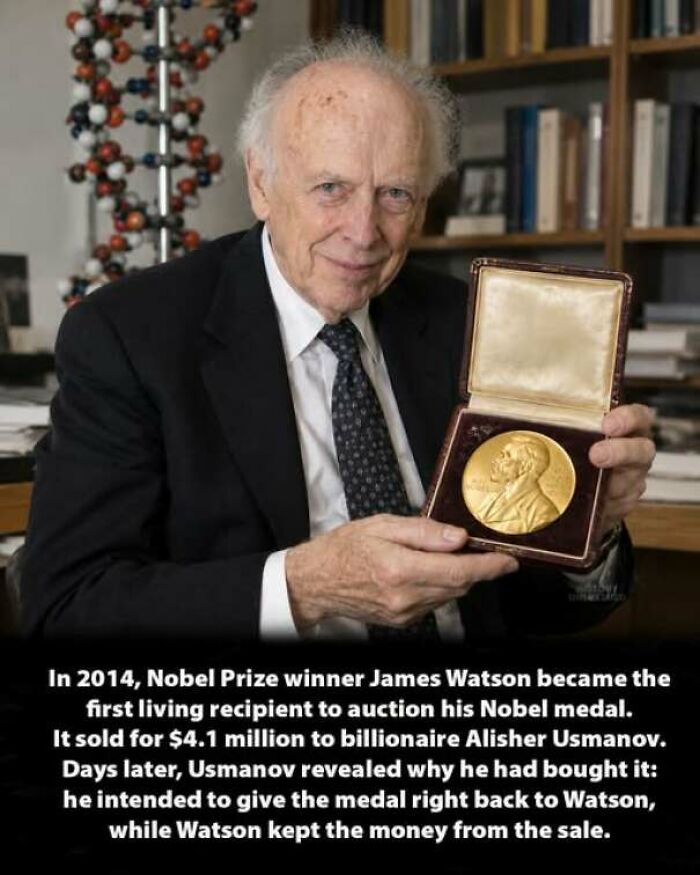
Image source: History Unleashed
#51
A Swedish king who believed coffee was dangerous reportedly tried to prove it with one of history’s strangest experiments.
During the 18th century, coffee became increasingly popular in Sweden.
Not everyone was pleased.
Swedish authorities worried about the drink’s effects on health and society, and coffee was subjected to taxes, restrictions and eventually outright bans.
King Gustav III was reportedly convinced that coffee was particularly harmful.
So he ordered an unusual experiment.
According to the traditional account, identical twin brothers who had been sentenced to d***h had their sentences reduced to life imprisonment.
There was one condition.
One brother was required to drink three pots of coffee every day.
The other was required to drink three pots of tea.
Two physicians were assigned to monitor the brothers and determine what effect the drinks had on their health.
Then the experiment took an unexpected turn.
Both doctors passed away before either of the twins.
Gustav III didn’t live to see the results either.
The king was shot at a masquerade ball in 1792 and passed away from his wounds less than two weeks later.
The twins kept drinking.
According to later accounts, the brother assigned to drink tea eventually passed away at the age of 83.
The coffee drinker reportedly survived even longer.
The experiment obviously wouldn’t meet modern scientific standards, and many details survive through later historical accounts rather than complete experimental records.
But Gustav III’s attempt to demonstrate the dangers of coffee certainly didn’t produce the result he expected.
The doctors passed.
The king passed.
The coffee drinker kept drinking coffee.
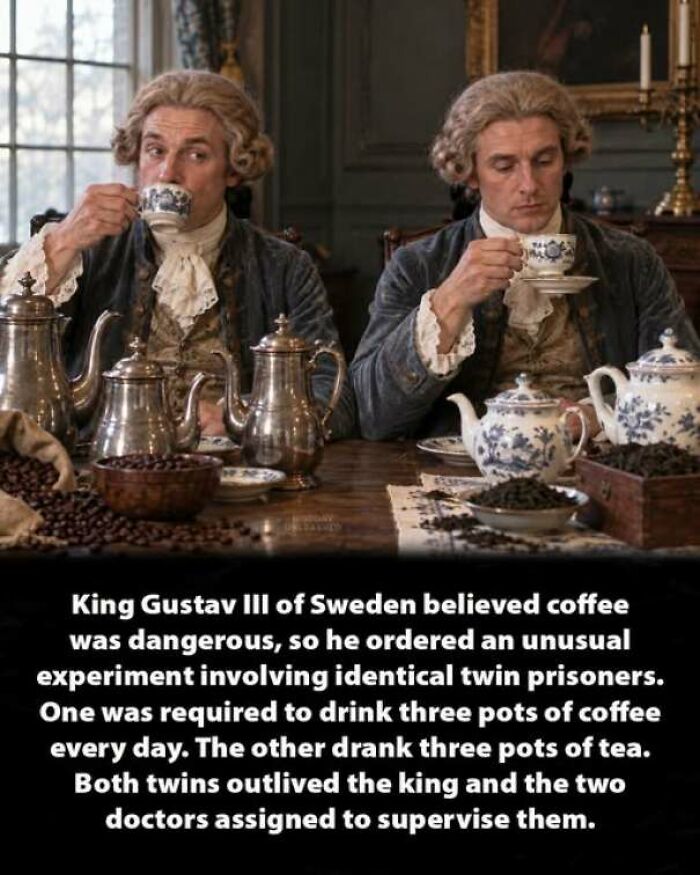
Image source: History Unleashed
#52
For centuries, crossing London Bridge meant passing through an entire neighborhood built above the River Thames. It could also mean walking beneath the severed heads of convicted traitors.
Completed in 1209, the medieval stone London Bridge became one of the great landmarks of the city.
For hundreds of years, it was London’s only bridge across the Thames, making it one of the busiest routes into the city.
But this was nothing like the London Bridge we know today.
Homes and businesses were constructed directly on the bridge.
By 1358, records show 138 houses and shops standing along it.
People lived, worked, shopped and worshipped above the river. The bridge contained businesses, inns and a chapel dedicated to Thomas Becket.
In places, the buildings rose several stories high, making the crossing resemble a crowded London street more than a bridge.
But people approaching the city from the south could also encounter a far darker sight.
For centuries, the heads of people convicted as traitors were displayed on spikes near the bridge’s gateway as a warning to anyone entering London.
Among the famous figures whose heads were displayed there were Scottish knight William Wallace, rebel leader Wat Tyler and statesman Thomas More.
Some heads remained exposed for extraordinary lengths of time.
The medieval bridge survived fires, freezing winters and centuries of constant use. Its buildings were eventually removed, and the bridge itself was replaced in the 19th century.
By the time Old London Bridge was finally demolished in 1831 and 1832, it had stood across the Thames for more than 600 years.
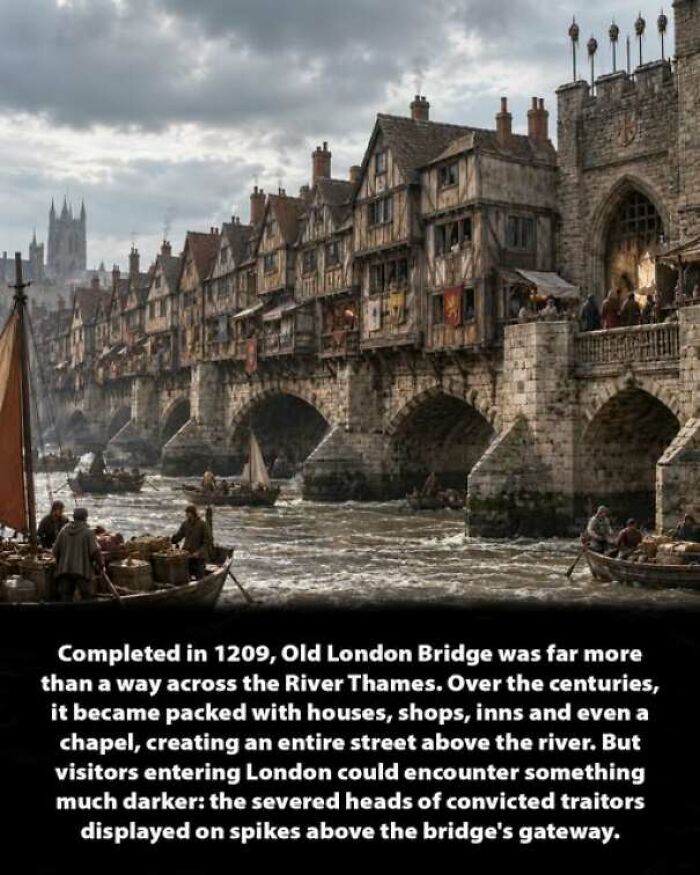
Image source: History Unleashed
#53
In 1714, a naval captain ran out of ammunition during a battle, so he asked his enemy if he could borrow some more to keep fighting.
During the Great Northern War, Peter Jansen Wessel commanded the Dano-Norwegian warship Løvendals Gallej. In July 1714, he encountered the larger De Olbing Galley, an English-crewed vessel headed for Swedish service.
The two ships opened fire and fought intermittently for roughly 14 hours across two days. Both vessels were badly damaged, but Wessel eventually faced a problem. He was nearly out of ammunition.
Instead of surrendering, Wessel sent an envoy to the opposing captain. He thanked him for a good fight and asked if he would be willing to provide some ammunition so the battle could continue.
The answer was no.
With neither side in a good position to continue, the two captains reportedly drank a toast to each other’s health before sailing away from one another.
Wessel’s superiors weren’t nearly as amused. He was court-martialed for the incident, partly because he had revealed his ammunition shortage to the enemy and risked his ship against a superior force.
He defended himself successfully and was acquitted.
Less than two weeks later, he was promoted to captain.
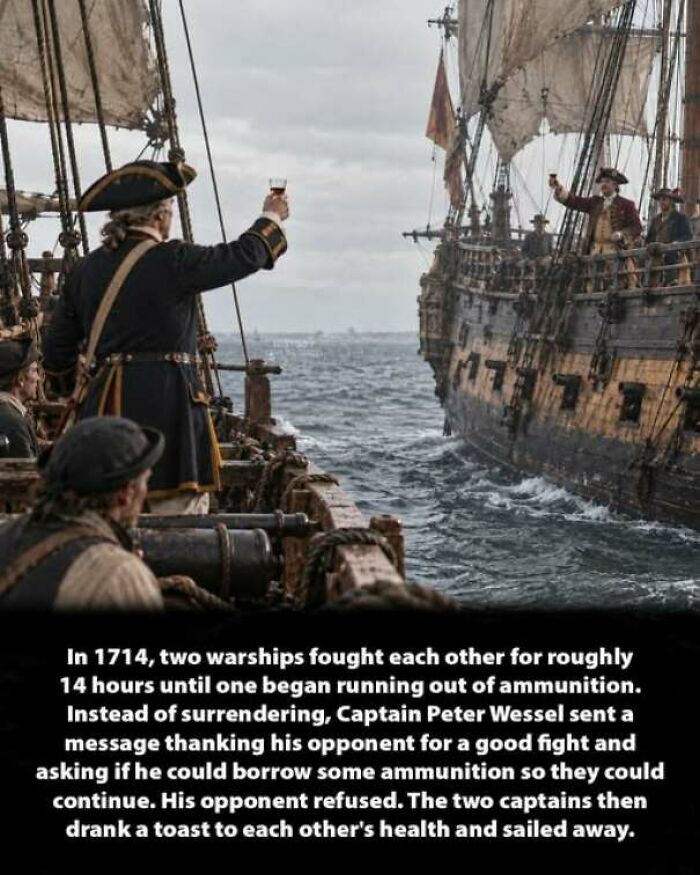
Image source: History Unleashed
#54
In 1849, Denmark’s king gave up absolute power and reportedly found an immediate upside: he could finally sleep in.
Denmark had been governed as an absolute monarchy for nearly two centuries when Frederick VII inherited the throne in 1848.
Across Europe, demands for political reform were growing, and Denmark was no exception.
Rather than attempt to preserve absolute royal rule, Frederick accepted a constitutional system.
On June 5, 1849, he signed Denmark’s new constitution, ending the absolute monarchy and establishing a constitutional system with an elected parliament and protections for individual rights.
According to a story that became associated with the king, Frederick reacted to surrendering his absolute authority with a remarkably casual observation:
“Now I can sleep late in the mornings.”
Different versions of the remark survive, so the exact wording is uncertain.
But Frederick VII’s decision marked one of the most important political changes in Danish history.
June 5 is still celebrated in Denmark as Constitution Day.
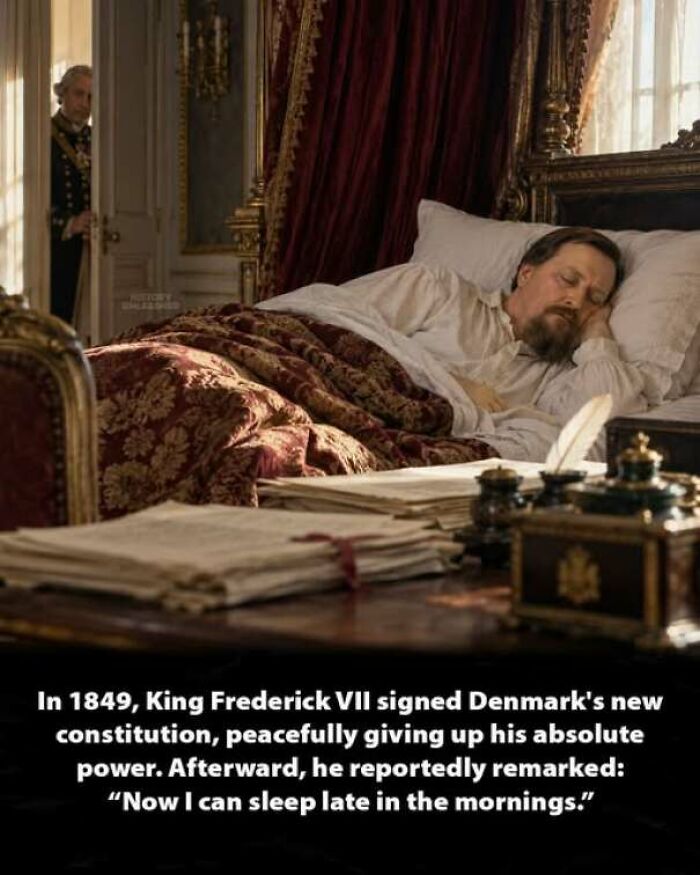
Image source: History Unleashed
#55
In 1921, China’s 15-year-old former emperor, Puyi, discovered the telephone.
He immediately wanted one.
Although Puyi had been forced to abdicate as a child, he was still allowed to live inside Beijing’s Forbidden City, where the remnants of the imperial court continued treating him as emperor.
When his Scottish tutor, Reginald Johnston, explained how telephones worked, Puyi became fascinated. He soon learned that his own father already had one and ordered palace officials to install a telephone for him too.
His advisors were horrified.
They argued that telephones had no place in imperial tradition and worried that allowing ordinary outsiders to speak directly to the emperor would damage his dignity.
Puyi later believed they were worried about something else.
For most of his childhood, he had been extraordinarily isolated from the outside world. Newspapers and his foreign tutor were already giving him access to information palace officials couldn’t completely control.
A telephone would give him another direct connection.
Puyi refused to back down.
The telephone was installed.
Then the 15-year-old emperor received a telephone directory.
He began calling people around Beijing for fun.
Puyi later recalled calling a famous Peking opera performer and an acrobat, then hanging up without identifying himself. He also called a restaurant and ordered a meal to be delivered to a fake address.
Eventually he called prominent intellectual Hu Shih and challenged him to guess who was calling.
When Hu couldn’t, Puyi revealed his identity.
The scholar was so surprised that he later checked with Puyi’s tutor to make sure the Emperor of China really had just randomly called him.
More than a century ago, palace officials worried about what might happen if a teenager gained unrestricted access to the latest communication technology.
He got it and immediately started making prank calls.
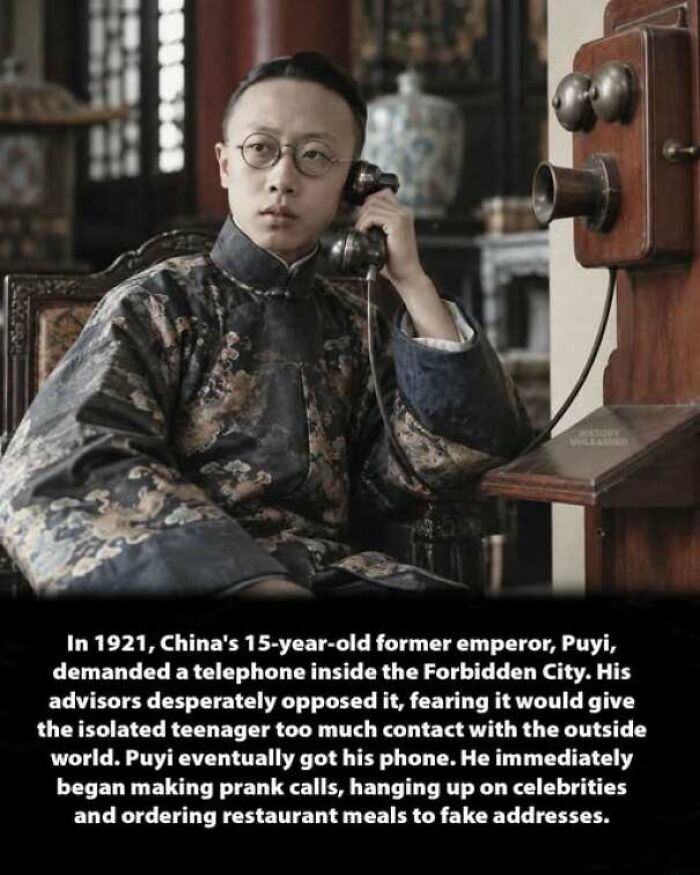
Image source: History Unleashed
#56
One of the most valuable secrets of the ancient world was reportedly smuggled into the Byzantine Empire inside hollow canes.
For centuries, silk traveled west from Asia through a vast network of traders.
By the sixth century, the Byzantine Empire still depended heavily on foreign sources for the luxury fabric, with its Persian rivals controlling important parts of the trade.
Emperor Justinian I wanted another option.
According to the Byzantine historian Procopius, monks who had spent time in the East told Justinian they knew how silk was actually produced.
The secret was silkworms.
The monks explained that transporting the worms themselves would be difficult, but their eggs could survive the journey.
Justinian promised to reward them if they succeeded.
The monks traveled east and eventually returned to Constantinople carrying silkworm eggs. Another ancient account describes the eggs being transported inside the hollow stem of a plant, giving rise to the famous story that they were smuggled inside hollow canes.
The eggs hatched successfully.
The silkworms were fed mulberry leaves, and for the first time the Byzantine Empire could produce its own raw silk rather than relying entirely on imports.
A handful of tiny eggs had helped establish an industry that would become one of Byzantium’s most famous luxury trades.
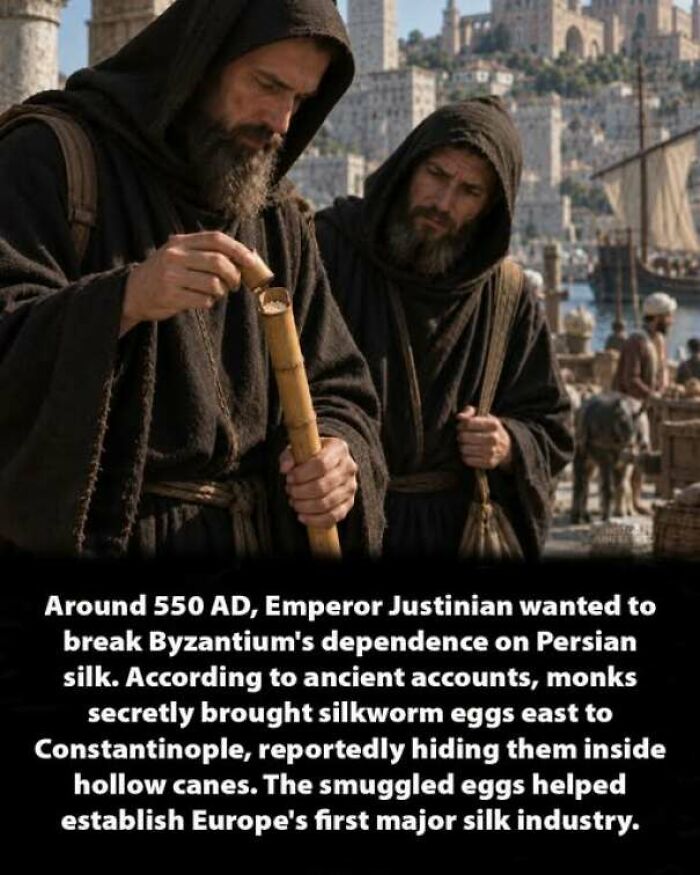
Image source: History Unleashed
 Follow Us