Saying that our planet is beautiful almost feels like an understatement. We often forget to appreciate the nature around us, but if we take a moment to look closer, we can see just how complex and incredible it really is. For many photographers around the world, this beauty is a constant source of inspiration and the reason they dedicate their work to capturing it.
Nature Photographer of the Year (NPOTY) brings together photographers from around the world who capture everything from breathtaking landscapes and remote corners of the planet to the incredible wildlife that inhabits them. Looking through the competition’s photos, it’s hard not to be amazed by the moments these photographers manage to capture.
While we wait for this year’s People’s Choice Award winner to be announced, we thought it would be the perfect time to look back at some of the most remarkable wildlife photos featured in the competition between 2021 and 2025.
Scroll down to check out these captivating shots, and get ready to be reminded of just how wonderful our planet is!
More info: naturephotographeroftheyear.com | Instagram | Facebook
#1 Stormy Seal By Peter Van Der Veen
The weather forecast predicted a windy day, and my friend knows a place where a young seal had been seen. It was on the coastline of the Netherlands.
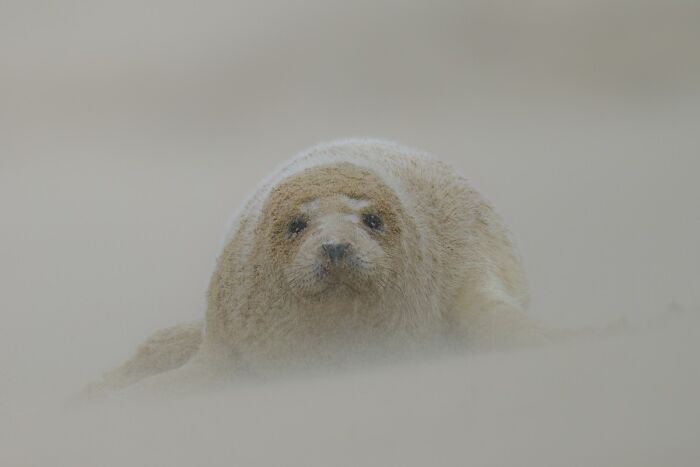
Image source: Nature Photographer Of The Year

#2 Parakeet Bitting Monitor Lizard By Hira Punjabi
The image was taken at Keoladeo National Park in Bharatpur, Rajasthan, India. The park is considered one of the best in India for observing and photographing both resident and migratory bird species.
I have been visiting this park for the last 33 years, always making two trips each winter to photograph the migratory birds. The parakeets are resident birds of the park, and I’ve often observed conflicts between these birds and reptiles. The monitor lizards frequently invade the parakeet nesting sites, and on this occasion, a pair of parakeets managed to call in other parakeets. Together, they attacked the lizard.
In January of this year, I was fortunate to witness this dramatic scene for nearly 45 minutes, capturing some incredible behavioral shots of the species. It was truly a dream shot for me.
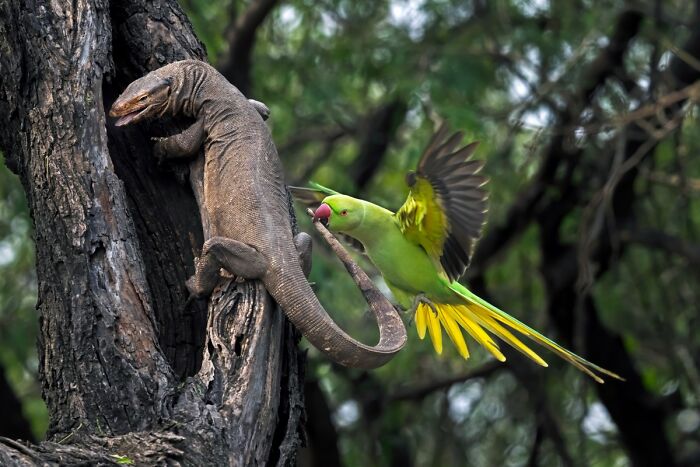
Image source: Nature Photographer Of The Year
#3 Descending By Hannes Lochner
Emerging from a day-long slumber, a youthful leopard awakens atop a majestic Mashatu tree. As it descends, the leopard seamlessly melds with the tree’s sinuous roots, almost blending into the landscape from a distance. The beauty of the scene lies in how effortlessly the leopard integrates with the tree’s base, appearing as an extension of the intricate, winding roots. Its sleek form gracefully merges with the organic pattern of the roots, creating a mesmerizing camouflage that makes the majestic creature nearly imperceptible against the natural backdrop. The harmonious blend of the leopard’s coat and the tree’s roots exemplifies the seamless unity between the animal and its environment—an exquisite display of nature’s artistry and the innate ability of creatures to adapt and merge with their surroundings.
Species name: Leopard (Panthera pardus)
Location: Mashatu Private Game Reserve, Botswana
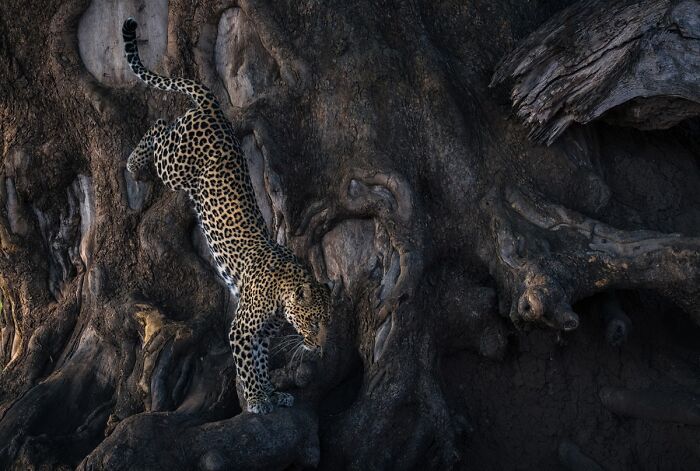
Image source: Nature Photographer Of The Year
#4 Greeting A Friend By Dewald Tromp
The conservation of the critically endangered Mountain Gorillas in Rwanda is one of Africa’s rare success stories and serves as a beacon of hope for the continent. Fewer than 1,000 individuals remain in the rainforests that border Rwanda, Uganda, and the DRC. During gorilla trekking, visitors are allowed to approach within 7-10 meters of individual gorilla families, though maintaining a safe distance is not always easy for the gorillas themselves.
The dominant Silverback casually flopped down directly in front of me, observing his reflection in my lens. Surrounded by thick vegetation, I had nowhere else to move and adopted a submissive posture, keeping my eyes downcast. He reached out his hand to touch his reflection, and for the briefest moment, I imagined him extending his hand to greet me as an old friend—a moment in time I will cherish for the rest of my life.
Image taken in Rwanda at Volcanoes National Park
Mountain Gorilla (Gorilla beringei beringei)
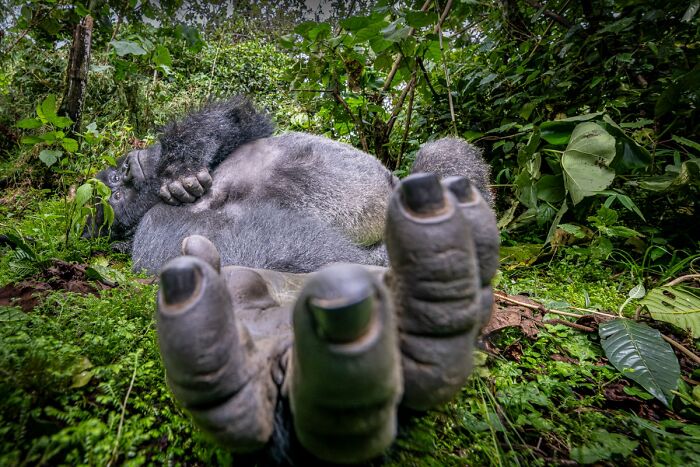
Image source: Nature Photographer Of The Year
#5 Reflection By Geza Szabó
I took this photo in Hungary during the winter. Deer are quite common here and primarily inhabit forest edges, with scattered fields and meadows. As food becomes scarcer in winter, many deer visit crop fields to feed. To help, experts (such as forest officers and national park staff) set up feeding stations in various locations throughout the forests, making food more accessible to the deer.
I took the photo from a bird hide in a small, secluded field within the forest. There were lights positioned in front of the hide and others installed behind the “scene,” where seeds were scattered, waiting for the deer. A small birdbath was also placed nearby, where the reflection of the deer appeared. All I had to do was wait for the deer to show up.
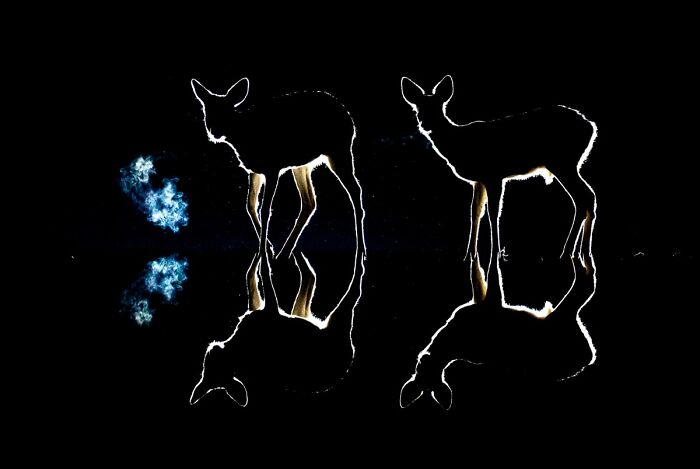
Image source: Nature Photographer Of The Year
#6 Unhealthy Treats By Daniela Anger
Crab-eating macaques, also called long-tailed macaques (macaca fascicularis), have a long history alongside humans in Lopburi, a city north of Bangkok in central Thailand. They are the symbol of the province and are a popular tourist attraction. These highly social animals live in huge groups in temples, abandoned houses, and city parks. For me, the most fascinating aspect is the complex relationships with the people of this area. On the one hand, they are sacred animals that are believed to bring prosperity and luck into the province. On the other hand, their exploding population causes conflicts.
I spent one entire day in the town and observed that locals supported the monkeys by delivering food like vegetables and fruits all day long in huge amounts. This kind of food belongs to their natural diet.
Stalls were selling treats that visitors fed to the animals. The sold treats contained not only healthy and appropriate food, but also sweets like little plastic bags with colored sugar water. They were very much welcomed by the monkeys, which grabbed as many as they could. One individual brought its prey next to one of the monkey statues, which were built in honor of the furry inhabitants in the center of the city, to enjoy the sweets. Of course, consumed in huge amounts, these sweets cause health problems like illnesses and can also lead to aggressive behavior towards humans.
To find a way for peaceful coexistence, many challenges need to be overcome.
Authorities and conservation organizations are working hard on solutions to protect the charismatic little monkeys, which have been listed as endangered on the IUCN list since this year (2023). One is to educate the public on how to treat and protect the animals. It may need some time but efforts are done already.
I took the image of the scene to combine the many aspects of the human-macaque interaction like mutual interferences, conflicts, admiration, thoughtlessness, tradition, and vulnerability to make the viewers thoughtful like it happened to me.
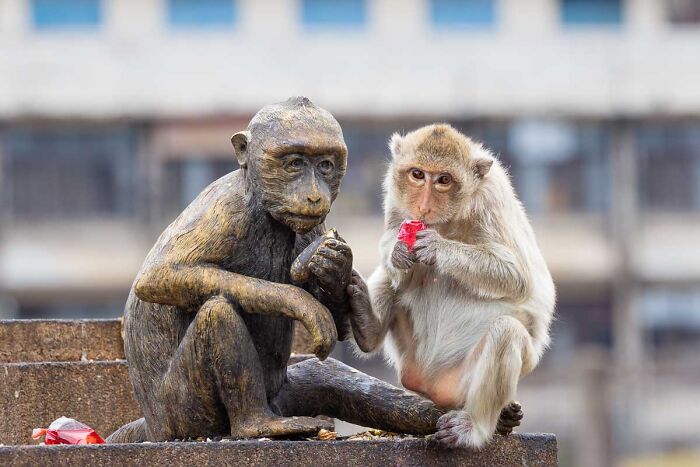
Image source: Nature Photographer Of The Year
#7 Smooth By Rafael Armada
To evade their underwater predators, flying fish jump to the surface of the sea and swiftly glide, using their fins as sails and their tails as a rudder. However, once they’re out of the water, they are not out of danger, as seabirds stalk them from above. These fish inhabit the shallower strata of tropical oceans around the world and serve as the intermediary link between zooplankton, their primary food source, and larger predators. This fish, almost transparent, was photographed in the Solomon Sea, in the Pacific Ocean to the east of Papua New Guinea.
When I’m taking pictures of really fast animals like flying fish, I don’t just want to freeze them in one frame. I want to show their movement. The trail they leave behind is part of the composition. For this reason, I took this picture at 1/125 s; It captures the fish, its trail, and a smooth background. Getting this shot means taking lots of pictures in continuous shooting mode, and paying close attention for a moment that you can’t predict. This picture was taken from a boat, employing a telephoto lens.
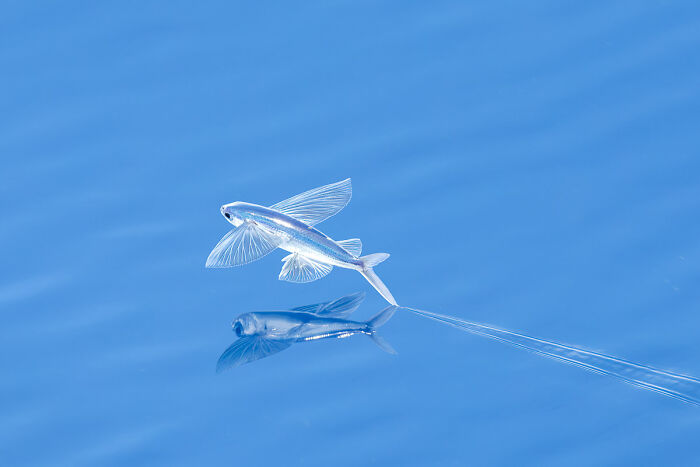
Image source: Nature Photographer Of The Year
#8 Itching Sight By Andres Novales
The very first thing that stood out when finding this Amazon Scarlet Snake (Pseudoboa coronata) was its bright red coloration, setting it apart from the dark leaf litter. I got low, trying to frame the snake for some up-close portraits. At first, nothing seemed out of the ordinary; I was really focusing on capturing the beautiful red and black contrast. It wasn’t until some minutes later that I noticed something off with the snake’s eye. It was so small that I couldn’t really tell what was going on. After going through my previous images, I could see that several mites were wedged between the snake’s eye and scales. I immediately looked back at the snake and saw the mites moving. That was the moment when this itching sight was captured. This took place a couple of kilometers off the Mazan River located in Iquitos, Peru.
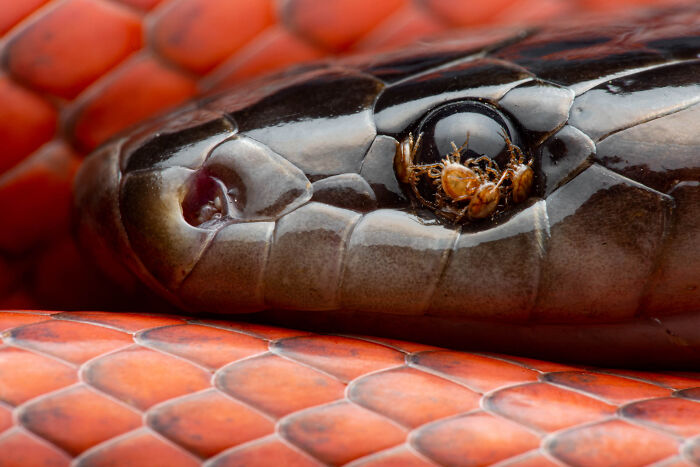
Image source: Nature Photographer Of The Year
#9 Touch By Tomasz Szpila
During our stay in Uganda, the guides wanted to take us to the gorillas and the Nshongi family, among which they suspected the birth of a new group member. The guides mentioned such a possibility, but they were not sure. The female, which the guides had seen pregnant before, had been hiding deep in the bushes for many days and did not allow anyone to come closer to be observed.
When my other companions walked away, looking for a convenient position to observe and take photos hoping that the female would show them her newly born offspring, I stayed where I was, watching a group of gorillas hidden in dense bushes. This tactic paid off because, for a short moment, the female turned towards me, showing her gorilla, which was a few days old. I only had to be quick to find the gap between the branches crossing in all directions and get a reasonably clear frame. I was successful, and the birth of a new gorilla has been confirmed. This seven-day-old toddler, cuddled against his mother’s breast, is tenderly touched by his much older brother.
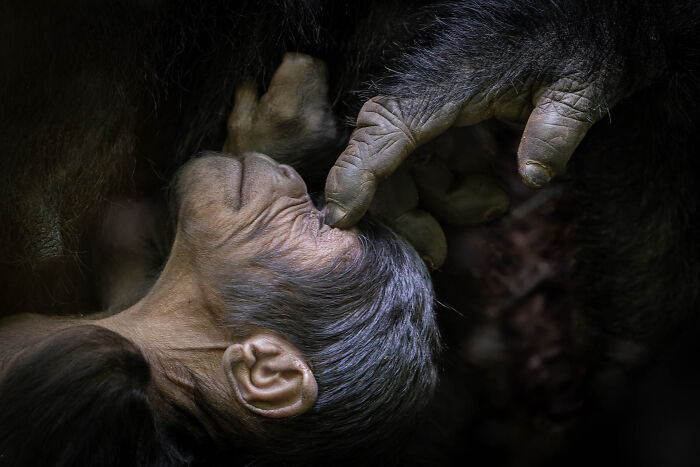
Image source: Nature Photographer Of The Year
#10 Just Chilling By Brian Hammond
I had travelled to Svalbard seven years previously, but wanted to return with better equipment and on a much smaller vessel, finally doing so last year.
We had enjoyed a few polar bear sightings, some at a considerable distance while exploring the archipelago, but on the penultimate day in the North of the islands, we came across this female who had located a Walrus carcass on the rocky shoreline. She had obviously been there with it for some time, by the size of her distended belly and the marks in the snow.
We then watched her repeat a cycle of sleeping in a snow hole she had dug above the shoreline, emerging to stretch, before then making her way down to eat her fill of the carcass. She would look up from time to time, with her head and chest smothered in blood. It was very difficult to find a clear angle and frame a composition, as the carcass was nestled amongst large rocks and the idling Zodiac was being tossed up and down in the offshore swell, often causing the images to be clipped, or have the horizon at very extreme angles. However, once repleat, she would briefly wade into the sea to wash the worst of the blood from her coat, before returning to the snow slopes above the carcass to snow bathe. Here she would snow plough, roll and toboggan, in order to return her coat to its pristine condition, which she could achieve surprisingly quickly. She would then return to her snow hole and sleep, repeating the process several hours later.
This snow bathing and later play presented the best opportunity to photograph her, but when we first found her the light was poor, and from our lower angle on the sea she was often partly obscured by the largest rocks. Returning later in the evening, we found her higher on the slopes, clear of all obstruction, just playing in the snow as she was already spotlessly clean. Over the course of the next twenty minutes, we watched as she snow ploughed, slid down the slopes, rolled, or just lay on her back chilling out in the sun before we left her to her evening, and this is when this image was taken.
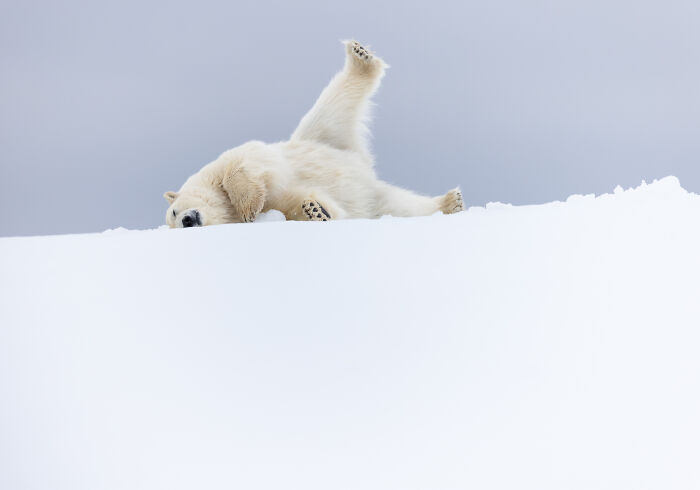
Image source: Nature Photographer Of The Year
#11 Bounced Out And Into Care By Douglas Gimesy
In the home of wildlife carer and founder of Bunurong Wildlife Carer (Inverloch, Victoria, Australia), an anesthetized Eastern Grey kangaroo joey (Macropus giganteus) lies on the floor ready to be examined for broken bones and other injuries.
Anaesthetised by Wildlife Victoria’s Travelling Veterinary team, named Donald, he came into care when he was bounced out of his mother’s pouch as she was chased by a dog off-lead.
Despite some grazes and bruising from hitting the hard road surface, after the X-ray, Donald was cleared of any injury. At the time of taking this photo, Donald was only a few Kgs in weight and remained with Bunurong Wildlife Care until he had steady weight gain and then was buddied with another joey for same species comfort. Both were then relocated to another carer to continue their rehabilitation journey.
This image forms part of a larger series I decided to create to show the wonderful and important work of wildlife rescuers, carers, and Wildlife Victoria’s Travelling Veterinary team: A team that provides free veterinary support to volunteer wildlife rehabilitators in Victoria, as well as a rapid response during major emergencies.
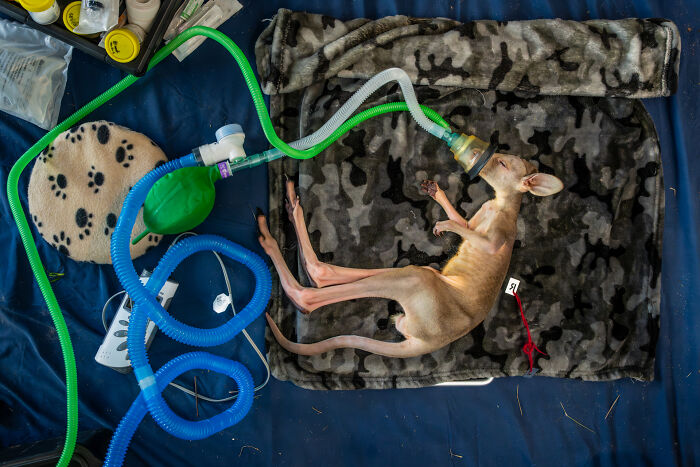
Image source: Nature Photographer Of The Year
#12 Giraffe In An IKEA Parking Lot By Jo-Anne Mcarthur
In 2016 I was commissioned by the Born Free Foundation to document a cross-section of zoos in Europe. I encountered this Rothschild’s giraffe in Germany, owned by a company that seemed to be part zoo, part circus. Their event space was set up next to an Ikea, and I saw that I could photograph one of the giraffes with my lens pointing up towards him or her, with the Ikea sign in the background. I knew that this would be a good way of showing the absurdity of keeping wild animals where they do not belong.
It can be difficult to convey the life of a wild animal in captivity through a photograph. There is so much that the photo cannot reveal. Was the animal wild-caught and transported from overseas? Were they taken from their families? Did any friends or family members die in the process? Were they born in captivity, and have they been sold between zoos and circuses? Have they ever had enough room to run? Do they wish they could choose other foods to eat? Are they happy, or lonely?
This image became one of the many in my book about zoos and aquaria, called Captive, which was published in 2017.
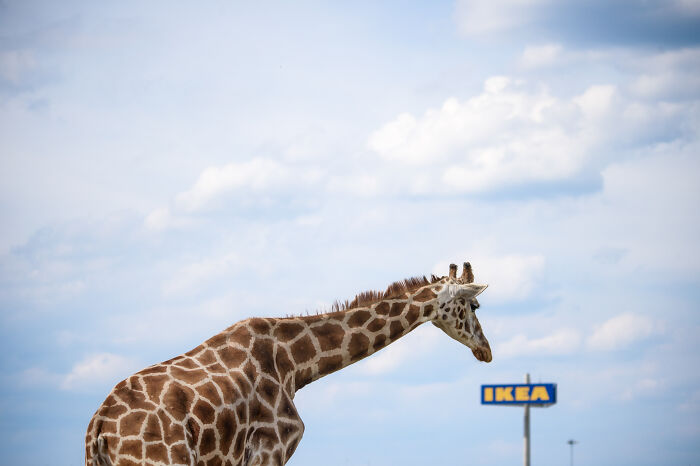
Image source: Nature Photographer Of The Year
#13 Why The Fulmar?! By Tomáš Grim
In the Czech Republic, including here in the city of Olomouc, Eurasian jackdaws commonly breed in abandoned holes excavated in housing insulation by woodpeckers. Silhouettes of birds, usually raptor-shaped, are used to deter birds from buildings. Here, the jackdaws were breeding above a fulmar silhouette, as seen by the abraded area at the top of the picture. I cropped the image to eliminate the nest cavity, for a minimalist and effective composition. The jackdaw’s puzzled expression says it all: ‘Why the fulmar?!’
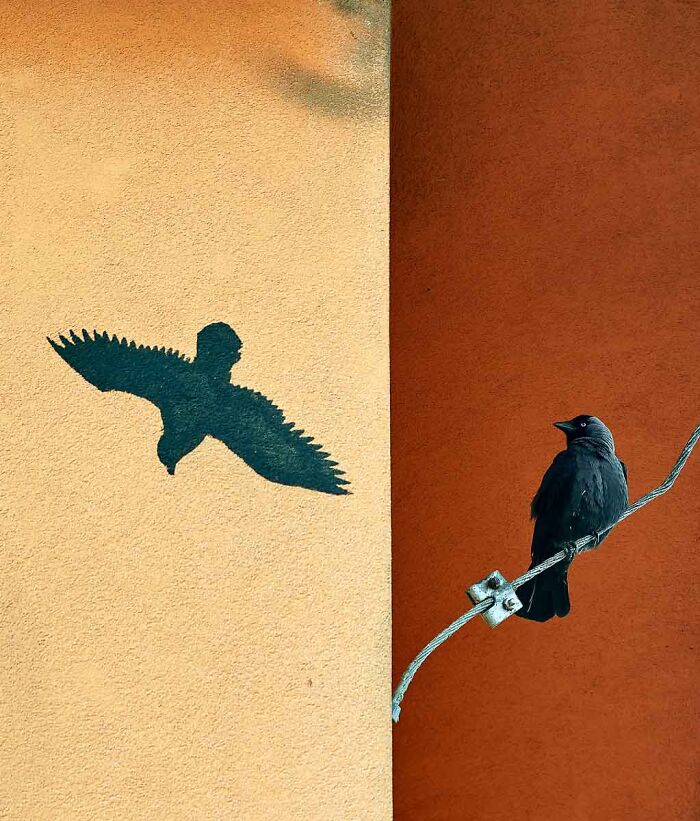
Image source: Nature Photographer Of The Year
#14 Unexpected Guest By Krisztina Mácsai
I found this abandoned wasp nest in my garden. Jumping spiders love to hide in small places, so I thought it might be interesting to introduce the nest to the spider, who was wandering on my backyard patio. As expected: he loved it!
The spider was exploring the wasp nest with confidence, and after a little while, he settled down in one of the abandoned tubes and turned his attention to me. Jumping spiders are very attentive, they like to observe my gear, especially the diffuser. I always find it fascinating how they are looking around curiously, trying to decipher what they are staring at. Usually, I like to portray spiders in vivid, colorful environments, but in this case, I especially liked that the colors of the spider matched the colors of the nest, making it a good hiding spot for the spider.
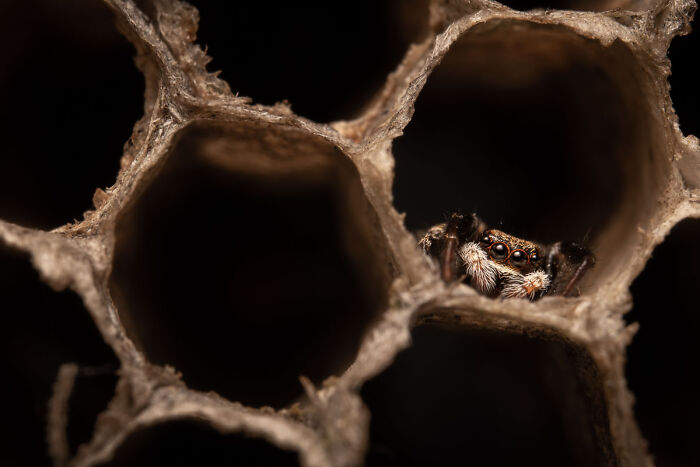
Image source: Nature Photographer Of The Year
#15 In The Tree Hollow By Jan Piecha
For several years now, I have been working on a photo project about raccoons with a friend. The photo of the female and her offspring was also taken in this context. I observed the family for many days and the female was not shy towards me, which is why I had the chance to document intimate insights into her family life. I didn’t use a flash to take the photo.
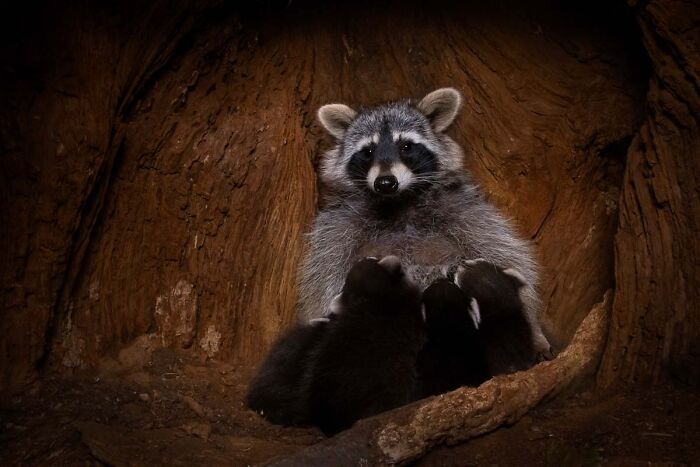
Image source: Nature Photographer Of The Year
#16 Curiosity By Wim Van Den Heever
I spend a couple of weeks in the Amboseli region of Kenya each year working and photographing some of the huge tuskers of Africa. I specifically enjoy working with this one huge iconic bull, named Craig. This magnificent gentle giant is such an amazing animal to be around, with his gentle demeanor and awe-inspiring presence. Knowing the general route he was moving towards, I placed a camera on a ground pod and waited for him to approach. I was lucky when he stopped and stared at the camera when walking past it. With a remote control, I managed to trigger the camera and capture this scene. An absolute highlight of my life for me!
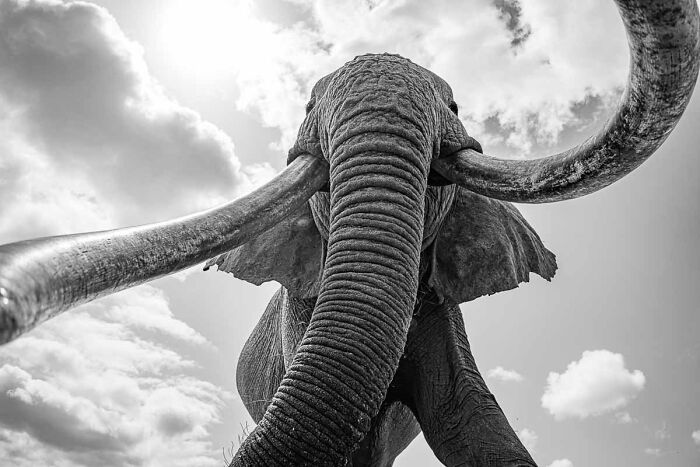
Image source: Nature Photographer Of The Year
#17 The Little Hunter By Winfried Wisniewski
For several years, I was photographing for a new book, “Der richtige Augenblick” (“The right moment”). I tried to find the right moment in the behavior of birds and mammals, for example, fighting ruffs and black grouse, and hunting eagles. I spent a long time in Africa trying to photograph the fascinating hunt of cheetahs and leopards. One day in March 2016, I followed a leopard mother with her half-grown cub in the high grass of Mara Masai Preserve. The young leopard played with its mother and stalked her again and again and jumped on her back. It was very difficult to photograph, because you couldn’t see the young in the high grass at all. When you saw the cub, it was already in the air. So you had to anticipate where the young leopard was and rely on your autofocus system to focus on the animal. At least once it worked. In the end, it was luck.
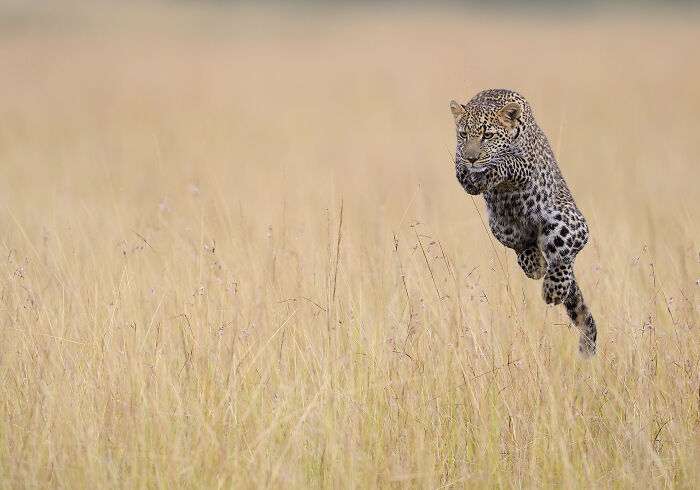
Image source: Nature Photographer Of The Year
#18 Your Protection Is My Home Pollution By Nicholas Samaras
“Stratoni” is a small seaside village on the Halkidiki peninsula in northern Greece, which was abandoned many years ago by swimmers and most divers because of the gold mine on the edge of the Gulf. It is a place where I have regularly dived over the past 10 years to observe and photograph the local seahorse population (Hippocampus hippocampus, short-snouted seahorse) that lives in the small bay and is perhaps the only known colony of seahorses in Greece. You can meet them more easily in large numbers during the summer months if you dive to a depth of 8-17 meters. The area where they live is a large area consisting of sand without the presence of seagrass or rock formations. It looks like a large desert, and the only places that can be protected and support feeding are some carried materials such as leaves that end up in the sea from the nearby mountain, branches, and even litter.
However, for some reasons that have not yet been discovered, seahorses continue to live there and multiply at a steady rate. All this time in Stratoni, I have witnessed some amazing scenes with seahorses, watching them swimming, peacefully floating, achieving amazing camouflage, flirting, and mating. Over the years, the seahorse’s colony has survived enormous natural disasters, overfishing, waste thrown into the sea from the village pipelines, and interventions by the adjacent gold mine.
When you regularly dive at a point, you have the opportunity to observe the changes that occur at that point and how much the human presence affects the environment. The COVID-19 virus in 2020 and the mandatory use of plastic gloves, disposable masks, and sanitizers have led (and still lead) to an even greater contamination of the already polluted sea. It’s the promise of pollution to come if nothing is done. Unfortunately, the already burdened bay has to face another problem, the “Covid waste”.
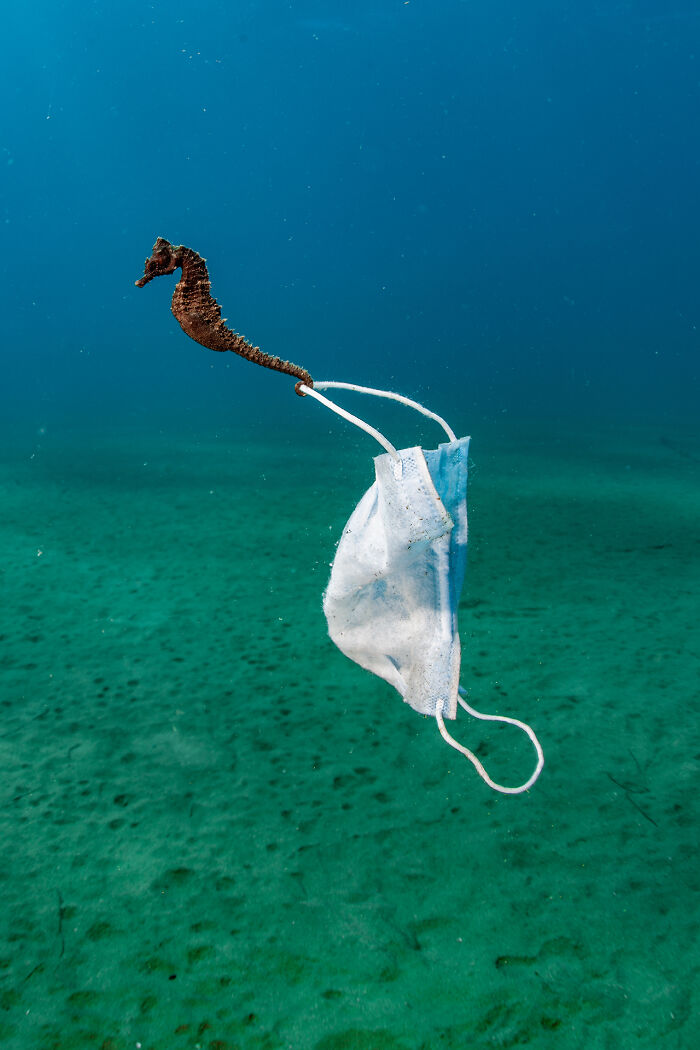
Image source: Nature Photographer Of The Year
#19 Glorious Hunting By Panos Laskarakis
The toughest photograph I took was when I witnessed an extraordinary hunting in the wild nature of the Okavango Delta in Botswana during the dry season in August. It started with dozens of powerful lions attacking buffaloes in the middle of the day. At this point, the scene was already a little difficult to capture, as the attack was very intense and the battle between the lions and the buffaloes was dramatic, with lots of blood and blood-curdling screams just before the kill!
But this is normal in nature, so this isn’t the reason why I say it was the toughest. The best part still had to come through. In the middle of the next night, the lions came under attack by almost 30 hyenas trying to steal the kill from them! It was a rare and cruel scene that I, the guide on the safari, and clients, of course, had never seen before. The ferocity, the sounds of terror coming from everywhere, and the intense darkness made the shots very tough to get.
The next morning, this large male lion returned and peered through the bones, creating this portrait. That was the moment I felt the power of the king in my heart!
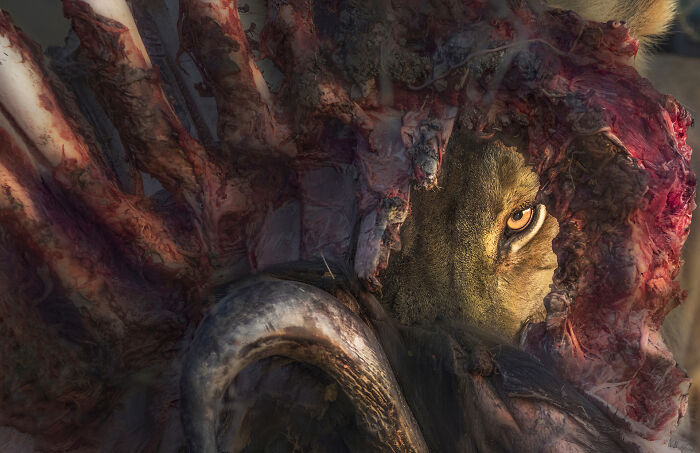
Image source: Nature Photographer Of The Year
#20 The Whale By Stephane Granzotto
I’ll never forget the moment I pressed the shutter. Right in front of me, a humpback whale suddenly shot up, its enormous mouth wide open. It swallowed an entire school of herring in one dramatic gulp. The scene unfolded north of the Arctic Circle in Norway during the winter. What makes the photo even more remarkable is the invisible teamwork behind it: a pod of orcas had spent minutes herding the fish into a tight ball, herding them with precision. And then, from the depths, the humpback whale suddenly appeared, taking advantage of the chaos to feed.
Through my lens, I captured not only the power of this moment but also the complexity of ocean life: a web of competition and cooperation, of survival and opportunity. It reminded me that every photo is more than a frozen image; it tells a story about connection, timing, and the fragile balance that sustains marine life.
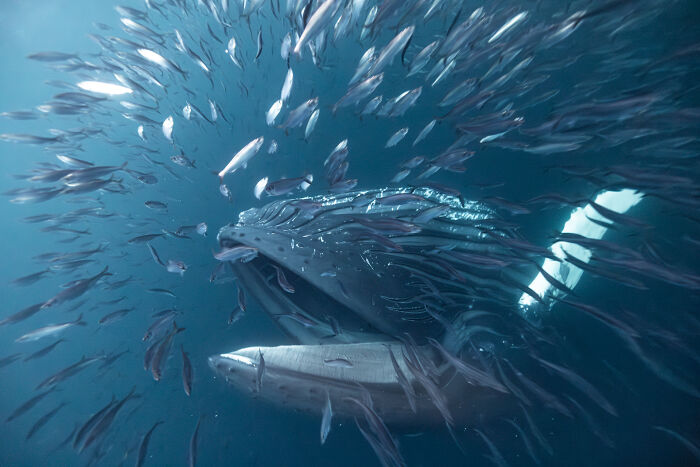
Image source: Nature Photographer Of The Year
#21 Adelie Side-Eye By Roie Galitz
The photo shows a young Adélie penguin in Antarctica in the final stages of molting. He’ll soon be jumping into the water and flying out. The photo was taken on the Antarctic Peninsula, south of Peterman Island. I saw a group of molting youngsters at the water’s edge, and they looked very interesting, especially this male with his hairdo.
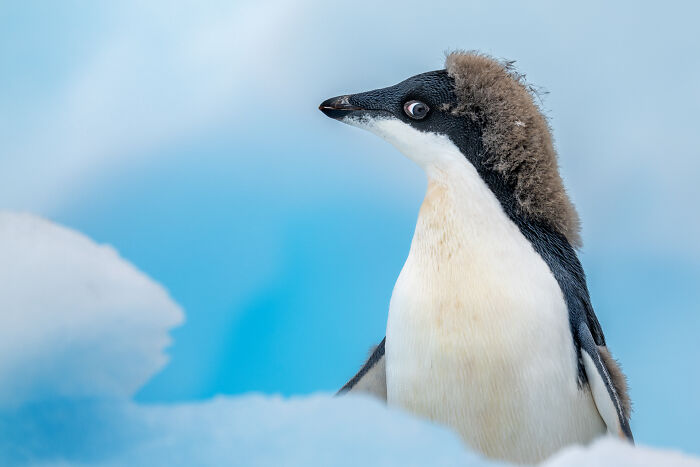
Image source: Nature Photographer Of The Year
#22 Muddy Trick By Tomasz Szpila
During safaris, photography in the middle of the day is usually avoided because of the harsh light and the reduced activity of animals that tend to rest in the shade. But on this occasion, while relaxing after the morning drive, we noticed elephants visiting the waterhole only about 300 meters from our tents. Instead of letting the opportunity slip by, we asked our guide to take us closer by vehicle, so I could try for a tighter composition. My goal was to capture only the head, the trunk, and the spray of mud suspended in the air.
The subject was a solitary bull African elephant (Loxodonta africana) in the Okavango Delta, Botswana. In the late morning heat, he was fully engaged in his natural skincare routine, scooping up mud and flinging it across his massive body. To the eye, the mud seemed to fly in a random, chaotic pattern, but when frozen by the camera, it revealed unexpected and almost sculptural shapes. The elephant spent only a few minutes at the waterhole before continuing on his way, leaving us with a fleeting but powerful reminder of how even the simplest behaviors can become extraordinary when seen through the lens.
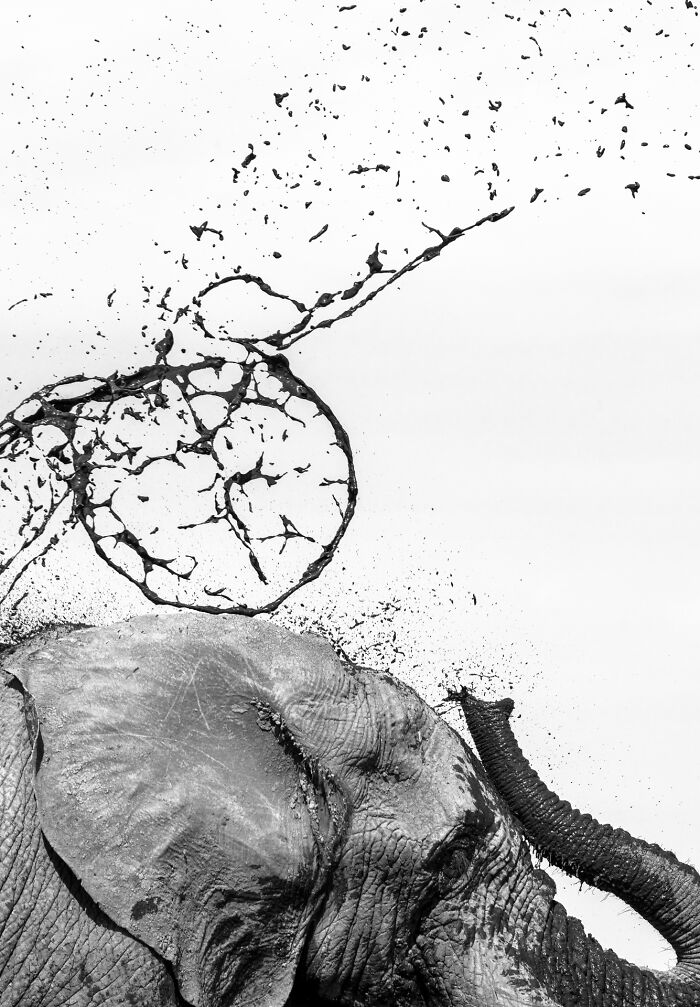
Image source: Nature Photographer Of The Year
#23 Parenting Goals By Thomas Vijayan
Emperor penguins, native to Antarctica, display remarkable family dynamics. These majestic birds engage in an intricate dance of cooperation and nurturing to ensure the survival of their chicks in the harsh polar environment. Both parents actively share the responsibilities of caring for their offspring, taking turns incubating eggs and braving the cold conditions to secure food. Parental care is crucial for the chicks’ survival, with each chick always being looked after by one of its parents.
Before capturing this image, I spent hours lying flat on the sea ice, allowing the penguins to become accustomed to my presence. Gradually, I began photographing them from different angles. This image is especially dear to me as it depicts the deep family love and affection between the penguins, highlighting the strong bond they share. In their synchronized warmth, these fluffy youngsters find comfort and strength in the heart of the frigid wilderness.”
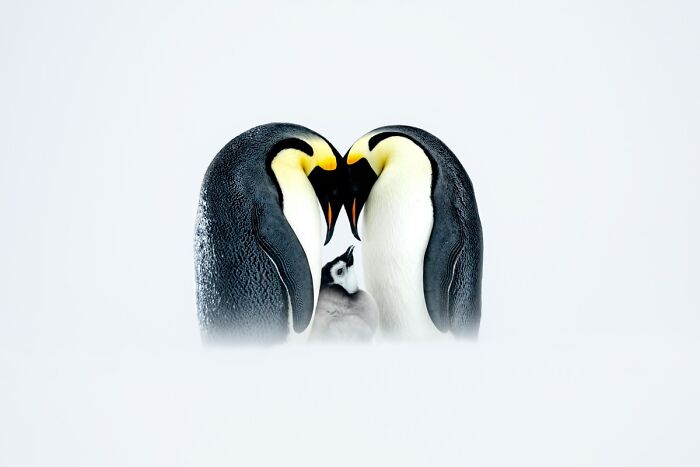
Image source: Nature Photographer Of The Year
#24 Fruiting Spider By Ronald Zimmerman
Tarantula Killed by Parasitic Fungi in the Rainforest near the Tambopata River, Peru (March 2022)
During my stay in the Peruvian Amazon, I went on numerous night hikes, and this discovery was among the most spectacular, thanks to the sharp eyes of a friend.
In the Amazon, insects and spiders are often hijacked by parasitic fungi that control their every move. This particular tarantula fell victim to a mind-controlling fungus known as Tarantula cordyceps (Cordyceps caloceroides). The fungus infects spiders through spores that attach to and penetrate the body, gradually taking control of the host’s behavior.
As the infection progresses, the “mind-controlled” spider is compelled to move to a microclimate favorable for the fungus’s growth. Meanwhile, the fungus feeds on the spider’s innards until the final stage of its life cycle. At this point, the spider moves to a specific location where it dies slowly.
Several days after the spider dies, the fungus’s fruiting bodies, or mushrooms, emerge from its shriveled corpse, turning it into a launchpad from which the spores can spread. These spores travel widely and infect new spiders.
To capture the eerie atmosphere, I used a low-angle shot with an off-camera flash, held by another friend, enhancing the dramatic and otherworldly mood of the scene.
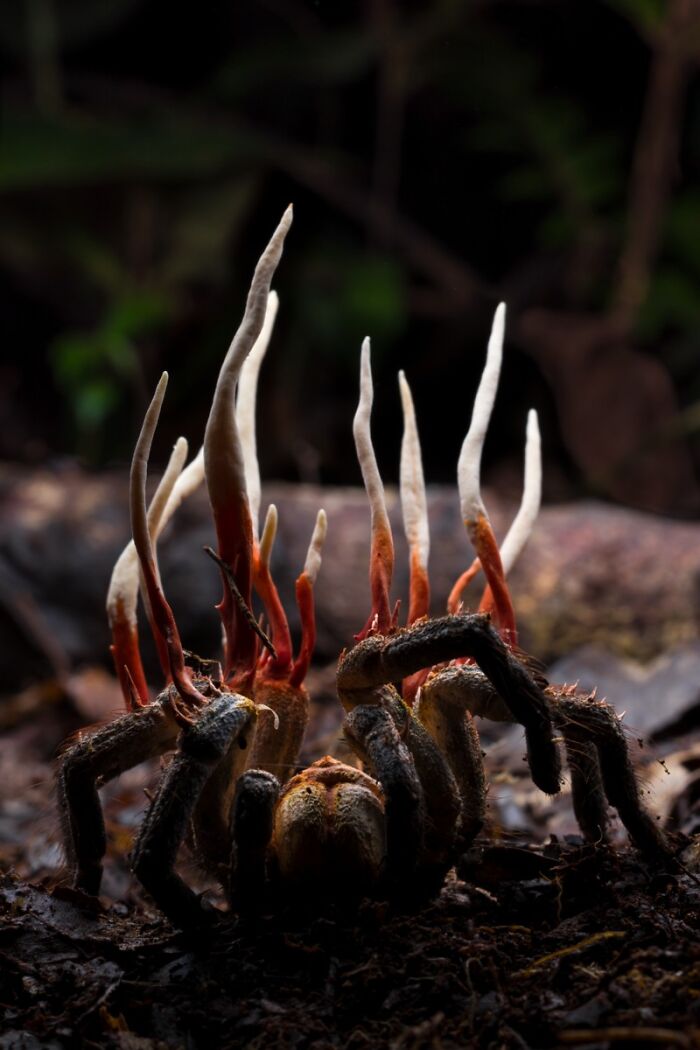
Image source: Nature Photographer Of The Year
#25 Image Of An Ibis By Jian Hu
The crested ibis, once widely distributed across Japan, Korea, Russia, and most parts of China, is known as the “Oriental gem” and the “auspicious bird.” From 1963 to 1981, the species became extinct in three regions: Russia, Japan, and the Korean Peninsula. In 1981, only seven wild crested ibises were found in Hanzhongyang County, China. Thanks to the tireless efforts of countless individuals over the decades, the population has now grown to more than 10,000 crested ibises.
Winter is the most beautiful season for the crested ibis. Its feathers become dazzlingly white, and its head takes on a jewel-like red hue. This photo was taken on an early morning in Yang County, China, in December 2023.
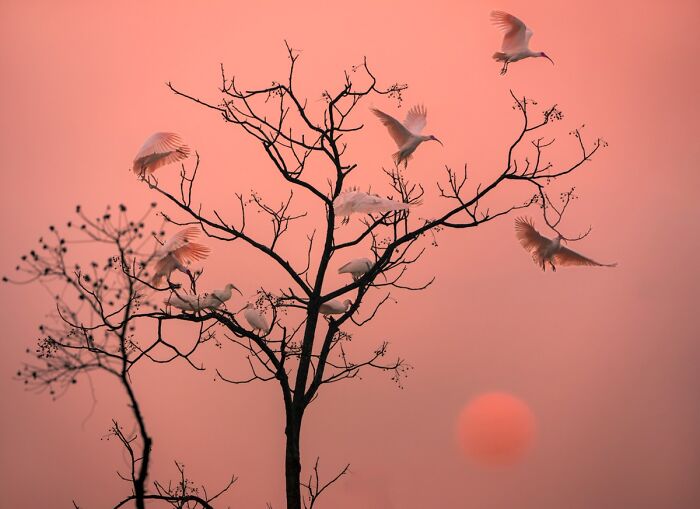
Image source: Nature Photographer Of The Year
#26 Conflict Between Two Clans By Borisov Evgeny
The photo was taken in Serengeti National Park in Tanzania. The filming was done from an ambush, where I observed two nearby clans of hippopotamuses. The territorial battle lasted 15 minutes.
It was an emotional and noisy scene, as the two clans fought fiercely. Hippos are most aggressive when protecting their young or defending territory, but this case was an exception. In this showdown, the young were ultimately the last to be involved. The males gave the babies a fair beating, but fortunately, all survived.
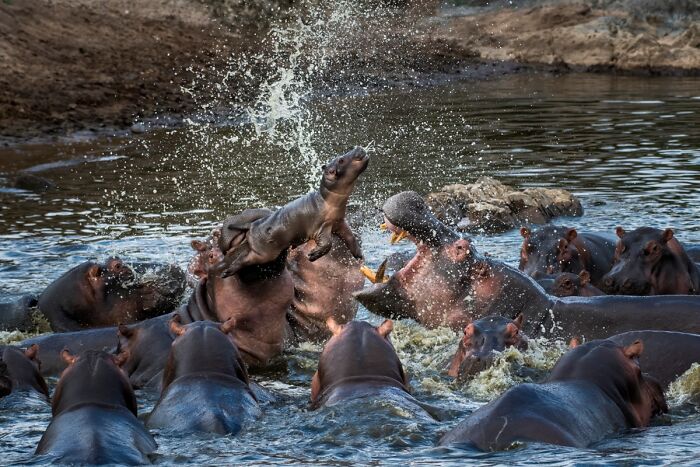
Image source: Nature Photographer Of The Year
#27 Massive Migration By Barrett Hedges
The salmon migration is one of the greatest migrations on Earth. Every year, I have the opportunity to witness the salmon run and photograph it, and it’s always exciting. I had been photographing brown bears chasing after salmon for many years and was happy with the photos I was getting. However, I started to seek a new perspective beyond just eye level with the bears. Finding an area that could provide the shot I envisioned was challenging. I explored many locations where brown bears chase fish, but none of them offered the perspective I was looking for.
When I found this cliff, so close to the river, I was thrilled by the possibilities that vantage point could offer. However, salmon runs vary each year in terms of how many fish return and when they return, so you never know what the salmon run will be like until you arrive on location. With salmon runs dwindling in many parts of Alaska, I wasn’t sure if the type of shot I was hoping for would even be possible. But when the day finally came and all the elements aligned—the salmon at peak migration, a large return of fish, the weather, and a brown bear swimming by—it was an incredible moment. I was able to capture so many sockeye salmon swimming around the brown bear in the river as it tried to catch them!
Taken in Katmai National Park. Ursus arctos horribilis and Oncorhynchus nerka.
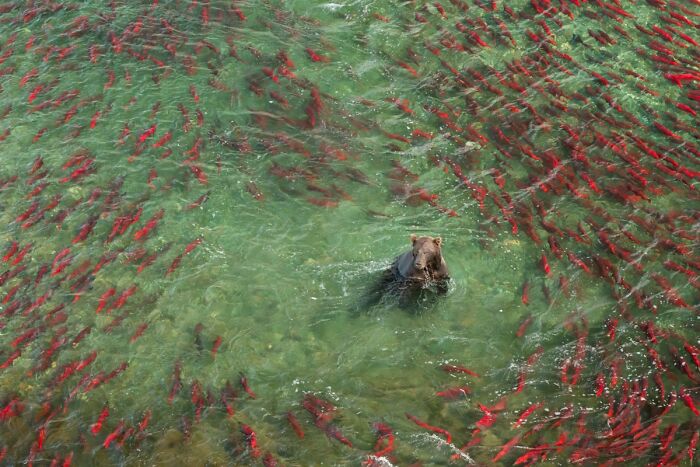
Image source: Nature Photographer Of The Year
#28 Fierce Encounter By Bo Wang
In this captivating photograph titled “Fierce Encounter”, the raw energy and intensity of the natural world come to life. At the heart of the image, two Red Fox kits, one sleek silver-colored and the other striking cinnamon-colored engage in a thrilling confrontation that evokes a sense of primal power.
The process of capturing this photograph involved immersing myself in the territory of the foxes, assuming the role of a nature photographer and respectfully blending into their natural habitat. On San Juan Island in the state of Washington, I spent several days studying the behavior patterns of the foxes as well as the surrounding area. Then, I selected a location where the foxes were frequently seen for shoot.
One day, I took my position amidst the island’s thickets and chose the best background and foreground for better results, patiently awaiting the appearance of the foxes. Finally, the moment arrived as the two fox kits engaged in their fierce encounter right before my eyes. Swiftly adjusting my camera settings, I aimed to capture the heightened expressions and intricate details of the foxes. Every movement presented a potentially singular opportunity, and I remained fully absorbed in capturing the essence of that fleeting moment, seeking the most authentic and vibrant composition. This process encompassed more than just technical challenges; it was a unique experience of merging with nature. I deeply felt the power of the natural world and the untamed allure of the foxes.
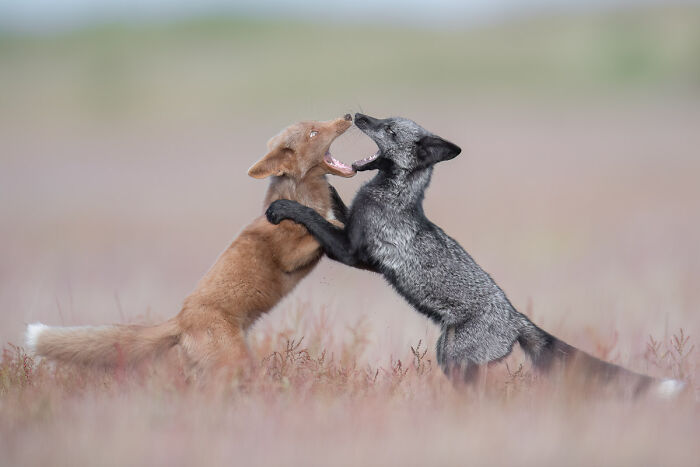
Image source: Nature Photographer Of The Year
#29 Winter Curse By Yuto Hirasawa
I took this image in eastern Hokkaido, Japan. This Ezo sika deer was the talk among photographers, and I also wanted to take pictures of him. I drove to the east and looked for this double-headed deer. It did not take much time to find him, and he walked towards me in a snowstorm. At first sight, I was shocked because this poor deer has to live through a harsh winter with a rotting skull locked in his antlers. At the same time, I was touched by his will to live. I don’t know if he is still alive or not. But I will never forget this encounter.
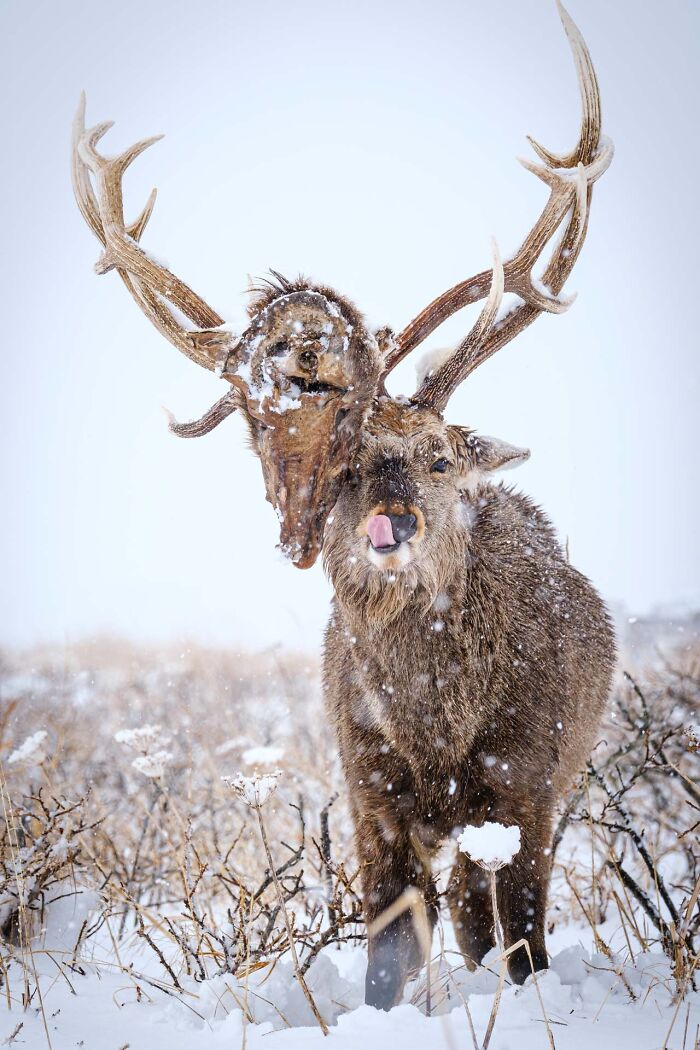
Image source: Nature Photographer Of The Year
#30 Coexistence By Byron Grobler
The Pilanesberg National Park in South Africa has a rich human history that dates back to the Stone Age. For centuries, people coexisted here with leopards and a diverse range of other wildlife. Imagine it’s the 13th century. You’re a hunter-gatherer in this ancient volcanic complex and your job is to find and provide food for your community while avoiding dangerous encounters with lions, leopards, buffaloes, and elephants.
Now imagine you’re a leopard and your job is to provide food for yourself and potentially a cub or two while avoiding dangerous encounters with humans and other predators. These are some of the things that cross my mind when photographing wildlife. It sounds like a tough life either way, but this is all a part of co-existing within a healthy ecosystem.
This image tells a story of co-existence in today’s world. Where the newly defined lines of human architecture meet something as wild and unpredictable as a leopard. Well before Pilanesberg became a protected area, dam walls were built to support farming and ranching. To this day, these dams remain a vital source of life for a large population of wildlife. In this case, it was simply a shortcut for a female leopard on a territorial patrol. We may not be as immersed in nature as we once were, but we surely are still a part of it. I can only hope for us to co-exist like this in more areas around the world.
The key to making this shot possible was an understanding of the subject and its behavior. Guiding in an area for a while allows you to begin to identify and notice certain habits from different individuals. This particular leopard is very relaxed in the presence of vehicles to start, which made it easy for me to maneuver into positions without disturbing her. As she made her way towards the dam wall, I positioned myself in line with the wall in case she crossed over it, and of course, she did.
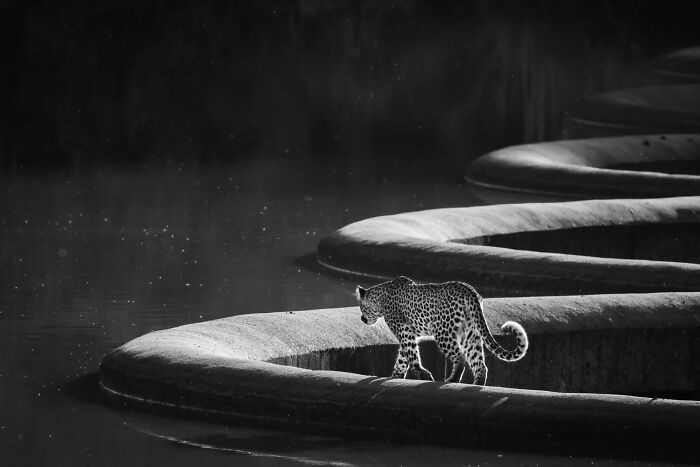
Image source: Nature Photographer Of The Year
#31 Sticky Situation By Anton Sorokin
A dramatic moment on the Amazonian forest floor as this stick insect has wandered into a precarious position in front of the cane toad (Rhinella marina). Voracious predators, these toads are known for eating any smaller animals that fit into their mouths.
As I hiked through the Amazonian forest at night, I saw the toad from a distance, leaning forward and slightly angled at the forest floor – its body language told me something had caught its interest. I very slowly approached so as not to disturb the toad, and as I got closer, I could make out a stick insect that had wandered into a very dangerous situation on the forest floor in front of the amphibian.
The insect, realizing the danger, holds completely still, hoping its camouflage will save it. The toad knows its prey is nearby but is unsure of where and watches for any sign of movement to betray the location.
I lay down on the forest floor to get an intimate perspective of the scene – I waited for a long time, but of the 3 participants, my patience was the first to run out as I was being bitten by sandflies and mosquitoes. As a result, I was not able to see the resolution of this life -or- death game of patience and do not know how it ended.
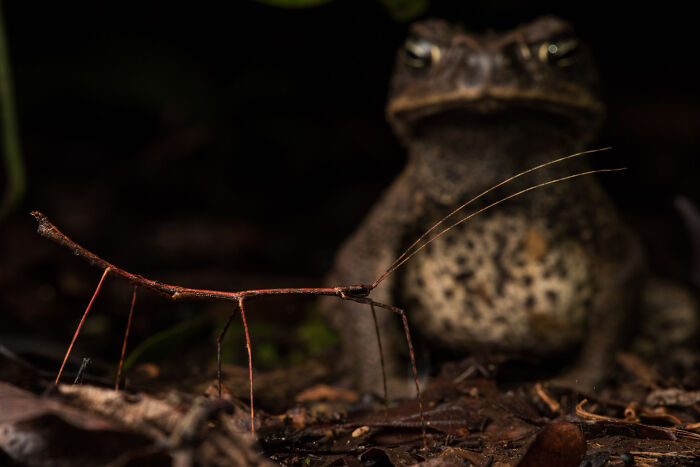
Image source: Nature Photographer Of The Year
#32 Two Owls On The Church By Simone Baumeister
In this area, there is a very large population of Eagle owls. There are Eagle owls in every quarry, sandpit, gravel pit, and also at some churches. In recent years, I have visited the areas where many walkers spend their leisure time. So the animals there are less shy of people.
As soon as the adult birds leave the breeding grounds after about 5 weeks to keep watch from surrounding trees or houses, and the chicks start to explore the territory on their own, it is a good time to take pictures.
The young animals made their first flight exercises and the first hunting attempts in my unhidden presence. They flew at the church roof, crashed during their first landing attempts at the high cross at the church, and cleaned their feathers before taking a nap. All in the presence of the likewise relaxed old animals and me.
These two young sibling Eagle owls lived at a church in northern Germany – Emsland. After a few weeks, the young owls learned to fly. While sitting at the cross in the evening, the owlets were waiting for their mother.
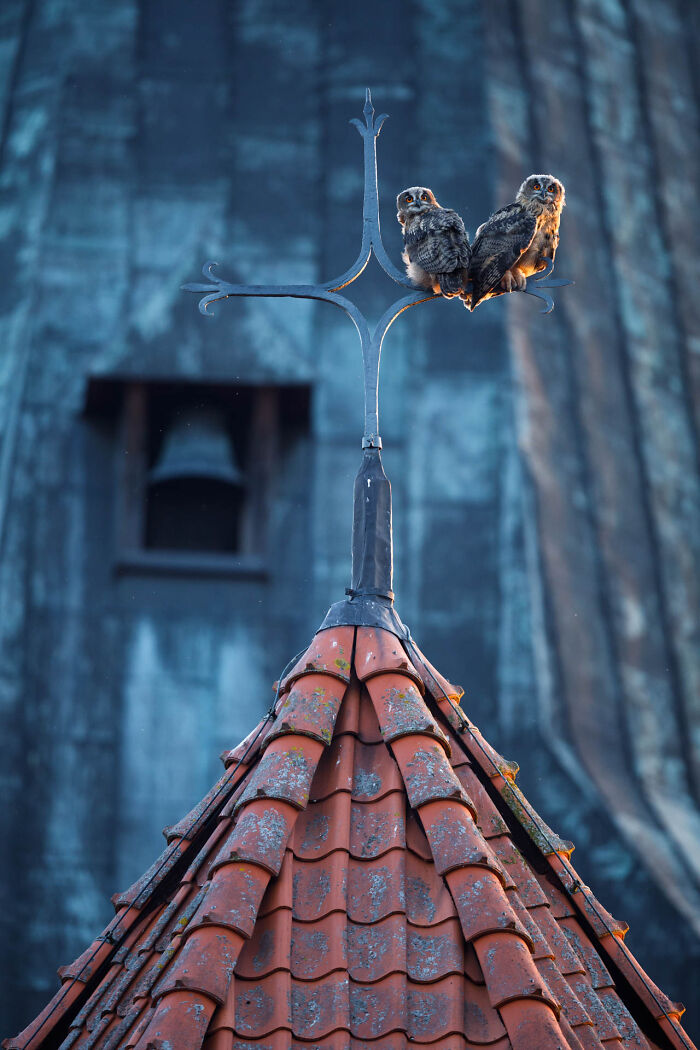
Image source: Nature Photographer Of The Year
#33 Puffins In Storm By Knut-Sverre Horn
I have spent several days on the famous bird cliff on the island of Hornøya in Varanger, Northern Norway (slightly north of 70 degrees). Hoping for some heavy snow showers to make their magic work in my photos of the seabirds. Falling snow always breathes an illusion of life and presence in still images, and I will take snow photos whenever I can. (I also do this from people or dogs, too, if there’s no wildlife around.) However, the weather forecast was not very accurate though, and I returned home disappointed. After a few days, the weather reports were favourable again, and I rushed back to the island. This time, luck was on my side: dense clouds rolled from the Barents sea and shrouded the seabirds in white. I knew the shower would probably not last long. I shuttled frantically between shags, guillemots and puffins, taking flight shots and portraits as fast as I could. The island was flooded in sunlight again 34 minutes later. This puffin shot is one of the best images of the day. Nothing special – just a regular documentary photo – like 98 percent of my photos.
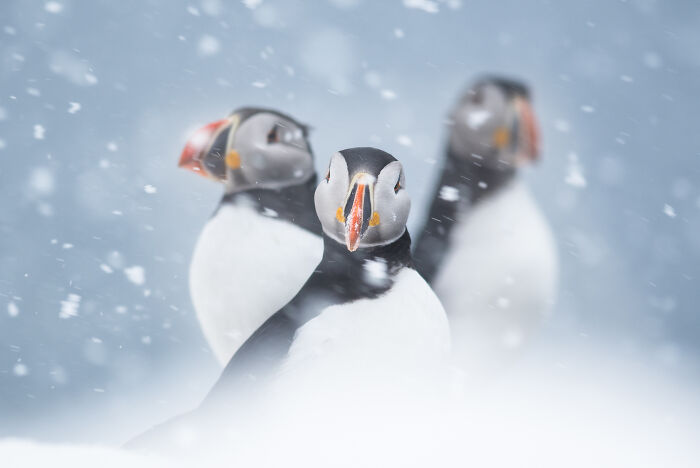
Image source: Nature Photographer Of The Year
#34 My New Toy By Celia Kujala
Play is very important in the development of young Steller sea lions and they love playing with anything they find in their environment. When I was diving at Norris Rocks off Hornby Island, British Columbia, Canada, I watched this young sea lion play with a starfish. As I watched her, she swam over to me to show me her beautiful toy. I was able to capture the image just as she was presenting the starfish to me. Sadly, Steller sea lions are listed as Near Threatened on the IUCN Red List. By observing their playful nature, I hope people will feel a connection with them and want to protect them and their environment.
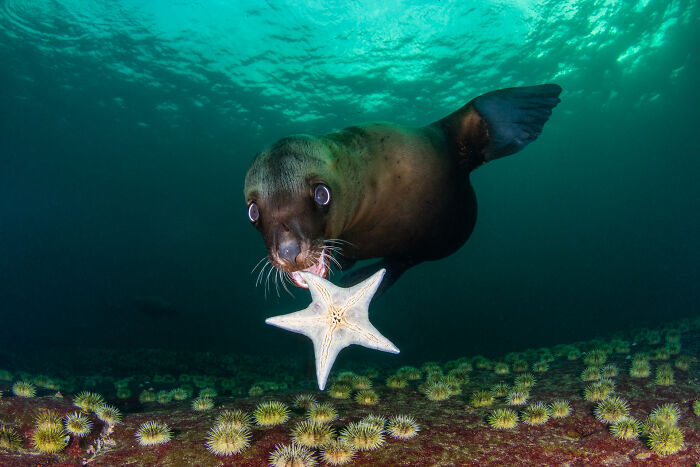
Image source: Nature Photographer Of The Year
#35 Unity Is Strength By Yuan Minghui
In Xishuangbanna Tropical Botanical Garden in Yunnan Province, there are several big trees near my hotel. The nest of Oecophylla smaragdina is built in the crown of the tree. They are ferocious by nature and are good at catching all kinds of insects. When the weather is fine, the workers will divide into several groups to hunt for insects. One morning, I found that they were working together to subdue a green katydid and carried it to a tree. Every kingdom of Oecophylla smaragdina will build a castle of its own. Although the kingdom of Oecophylla smaragdina maintained hostility and did not contact other similar kingdoms, there was a little war between their kingdoms. War usually only takes place with animals of other races. I knelt on the ground and shot this work at a low angle close to the ground in order to obtain the best focal plane.
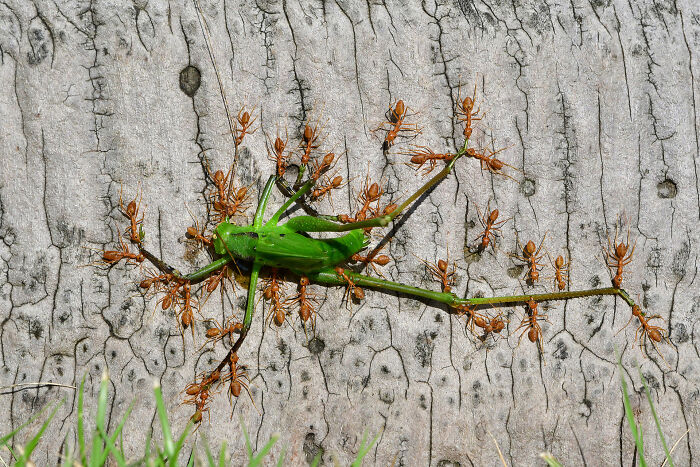
Image source: Nature Photographer Of The Year
#36 A Leopard Named Olimba Just Killed A Baboon By Igor Altuna
This photo was taken in Zambia, in the South Luangwa Nsufe Sector National Park. The leopard had hunted a small baboon; the baboon’s older brother took the baboon with him for about 5 hours, released it, left it, and then came back. The leopard wanted to eat the baboon, but this other baboon wouldn’t let her. In the end, there was a confrontation between the two, and the older brother of the baboon also died.
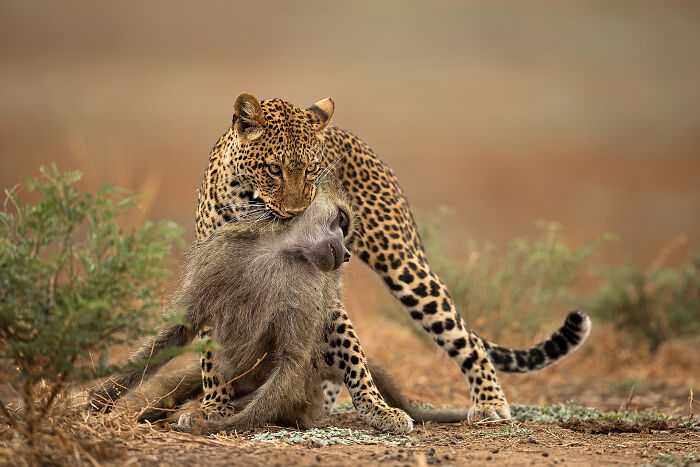
Image source: Nature Photographer Of The Year
#37 Marble Theatre By Massimo Zannini
In spring, salamanders, like all amphibians, begin their breeding season. During this period, they inhabit various aquatic habitats, including springs, small ponds, and sometimes even old abandoned reservoirs.
This photo was taken in a unique setting: the Valsora quarries in Tuscany, in the province of Carrara, which take their name from the famous white marble.
It’s a surreal environment where the impermeable material has created natural pools, sometimes as deep as ten meters. Here, these beautiful, colorful creatures have found a permanent home.
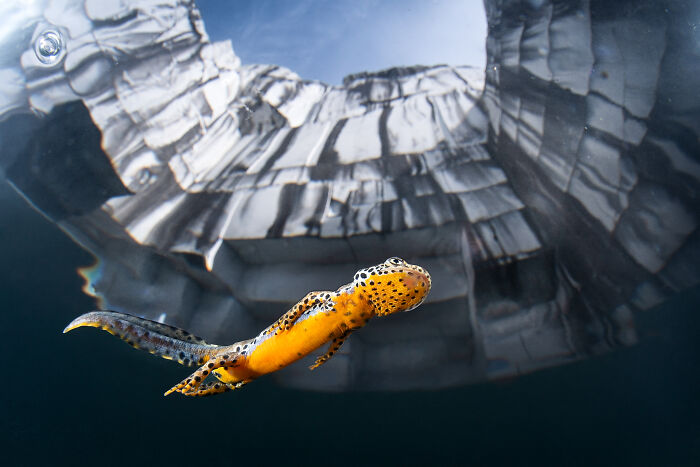
Image source: Nature Photographer Of The Year
#38 Aerial Acro-Bats By Imre Potyó
Outside, it is freezing cold winter, but the 10°C temperature and the unique environment of the mine attract animals. Lesser horseshoe bats (Rhinolophus hipposideros) winter in an abandoned iron ore mine in the Börzsöny Mountains (Hungary). Researchers have pointed out that lesser horseshoe bats also move during the winter, meaning their strategy differs from other bats. This behavior is amazing and unusual. We wouldn’t expect insect-eating bats to fly in winter.
During winter, the bats often fly out from their mines into the bare trees. Occasionally, they break their hibernation and fly out to feed in the winter forest, hunting winter moths. Sometimes, they even fly into the snowy woods. I’ve experienced something similar myself. It’s truly amazing to see bats take flight among the bare trees.
During these moments, you might have the chance to capture them near the entrance to their underground hibernation site using a camera trap. I created this image without any disturbance or artificial guidance. I have been photographing them in this mine for ten years without causing any harm, strictly following ethical guidelines. I don’t use distractions, such as curtains or sheets, to herd them.
It was magical. Witnessing their winter flight and feeling the air currents created by their wings on our faces is one of the most beautiful experiences. I would like to draw attention to the hidden, nightly wonders of a wintry forest.
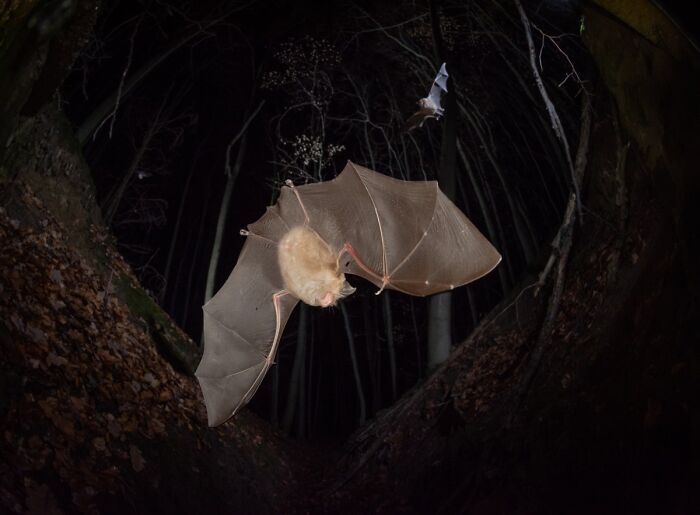
Image source: Nature Photographer Of The Year
#39 Three’s A Crowd By Ian Wood
I have a badger sett quite close to my house in St Leonards on Sea, East Sussex, England, and I regularly see them foraging outside at night. During a hot summer, I started leaving my front door open to let some air into the house, and I was amazed to see a badger come into my porch for a sniff around while I was cooking one evening. Badgers have poor eyesight but an incredible sense of smell, so I presume it was the scent of my food that made it so curious.
I love badgers, and my partner gave me these slippers as a Christmas gift, which I had used to help keep the door open. I set up my camera with a wide-angle lens, a homemade motion sensor, and an extremely low-powered flash in case any badgers ever returned. I also left the light in my porch on and kept my front door open every night. For the next three weeks, I checked the camera every morning with no results until one day I woke up to find several images of this badger having a sniff around. I liked this image the most, as it looks like the badger is pausing with one paw raised near my slippers.
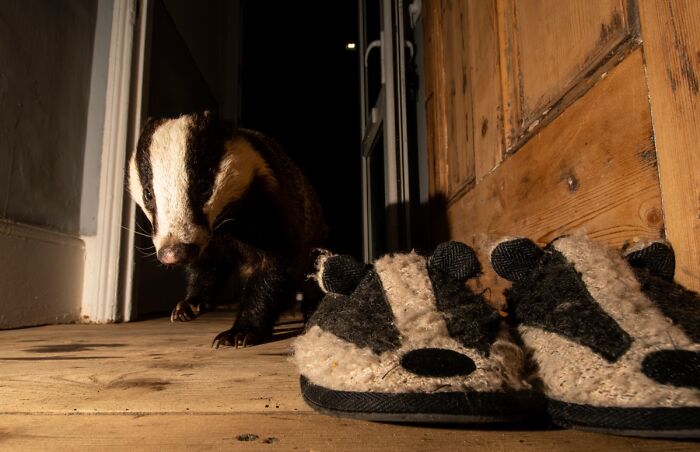
Image source: Nature Photographer Of The Year
#40 Face To Face By Jan Piecha
For several years now, I have been working on a photo project about raccoons with a friend. In this context, we also accompanied them on their forays into urban areas. Here they often use parked cars to hide underneath. We wanted to capture this behavior in the picture.
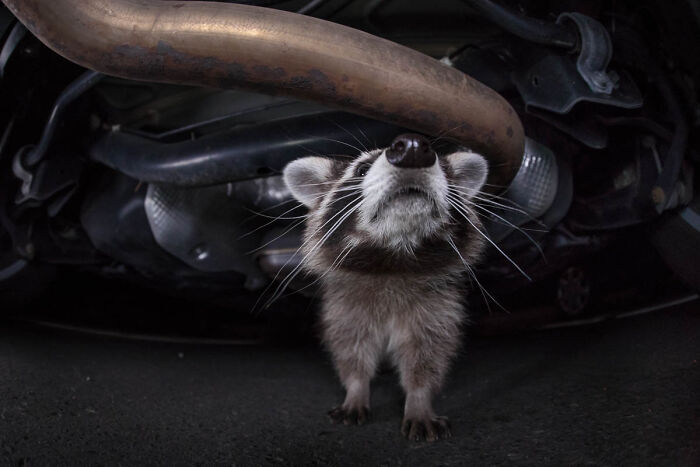
Image source: Nature Photographer Of The Year
#41 La Dama Blanca By Stanislao Basileo
There are places in the world where nature still puts on a show. I’m talking about the Alentejo region in Portugal. Towards the beginning of April, the storks arrive to nest on the cliffs in the middle of the ocean, a unique event in the world. It took me several days to take this shot, waiting for the right light and the right waves.
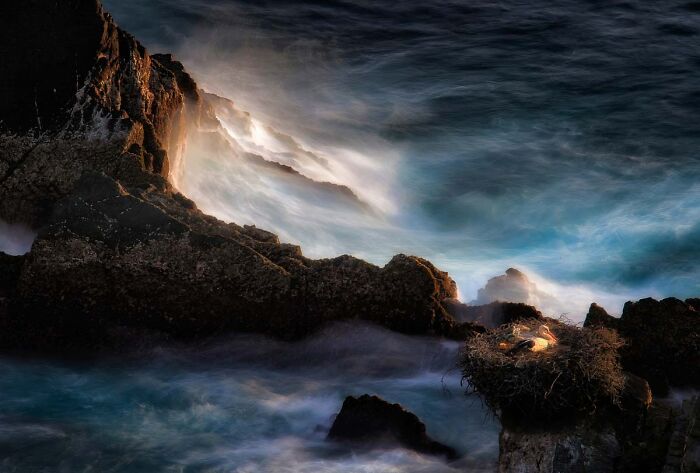
Image source: Nature Photographer Of The Year
#42 Small Doctor, Big Patient By Gaetano Gargiulo
I took this picture at a popular Sydney (New South Wales) dive site called “Bare Island”.
Little known to many divers is the location of a cleaning station where you can often find large fish getting serviced by several Eastern Cleaner Clingfishes (Cochleoceps orientalis Hutchins). In this case, a very friendly and relaxed Blue Groper (Achoerodus viridis) was having the gills and the mouth cleaned, using strobes at minimal power, the red focus light, and low shutter speed I was able to shoot several pictures including several details of the cleaning action without disturbing the cleaning.
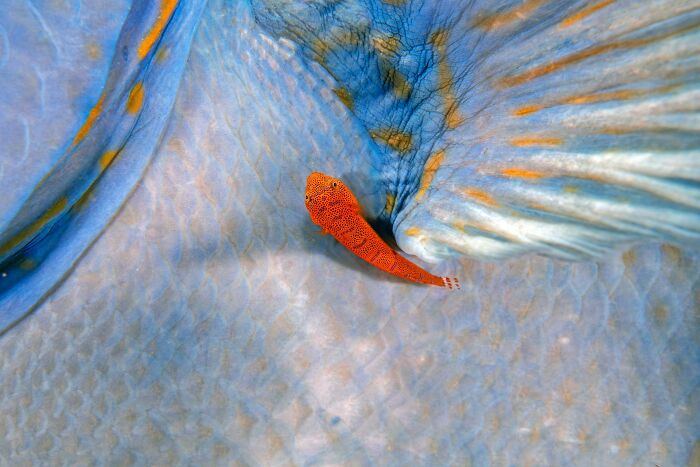
Image source: Nature Photographer Of The Year
#43 Wild Flight In Manhattan By Pascal Beaudenon
What a magnificent show of these flights of Canadian geese (Branta Canadensis) in the heart of New York City, one of the world’s largest megalopolis. They have made the city and its surroundings their home all year long. According to the NY Department of Environmental Conservation, 200,000 geese reside all year round in the state. A century ago, there were no resident geese, apart from a few descendants of captive birds set free.
Migrating geese were only seen between October and April, but in the ’50s and ’60s, the department intentionally released this species in the region of Albany to establish resident flocks for hunters. « You gotta know what you’re doing when you let something go », said Tait Johansson, naturalist-in-residence at the Bedford Audubon Society. Ever since, and after the 1990s, the birds have been considered a nuisance for some, and the population is regulated through eradication measures.
On January 15, 2009, a few minutes after taking off from La Guardia, US Airways flight 1549 made an emergency landing on the Hudson River after a flock of geese collided involuntarily with the plane. The idea behind this series is to show these two worlds from the angle of aesthetics, uniting the space and its urban structures with the local wildlife and its beauty.
This photograph was taken on November 23, 2019, at 8:29 am from the docks of Jersey City which faces the western side of downtown Manhattan. These two Canadian geese are flying at sunrise over the Hudson River towards Liberty Park, one of the places where they gather in peace…
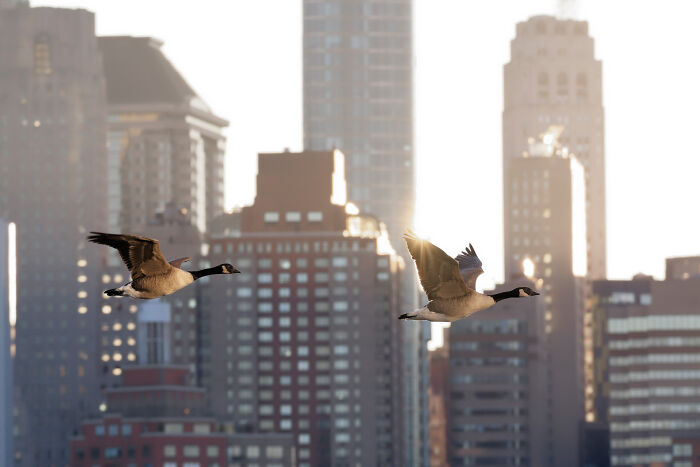
Image source: Nature Photographer Of The Year
#44 Scale Spectrum By Bernhard Schubert
Pitch-black, so-called melanistic common adders (Vipera berus) can be found in the Alps just as frequently as normally colored individuals. This specific animal was crossing a meadow surrounded by forest in the very Eastern part of the Alps. During wintertime, this area is used as a ski slope. It coiled up and stayed in position for a couple of minutes, giving me enough time to pull out my camera. For the first time, I used a flash during daylight for photographing a diurnal snake. I positioned the flash below the camera, and that allowed me to eliminate the daylight and show this interesting gleam, caused by the light, which split into many different colors as it reflected on the scales.
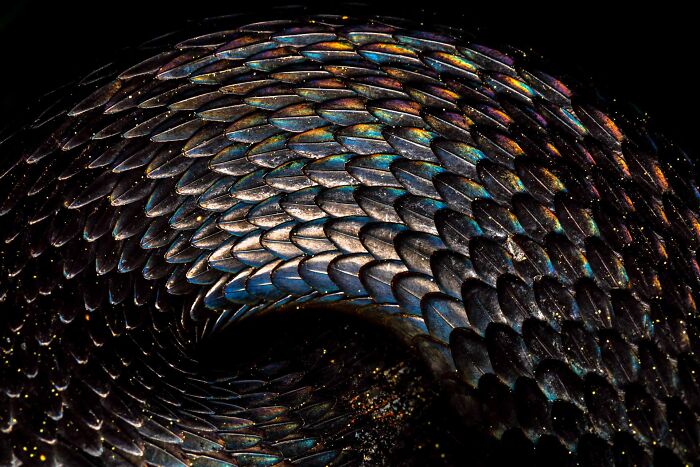
Image source: Nature Photographer Of The Year
#45 Escape By Johan Van Wyk
The Kgalagadi National Park is the second largest Nature Reserve in north west South Africa, and borders Namibia. It is one of the Country’s “Arid” parks, and consists mainly of desert and sand dunes. It is home to all of the large African cats, and big herds of springbok, wildebeest, ostrich and many smaller antelopes. To assist survival of these animals during the extremely hot summer months (daytime often above 45C), some waterholes have been created in strategic spots. The sparse vegetation gives great opportunities for wildlife photographers, especially around the few waterholes. The Blackbacked Jackal have learnt to ambush the Cape Turtle Dove and Namaqua Sandgrouse at some waterholes. Both bird species have a ritual of early morning drinking with its hundreds, and that’s when the Jackal tries to catch some food. The hunt is only successful now and then, but this “game” can last for hours. At the cost of extreme patience, it does provide the photographer with some excitement, and the odd rewarding shot.
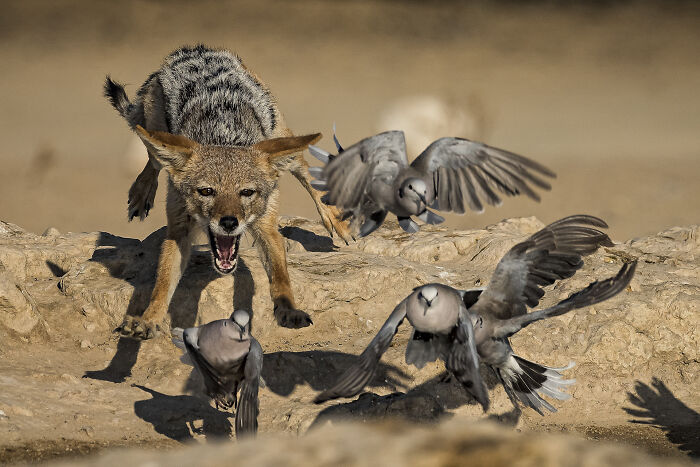
Image source: Nature Photographer Of The Year
#46 Flamingo Fly Over Lake Magadi By Richard Li
On January 10th, 2020, I flew over Lake Magadi in Kenya by helicopter, hoping to see the colorful patterns formed by various minerals floating on the water. When I found an area with particularly beautiful patterns, I asked the pilot to circle around this area for a few more laps to give me time to enjoy the rare beauty. Several flocks of flamingos flew leisurely during the period. When they flew to the appropriate position, I shot hundreds of photos with my Nikon D850 set to 200 second. This is one of them.
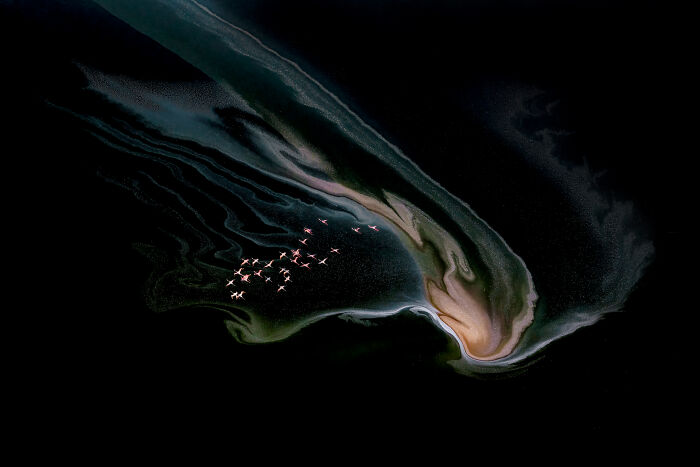
Image source: Nature Photographer Of The Year
#47 Alien Invasion By Ripan Biswas
There was a seasonal swamp near my home in Coochbehar (India). Every monsoon, the swamp is full of different types of insects and amphibians. I visit that place regularly, almost every day, during the monsoon. One day I came across a group of plant-hopper nymphs that found shelter in the grass blades of a bush in the swamp. The bush was in the middle of the swamp. There was knee-deep mud around the bush. I started observing them and found that there were some paper wasps visiting the bush. The wasps came and took the helpless nymphs into their mandibles.
It was a challenge to take pictures of the paper wasps. I was in knee-deep mud; my movements were restricted. The mud was slippery; standing became difficult, and it was hot and humid. I used a C-type bracket and attached a remote control to it. This is how I used my camera with one hand. On the other hand, I held a flash that was remotely controlled by a transmitter. I used a wide angle-macro lens to take both the wasp and the environment in a single picture. The lens is a manual lens, so you cannot focus automatically. I pre-focused at a certain distance and tried to move the camera towards the flying wasp to get the wasp in focus. It was a ‘trial and error’ method, and 99% of my pictures were out of focus. To get the ambient light, I used a slower shutter speed, a flash to freeze the subject, and a lower angle. So the wasp looked like an alien who came down to attack us. I worked there for a week and got only a handful of photos.
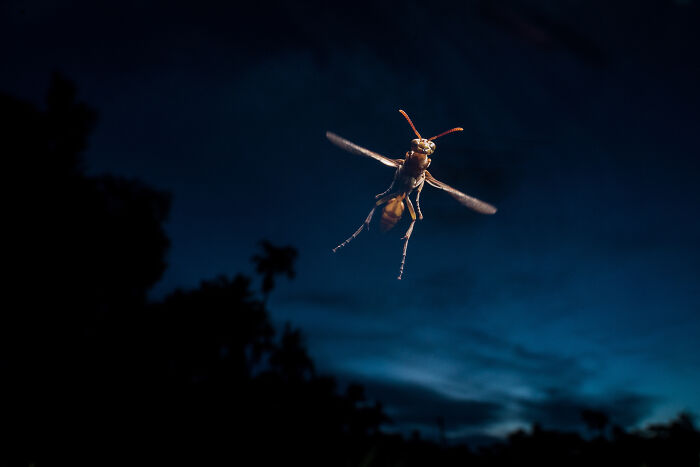
Image source: Nature Photographer Of The Year
#48 Cutie Daughter By Alex Zozulya
This photo was taken during a visit to the islands of South Australia. White capped sea lions are local endemics and a vulnerable species, but otherwise they behave much like sea lions everywhere in the oceans: curious, friendly, and playful.
They do not mind human contact. What matters most is that they have something to keep them engaged. Although they may first show interest only from a distance, lying quietly on the seabed and watching without moving, they slowly begin to relax. Gradually, they behave more boldly and eventually open up completely. The photo captures the moment of their very first encounter, the instant of first eye contact.
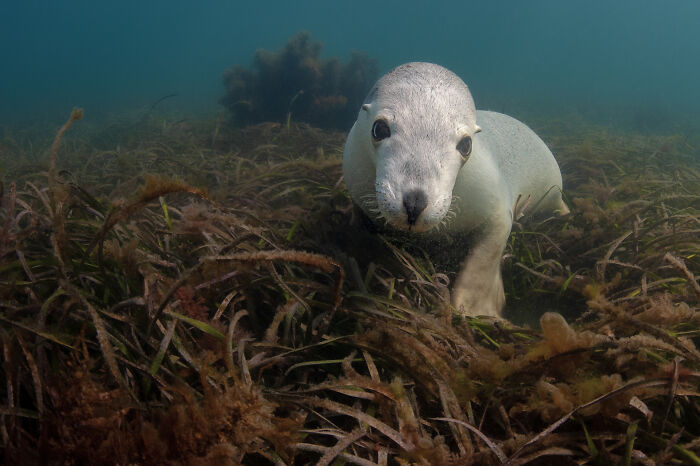
Image source: Nature Photographer Of The Year
#49 Gorilla By Tom Way
I’ve been gorilla trekking for over 10 years and have completed more than 75 mountain gorilla treks. During this time, I’ve primarily focused on taking portraits of gorillas with a longer lens, but when I reviewed my portfolio, I realized it could also be important to photograph the gorillas in their habitat.
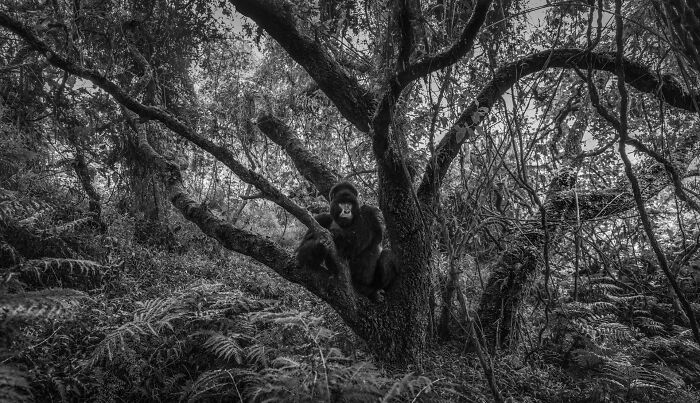
Image source: Nature Photographer Of The Year
#50 Patterns Of Africa By Mateusz Piesiak
During an expedition to the South Luangwa River in Zambia, I came across a leopard resting on a tree branch. He seemed clearly content after enjoying a hearty meal. We spent several hours with him, quietly watching him sleep in the warm afternoon light. After a while, I decided to capture the scene from a different perspective. I attached a teleconverter and framed the shot so that the leopard’s fur and the texture of the tree trunk completely filled the frame. The result was an intriguing composition that emphasized the diverse textures and natural patterns of Africa.
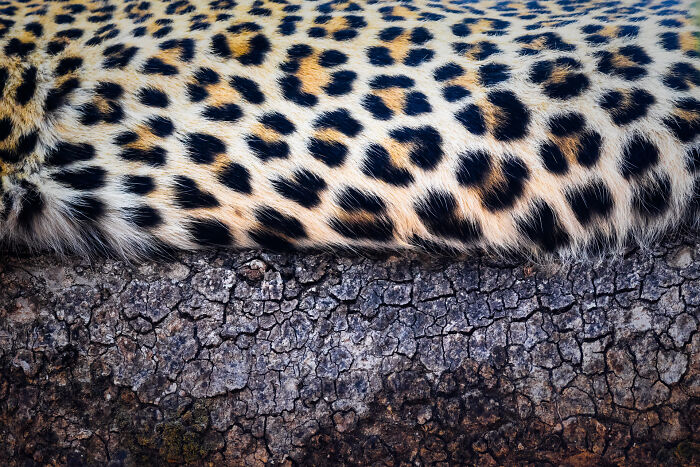
Image source: Nature Photographer Of The Year
#51 Passenger And The Giant By Craig Parry
This photo, taken in August 2019 in the Kingdom of Tonga, captures the behavioral interaction between a humpback whale and a remora. When the whale approached curiously, closing the distance between us, its movement provoked an immediate reaction from the remora, which immediately darted to the other side of its body for cover. Such moments highlight the sensitivity and awareness of marine life, from the largest mammals to the smallest fish, and the complex relationships that exist within the ocean ecosystem.
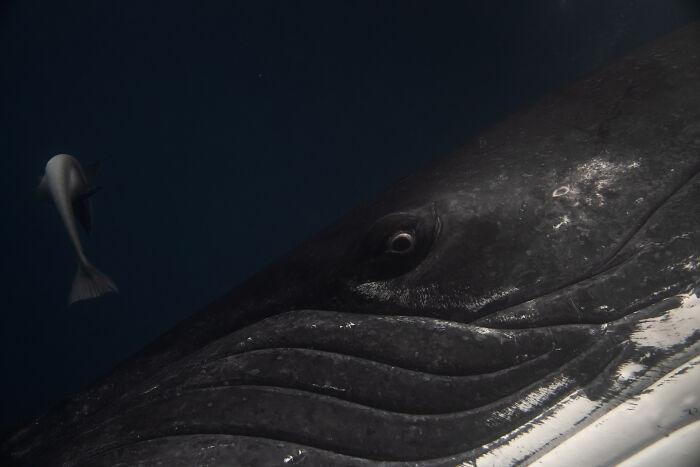
Image source: Nature Photographer Of The Year
#52 UV Baby Transport By Michael Schreiber
A scorpion glows with its young under the light of two UV lamps. After birth, the mother scorpion carries her young on her back and remains motionless in case of imminent or potential danger. The young remain on their backs for protection until their exoskeletons have hardened. Found on the dead wood of a fallen tree in Bogani Nani Wartabone National Park, near Gorontalo, Sulawesi, Indonesia.
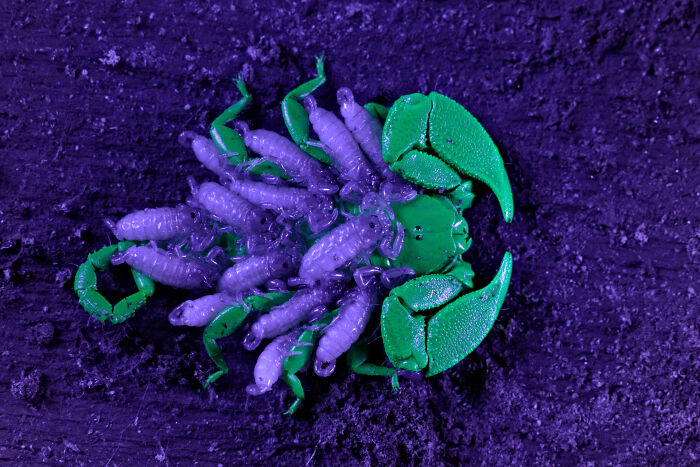
Image source: Nature Photographer Of The Year
#53 Gorilla Greens By Richard Peters
After a typical trek in Uganda’s Impenetrable Forest National Park, we found our family of mountain gorillas. After observing them for some time, this silverback walked to a fresh patch of vegetation, sat down, and began eating the leafy greens. Keeping a safe distance, when he momentarily put his hand up, the act of blocking his face as he rubbed it put all the focus of the scene on the green of the leaf. With no eyes to drawn the viewer away I loved that splash of colour becoming the focal point of the image.
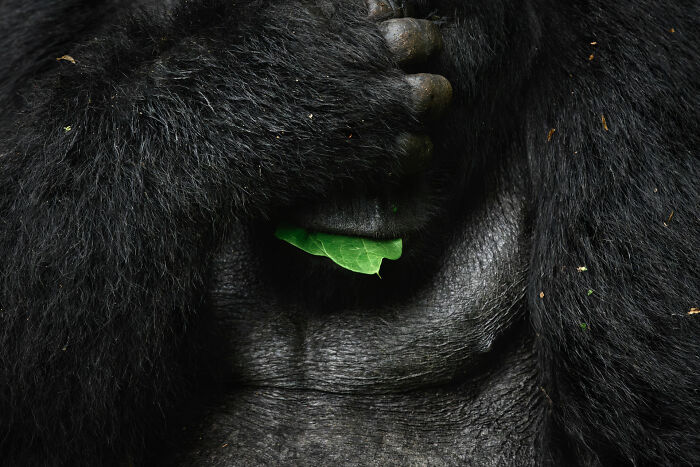
Image source: Nature Photographer Of The Year
#54 Under The Northern Lights By Liron Gertsman
On the night of May 10, 2024, we witnessed something I never thought I’d ever experience from my hometown of Vancouver, Canada: the Northern Lights dancing across the sky all night long, from horizon to horizon! Vancouver is relatively far south for a Northern Lights viewing event, so this was a very rare occurrence. Knowing that a “geomagnetic storm” was expected, I began planning photo ideas for the coming night. I’d long dreamed of photographing birds with the Northern Lights, so that’s what I focused my attention on. Knowing that a wide-angle lens would be best for photographing the Northern Lights, I needed to find a bird that typically behaves indifferently toward human presence. I thought the city’s Canada geese would be the perfect birds to photograph, and I finally had some success photographing this pair of geese as the Northern Lights danced across the sky. In the background, during the 1.3-second exposure, you can see some lights from cars driving through the park. It was worth losing a night’s sleep! The geese are completely illuminated by the light from the nearby city buildings.
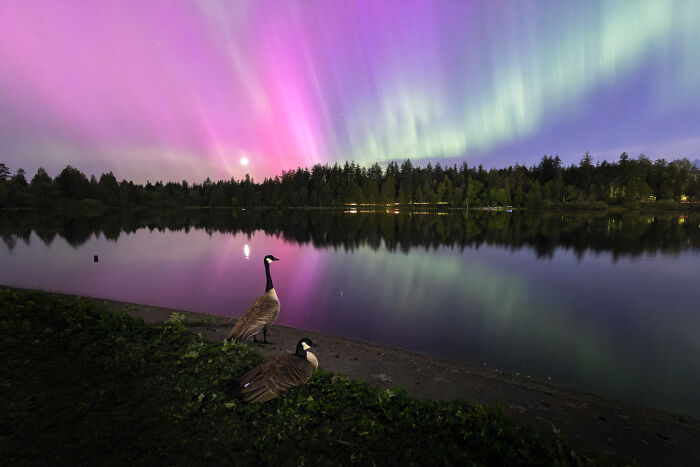
Image source: Nature Photographer Of The Year
#55 Hermine In The Snow By Frank Jacobs
During my photo trip to Kuusavo, Finland, in March 2025, I had the chance to capture a small stoat darting through the snow. It was a magical moment: the animal moved swiftly, weaving back and forth across the white landscape in search of food. Its sleek white winter coat blended almost perfectly with the snow, making it both a challenge and a thrill to track with my camera. Every pause, every sudden leap offered a fleeting opportunity to press the shutter, and the combination of speed, light, and the sheer beauty of this tiny creature made the encounter unforgettable. After this trip, I still call it my “Little Star.”
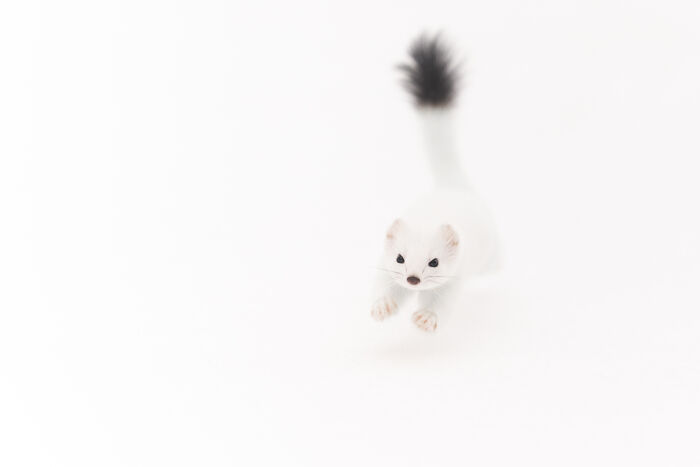
Image source: Nature Photographer Of The Year
#56 Together In Light And Shadow By Rahul Sachdev
This photograph captures two giraffes moving together through a haze of dust, their elegant silhouettes standing out sharply against the monochrome background. The contrast between their towering forms and the billowing dust creates a dreamy, almost surreal atmosphere — a blend of grace, strength, and vulnerability that speaks of camaraderie and resilience in the wild, where every movement is part of a larger rhythm of survival and coexistence.
I made this image in Solio Game Reserve in Kenya, a private reserve nestled between Mount Kenya and the Aberdare Mountains. Solio is world-renowned not only for its rhino conservation but also for the abundance of other wildlife, including the reticulated giraffe (Giraffa camelopardalis reticulata), easily recognized by its sharp, polygonal coat pattern edged in white.
The idea for this frame emerged as I watched a small group of giraffes crossing a dry patch of land where loose dust drifted through the air. I realized that by positioning myself with the light behind the dust clouds, I could transform the moment into something more abstract and artistic. Rendering the photograph in black and white removed distractions and emphasized the sculptural forms of the giraffes and the ethereal texture of the dust. By slightly underexposing and using a longer focal length, I achieved the strong silhouettes and atmosphere I had envisioned.
The two giraffes walked quietly together, likely moving between feeding grounds. With each step, their steady gait lifted small clouds of dust from the dry earth, creating the natural backdrop that completes this scene. Their calm companionship highlights the subtle social bonds giraffes often maintain, whether between females and their offspring or smaller groups traveling within a larger herd.
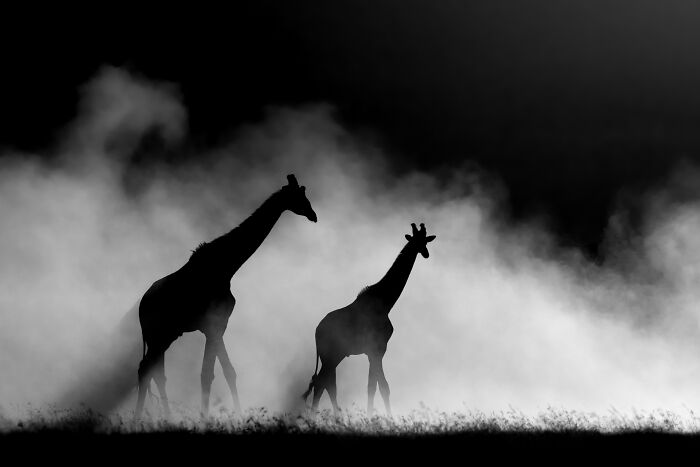
Image source: Nature Photographer Of The Year
#57 Rest Easy By Tom Way
The conservation success story surrounding mountain gorillas is extremely positive. Although there were fears that gorillas might become extinct due to habitat loss and poaching, increased permit fees and better protection have led to gorilla populations almost doubling in the last 30 years. With close monitoring by anti-poaching units and ranger teams on a daily basis, these groups of gorillas can now rest a little easier.
Mountain gorillas generally spend their day either eating or sleeping, needing to consume up to 20kg of vegetation a day. This silverback had just finished his breakfast before settling down for a morning nap.
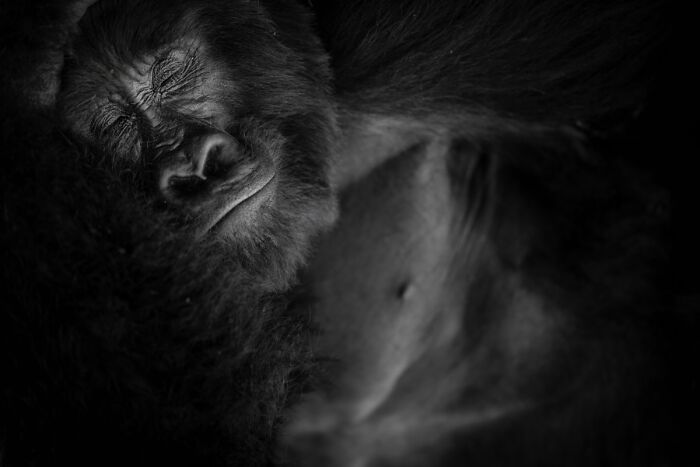
Image source: Nature Photographer Of The Year
#58 The Beaver House By Rémi Masson
In the French Alps, July 2023. I’ve been waiting motionless against the bank in a rather uncomfortable position for over an hour now. Doubts are slowly creeping into my mind. Is this really the entrance to a beaver burrow? Situated between two rocks, the submerged cavity has a well-defined opening and looks relatively deep. But is it inhabited, or just a temporary shelter?
Absorbed in my thoughts, I pay no attention at first to the fine particles of sediment escaping from the gaping hole like tiny flakes. But a larger movement of water suddenly brings me back to reality. A beaver is emerging from the hole—the moment I’ve been hoping for is about to become real!
I can now clearly make out its head. It stops at the entrance and looks in my direction. Has it seen me? Possibly, but it’s hard to be sure. I huddle even closer to the bank. The animal extricates itself completely from its burrow, swims a few meters underwater before surfacing and heading toward the vegetation along the edge.
Its night has just begun. In all, this encounter will have lasted only a handful of seconds but felt like an eternity.
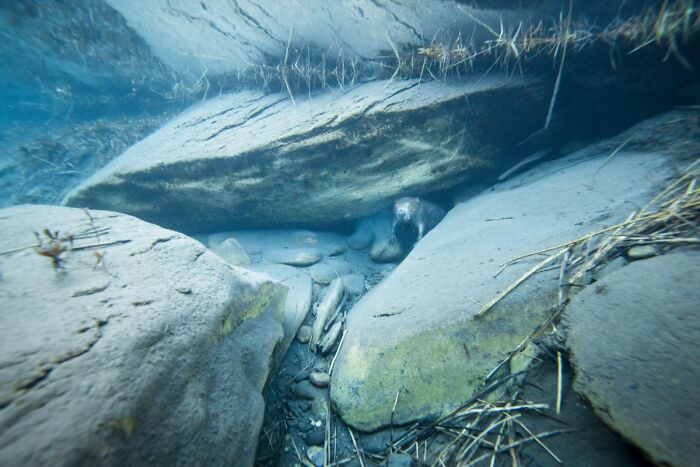
Image source: Nature Photographer Of The Year
#59 Flight Of The Night Hunter By Neil Aldridge
A lesser horseshoe bat (Rhinolophus hipposideros) takes flight on a starry night, hunting over grassland vegetation on an organic farm in Devon, England.
Intensive agriculture and development have decimated habitats such as meadows and native woodlands, leading to a significant decline in lesser horseshoe bat populations in Britain. To highlight the bat’s connection to this crucial habitat while minimizing disturbance, I used red filters on low-powered flashes for the image exposure.
I positioned the camera and trigger to face upwards along the route the bats typically follow from their roost. The camera was set to f14 with a 30-second exposure to capture both the bat and the starry night sky in intricate detail.
The lesser horseshoe bat was a focal species in the Back from the Brink project, a collaborative conservation initiative aimed at saving England’s most threatened species and habitats. I worked on this project in partnership with The Bat Conservation Trust.
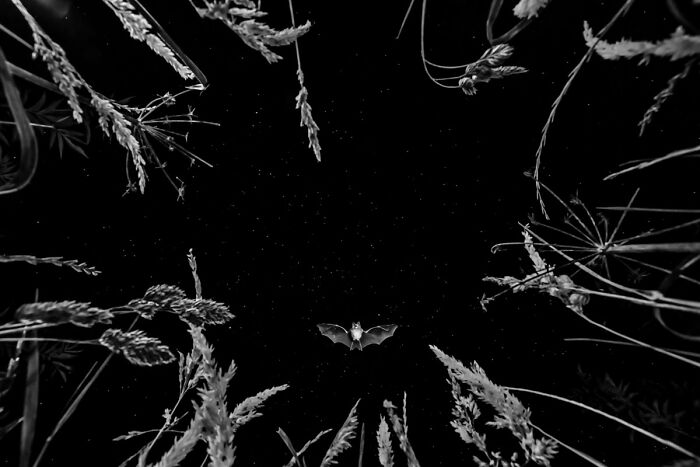
Image source: Nature Photographer Of The Year
#60 In The Shadow Of Mont Blanc By Francesco Guffanti
The wolf (Canis lupus italicus) has returned to the shadow of Mont Blanc. In recent years, I have followed the life of the pack, observing its hunting trips, the growth of the pups, and the social dynamics between them. It has been a unique privilege, for which I will always be grateful.
I discovered that wolves occasionally use this panoramic path during their hunting trips, so I set up a camera trap with the help of a PIR sensor and two flashes to capture their passage at the foot of the majestic Mont Blanc.
After several attempts and dealing with malfunctions caused by the freezing winter, I finally managed to get the shot I had long desired.
This photo is part of the project and photographic book Nuovi Equilibri, developed in collaboration with my friend André Roveyaz, documenting the return of the wolf to the upper Aosta Valley.
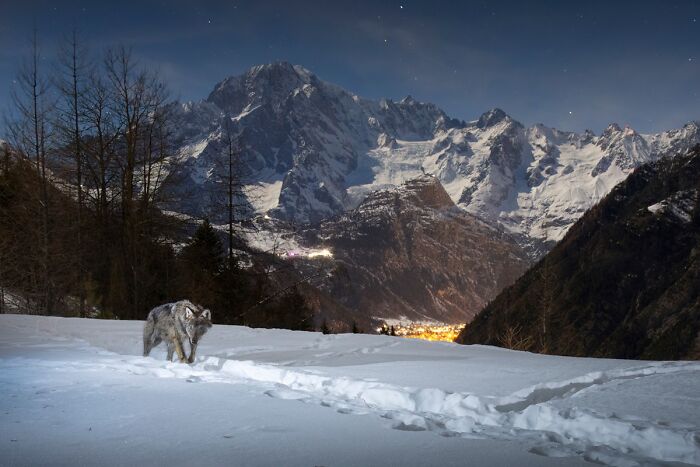
Image source: Nature Photographer Of The Year
#61 The Haunted Wreck By Andrea Izzotti
After arriving in La Paz, Baja California, Mexico, to dive in the biodiversity-rich waters of the Sea of Cortez, the area was hit by Hurricane Norma, which churned up the sea and the coast with very strong winds, forcing me to take shelter for two days in a safe location. It wasn’t possible to dive until a few days later, and the consequences of the powerful storm were evident, even underwater: destroyed corals and visibility reduced to just a few meters, with the sea turned green and full of suspended particles.
I attempted a wreck dive, and the sunken ship suddenly appeared to my eyes, as if shrouded in fog. When we encountered a turtle relaxing on the deck of the submerged wreck, I realized it was time to use a creative technique before the animal surfaced to breathe.
I chose a slow shutter speed and a backward camera movement, hoping to convey the eerie atmosphere I was experiencing—a nearly haunted wreck, where the turtle seemed like a phantom guardian of the deep.
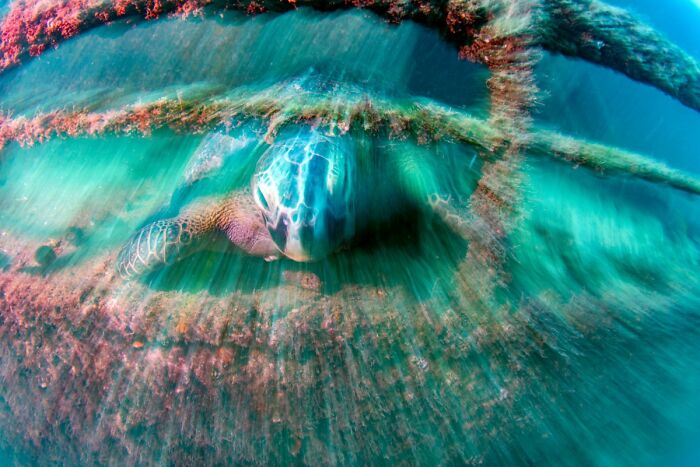
Image source: Nature Photographer Of The Year
#62 Companions By Jomtup Charoenlapnumchai
In the early morning at Huai Kha Khaeng Wildlife Sanctuary, wild animals are walking through the streets almost every day. Whether it’s a deer or a wild boar. The next morning, I went and waited in the same place to wait for an animal to cross the path. I kept waiting until about seven o’clock, when a herd of wild boars ran across the path in front of me, so I hurriedly took a picture.
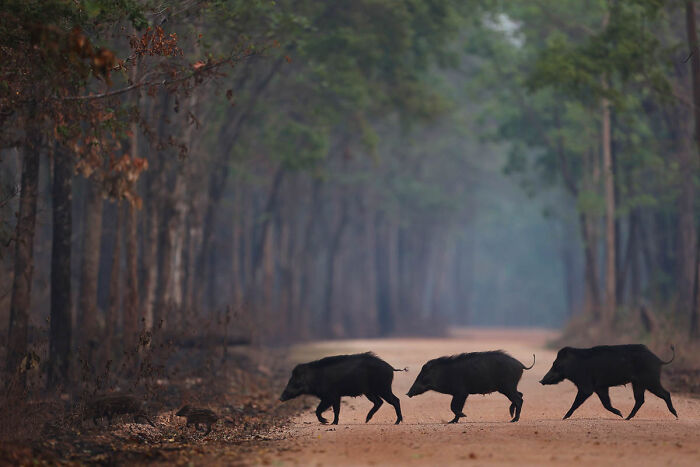
Image source: Nature Photographer Of The Year
#63 Out Of The Snow By Kurt Jay Bertels
Experiencing the high Arctic gives you an immediate understanding of just how well-built polar bears really are! The conditions would quickly kill us but don’t faze the bears at all. This polar bear was moving along the coast of Hudson Bay in Canada looking for any source of food while waiting for the sea ice to form. The wind picked up, whipping the snow all around and dropping the temperatures considerably, but the bear just kept going without even slowing down. It was spectacular to see!
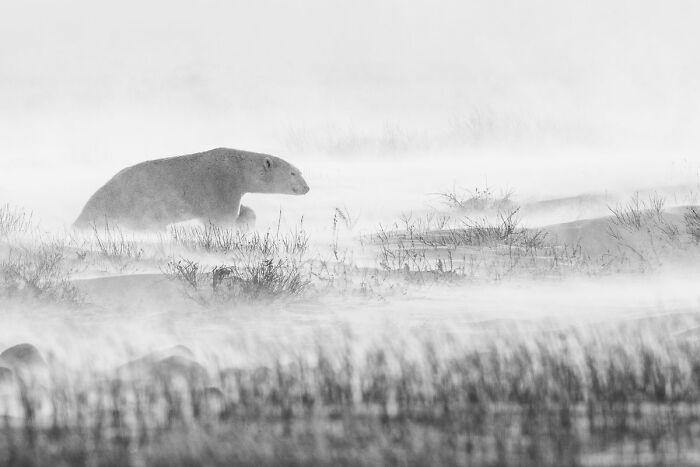
Image source: Nature Photographer Of The Year
#64 Heart Of The Sea By Liang Fu
The photograph was taken during a blackwater dive in Romblon, Philippines. Blackwater diving is a type of scuba diving that takes place at night in the open ocean, with thousands of meters of water below the boat. Divers descend a rope with underwater lights as their only orientation system. When the tide and moon phases are right, creatures from the deep migrate to shallower waters. This vertical migration is one of the most remarkable natural phenomena. During the dive, I saw something shining under my searchlight at 28 meters deep. As I swam closer to investigate, I found a lava moray eel curled into a heart shape. I was extremely fortunate to capture this moment with my camera. The eel remained at that depth for less than 10 seconds before swimming down and disappearing into the darkness.
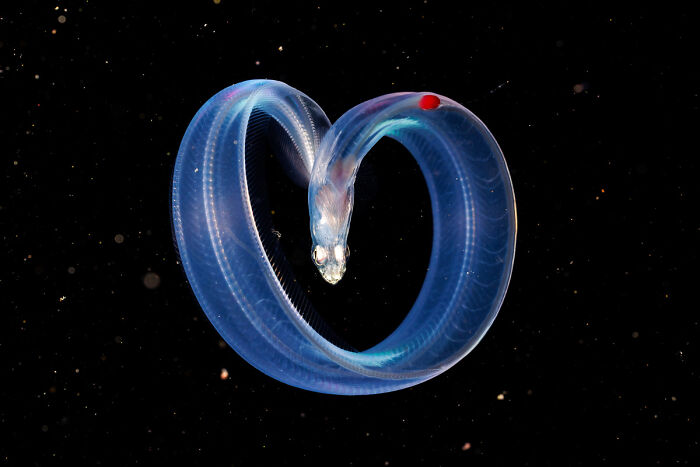
Image source: Nature Photographer Of The Year
#65 Flash Climb By Paul Goldstein
Baffin Island in early April is brutally cold, particularly when on a Skidoo. This was a moment when a mother was struggling with the sheer wall of a grounded iceberg looking for her yearling cub. Unsurprisingly she tumbled back among the broken ice. I had just enough time to fetch the tripod and set it up before this happened. She had been hunting and fortunately found her youngster soon after. I have photographed polar bears extensively but have never seen anything like this before in what is, surely, the most sublime area to photograph them.
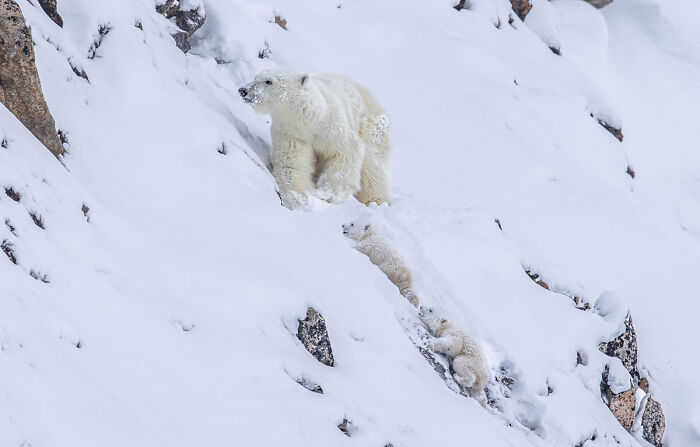
Image source: Nature Photographer Of The Year
#66 Glassy Goose By Alex Pansier
There’s something about the chill in the Dutch air that gets my pulse racing maybe, just maybe, we’ll get some snow! That’s exactly how I felt last December (2022) when I found a local pond that had completely frozen over. While there was no snow to be seen, I wasn’t disappointed. The thin layer of ice on the pond had driven all the ducks and geese to a single opening in the ice, perfectly positioned between the sun and me. Talk about a golden opportunity for some backlit shots, one of my go-to photography styles. After hanging around for a few days, I started to get the hang of the geese’s behavior. So, the moment I started stretching, my camera was already up and ready. That’s how I captured this shot. A white goose flapped its wings, sending droplets flying all around. I was pretty chuffed with that already, but when I reviewed the shots on my computer, one stood out. You could see the goose’s head as a shadow in the feathers, giving the photo that extra kick.
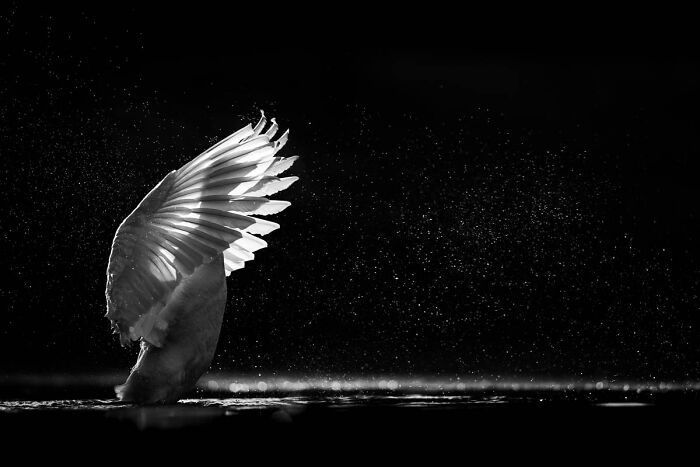
Image source: Nature Photographer Of The Year
#67 Magical Moment With Moon Jellyfish In The Kelp Forest By Mayumi Takeuchi-Ebbins
This is a small school of Moon jellyfish and Japanese kelp.
I took this image from the Minamata Sea, Kumamoto Prefecture, Japan, in April 2022. There is a phenomenon where lots of Moon jellyfish gather close to shore between April and May in the Minamata Sea; also, Japanese kelp grows in cold water from winter to spring in Japan. But it is very difficult to see these two subjects together unless you know when and where to dive for aiming. I was looking for these subjects together for two years, and finally, I succeeded in shooting Moon jellyfish in the kelp forest. The kelp forest will disappear by the middle of April due to water temperature, and Moon jellyfish won’t turn up until a certain temperature. It was very difficult to read the right timing to shoot this magical moment for collaboration with Jellyfish and the kelp forest. I have chosen the correct date for this and checked high tide and low tide and the sun’s direction before diving and choosing the right time to see them. I spent a week finding jellyfish, and finally, I could shoot this image after all my efforts.
There were not many jellyfish at that time, but I carefully chose the best composition so I could get as many jellyfish as possible into the frame in the kelp forest and Snell’s window effect. I never forget how it was such a beautiful time to see some moon jellyfish floating in the kelp forest, and it was a magical time.
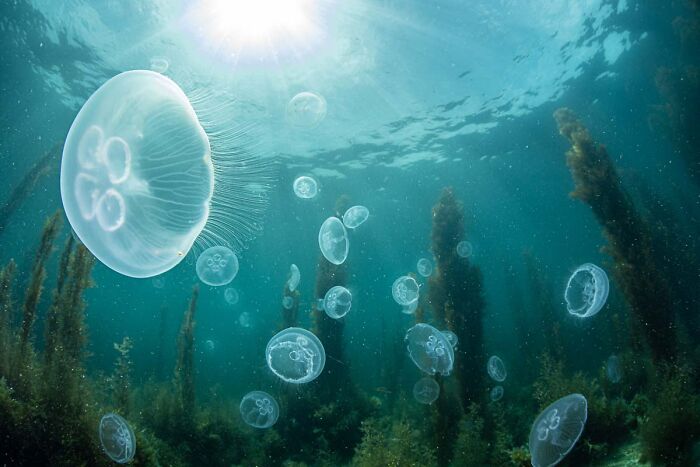
Image source: Nature Photographer Of The Year
#68 Elephant Shadows By Patrick Bentley
Having crossed the Luangwa River, an elephant matriarch leads her herd across the sandy riverbank into the National Park. Creatures of habit, they have used this same crossing point for decades. Photographed from a licensed drone in South Luangwa National Park, Zambia.
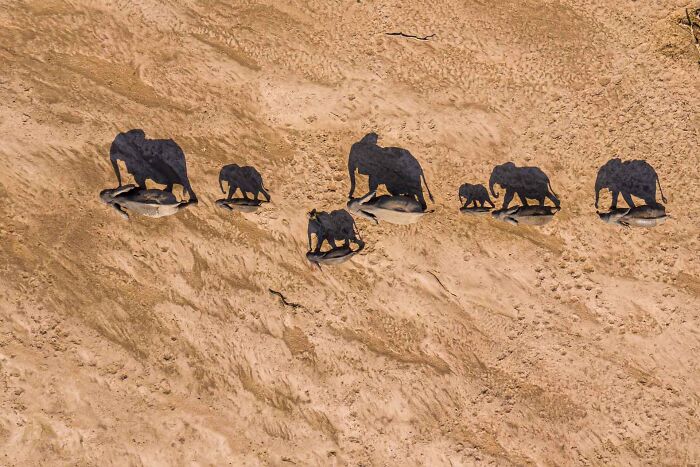
Image source: Nature Photographer Of The Year
#69 Hunting Bear By Lassi Rautiainen
In April snow cover is so hard that even humans can walk on snow because it’s cold at night but warm by daytime. And first bears awake in April. Every April I try to take shots if some interesting happens. In that case, the raven “attacked” pushing the bear back. Ravens do it to other mammals too hoping that they will go away. The picture was taken in Finland in Kuhmo near the Russian border.
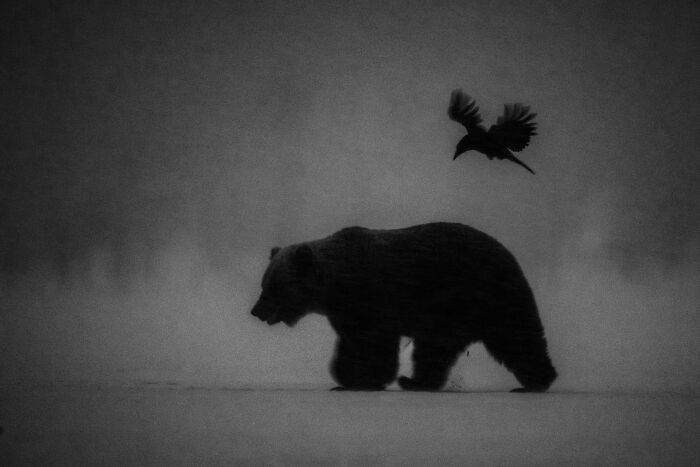
Image source: Nature Photographer Of The Year
#70 Stuck In Life By Alex Pansier
This photo of a seal, taken last May on the island of Dune (next to Helgoland), touches me. The animal seems to have cataracts and has also become entangled in a fishing net. Literally Stuck in Life.
It’s a heart-wrenching scene that highlights the devastating impact of human activity on marine life. Fishing nets are designed to catch fish, but they can also unintentionally trap other marine animals like seals, dolphins, and turtles. When a seal becomes entangled in a net, it can’t swim or move properly, making it difficult for it to breathe, eat, or avoid predators. Yet it is as if the creature has a smile on its face, and it seems used to the net. This contrast appealed to me. Taking the photo in high key allowed me to approach this contrast even more.
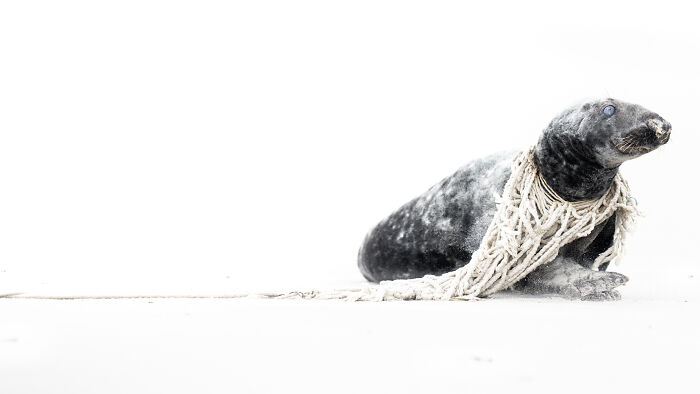
Image source: Nature Photographer Of The Year
#71 Goats In Fake Snow By Carlos Pérez Naval
I took this image in Teruel (Spain). I had taken a lot of pictures of Iberian Ibex. And a few years ago, I tried to take a few photos of the seeds of the poplar that were spread by the wind. After taking some photos, I realized that it was really interesting. So the next year I went there every afternoon when the seeds were spreading (which is not too many days), and I took some photographs like this one. It was a really short moment, because the sun had to lie just behind the rocks and the Ibex had to stand on top of the mountains, creating an enchanting moment in which the seeds seemed to be stars or snow.
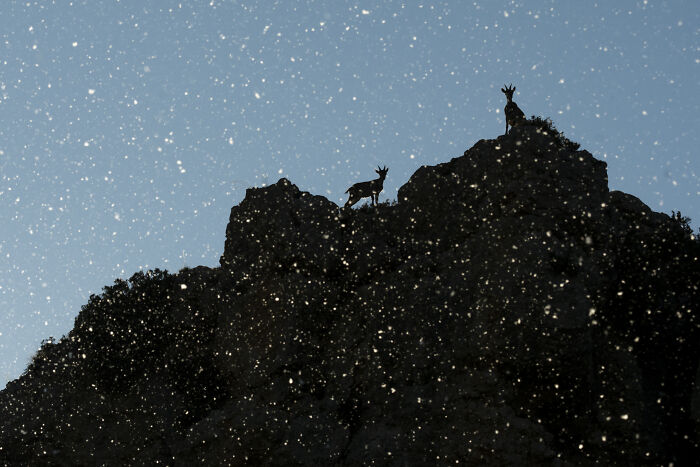
Image source: Nature Photographer Of The Year
#72 Road Block By Vince Burton
For many years, it has been on my bucket list to visit Yellowstone National Park. I decided to visit during the winter months, expecting there to be fewer people and therefore hopefully witness more wildlife in its natural environment. During the winter, there can be a lot of snowfall in Yellowstone, and therefore the wildlife often uses the roads to move around on the packed snow roads rather than the deeper powdery snow off-road. This image made me smile as it just made me think of a Road Block, Yellowstone style, with this herd of bison moving slowly. It was an impressive sight to see as they moved passed us.
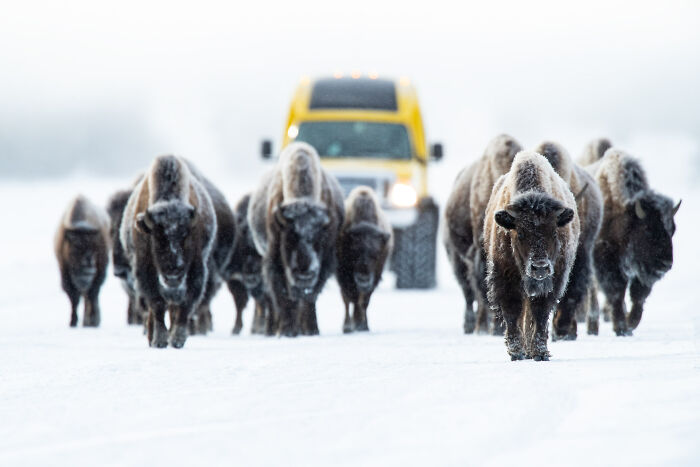
Image source: Nature Photographer Of The Year
#73 Window To The Salt Pan By Mano Aliczki
Greater flamingo feeding in an artificial salt pan seen through a ‘window’ on the levee in Sardinia, Italy. The former salt evaporating site turned regional nature park in Sardinia is home to one of the largest breeding colonies of greater flamingos in Europe. I spotted the lonely flamingo on the water from the opposite bank and had to move quickly into position, anticipating (or rather hoping) it would line up with the wooden frame for a shot. The flamingo lifted its head from under the water for a split second when reaching the frame, allowing only one shot, before carrying on with feeding.
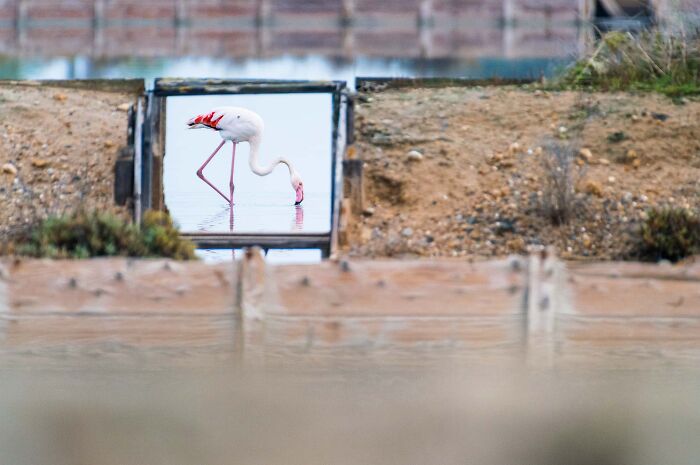
Image source: Nature Photographer Of The Year
#74 Life Cycle By Franco Banfi
While I was documenting a group of short-finned pilot whales (Globicephala macrorhynchus), I spotted this female carrying her dead calf. She was surrounded by other members of the group, escorting and consoling the mother during her endless swim. Short-finned pilot whales are very social marine mammals and have inquisitive attitudes. Each member of the pod is strongly bonded to each other, and they do everything together: resting, hunting, socializing, playing, traveling… and burial.
After some days of research, the researchers spotted two females carrying their two new-borns baby (dead at birth) in the open ocean for days, reluctant to let go. The male kept the other researchers and me at a safe distance from the two females. He was never aggressive, but his intentions in protecting the two mothers were clear. It was heartbreaking to witness the behavior of the entire group. In this situation, one difficult thing was to deal with my emotions.
Picture taken with the approval of the Portugues Ministerio para la Transicion Ecologica, Secretaria de Estado de Medio Ambiente. In Tenerife, nobody can freely swim with cetaceans without having previously obtained a special license issued by the Government. This kind of photograph can only be taken while snorkeling or free-diving, holding our breath and swimming at the same time. It is forbidden to use underwater equipment such as scuba tanks, rebreathers, underwater scooters, etc.
Species: Short-finned pilot whale (Globicephala macrorhynchus)
Location: Tenerife island, Canary archipelago, Atlantic Ocean
Conservation status (IUCN): Least Concern
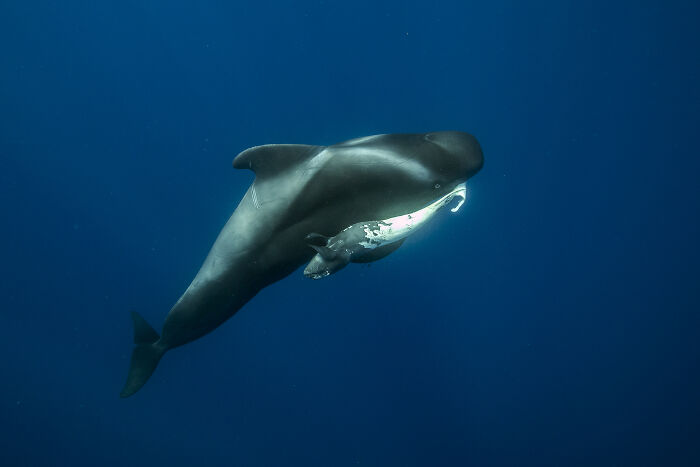
Image source: Nature Photographer Of The Year
#75 The Lion Going Down By Hong Chen
When we were photographing a lion sitting on a big rock in the Serengeti (Tanzania), suddenly another lion under the rock roared. The lion on the rock instantly got up and rushed down… I was excited when I saw this and quickly pressed the shutter.
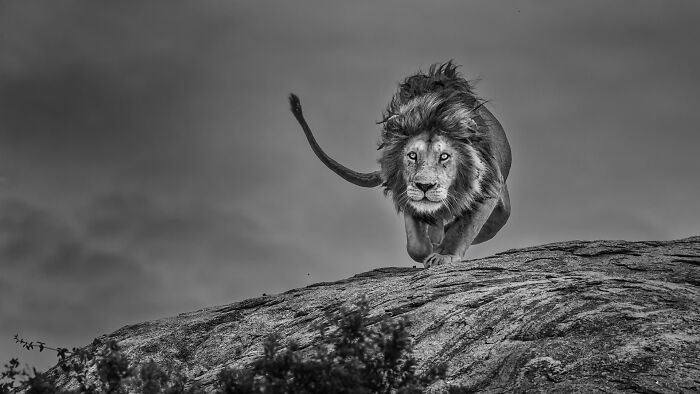
Image source: Nature Photographer Of The Year
#76 Curious Neighbors By Yaron Schmid
Giraffes have amazing eyesight, and being tall is definitely an advantage. Add to that their curious nature, and you’ve got yourself one of the best spotters in the bush. When they see a cat, they will often stop what they do and stare in the cat’s direction. Often they will, against what most will imagine, start walking towards the cat, getting very close to it at times, to show the cat that they’ve seen it. So when our guide saw a herd of giraffes standing and staring in the same direction, he knew that there must be a cat in the area. All we had to do was drive towards the giraffes, look in the direction they were all looking, and spot the lioness…
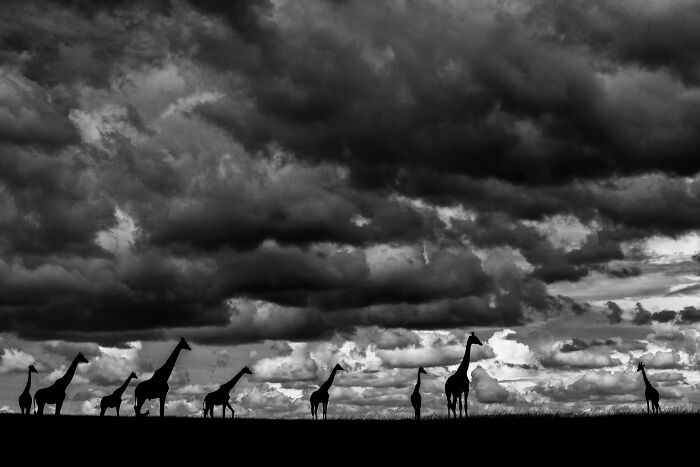
Image source: Nature Photographer Of The Year
 Follow Us