As reports of the attack on Pearl Harbor reached the American public on December 7, 1941, a dental surgeon named Lytle S. Adams was driving home to Pennsylvania from a trip to New Mexico’s Carlsbad Caverns, where he had witnessed the famed spectacle of millions of bats spiraling out of the cave mouth at dusk.
Inspired by the chiropteran display, Adams came up with an idea he believed could win the war: strap tiny bombs to bats, release them over Japan, and let the animals do the rest.
He fired off a letter to the White House, and President Franklin D. Roosevelt was intrigued enough to scrawl a note on the memo:
“This man is not a nut. It sounds like a perfectly wild idea but is worth looking into.”
Within weeks, what would become “Project X-Ray” was a funded, multi-year U.S. military program recruiting a disparate team of experts in pursuit of a bomb small enough, and a bat strong enough, to overwhelm Japanese cities with an onslaught of fires hitting roosting spots at the top of structures.
As outlandish as the plan may sound, it very nearly came to fruition. However, according Dr Rodrigo Medellín, a senior professor of Ecology at the National Autonomous University of Mexico (UNAM) and the world’s foremost expert on the species chosen for the mission, it could never have worked in the way its inventor imagined.
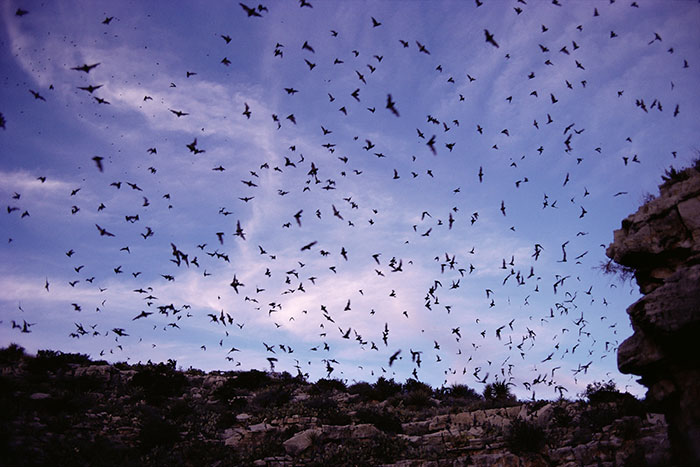
Mexican free-tailed bats inhabit Carlsbad Caverns in their millions. Source: Getty Images
“The people who chose the Mexican free-tailed bat for this were clearly not experts in bats,” Medellín told Bored Panda.
Regardless of its feasibility, Project X-Ray remains one of the strangest footnotes of the Second World War. It is also the first chapter in a story still being written today, one involving cyborg cockroaches, mine-hunting sealions and an ongoing ethical debate about which animals we still feel comfortable exploiting for military aims — and why.
A Dentist’s Wild Idea
While Project X Ray is famed for being the brainchild of a dentist, Adams had not practiced tooth care for around 18 years by the time he came up with his bat bomb plan, having pivoted his career in 1928 to focus on an airmail pickup system he had invented.
His Project X Ray proposal was based on two things he believed about the Mexican free-tailed bat (Tadarida brasiliensis): that it roosted in uncontrollable numbers inside the eaves and attics of buildings, and that it was strong enough to carry a small weight over a long distance.

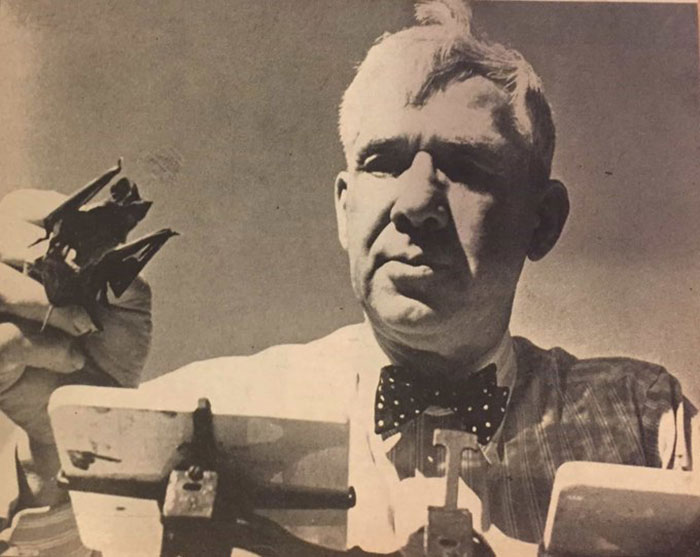
Lytle S. Adams holding a Mexican free-tailed bat. Source: X
The plan was to attach a miniature, timer-triggered incendiary device to each bat, load tens of thousands into modified bomb casings, and release them from aircraft over a Japanese city. As the casings fell, the bats would wake, scatter and tuck themselves away to roost, exactly as they do in their natural habitat. Sometime later, thousands of tiny fires would ignite simultaneously across a city built largely from wood and paper, overwhelming emergency services and destroying public morale.
According to an account left by Bernardo Villa, a Mexican biologist who worked alongside the project’s scientists and later became Medellín’s mentor, the logistics alone were extraordinary. Because live bats couldn’t be fed or kept active in the numbers required, the military built a refrigerated “artificial cave” and chilled hundreds of thousands of the flying beasts to around 5°C to force them into hibernation, buying time to fit them with their payload before loading them into custom transport boxes alongside their one-ounce bombs.
Life magazine, reporting on the program at the time, called it “one of the most extraordinary military operations ever conceived.” The definitive test came at a mock Japanese village the military built at Dugway Proving Ground in Utah, complete with the wood-and-paper construction typical of Japanese homes.
By the project’s own figures, a single load of bat bombs was projected to start somewhere between 3,600 and 4,700 fires — against no more than 400 for an equivalent load of conventional incendiary bombs. On paper, it promised to be one of the most efficient fire-starting weapons the United States had ever devised.
But its most dramatic result came earlier, and by accident: during a trial at an auxiliary airbase near Carlsbad in 1943, a handful of test bats escaped before being loaded into the casings, roosted under the base’s own buildings, and burned much of it to the ground.
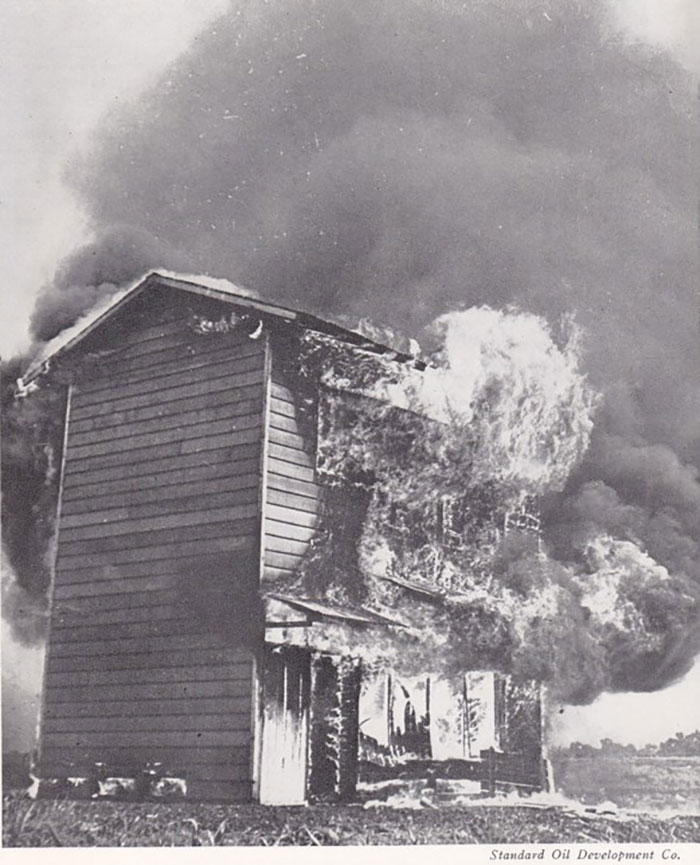
Incendiary tests on Japanese style structures at Dugway Proving Ground. Source: IPJJF
For decades, that fire has been told as an embarrassing accident — proof the weapon worked almost too well. But according to Medellín, who is affectionately known as “the batman of Mexico,” that version of events is questionable.
Wrong Bat, Right Accident
Medellín has mapped Mexican free-tailed bat colonies for decades, from the tens of millions that stream out of caves across northern Mexico and the southern United States each summer, to the smaller colonies that shelter through winter in Mexico City. On the subject of Project X-Ray, his immediate reaction was that the team behind it had picked the wrong bat.
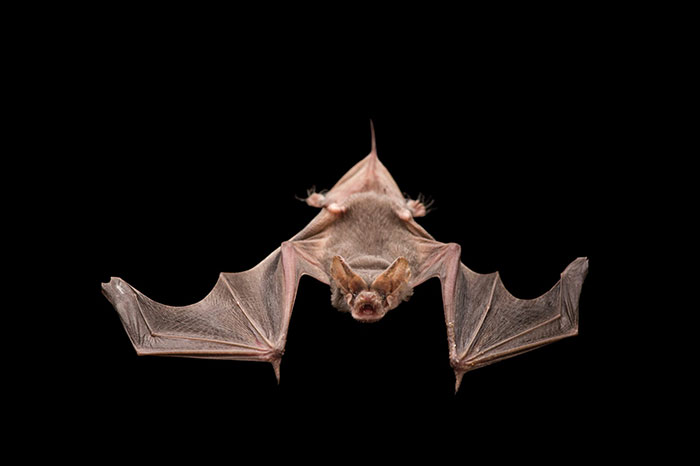
A Mexican free-tailed bat. Source: Nevada Department of Wildlife
The species, he explained, has an unusually high “wing loading” — long, narrow wings built for fast, direct flight over huge distances, the way a glider is built for distance rather than cargo. It’s an adaptation that makes the free-tailed bat remarkable in its own right: according to Medellín, it’s the fastest self-powered flying animal on Earth, capable of reaching 160 kph (99.4 mph)— faster than a peregrine falcon without the help of gravity in a dive.
But that same wing shape, he says, makes the species one of the worst possible choices for carrying extra weight. A Mexican free-tailed bat weighs around 12 to 15 grams; the bombs Project X-Ray planned to strap to each one weighed roughly twice that. “That is impossible for them to fly long distances at all,” Medellín said.
By his estimate, a bat carrying twice its own body weight might manage a single kilometer before it was forced to land — nowhere near the ranges Adams and his team were counting on.
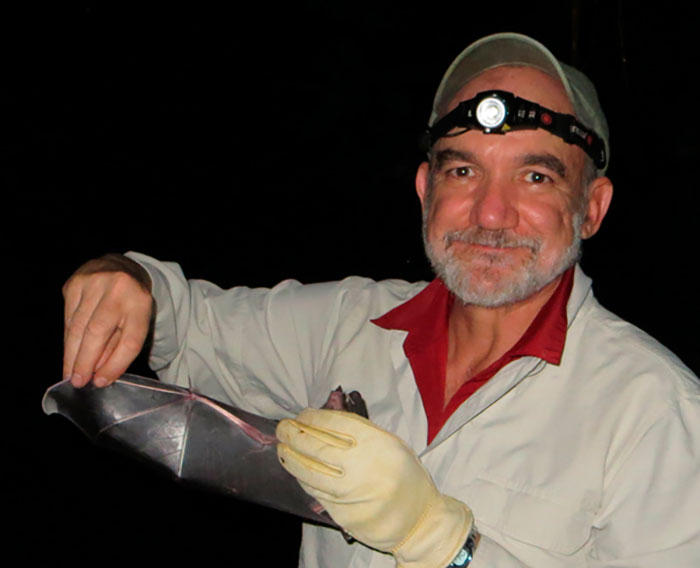
Dr Rodrigo Medellín inspecting a bat. Source: UNAM
That’s what makes the Carlsbad fire so telling. Rather than a fluke, Medellín argues it was the experiment working exactly as the bats’ biology dictated. “If you ask me, I don’t think that was a mistake,” he said. “That was the actual bat landing as far as it could go, carrying twice its own weight. And the farthest they could go were the barracks, which is where the fire started.”
The most “successful” moment of Project X-Ray, in other words, may have been proof the whole concept was doomed. “The dentist is a dentist,” Medellín said. “He’s not an aeronautic specialist.”
A History of Weaponizing Instinct
Project X-Ray was shelved in 1944 — after nearly $2 million (around $37 million in today’s money), two years of research, and an eventual verdict from military planners that it simply wouldn’t be combat-ready before the war ended.
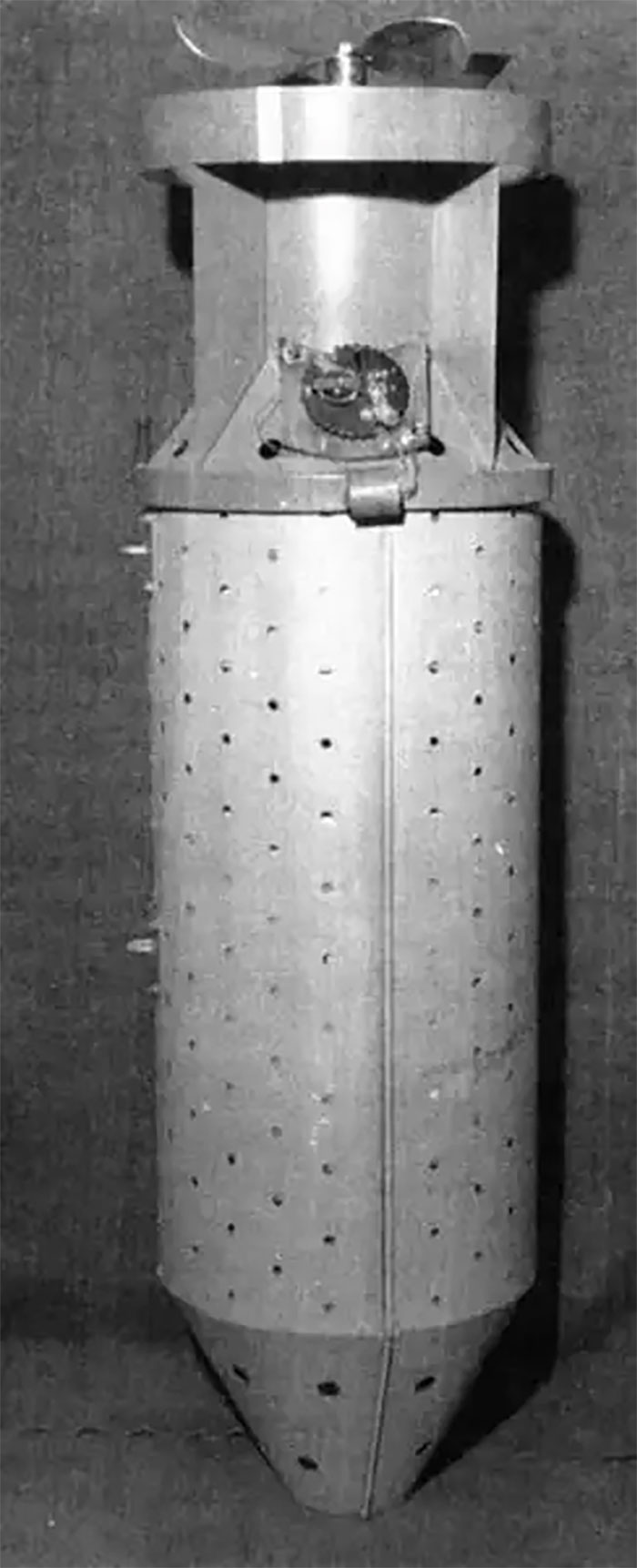
A bat bomb casing. Source: Bat Bomb: World War II’s Other Secret Weapon, by Jack Couffer, University of Texas Press, 1992
Jack Couffer, the youngest scientist on the team, later wrote a book about the project’s strange cast of chemists, zoologists and Army bureaucrats. But the bat bomb wasn’t the only attempt to turn an animal’s natural behavior into a weapon. The United States also explored training pigeons to peck at a target screen and steer missiles toward enemy ships, while the Soviet Union trained dogs to run explosives under German tanks — a program remembered largely for its failure, after dogs trained around Soviet vehicles ran toward the smell of familiar diesel fuel rather than the enemy tanks they were meant to target.
According to Dr. Josh Milburn, a philosopher at Loughborough University who researches the ethics of animals in war, what unites these cases is that they exploit animals’ own instincts rather than simply putting them to work.
“They’re not just an empty resource,” he told Bored Panda. “They were using the animal’s own agency… to take advantage of that agency and push it towards our particular goals.”

Dr Josh Milburn. Source: University of Loughborough
None of these tactics could be attempted today by any state observing international law. Milburn points to Protocol II of the 1980 Convention on Certain Conventional Weapons — the same treaty regime behind the ban on landmines — which specifically outlaws booby traps attached to living or dead animals.
“They are not very controllable, obviously,” Milburn said. “If you put a bomb on a bat, the bat could go in any direction and anyone could get caught up in it.”
Essentially, a living autonomous creature makes for an indiscriminate weapon — and indiscriminate weapons are exactly what the modern laws of war are designed to rule out.
Beyond Bat Bombs
Militaries can no longer strap bombs to living animals, but they haven’t stopped putting animal abilities to use. Bats themselves remain a source of inspiration: Medellín notes their echolocation has already shaped car parking sensors, and is now inspiring solar-powered surveillance drones modelled on bat wings, so they never have to land to recharge.
Other animals have simply been redeployed. Dolphins and sealions, prized for echolocation reportedly sharper than artificial sonar, are still used to detect naval mines, while trained dogs remain unmatched at sniffing out explosives. Milburn highlighted how Russia has reportedly deployed animals, including so-called “spy whales” — beluga whales fitted with harnesses, allegedly for Arctic surveillance.
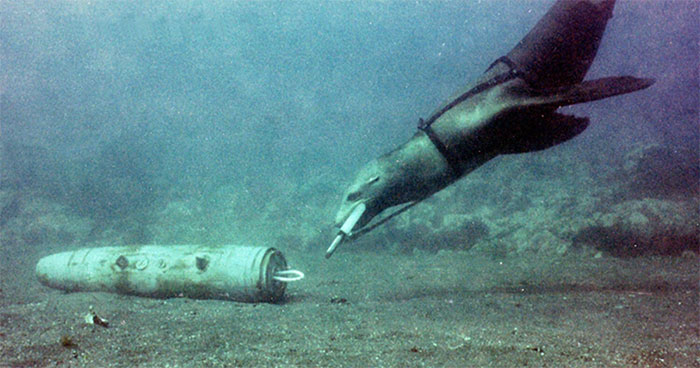
A sealion on a mine detecting mission. Source: U.S. Navy via NSBC News
Where things have genuinely moved on is the shift from exploiting an animal’s instincts to directly controlling its body. The U.S. Defense Advanced Research Projects Agency (DARPA) and a German start-up working with NATO have both developed cyborg insects: cockroaches and beetles fitted with tiny cameras and electrodes, steered remotely with a joystick. Medellín notes that after an earthquake in Myanmar in 2025, cyborg cockroaches were deployed alongside — and in some cases in place of — search-and-rescue dogs, crawling into rubble too small and unstable for a dog or robot to enter.
Their expendability is, in a sense, the point. “If it’s squished, it’s squished. It’s just a cockroach,” Medellín said of the technology, before pointing to the uncomfortable reality underpinning that assumption. “At the same time, we are increasingly aware that insects are more sentient than we ever realized. They feel more pain than we ever recognized.”
Milburn puts that same friction more bluntly: “As we learn more about animals, we get better at exploiting them… but we should be realizing more and more that we shouldn’t be exploiting them.”
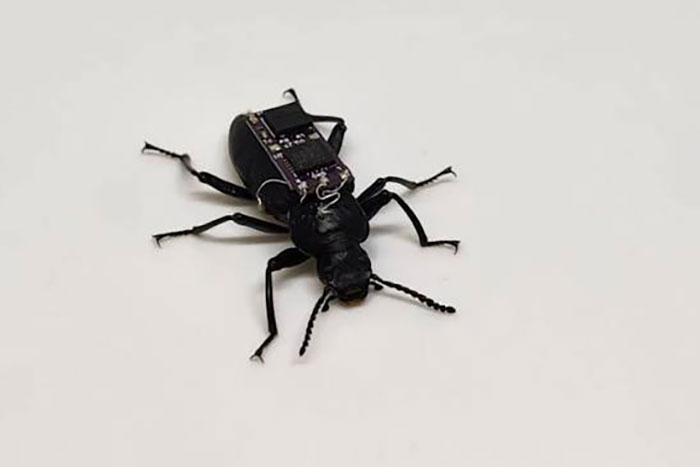
A cyborg beetle. Source: University of Queensland
Whose War Is It, Anyway?
For Milburn, the deeper question raised by both the bat bomb and its modern descendants isn’t really about bats, dolphins or cockroaches — it’s about how far a war fought entirely by humans can justify using animals who have no say in it.
“There is something particularly egregious about harming animals in war,” he said. “Because it’s not their conflict. They are not benefiting from this. They are being brought into our conflict.”
He points to London’s Animals in War Memorial and the tension baked into its own inscription: “They had no choice.” Visitors often leave cards thanking the animals “for their sacrifice” — language that treats them as willing participants, even as the memorial’s own wording says the opposite.
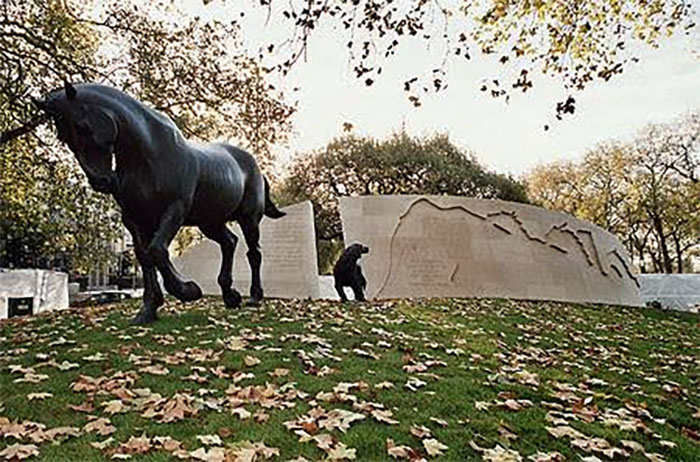
London’s animals in war memorial. Source: Animals in War Memorial Fund
A similar contradiction sank Britain’s purple poppy, introduced by the group Animal Aid in 2006 as a protest against using animals in war, but which Milburn noted was later withdrawn after it was increasingly worn to celebrate, rather than criticize, the practice.
He also points to a moment that briefly made the cost of war to animals impossible to ignore: the images that flooded out of Ukraine in 2022, of refugees fleeing with cats, dogs, and even hamsters.
There are signs, too, that the legal line is still moving. In December 2025, Congress passed its annual defense policy bill with a provision banning the Pentagon from using live dogs, cats, primates or marine mammals in live-fire trauma training, ordering simulators, mannequins and cadavers instead.
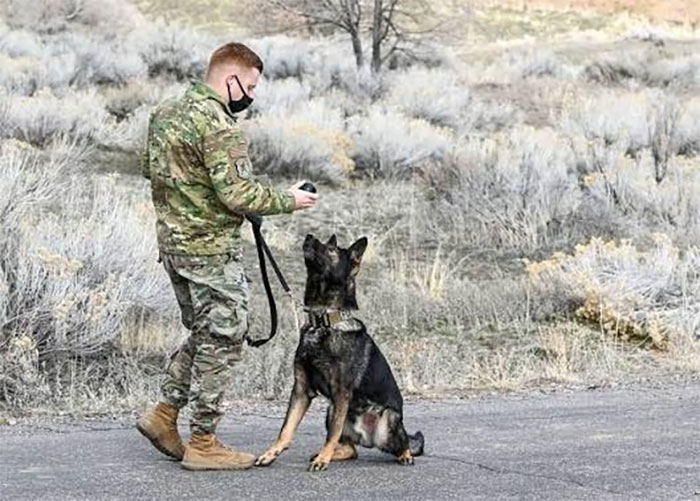
A military bomb sniffing dog in training. Source: Hill Air Force Base
It’s a narrow change — animals remain part of the armed forces in plenty of other roles — but a reminder that the line between acceptable and unthinkable keeps shifting.
Asked what he’d say to someone who insists human lives will always matter more, Milburn pushes back on the framing itself.
“We need to be ready to critically engage without this kind of hierarchical thinking, this us-and-them thinking,” he said, describing it as the root of “the atrocities that we commit on a mass scale, which war is a paradigm example of.”
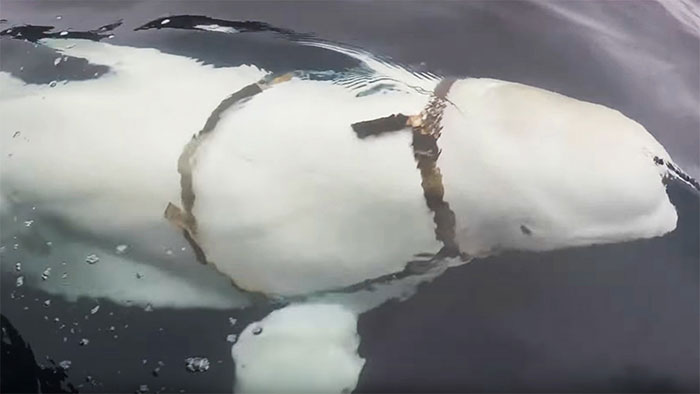
A Beluga whale fitted with a harness, suspected to have been used by Russia for spying. Source: The Moscow Times
Recognizing animals as victims of war, he stresses, isn’t about ranking their suffering above humans’ — it’s about recognizing that war is “even worse than we possibly imagined.”
Eighty years on, the questions Project X-Ray accidentally raised are still live: which animals we’re willing to exploit, which ones we’ve decided are off-limits, and how much of that line comes down to ethics rather than which animal is simply easiest to feel sorry for.
On that point, Medellín would like the record set straight. Bats, he notes, are among the most reviled animals on Earth — feared, misunderstood, and blamed for far more than they deserve. Yet by his own research, Mexican free-tailed bats alone help protect up to 30% of the corn and cotton grown across the southern United States and northern Mexico, devouring roughly 10 tons of crop-destroying insects every night for every million bats in a colony.
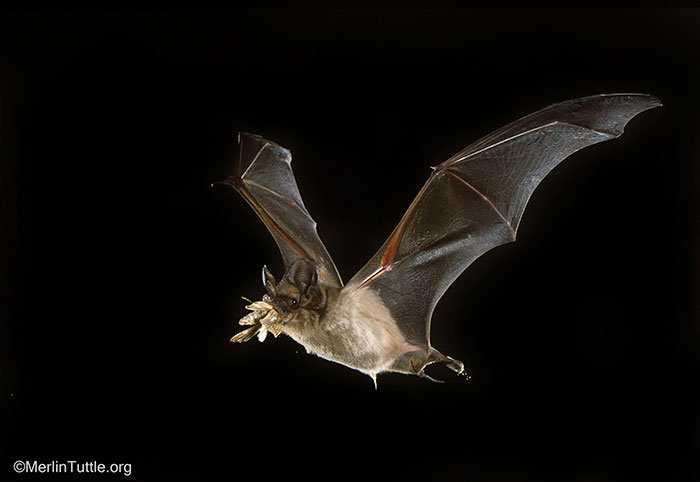
A Mexican free-tailed bat hunts an insect. Source: Merlin Tuttle Bat Conservation
“There’s many animals that have a negative public image,” he said. “None of those do more for your everyday well-being than bats.”
It’s hard not to wonder whether that reputation is exactly why, eighty years ago, a dental surgeon looked at a cave full of bats and saw the raw material for a bomb rather than a colony worth protecting.
 Follow Us