The world is full of little details, surprising connections, and interesting pieces of information that somehow rarely make it into everyday conversation. And so, it can be satisfying to learn a fact you never knew you needed to know, and the next thing, you just want to immediately tell someone else about it.
That’s exactly what makes pages dedicated to interesting facts so easy to get lost in. The Instagram page interestingasfacts, which has around 1.4 million followers, has built an audience around sharing the kind of bite-sized information that makes people pause mid-scroll. From surprising discoveries and unusual details to facts about history, science, animals, and everyday life, its posts offer plenty of reasons to keep scrolling.
Here are some of the most fascinating examples, so prepare to leave this list knowing a little more than you did before.
#1
Image source: interestingasfacts

#2

Image source: interestingasfacts
#3
Butterfly eggs are tiny wonders of nature, typically measuring between 1 and 3 millimetres in diameter. Despite their small size, they display an incredible variety of shapes, textures, and colours depending on the species.
Some eggs have smooth surfaces, while others feature intricate ridges, bumps, or other patterns. Their shapes can range from round to oval, with each species producing eggs that have distinctive characteristics.
The colours of butterfly eggs are equally diverse, ranging from white and yellow to green and other subtle shades. These variations can help researchers identify different species and understand their reproductive habits.
Female butterflies often lay their eggs on specific host plants, ensuring that newly hatched caterpillars have access to suitable food. This remarkable process marks the beginning of a butterfly’s life cycle, which transforms a tiny egg into a crawling caterpillar and eventually into a beautiful winged insect.
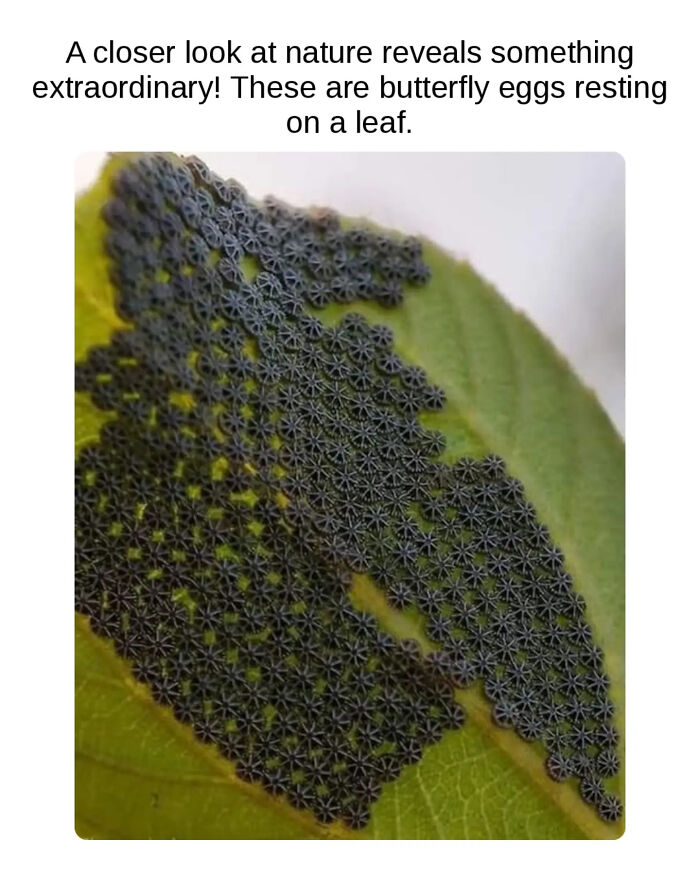
Image source: interestingasfacts
Humans have a natural tendency to chase information when something catches their attention. Science Insights explains that curiosity can arise when people notice a gap between what they know and what they would like to know, creating a small sense of uncertainty that encourages them to find an answer. That may be why an unusual fact can be so difficult to ignore, even when it has no obvious practical use.
Discovering the missing piece provides a sense of satisfaction, and surprising or novel information can make that experience even more rewarding. Rather than needing a major mystery to become curious, people can experience this same process through something as simple as learning an unexpected detail about an animal, object, place, or historical event
#4

Image source: interestingasfacts
#5

Image source: interestingasfacts
#6

Image source: interestingasfacts
That feeling of discovery can also encourage people to keep looking for more information. When something turns out to be different from what we expected, it naturally attracts attention because our brains are particularly sensitive to things that don’t fit our existing assumptions.
The moment of realizing that a familiar subject has an unfamiliar detail can therefore make learning feel less like work and more like exploration. This is part of what makes collections of interesting facts so easy to scroll through: each new piece of information creates another opportunity to encounter something unexpected and close another tiny gap in our knowledge.
#7
Petrified Forest National Park in Arizona, USA, is famous for its extraordinary collection of colorful fossilized wood. These ancient tree trunks may look like ordinary wood at first glance, but they have undergone a remarkable transformation over millions of years, preserving the structure of trees that lived long before humans appeared.
The process, known as petrification, begins when fallen trees become buried beneath sediment. Mineral rich water gradually enters the wood, depositing silica and other minerals within its cellular structure. Over time, these minerals harden into stone while preserving many of the wood’s original details.
The park provides a fascinating glimpse into the Late Triassic period, roughly 225 million years ago, when early dinosaurs lived alongside a variety of other ancient animals. Beyond its petrified trees, the area contains animal fossils, trace fossils, and geological evidence of ancient rivers and changing landscapes.
One of the most striking features of the fossilized wood is its vibrant range of colors. Iron compounds can produce red, orange, and yellow shades, while other minerals contribute darker and occasionally bluish or purplish tones. Together, these fossils offer scientists valuable clues about ancient ecosystems, geological processes, and the environmental conditions of a world that existed more than 200 million years ago.
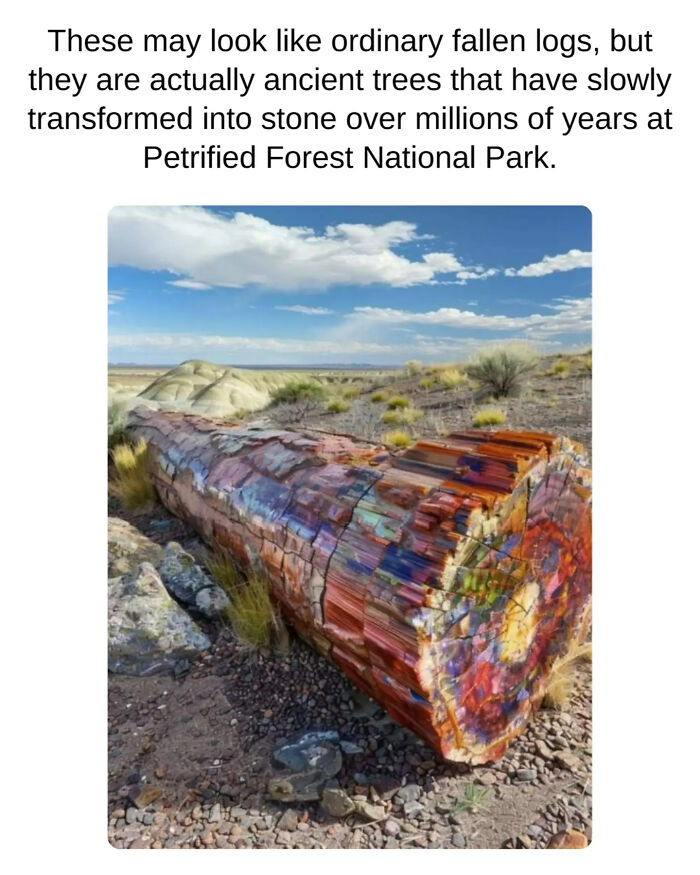
Image source: interestingasfacts
#8
Image source: interestingasfacts
#9
In 2012, beekeepers in northeastern France were shocked to discover that their bees were producing honey in unusual shades of blue and green instead of the familiar golden color. The strange discovery puzzled local honey producers, who initially struggled to understand why their hives were suddenly yielding such unusually colored honey.
After investigating the mystery, they traced the unusual colors to a nearby biogas plant that processed waste from an M&M’s candy factory. Bees had apparently found their way to sugary residue from the candy production process and were collecting it as an alternative food source to flower nectar.
The blue and green colors came from the artificial food dyes used in the colorful candy shells. As the bees collected the sugary material and brought it back to their hives, the pigments affected the appearance of the honey. The incident demonstrated how bees can sometimes exploit unexpected food sources when they are available nearby.
The discovery raised concerns among beekeepers because honey contaminated by industrial food waste could be difficult to sell as a natural product. In response, the facilities involved took steps to prevent bees from accessing the sugary waste. The unusual honey became a memorable example of how human activities can unexpectedly influence wildlife and the products that nature provides.
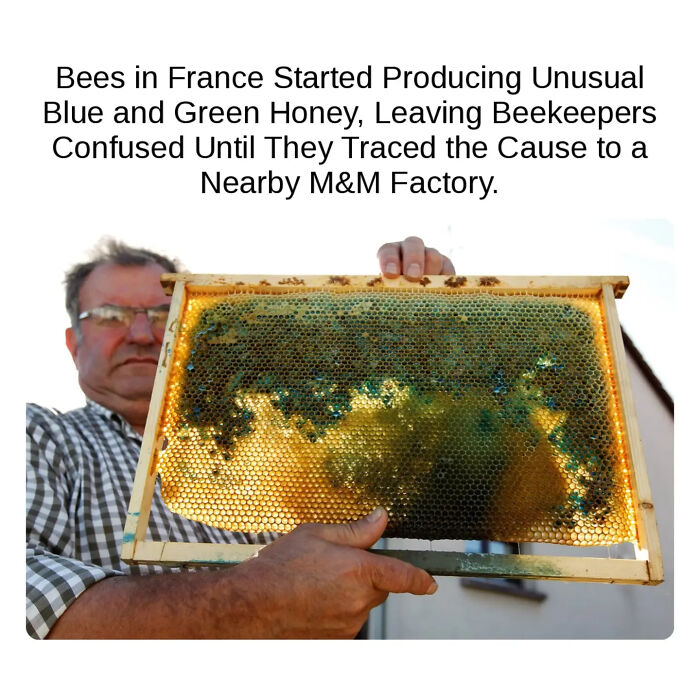
Image source: interestingasfacts
There is another reason these discoveries can stay with us long after we’ve encountered them. Psychology Today notes that information is more likely to be remembered when it is novel, surprising, emotionally engaging, or personally meaningful. Instead of treating every piece of information equally, the brain gives greater attention to things that stand out.
The hippocampus, which plays a major role in forming memories, works alongside the brain’s reward and motivation systems when we encounter novelty. As a result, an unusual fact can receive a stronger memory boost than an ordinary piece of information that never gives us a reason to pay particular attention.
#10
Image source: interestingasfacts
#11
Image source: interestingasfacts
#12
Image source: interestingasfacts
Surprise and emotion can make that effect even stronger. A fact that produces amusement, amazement, or disbelief is more likely to feel significant than one that simply confirms something we already expected. Connecting new information to something we already care about can have a similar effect, because personal relevance encourages deeper processing.
This helps explain why people can forget information they deliberately tried to memorize while effortlessly remembering an obscure fact they encountered years ago simply because it was strange enough to make them stop and think. The more an idea stands out, the more likely it is to leave a lasting impression.
#13

Image source: interestingasfacts
#14
Researchers examining small fragments of the meteorite identified two previously unknown minerals, which were named elaliite and elkinstantonite. Their chemical compositions had never been documented in naturally occurring minerals on Earth, making the discovery particularly significant.
These minerals are believed to have formed under unusual conditions inside the parent asteroid from which the meteorite originated. Studying them could help scientists better understand the extreme temperatures, pressures, and chemical processes that take place during the formation of asteroids and other celestial bodies.
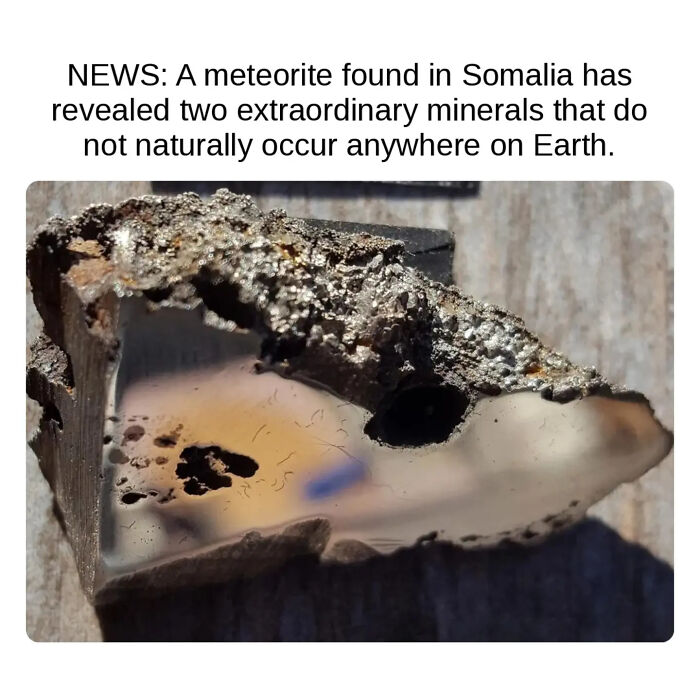
Image source: interestingasfacts
#15
Image source: interestingasfacts
Yet our enthusiasm for learning new facts also reveals something slightly humbling about how much we actually understand. The BBC has explored how people can mistake familiarity for genuine understanding, particularly through the illusion of explanatory depth.
Someone may use an everyday object for decades and feel completely comfortable saying they know how it works, only to struggle when asked to describe its mechanism step by step. Familiarity gives us a sense of fluency, but that doesn’t necessarily mean we possess the detailed knowledge needed to explain something properly.
#16
Astronomical rings, also known as armillary sphere rings, are fascinating examples of how science and jewelry came together during the Renaissance. Developed as miniature versions of traditional armillary spheres, these unusual objects were designed to represent the movements and positions of celestial bodies. When folded, they look like ordinary decorative rings, but when unfolded, their interlocking metal bands expand into a small spherical structure.
Beyond their unusual appearance, these rings also served a scientific purpose. Their engraved markings represented celestial coordinates and astronomical measurements, allowing some versions to function as basic astronomical instruments for observing the sky, estimating time, and understanding celestial movements. This made them much more than ordinary pieces of jewelry.
The rings became particularly popular in Germany during the 16th century, where skilled goldsmiths crafted them with remarkable precision. Some featured zodiac symbols, astronomical markings, and Latin inscriptions carrying philosophical or religious messages. They were often regarded as symbols of knowledge, education, social status, and religious devotion.
Today, surviving astronomical rings are treasured historical artifacts that reveal the remarkable craftsmanship of Renaissance metalworkers. They represent a time when scientific curiosity, artistic creativity, and personal adornment were closely connected, allowing people to literally wear a miniature model of the universe on their fingers.
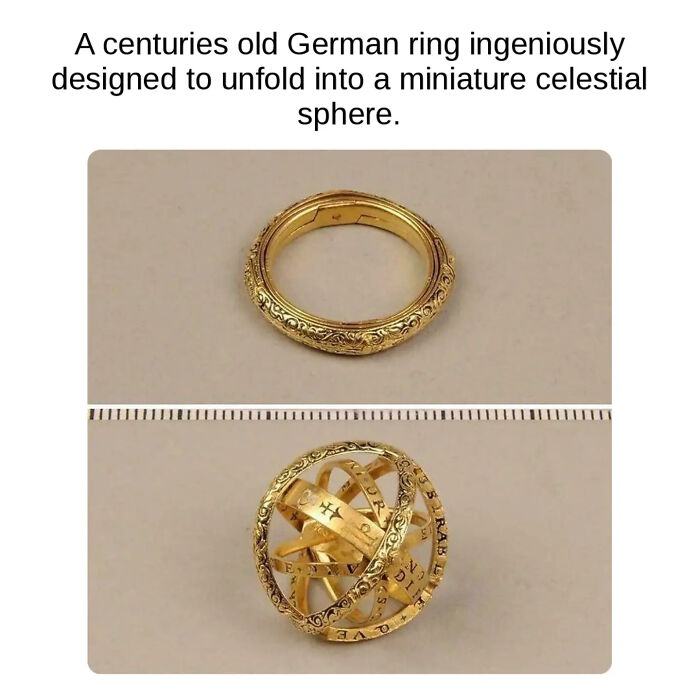
Image source: interestingasfacts
#17
Image source: interestingasfacts
#18
A coffee shop in Kent, UK, has taken a bold step to reduce waste by serving only customers who bring their own reusable cups. Its unusual policy aims to encourage people to make more environmentally friendly choices.
To show the scale of the problem, Otto’s Coffee House and Kitchen filled its shop floor with disposable cups. This powerful display highlighted how quickly takeaway cups can accumulate and contribute to environmental pollution.
The initiative encourages customers to bring their own cups instead of relying on single use alternatives. This simple habit can help reduce waste and promote more sustainable consumption.
Otto’s Coffee House and Kitchen hopes its efforts will inspire other coffee shops around the world to follow the same approach. Its message is clear: small changes in everyday habits can make a meaningful difference to the environment.
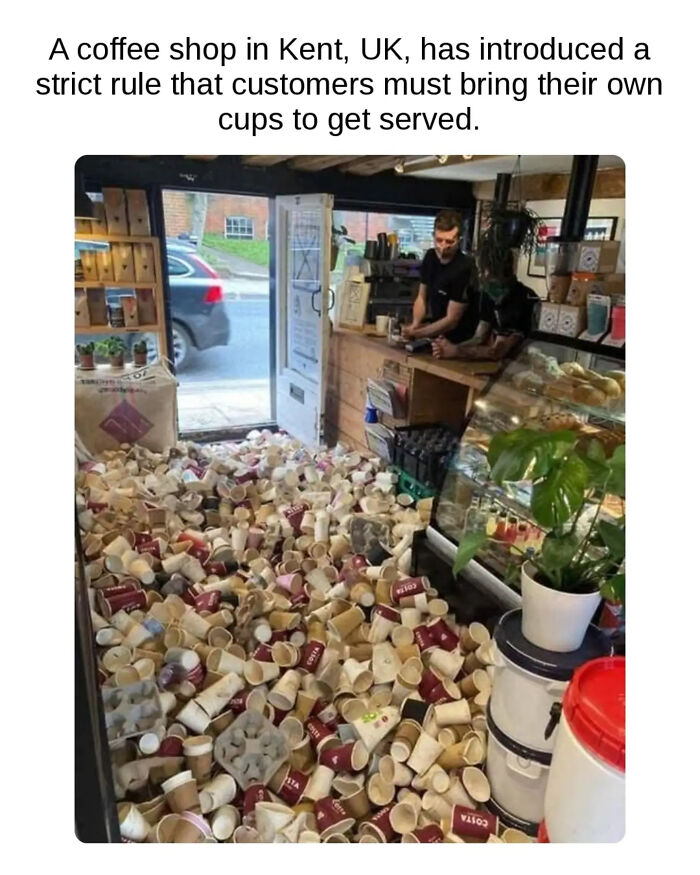
Image source: interestingasfacts
This gap can extend far beyond household objects. People can become confident in their understanding of complicated ideas simply because they have encountered the terminology, headlines, or general explanation many times. Repeated exposure makes information feel easier to process, while confirmation bias can encourage us to notice evidence that supports what we already believe and overlook information that challenges it.
The result is that uncertainty can remain hidden until we are actually asked to explain what we supposedly know. Coming across an unexpected fact can be a useful reminder that even subjects that seem completely familiar may contain layers of information we have never considered.
#19

Image source: interestingasfacts
#20
When Zak Brown was a teenager, he won a few thousand dollars on a game show, giving him an opportunity to spend the money on almost anything he wanted. Rather than using it for ordinary purchases, he made a decision that would help shape his future. He bought a go kart and began exploring his growing interest in motorsports.
That purchase became an important turning point in Brown’s life. The go kart gave him an opportunity to experience racing firsthand and develop a deeper passion for the sport. What began as a teenage interest gradually grew into a serious ambition, motivating him to learn more about competition, drivers, and the business behind motorsports.
Brown eventually became involved in professional racing, first as a driver and later as a businessman and motorsports executive. He founded Just Marketing International, a company specializing in motorsports marketing, and built a reputation for understanding the commercial side of racing. His work brought him into contact with major teams, sponsors, and influential figures across the industry.
In 2018, Brown became the chief executive officer of McLaren Racing, one of the most historic names in Formula One. His journey from buying a go kart with game show winnings to leading a world renowned racing organization demonstrates how a small decision can sometimes open the door to an extraordinary career. It is a reminder that following a genuine passion can create opportunities that are difficult to imagine at the beginning.

Image source: interestingasfacts
#21
Image source: interestingasfacts
And not every fact needs to have an obvious practical purpose to be worthwhile. Research points out that trivia can provide small opportunities to exercise memory because recalling information requires more active mental work than simply reading it again. This relates to the testing effect, in which retrieving information from memory can strengthen its later recall.
A casual trivia question can therefore do more than provide a moment of entertainment; it can turn an otherwise forgettable piece of information into something the brain has actively practiced retrieving. Curiosity can also encourage people to investigate related subjects, allowing one unusual fact to become the starting point for learning about something much bigger.
#22
Archaeologists discovered an extraordinary hoard of ancient coins hidden inside a large ceramic jar measuring approximately two feet wide and dating back to the fifteenth century. The bronze coins had developed a bright green coating due to a natural oxidation process known as verdigris, which occurs when copper reacts with moisture and other elements over time. The jar was buried more than six feet underground, possibly to protect a warrior’s wealth during a period of civil unrest in Japan.
Many of the coins featured square or circular openings in their centers, allowing them to be threaded together using ropes for easier storage and transportation. The collection included Japanese coins as well as several older Chinese coins from the Ming and Tang dynasties, suggesting the extensive circulation of currency and trade between different parts of East Asia.
Archaeologists initially estimated that the jar contained more than 100,000 coins, making it an enormous discovery. However, a wooden tablet buried alongside the hoard provided an intriguing clue about its actual size. It contained the Japanese inscription “nihyaku rokuju,” meaning 260, which may refer to 260 kan, a traditional counting unit representing 1,000 coins.
If this interpretation is correct, the jar could have contained as many as 260,000 coins. The discovery offers a fascinating glimpse into medieval Japanese wealth, monetary systems, and the lengths people went to protect their fortunes during times of political instability.
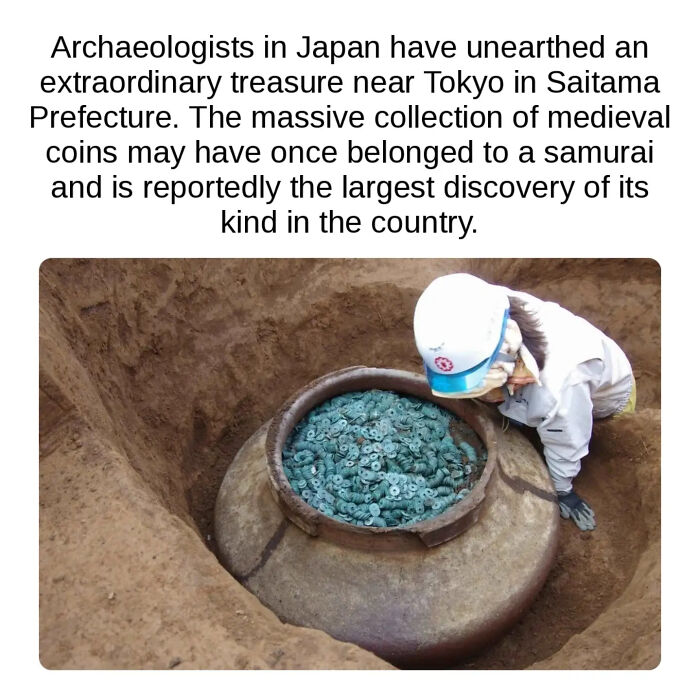
Image source: interestingasfacts
#23
Image source: interestingasfacts
#24

Image source: interestingasfacts
There is a social side to this fascination, too. Random facts give people something easy to share, whether it’s an unexpected discovery mentioned during a conversation or knowledge brought up during a trivia game. They can create moments of surprise and give people common ground without requiring everyone to share the same interests or expertise.
A strange fact about an animal, for example, might lead to questions about evolution, biology, or the environment, turning a tiny piece of trivia into a much wider exploration. What looks like meaningless information can therefore become a memory exercise, a conversation starter, or simply the first step toward discovering something else, and perhaps that’s part of why people never seem to get tired of finding out something they didn’t know before.
#25
Image source: interestingasfacts
#26

Image source: interestingasfacts
#27
Image source: interestingasfacts
It’s oddly satisfying to discover a fact that completely changes how you look at something familiar. Whether it fills a small gap in our knowledge, sticks in our memory because it was surprising, or sends us down a rabbit hole of related information, these little discoveries remind us that there is always more to learn.
We may know how to use countless things every day, but that doesn’t necessarily mean we understand them as well as we think we do. And perhaps that’s what makes interesting facts so much fun. They don’t have to change our lives or solve a major problem to be worth knowing. Sometimes, learning one completely unexpected detail is enough to make an ordinary day a little more interesting.
What is the most random fact you know that you still remember years later? Share it in the comments, we’d love to see what strange pieces of knowledge our readers have collected over the years!
#28

Image source: interestingasfacts
#29
This bizarre but true story involves identical triplets who were separated at birth by a prestigious adoption agency in New York. Years later, fate brought two of the brothers together when they happened to meet in college. Their striking physical resemblance led to the discovery that they were identical triplets who had been raised in different families without knowing about one another.
As the story unfolded, it became clear that they were not the only identical twins or triplets separated through the agency. Several children had been placed in different households as part of a secret research project led by psychiatrist Peter Neubauer.
Neubauer wanted to investigate how different family backgrounds and social environments influenced the personality development of genetically identical siblings. By studying children raised apart, he hoped to understand the roles that genetics and upbringing played in shaping human behavior. However, the children and their families were not fully informed about the true purpose of the separations, raising serious ethical concerns.
The study was never published in the form Neubauer had originally intended, and it faced widespread criticism over its methods and lack of informed consent. Records related to the research were deposited at Yale University, with access restrictions extending until 2065. The case remains a disturbing example of how scientific curiosity can come at a devastating human cost when ethical responsibilities are ignored.

Image source: interestingasfacts
#30

Image source: interestingasfacts
#31

Image source: interestingasfacts
#32

Image source: interestingasfacts
#33

Image source: interestingasfacts
#34
Image source: interestingasfacts
#35

Image source: interestingasfacts
#36
Image source: interestingasfacts
#37

Image source: interestingasfacts
#38
Image source: interestingasfacts
#39
Image source: interestingasfacts
#40
Japanese company Idemitsu Kosan has developed an innovative engine oil made from more than 80 percent plant based materials, including rapeseed and sunflower oils. The goal is to combine sustainability with the high performance required by modern engines.
In performance tests, the oil reportedly demonstrated 194 percent greater strength, 50 percent lower friction, 169 percent better engine protection, and 124 percent improved piston cleanliness compared with conventional mineral oil. These figures highlight its potential to improve engine efficiency and durability.
The oil has also been tested under demanding motorsport conditions, including a five hour endurance race with Mazda Spirit Racing. Its performance in this challenging environment demonstrated its potential for applications where engines must withstand prolonged stress and high temperatures.
Beyond performance, the oil reportedly reduces lifecycle carbon emissions by 82 percent compared with conventional alternatives. If these benefits translate into wider commercial use, this innovation could help make motorsports and everyday driving more environmentally sustainable without sacrificing performance.

Image source: interestingasfacts
#41
Image source: interestingasfacts
#42
Blue stripes appear when water freezes with very few air bubbles, allowing light to penetrate the dense ice and creating a deep blue color. These layers can form when liquid water fills cracks or spaces in existing ice and then freezes.
Green stripes can develop when seawater containing organic material becomes trapped and freezes into the iceberg. Brown or yellowish bands may form when sediment, rock particles, and minerals become incorporated into the ice.
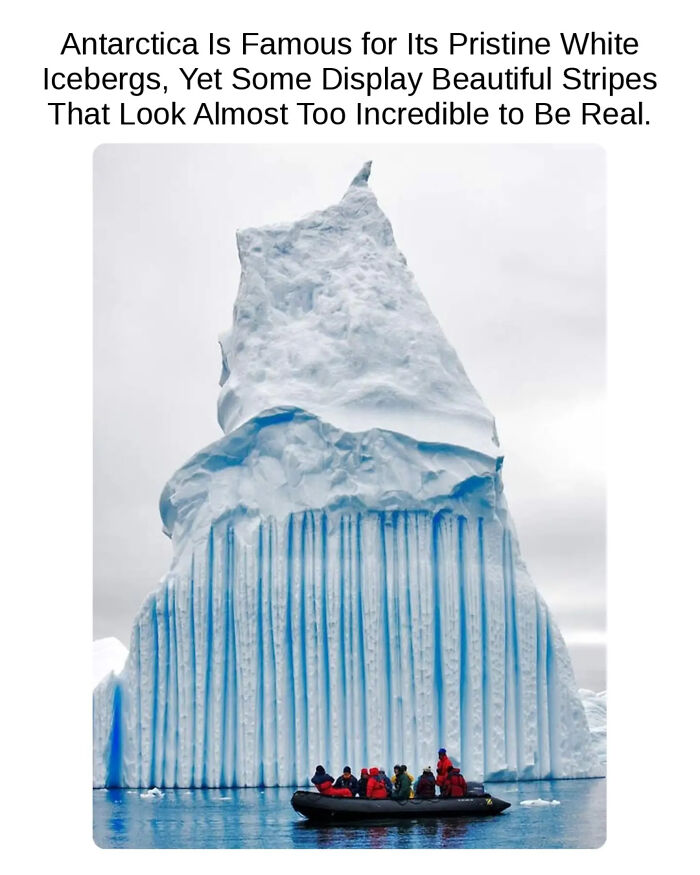
Image source: interestingasfacts
#43
Image source: teachingeverythingdaily
#44
Image source: interestingasfacts
#45
High in the mountains of China’s Shennongjia Nature Reserve, hundreds of wooden beehives cling to an almost vertical cliff face. Known as the “Wall of Hives,” this extraordinary arrangement is designed to protect native honey bees while creating one of the most unusual beekeeping sites in the world.
China has a long history of beekeeping, but native bee populations face growing threats from habitat loss, disease, and competition from introduced species. One of the most important native species is the Chinese honey bee, Apis cerana cerana, which plays a vital role in pollinating wild plants and crops. However, claims that more than 80 percent of China’s native bees have disappeared, or that European honey bees alone caused the decline, should be treated with caution.
Maintaining the cliffside hives requires remarkable skill and courage. Beekeepers climb using lower hives as footholds, while the highest boxes may require ropes to reach. The steep location also helps keep the colonies and their honey out of reach of bears and other hungry animals.
The surrounding Shennongjia region is renowned for its rich biodiversity, with a wide variety of plant species growing across different elevations and climate zones. The unusual hives have also attracted visitors fascinated by this remarkable combination of traditional beekeeping, human ingenuity, and wildlife conservation.
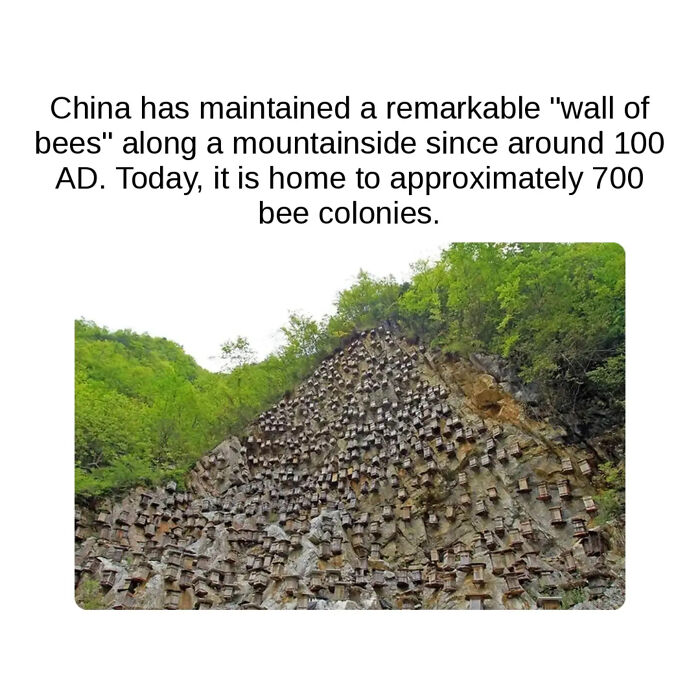
Image source: interestingasfacts
#46
Image source: interestingasfacts
#47

Image source: interestingasfacts
#48
Image source: interestingasfacts
#49

Image source: interestingasfacts
#50

Image source: interestingasfacts
#51
Image source: interestingasfacts
#52
Every autumn, a giant smiley face appears in a forest as the larch trees turn a brilliant shade of orange. Measuring approximately 300 feet in diameter, this remarkable woodland design becomes especially visible when the surrounding trees change color.
The face was carefully created using two different tree species. Rope was used to measure the circle, while Douglas fir trees were planted to form the eyes and mouth. Larch trees filled in the rest of the face, creating a striking contrast between the different shades of green and orange.
The design relies on the natural growth and seasonal changes of the trees rather than paint or artificial decorations. As autumn arrives, the larch trees change color, making the cheerful expression stand out against the surrounding forest.
Although both species are eventually intended to be harvested, the forest smiley face is expected to remain visible for at least another 30 to 50 years. It is a wonderful example of how thoughtful forestry can combine nature, creativity, and a little happiness into one unforgettable landscape.
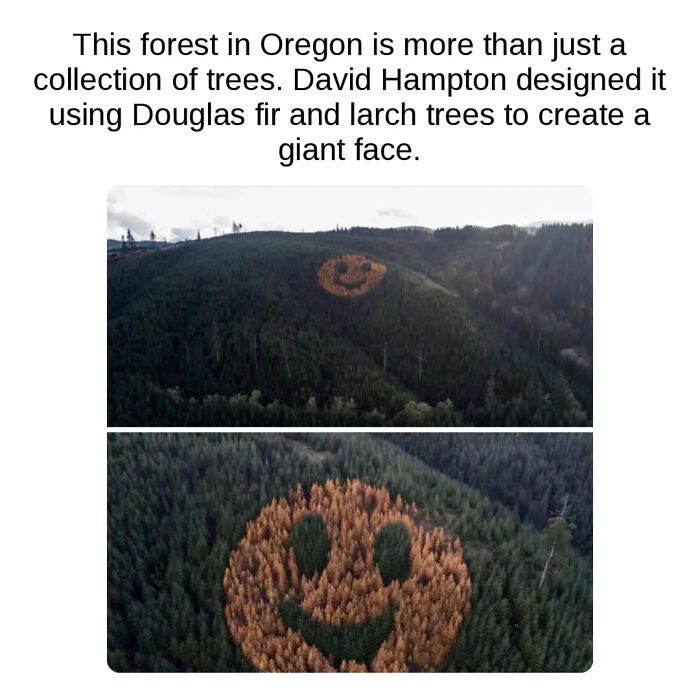
Image source: interestingasfacts
#53

Image source: interestingasfacts
#54
Image source: interestingasfacts
#55
Image source: interestingasfacts
#56

Image source: interestingasfacts
#57
Image source: interestingasfacts
#58
Image source: interestingasfacts
#59

Image source: interestingasfacts
#60
The Cashew of Pirangi, located in Rio Grande do Norte, Brazil, is famous for being the largest cashew tree in the world. This extraordinary tree covers an area estimated at between 7,300 and 8,400 square meters, making it comparable in size to around 70 ordinary cashew trees. With a circumference of approximately 500 meters, it is a remarkable natural attraction that draws visitors from around the world.
Unlike most trees that grow upward from a single trunk, the Cashew of Pirangi spreads outward across the ground. Its branches bend downward under their own weight, and when they touch the soil, they can develop new roots. Over time, this unusual growth pattern allows the tree to expand across a vast area, creating the appearance of an entire forest formed by one tree.
The tree is believed to have been planted in the 1880s, although its extraordinary size and growth pattern have inspired claims that it could be much older. Some estimates suggest it may be more than a thousand years old, but this age has not been conclusively established. Its exact age therefore remains a subject of debate.
Today, the Cashew of Pirangi is one of Brazil’s most fascinating botanical landmarks. Its enormous canopy provides shade for visitors, while its unusual network of branches demonstrates how plants can adapt and grow in unexpected ways. The tree is a striking example of nature’s ability to create something that seems almost impossible, turning a single plant into a sprawling living wonder.

Image source: interestingasfacts
#61

Image source: interestingasfacts
 Follow Us