From Renaissance courts to modern studios, portraits have been used to record status, commemorate relationships, construct public identities, and preserve the likenesses of people whose names might otherwise have disappeared from history.
Some of art history’s most recognizable faces belonged to people whose lives were almost as fascinating as the paintings themselves. Gertrude Stein reportedly sat for Picasso around 80 or 90 times, while Gustav Klimt’s Portrait of Adele Bloch-Bauer I took years to complete and was later caught up in one of the most remarkable art-restitution stories of the 20th century. Grant Wood, meanwhile, did not simply find a farmer and his wife to pose for American Gothic: the figures were modeled separately by his sister, Nan Wood Graham, and his dentist, Dr. Byron McKeeby.
The Cool Stories About Art community shared 12 iconic portraits and the real-life people who inspired them. Scroll down to discover who these sitters were and the circumstances in which some of art history’s most recognizable portraits came into being.
#1 Portrait Of Adele Bloch-Bauer I By Gustav Klimt, 1907
Adele was a wealthy Viennese socialite, art patron, and salon hostess. Her husband, sugar industrialist Ferdinand Bloch-Bauer, commissioned Klimt to paint her in 1903. Klimt worked on the portrait for four years, producing more than 100 preparatory drawings.
What makes her story particularly fascinating is that Klimt painted Adele twice. The second portrait, Portrait of Adele Bloch-Bauer II, was completed in 1912–13 and is now privately owned.
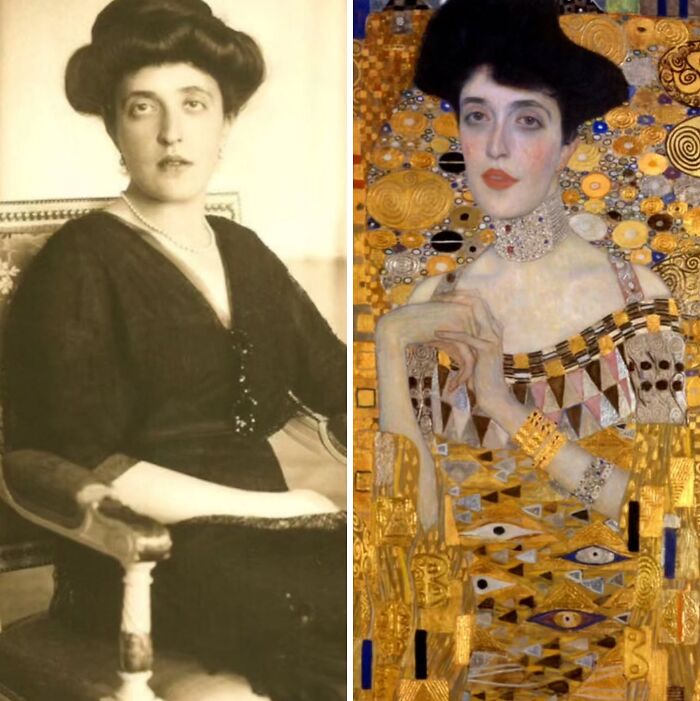
Image source: cool.stories.about.art

#2 Galatea Of The Spheres By Salvador Dalí, 1952
The portrait depicts Gala, Dalí’s wife and muse, but instead of rendering her face as a solid form, the artist constructed it from dozens of suspended spheres. They relate to Dalí’s fascination with atomic physics and the structure of matter. The National Gallery of Victoria describes the painting as part of his “nuclear mysticism” period, when he was combining his interest in contemporary science with religious and Renaissance ideas. From a distance, the spheres resolve into Gala’s recognizable face; up close, the portrait breaks apart into individual particles.
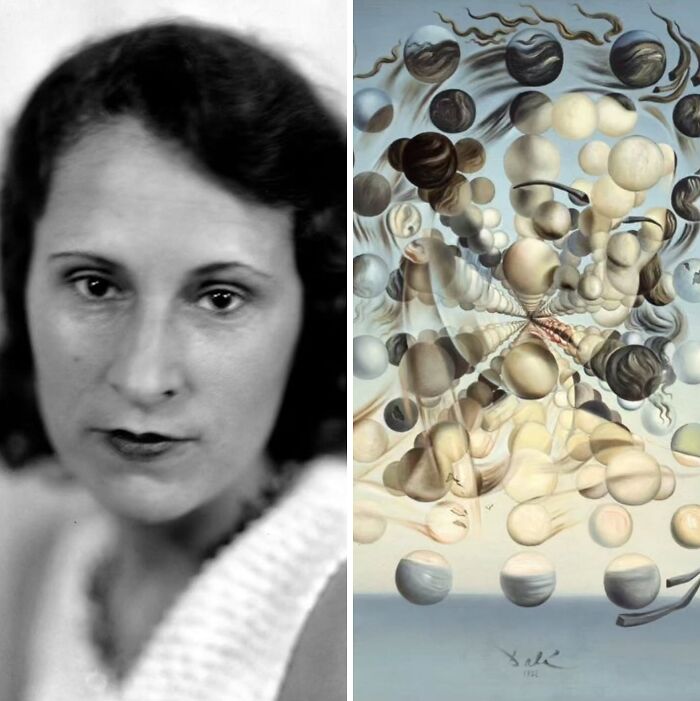
Image source: cool.stories.about.art
#3 Portrait Of Emilie FLöge By Gustav Klimt, 1902
Emilie Flöge was Klimt’s longtime companion, close friend, and one of the most important women in his life. She was also a fashion designer and co-owner of the famous Schwestern Flöge fashion salon in Vienna.
There is also an interesting personal detail: Flöge reportedly did not like the portrait. The Wien Museum notes that the painting was not to her liking and that Klimt eventually sold it to a museum in 1908.
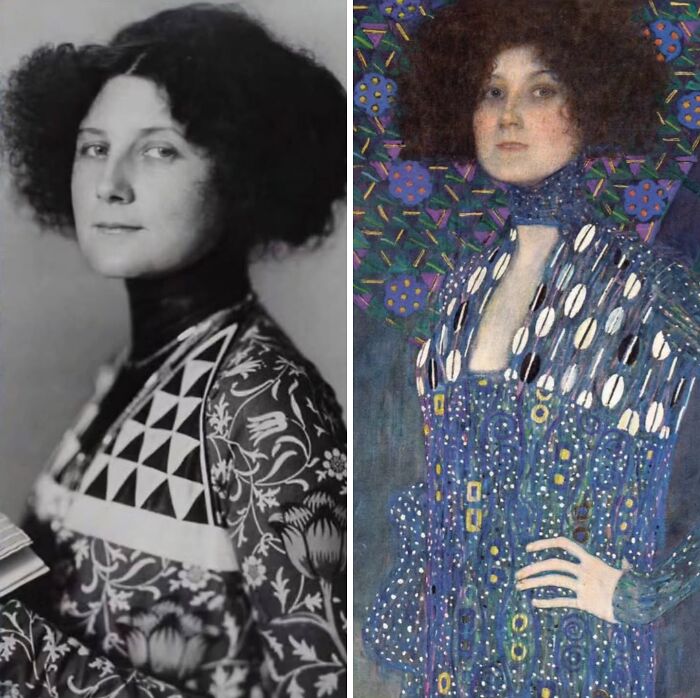
Image source: cool.stories.about.art
#4 American Gothic By Grant Wood, 1930
Wood spotted a small house in Eldon, Iowa, with a distinctive pointed-arch window and decided to paint it together with “the kind of people” he imagined living there. He then asked his sister Nan to model the woman and his dentist, Dr. McKeeby, to model the man. The two models never posed together in front of the house; Wood created the composition separately.
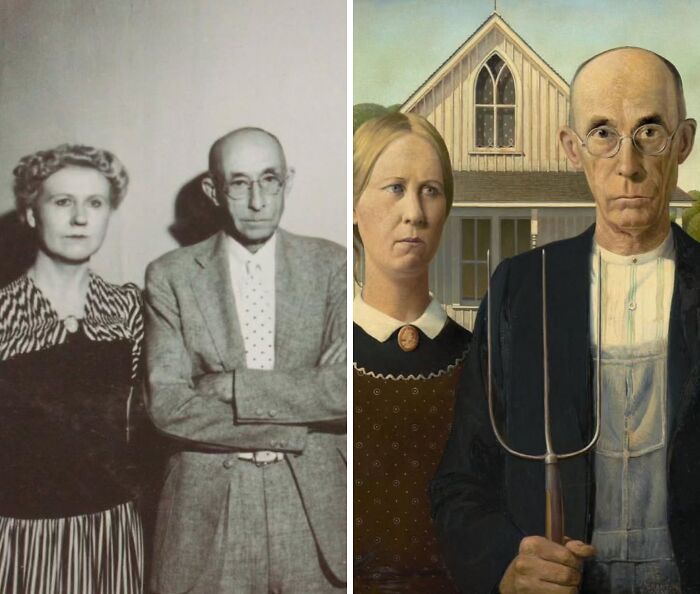
Image source: cool.stories.about.art
#5 L’arlésienne: Madame Joseph-Michel Ginoux (Marie Julien) By Vincent Van Gogh, 1888–1889
Marie Julien Ginoux ran the Café de la Gare in Arles with her husband, Joseph-Michel Ginoux. Van Gogh knew the couple well: when he first arrived in Arles, he lodged at their establishment, and Marie later remained on friendly terms with him.
The Metropolitan Museum says he made two very similar portraits of Marie Ginoux in 1888, while the broader L’Arlésienne group contains several versions. The Musée d’Orsay version was painted very quickly, Van Gogh wrote to his brother Theo that he had completed the figure in about an hour.
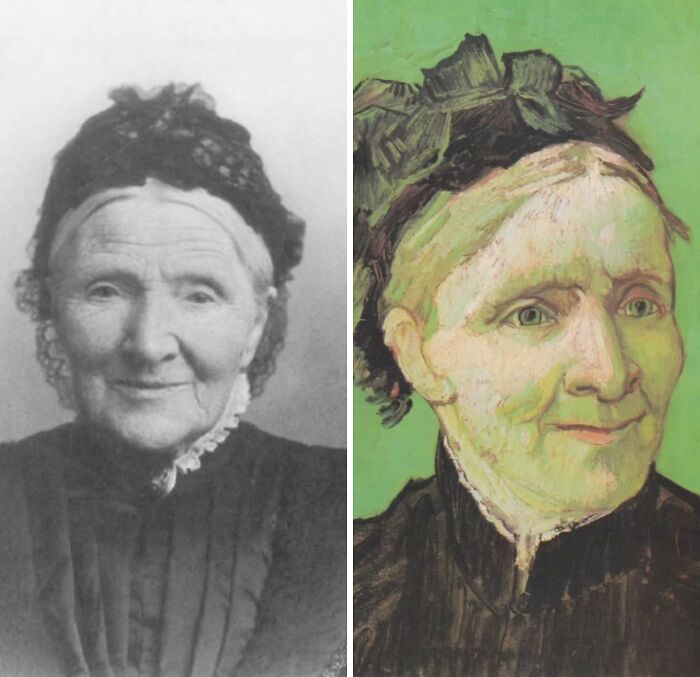
Image source: cool.stories.about.art
#6 Jeanne Hébuterne With A Necklace By Amedeo Modigliani, 1917
The woman in the photograph is Jeanne Hébuterne, Modigliani’s partner and one of his most frequently painted subjects.
Jeanne was a young French painter and art student when she met Modigliani in Paris in 1917. She became his companion and muse, and during their relatively short relationship he portrayed her more than 20 times, repeatedly emphasizing her distinctive auburn hair, pale complexion, blue eyes, and elongated features.
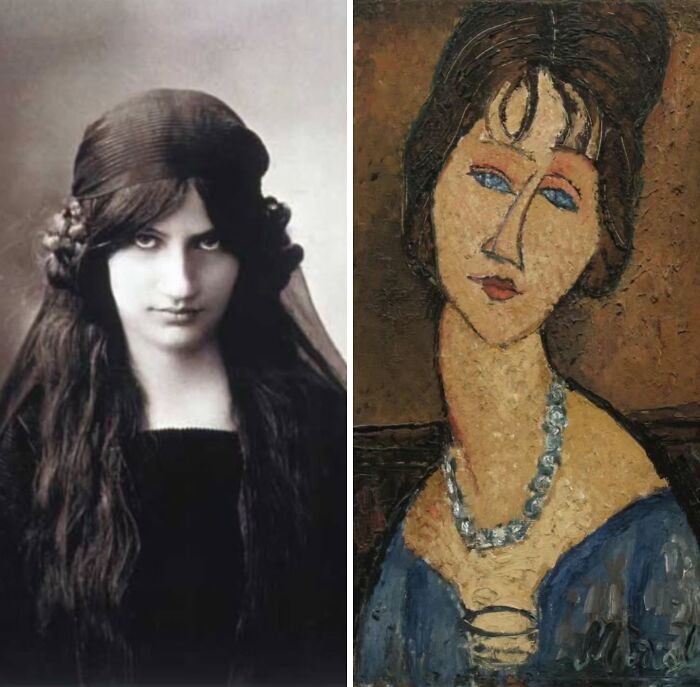
Image source: cool.stories.about.art
#7 The Precious Stones: Emerald By Alphonse Mucha, 1900
The Emerald figure is deliberately more mysterious and sinister than some of Mucha’s other famous women. The Mucha Foundation describes Emerald as “mysterious and menacing,” and the strange animal-headed chair behind her adds to that unsettling quality. The chair was actually inspired by one of Mucha’s own chairs, which appears in several of his drawings and photographs.
The unidentified model photographed in Mucha’s Paris studio around 1899–1900 appears to have provided a reference for the Art Nouveau artist’s personification of the emerald.
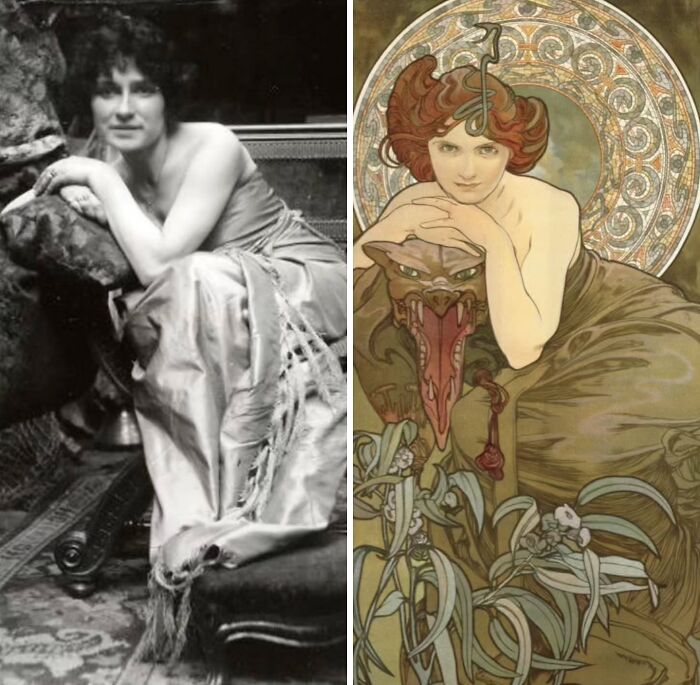
Image source: cool.stories.about.art
#8 Jeanne Samary By Pierre-Auguste Renoir, 1877
Jeanne Samary was a successful actress at the Comédie-Française in Paris. She first sat for Renoir in 1877, and he became particularly interested in her as a model, portraying her at least a dozen times in oil and pastel between 1877 and 1880.
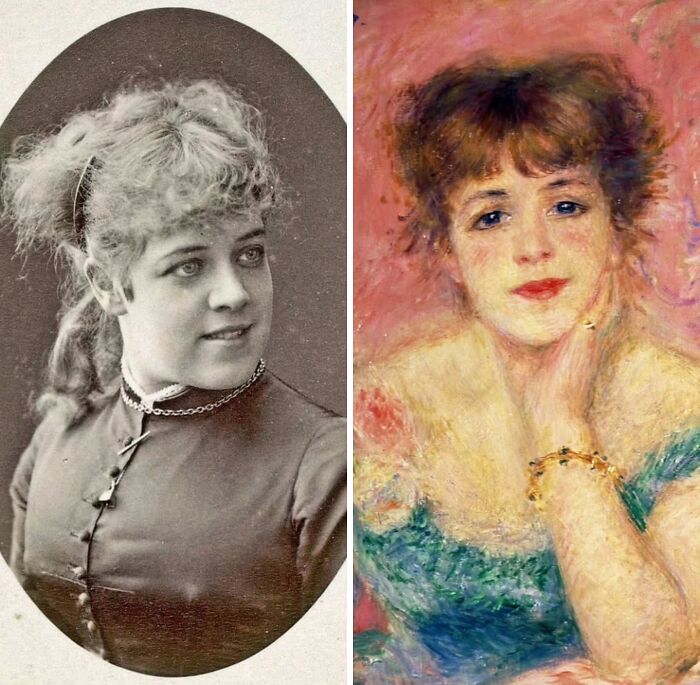
Image source: cool.stories.about.art
#9 Portrait Of Gertrude Stein By Pablo Picasso, 1905–1906
Stein commissioned Picasso to paint her portrait in 1905, and the process became unusually long. She reportedly sat for him around 80–90 times. Picasso eventually became dissatisfied with the face, wiped it out, and left for Spain. When he returned, he completed the face largely from memory, giving it the angular, mask-like quality seen in the finished painting.
The portrait also captures an important moment in Picasso’s development: the simplified, geometric treatment of Stein’s face reflects his growing interest in Iberian sculpture and non-Western art, and it came just before his move toward Cubism.
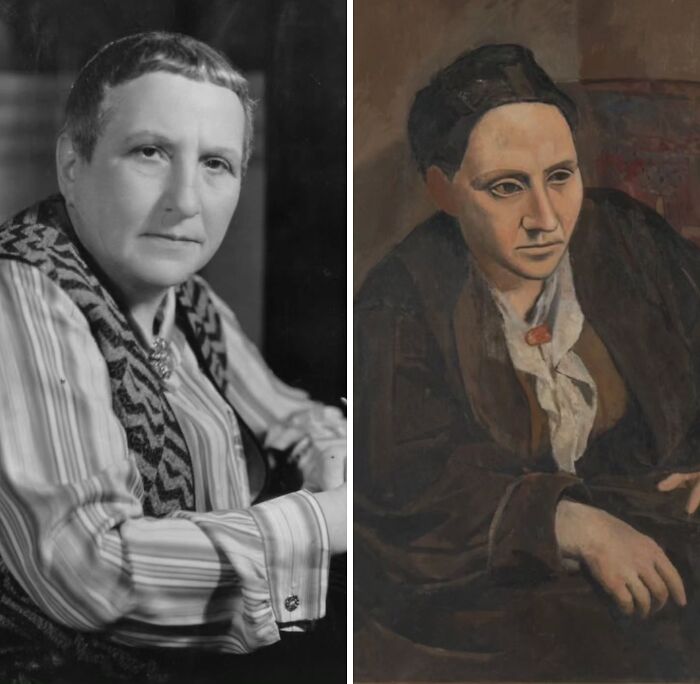
Image source: cool.stories.about.art
#10 Adeline Ravoux By Vincent Van Gogh, 1890
Adeline was the 13-year-old daughter of Arthur-Gustave Ravoux, the innkeeper whose family ran the inn in Auvers-sur-Oise where Van Gogh stayed during the final months of his life.
Adeline herself later recalled sitting for Van Gogh. She said he asked her permission to paint her, obtained her parents’ approval, and completed the portrait in a single afternoon. She remembered wearing a blue dress with a blue ribbon in her hair, and Van Gogh used blue extensively in both her clothing and the surrounding background.
The Cleveland Museum notes that Adeline wasn’t pleased with the portrait at the time and didn’t think it resembled her. Interestingly, a photograph of Adeline taken decades later shows a striking resemblance to Van Gogh’s painted version.
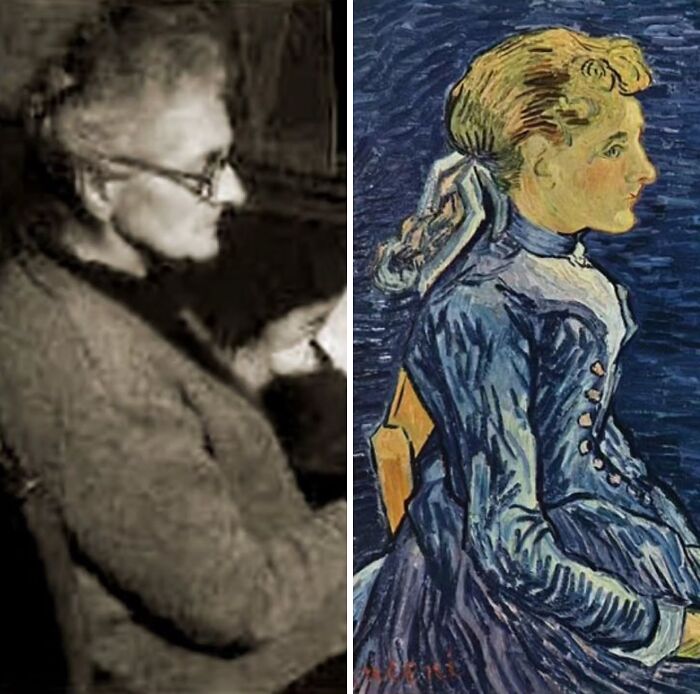
Image source: cool.stories.about.art
#11 Portrait Of Lydia Delectorskaya By Henri Matisse, 1947
Lydia was much more than a model. A Russian émigré, she first began working for Matisse and his wife in 1932, initially as a studio assistant and domestic worker. Matisse began asking her to pose for him a few years later, and she eventually became his principal model, studio assistant and secretary. She remained closely involved with him for the rest of his life.
Matisse became deeply familiar with her appearance and repeatedly returned to her as a subject. Christie’s notes that her distinctive features, particularly her almond-shaped eyes, thin nose and full lips, became important elements in his portraits of her.
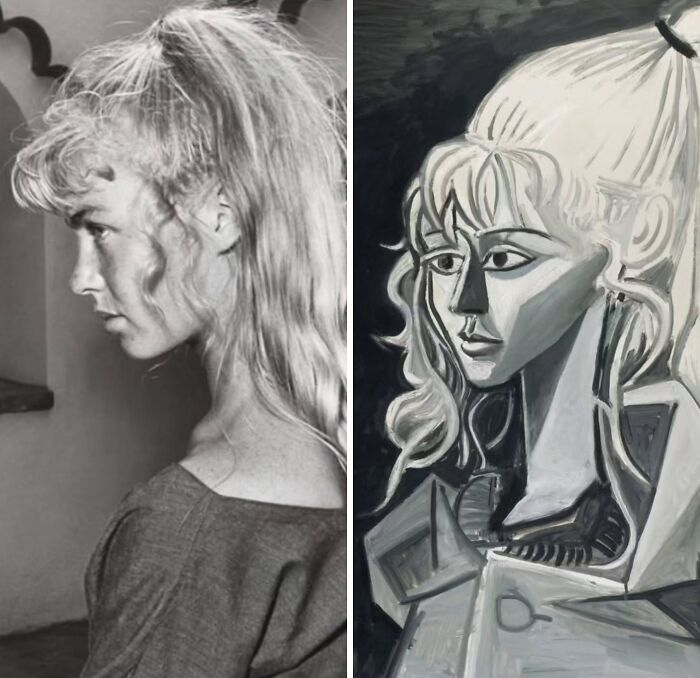
Image source: cool.stories.about.art
#12 Portrait Of Mucha’s Daughter, Jaroslava By Alfons Mucha, C. 1927–1935
Jaroslava Muchová was Mucha’s first child, born in 1909 in New York. She appears in a number of her father’s works and designs, and when Mucha was working on The Slav Epic in Zbiroh, she posed for his paintings and worked as his technical assistant. She later became a conservator of fine art.
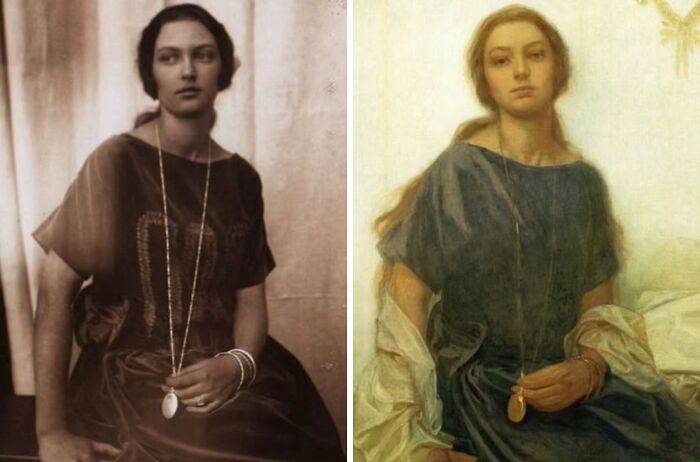
Image source: cool.stories.about.art
 Follow Us