Even though our universe is around 13.8 billion years old, it’s constantly growing, which is why most of us can barely keep up with all of its changes. Almost 95% of the cosmos still remains unknown to humankind, which makes it all the more mysterious and interesting.
Even though we laypeople might be in the dark about space, astronomers and cosmologists understand it so much better and are finally ready to reveal some of its secrets. Most of these facts about the universe might seem a bit baffling, so be prepared for a wild ride.
#1
An ancient Greek scientist calculated the size of the Earth using shadows. He was less than 1% off.
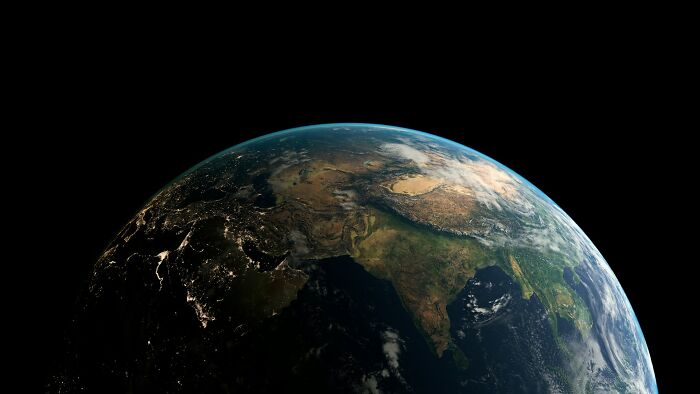
Image source: MatthewHecht, A Chosen Soul

#2
The fact that the Sun and the Moon appear roughly the same size in the sky is a complete cosmic coincidence. The Sun is 400x larger than the Moon in diameter, but it’s also 400x further away. We don’t know of any other Sun-Planet-Moon system that has this same 1:1 ratio. Experiencing a total solar eclipse — where a moon is just large enough to cover the star’s photosphere, but not so big that it blocks the view of the surrounding corona — is a Universally unique experience.
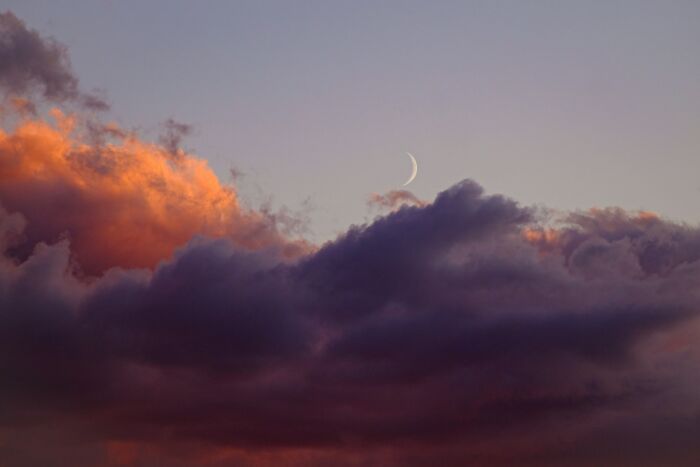
Image source: astronemma, Olena Karlyk
#3
We think of the moon as being very close but in reality the distance between Earth and the Moon is wide enough to fit all of the other planets in our solar system side by side.
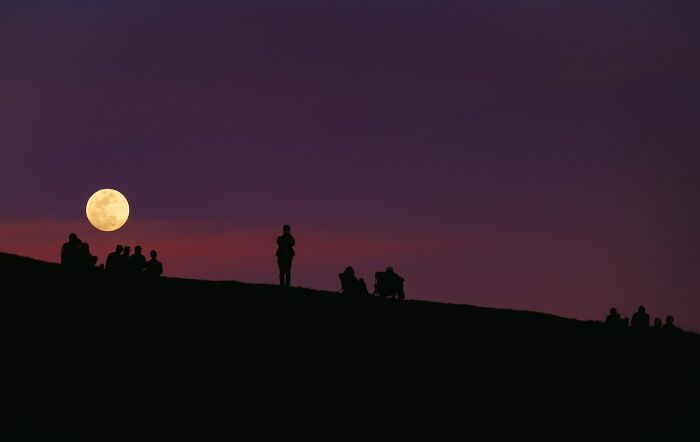
Image source: Ayvuir1, https://unsplash.com/photos/silhouette-of-group-of-people-under-purple-night-sky-x9TZjFdvr0Y
Space is huge, and it just seems to go on forever, and that’s kind of why it’s so hard to define clear limits for it. According to the Natural History Museum, outer space begins around 62 miles (100 kilometers) above Earth’s sea level, which is called the Kármán Line.
There is no exact point for it to start, but as you go higher in the sky, the Earth’s atmosphere thins, and that is considered space. What’s interesting is that our universe is constantly expanding, and the most distant galaxies are at least 13 and a half billion light-years away. It’s clear that the cosmos is full of interesting things, but what’s shocking is that we have yet to learn of many, including whether our universe is finite or infinite.
#4
There are more hydrogen atoms in a single molecule of water than there are stars in our entire solar system.

Image source: Ok_Ad_9188, Terry Vlisidis
#5
For the earth to become a black hole, it would have to be condensed down to about the radius of an olive.
For our solar system to become a black hole, it would have a radius of about 4km/6miles, about the radius of a mountain.
For the observable universe to become a black hole, the black hole maiE equates roughly to the observable universe.
Bonus: (Also, the largest black hole known has a radius bigger than entire orbit of Pluto around the sun.)
Edit: changed the observable universe to saying it measures roughly equal rather than larger.
Also, mea culpa, I read it the title quickly and didn’t realise it was specifically asking astronomers/cosmologists. Heavily interested in but definitely not one. Don’t listen to to me and downvote me to oblivion.

Image source: ToddUnctious, Lucio Patone
#6
Jupiter’s moon Europa is believed to contain more water than all of Earth’s oceans combined, despite only having roughly 1/68th the volume.
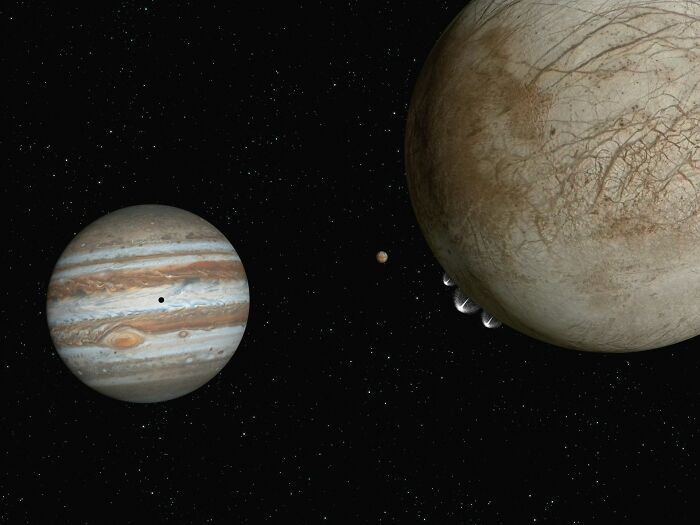
Image source: resh78255, NASA Hubble Space Telescope
You might have heard that there is no sound in space and that it’s absolutely quiet, but that is not exactly true. Research shared by the BBC’s ‘Sky at Night’ magazine explains that our ears perceive sound as a pressure wave that passes through some kind of medium and causes the small hairs and bones within to vibrate.
Since space isn’t a vacuum, except for areas in interstellar and intergalactic space, the electromagnetic vibrations can actually be experienced by humans. Within galaxies and nebulae, huge, swirling clouds of gas and dust can transmit pressure waves through their molecules, which can become sound. It’s also interesting to note that black holes make a low-pitched warbling sound that feels like it’s straight out of a sci-fi movie.
#7
The sheer scale of it.
100-400 billion stars in our galaxy alone. Estimated upwards of 2 trillion galaxies in the observable universe, which for all we know might only be a tiny fraction.
So that’s roughly 800,000,000,000,000,000,000,000 stars, each likely with planets, moons, and entire systems.
To quote Carl Sagan, we really are just a mote of dust suspended in a sunbeam.
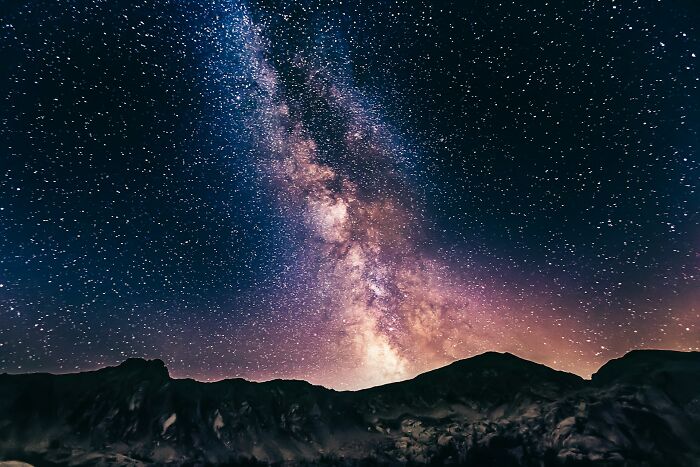
Image source: Physical_Studio6829, Dns Dgn
#8
Our galaxy, the Milky Way, and our nearest sizeable neighbor, the Andromeda Galaxy, are on a collision course, and they will eventually merge and form a new galaxy. But the space between individual stars is so vast that the expected number of collisions between a Milky Way star and an Andromeda star in the process is zero.
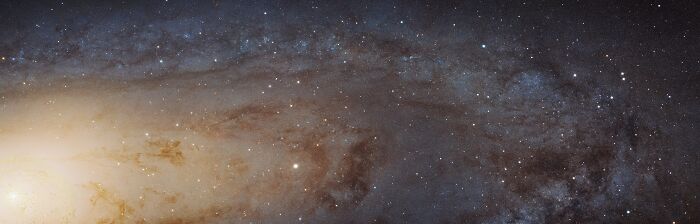
Image source: ProctologyExplosion, NASA
#9
“The nitrogen in our DNA, the calcium in our teeth, the iron in our blood, the carbon in our apple pies were made in the interiors of collapsing stars. We are made of star-stuff.”
– Carl Sagan.

Image source: bcramer0515, Priscilla Du Preez 🇨🇦
The moon is often seen as a loving companion of the Earth that controls the tides and provides beautiful cooling light to the planet. Even though this natural satellite seems round from our point of view, research has found it’s actually lemon-shaped, with flattened poles and bulges on both the near and far sides around its equator.
This interesting shape seems to have been created because of the Moon’s own spin and the tidal pull of the Earth. This might have happened when it was mostly liquid beneath a thin, rock-like crust, which could explain why it transformed this way.
#10
We haven’t found anywhere else in the universe that has fire. It’s a uniquely Earth thing.

Image source: TheDefected, Mike Erskine
#11
To calculate the circumference of a circle with a radius of 46 billion light years (the size of the known Universe) to an accuracy equal to the diameter of a hydrogen atom, you only need to use pi to 37 decimal places.
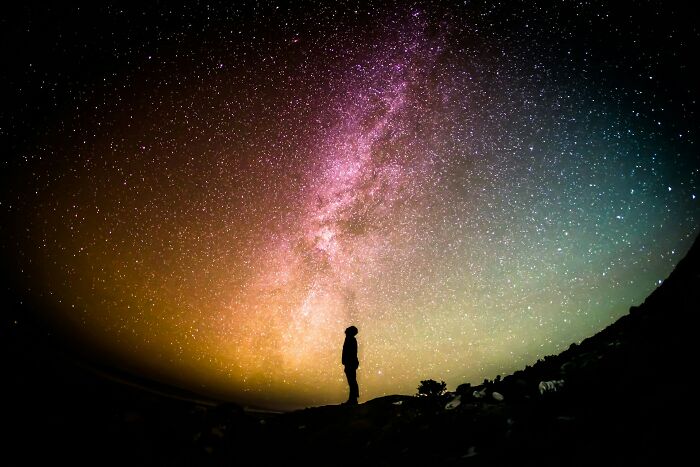
Image source: astronemma, Greg Rakozy
#12
Conditions on the surface of Venus differ radically from those on Earth because its dense atmosphere is 96.5% carbon dioxide, causing an intense greenhouse effect, with most of the remaining 3.5% being nitrogen. The surface pressure is 9.3 megapascals (93 bars), and the average surface temperature is 737 K (464 °C; 867 °F), above the critical points of both major constituents and making the surface atmosphere a supercritical fluid of mainly supercritical carbon dioxide and some supercritical nitrogen.
Image source: FiveCatPenagerie
Space seems full of beautiful things like galaxies, comets, and nebulas, but apparently there’s also a lot of junk floating around in it. According to National Geographic Kids, space debris refers to any machinery or trash left behind by humans, including old satellites, rockets, and even spanners that might have been dropped during the construction of the International Space Station.
Scientists estimate there are nearly 500,000 pieces of space junk today, and those in lower orbits might re-enter the atmosphere and burn up before reaching the ground. Anything left at higher altitudes like 22,369 miles (36,000 kilometers) might circle the Earth for hundreds or even thousands of years.
#13
Things that are farther away look smaller, right? So, galaxies that emitted light two billion years ago look smaller than the ones that emitted it one billion years ago, because they’re twice as far away.
Nothing unbelievable there.
Except, as you go back in time, that trend slows down, and eventually reverses. Galaxies that emitted light less than a billion years after the Big Bang are **bigger** in the night sky than ones that emitted it more recently.
Everything in the universe was a lot closer at the time, so as you look at light that was emitted soon after the Big Bang, the galaxies appear much larger in the sky.
Xkcd did a comic called “Angular Diameter Turnaround” illustrating the phenomenon.
Image source: Nimelennar
#14
The night sky isn’t dark. Trillions of stars are shining bright in our direction. We just can’t see the frequencies of light arriving here. The light has been “stretched” by the expansion of the universe, so it’s no longer within the range of the visible spectrum.
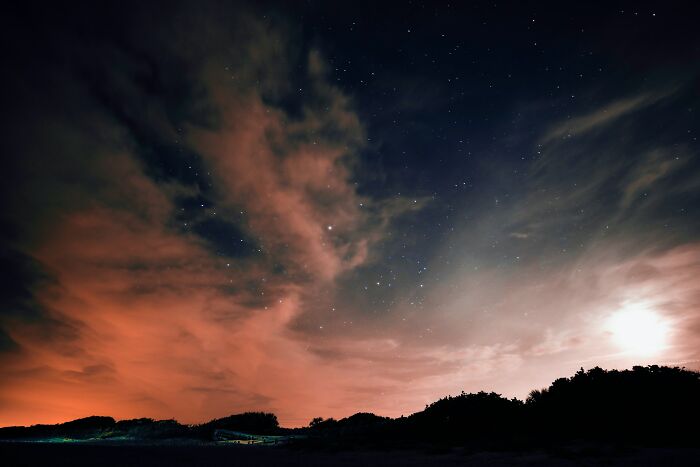
Image source: jayshareef, Aral Tasher
#15
Normal matter only accounts for around 5% of the contents of the Universe. Around 25% is Dark Matter — we can’t see it (ie it has no interaction with light) but we can see its indirect gravitational effects. And the rest is Dark Energy, completely unrelated to Dark Matter, that is the term we use for what is causing the expansion of the Universe to accelerate. (If you are wondering why energy counts as contents, think of E=mc^2, a simplified form of Einstein’s equation which links energy E and mass m).
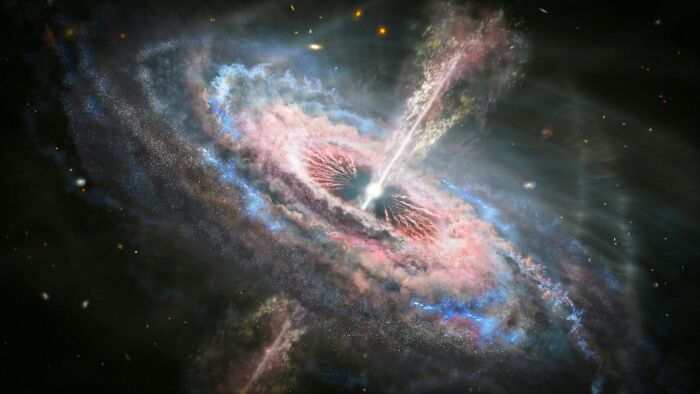
Image source: astronemma, NASA Hubble Space Telescope
Since the universe is so vast, space junk might not seem like a big deal, but every year, scientists have to perform hundreds of satellite collision-avoidance maneuvers. That’s why it’s important for us to take initiative and clear our atmosphere; one way might be for the United Nations to ask all companies to remove their satellites from orbit within 25 years after the end of their mission.
Another direct way to get rid of junk would be to find ways to drag it closer to our atmosphere, where it will burn up. There are many ways of doing this with nets, magnets, or even lasers, but whichever method is chosen must be sustainable in the long run.
#16
For every one of the roughly 436 quadrillion seconds since the Big Bang, there are roughly 160,000 stars. There’s roughly 1.6X as many planets as stars. For that reason alone, it’s highly improbable that we are alone in the universe.
Image source: MegaGrimer, Jeremy Thomas
#17
Photons do not experience time. Traving the speed of light causes them to hve 100% time dialation, so they experience the momment or their creation and absorbrion simultaneously.
Image source: Niro5, Aron Visuals
#18
If you could travel at the speed of light, you could circle the Earth 8 times in a single second, but it would take 8 minutes to get to the Sun and 4 years to get to our closest neighboring star. Space is so BIG that our minds struggle to comprehend it.
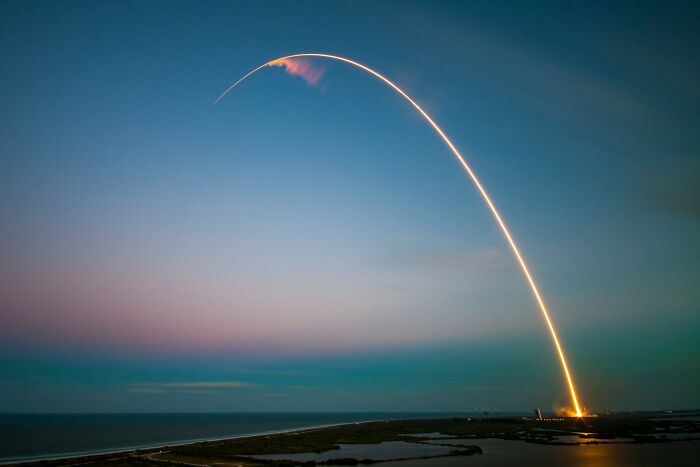
Image source: tallperson117, https://unsplash.com/photos/rocket-launch-light-trail-at-dusk–p-KCm6xB9I
Mars is known as the Red Planet because of the iron oxide in its soil, and this hue is visible to us from Earth even without a telescope. Despite its bright color, NASA researchers have shared that a blue sunrise is visible on it, which might seem bizarre to us humans.
Martian sunsets and sunrises are so distinctive because fine dust in the atmosphere lets only blue sunlight pass through. This becomes even more prominent against Mars’s color, and because the rest of the sky is usually yellow or orange.
#19
Here’s a crazy one: if you took all the DNA in your body and stretched it out end to end, it would be roughly 42 billion miles long. That’s enough to go from Earth to the Sun and back more than 200 times. All of that DNA is packed inside microscopic cells. .

Image source: MapWise3890, Getty Images
#20
I ain’t one but the fact that total solar eclipses are a super rare thing for a planet to have.
To specify: By “total solar eclipse” I meant how perfect they are here since you can see the corona.
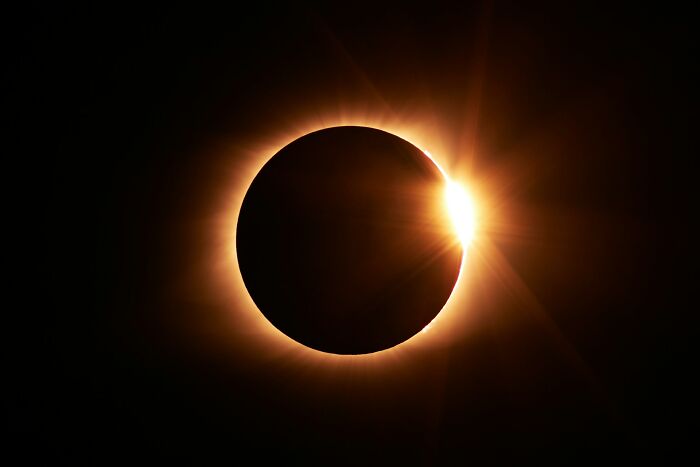
Image source: ThatOneGammaRay, Jongsun Lee
#21
There are more stars in the observable universe than there have been seconds since the big bang.
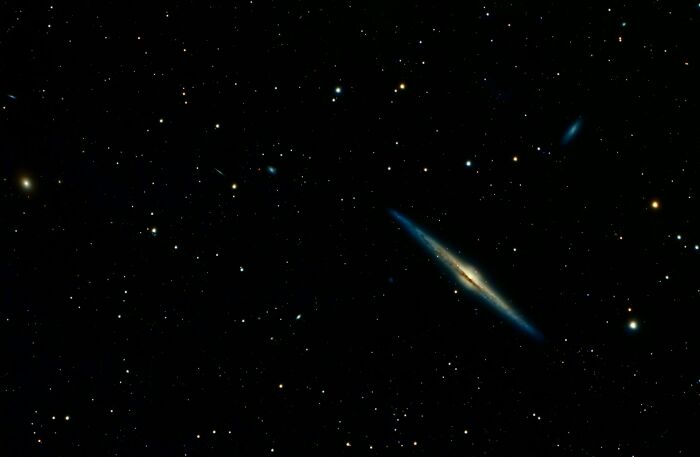
Image source: TheOrangePro, Guillermo Ferla
Everyone might have dreamed of going to space one day, but astronauts are the people who have had the chance to explore the universe. Beyond their incredible travel experience, going to space can also make astronauts grow about 2 inches (5 cm) taller.
Researchers have studied this slight height boost extensively, and ultrasound technology found that when the spine isn’t under Earth’s gravity, its vertebrae can expand and relax, making astronauts a little taller. Unfortunately, this change is short-lived: once they return to Earth, their height returns to normal after a few months.
#22
Every single planet in our solar system – including Jupiter, Saturn, Uranus, and Neptune – can easily fit in the space between Earth and the Moon at its apogee, with over 4,000 km to spare.
When we look at textbook illustrations, space feels crowded. In reality, the emptiness of the universe is horrifyingly massive.
Image source: ResourceFront5884, NASA
#23
The further out you look in space the faster things appear to be moving away from us. Some objects are flying away from us faster than the speed of light because the space between is actually growing that fast. The furthest objects appear more and more red until the wavelengths vanish into the infrared. Anything beyond this cosmic horizon will never be seen again.
Image source: thermalexposure
#24
Time didn’t always exist. It’s not a “brute fact”.
And there is no single “true” time in the universe. It’s different for all observers, depending on their movement through space.
Image source: ImprovementFar5054
Another interesting thing about astronauts is that they can’t burp in space, which might seem uncomfortable, but it’s because of the lack of gravity. This means that the air in their stomach doesn’t separate from ingested food and rise up and come out as it does for us.
Hearing this sound can be unpleasant for a lot of people, but for astronauts, if solids, liquids, and gases are all mixing around like that in their stomach, a burp could end up being vomit instead. This obviously would be an unpleasant experience for everyone, especially the unfortunate person who tried to burp.
#25
The energetic phase of the universe’s existence will be much, much shorter than the amount of time that will pass when all particles in existence are so distant from one another that interaction between them is impossible.
All the billions of stars, galaxies and everything in them are literally just very fleeting sparks in an almost unimaginably vast expanse of time.
Image source: NumbSurprise
#26
Not the ENTIRE universe but when atoms in the core of the Sun fuse and release energy, that energy bounces from atom to atom for hundreds of thousands of years until it reaches the surface then zips into space.
Image source: Fabulous-Pause4154
#27
Gravity has infinite range.
Image source: PuzzleheadedClue9837
There’s still so much about space that we are yet to figure out and observe, but what we already seem to know sometimes feels too big for our little brains to hold. With ever-changing galaxies, nebulas, and even stars, it’s great that you were able to understand a little bit of the universe as it is today. Who knows what it might be like tomorrow?
We’d love to hear any space facts you might have, especially ones that might seem sun-believable. Do share any interesting things with us in the comments below.
#28
We can tell how long ago the solar system formed by looking at ratios of radioactive isotopes in little glassy blobs called chondrules found inside meteorites.
Image source: Brruceling
#29
Due to quirks of speed, gravity, and space-time, If you could achieve constant acceleration, a young human could reach the edge of the observable universe within their lifetime. Meanwhile the sun would burn out during your trip.
Image source: JoeHio
#30
The Bing Bang happened everywhere at once. There is no center of the universe.
Image source: DeathMetal007
#31
Around 94% of all the stars that ever will exist already exist.
Image source: karl2025
#32
Light that originates from the core of the sun from fusion takes like 30,000 years to make its way outside of the sun, then to take 8 and a half or so minutes to make its way from the sun to us.
Image source: TahoeBennie
#33
The fact that we have measured the size of galactic super structures at all without ever leaving near Earth is incredible.
Image source: Shiftysan
#34
I always liked the one that goes: If you shrink the Milky Way down to the size of the United States of America, the center of it is roughly Kansas. Our solar system is roughly Denver, and the orbit of the planets around our sun is roughly the size of the swirls of your fingerprint.
EDIT: Denver is the location of our solar system in the same way that Kansas is the center of the Milky Way.
Image source: kicklucky
#35
Time dilation is real, measured, we even have to adjust satellites for it.
Relativity is weird, if you travelled at the speed of light to Proxima Centauri it would take 4.24 years for someone watching from Earth. For you, it would be instant. Time stops at the speed of light and time is causality.
Image source: Physical_Studio6829
#36
In cosmology, there is a certain factor in the equations of the universe known as w. Right now, we believe that w = -1. But if it’s less than -1, things could go very, VERY wrong with no warning.
The vacuum of space we now perceive could actually be a “false vacuum,” and if a bubble of true vacuum suddenly appeared–and there’s nothing to stop that from happening–then all matter would instantly fall apart inside that bubble…which expands outwards at the speed of light, so if it happened elsewhere, even a billion years ago (and a billion light years away), we could never see it coming. In an instant, we would just wink out of existence.
So, you know, sleep tight….
Image source: DrColdReality
#37
A **magnetar** is a highly magnetized neutron star. It is the ultra-dense core left behind when a massive star collapses.
A magnetar’s magnetic field is roughly a trillion times stronger than Earth’s. It is 100 million times stronger than the most powerful magnet engineered by humans.
If you came within 1,000 kilometers of a magnetar, the magnetic field would stretch your atoms into thin cylinders. Your basic chemistry would fail, and you would dissolve. If a magnetar were placed halfway to the moon, it would wipe all magnetic data on Earth.
Magnetars pack the mass of 1.5 suns into a sphere roughly 12 miles across. A single teaspoon of magnetar matter weighs about a billion tons.
A magnetar’s solid crust is under severe magnetic stress. When the crust snaps, it causes a starquake. This releases a massive burst of gamma rays. In 2004, a blast from a magnetar 50,000 light-years away hit our solar system. The radiation physically compressed Earth’s ionosphere and blinded several space satellites.
H/t to Phil Plait (“Bad Astronomy”) for introducing me to these monsters over a decade ago.
Image source: brownlawn
#38
The interior of the sun, is enormously hot and high pressure. The massive pressure rattles hydrogen atoms so hard that they can bump into each other and fuse into helium, releasing a bit of energy.
The sun produces so ridiculously much energy that even here on earth 150 million km away it can be blazingly hot in the midday sun.
But if you took 1m^3 of the sun’s core, and compared it to 1m^3 of human body, our human bodies actually output more energy per volume. It’s just that the sun’s core is unimaginably large. .
Image source: Stroop_Doop
#39
Some “95%” factoids :
95% of stars that have, or ever will be born have already been born. We are at the end of the age of star formation.
95% of all the stars / galaxies we can see are forever unreachable, even if we could travel at the speed of light due to the expansion of space.
95% of all the mass-energy in the universe is dark. All the light from all the stars and galaxies we see only make up 5 percent of the universe.
Image source: PuppiesAndPixels
#40
There are galaxies so far away that, because the universe’s expansion is accelerating, light they emit *today* will never reach us.
They are not outside the universe or hidden behind anything. They are simply receding so quickly that the gap grows faster than their future light can cross it.
Image source: yumi1115
#41
The nearest star is so far away that if the voyager II (the fastest and further away ship we have) was headed to it, it would take 82 THOUSAND years to get there.
Image source: Ztclose_Record_11
#42
From a photon’s “point of view” time and distance are zero.
(Photons cannot really have a POV since they don’t have a rest frame.)
So a photon emitted by a star a billion years ago would be absorbed by your eye with no time passing in between.
Image source: greenmeat3
#43
Black holes are the universe’s existential panic attacks, screaming so loudly that even light gets scared and freezes. They are cosmic vacuum cleaners with no off switch, running on a diet of pure time and regret. If you fell into one, you would be stretched into a single noodle of spaghetti, proving that the laws of physics ultimately prefer Italian cuisine over human geometry.
Image source: Unusual__League
#44
Every single electron in the universe is perfectly identical. They don’t have variations in size, mass, or electric charge.
Image source: MazzleMaze
#45
Time dilation and length contraction are like two sides of the same coin.
Observer sees the rocket on its way to Andromeda blasting past at 99 percent C and observes their time moving so slow its almost stopped.
Crew on the rocket time moves normally but due to length contraction arrive almost instantly. The rocket
turns around and returns to Earth again almost instantly, but the observer who saw them depart is
millions of years d**d.
Image source: Gloorplz
#46
The universe is expanding faster than the speed of light, which seems impossible but is backed by evidence.
Image source: MignonFlora
#47
The planet Pluto (never letting that go) was found because famed astronomer Percival Lowell calculated that the orbits of Uranus and Neptune were not quite right and something had to be pulling on them. A “human computer team” then calculated out where the missing planet (then called Planet X) should be and an observatory that Lowell built and that was named after him started to look for it in that area.
They actually captured pictures of it in 1915 but didn’t recognize what it was. Lowell died before Pluto was located, using his observatory and in the predicted location, in 1930.
This is where it gets weird.
Almost immediately scientists examining Pluto began questioning if it could truly be the object influencing the orbits of the two planets as the size continued to be revised downward. It took until the 70s for scientists to be able to properly figure out the mass of Pluto and to confirm that it was too small to have the expected gravitational pull on Uranus and Neptune. This left confusion as to what was causing the incorrect orbits of the two planets.
Scientists resumed the search for Planet X to resolve the calculations made by Lowell and his team.
In 1989 the data finally came in Voyager II came close enough to Neptune to give true values on its size and the revision led to re-running of the math and the correction of the orbital patterns. Planet X was determined to be a myth because the math no longer supported it.
However… how did Lowell and his team correctly predict, in the massive space in our solar system and, and based on totally incorrect math, where Pluto would be?
The idea that they were working from invalid data and yet still managed to find something in almost precisely the spot they predicted is insane.
And the Planet X theory is making a comeback now.
As we continue to find more and more objects in the outskirts of the system we are finding new equations that do not make sense. Objects moving in patterns that show some influence shaping their course that we have not seen.
There is Sedna, a dwarf planet with such an eccentric orbit that its course had to have been set by passing by a planet, but its course takes it too far from any of the planets to have had that influence.
There are clusters in the Kuiper Belt that indicate something is moving objects in several regions.
As of today, there are several theories that there may be objects larger than Earth out in the edges of the system that are quietly shuffling through and impacting the smaller bodies on the fringes.
Image source: Bogusboy77
#48
Orbital speed fact:
Orbit basically means ‘travel sideways so fast that even though you are always falling, the horizon falls as fast as you do.’
The International Space Station (or any other body in stable low earth orbit) travels so fast that in the time it takes a rifle bullet to cross a cricket pitch (~20 metres from one wicket to the other), the ISS would have crossed the entire stadium, grandstand, oval and all.
Image source: sirgog
#49
Amost everything we know about objects we can never visit comes from tiny signals: photon.
A photon can leave a distant galaxy billions of years ago, cross an almost unimaginable expanse of space, and eventually hit a detector on Earth. From that tiny piece of information – thanks to the efforts of researchers – we are able to infer the galaxy’s composition, motion, temperature, age, and sometimes even the presence of objects we cannot see.
We essentially reconstruct the universe from clues that have travelled across it to find us. I work with this data everyday yet it never fails to awe me.
Image source: SherDrome
#50
The light from the stars in the sky is from the past. Many aspects of the night sky are larger than a full moon, but our eyes can’t resolve them. You can apparently get the perspective of the earth flying through space in a meteor storm.
Image source: Geo_Music
#51
A meteor shower is most often the result of earth passing through the tail debris of a comet.
Image source: reflect-the-sun
#52
When we observe a photon from the CMB we are observing a photon produced in the youth of the Universe, billions of years ago. However, from the reference frame of this photon, it was just created and literally no time has passed for it.
Image source: Ih8P2W
#53
There is no scientific proof of passage of time. Time exists as a coordinate, but there isn’t a single formula or experiment that can prove that time actually flows. It’s just how we perceive it.
Image source: Tricky_Ordinary_4799
#54
Mass does not create gravity by bending space-time.
The space-time actually IS bent and we call the result mass and gravity.
Also there ist no matter in the universe. It is all just energy interacting on different levels. “Solid” ist just our description for the strong forces coupling the dots of energy (quarks, electrons).
So basically the universe ist just bent space-time, creating “mass” on one side of the medal and “energy” on the other. There is even a formular describing the connection. ;-).
Image source: unique-constraint
#55
We have no clue what ~95% of the observable universe is made out of.
Image source: Jezoreczek
#56
Not an astronomer, just a space nerd who falls down Wikipedia holes at 2am. The one that broke my brain: the observable universe is about 93 billion light-years across, but the universe is only 13.8 billion years old.
How? Nothing traveled faster than light. Space itself expanded between us while the light was traveling. So the light took 13.8 billion years to reach us, but the stuff that emitted it is now like 46 billion light-years away in every direction.
It’s like walking 10 miles on a moving walkway and ending up 20 miles from where you started. I still don’t fully accept it emotionally.
Image source: StunningAudience2974
#57
There is no true “now” in time. Now has no universal meaning. It makes no sense to even ask what is happening “now” in the Andromeda galaxy.
Image source: Vivid_Warning7982
#58
That even the known universe is much much bigger than the Big Bang Theory suggests it should be per the math. It is roughly 95-100 billion light years from side to side & it should be, in “reality”, about two thirds that size. There are so many awesome things like this btw, unexplainable to our ken.
Image source: anon
#59
People often underestimate distances in astronomy. The moon is so far from the Earth, you could put all the planets of our solar system between.
Also the evening star is actually Venus.
Image source: Archaros
#60
We’re closer to the size of the observable universe than to the Planck length.
Image source: nikolaibk
#61
Here’s something fun.
The Speed of the Universe and space itself expanding, is faster than the *speed of light itself* at this point.
If you want an explanation for this just ask, I can explain this one.
Image source: FIR3W0RKS
#62
The singularity of a black hole is more of a point in time rather than a point in space. Because their gravity is so intense, that the direction of time (which is always pointing forward) bends a bit and starts to point at the singularity. That’s mainly why nothing can escape. Once you cross the event horizon the singularity isn’t really a point in space you travel to, but becomes a point in time in your future; it would be like trying to escape from tomorrow afternoon. No matter how hard you tried or how much you moved in space, you would inevitably arrive at tomorrow afternoon eventually. Take this with a grain of salt tho bc this is also a massive oversimplification of the topic haha.
Image source: Vexymythoclasty
 Follow Us