For something as simple as a kiss, Gen Z apparently has a lot to think about.
A new survey has sparked a heated conversation after revealing that younger adults are increasingly overthinking romantic kissing, with some worrying about the “right moment,” their technique, and whether they have enough confidence to make a move.
And while many are horrified by the idea of a generation growing up without much kissing, young people have a very different explanation.
They say the modern dating world has made spontaneous intimacy feel far more complicated.
According to a survey, a “kissing recession” may be revealing something bigger about Gen Z

The numbers behind the controversy come from the 2026 Big Kiss Report, based on a YouGov survey of 2,078 UK adults conducted between May 15 and 18.
The report was a nationwide campaign and lifestyle study commissioned by the oral hygiene brand Waken Mouthcare.
More than a third of respondents, 35%, said they kiss romantically less often than they did five years ago, while 27% believed kissing has become less common in Britain.
Nearly one in five said they had not shared a romantic kiss in more than a year.
But the figures become particularly interesting among 18- to 24-year-olds.
40% said they overthink whether it is the “right moment” to kiss someone, 28% worry they are bad kissers, and 32% have avoided a kiss because they lacked confidence.


There is also an extremely modern problem getting in the way: mouths.
60% of 18- to 24-year-olds said they had avoided a romantic kiss because of concerns about their breath, the taste in their mouth, or dry mouth.
Across the entire sample, bad breath emerged as the biggest reported “kiss ki**er,” with 63% of respondents naming it as something that could ruin a romantic moment.
According to Arise News, Waken Creative Director Rylan said, “People definitely seem more in their heads about kissing now. Everyone’s analyzing the moment instead of just going for it. But at the same time, everyone still loves a good kiss.”
The company’s founder, Simon Duffy, meanwhile shared, “What comes through really clearly in the research is that confidence and self-consciousness are playing a much bigger role in intimacy than many people realize.”
Gen Z has a very different answer to the “why aren’t you kissing?” question

The reaction from young people has been almost as fascinating as the survey itself.
When news.com.au discussed the findings on its Unserious podcast, host Caleb Bond, himself a member of Gen Z, was apparently horrified by the revelation.
“We’re stuffed as a society! Gen Z have given up kissing, they’ve given up having s*x, they’ve given up drinking… they’ve given up doing anything,” he declared.
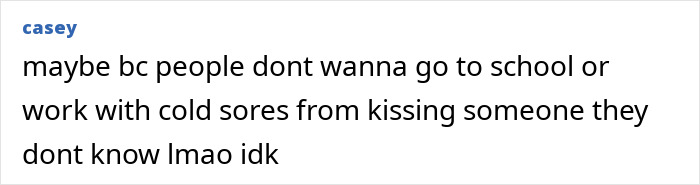
Some Gen Z commenters argued that avoiding a spontaneous kiss is not necessarily a sign of social decline.
It can be a conscious decision to avoid an uncomfortable, awkward, or potentially misread situation.
One commenter wrote, “If we do and it’s the wrong timing, wrong place, some story can be made that we have a**aulted them and were off to jail and thousands in fines so yeah, why would we risk it?”
Another argued, “Most couples used to meet at work or get introduced by family friends, but now we realize how f**ked it is trying to date co-workers, and none of our families socializes in person anymore.”
Dr. Candice Cooper-Lovett, a relationship expert with a PhD in Couples and Family Therapy, believes there may be several factors behind the hesitation.
“I believe there are likely multiple reasons why some Gen Z individuals might hesitate when it comes to kissing,” Cooper-Lovett told Bored Panda.
She pointed to “social anxiety, fear of rejection, uncertainty over whether someone will reciprocate,” less experience with spontaneous in-person flirting, and greater awareness of how differently the same interaction can be perceived.
“Many young adults are more cautious now, than at any point previously,” she said. “I attribute much of this to the fact that many young adults today, are highly sensitive to the idea that while a certain event/interaction may seem mutually desirable to one individual, it may not necessarily convey the same message to the other person.”

“Consequently, many young adults are inclined to pause before acting, as opposed to acting without forethought.”
Casual kissing traditionally relied on environments where strangers could actually meet, flirt, read one another’s body language, and take a chance.
S**ologist Dr. Jenn Kennedy believes some young adults may simply have missed opportunities to develop those skills naturally.
“Gen Z adults haven’t been raised with as many one-on-one interactions,” Kennedy told Bored Panda. “They missed the baby steps of fumbling, teenage exploration because often their whole maturation was delayed.”
The expert added, “They don’t kiss as a spontaneous act, but overthink and plan it like a grand, committed offering. They struggle more with intimacy of all sorts, so s**ual touch (kissing included) spikes anxiety about ‘getting it right’ and it meaning so much.”
If fewer young adults are drinking, clubbing, or meeting strangers face-to-face, there are simply fewer opportunities for those moments to happen.
And the decline in drinking among young people is not entirely imagined.
Research has documented substantial reductions in youth al**hol consumption across several high-income countries, although newer data suggests the trend is not uniform and may be changing as Gen Z gets older.
According to social theorist Sarah Stein Lubrano, as quoted by The Guardian, people are spending less time talking to strangers “or asking each other on dates,” leaving everyday social skills increasingly underused.
“If people don’t take even the risk of kissing, we’re really not going to take bigger, more important risks,” Lubrano said.
Research has also documented a decline in young adults’ s**ual activity in the US, with researchers pointing to factors such as relationship formation, economic insecurity, electronic media, and psychological distress as possible contributors.
From Britain, where the survey was conducted, to the rest of the world, intimacy itself may be changing drastically

Meanwhile, international research following the COVID-19 pandemic found changes in partnered s**ual and affectionate behaviors across a 26-country sample, showing just how much social disruption can affect physical intimacy.
That does not mean every young person is retreating from romance.
It does suggest that the environments in which intimacy develops are changing.
Moreover, the YouGov survey was conducted among UK adults, and the data cannot establish that Gen Z everywhere is kissing less.
But Britain is hardly the only country where young people’s relationships with dating, s*x, al**hol, and face-to-face socializing have changed.
The trend is even more pronounced in countries like Japan and South Korea, where millions of young adults are actively opting out of dating and physical contact entirely.
Evidence also suggests that the post-pandemic world has complicated physical connection in ways that cannot be reduced to one generation simply being “shy.”

Young adults spent formative years during a period when physical proximity was actively discouraged.
At the same time, dating moved further onto apps, social interaction became increasingly mediated through screens, and the cost of going out rose.
S*x and relationship expert Dr. Jessica O’Reilly told Bored Panda that dating apps and social media may have changed how young adults practice romantic communication before they ever meet in person.
“When so much early flirting happens through a screen, you may have fewer opportunities to practice reading all the cues that come with connecting face-to-face,” she said.
But she cautioned against viewing technology as entirely negative, noting that apps can also give people more opportunities to communicate their desires and boundaries before meeting.
One anonymous 24-year-old told The Guardian they had kissed only three times since their teens, adding that the thought of kissing someone they did not know made them “want to shrink away like a turtle.”

And O’Reilly does not believe the trend is necessarily a reason to panic.
“I wouldn’t sound the alarm over young people kissing less or waiting longer to become physically intimate,” she said.
“There’s no prescribed amount of kissing, s*x or physical affection required for a fulfilling romantic life. If they’re choosing what actually feels good and right for them rather than simply doing what they think they’re supposed to do, I see that as a positive shift.”
Ultimately, the “kissing recession” is not proof that Gen Z is broken, doomed, or “stuffed.”
But it does raise an uncomfortable question about what happens when a generation becomes increasingly comfortable communicating through screens while becoming less comfortable with the messy, unpredictable nature of connecting in person.
“We’re stuffed as a society…” Gen Z’s kissing crisis sparks panic among social media users










 Follow Us