When Janus Metz Pedersen’s UNABOMBER arrives on Netflix in September 2026, it will explore Ted Kaczynski’s story, alongside Henry Murray’s psychological experiments linked to his emergence as the Unabomber. Dubbed the Unabomber for targeting UNiversities and Airlines at the onset of his terror campaign, Kaczynski crafted and mailed bombs to people he believed were fostering technological advancement and the destruction of the natural environment. From May 1978 to April 1995, the Unabomber terrorized Americans with his homemade bombs, killing three people and injuring at least 23.
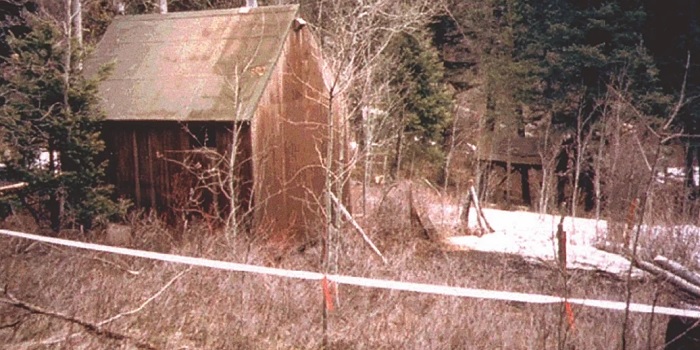
Before becoming a lone wolf terrorist, Ted Kaczynski was an assistant professor at UC Berkeley, where he taught mathematics. He abruptly resigned in June 1968, abandoned civilization, and moved into a remote cabin he built near Lincoln, Montana. From there, he carried out his terror campaign, rationalizing his murders as a necessary solution to the evils of science and technology. His reign of terror ended in April 1996 when the authorities raided his cabin. However, his arrest sparked a polarizing conversation about his sanity and what drove the brilliant mind to commit serial murder. Pedersen’s movie explored all of that, but here are facts that bring the true scale of his crime into perspective.
01. Investigators Couldn’t Crack The Case Until His Brother Came Forward
After targeting a flight from Chicago to Washington, D.C., an FBI-led task force code-named UNABOM was created to investigate and apprehend the individual behind the bombs. Ted Kaczynski’s bombs became more sophisticated over the years. Yet, the task force made no headway in uncovering the Unabomber’s identity. Kaczynski’s bombs were practically untraceable, and he left misleading clues to throw off the authorities. Worst still, he kept his evil deeds to himself, making it hard for the task force to get any meaningful lead, even when it offered a $1 million reward for useful information.
His undoing came when he began writing the media, discussing his motives while demanding the publication of his essay in a major newspaper. The FBI didn’t want to give in to a terrorist, but obliged after the task force’s recommendation to do so. The UNABOM task force hoped a reader might identify the author from the sentiments expressed in the essay. That reader was Ted’s brother, David Kaczynski.

02. Over $50 Million Was Spent Investigating The Unabomber
The Unabomber was a hard nut to crack. For nearly 18 years, the FBI-led UNABOM task force couldn’t uncover his identity until his brother recognized his writing and approached the authorities. Before that happened, the task force had spent at least $50 million investigating the case. “A task force involving the FBI, the Office of the Postal Inspector, and ATF spent more than $50 million tracking Kaczynski over the years,” reads an NCJRS report published in 2000. In the 18-year manhunt, the task force grew to a team of over 150 investigators, analysts, forensic scientists, and their like.
03. Ted Kaczynski Was Suspected Of Being The Zodiac Killer
After mailing 16 bombs and evading the authorities for many years, Ted Kaczynski’s arrest in April 1996 was a huge news story for multiple reasons. His identity and anti-technology ideology sparked a wave of debates, fueling speculations about the scope of his crimes. Notably, he was suspected of being the Zodiac Killer, who murdered no fewer than five people between 1968 and 1969 in the San Francisco Bay Area, where the Unabomber lived from 1967 to 1969.
The Zodiac Killer also wrote to the media, threatening bombings and more killings if the outlets failed to print his letters. Kaczynski was investigated as the Zodiac Killer but was eventually ruled out by the FBI and San Francisco Police Department. Among other reasons, the handwriting and fingerprints of the two killers weren’t similar. And the Unabomber wasn’t in California on some dates of the Zodiac Killer murders.
04. The FBI Probed His Connection To The Chicago Tylenol Murders
While serving his life sentence, the FBI tried to establish if the Unabomber had any connection to the Chicago Tylenol Murders. At least seven people died in 1982 after consuming acetaminophen capsules mixed with potassium cyanide. Ted Kaczynski lived in Chicago around the same time, where he began his terror campaign before spreading his wings to Utah, Vanderbilt, California, and Michigan. In 2011, the Unabomber offered to provide DNA samples to assist the Bureau’s investigation, but only if the government abandoned its decision to auction his personal effects. The government rejected his demands, and that was that. The Unabomber was never charged for the murders.
05. The Unabomber Struggled With Gender Dysphoria
The Unabomber’s rage was partly attributed to his gender dysphoria. In his 20s, Kaczynski endured a strong urge to change his gender identity. He was considering a sex change operation and decided to discuss his fantasies about being a woman with a psychiatrist. However, he backed out of this with a rage that made him realize he wanted to kill.
“I felt disgusted about what my uncontrolled sexual cravings had almost led me to do,” he wrote in his journal. “And I felt humiliated, and I violently hated the psychiatrist. Just then there came a major turning point in my life. Like a Phoenix, I burst from the ashes of my despair to a glorious new hope.” This hope was the resolve to take his rage out on others. “I will kill, but I will make at least some effort to avoid detection so that I can kill again,” he promised himself. Check out the real-life inspiration behind Disclosure Day, Steven Spielberg’s new alien movie.
 Follow Us


