Benjamin Franklin is perhaps the most aggressively mythologized man in American history, which is an extraordinarily competitive category. He flies his kite, he founds his nation, he grins from your wallet, and he sits comfortably in the imagination of every conservative commentator who has ever used the phrase “the Founders intended” without troubling themselves too much with what the Founders actually said.
Franklin is their guy. Wise, godly, industrious, moral. A man of the people. A true American. He was also the man who wrote a scientific essay arguing that humanity’s most urgent intellectual priority should be making flatulence smell better. So.
The distance between the Benjamin Franklin of national mythology and the Benjamin Franklin of historical record is not a short walk. It is, in fact, a journey of such considerable length and scenic interest that it deserves its own guided tour. Because the real Franklin, brilliant, contradictory, deeply weird, occasionally monstrous, and almost always fascinating, would not survive a single news cycle in the current political climate. He would be canceled before the kite left the ground.
Buckle up, because the man on your hundred-dollar bill had bodies in his basement, doubted the divinity of Jesus, owned enslaved people, wrote a detailed letter advising a young man on the merits of sleeping with older women, and spent his mornings sitting naked in front of open windows in the name of personal wellness. And that is before we get to the racism. Which we will absolutely be getting to.
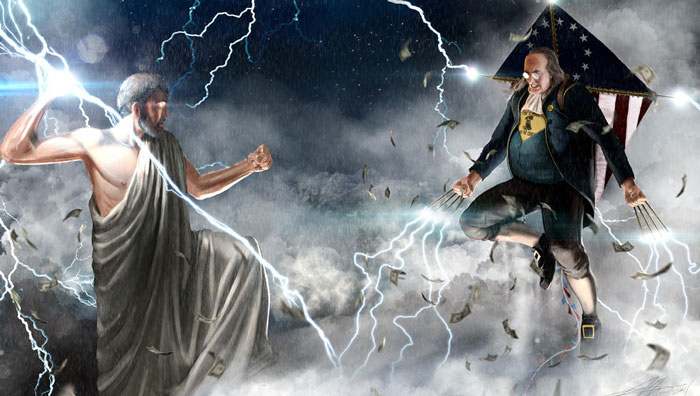
Image credits: SharpWriter / DeviantArt
Religious red flags
Let us begin where it will hurt the most, which is religion. Benjamin Franklin is routinely claimed by the American Christian right as evidence that the Founding Fathers built their nation on Christian values. His face appears in religious publications alongside quotes about providence and virtue. He is, in the popular imagination, a man of deep and conventional faith.
He was nothing of the sort. Franklin was a Deist, someone who believes in a creator God but considers organized religion largely man-made, miracles deeply suspicious, and the divinity of Jesus unprovable at best. In a letter written to Ezra Stiles just weeks before his death in 1790, Franklin was asked directly about his views on Jesus Christ.
His response was diplomatic evasion 101: “I have…some doubts as to his divinity; though it is a question I do not dogmatize upon, having never studied it, and think it needless to busy myself with it now, when I expect soon an opportunity of knowing the truth with less trouble.”
He was 84 years old and dying, and he still couldn’t quite commit to the Jesus question. “I’ll find out soon enough” is not the deathbed testimony of a man of devout Christian faith. It is, however, the testimony of a man who was extraordinarily good at keeping all available doors open, a skill he deployed, as we shall see, across multiple areas of his life.
Franklin attended church rarely, dismissed organized religion as useful for controlling the masses but unnecessary for genuine moral living, and was a proud Freemason for most of his adult life. This is an affiliation that has historically sent the Christian establishment into considerable agitation. The Founders built a secular republic, and Franklin was perhaps its most enthusiastic architect.

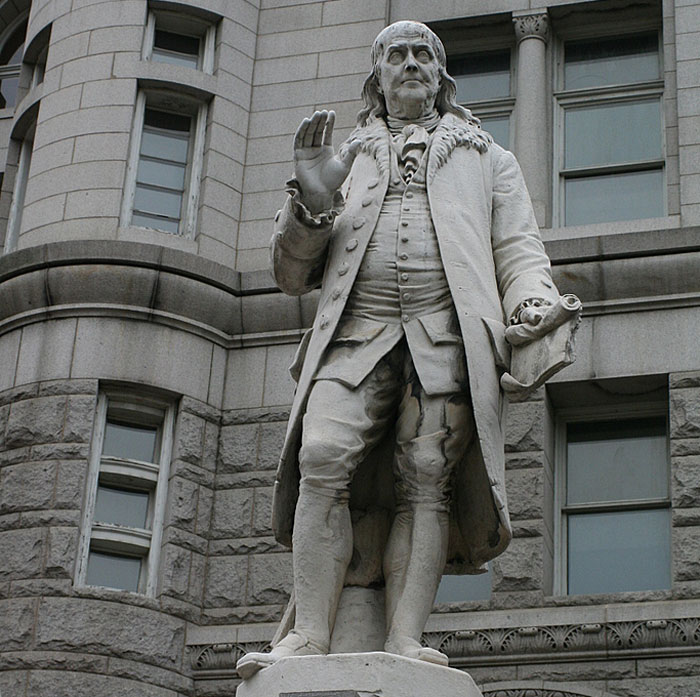
Image credits: Gregory.lussier / Wikipedia
The slavery smudge on his record
This one requires no dramatic framing, because the facts are dramatic enough on their own. Benjamin Franklin owned enslaved people. For most of his adult life, he kept enslaved individuals, named George and King, as household servants, and he published advertisements in his Pennsylvania Gazette for the sale and capture of enslaved people without apparent moral crisis.
The late conversion matters as Franklin did eventually become president of the Pennsylvania Abolition Society in 1787 and submitted a petition to Congress arguing for the end of slavery in 1790. But it came after decades of direct participation in the institution. His admirers tend to lead with the conversion. History insists we note the decades.
What makes Franklin’s slaveholding particularly complicated is that he was, simultaneously, writing extensively about liberty, natural rights, and the essential dignity of man. The cognitive architecture required to hold those two positions, freedom as humanity’s birthright and the ownership of human beings as a personal convenience, is something American mythology has never quite worked out how to address. It tends to solve the problem by simply not mentioning one half of the equation.
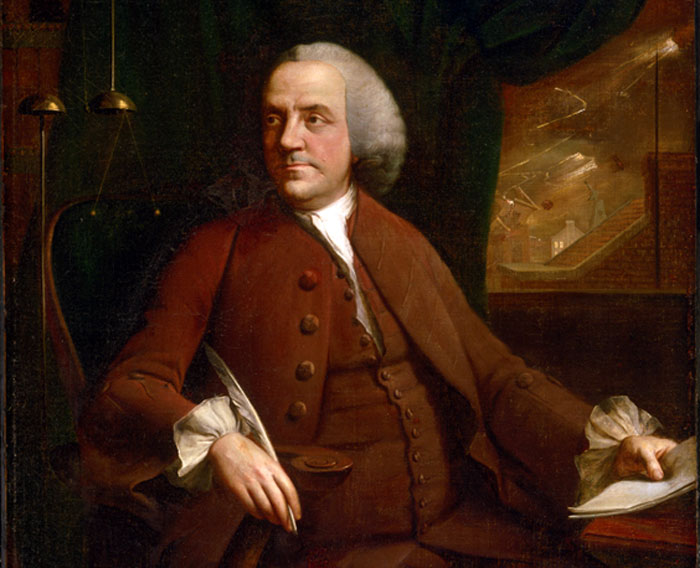
Image credits: Mason Chamberlin / Philadelphia Museum of Art
How to catch a mistress
In 1745, Benjamin Franklin wrote a letter to a young male friend who had apparently asked for his advice on matters of the heart, or, more accurately, matters considerably south of the heart. The letter, known to history as “Advice on Choosing a Mistress,” is a document of such spectacular candor that it reads, even now, as deeply alarming.
Franklin’s central argument was that if a young man was determined to pursue an extramarital arrangement, which Franklin clearly considered inevitable, he should under all circumstances choose an older woman over a younger one. He provided eight reasons for this position, ranging from the practical (older women have better conversation) to the philosophical (their gratitude is more reliable) to the genuinely startling.
Reason number five noted that older women are less likely to produce illegitimate children, which, coming from a man who had at least one illegitimate child of his own (his son William, whose mother remains unknown to history), suggests the complete absence of self-awareness.
The letter’s final line has become one of the most quoted and least contextualized sentences in Franklin’s entire oeuvre: older women, he concluded, are so grateful. Benjamin Franklin, Father of the Nation, was essentially writing a field guide to the situationship. Some things, it turns out, are timeless.

Image credits: Joseph Corl / Unsplash
What’s In Your Basement, Ben
In 1998, workers renovating Franklin’s former London home at 36 Craven Street made a discovery that would have ended the career of any modern politician before the press conference finished. Buried beneath the house were approximately 1,200 pieces of human bone, belonging to at least ten individuals, six of them children.
The explanation, historians assure us, is relatively mundane by eighteenth-century standards: Franklin’s young Scottish friend William Hewson was operating an anatomy school from the property and required cadavers, which in the 1760s meant grave robbery, since legal acquisition of bodies for scientific study was essentially impossible. The bones were almost certainly stolen from nearby cemeteries and dissected for medical education.
Almost certainly. And Franklin almost certainly knew. His response to this particular piece of information is unrecorded, so we can only use our imagination when it comes to his level of involvement. The Craven Street Bones, as they are cheerfully known, now sit in the Benjamin Franklin House museum, which to its considerable credit displays them openly and explains the history with commendable transparency. This is more than can be said for most of Franklin’s modern admirers.
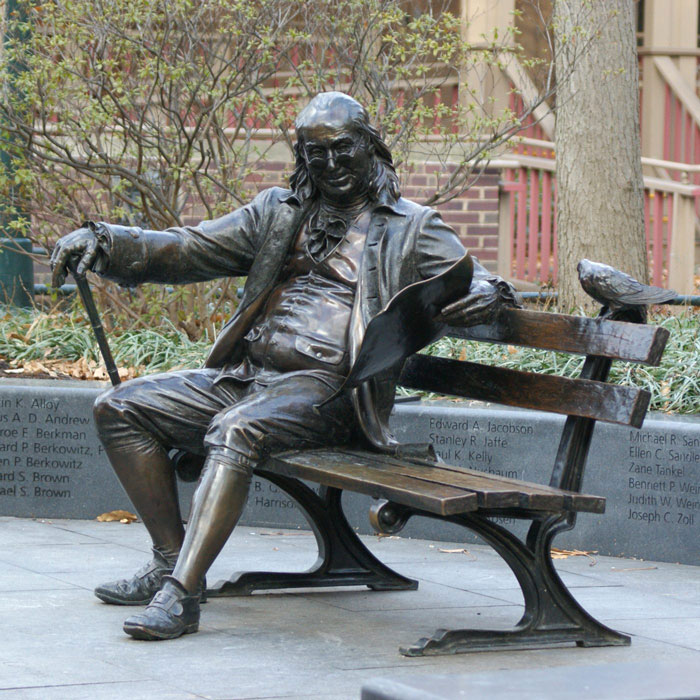
Image credits: George Lundeen / Association for Public Art
Fart Proudly
We cannot, in good conscience, write about the real Benjamin Franklin without addressing the flatulence essay, because it is perhaps the purest expression of who he actually was: a man of enormous intellect, irreverent wit, and a complete unwillingness to take himself seriously in the way that history insists on taking him.
Around 1781, while serving as American ambassador to France, Franklin wrote a satirical letter, titled officially “To the Royal Academy of Brussels” and unofficially, and gloriously, “Fart Proudly.” In it, he argued that scientific academies were wasting their time on abstract theories when they could be solving a problem that affected every single human being on earth: the social inconvenience of intestinal gas.
He proposed a research program into dietary supplements that would render flatulence not merely inoffensive but actively pleasant. He was thorough and detailed. He was a founding father of a nation, and he was writing, with great seriousness, about making farts smell like perfume.
The essay was never published in his lifetime, which might have been a small mercy. It exists in the historical record as proof that the man who negotiated the Treaty of Paris and invented the lightning rod also spent his ambassadorial downtime writing scatological comedy. He was impossible to fully categorize.
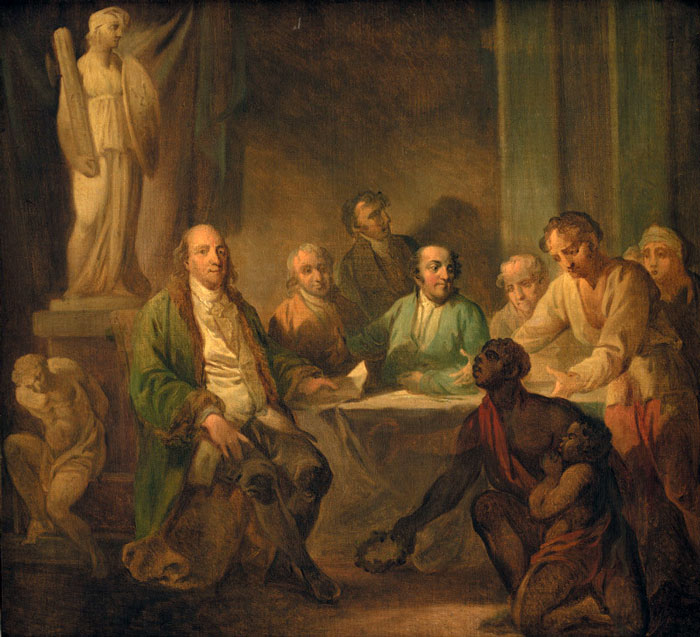
Image credits: Christian August Lorentzen / SMK.DK
His racial views that are easily forgotten
In 1751, Franklin published “Observations Concerning the Increase of Mankind,” an essay that contains passages so starkly at odds with his mythological status that they merit direct quotation. Franklin expressed explicit concern about immigration, specifically German immigration into Pennsylvania, because it would, in his words, “darken” the complexion of the population. In a 1753 letter to Peter Collinson, he went further, calling the immigrants “generally of the most ignorant Stupid Sort of their own Nation”.
He referred to most of the world’s people as “swarthy,” questioned why America should be “blacked” or “tawny,” and expressed his preference for preserving what he called the “lovely white” complexion of the Anglo-Saxon people. He later expressed some regret about the essay, though characteristically, Franklin’s version of regret was quiet repositioning.
When Franklin oversaw later republications of his writings, he quietly scrubbed the offensive closing paragraphs regarding the “swarthy” nature of Germans from his work. He seemingly realised his views were those of a man who had not spent much time outside Pennsylvania’s borders. His years in London and Paris appear to have genuinely broadened his worldview; exposure to Enlightenment thinking in France in particular seemed to soften the harder edges of his earlier nativism.
His eventual and genuine conversion to abolitionism, culminating in his presidency of the Pennsylvania Abolition Society in 1787 and a formal anti-slavery petition to Congress just weeks before his death in 1790, suggests a man capable of real moral evolution. But evolution is not the same as accountability. Franklin never publicly repudiated the 1751 essay.
He never named it directly as a failure of character. He simply moved forward, leaving the document in the historical record like a chair pushed quietly into a corner of a room nobody was supposed to enter. The Benjamin Franklin who belongs to conservative mythology as a champion of universal liberty wrote a document that reads like a brief for ethnic nationalism, and that can’t be redacted.
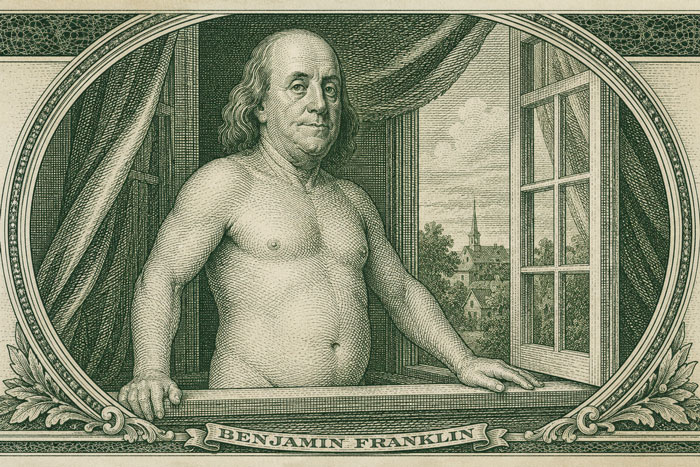
Image credits: AI generated image
Air bathing
Finally, and perhaps most humanisingly, Benjamin Franklin began most of his mornings by sitting naked in front of open windows for extended periods, a practice he called his “air bath” and which he credited for his considerable vitality and health. He believed the circulation of cold air across the unclothed body was essential for wellbeing, and he practiced this with more dedication than he did religion.
His neighbors in both London and Philadelphia were presumably less enthusiastic about this particular wellness routine, though one imagines they were too intimidated by his accumulated stature as inventor, statesman, philosopher, and bestselling author to raise the matter directly.
Maybe he was the founding father we deserved
Benjamin Franklin was a genius. He was also a slaveholder, a Deist who would horrify the Christians who claim him, a man with a documented interest in older mistresses and suspicious basement archaeology, the proud author of a flatulence manifesto, and a wellness enthusiast whose morning routine would get him on the registry.
He was, in other words, a human being — spectacularly talented, genuinely contradictory, and almost entirely incompatible with the flat, laminated, wallet-sized version of himself that American mythology has been carrying around for two and a half centuries.
The real Benjamin Franklin is far more interesting than the myth. He is also, it must be said, considerably harder to put on currency. Though given that he apparently had no objection to farts, he might have found the whole thing rather funny.
 Follow Us