In 2023, bystanders saw a Canberra teen inhale from a balloon, then accelerate his Holden Commodore through oncoming traffic and directly into a pond. First responders arrived within minutes, finding the car so deeply submerged that the young man could not be saved. Divers later pulled his body from the still-submerged vehicle. A coroner found that his cognitive function must have been seriously impaired by the overuse of nitrous oxide.
It can be purchased without restrictions in the United States and is found everywhere from dentists’ offices to whipped cream canisters, like in the case of an Ohio University fraternity pledge, Collin Wiant. He was subject to a brutal fraternity initiation, being forced to take substances and perform menial tasks for Sigma Pi members. Around November 2018, 911 was called, and when paramedics found him, he had already passed away. A toxicology report ruled the cause as “asphyxiation due to nitrous oxide ingestion.”
Neither of these young men passed away from an illegally obtained substance. Both ended up inflicting neurological damage on themselves with the same gas that was previously contained in the now-discarded whipped-cream chargers sometimes strewn about outside of nightclubs or on park lawns. Nitrous oxide, sometimes called Nos, nangs or whippets, is readily available for purchase at stores, gas stations, smoke shops, and even online, through Amazon. Despite being aware of nitrous oxide’s ability to cause irreversible neurological damage to the point of being fatal, lawmakers have been tackling it piecemeal, at a glacial pace.
Getting high on nitrous oxide means inhaling from a balloon or a whipped cream canister, and the way it’s done is central to why it’s so easy to overdo
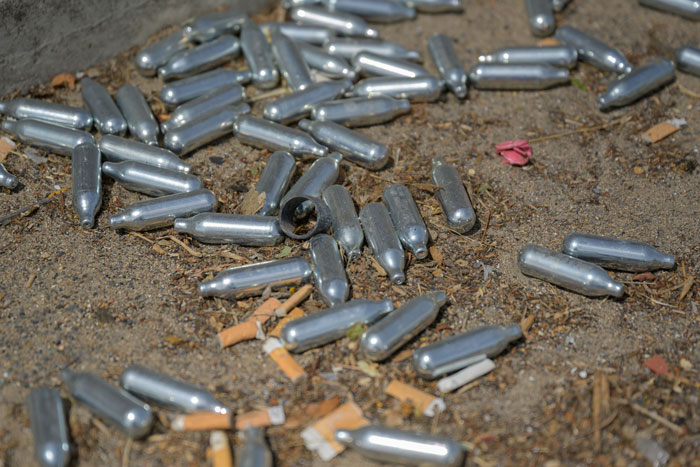
Image credits: Malcolm P Chapman / Getty Images (not the actual photo)

The high lasts about thirty seconds, and with roughly eighty hits in a single canister, the whole point is to inhale again and again
A typical user will purchase nitrous oxide in a tank or, sometimes, in packs of tiny canisters. It’s often stored at very low temperatures, so they will then inhale the colorless gas through a balloon or a repurposed whipped cream canister to avoid internal frostbite. As it enters their lungs, it will make its way into the bloodstream, causing a nearly immediate high.
People report euphoria, relaxation, and sometimes fits of giggles, which is why it’s sometimes called “laughing gas.” This high will last about thirty seconds. This, coupled with the fact that most canisters have approximately 80 uses, means that it will be inhaled again and again in a short period of time.
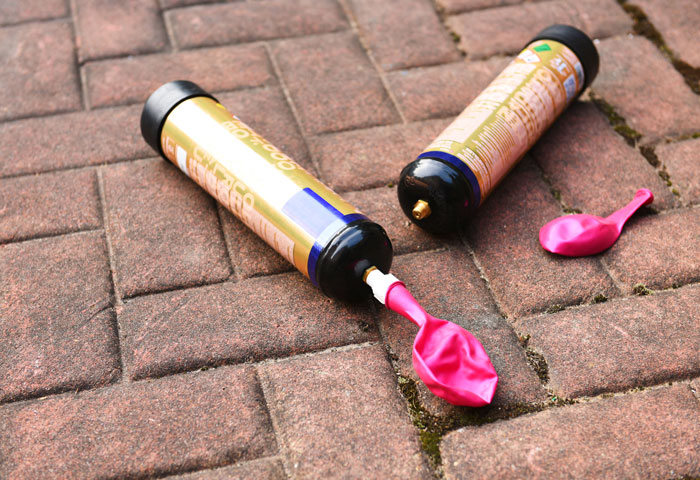
Image credits: Peter Dazeley / Getty Images (not the actual photo)
While the high feels harmless, the gas is quietly inactivating the vitamin B12 users need, and what makes it dangerous is that it’s cheap, legal, and everywhere
While the user is getting high, most remain blissfully unaware that nitrous oxide also inactivates vitamin B12, which, in time, begins to cause serious, irreversible neurological damage. In time, a regular nitrous oxide junkie will begin to exhibit symptoms of a B12 deficiency, starting with anemia and going all the way up to full-body paralysis.
Many users are ignorant of the dangers of abusing nitrous oxide. Londoner Kerry-Anne Donaldson abused nitrous oxide for five years, until she was hospitalized for numbness in her limbs. There she learned that she had suffered permanent nerve damage and would be wheelchair bound for the rest of her life.
The underlying issue is that many users aren’t entirely aware of the risks, treating nitrous oxide as just another method to get high. What sets it apart is accessibility. It’s openly sold in various locations, it’s cheap, and easy to use. It can be impulse bought. The high is short enough that the user might chase it again and again immediately after it wears off.
Since 2022, some sellers have started to offer even larger canisters, containing around 600 grams of nitrous oxide. They are often sold in colorful packaging, with names like “Galaxy gas” and “Hot whip.” It’s easy to imagine someone chasing a high to assume that anything being sold in a gas station can’t be that bad.
They might even see it as a “healthier” alternative to better-known controlled substances. All these conditions come together to make a drug that can be abused repeatedly in one session. A study published in Regulatory Toxicology and Pharmacology suggested that many users will take ten or fewer balloons per “session.”
The gas itself has actual uses, making it hard to just outright outlaw it. Some countries have taken steps to instead try to limit people’s access. Australia, where its canisters are commonly referred to as nangs, has made it a criminal offense to use them recreationally, although it can still be purchased for food preparation. Germany has made it illegal for minors to purchase nitrous oxide in any form.
The United States has been lagging behind. The FDA only got around to making an official recommendation against recreational use in 2025, naming the stores and vendors that sold it, including giants like Walmart and Amazon.
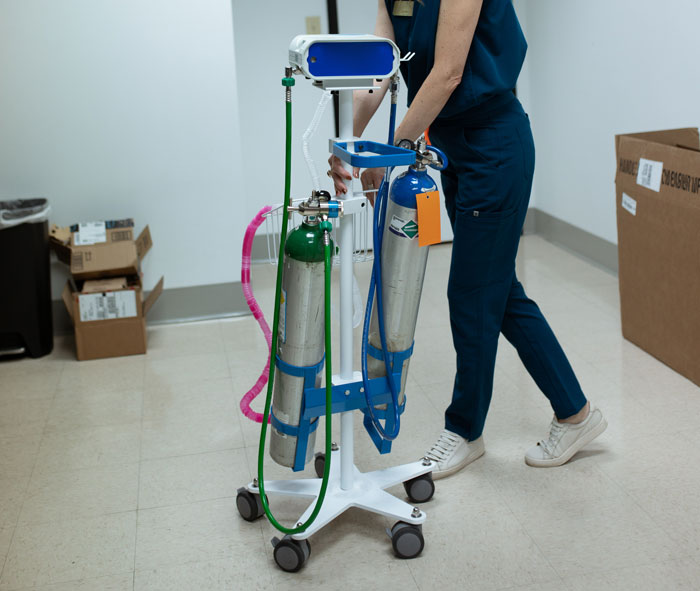
Image credits: Tatsiana Volkava/ Getty Images (not the actual photo)
Because the gas has real, legitimate uses, governments have struggled to regulate it, and the US has moved slower than almost anyone despite decades of clear evidence
However, it’s still entirely legal to buy and sell it, although some states have banned the sale of nitrous oxide to minors. The states in question are New York (under 21), Oregon (under 18, effective Jan 1, 2026), California (under 18), and Washington (also since 2026). There is solid evidence that nitrous oxide has been used as a recreational drug since the 1970s in the United States and Canada. People have known about its ability to induce euphoria since the 1800s, when chemists would offer their services at parties. That’s nearly a sixty-year gap between understanding the risks and taking any steps.
Lawmakers can’t claim ignorance, as the dangers posed by abusing nitrous oxide have been studied for multiple decades. Research on US nitrous oxide mortality found that more and more people are dying from overdoses since 2010, although the death rate has leveled out since 2023. At the same time, there has been little regulatory action to limit its recreational use. The typical nitrous oxide user probably won’t die, but permanent nerve damage is still a serious issue, particularly for Americans who live in car-centric cities.
At the same time, it’s very difficult to ban the sale of nitrous oxide, as it still has legitimate uses. Lawmakers have the unfortunate task of trying to work out a method of limiting sales on a good where it can be hard to know the intent of the buyer or seller. This is the position retailers take, arguing that they can’t just interrogate every buyer.
In cases where regulators do put some limited pressure on retailers by making them potentially liable, buyers will simply lie that they are purchasing it for food preparation. At the same time, distributors are well aware of who is buying nitrous oxide and why they want it, producing colorful cans and flavored variations, to be sold alongside vapes in smoke shops.
Until there is a simple, scalable method to limit recreational users from purchasing nitrous oxide, regulators should consider limiting the damage. Lawmakers have to tackle educating the public about what actually happens when a person frequently abuses nitrous oxide. Until then, there will be more young lives, like Collin Wiant’s and Kerry-Anne Donaldson’s, cut short.
 Follow Us