With today’s 24/7 news cycle, it’s hard to keep up with everything that’s going on. And it’s even more challenging to learn about the past while history is unfolding right in front of our eyes. But if you’re interested in learning about historical items that you probably didn’t hear about in school, you’ve come to the right place, pandas.
We visited the Historical Marvels Facebook group and compiled a list of their most fascinating posts below. From incredible archeological finds to fun facts about the most interesting locations on Earth, we hope you enjoy scrolling through these posts. And be sure to upvote the ones that teach you something new!
#1
The fabric appears weightless, the material is not. In 1869, Italian sculptor Giovanni Battista Lombardi carved the “Veiled Woman” from a single block of marble, shaping a translucent veil over the figure’s face. The folds press against the nose, lips, and chin while lace details gather at the chest.
The illusion comes from carefully thinning the marble and smoothing transitions so light diffuses across the surface. The result resembles soft cloth despite the solid stone beneath. The sculpture relies on subtle depth changes measured in millimeters.
The technique is documented in 19th-century academic sculpture. The visual effect remains striking. The balance between fragility and structural strength leaves the execution difficult to fully explain.
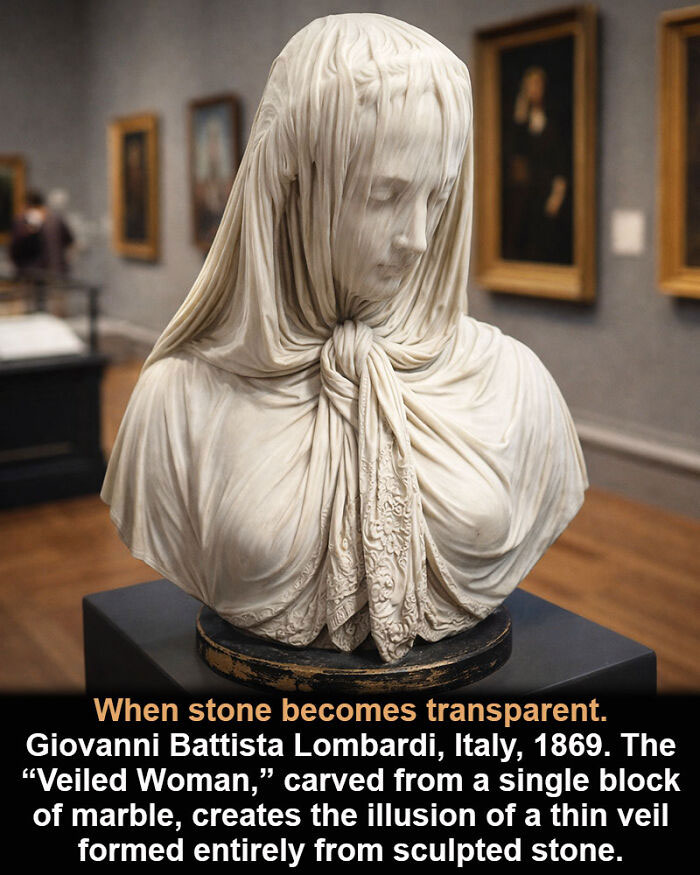
Image source: Cristian Ionut Ceausu

#2
The statue looked solid; the scan showed a body. In 2015, a CT examination of a 1,000-year-old Chinese Buddha sculpture revealed a mummified monk seated inside in lotus position. Researchers identified the remains as Liuquan, associated with the Chinese Meditation School. The figure was not merely symbolic. It enclosed a preserved individual.
Imaging showed skeletal structure and internal material consistent with intentional preparation. The body appears carefully positioned before the statue was sealed, transforming the sculpture into both a devotional image and a physical reliquary. The discovery connects craftsmanship with ritual practice rather than simple funerary placement.
The scan confirms the presence and arrangement, but the full sequence remains unclear. It is uncertain how long the process lasted or how widely the practice occurred. The statue survives. The ritual behind it remains partly unresolved.
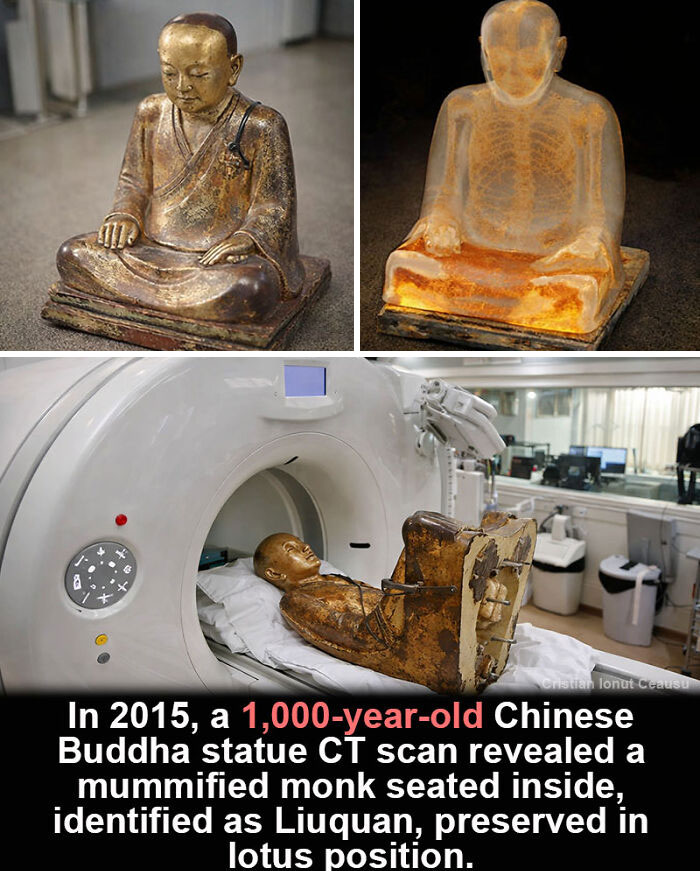
Image source: Cristian Ionut Ceausu
#3
A famous epic reduced to almost invisible writing. In the 16th century, an extraordinary miniature manuscript was created containing Dante Alighieri’s Divine Comedy, the monumental poem that shaped Italian literature during the late Middle Ages. The book is now preserved in the Austrian National Library in Vienna, where it remains one of the smallest manuscripts of its kind.
Despite its tiny size, the manuscript contains the entire work written in Italian. The lettering is so small that it can barely be read with the naked eye, requiring magnification to distinguish individual characters. Yet the pages do not contain text alone. Tiny pen drawings accompany sections of the poem, executed with a precision that matches the microscopic calligraphy.
Creating such a manuscript demanded remarkable control of the hand and extraordinary patience. Every letter had to remain legible at a scale far smaller than typical Renaissance script, while the pages themselves retained the structure of a traditional book.
Miniature books existed as demonstrations of skill, devotion, and craftsmanship. But works of this scale push the limits of what handwriting can achieve.
The text is familiar. The size of the book still challenges expectations about how small a written world can become.

Image source: Remember When
Once you graduate from school, it’s incredibly easy to stop learning about history altogether. After all, if you’re not forced to sit in a classroom and memorize facts for a test, you’re probably not going to take time out of your busy life to learn about the Roman Empire or Ancient Egypt. But actually, you should. Because there’s so much to know!
That’s why the Historical Marvels Facebook group is such a popular place. Since its creation in 2024, the community has amassed an impressive 183.5K members. And they’re quite active, as the group has already received 45 new posts just today. Clearly, plenty of people yearn to learn more about the past, and this is a wonderful place to start with easily digestible information.
#4
A hairstyle that survived longer than the people who made it. Around the 14th century BC, in the thriving workers’ village of Deir el-Medina near Luxor, a woman named Meryt owned a carefully crafted wig made entirely from human hair.
The wig was discovered in the tomb of Kha and Meryt, a burial that has become one of the most informative windows into daily life in ancient Egypt. Unlike many ancient burials that were disturbed over time, this tomb preserved numerous personal objects in remarkable condition.
Meryt’s wig reveals the level of attention Egyptians devoted to appearance and presentation. Individual strands of human hair were twisted and arranged into long, structured curls that still maintain their form today.
The wig had been stored inside a temple-shaped acacia wood box inscribed with Meryt’s name. This detail suggests it was considered a valuable personal possession rather than a simple cosmetic accessory.
Today the wig is preserved in the Egyptian Museum in Turin, where it continues to draw attention from researchers and visitors alike.
Objects like this rarely survive thousands of years. The wig itself remains visible. The social meanings behind such elaborate personal items are still being pieced together.

Image source: Echoes of Yesterday
#5
The drawing looks modern, the surface is clay. Around 2100 BCE in Umma during the Sumerian Ur III period, a tablet was inscribed with a house layout centered on an open courtyard. Parallel lines represent walls, while narrow gaps indicate doorways, forming a structured architectural plan rather than decorative imagery. Room dimensions appear expressed in cubits, suggesting proportional planning. The arrangement resembles later courtyard houses, with spaces organized around a central open area. The precision implies forethought and standardized measurement. The tablet reads like a working design. Now preserved in Berlin, the artifact documents early architectural thinking in Mesopotamia. The structure is clear. Whether it reflects a real house, a model, or an instructional example remains uncertain, leaving its intended use open.
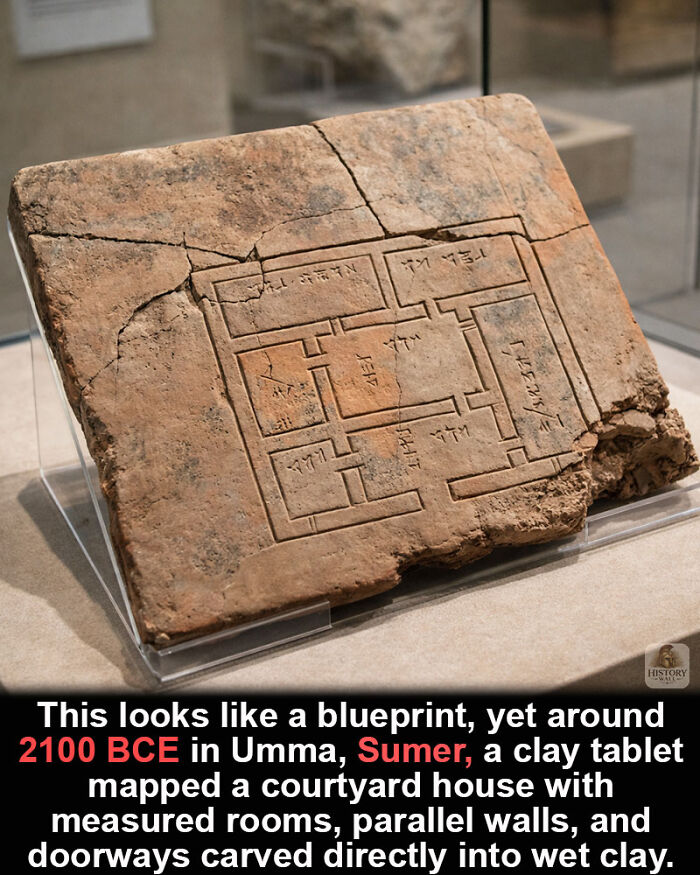
Image source: Nouza Expla
#6
The mosaic appeared just before the site changed forever. In Zeugma, modern Turkey, a Roman-period glass mosaic dated to about the 2nd century CE was uncovered in 2000 during rescue excavations before the Birecik Dam project. The discovery emerged from layers of collapsed architecture.
Circular medallions depict mythological figures surrounding a central portrait. The surface is composed of colored glass tesserae arranged with precise shading. The panel likely decorated an elite residence within the Roman city.
Excavations were conducted quickly as water levels were expected to rise. The mosaic was preserved, but much of the surrounding context was lost. The artwork survives. The full story of the building it once belonged to remains incomplete.
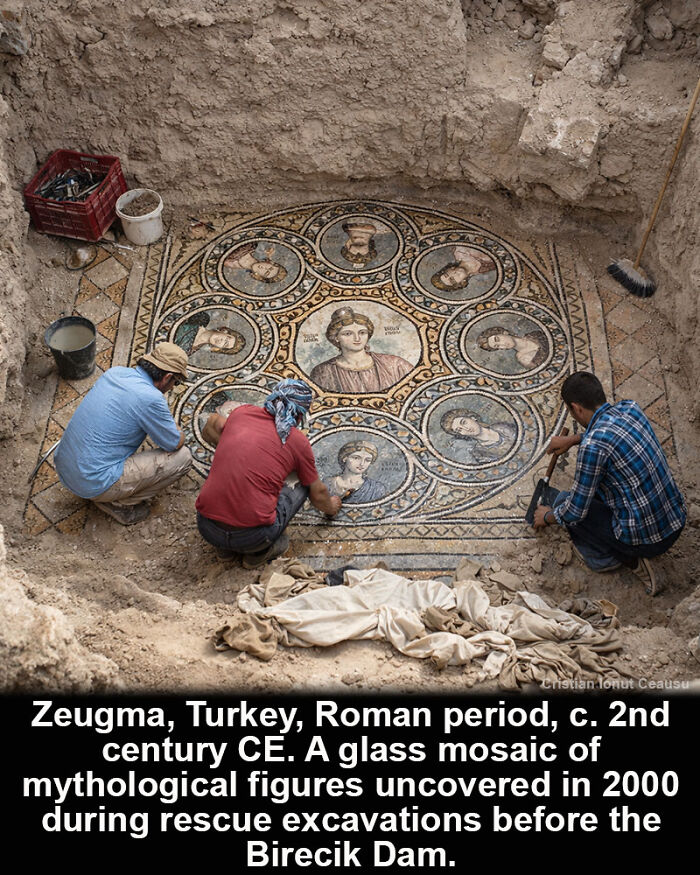
Image source: Cristian Ionut Ceausu
According to Nord Anglia Education, taking time to educate yourself on the past is always worth it. One of the reasons why is that it helps us develop a deeper understanding of the world. As Kamala Harris famously said, “You think you just fell out of a coconut tree? You exist in the context of all in which you live and what came before you.” So if we want to understand the world we’re currently living in, we’ve got to have context.
Having a greater understanding of the past also helps you become a more well-rounded person. History is chock-full of stories and lessons that you can apply to situations you find yourself in today. Plus, knowing all of these stories might help you relate to others, if you have a better understanding of their culture and why they are the way they are.
#7
The decoration was placed where no one would see it. Around 300 BCE, a Scythian woman’s boots were buried in the permafrost of the Altai Mountains, preserving leather, felt, and stitching in exceptional condition. The frozen environment sealed details rarely surviving in steppe nomadic clothing. Excavated in 1993, the footwear revealed layered construction designed for insulation, including thick felt lining and reinforced leather panels. The most striking detail appears inside the soles, where patterned inserts and geometric decoration were carefully arranged. These elements were hidden during use, suggesting a purpose beyond display. The boots are now housed in the Hermitage Museum in St. Petersburg. Their craftsmanship shows technical skill and aesthetic planning. Why elaborate decoration was placed inside functional winter footwear remains unresolved, leaving the intention behind the design open.
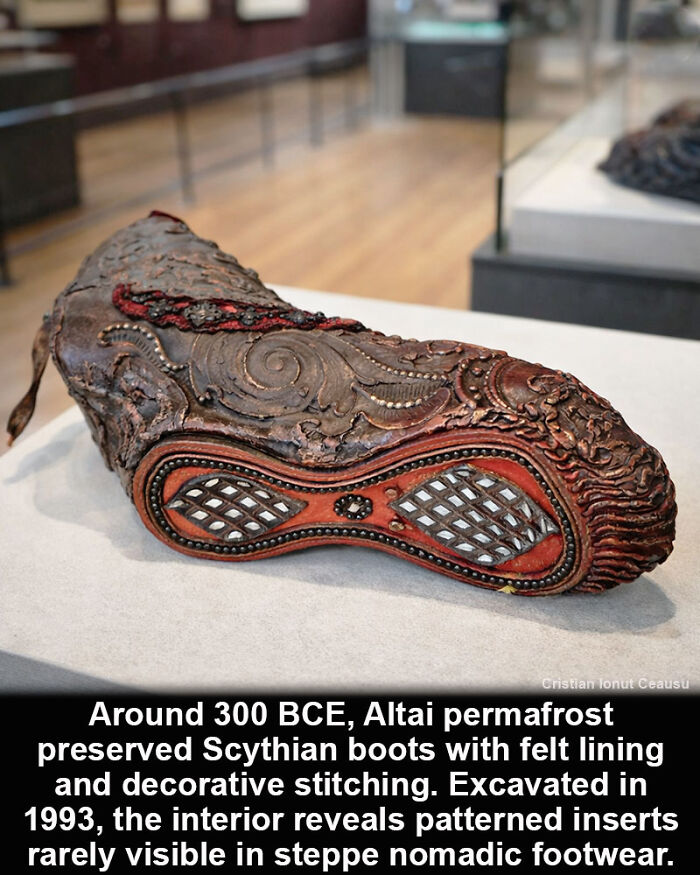
Image source: Cristian Ionut Ceausu
#8
A Roman street still lies beneath everyday life. In the historic center of Verona, Italy, near the remains of Porta Leoni, archaeologists revealed part of the ancient Roman city preserved directly below the modern street level.
The contrast between the two worlds is striking: pedestrians move above while a two-thousand-year-old roadway rests quietly beneath them. Porta Leoni itself dates to the 1st century BC and once served as one of the principal entrances to Roman Verona during the late Roman Republic.
Excavations in the area exposed the original stone pavement of a Roman street leading into the gate. The surface still bears the uneven wear of ancient traffic, where carts and pedestrians once entered the city through its fortified gateway.
Large stone blocks, drainage channels, and fragments of surrounding structures reveal how carefully the Romans organized their urban space.
Over centuries, Verona continued to grow. Medieval construction, Renaissance rebuilding, and modern development gradually raised the street level above the Roman remains. Instead of disappearing, the older city simply became a lower layer beneath the newer one.
Today visitors can stand above the excavation and look directly down onto the ancient road.
The ruins clearly show where Roman Verona stood. How many more layers of the city still lie hidden below remains an open question.
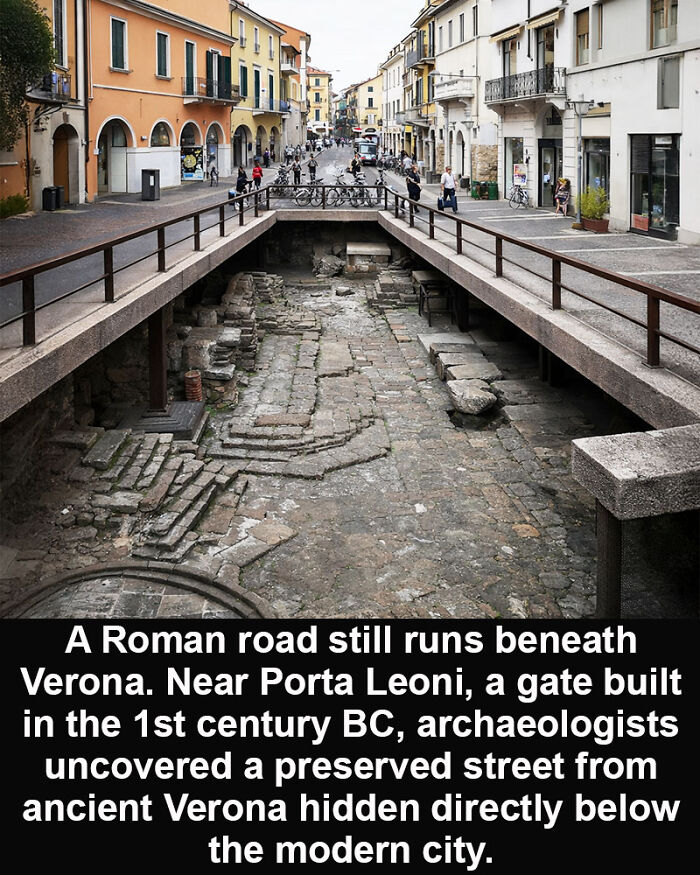
Image source: historicalmarvels
#9
Your eyes insist it is fabric. Your hands would disagree. This intricate piece, created by Greek artist Argiris Rallias, is not cotton lace but marble carved to imitate it.
The surface mimics crocheted patterns, complete with layered folds and openwork details that appear almost fragile.
Marble is traditionally associated with solidity and permanence. Here, it becomes something that looks light and flexible.
The work challenges assumptions about material limits. Stone remains stone. The illusion lingers.
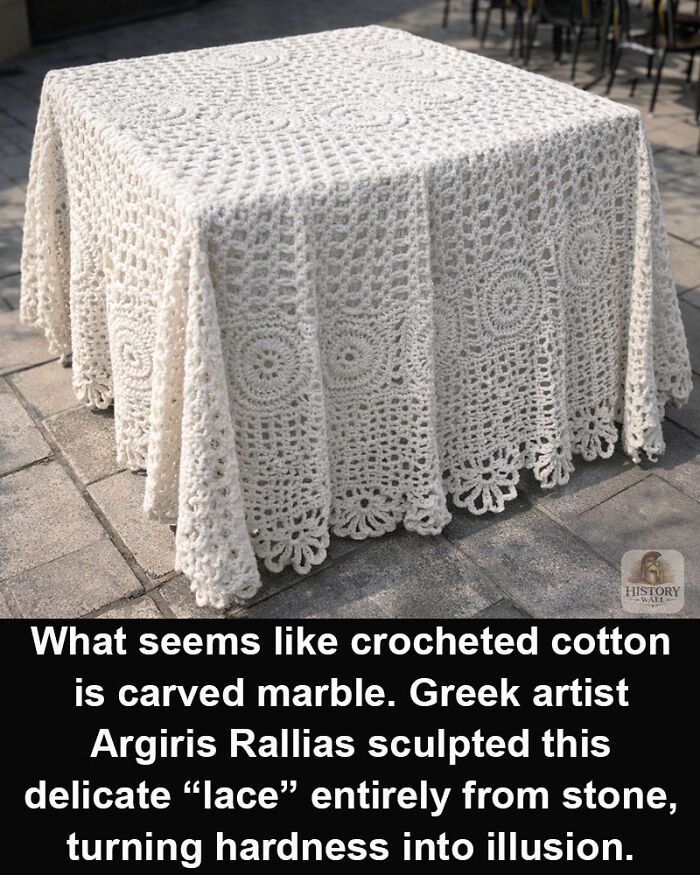
Image source: Nouza Expla
At the same time, knowing about your own history, whether that be your family’s or your country’s background, will help you understand your own identity. Even something as simple as knowing why certain foods are important to your culture or why you have specific traditions for certain holidays can help you feel a connection with your ancestors. And when you know the reasoning behind these decisions, your cultural traditions might become more important to you.
#10
This bracelet from the tomb of Tutankhamun dates to the 18th Dynasty of Egypt’s New Kingdom, around 1332–1323 BC. Crafted from gold, lapis lazuli, carnelian, turquoise, and quartzite, it displays one of the most important symbols in ancient Egyptian culture, the scarab beetle.
To modern eyes, the scarab may seem like an unusual decorative choice. For the Egyptians, however, it carried profound cosmic meaning.
They observed how dung beetles rolled small balls across the desert sand and buried them in the ground. From these spheres, new beetles later emerged. This natural cycle suggested a powerful idea: life emerging again from what seemed lifeless.
Egyptians connected this behavior with the movement of the sun across the sky. Just as the beetle pushed its sphere of earth, the god Khepri, a form of the sun god Ra, was believed to push the solar disk across the heavens each morning. The scarab, therefore, became a symbol of renewal, rebirth, and the eternal cycle of life.
Because of this meaning, scarabs appeared everywhere in Egyptian culture. They were carved into amulets, seals, rings, and royal jewelry. Many were placed in tombs to protect the dead and ensure rebirth in the afterlife.
The bracelet from Tutankhamun’s tomb shows how symbolism and craftsmanship came together. It was not simply jewelry. It carried a message of protection, regeneration, and divine power, reflecting the beliefs that shaped Egyptian life and death more than three thousand years ago.
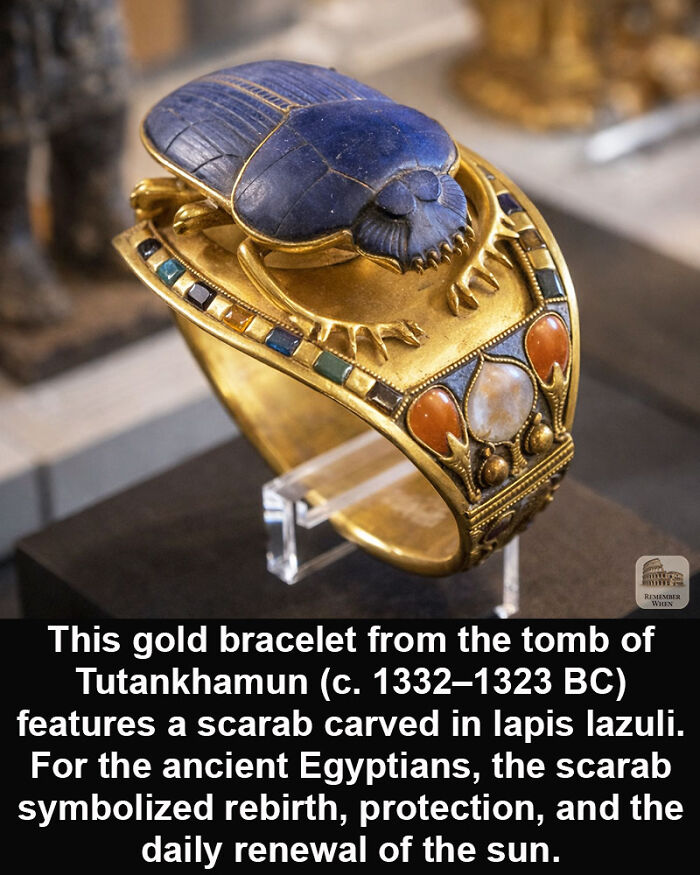
Image source: Remember When
#11
The teeth were alive, the drilling was deliberate. Between roughly 200 and 900 CE in the Maya lowlands, individuals modified their teeth by inserting jade and other stones into carefully carved cavities. The holes were chipped or drilled directly into enamel, then filled with decorative inlays.
Adhesives appear to include plant resins mixed with mineral powders, holding the stones in place. Many examples avoid penetrating the pulp, suggesting knowledge of tooth structure. The result combined cosmetic display with controlled technical execution.
Archaeological finds show variations in style, placement, and materials across Maya regions. The technique is documented. Whether driven primarily by status, ritual identity, or aesthetics remains debated, leaving the intention open
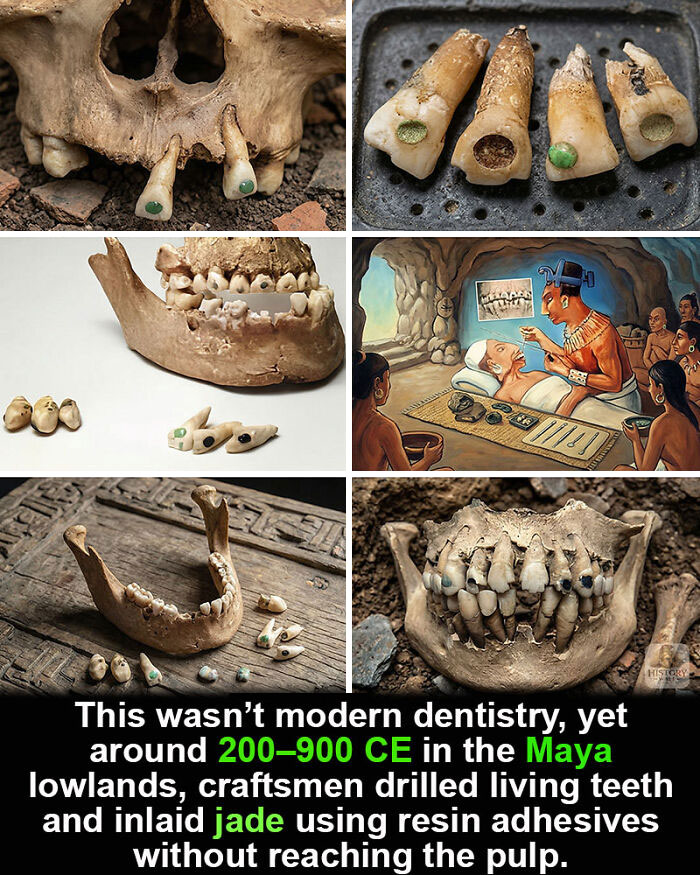
Image source: The Nostalgic Era
#12
It stands underwater, yet once belonged to a royal city. This “Dark Queen” statue, often linked to Cleopatra III and dated before 142 BCE, was discovered in 2000 in the submerged city of Heracleion near Alexandria.
Heracleion functioned as a major port before sections of the city sank beneath the Mediterranean. The statue remained buried in seabed sediment for centuries.
Cleopatra III ruled as a Ptolemaic co-regent and played a significant political role. The sculpture likely formed part of dynastic representation within the harbor complex.
After recovery, the artifact was transferred to the Alexandria National Museum. The statue survives clearly, yet the exact identification and original context within Heracleion remain debated.
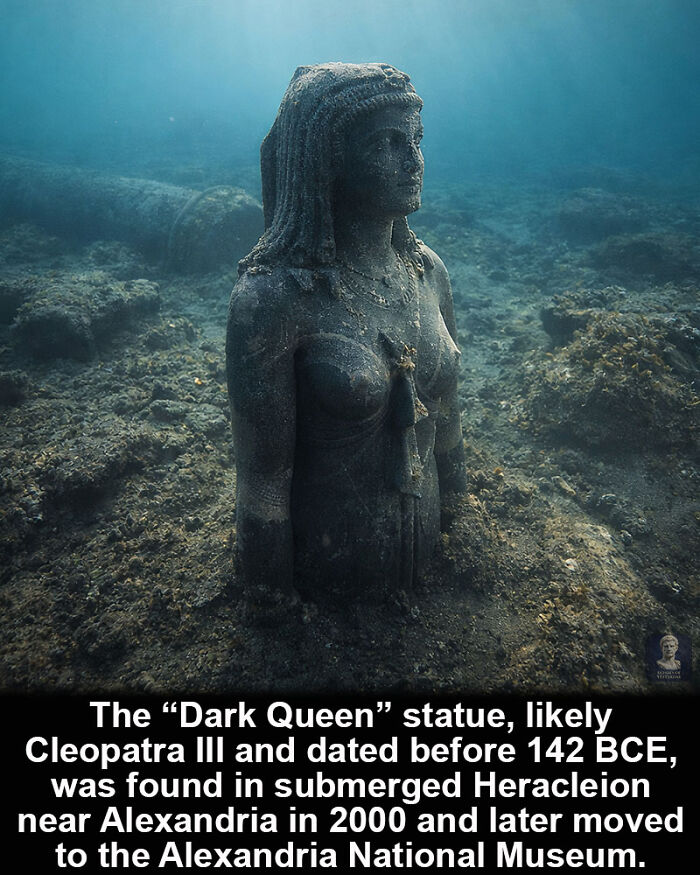
Image source: Echoes of Yesterday
In life, it’s always better to learn from someone else’s mistakes than from your own. And we all know that history repeats itself. So if studying history can help you to avoid making certain mistakes, more power to you. Especially today, when we have access to infinite information online, there’s no excuse to be ignorant about the past. Sure, it’s impossible to know everything. But having a basic understanding of history can be useful in all aspects of your life. It might even save you some headaches!
#13
They were not just shoes. They changed how people moved through the city. In Venice between the 15th and 17th centuries, women wore chopines, high platform footwear designed to lift them above the mud and debris of the streets.
Made with tall wooden bases, these shoes protected expensive fabrics from damage, but their height quickly became a visible sign of wealth. The higher the platform, the more status it implied. Both noblewomen and courtesans adopted them, turning function into display.
Walking in them required balance, sometimes assistance, and careful movement through narrow streets.
The objects remain.
How practical they were beyond symbolism is still open to question.
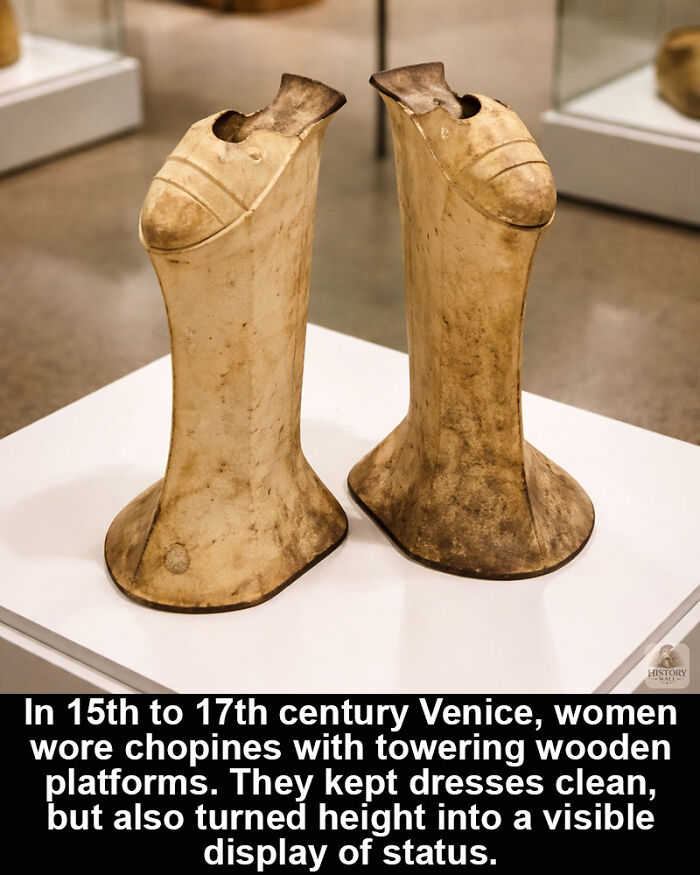
Image source: Nouza Expla
#14
At just 23, Michelangelo Buonarroti produced a sculpture in Rome that resists simple explanation. The Pietà, completed between 1498 and 1500 for a French cardinal, was carved from a single block of Carrara marble with a finish so refined it suggests flesh more than stone.
The Virgin Mary does not match expectations. She appears younger than her son, her expression controlled, almost detached. Her robes expand far beyond natural proportion, quietly solving the problem of supporting Christ’s body without visible strain. These decisions feel deliberate, not symbolic decoration.
This is also the only work Michelangelo ever signed, the name cut across Mary’s sash. After this, he never repeated the act.
The craftsmanship is documented. The intent behind these choices remains open.
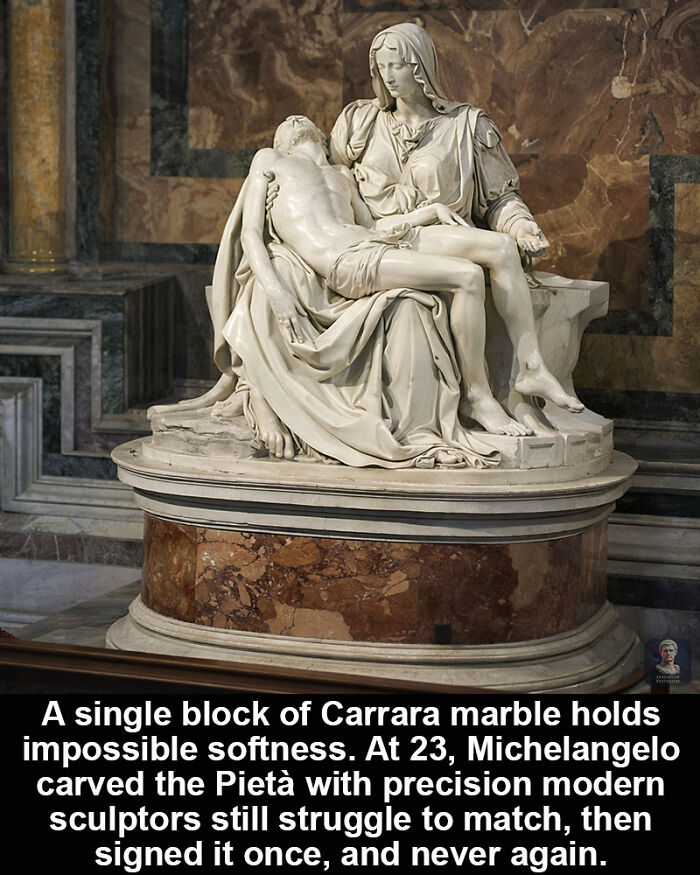
Image source: Echoes of Yesterday
#15
The guardian survived, the architecture around it did not. At Persepolis in Iran, a lamassu carved around 518 BCE under Darius I once stood at an Achaemenid gateway. The figure combines a human head, wings, and a powerful body, cut directly into massive stone blocks.
In 330 BCE, Alexander’s forces destroyed large parts of Persepolis. Walls collapsed and structures burned, yet the guardian relief remained partially preserved. Centuries of erosion softened the carved surface but did not erase the form.
The lamassu symbolized protection at imperial entrances. The gateway vanished, but the guardian still stands. The intention is known. The endurance feels unintended.
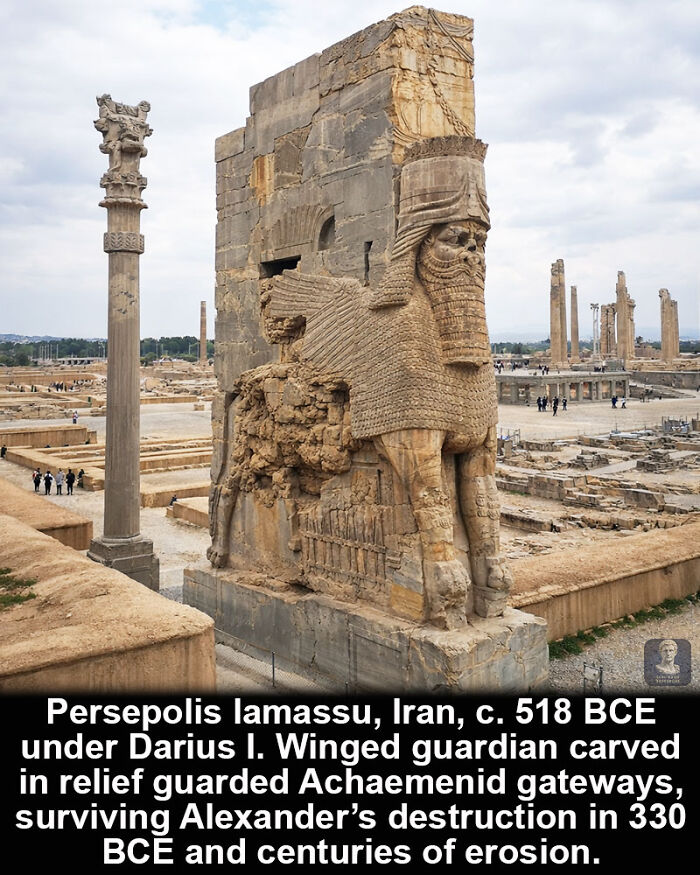
Image source: Echoes of Yesterday
Now, many of the posts on this particular list are archaeological findings. And if you’re wondering why archeology is still so important today, Shadreck Chirikure, Professor of Archaeological Science at the University of Oxford, has got you covered.
First, he notes that archeology can teach us many lessons from the past. If you want to find the most sustainable and responsible practices, just look at our ancestors. They were resourceful because they had to be, but it’s still wise for us to follow in their footsteps today. Farming practices, for example, were much more efficient and environmentally friendly before everything became about profits over ethics.
#16
The object is Roman, the wrapping is Viking. In the late 8th to early 9th century, western Scotland, the Galloway hoard preserved a small rock crystal jar originally made in the Roman world and later encased in gold thread. The container measures about 5 cm, 2 inches high, and was placed in a silk-lined leather pouch before burial.
The elaborate wrapping suggests the jar was valued beyond simple storage. Its transparency and protective casing imply ceremonial handling. The reuse connects different cultural traditions within a single object.
Discovered in 2014 in a ploughed field, the hoard preserved the jar remarkably intact. The craftsmanship is clear. The substance once held inside remains unknown, leaving its precise role open.
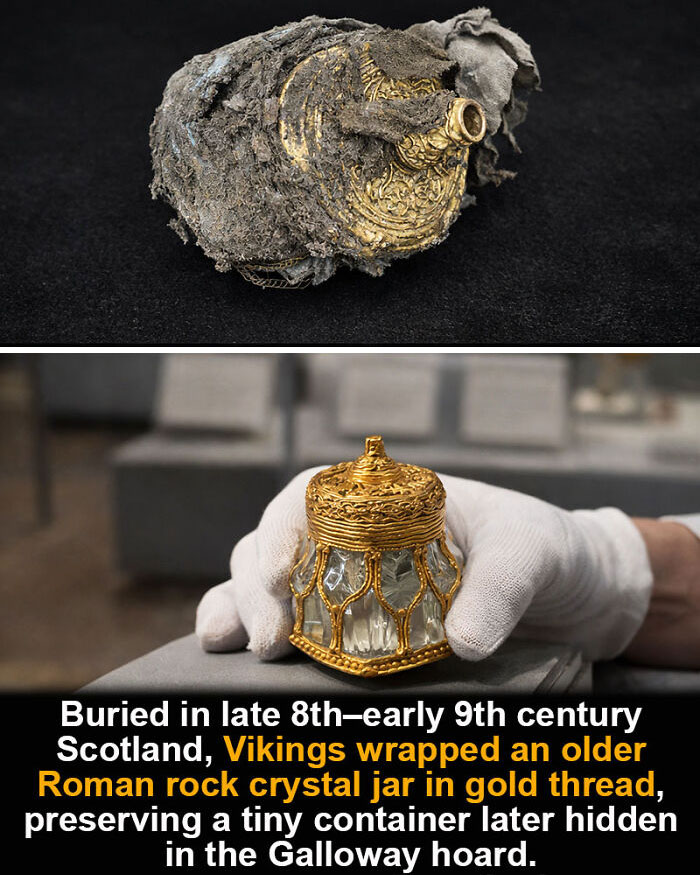
Image source: Cristian Ionut Ceausu
#17
Some of the most unusual details of medieval architecture are not found on the ground, but high above, where few people ever look. On the roof of Salisbury Cathedral in England, a curious carving appears among the Gothic stonework.
A small grotesque seems to bite the face of a much larger gargoyle, creating a scene that feels unexpectedly playful.
Salisbury Cathedral was built between 1220 and 1258 and remains one of the most complete examples of Early English Gothic architecture. Like many cathedrals of the period, its roofline is decorated with gargoyles and grotesques carved directly into the stone.
Gargoyles had a practical function. Their open mouths served as water spouts, channeling rainwater away from the cathedral’s walls to protect the structure. Grotesques, on the other hand, were usually decorative figures shaped by the creativity of the stone carvers.
This unusual sculpture appears to combine both traditions, turning the stonework into a small visual joke placed high above the ground.
Medieval craftsmen rarely left written explanations for such details.
The figures remain in place today, leaving modern viewers to wonder whether the scene carried symbolic meaning, quiet satire, or simply the private humor of a mason working on the cathedral nearly eight centuries ago.
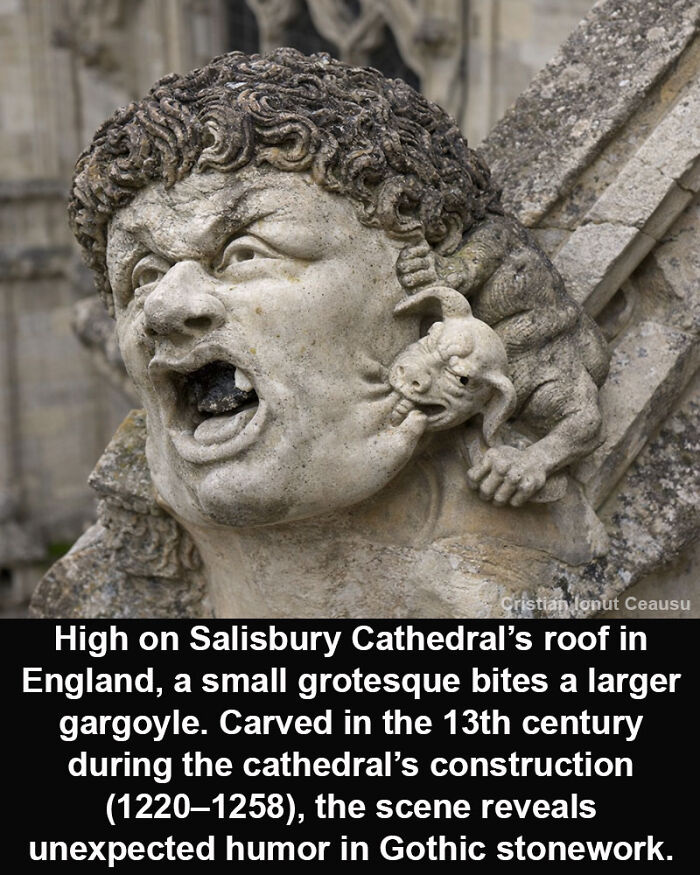
Image source: Cristian Ionut Ceausu
#18
At first glance, it feels playful. But the more closely this statue is studied, the stranger it becomes. This marble sculpture from the 1st century CE was discovered at Villa Ludovisi in Rome.
It depicts a child bending forward while holding a theatrical mask in front of the face. The mask itself is large and dramatic, with exaggerated features typical of Roman stage masks used in ancient theater.
Roman sculpture rarely focused on childhood scenes like this. Most surviving works celebrate gods, emperors, heroic figures, or mythological narratives. Here, instead, the sculptor captured a moment of imitation, a child appearing to “become” the character represented by the mask.
One detail stands out. The mask is carved with deep eye openings and a carefully detailed beard, clearly representing a mature theatrical character, not a child. The contrast between the small body and the adult mask creates a curious visual tension that Roman viewers likely understood immediately.
Some scholars believe the statue may have decorated a garden or villa courtyard where theatrical themes were popular. Others suggest it reflected the broader Roman fascination with performance, identity, and disguise.
The date is known. The location is documented.
What the sculptor truly intended this scene to represent is still debated.
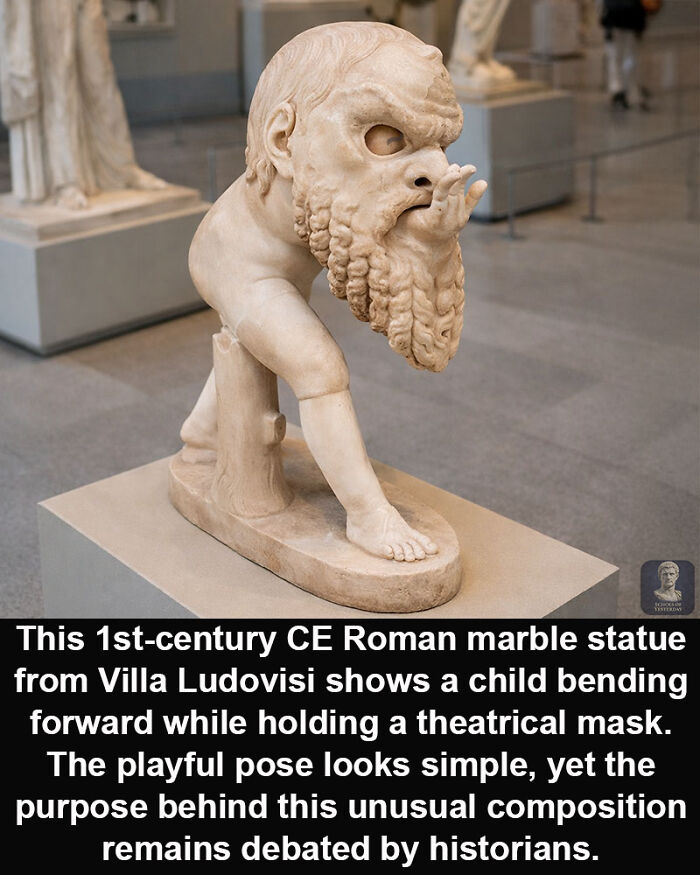
Image source: Echoes of Yesterday
Chirikure also points out that archaeology can shine a light on how ancient civilizations and societies organized themselves. When we discover things that were actually owned and used by these people, we can learn far more about them than we might learn from a history book. Especially when it comes to communities that have since been colonized by Western nations. History is written by the winners, but archaeological evidence can’t lie.
#19
Some city halls display coats of arms or statues of rulers. Munich’s New Town Hall chose something more dramatic. High above Marienplatz, a bronze dragon clings to the façade of the Neues Rathaus, one of the most recognizable buildings in the Bavarian capital.
The structure was built between 1867 and 1909, designed by architect Georg von Hauberrisser in an elaborate neo-Gothic style that deliberately echoed medieval architecture.
The enormous building replaced Munich’s older town hall as the city expanded rapidly in the late nineteenth century. Its façade was designed not as a simple administrative building, but as a monumental display of sculpture, towers, arches, and symbolic figures.
Among these figures is the dragon.
Positioned against the stone walls, the creature appears almost alive, wings spread as if emerging from the building itself. Dragons were common symbols in medieval European imagery, often representing forces that must be confronted, controlled, or guarded against.
Placed on the façade of a civic building, the dragon takes on another meaning.
It becomes a watchful presence above the square below.
For visitors walking through Marienplatz, it is easy to overlook among the hundreds of sculpted details.
Yet once noticed, the dragon becomes one of the most memorable figures on Munich’s vast New Town Hall.
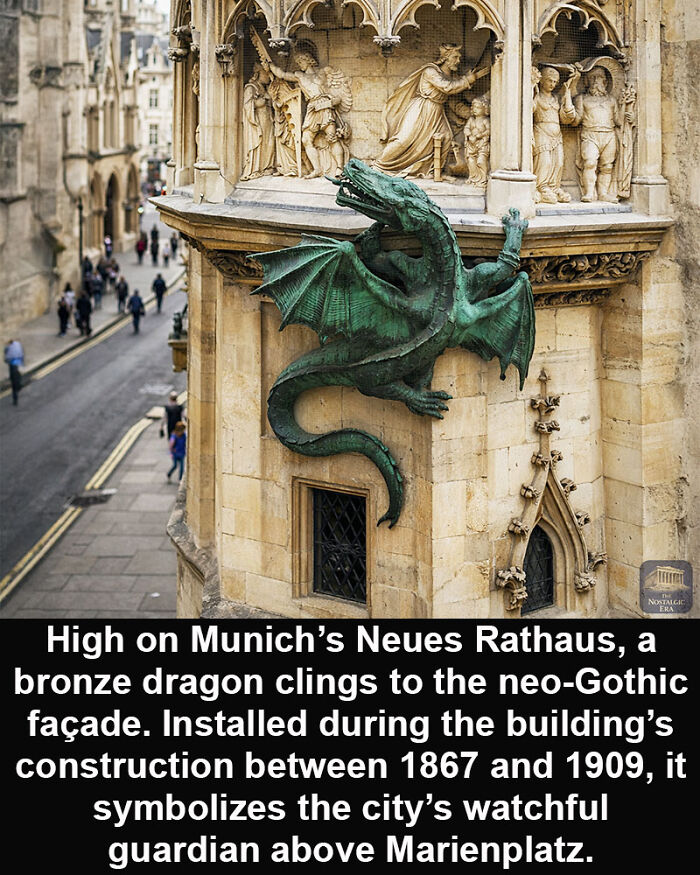
Image source: Cristian Ionut Ceausu
#20
Not every artifact from the ancient world was created on purpose. Some survive purely by accident. One mud brick from the ancient city of Ur preserves a human footprint impressed more than four thousand years ago.
Ur, located in southern Mesopotamia in what is now Iraq, was one of the great cities of the early Bronze Age. Around 2000 BC it was a thriving urban center with temples, homes, workshops, and city walls built largely from sun-dried mud bricks. Because stone was scarce in southern Mesopotamia, clay bricks formed the basic building material of nearly every structure.
At some point during construction, a brick was still soft when someone stepped onto it. The toes and heel pressed clearly into the wet clay. Normally such a mark would have been smoothed out before the brick dried. In this case it remained, and the brick hardened with the footprint preserved.
The result is not a royal inscription or ceremonial object. It is something simpler.
Today the brick, kept in the British Museum, captures a brief moment from daily life in ancient Ur. A single step taken thousands of years ago became part of the archaeological record.
The city vanished long ago.
But the trace of one person passing through it remains.
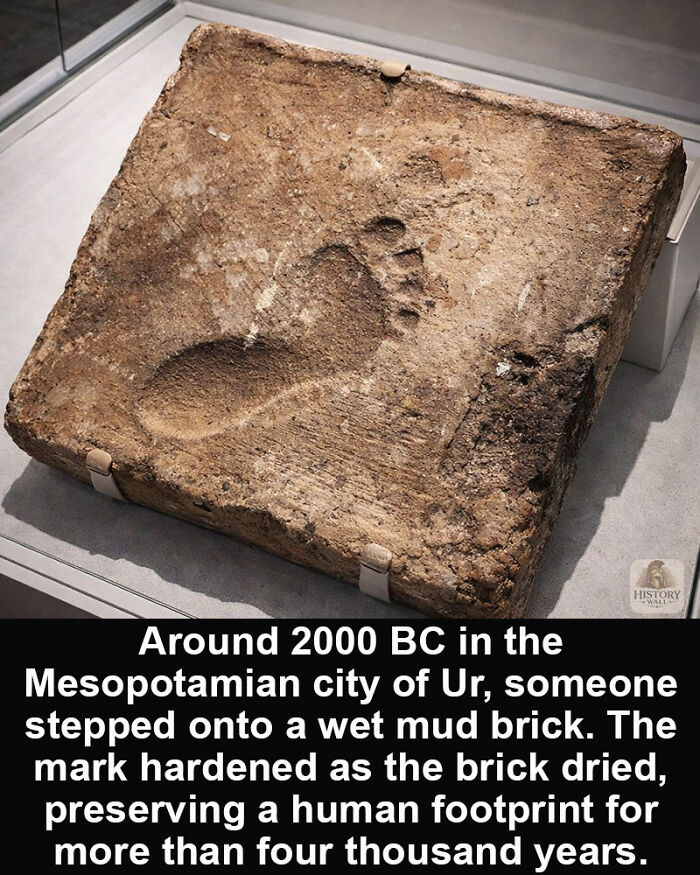
Image source: Nouza Expla
#21
A reef turned to stone. Carlsbad Caverns in New Mexico was not shaped by fire or lava, but by the slow chemistry of an ancient ocean. Around 250 million years ago, during the Permian period, this region was covered by a shallow sea.
A massive reef formed along its edge, built by sponges, algae, and marine organisms whose remains became limestone.
Over time, tectonic uplift raised the reef above sea level. Later, acidic groundwater dissolved the limestone, carving immense chambers beneath the desert. The result is a cavern system filled with dramatic passages, delicate formations, and walls that still contain marine fossils from that vanished sea.
The spiraling entrance path leads visitors steadily downward, creating a sense of descent into something far older than human memory. What feels like a journey into the depths of the Earth is, in fact, a walk through the remnants of an ancient ocean preserved in rock.
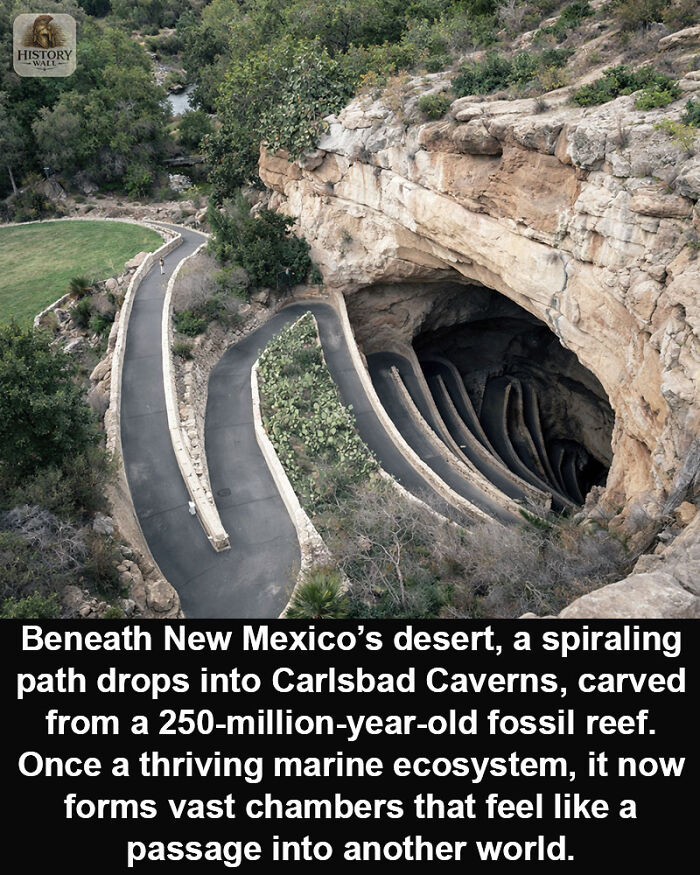
Image source: Nouza Expla
Something else that makes archaeology special is that it uses multiple fields of knowledge all at once, Chirikure notes. Once something is discovered, it needs to be interpreted, and sometimes translated. This might require input from several different experts to help get the full picture of what’s been found. But that doesn’t mean that these findings are only interesting to scientists. Archeological sites are some of the most popular tourist destinations in the world, such as Stonehenge, Machu Picchu, and Pompeii. So clearly, people are fascinated by archaeology!
#22
Power was worn, not displayed from afar. The Talisman of Charlemagne, crafted in the 9th century, reflects the fusion of faith and authority in the Carolingian world. Its circular gold frame is richly decorated with filigree and inset with 53 precious stones.
At its center lies a large cabochon-cut sapphire, beneath which a relic was placed, transforming the pendant into a portable shrine.
Tradition connects the piece to Caliph Harun al-Rashid, suggesting it may have been a diplomatic gift to Charlemagne, ruler of a vast Frankish empire. Whether every detail of that story can be confirmed, the talisman’s status is clear. It was buried with Charlemagne in 814, signaling its personal importance.
In the year 1000, Emperor Otto III reportedly reopened the tomb and recovered the pendant. Over centuries, it traveled through royal and ecclesiastical hands before finding a home in the Tau Palace at the Cathedral of Reims.
Its craftsmanship is documented. Its full symbolic meaning remains layered in history
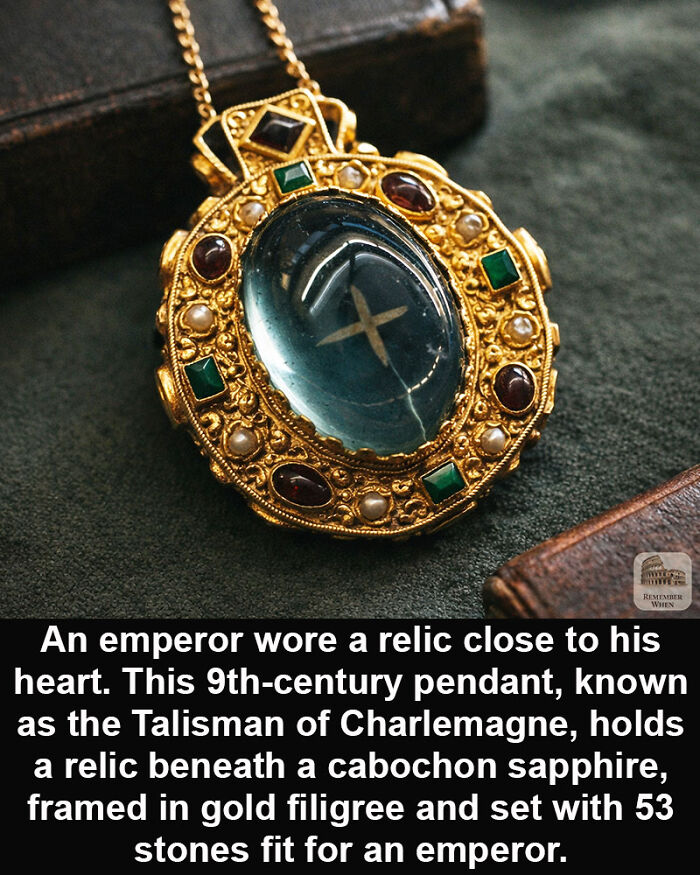
Image source: Remember When
#23
Vardzia, a 12th-century cave monastery complex in southern Georgia, was carved into the Erusheti Mountain on the left bank of the Mtkvari River. Behind the stone façade lie around 500 caves, linked by tunnels and stairways, forming dwellings, churches, storage chambers, and wine cellars. One surviving church still preserves fragments of medieval frescoes painted directly onto rock walls.
At its zenith, the site could shelter up to 50,000 people. The scale alone challenges assumptions about medieval construction in the Caucasus. Historians understand the political context and royal patronage behind its creation, yet the logistical coordination required to hollow out an entire mountainside remains difficult to fully reconstruct.
The structure is documented. The intention behind its precise layout and defensive integration is still debated.
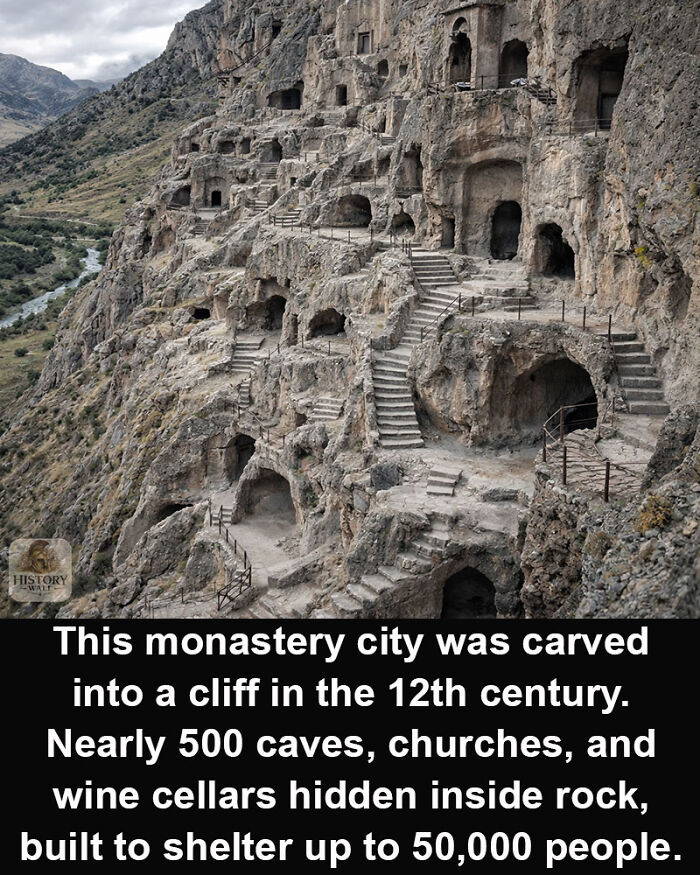
Image source: Nouza Expla
#24
The dagger looks metallic, yet it is entirely stone. The Hindsgavl Dagger from Denmark, dated around 1900 BCE at the end of the Nordic Stone Age, is crafted from flint using fine pressure flaking. The blade narrows sharply while the handle widens into a fishtail shape.
The thin, symmetrical profile resembles early metal daggers. The surface shows carefully controlled flake removals creating a balanced outline. The delicate edges suggest display or symbolic use rather than heavy cutting.
This craftsmanship appears during a period when metal objects were emerging in northern Europe. The precise techniques required remain debated, but the dagger demonstrates advanced flint working shaped to imitate metal forms
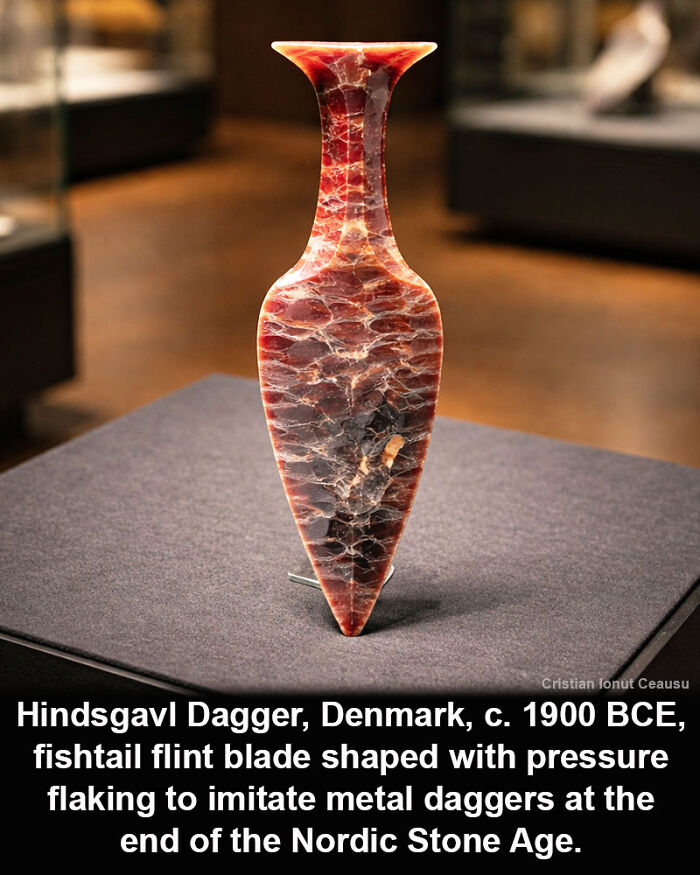
Image source: Cristian Ionut Ceausu
Are you feeling inspired to learn more about history after scrolling through this list, pandas? Keep upvoting the photos that teach you something new, and let us know in the comments below if you have any more fun facts you’d like to share. Then, if you’re looking for another article from Bored Panda featuring fascinating archaeological finds, look no further than right here!
#25
The coastline of Sliema, Malta, is defined by geometric basins that seem to bleed directly from the rock. Tourists and locals alike gaze at the Fond Għadir pools, often attributing their creation to the engineering prowess of the Roman Empire.
The narrative is alluring, but it falls apart under scrutiny. These structures are not remnants of an ancient past, but deliberate creations of the Victorian era.
In the 19th century, these pools served as secluded sanctuaries. They were carved to enforce privacy and modesty, allowing Victorian society to immerse themselves in the sea while remaining protected from the public eye.
The precision required to chisel these canals into the limestone is remarkable, suggesting a mastery of the coastal geology that modern construction often overlooks.
Historians have confirmed the timeline, yet the deeper story remains elusive. We see the shapes they left behind, but we only catch glimpses of the social pressures that demanded such labor-intensive architecture.
The techniques are clear, but the full extent of their original function feels incomplete. As we walk along the shoreline today, the rock reveals a history that is much closer to our own time than we dare to imagine.
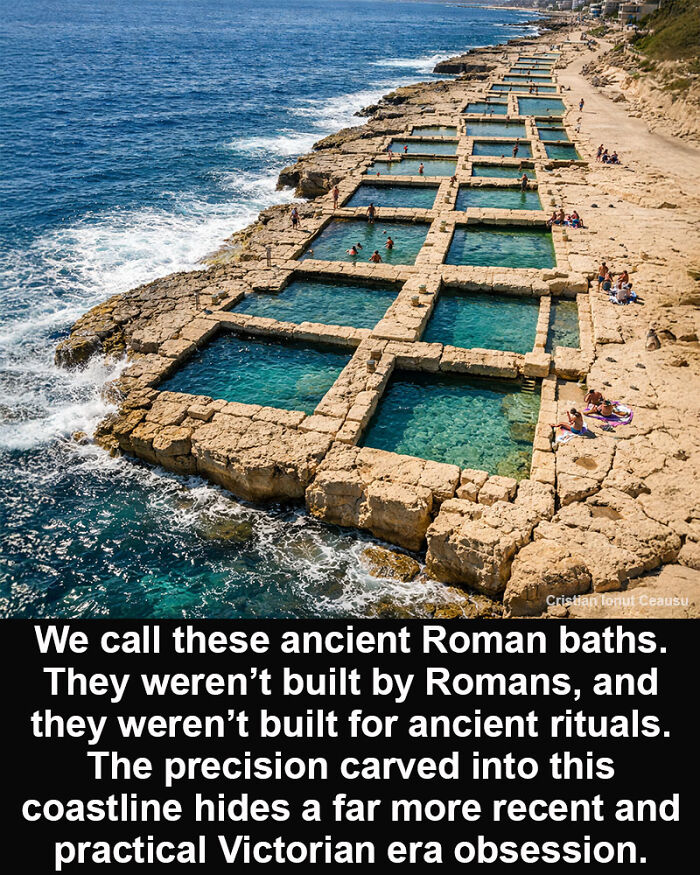
Image source: Cristian Ionut Ceausu
#26
The footprints show movement, not a camp. Around 21,000 to 23,000 years ago at White Sands, New Mexico, a trackway records a woman crossing wet ground while carrying a child. The impressions vary in depth, and smaller prints appear briefly beside the main path.
Later footprints follow the same route in reverse, indicating a return journey. The spacing and direction suggest purposeful travel rather than wandering. The sequence captures a short moment preserved in sediment.
Researchers document the trackway clearly. The reason for the trip, whether relocation, search, or escape, remains uncertain, leaving the story open.
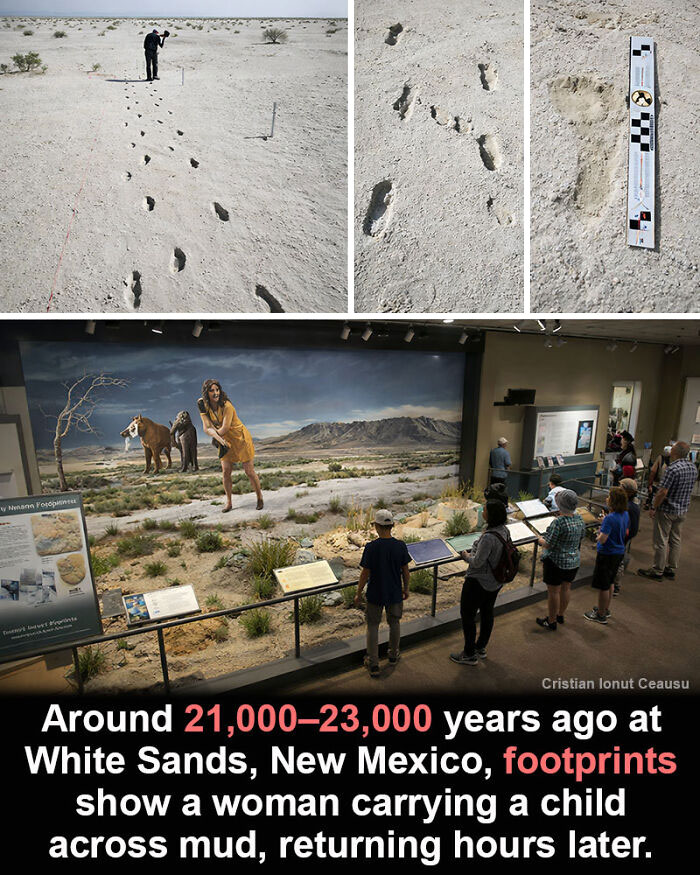
Image source: Cristian Ionut Ceausu
#27
The castle fits the legend, the history does not. Built in the 14th century near Bran and Brașov in Transylvania, Bran Castle guarded a crucial mountain pass linking regions across the Carpathians. Its dramatic towers and narrow interiors later aligned with imagery popularized by Bram Stoker’s Dracula.
Despite the association, no historical proof confirms Vlad the Impaler lived at Bran. As ruler of Wallachia, he moved between fortified sites for strategic reasons, with Poenari Castle frequently cited as a principal residence. The Dracula link developed from atmosphere and geography rather than documented occupation.
Today, Bran Castle stands as a major tourist destination shaped by both architecture and myth. The structure is authentic. The Dracula connection remains symbolic rather than historical.
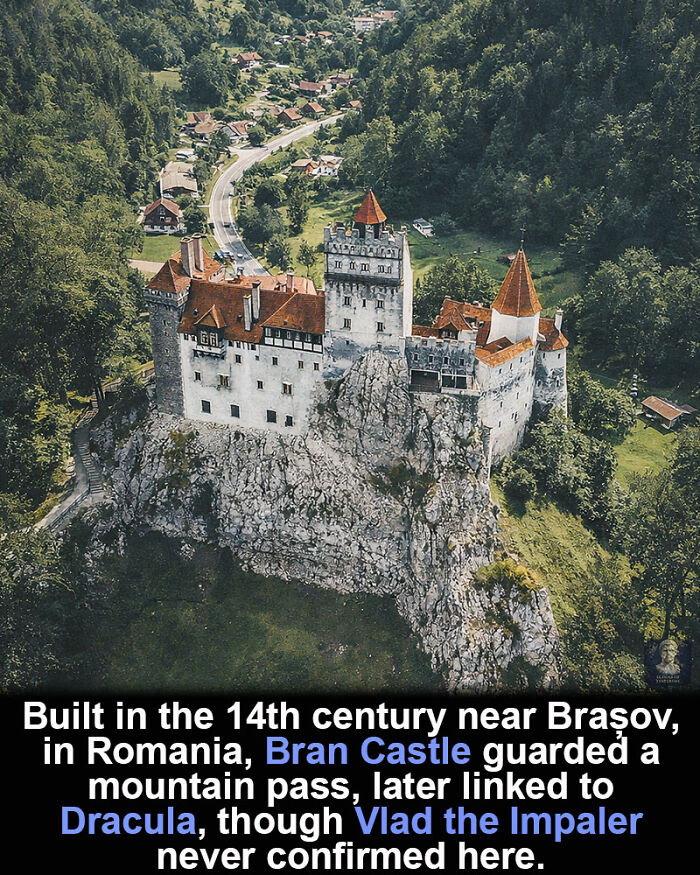
Image source: Echoes of Yesterday
#28
The house looked like a mound, the living space lay below. More than 500 years ago in North America, some Indigenous communities built earth-covered homes with sunken interiors supported by wooden frameworks and layered with soil. From the outside they appeared as low grassy domes rather than exposed buildings.
Access came through a narrow entrance passage that reduced wind and trapped warmth. Inside, a central hearth vented smoke through an opening above, while storage areas lined the walls. The surrounding earth acted as insulation, stabilizing temperature during winter cold and summer heat. The design adapted architecture directly to climate.
Archaeological remains and ethnographic records document these structures across different regions. The principle is consistent, but materials and layouts vary widely. The concept endured. The specific forms depended on local traditions.
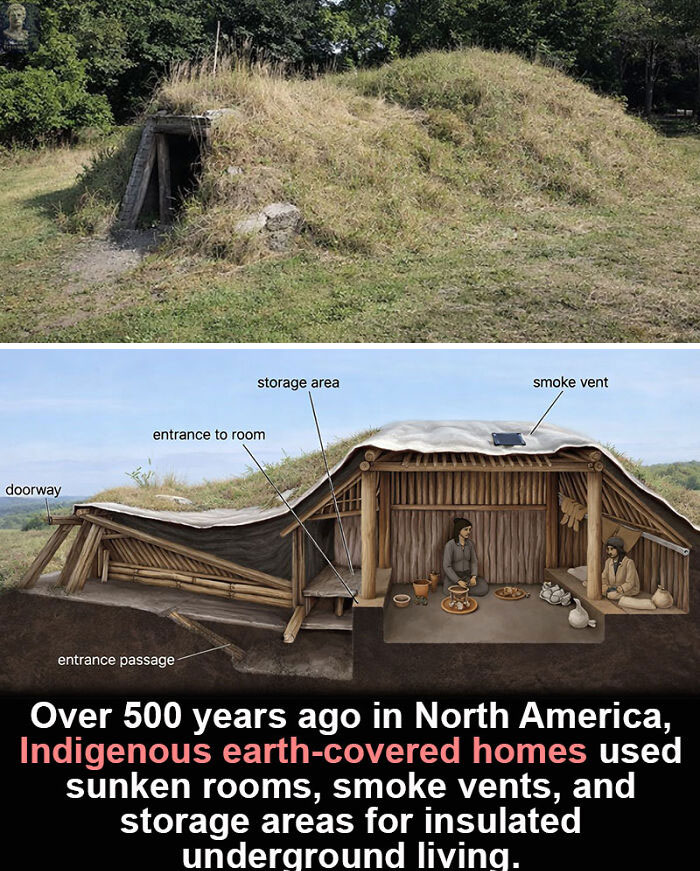
Image source: Echoes of Yesterday
#29
They look like maps, yet they chart motion instead of land. In the Marshall Islands, traditional stick charts made from curved palm ribs and coconut fiber were long mistaken for literal island diagrams. Their structure actually encodes wave refraction around islands, translating ocean behavior into a portable framework. Coconut fiber intersections mark island positions, while sweeping ribs trace dominant swell paths. Some charts include diagonal curved sticks that represent multiple seasonal wave directions, allowing navigators to anticipate shifting patterns rather than memorize fixed routes. The design reflects movement across open water, not static geography. Ethnographic records confirm their navigational role, but interpretation depended heavily on experience and oral instruction. Each chart functioned as a guide to reading swells, not a universal template. The construction is documented. The full logic behind how different navigators internalized these patterns remains open.
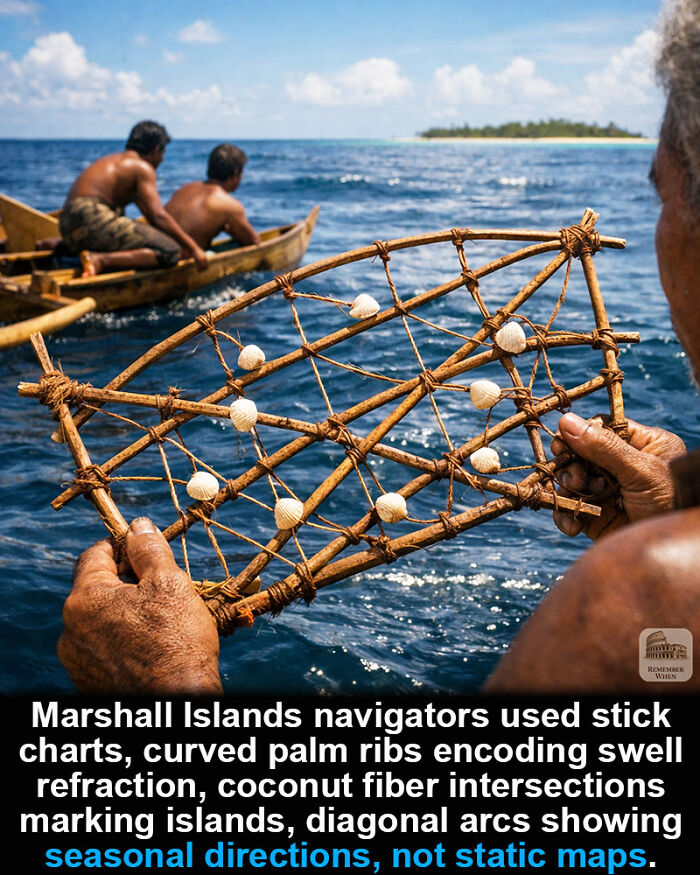
Image source: Remember When
#30
It appears carved from the canyon wall rather than placed across it. Completed in 1793, Puente Nuevo in Ronda, Spain, spans the El Tajo Gorge high above the Guadalevín River.
The bridge rises about 120 m, 390 ft above the water, while the canyon reaches roughly 150 m, 492 ft in depth. Massive masonry piers anchor directly into the rock, visually merging the structure with the cliff faces.
The crossing links Ronda’s old and new towns. From many angles, the bridge seems embedded into the canyon rather than standing independently.
Historical records confirm the construction, yet the full logistics of building within such steep terrain remain partly inferred. The structure is visible and measured, but the complete construction process inside the gorge remains open to interpretation.
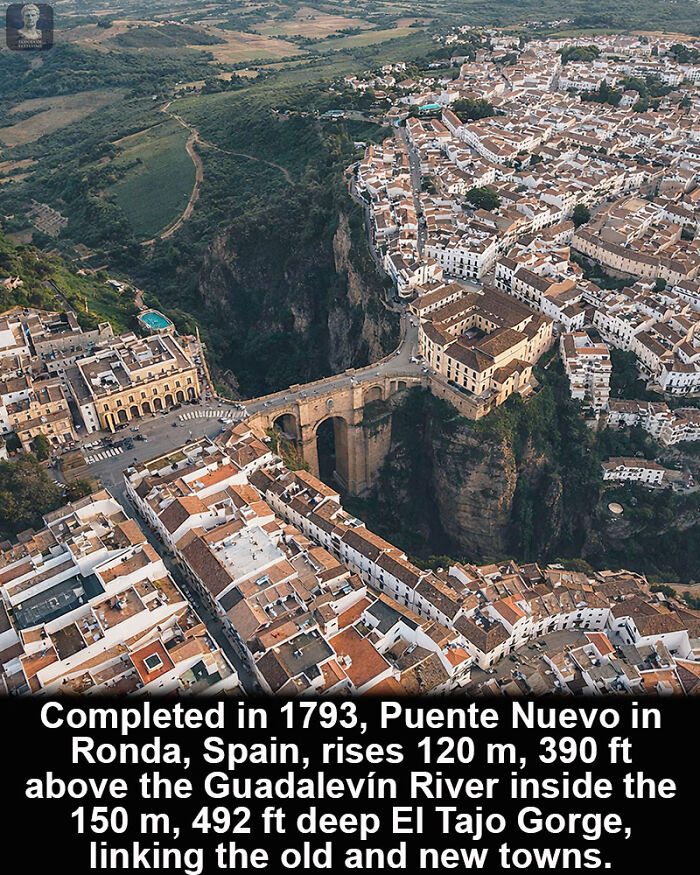
Image source: Echoes of Yesterday
#31
Two submerged sites continue to divide interpretation. Near Yonaguni Island, Japan, about 62 miles (100 km) east of Taiwan, massive stepped rock formations descend to roughly 82 ft (25 m) underwater. Marine geologist Masaaki Kimura has suggested they resemble terraces, platforms, and pyramid-like structures.
Across the Pacific, the Bimini Road in the Bahamas stretches about 1,476 ft (450 m) beneath roughly 20 ft (6 m) of water. The formation consists of large rectangular limestone blocks arranged in a linear pattern extending from North Bimini Island. Radiocarbon dating of fossil shells within the stones has been cited at around 3,500 years old.
Global sea levels rose about 459 ft (140 m) between roughly 14,000 and 7,000 years ago, flooding extensive coastal regions where early populations lived.
Some researchers interpret both sites as natural geological formations. Others point to alignment and stepped geometry. The structures are mapped, but whether they reflect geology or submerged construction remains debated.
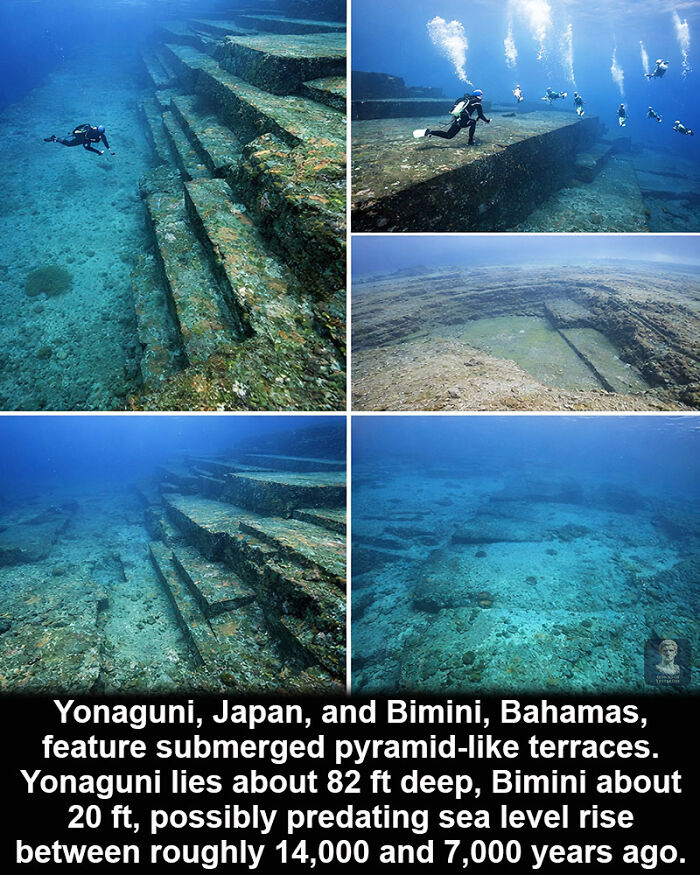
Image source: Nouza Expla
#32
The face appears unfinished, yet intentionally carved. At Karahan Tepe in southeastern Turkey, dated to about 11,000 BCE, a humanoid head emerges directly from bedrock within a large megalithic complex.
The site, estimated to be around 13,000 years old, predates Stonehenge by roughly 8,000 years and is part of the same Pre-Pottery Neolithic tradition as nearby Göbekli Tepe. Excavations have revealed pillars, carved figures, enclosures, and areas interpreted as domestic spaces, suggesting sustained occupation.
Some sculptures have been interpreted as depicting unusual human traits, including figures described with extra digits. Animal imagery, including predators, appears alongside human forms carved into stone.
Only a fraction of Karahan Tepe has been excavated. The structures were deliberately buried in antiquity, and the reason remains debated. The visible carvings suggest a complex Ice Age community, but the full extent of the site is still unknown.
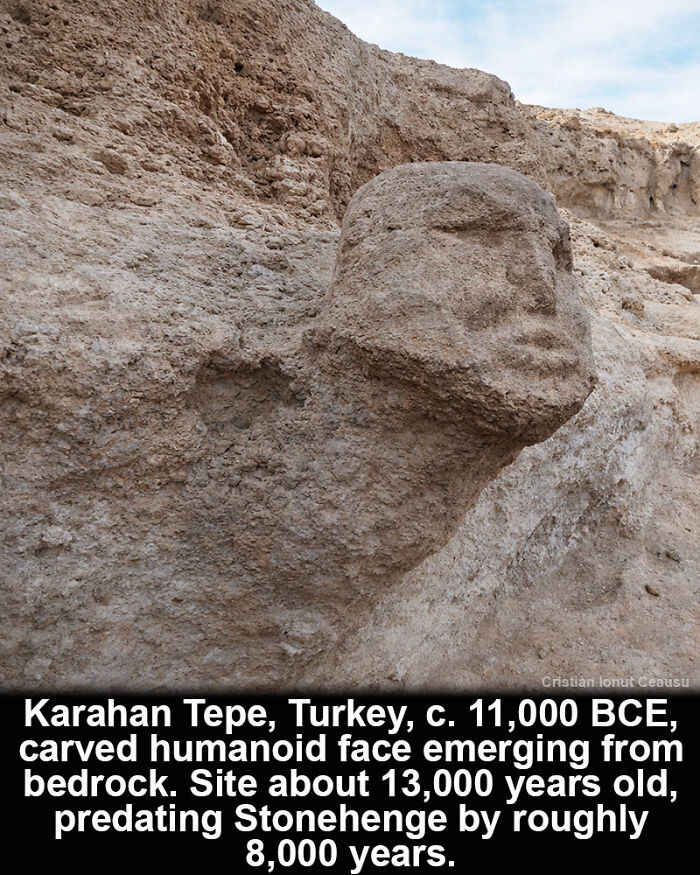
Image source: Cristian Ionut Ceausu
#33
The stones were shaped into near-perfect spheres. In southern Costa Rica, Diquís culture stone spheres dated roughly 600–1500 CE were carved from granodiorite boulders. The largest examples measure about 8.7 ft (2.66 m) in diameter. Surface finishing shows pecking, grinding, and smoothing techniques.
Many spheres were originally positioned near settlements, plazas, and elevated ground. Some were found partially buried, indicating intentional placement. Sizes vary from small stones to multi-ton spheres. Archaeological context links them to the Diquís cultural region.
The function remains uncertain. Proposals include markers, status symbols, or spatial alignments. The shaping methods demonstrate controlled stoneworking.
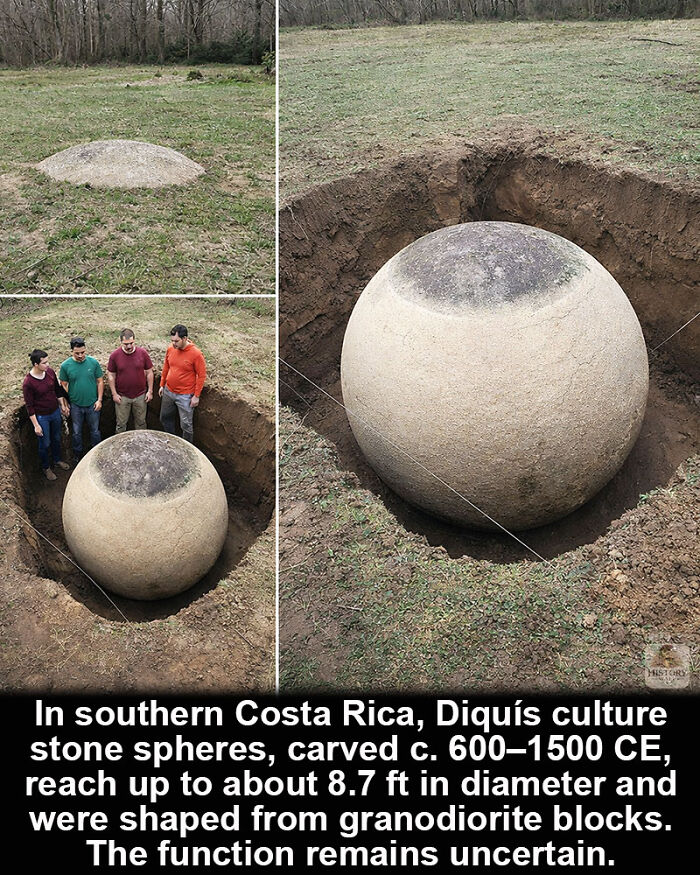
Image source: Nouza Expla
#34
The figures were shaped to sit together. The “Lovers from Gumelnița,” dated to the 5th millennium BCE in present-day Romania, form a small clay pair measuring about 2.7 inches (6.8 cm) in height. The two stylized figures are positioned side by side, creating a compact composition. The surfaces show incised decoration and faint traces of red and white pigment. The clay was hand-modeled and fired, preserving subtle details of posture and symmetry. The arrangement suggests intentional pairing rather than separate figurines later joined. Comparable intimate compositions are rare in the Gumelnița cultural horizon. The object preserves proximity as design. The figurine documents Eneolithic symbolic expression. The precise meaning of the paired figures remains uncertain.
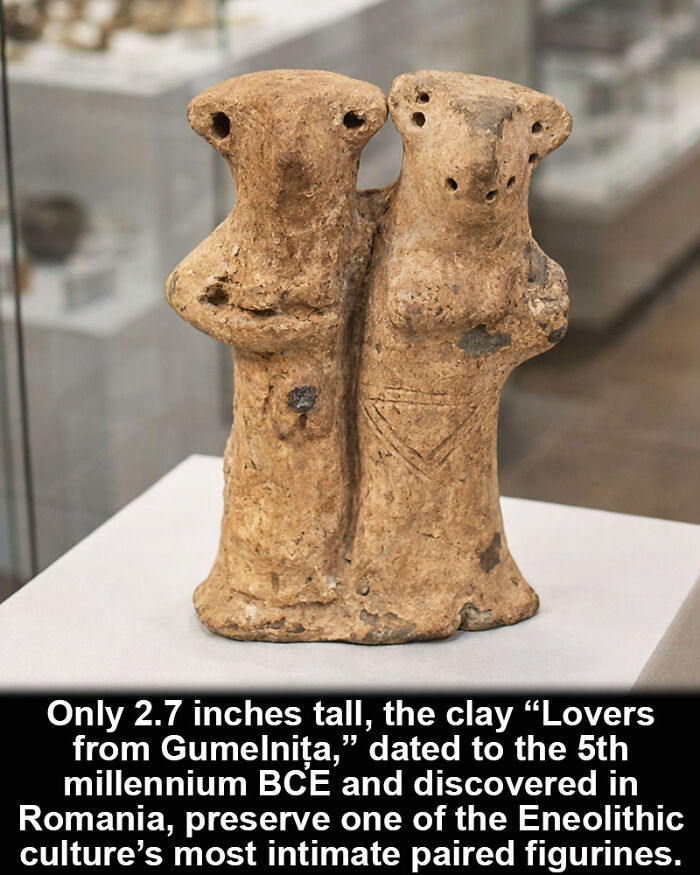
Image source: Cristian Ionut Ceausu
#35
The desert surface concealed engineered water routes. In the Fezzan region of the central Sahara, during the 1st millennium BCE, the Garamantes constructed underground foggara galleries to capture groundwater beneath dunes. These sloping tunnels carried water toward oasis fields and settlements.
Archaeologists documented branching networks extending for tens of kilometers. Vertical shafts punctuate the lines, allowing excavation and maintenance. The system supported agriculture and habitation in terrain lacking surface rivers. Settlements appear organized around these hidden channels.
The infrastructure reshaped survival in the Sahara. The tunnels demonstrate sustained hydraulic planning. How coordination across such long subterranean networks was organized remains uncertain.
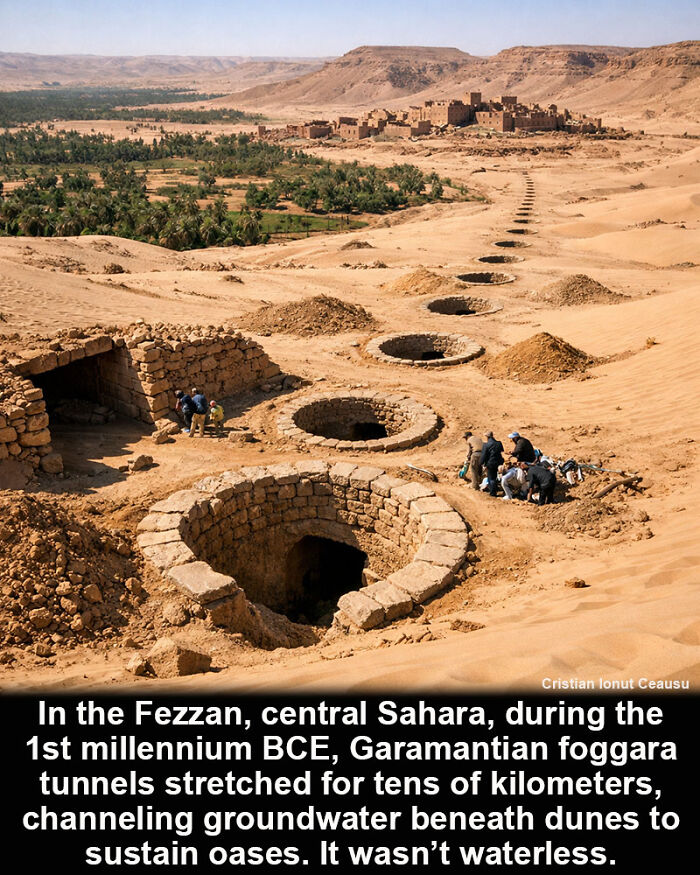
Image source: Cristian Ionut Ceausu
#36
The ship was built for water, then sealed in earth. The Oseberg ship, constructed around 820 CE and buried in 834 CE near Tønsberg, Norway, was placed intact inside a large burial mound. Instead of dismantling it, builders hauled the entire vessel ashore and erected a wooden chamber directly on deck.
Inside were two elite women surrounded by carved sledges, wagons, beds, textiles, tools, and sacrificed animals. The hull’s thin planking and shallow keel suggest ceremonial emphasis rather than heavy maritime use. The craftsmanship is precise, the burial deliberate.
Archaeologists recovered the ship in 1904, preserved by dense clay. The structure is documented. The intention behind removing a functioning longship from use and entombing it intact remains unresolved.
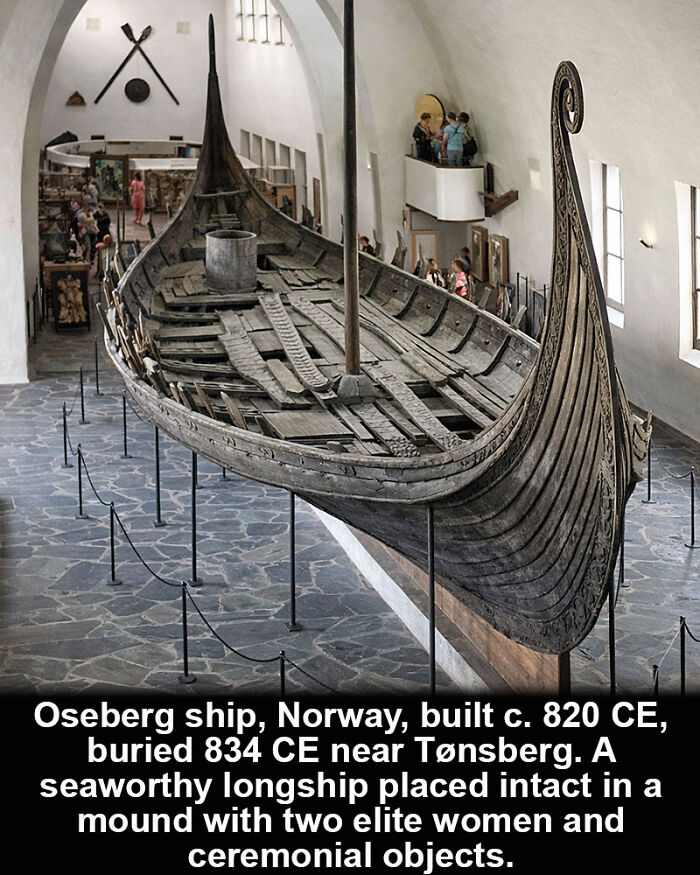
Image source: Cristian Ionut Ceausu
#37
The familiar view hides the process behind it. The Great Sphinx of Giza, carved around 2500 BCE under Pharaoh Khafre, is typically seen from the front, where its human face dominates the landscape.
From behind, the perspective shifts. The full lion body becomes clear, including the massive carved tail that runs along its back, revealing how the monument was shaped directly from the surrounding limestone plateau.
This was not assembled piece by piece. It was carved in place, transforming natural rock into a unified form that has endured for millennia.
The structure remains.
The full sequence of how it was carved at this scale is still not completely understood.
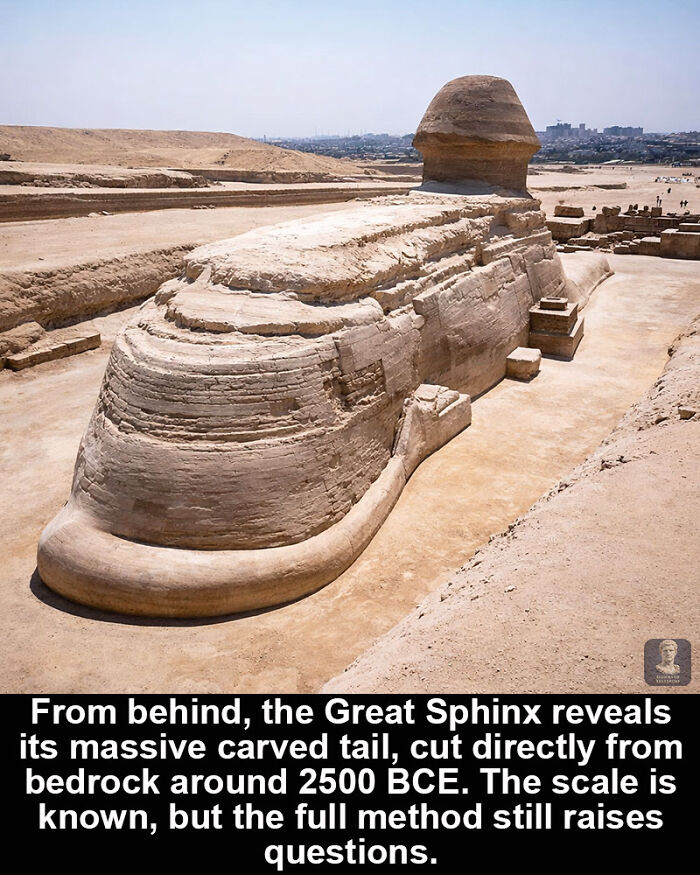
Image source: Echoes of Yesterday
#38
The surface looks recent, the statue is ancient. Around 670 BCE in Egypt, the copper alloy figure of princess-priestess Takushit was decorated with intricate inlaid metals forming hieroglyphic scenes across the body. The inscriptions remain sharply visible despite millennia.
The contrasting metals and controlled engraving suggest careful alloy preparation and finishing techniques. Corrosion appears limited, preserving both text and imagery. The result combines sculpture, inscription, and metallurgy in a single object.
Now held in the British Museum, the statue demonstrates sophisticated metalworking in the Late Period. The craftsmanship is evident. The precise workshop methods behind its long-term preservation remain unresolved.
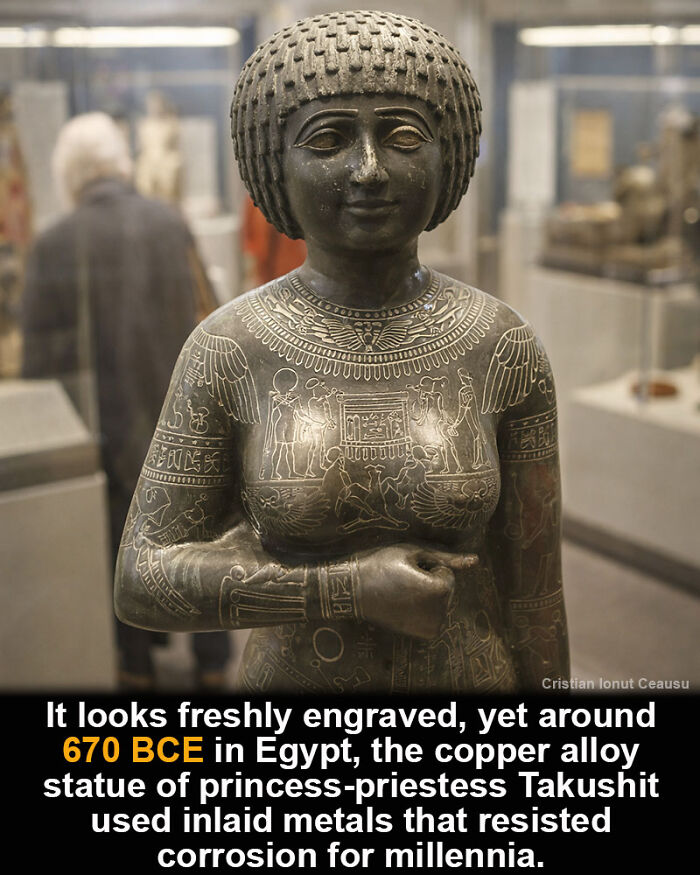
Image source: Cristian Ionut Ceausu
#39
Ancient plumbing still visible beneath the floors of Bath, England reveals how advanced Roman engineering could be.
When the Romans established the city of Aquae Sulis in the 1st century CE, they built an elaborate bathing complex around the area’s natural hot springs. These springs produce mineral-rich water heated deep underground, emerging at temperatures of about 46°C (115°F).
To control and distribute this constant flow, Roman engineers constructed a sophisticated hydraulic system. Lead pipes, stone channels, and reservoirs directed the water from the spring into the various bathing rooms, including the Great Bath, hot pools, and drainage systems.
Some of the original lead pipes from the 1st–2nd centuries CE are still preserved today within the archaeological remains of the Roman Baths. Their survival highlights both the durability of Roman materials and the careful design of their water infrastructure.
The baths were not only a place for washing. They served as a social, religious, and cultural center, closely connected to the temple of the goddess Sulis Minerva, to whom the springs were sacred.
Nearly two thousand years later, the site continues to demonstrate how Roman engineers combined natural resources, architecture, and hydraulic knowledge to create one of the most remarkable spa complexes in the ancient world.
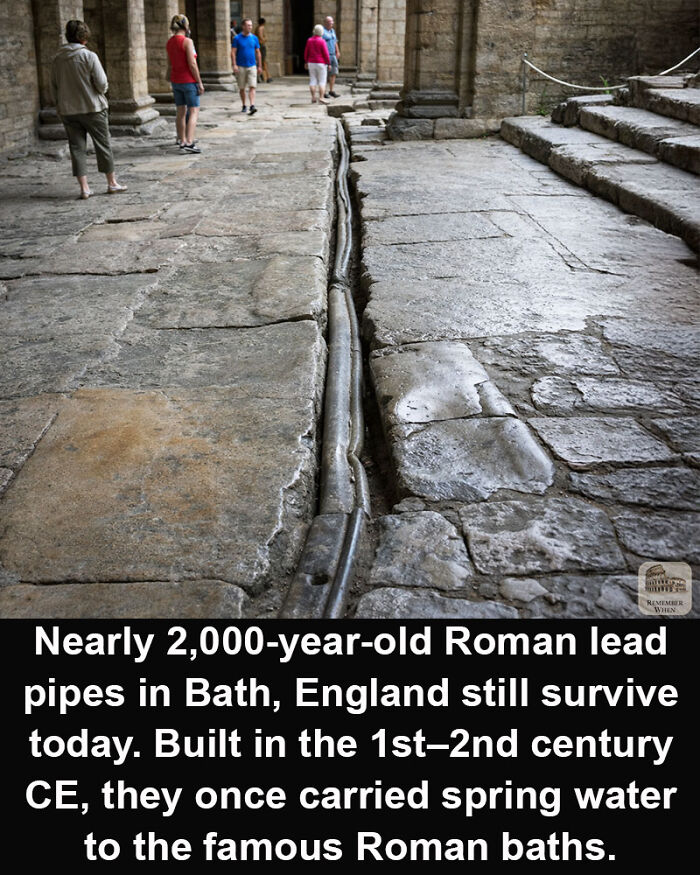
Image source: Remember When
#40
A mosaic hidden beneath centuries of rubble. In the ancient city of Jericho, one of the most remarkable floor mosaics of the early Islamic world lies within the ruins of Hisham’s Palace, a complex built in the 8th century during the Umayyad period.
The palace was part of a larger desert estate that included reception halls, courtyards, and bathhouses decorated with detailed stone mosaics. Among them, the most famous design appears in the palace bathhouse floor, often called the “Tree of Life” mosaic.
At the center stands a stylized tree spreading its branches across the panel. On one side, gazelles graze peacefully beneath the branches. On the other side, a lion attacks its prey. Many scholars interpret the scene as a symbolic contrast between peace and power.
The mosaic floor itself is enormous, made from thousands of carefully arranged stone tiles forming geometric and natural motifs across dozens of panels.
In 947 AD, a powerful earthquake struck the region, causing parts of the palace to collapse. The debris buried sections of the mosaic, unintentionally preserving it for centuries.
The ruins were rediscovered in the 19th century, and British archaeologist Robert Hamilton conducted major excavations in the 1930s.
Today Hisham’s Palace remains one of the most important early Islamic archaeological sites in Palestine.
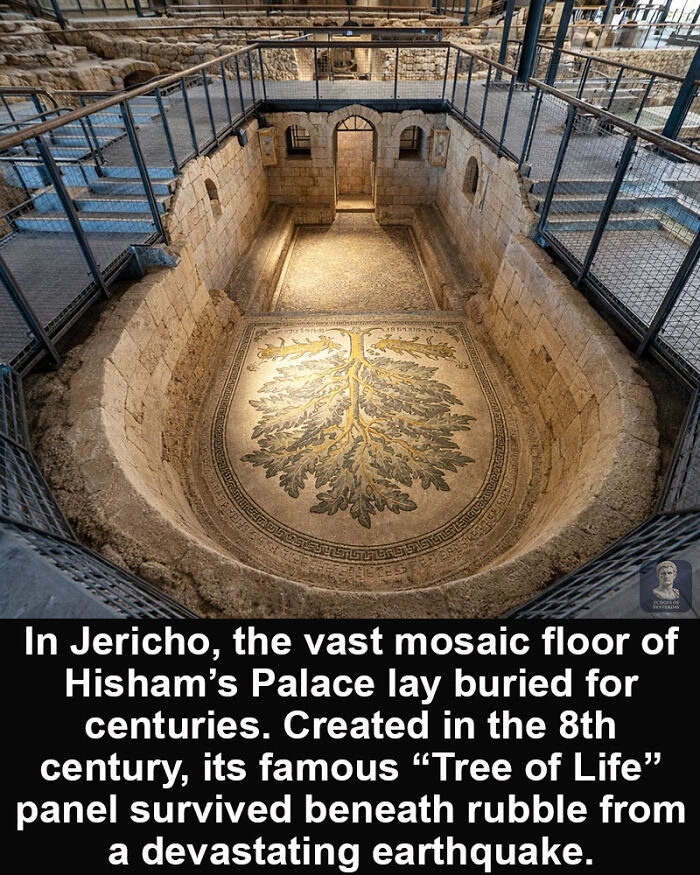
Image source: Echoes of Yesterday
#41
The discovery was genuine. The conclusion was the worst fossil reconstructions ever made. In 1663, fossilized bones were unearthed near Magdeburg, in present-day Germany.
At the time, paleontology did not yet exist as a scientific discipline. Scholars relied heavily on biblical descriptions and ancient writings when interpreting unusual remains.
The bones were assembled into what became known as the “Magdeburg Unicorn.” A prominent horn was placed on the skull, and the skeleton was presented as physical proof of a legendary creature long described in texts. The reconstruction reflected the worldview of the 17th century more than the anatomy of the animal itself.
As scientific methods advanced, researchers revisited the remains. Comparative anatomy eventually demonstrated that the fossils belonged to a woolly rhinoceros, an Ice Age species that once roamed Europe.
The skeleton still stands as a reminder.
Facts can be discovered.
Understanding takes longer
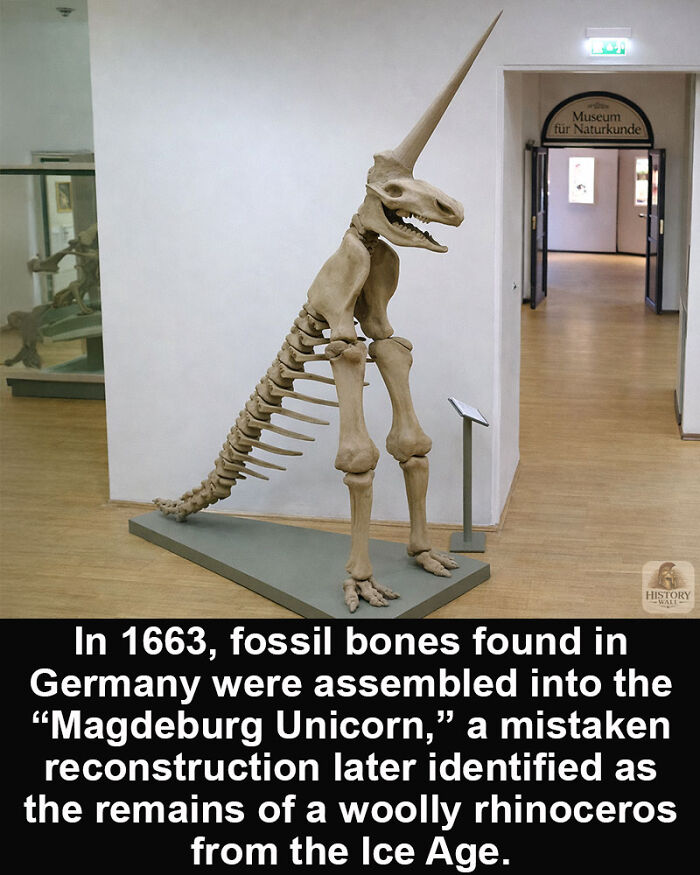
Image source: Nouza Expla
#42
In 2023, excavations in Aizanoi brought a classical presence back into view. The ancient city, located in modern western Turkey and known for its Roman-era Temple of Zeus, has long revealed architectural remains and inscriptions.
This time, archaeologists uncovered a fragment identified as part of a statue of Aphrodite, buried for more than two thousand years.
The sculpture surfaced from layers of compacted soil shaped by centuries of natural processes. Though incomplete, the fragment preserves the refined features typical of classical artistry, indicating it once formed part of a larger composition displayed in a civic or sacred space.
Only a portion has been recovered.
Whether additional fragments remain nearby is still unknown, and ongoing excavations may clarify the statue’s original setting and scale.
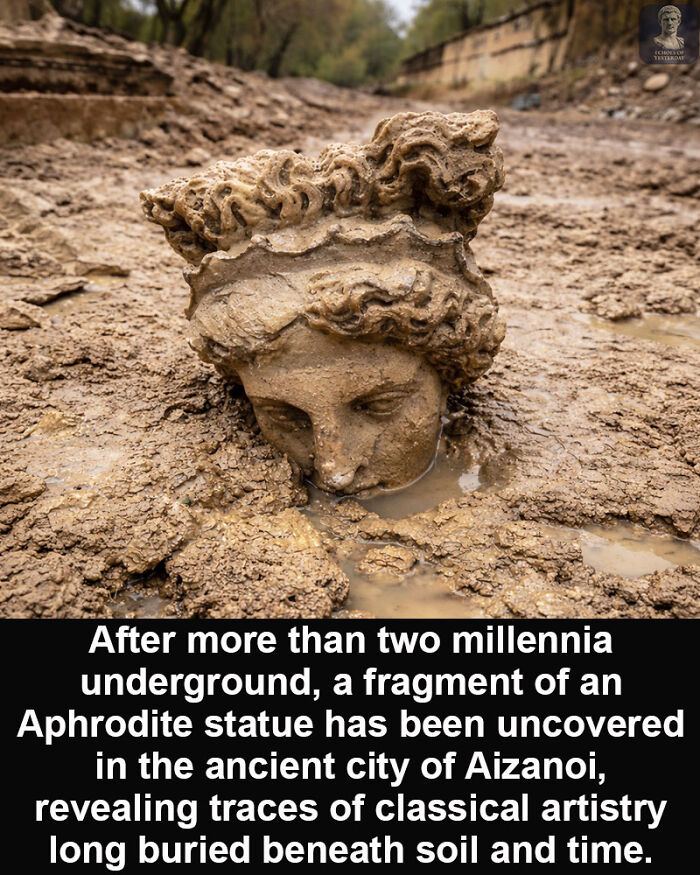
Image source: Echoes of Yesterday
#43
These pipes were never meant to be seen. At the Pingliangtai site in China’s Central Plains, archaeologists uncovered a network of ceramic water pipes dating to around 2000 BC. Buried beneath the settlement, the system redirected water away from living areas, reducing flood risk in a landscape prone to seasonal rainfall.
The pipes were carefully fitted, aligned, and standardized. This was not improvisation. It reflects advance planning, coordinated labor, and a shared understanding of water behavior. The settlement above depended on what was hidden below.
Pingliangtai belonged to a late Neolithic culture transitioning toward early urban life. There were no written plans, no metal tools, and no formal engineering tradition as later societies would define it. Yet the infrastructure functioned with clarity and intent.
Archaeologists can describe how the pipes worked. They cannot fully explain how such planning emerged so early, or how knowledge was transmitted across generations. The system suggests a level of organization that complicates simple ideas of primitive villages.
Long before cities were defined by walls or monuments, some were defined by what they buried underground.
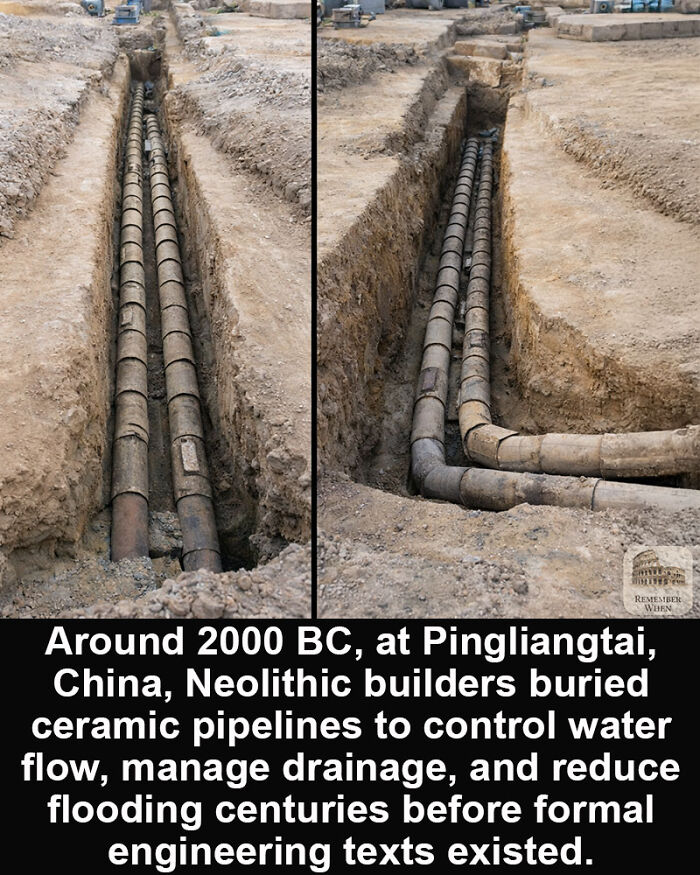
Image source: Remember When
#44
This looks like wood. It isn’t. In Petrified Forest National Park, Arizona, fallen trees from the Late Triassic Period, around 220 million years ago, remain scattered across the landscape. What appears to be grain, bark, and growth rings is actually stone.
The transformation is precise. After burial, groundwater rich in silica moved through the logs. Organic material decayed, but its microscopic structure remained. Over time, silica crystallized in place, replacing each cell with quartz while preserving the original form. The result is wood in shape only, gemstone in substance.
One detail stands out when viewed closely: growth rings and knots are still visible, yet they fracture like glass. Color bands come from trace minerals, iron, manganese, and carbon, locked in during crystallization.
Geology explains the process. What it cannot fully recreate is the scale. Entire forests fossilized where they stood.
The trees are mapped. The chemistry is known. What remains uncertain is how often landscapes like this vanish so completely, leaving only stone memories behind.
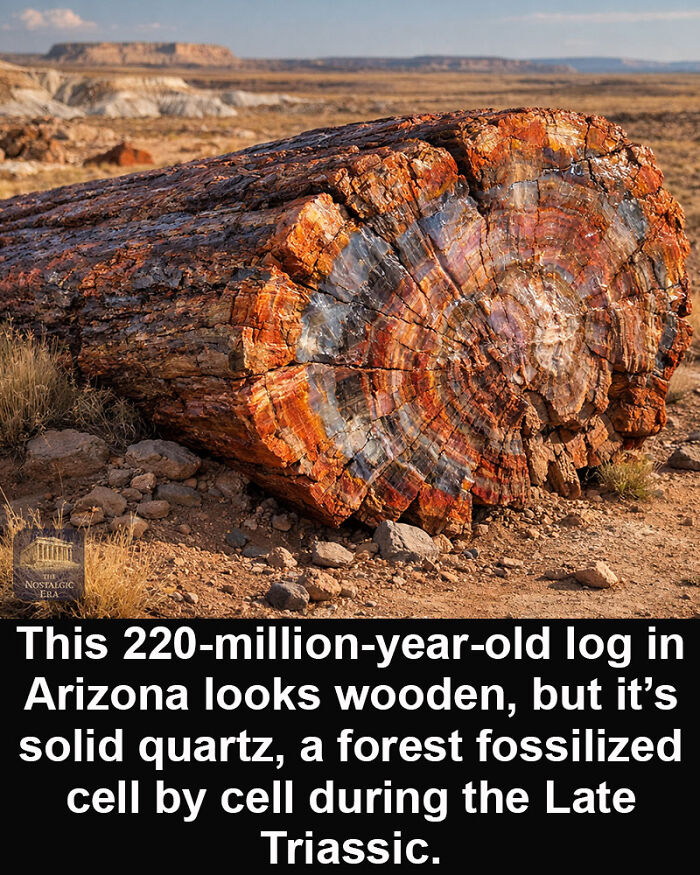
Image source: The Nostalgic Era
#45
This exposed staircase on the cliffs of Rio de Janeiro was not built as a monument or a tourist attraction. It was carved gradually in the mid-20th century by climbers and hikers accessing steep granite routes in the Tijuca Massif, most commonly associated with trails leading toward Pedra da Gávea.
The steps were cut directly into the rock to solve a practical problem. Sheer slabs offered no safe footing, especially in rain. Rather than reroute the path, climbers carved narrow footholds and installed chains anchored into the cliff to assist ascent and descent. The goal was access, not comfort. No machinery, no large-scale planning, just hand tools, experience, and repetition over time.
What remains today is a hybrid structure. Part trail, part climbing route. It reflects a period when exploration preceded regulation, and terrain was adapted minimally to human movement rather than reshaped. The staircase exists because people needed to pass here, and chose the cliff instead of the long way around.
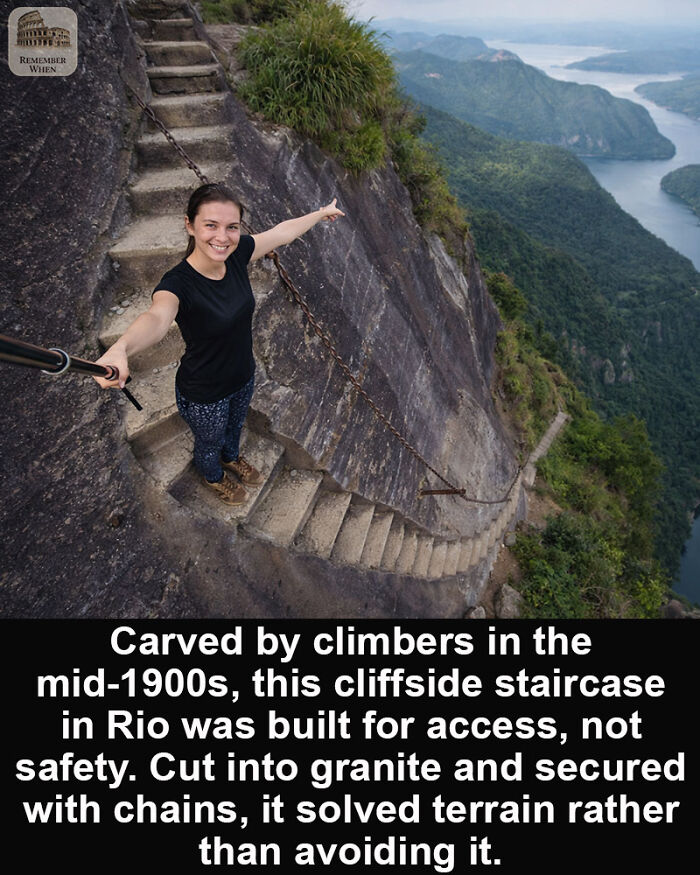
Image source: Remember When
#46
These mountainside quarries in the Sacred Valley contain large rock faces marked by deep channels, straight grooves, and grid-like cuts carved directly into the stone. Many of the surfaces appear unusually precise, forming straight lines and sharp angles across the rock.
The quarry complex was used centuries ago by pre-Inca cultures and later by the Inca civilization, which expanded construction at Ollantaytambo into one of the most impressive fortified and ceremonial sites in the Andes.
The marks seen in the stone likely relate to the process of detaching massive blocks that would then be transported down the mountain. Some of the stones quarried here weigh many tons and were later fitted into temples and terraces in the town below.
Researchers generally believe the cuts were made using stone hammers, chisels, and controlled splitting techniques. Even so, the precision of some quarry marks continues to attract attention.
The quarry clearly shows the stages of ancient stone extraction.
What remains debated is the exact sequence of methods used by Andean builders to shape and separate such enormous blocks from the mountain
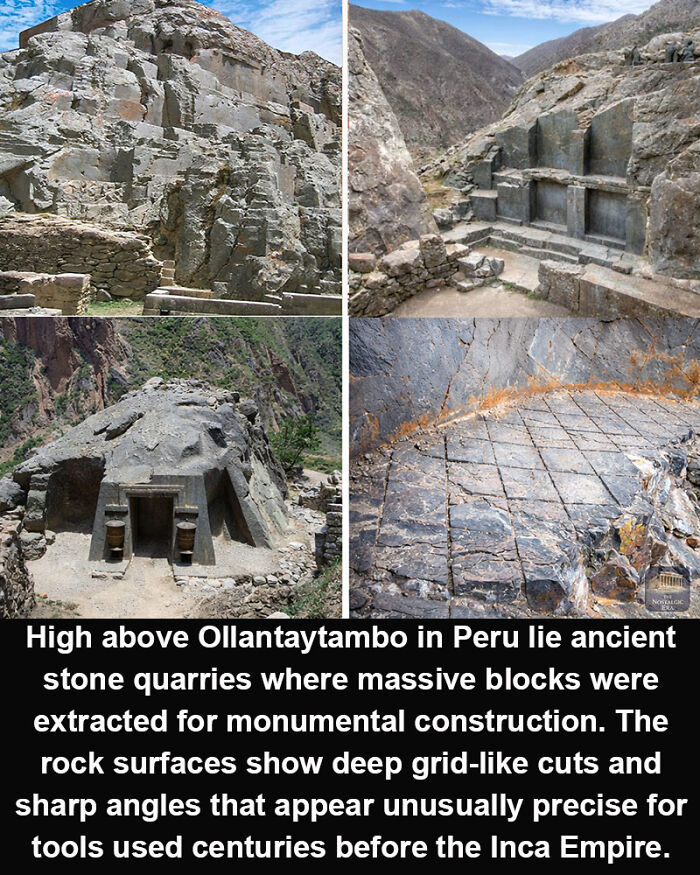
Image source: The Nostalgic Era
#47
A stone face watches the valley. High on the hills near Todmorden in West Yorkshire stands a striking sculpture known as the Whirlaw Wizard. Carved directly into the rock, the robed figure appears to stare quietly across the surrounding countryside.
The sculpture sits close to a group of unusual rock formations known as the Bridestones. These weathered stones have drawn attention for centuries and are surrounded by local tradition. Some stories refer to them as the Todmorden Giants, while others call them the Plague Stones, linking them to old regional legends and historical folklore.
The Whirlaw Wizard itself resembles a hooded figure with a long beard, often interpreted as a wizard or shaman watching over the landscape. Its exact meaning remains open to interpretation, adding to the atmosphere of the site.
Over time, the Bridestones and the nearby sculpture have become a recognizable symbol of the Todmorden area. Walkers, photographers, and visitors often climb the hillside to see the figure and the ancient stones overlooking the valley below.
The rocks themselves are shaped by natural forces.
But the stories surrounding them continue to grow
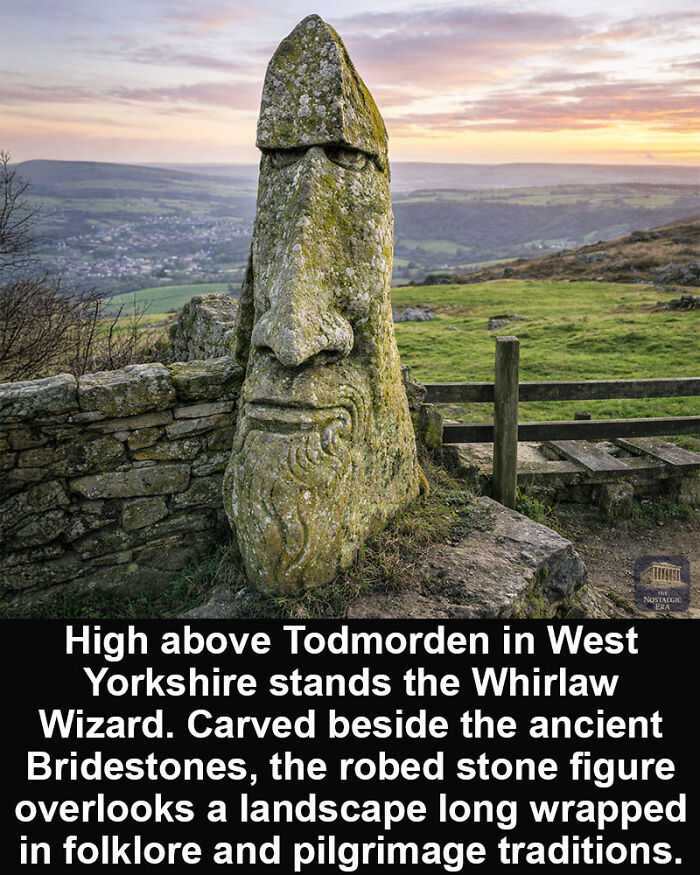
Image source: The Nostalgic Era
#48
In Abhaneri, Rajasthan, Chand Baori sinks deep into the earth with exact repetition. Thousands of steps follow strict geometry, not decoration. This was infrastructure designed with discipline, where mathematics quietly controlled water, temperature, and movement.
Post description (~150 words)
Chand Baori immediately unsettles modern expectations of ancient engineering. Built around the 9th–10th century, this stepwell descends more than 30 meters across 13 levels, formed by thousands of perfectly aligned stone steps. The design is not ornamental excess. It is controlled repetition, executed in an era without modern surveying tools.
One concrete detail defines the structure: each step mirrors the next with minimal deviation, creating a geometric grid that stabilizes the walls while maximizing access to water as levels rise and fall. The well also maintained cooler temperatures, sometimes several degrees lower than the surrounding desert heat.
Chand Baori functioned as both infrastructure and social space, carved with deities and mythological figures that framed daily life around water. Archaeology explains its purpose and age. It does not fully explain how such precision became routine, or why this logic vanished from later construction traditions.
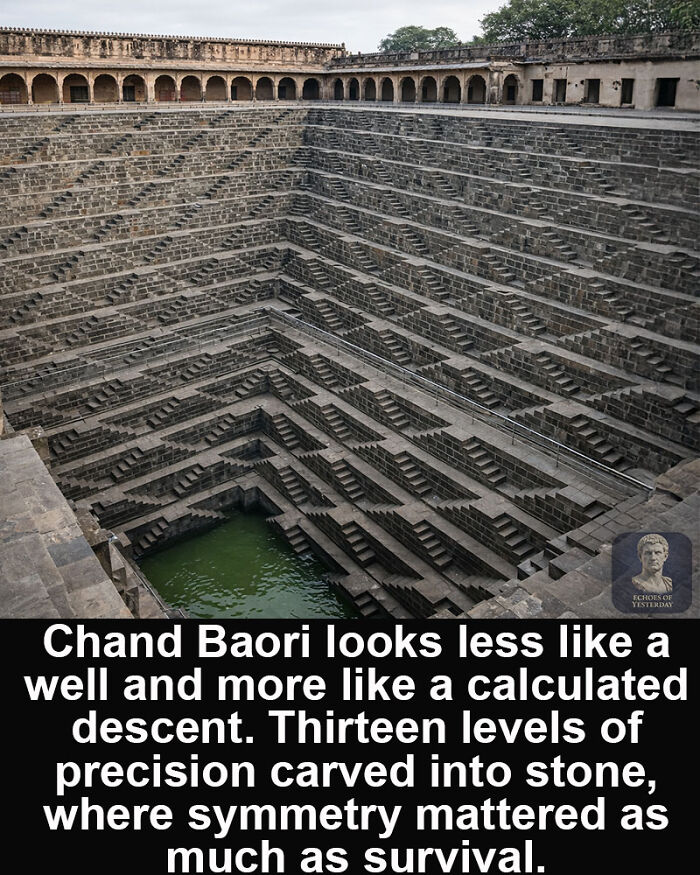
Image source: Echoes of Yesterday
#49
In the heart of Megoňky, Slovakia, lies a geological wonder that captivates the imagination: mesmerizingly round rock spheres. These extraordinary natural formations vary in size, measuring anywhere from a modest 12 inches to an awe-inspiring 6.5 feet in diameter, with legendary giants that once reached a staggering 10 feet. Though the quarry walls may now only whisper of the colossal 16-foot spheres that once graced the land, their intriguing indentations tell a tale of a time long past. Theories abound regarding their origin, with suggestions ranging from the bizarre – such as dinosaur eggs or alien artifacts – to the scientifically grounded. Most experts lean towards the notion that these remarkable orbs are a natural phenomenon, dating back over 40 million years. Regardless of their origin, the spheres of Megoňky remain a source of wonder and curiosity, enchanting every visitor drawn to this unique destination.
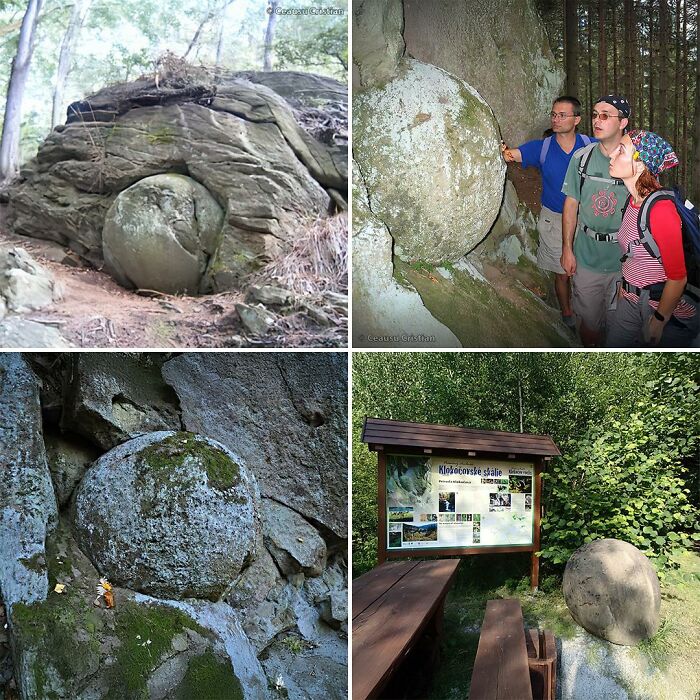
Image source: Revealed
#50
Neamț Fortress – the stronghold that resisted kings Built at the end of the 14th century, Neamț Fortress was one of the most powerful strongholds of medieval Moldavia. In 1395, the King of Hungary, Sigismund of Luxembourg, launched a military campaign against Moldavia, seeking to expand his influence beyond the Carpathians. His armies advanced close to the fortress, a key strategic point. However, according to Moldavian chronicles, the fortress did not fall, and its resistance became a symbol of independence and defense. Today, Neamț Fortress remains one of the most impressive testimonies of Romania’s medieval past.
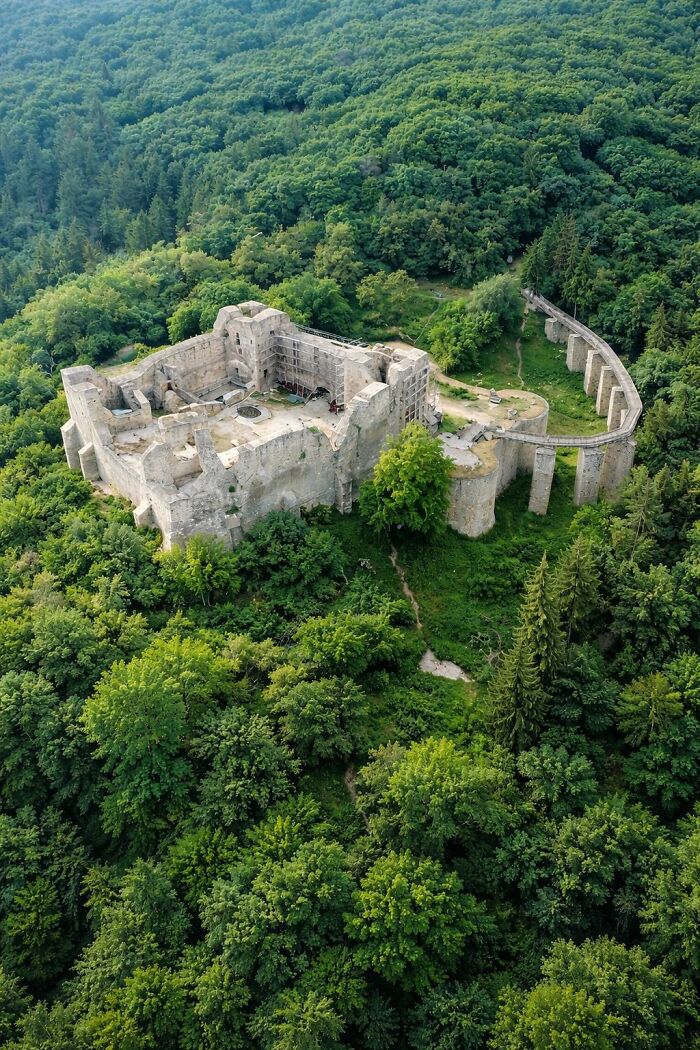
Image source: Ceausu Gabriel
#51
The capital stood on water, not solid ground. Founded in 1325 on Lake Texcoco, Tenochtitlan became the center of the Aztec Empire, built with canals, causeways, and artificial islands. Movement through the city relied on boats, while raised roads connected districts to the mainland. The urban plan adapted architecture to a lake environment.
Ceremonial temples rose above the central precinct, surrounded by gardens and neighborhoods arranged across chinampas. Waterways structured daily life, trade, and transport, turning canals into primary routes instead of streets. The city combined hydraulic engineering with monumental construction.
Spanish descriptions and archaeological remains confirm this layout. The structure is clear, yet population estimates and circulation patterns remain debated. The lake setting defined the city. The full scale of its activity remains partly inferred.
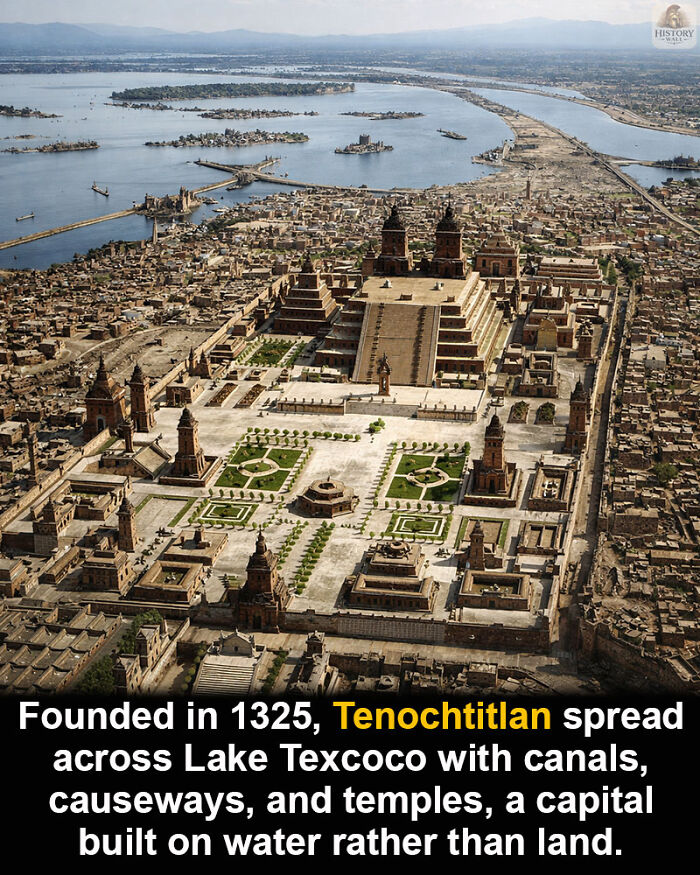
Image source: Nouza Expla
#52
The shoreline changed, the footprint persisted. In 6 AD, Caesarea on Israel’s Mediterranean coast became the capital of Roman Judaea, built with an engineered harbor, theater, and organized urban grid. The city later appears in the Acts of the Apostles, linked to Paul, Peter, and Philip, placing it within early Christian history.
Ancient descriptions and archaeology indicate a coastal metropolis with maritime infrastructure extending into the sea. Over time, sections of the harbor submerged while the theater and structural foundations remained visible on land. The modern aerial view still follows the outline of the Roman plan.
The layout is documented, but daily life within the city is reconstructed from fragments. Buildings survive in parts, and the harbor exists partly underwater. The location remained continuous. The full scale of the original city remains partly inferred.
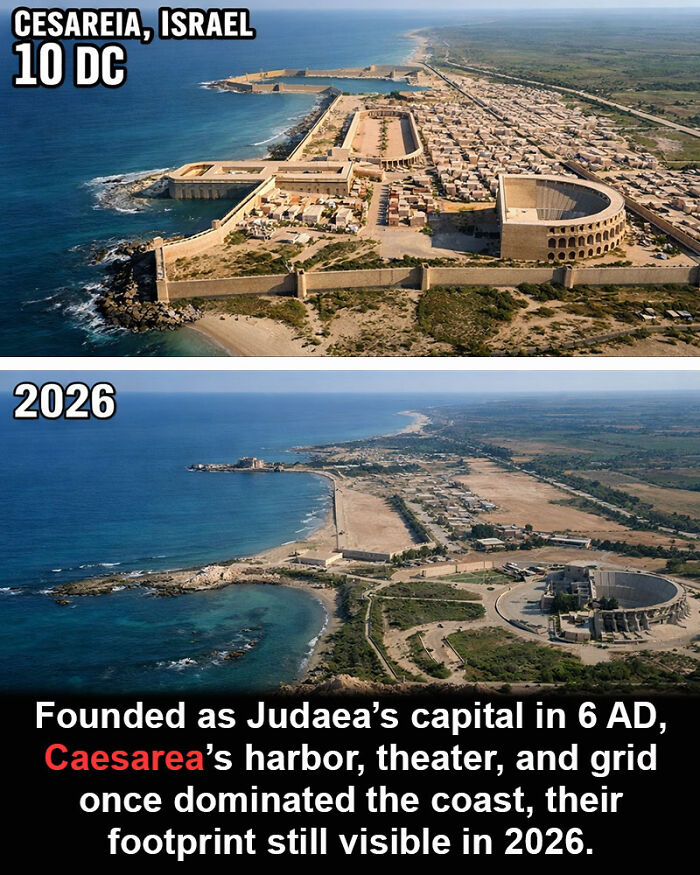
Image source: Remember When
#53
This linen tunic from Asyūṭ in Middle Kingdom Egypt, dated around 2000 BCE, preserves a surprisingly tailored form. The garment was stitched from three pieces of linen and finished with dense horizontal pleats. The cut follows the body from wrists to ankles, suggesting a close fit rather than loose draping.
Such shaping required measured folding and deliberate construction. The design challenges the assumption that early Egyptian clothing relied mainly on simple wrapped fabric.
The sealed tomb preserved the linen for nearly 4,000 years. The tunic’s construction is clear, yet how widespread this fitted style was in everyday use remains debated.
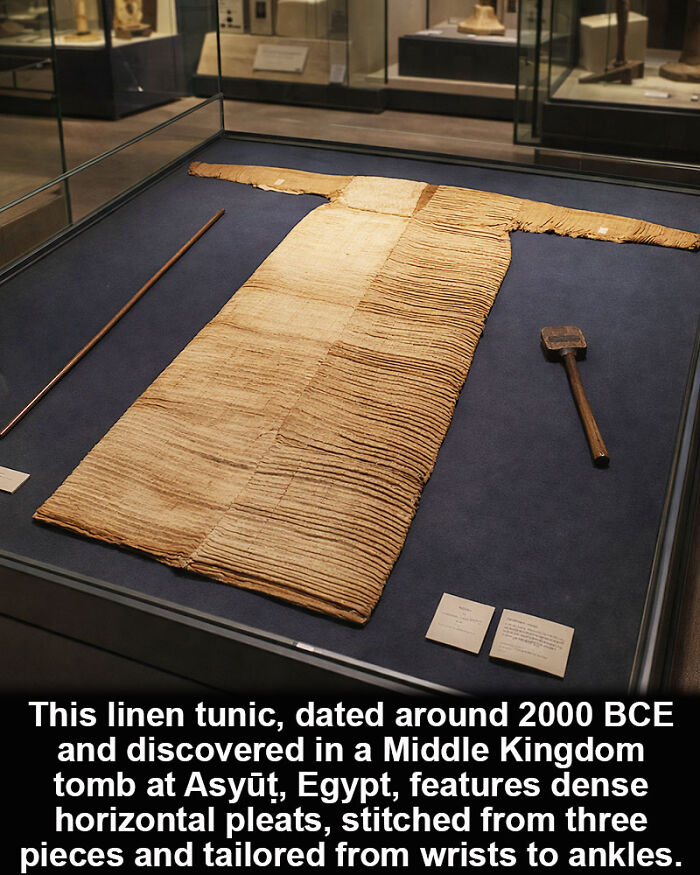
Image source: Cristian Ionut Ceausu
#54
The ruins suggest more than what survives. The Martand Sun Temple in Kashmir, built in 760 CE, once stood within a vast rectangular courtyard surrounded by colonnaded chambers.
At the center rose the main shrine dedicated to the Sun God. The surrounding arcades formed a structured perimeter, creating a monumental open court aligned around the core structure. The scale reflects deliberate planning in Kashmiri temple architecture.
In 1401 CE, the complex was destroyed under Sultan Sikandar Shah Miri. The upper structures disappeared, leaving foundations, walls, and partial colonnades.
Today the layout remains readable. The enclosure outlines the original design, yet much of the vertical architecture is lost. The footprint survives clearly, but the full visual impact of the temple remains open to reconstruction.
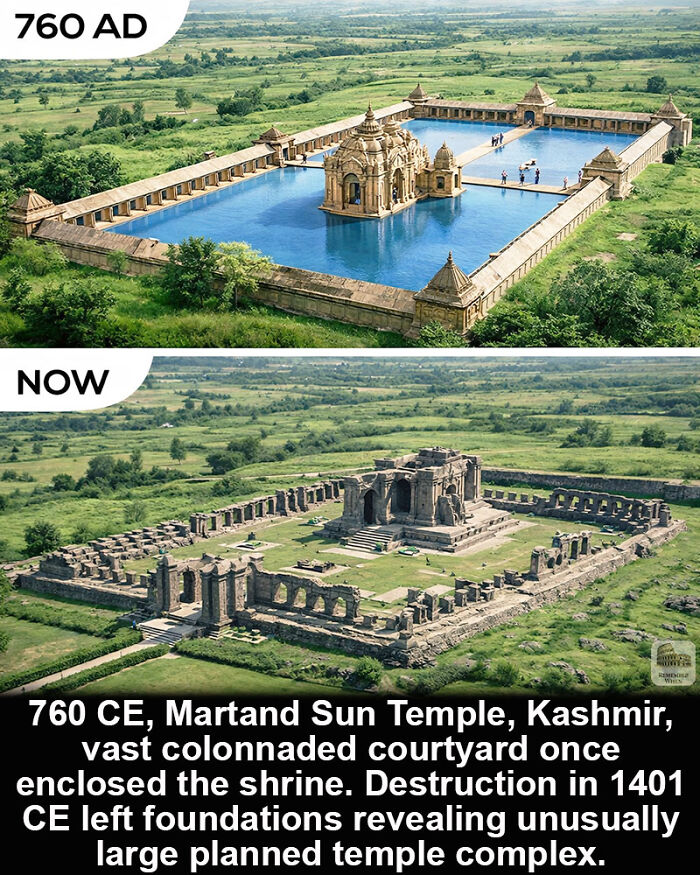
Image source: Remember When
#55
A desert complex built at scale. Around 828 CE, Pueblo Bonito rose in Chaco Canyon, northern New Mexico, eventually expanding to more than 600 rooms arranged in a massive D-shaped plan.
The structure reached up to four stories. Its centerpiece, the Great Kiva, measured over 66 feet, 20 meters, in diameter. These circular chambers were roofed with large wooden beams, most now gone after centuries of decay.
The timber did not come from nearby. Many beams were transported from mountain forests roughly 50 miles, 80 km, away. With no pack animals or wheeled vehicles, each log had to be carried by coordinated human effort.
Stone masonry walls used shaped sandstone blocks with a core-and-veneer technique. Some alignments appear linked to solar and lunar cycles. The scale, engineering, and logistics suggest Pueblo Bonito functioned as a regional ceremonial and administrative center rather than a simple settlement.
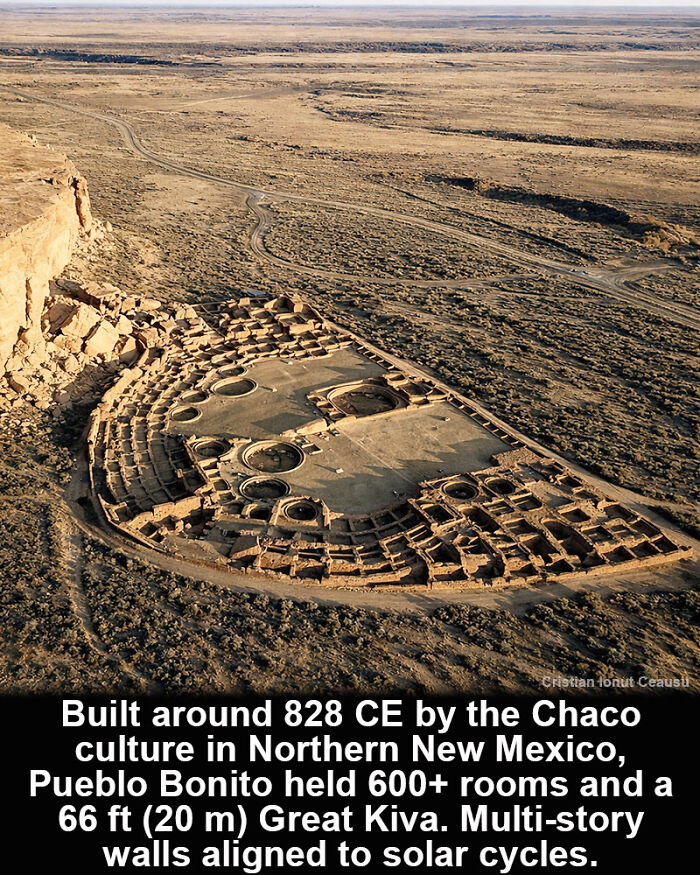
Image source: Cristian Ionut Ceausu
#56
The corner is not angular, it is sculpted. At Sacsayhuamán near Cusco, Peru, 15th century CE, a massive rounded andesite block forms the edge of the wall, curving smoothly into neighboring stones without mortar.
Unlike straight masonry, the corner is shaped as a continuous surface. The hard andesite appears softened into flowing contours, with joints wrapping around adjacent blocks. Some stones in the complex weigh many tons and were positioned at about 11,500 ft (3,500 m) above sea level.
This rounded geometry reduces stress concentration and allows slight movement during earthquakes. The walls have endured repeated seismic activity while maintaining tight joints.
Researchers suggest shaping with hammerstones, abrasion, and repeated fitting. Yet the smooth curved transitions in extremely hard stone remain difficult to reproduce. The structure is measurable, but the exact technique behind the rounded corner remains unresolved.
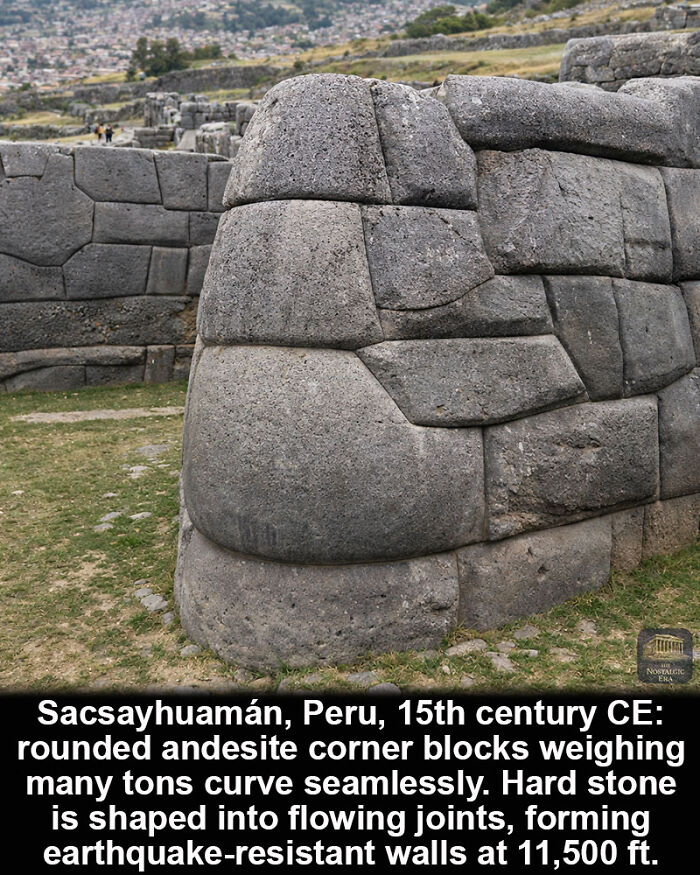
Image source: The Nostalgic Era
#57
The animals vanished, the paintings remained. In the Chiribiquete region of the Colombian Amazon, extensive rock art dated to about 10,600 BCE stretches across roughly 8 miles (13 km) of sandstone cliffs.
The panels depict large mammals interpreted as mastodons, giant sloths, and other Ice Age fauna. Human figures, handprints, and geometric designs appear beside them. Many images are positioned high above ground level, suggesting scaffolding or natural ledges were used to reach the surfaces.
These paintings likely accumulated over long periods, documenting animals that disappeared near the end of the last Ice Age. The scale indicates repeated visits by different groups.
Dating relies on nearby deposits and stylistic analysis rather than direct pigment testing. The scenes are preserved, but whether they record daily life, ritual meaning, or memory of vanished animals remains unresolved.
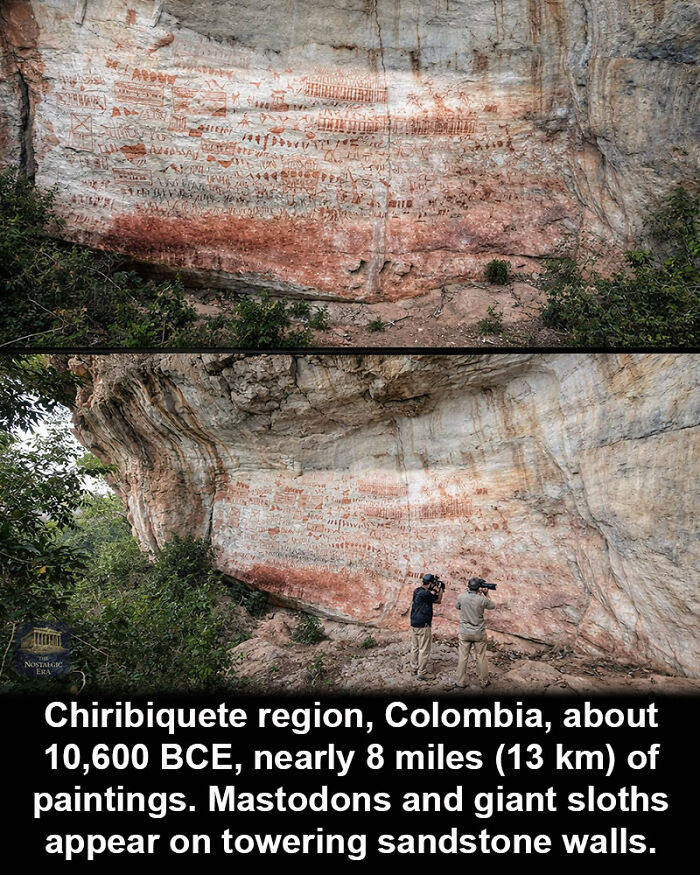
Image source: The Nostalgic Era
#58
The city appears to float, yet its foundations are buried wood. Venice, Italy, founded from the 5th century CE, was built on millions of timber piles driven deep into lagoon sediments.
Workers hammered long wooden trunks, often reaching about 60 ft (18 m), through soft silt until they reached compact clay. The piles were placed tightly together, creating a dense platform. Horizontal beams and stone slabs were then laid above, forming the base for buildings.
Submerged in oxygen-poor water, the wood resisted decay. Over time, minerals from the lagoon hardened the timber, turning the piles into stable supports capable of carrying heavy masonry.
Palaces, churches, and towers rose on this hidden grid. The water dominates the surface, but beneath Venice lies a submerged forest that still supports the city centuries later.
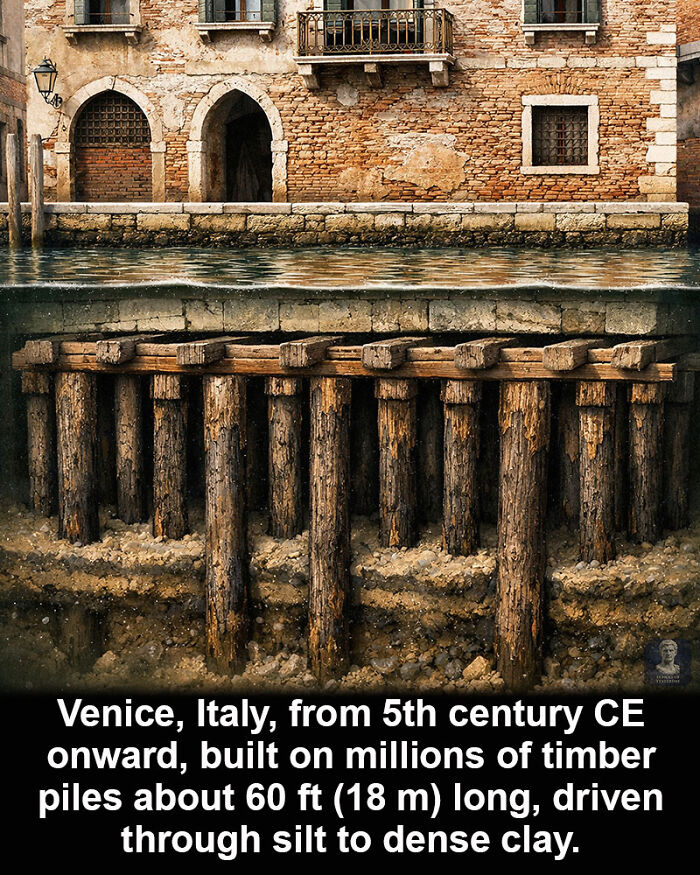
Image source: Nouza Expla
#59
The stone was cut but never transported. At Baalbek in Lebanon, a limestone monolith measuring about 64 ft (19.6 m) in length and weighing roughly 3.3 million lb (1,650 tons) remains in the quarry. The block is partially separated from the bedrock, with cutting channels visible along its sides. Nearby, the Temple of Jupiter platform includes enormous foundation stones. Three of these, known as the Trilithon, weigh around 2 million lb (1,000 tons) each. The construction shows large-scale quarrying and placement of massive blocks during the Roman period. The unfinished monolith indicates even larger plans. The quarry preserves the process. The block demonstrates the scale achievable with ancient stoneworking. The precise reason it was left in place remains uncertain.
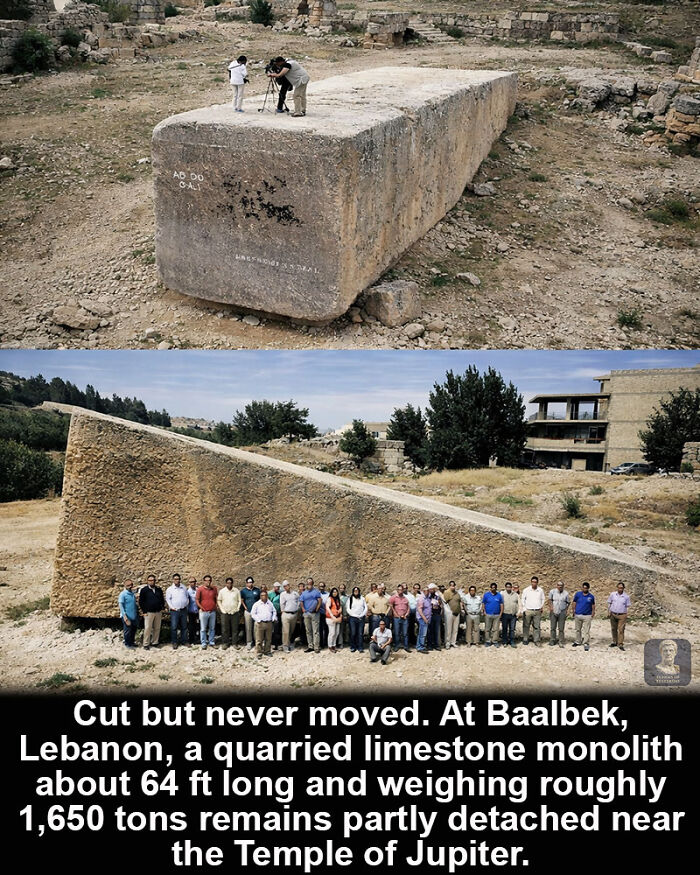
Image source: Echoes of Yesterday
#60
The tomb begins with a long descent. At Mycenae, Greece, in the 14th century BCE, the Tsarskyi Tomb was approached through a deep dromos cut into the hillside. The passage is lined with large, carefully set stones forming steep, symmetrical walls.
The corridor narrows toward the burial chamber entrance. Stone blocks stabilize the cut bedrock, creating a monumental approach rather than a simple path. The design directs movement and frames the tomb façade. The precision suggests planned excavation and coordinated masonry work.
The engineering lies in the approach itself. The dromos structures the experience before entry. The exact methods used to cut and align the passage remain uncertain.
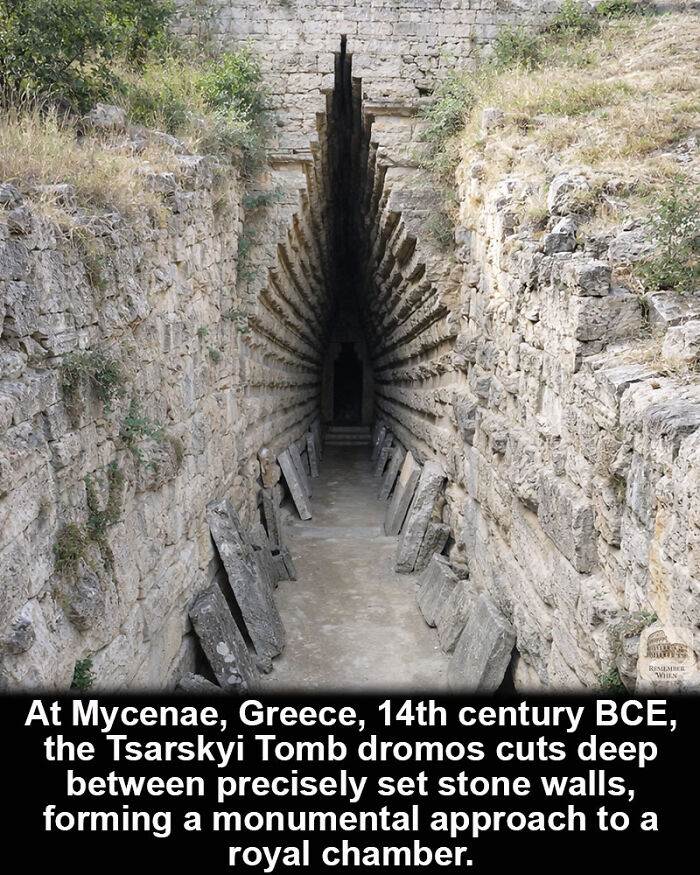
Image source: Remember When
#61
The layout removes streets entirely. Çatalhöyük, central Turkey, c. 7400–5200 BCE, consisted of tightly packed mudbrick houses sharing walls in a dense cluster.
Access came through roof openings, with ladders descending into living spaces. Interiors included raised platforms, ovens, storage bins, and painted walls. Burials often lay beneath floors.
The settlement formed a continuous surface across the mound. Movement likely occurred across rooftops rather than ground-level paths.
The architecture is documented. How circulation functioned daily for thousands within this enclosed layout remains debated.
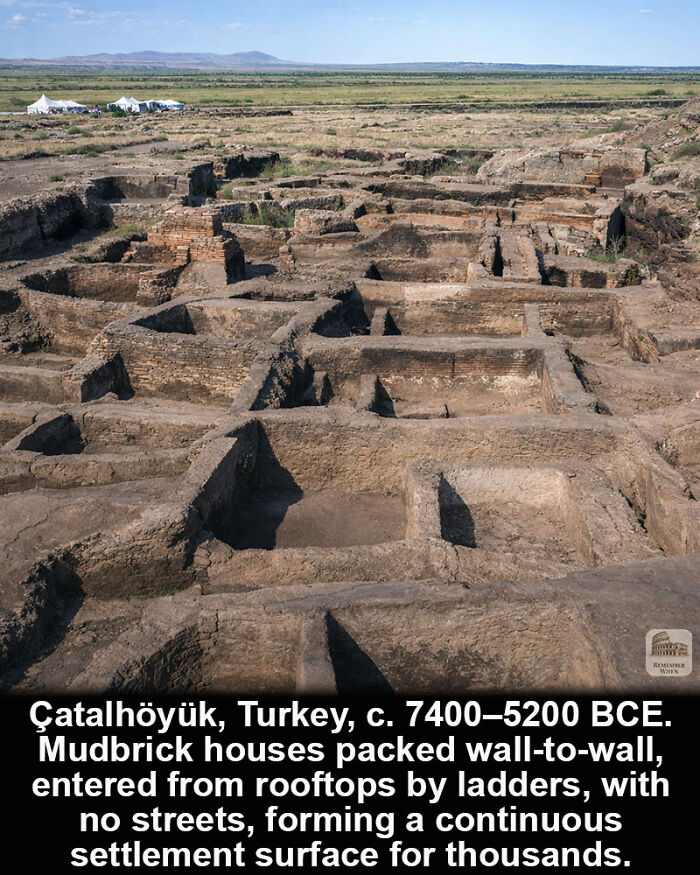
Image source: Remember When
#62
The ruins lie where ships once anchored. Thonis-Heracleion, Egypt, flourished between the 6th and 2nd centuries BCE as a major port at the Nile’s Mediterranean entrance. Earthquakes, subsidence, and soil liquefaction caused large sections of the city to sink, sealing temples and harbor structures beneath sediment.
Marine excavations uncovered ritual vessels, statues, and offerings from a sanctuary associated with Aphrodite. Pottery, cult objects, and architectural blocks remained where they fell. The sediment preserved fragile materials and spatial relationships.
The underwater remains show a functioning port where Egyptian and Greek practices overlapped. The finds document ritual activity inside a harbor district. The city survives as a submerged archaeological landscape.
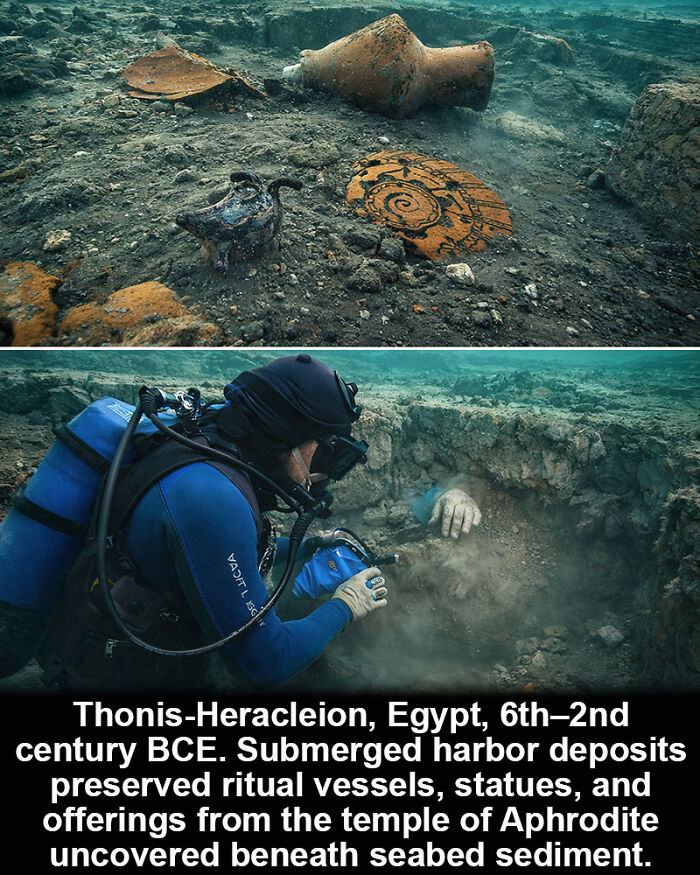
Image source: Cristian Ionut Ceausu
#63
The stones still show how they were moved. At Qorikancha in Cusco, constructed in the 15th century, many blocks include squared protrusions carved directly from the same stone. These features were not decorative. They served as practical grips during construction.
Inca masons shaped the blocks, leaving bosses that allowed ropes or wooden levers to hold and guide each piece. After positioning, some projections were removed, while others were left intact. Their placement varies depending on how each stone was handled.
The result preserves part of the building process in the finished wall. The projections reveal how massive blocks were maneuvered and aligned without mortar.
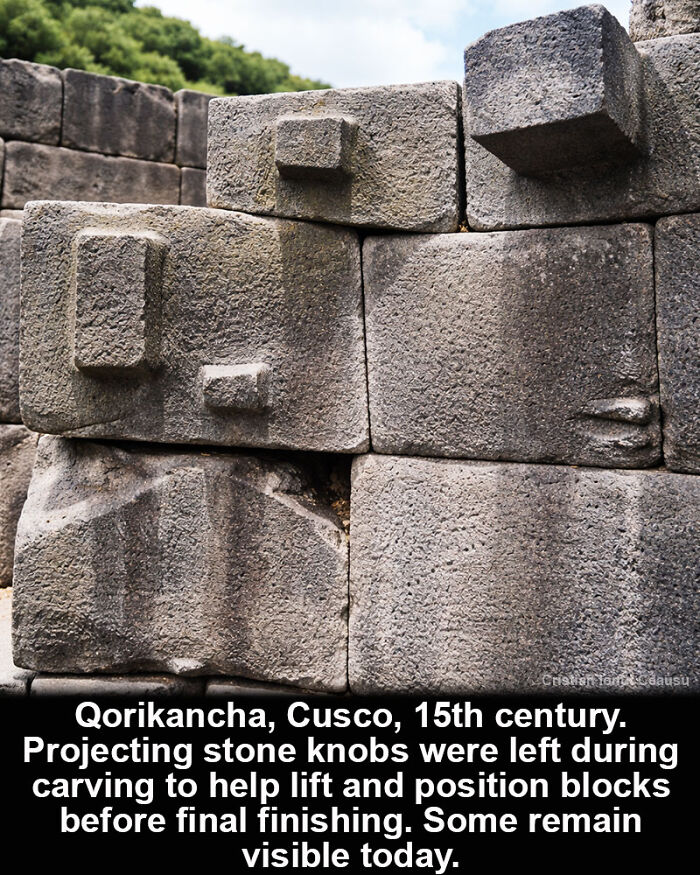
Image source: Cristian Ionut Ceausu
#64
The houses existed before the builders arrived. In Pampachiri, Andahuaylas Province in southern Peru, cone-shaped rock formations formed by volcanic activity and erosion over three million years ago now function as dwellings. The cones rise roughly 20 to 26 feet, creating natural roofs.
Residents constructed stone walls at the base of the formations, enclosing interior spaces beneath the rock. About thirty of these cone structures are currently used as homes by families in the area. The surrounding landscape contains many similar formations.
The geology provided the structure, while people completed the architecture. Natural shapes became practical shelters adapted to local living conditions.
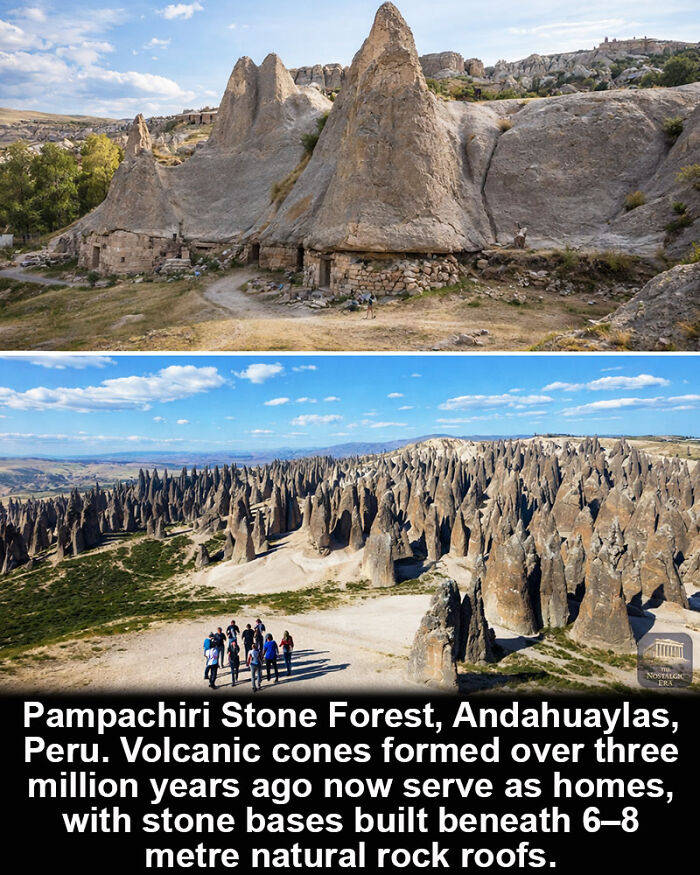
Image source: The Nostalgic Era
#65
The blocks were not required to match perfectly. Around 2580–2560 BCE, during the construction of Khufu’s pyramid at Giza, Egyptian teams placed gypsum-based mortar between limestone blocks. The material was poured as a slurry, settling into gaps and leveling irregular faces before the stones fully seated.
Microscopic petrographic studies identify deliberate recipes with fine gypsum components mixed for large-scale application. The mortar acted as a bedding compound rather than a strong adhesive. Under weight, it spread and stabilized the courses.
This approach reduced the need for perfectly dressed stone surfaces while maintaining alignment. The exact preparation and mixing process remains debated, yet the repeated presence of controlled mortar layers suggests a practical engineering shortcut built into the pyramid’s construction.
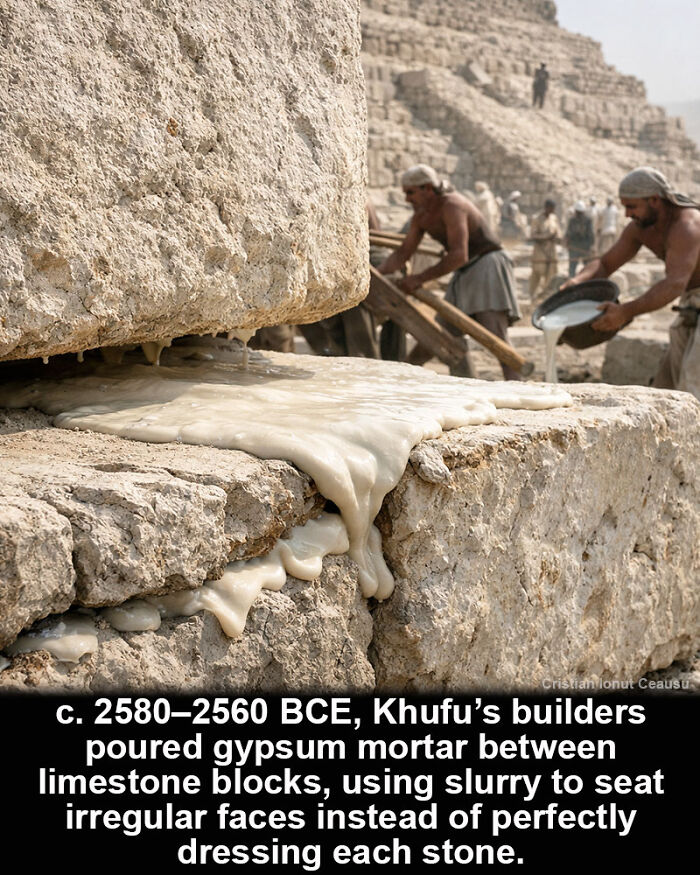
Image source: Cristian Ionut Ceausu
#66
The statues stayed the same while empires changed around them. The bronze Horses of Saint Mark, attributed to Lysippos and possibly originating from Chios, are recorded by the 8th–9th centuries CE. In 1204, Venetian forces removed them during the Fourth Crusade and installed them at St Mark’s Basilica in Venice.
Napoleon later transported the horses to Paris, where they remained until their return. Centuries of exposure led to preservation concerns, and the originals were moved inside the basilica. Replicas now occupy the exterior position.
The journey is documented across multiple periods. The sculptures survived relocation, conflict, and exposure. Their original context remains uncertain.
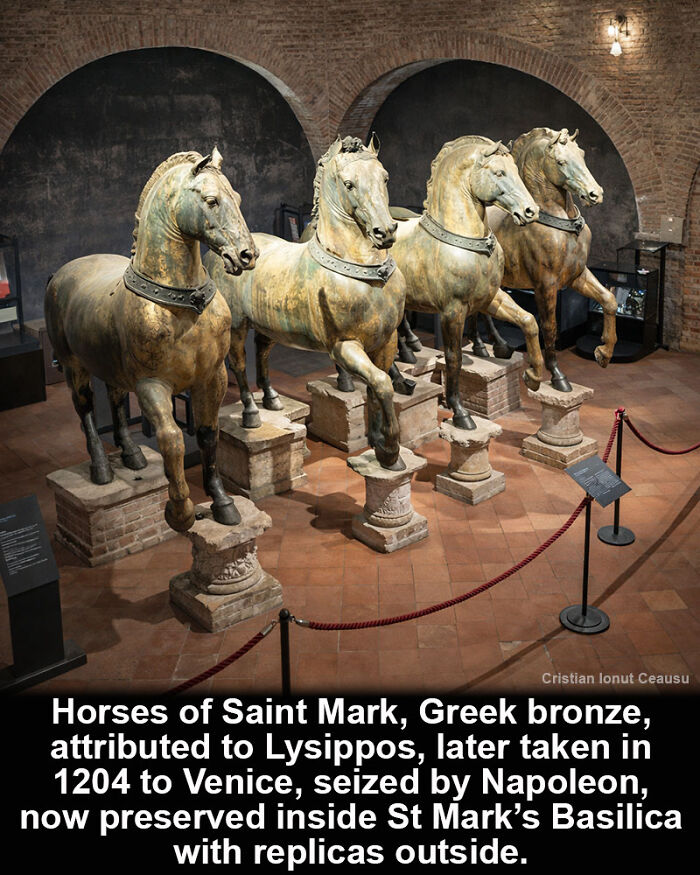
Image source: Cristian Ionut Ceausu
#67
The marsh crossing was built like a planned roadway. The Sweet Track in Somerset, England, constructed in 3800 BCE and dendro-dated from preserved timbers, used paired oak planks laid over supporting rails. Crossed wooden pegs fixed the elements together, creating a stable surface across wetlands.
Thousands of timbers were cut, shaped, and positioned along a defined route. The structure formed a continuous raised causeway rather than isolated stepping platforms. The carpentry required coordinated cutting, transport, and placement of large oak components.
The project suggests organized planning within Neolithic communities. How labor was coordinated remains uncertain, but the pegged plank system represents one of the earliest engineered timber roads in prehistoric Europe.
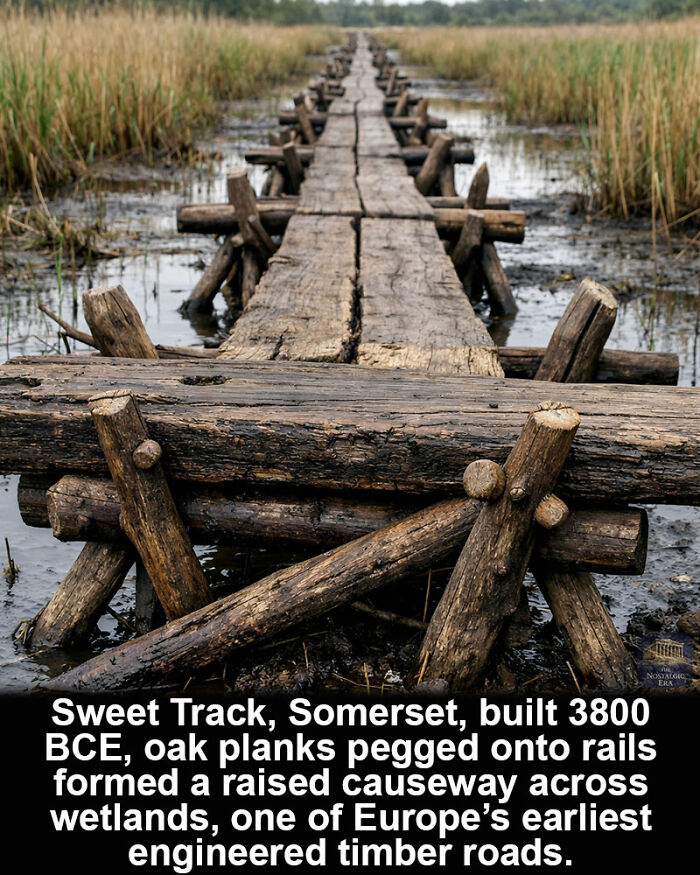
Image source: The Nostalgic Era
#68
They appear delicate, yet they moved water like industrial machines. In Ottoman-era Hama, Syria, particularly between the 16th and 19th centuries CE, enormous wooden norias rotated in the Orontes River. Some wheels exceeded 20 metres in diameter, with rows of buckets fixed along their rims.
As the current turned the wheels, buckets filled at the bottom and emptied into elevated aqueducts. This continuous motion lifted water to canals feeding gardens and fields. Contemporary estimates suggest flows reaching dozens of cubic metres per hour depending on river conditions.
The structures were built almost entirely from timber, without engines or metal drive systems. Their size and output contrast with their materials. The precise efficiency varied, yet the persistence of these giant wooden hydromechanical machines indicates a long-lived irrigation solution scaled without industrial technology.
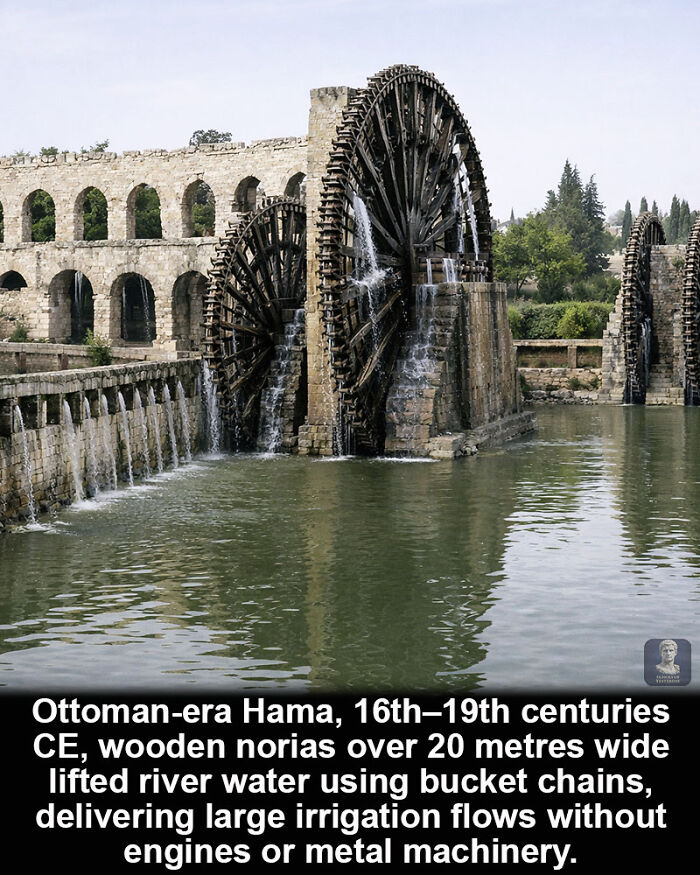
Image source: Echoes of Yesterday
#69
A single stone balanced high above a Norwegian fjord has become one of Scandinavia’s most famous natural landmarks. Kjeragbolten is a large glacial boulder wedged in a mountain crevasse on Kjerag mountain, overlooking Lysefjord in southwestern Norway.
The rock was deposited during the last Ice Age, when glaciers transported and dropped massive stones across the region.
At some point, this particular boulder became trapped between two vertical rock faces, where it has remained for thousands of years.
The site lies about 1,000 meters (approximately 3,280 feet) above the fjord below.
Today hikers follow a challenging trail across the Kjerag plateau to reach the famous rock. Many visitors carefully step onto the boulder to take photographs while standing between the towering cliffs.
Although the drop below is dramatic, the stone itself is tightly wedged and considered stable.
Kjeragbolten has become a symbol of Norway’s rugged landscapes, attracting travelers from around the world who come to experience the unique combination of geology, height, and breathtaking views over the Lysefjord.
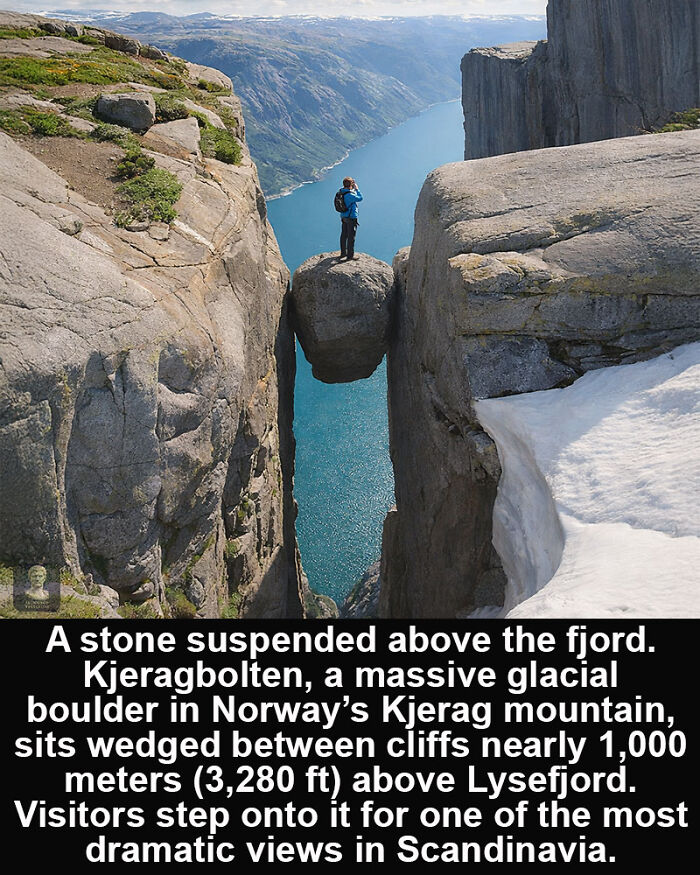
Image source: Echoes of Yesterday
#70
Harpea Cave is one of the most striking natural formations in the French Basque Country. Located near the village of Estérençuby, only a few meters from the border between France and Spain, the cave sits beneath a dramatic folded ridge of limestone. The name “Harpea” comes from the Basque language and means “the place under the rock.”
The formation is part of an anticline, a geological structure created when layers of rock are compressed by tectonic forces and pushed upward into a curved fold. In these structures, the oldest rock layers are found at the center of the fold.
The limestone that forms this ridge developed millions of years ago. Over time, erosion and natural processes carved out the opening beneath the folded layers, creating the cave that can be seen today.
The exposed rock clearly reveals the curved layering created by these ancient geological forces, making Harpea Cave a fascinating natural example of how mountains and landscapes slowly take shape over long periods of time.
Today the site attracts hikers and geology enthusiasts who come to see this unusual cave hidden beneath the folded mountain.
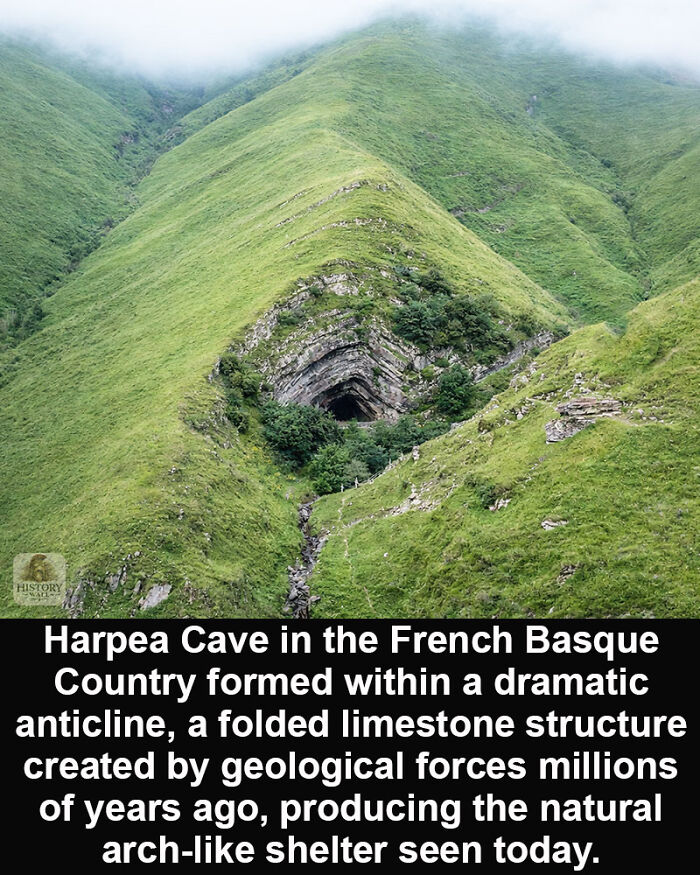
Image source: Nouza Expla
#71
A single stone rising from an open field has watched more than 6 millennia pass. In Brittany, France, the Menhir du Champ Dolent stands as one of the largest surviving standing stones from the Neolithic world. The monument reaches roughly 9 meters (about 30 feet) in height and weighs an estimated 300 tons. It was erected more than 6,500 years ago during a period when prehistoric communities across western Europe began raising large megalithic monuments. Brittany is especially rich in these ancient stones. Thousands of menhirs, dolmens, and stone alignments appear throughout the region, suggesting complex ritual landscapes created long before written history. The exact purpose of the Menhir du Champ Dolent remains uncertain. Archaeologists have proposed several possibilities, including territorial markers, ceremonial gathering points, or monuments connected to seasonal or astronomical observations. Without written records, the original intention behind many megaliths is difficult to confirm. What remains clear is the effort required to raise such a structure. Transporting and erecting a stone of this size would have demanded careful planning and coordinated labor from a Neolithic community with limited technology. Today the monolith still dominates the surrounding fields, a solitary reminder of the societies that shaped the landscape of prehistoric Europe long before cities or kingdoms emerged.
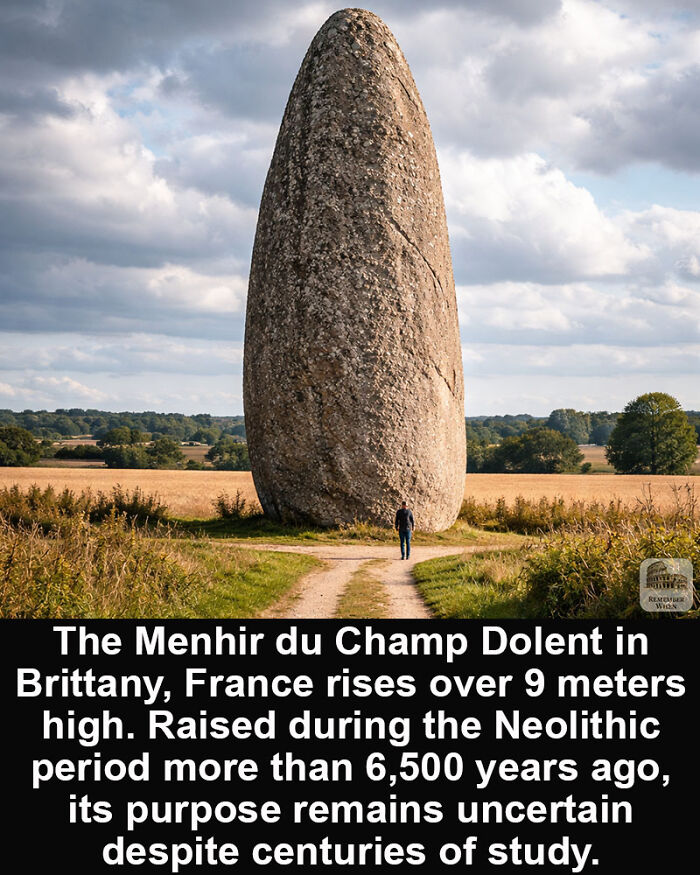
Image source: Remember When
#72
For nearly 1,000 years, a wooden canoe rested silently beneath the waters of Lake Waccamaw in North Carolina. Its rediscovery began unexpectedly in 2021 when three teenagers swimming in the lake stepped onto what they first believed was a fallen log.
As they dug through the mud, the object continued to extend far beyond what they expected. What emerged was the outline of a long, ancient canoe.
The family alerted the North Carolina Office of State Archaeology, which confirmed the discovery as a rare Native American watercraft. The canoe measures about 28 feet (8.5 meters) long and is estimated to be around 1,000 years old.
Archaeologists worked alongside members of the Waccamaw Siouan Tribe, whose ancestors lived in the region for centuries. Tribal Chief Michael Jacobs described the discovery as an opportunity to better understand the Indigenous history of southeastern North Carolina.
For nearly two years the canoe remained stabilized near the discoverers’ pier while experts prepared a careful recovery operation. Eventually, a team of divers and archaeologists lifted the vessel from the lake.
The canoe will now undergo preservation and scientific analysis in a laboratory.
What researchers hope to learn is not only how the vessel was made, but how people once traveled, traded, and lived along the waters of Lake Waccamaw centuries ago.

Image source: Cristian Ionut Ceausu
#73
The rock may be ancient. The claim requires proof. Geodes are natural rock formations that develop when mineral-rich fluids fill cavities inside volcanic or sedimentary rocks.
Over long periods, crystals form within, sometimes in formations linked to rocks hundreds of millions of years old.
Stories have circulated about a metal ring allegedly discovered inside a geode said to be over 200 million years old. Such accounts often imply an artifact older than human civilization.
Yet geology and archaeology require careful documentation. The age of a geode refers to the host rock, not automatically to any object associated with it. Without controlled excavation records, laboratory analysis, and peer-reviewed publication, extraordinary conclusions cannot be confirmed.
Claims of ancient or extraterrestrial origins remain speculative.
What endures is a reminder that evidence, not mystery alone, determines history.
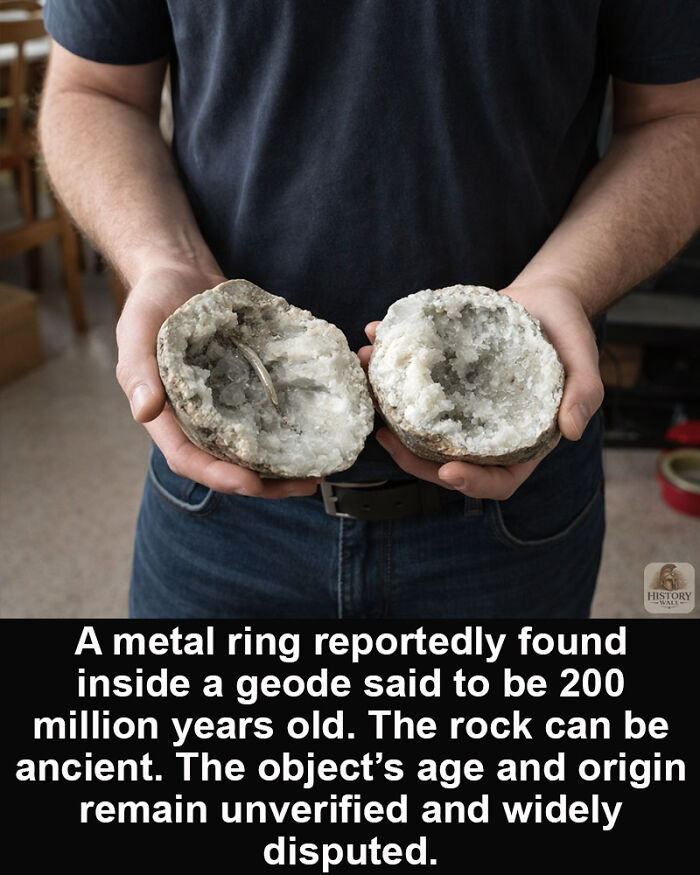
Image source: Nouza Expla
#74
At first glance, the proportions feel wrong. That was intentional. Dating back nearly 700 years, this house in Aveyron is considered the oldest surviving private residence in France. Built in the 13th century, it belonged to a woman named Jeanne, whose choices are still visible in stone.
The ground floor is deliberately smaller than the upper levels, a design used to reduce land footprint taxes calculated at street level. Above it, the structure expands outward, reclaiming space without paying for it.
The materials tell a second story. Thick stone walls, carefully cut blocks, and durable construction signal wealth. This was not a poor dwelling bending rules out of desperation, but a calculated response by someone who understood both law and status.
Medieval towns were dense, regulated, and unforgiving. Architecture became negotiation. Every beam and corner carried intent.
Today, restoration efforts aim to preserve this balance between ingenuity and survival. The house remains standing not because it was simple, but because it was clever. It shows how medieval life shaped buildings as much as stone shaped cities.
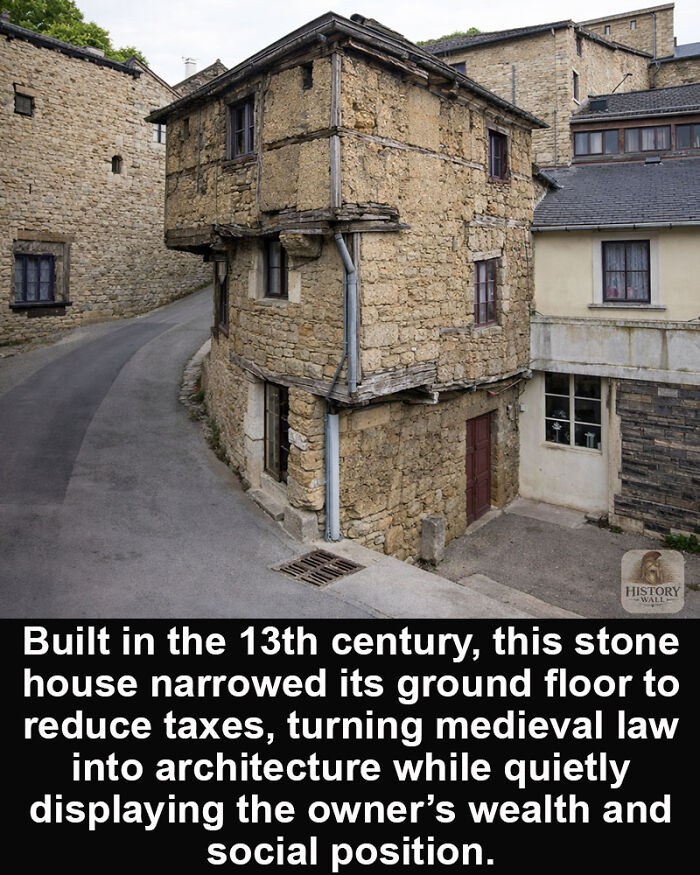
Image source: Nouza Expla
#75
The highest mountains were not always above the sea.
Marine fish fossils have been discovered near the upper reaches of the Himalayan Mountains, preserved in sedimentary layers formed underwater. The species are unmistakably marine, yet today they rest thousands of meters above any ocean.
Modern geology explains this through tectonic uplift, as the Indian plate collided with Eurasia and slowly raised former seabeds into mountains. The process is documented. The timeline is long. What remains unsettled is whether this explanation alone accounts for the global pattern of marine fossils found on high land across continents.
Ancient texts describe a different world order. The Biblical Flood speaks of waters covering all terrain, erasing distinctions between sea and summit. Similar flood accounts appear in Mesopotamian, Asian, and Indigenous traditions.
The fossils do not interpret themselves. They simply remain where water once was. Whether they reflect slow upheaval, a catastrophic flood remembered in scripture, or an overlap of both is still debated.
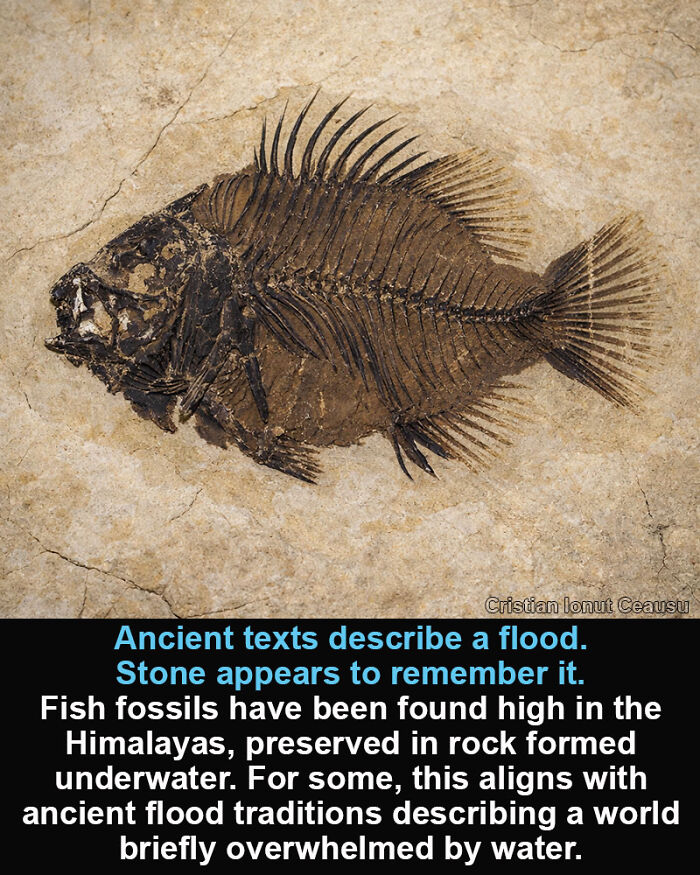
Image source: Cristian Ionut Ceausu
#76
Some ancient structures survive as silent ruins. Others continue to function exactly as they were designed. In the region of Burdur in southwestern Turkey, a monumental Roman fountain associated with the ancient city of Sagalassos has been known to flow with water nearly two thousand years after its construction.
The fountain once stood as part of a prosperous Roman urban center in the mountains of Anatolia. During the Roman Imperial period, Sagalassos developed into an important regional city, complete with baths, theaters, temples, and elaborate public fountains. These fountains were not only decorative monuments but also vital elements of urban water distribution.
Roman engineers constructed extensive aqueduct systems that transported water from distant springs to cities. Once the water reached urban centers, carefully designed channels and pressure systems distributed it to fountains, baths, and households. The fountain visible today reflects both the artistic and technical sophistication of that system.
Carved marble columns, sculpted architectural elements, and flowing water combine to create a structure that still demonstrates the durability of Roman hydraulic design.
The fountain continues to flow.
Exactly how the ancient system maintained its reliability across centuries remains a striking reminder of Roman engineering skill.
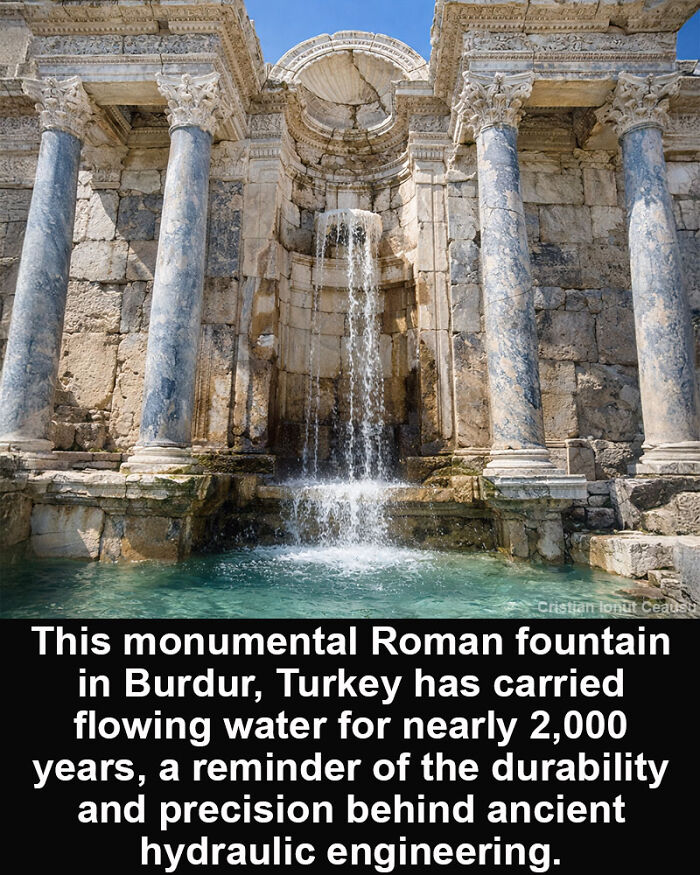
Image source: Cristian Ionut Ceausu
#77
It was written to proclaim dominance. One silence still defines it. The Sennacherib Prism, often called the Taylor Prism, is a 38-centimeter clay artifact inscribed with cuneiform accounts of King Sennacherib’s reign over the Neo-Assyrian Empire from 705 to 681 BC.
Found in 1830 by Colonel Robert Taylor and now housed in the British Museum, it describes the 701 BC invasion of Judah in detail.
Cities are listed as captured. Populations are deported. Jerusalem is surrounded, but not taken.
The text affirms Assyrian power and building achievements. It also leaves historians comparing its claims with the Books of Kings and Chronicles.
The conquest is declared. The absence remains.
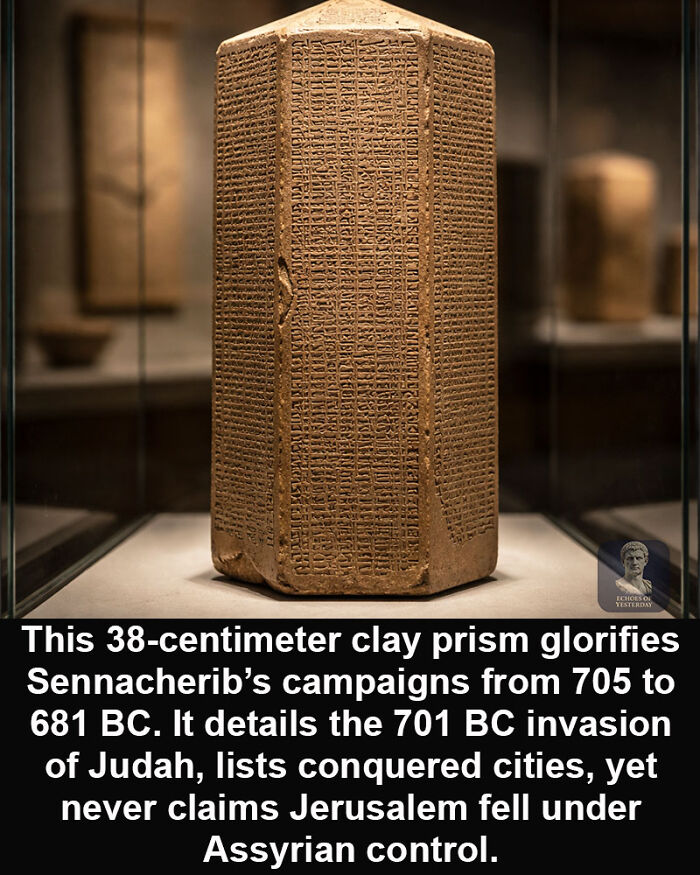
Image source: Echoes of Yesterday
#78
Hidden beneath Saqqara’s sands, the southern tomb of King Djoser dates to Egypt’s Third Dynasty, around 2700 BCE, making it one of the earliest large-scale stone constructions known. The descending stairway carved into the bedrock leads deep underground, showing that Egyptian builders were already working with precision and long-term planning more than 4,700 years ago.
This tomb forms part of the wider Step Pyramid complex at Saqqara, created during Djoser’s reign, a period that marked the transition from mudbrick structures to permanent stone architecture. The uniform steps, steep descent, and carefully aligned walls indicate deliberate engineering rather than experimental construction.
Unlike later royal burials hidden in the Valley of the Kings, this subterranean structure was integrated into a ceremonial landscape visible above ground. Its location, depth, and execution demonstrate that by the Third Dynasty, Egyptian architects had mastered stone cutting, spatial planning, and underground design centuries before the pyramids of Giza were built
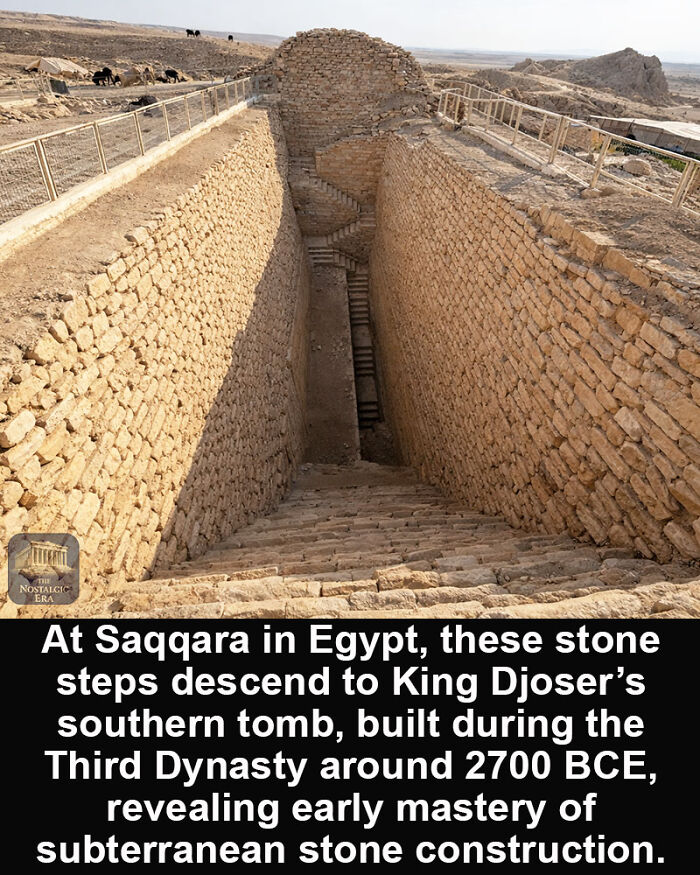
Image source: The Nostalgic Era
#79
The walls rely on shape, not cement. Sacsayhuamán, on the northern edge of Cusco, consists of enormous polygonal stones fitted together without mortar. Many blocks weigh dozens of tons, with some exceeding 100 tons. Their irregular faces interlock tightly, creating stable joints.
The layout forms three large zigzag terraces. These angled walls provided defensive advantages while also acting as retaining structures for the hillside. The largest stones appear in the lower courses, supporting smaller ones above.
The precision comes from shaping each block to match its neighbors. The result is a continuous wall where weight and geometry hold the structure together.
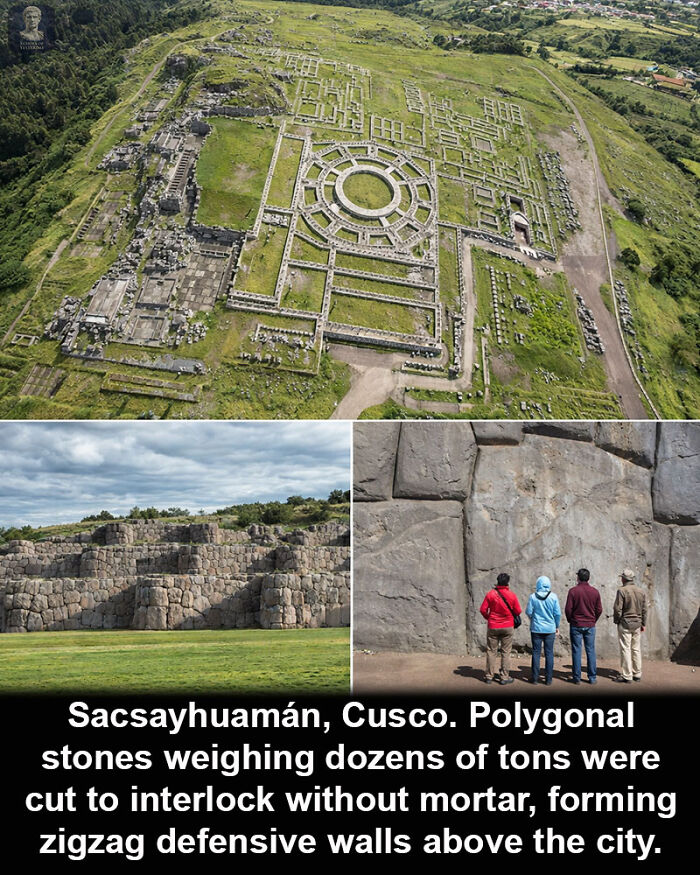
Image source: Echoes of Yesterday
 Follow Us