Maybe true crime documentaries have you clutching your partner’s hand when you make that nightly trip to the loo. Or maybe it’s weird internet facts and mysteries that make you spiral for hours on end.
Whatever you’re into — basically whatever gives you the chills or makes your skin crawl — this list has something for everyone.
Even just putting it together from ‘The Scary Fact’ Instagram account had us fully spooked and side-eyeing dark corners. Proceed at your own risk… and maybe keep a light on.
#1
Anthony Borges was just 15 years old when he used his own body to shield his classmates during the Parkland school sh00t!ng. In the middle of chaos, he chose to stand between danger and other students, turning himself into a barrier while everything around him was collapsing into panic and violence.
He was sh0t 5 times, and this is him showing his scars in court. That is what makes the image so powerful. The scars are not just wounds. They are lasting proof of a moment when a teenager absorbed unimaginable pain to protect others, carrying the physical evidence of that day into the courtroom for everyone to see.
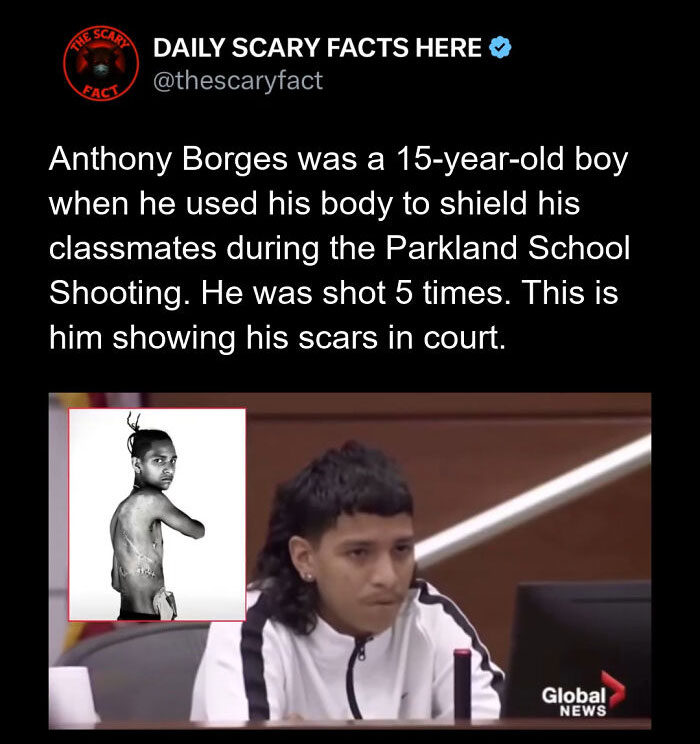
Image source: thescaryfact

#2
Image source: thescaryfact
Logically, fear is supposed to protect us because our ancestors were out here dealing with actual, real-life threats like wild animals and hostile environments.
It is why fear usually triggers the fight-or-flight response.
Over time, we also learnt to channel this instinct into stories, and even a source of entertainment.
The earliest traces of horror go way, way back. On ancient Mesopotamian clay tablets like those that tell the story of ‘The Epic of Gilgamesh,’ one can find ghosts, ogres, demons, monstrous beasts, and even proto-zombies.
They are evidence that even early storytellers loved weaving in creepy and supernatural stuff to teach lessons and tap into the same fear instincts that still make us binge horror today.
#3
Bonnie Haim disappeared in 1993, leaving behind a mystery that only grew darker with time. Back then, her 3-year-old son said his father had MU#D3R3D her, but no one believed a child’s words could hold the truth. The years passed, the case went cold, and her disappearance became one more unanswered nightmare.
Then, 20 years later, while making changes to the home, that same son uncovered his mother’s remains buried in the backyard. The discovery turned a forgotten claim into something horrifyingly real. His father was later convicted of MU#D3R, making the story even more chilling because the truth had been spoken from the beginning and ignored for decades.
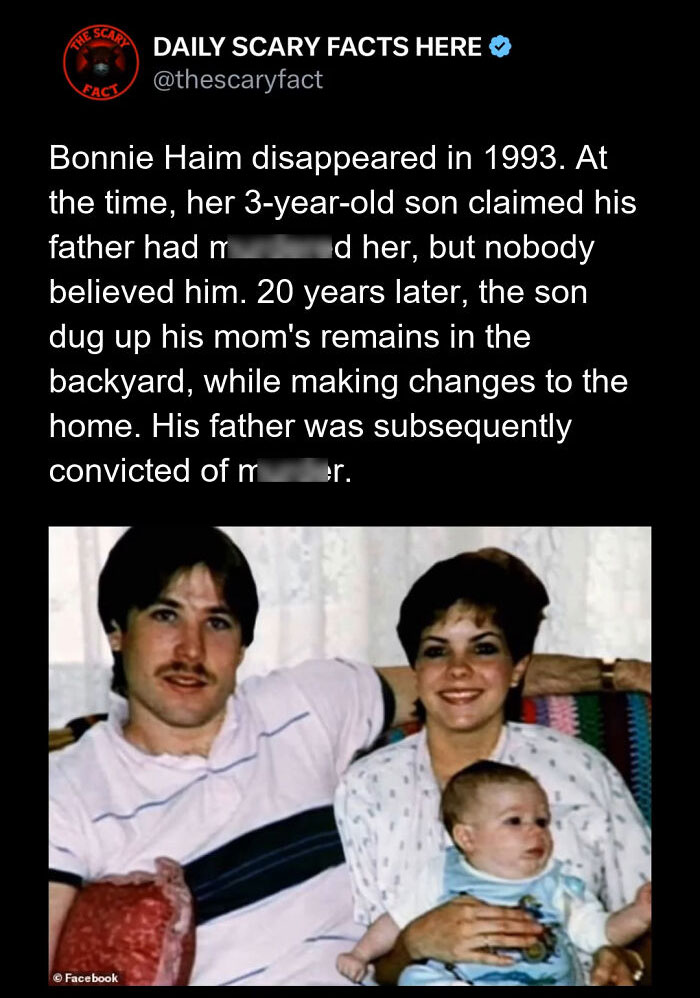
Image source: thescaryfact
#4
This X-ray showing Robbie Knievel’s spine, alongside an actual photograph of the metal device after he passed away in January 2023, reveals the brutal cost of a life spent pushing the human body beyond its limits. The image is not just medical. It looks like proof of years of impact, damage, and survival held together by metal deep inside the body.
What makes it so haunting is the contrast between spectacle and aftermath. People remember the jumps, the danger, and the stunts, but images like this show what was left behind when the cameras were gone. It turns a legendary career into something far more physical and unsettling, exposing the hidden price of living on the edge for so long.
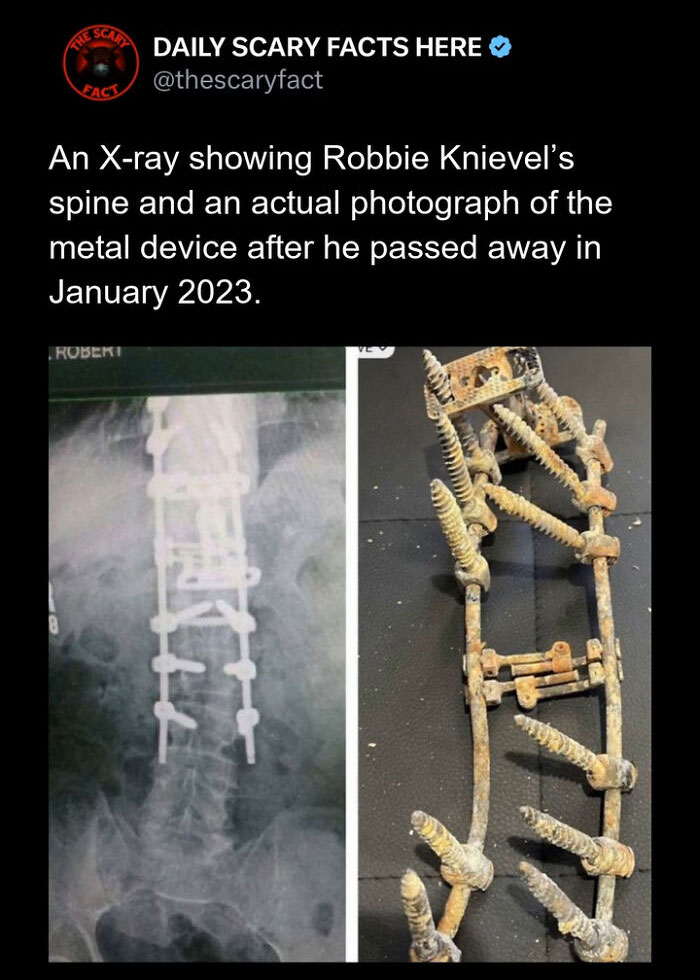
Image source: thescaryfact
Be it creepy facts, ghost stories, or full-on nightmare fuel TV shows and movies — they all basically let us face the worst fears… but from the safety of our couch, wrapped in a blanket, snacks in hand.
“The paradox of horror is a very old puzzle. Even Aristotle spoke about how weird it is that we’re set up to evade and to avoid dangerous, disgusting, harmful, horrible things. Yet we feel magnetized to be in spaces where we’re in touch with disgusting, horrible, noxious, or horrifying things,” Mark Miller, a research fellow at Monash University in Australia and the University of Toronto, tells the BBC.
#5
In 2014, Daniela Liverani thought her constant nosebleeds were just the result of a motorbike crash, until she noticed something moving inside her nostril while showering. What began as an annoying and confusing symptom suddenly turned into something far more disturbing, as the cause was not an injury slowly healing, but something alive inside her body.
At the hospital, doctors pulled out a 3-inch leech that had reportedly been living inside her nose for weeks. That is what makes the story so horrifying. The idea of a parasite hiding unnoticed in such a sensitive place turns an already unpleasant situation into something deeply unsettling that feels almost impossible to read without cringing.
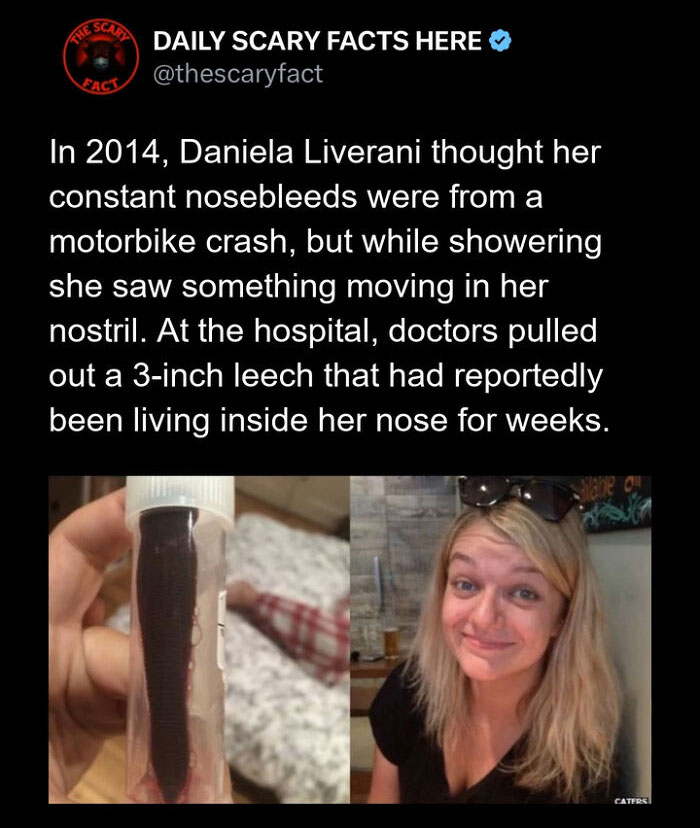
Image source: thescaryfact
#6
Jean Hilliard crashed her car in subzero weather and walked two miles trying to find help before collapsing just 15 feet from a friend’s house. So close to safety, she fell into the freezing cold and was left there for hours, her body locked in conditions that should have made survival impossible. It reads less like reality and more like something out of a nightmare.
When she was finally found, she was frozen solid and her heart rate was extremely low. At the hospital, doctors slowly warmed her, and against all odds she made a full recovery. What makes the story so haunting is that she stood on the edge of death in the most unforgiving cold imaginable, yet somehow came back.
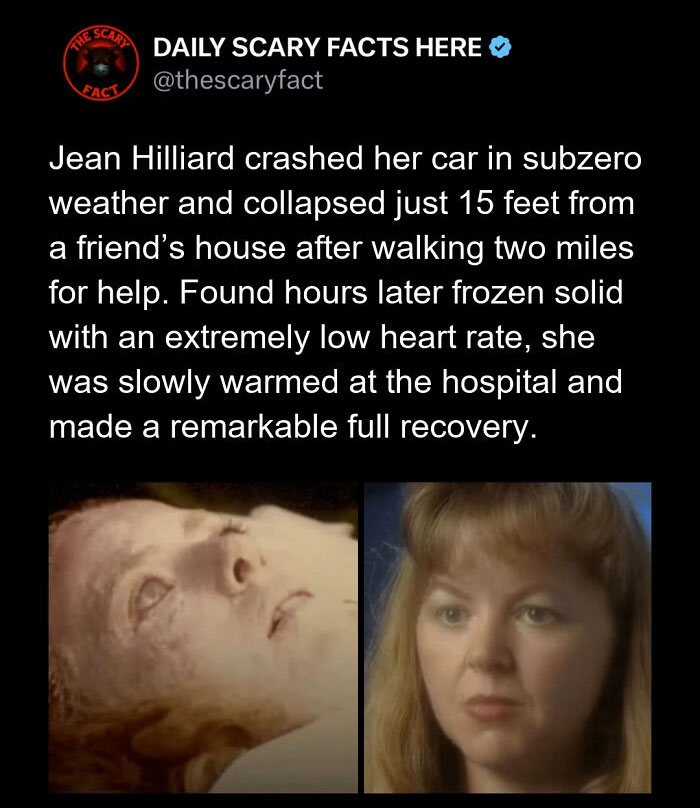
Image source: thescaryfact
#7
Thechikottukavu Ramachandran, commonly known as Raman, is India’s tallest elephant and one of its most feared captive animals. Over his lifetime, he has ki!!ed 15 people and 3 other elephants, earning a reputation as the most dangerous captive elephant. His sheer size alone is intimidating, but the history attached to him makes that presence even more unsettling.
People who cared for Ramachandran said the deaths were not intentional, but accidental, which adds a strange and chilling complexity to his story. That means the danger did not come from planned aggression, but from the raw force of an animal so powerful that a single moment could turn fatal. It is that unpredictability that makes his legend so frightening.
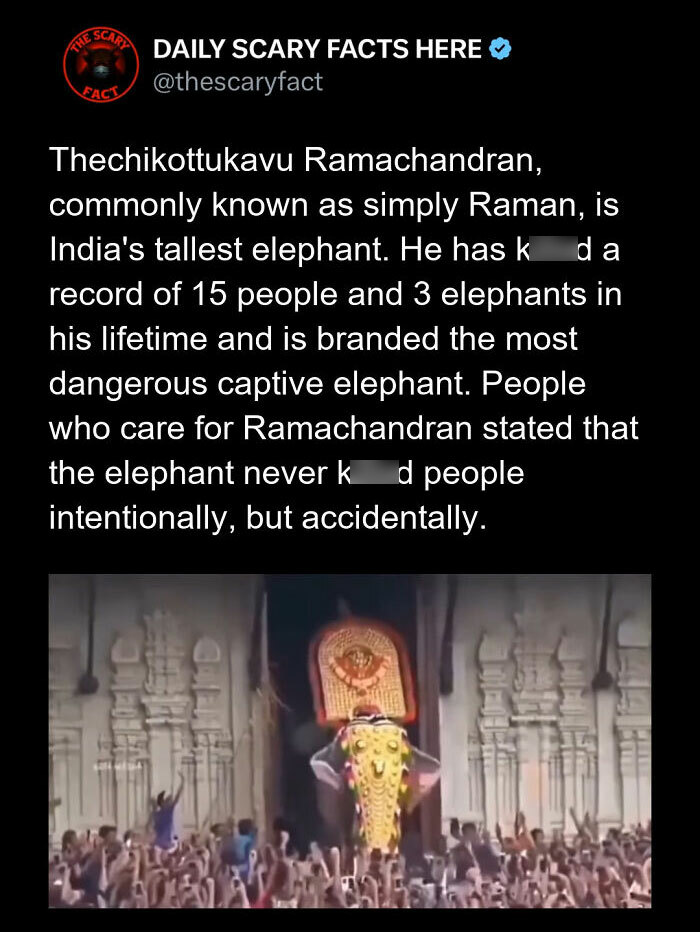
Image source: thescaryfact
Feeling a little bit scared in a totally controlled, no-actual-danger way is fun for a lot of people.
In a poll, about 48% of Americans said that they liked watching horror movies.
There are significant differences by age though.
Scary movies appeal more to younger people — 71% of Americans under the age of 35 say they enjoy scary movies, while just 23% of those 65 and above do.
Half of those who said they sometimes had nightmares after watching a scary movie confessed that they still enjoy watching them.
#8
Robert DuBoise’s life changed dramatically over the span of nearly four decades. At the age of 18, he was arrested for a crime he did not commit. This wrongful arrest led to his conviction and imprisonment, a harrowing experience that kept him behind bars for 37 years. During his time in prison, DuBoise maintained his innocence, but it wasn’t until advancements in DNA technology provided a new avenue for justice that his case was re-examined.
At the age of 56, DuBoise was finally exonerated and freed from prison, thanks to DNA evidence that proved his innocence. His release marked a moment of profound relief and a new beginning, highlighting the critical importance of forensic science in correcting miscarriages of justice. The contrast between the young man unjustly incarcerated and the mature man freed by the truth underscores the significant impact of wrongful convictions on individuals’ lives.
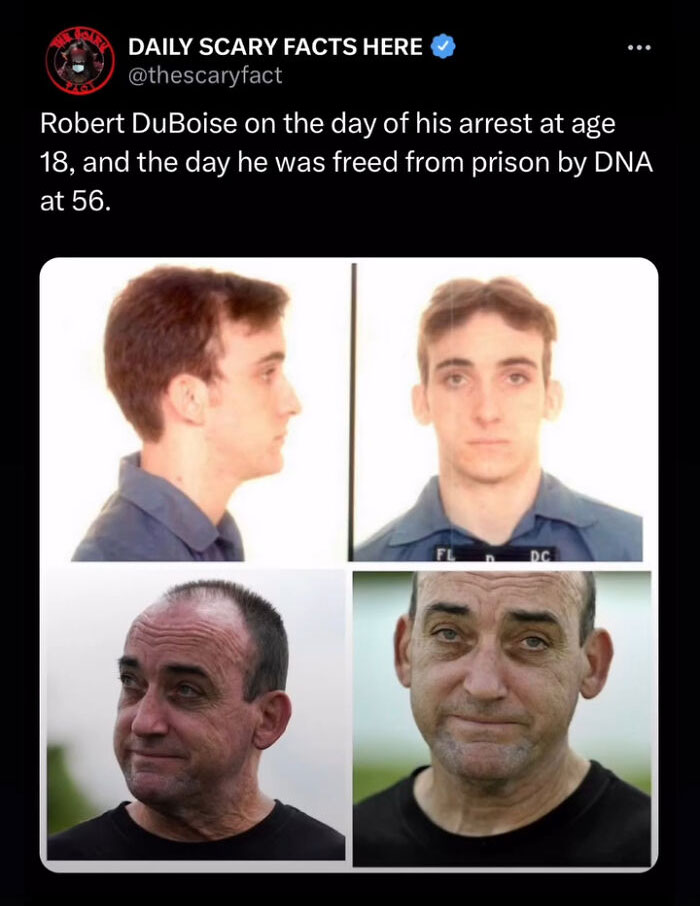
Image source: thescaryfact
#9
A Chinese woman dealing with chronic rhinitis, headaches, and breathing problems finally learned the shocking cause of her pain. Doctors discovered a b%ll3t lodged near her nostril, something that had remained there for nearly half a century without her realizing it. The answer to years of suffering had been hidden inside her body the entire time.
She later connected it to an incident 48 years earlier, when, at 14, she felt a sharp pain in her temple and assumed she had only been struck by a pebble. That small moment, dismissed as harmless, had actually left behind something far more dangerous. The idea that a person could carry such a hidden injury for decades makes the story almost unbelievable.
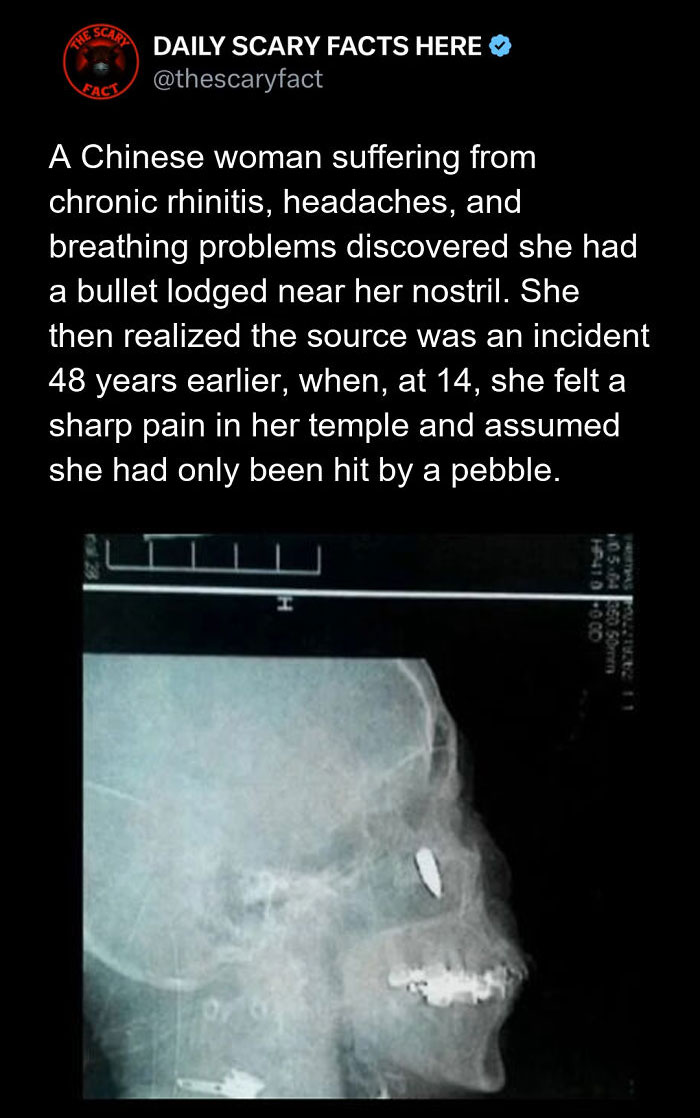
Image source: thescaryfact
It’s not just movies, many people also actively seek out scary stories through books, podcasts and social media — be it horror, mystery, thriller, or true crime.
A 2025 study found as many as 74% of people in the UK read true crime content, making it one of the most popular scary genres.
Many of us like to casually unwind to real-life stories of murder, deception, crime and forensic investigation.
It’s because of something called “defensive vigilance.”
Like we mentioned earlier, our brains are wired to pay attention to real danger so we can figure out how to stay safe. Reading about a murder case or listening to a creepy true story fires up the same parts of the brain as a scary movie.
It’s curiosity about real-world danger that feels useful, not just entertaining.
#10
During the 9/11 attacks, NYPD officer John Perry was at police headquarters filing his retirement papers when he heard the first explosion. Instead of walking away from the job for good, he asked for his badge back and ran straight toward the tower to help. In a moment when thousands were fleeing in fear, he chose to move toward the danger.
He was in the south tower assisting a woman when the building collapsed, and he died while trying to save her. His final actions turned what should have been an ordinary last day into an act of extraordinary courage. The NYPD later awarded him the Medal of Honor, but his story still stands as one of the most haunting acts of sacrifice from that day.
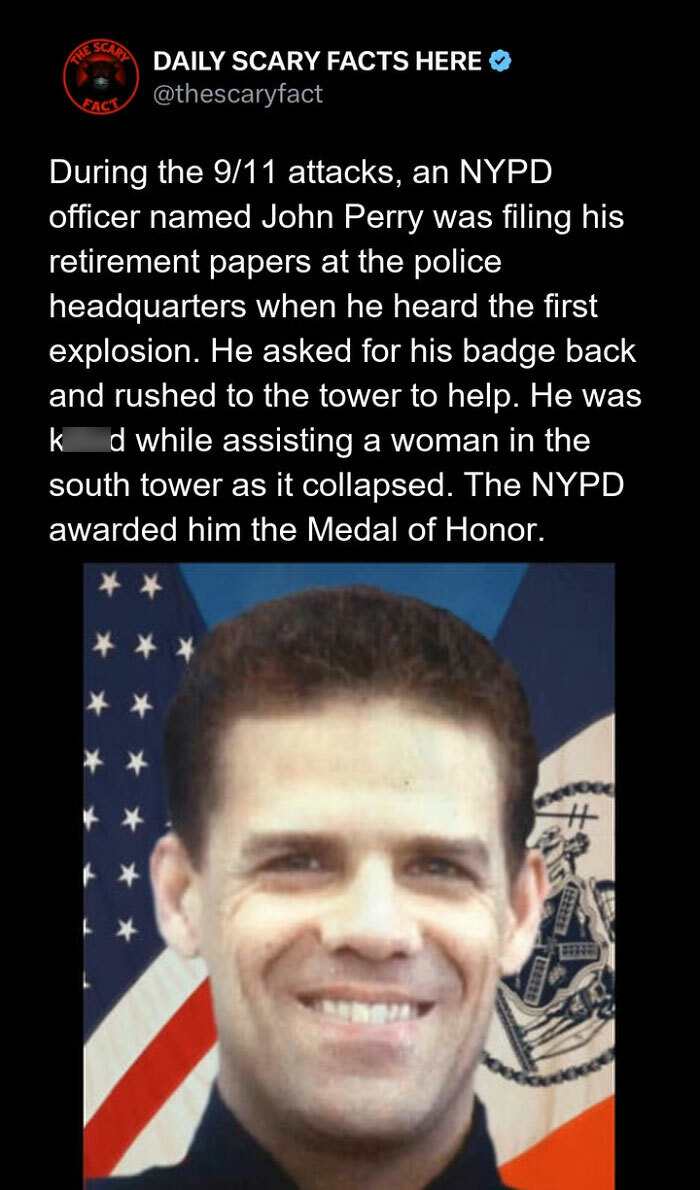
Image source: thescaryfact
#11
On December 23, 2023, 45-year-old Amanda Richmond Rogers jumped into a freezing Alaska river after her dog, Groot, fell through the ice. The water was brutal, the current was unforgiving, and she disappeared beneath the surface without ever coming back up. It was a desperate act of love in one of the harshest conditions imaginable.
Four months later, in March 2024, her body was finally found. Even after all that time in the icy water, she was still holding him. That single detail turned an already heartbreaking story into something almost unreal, capturing the final seconds of a bond so strong it lasted beyond death itself.
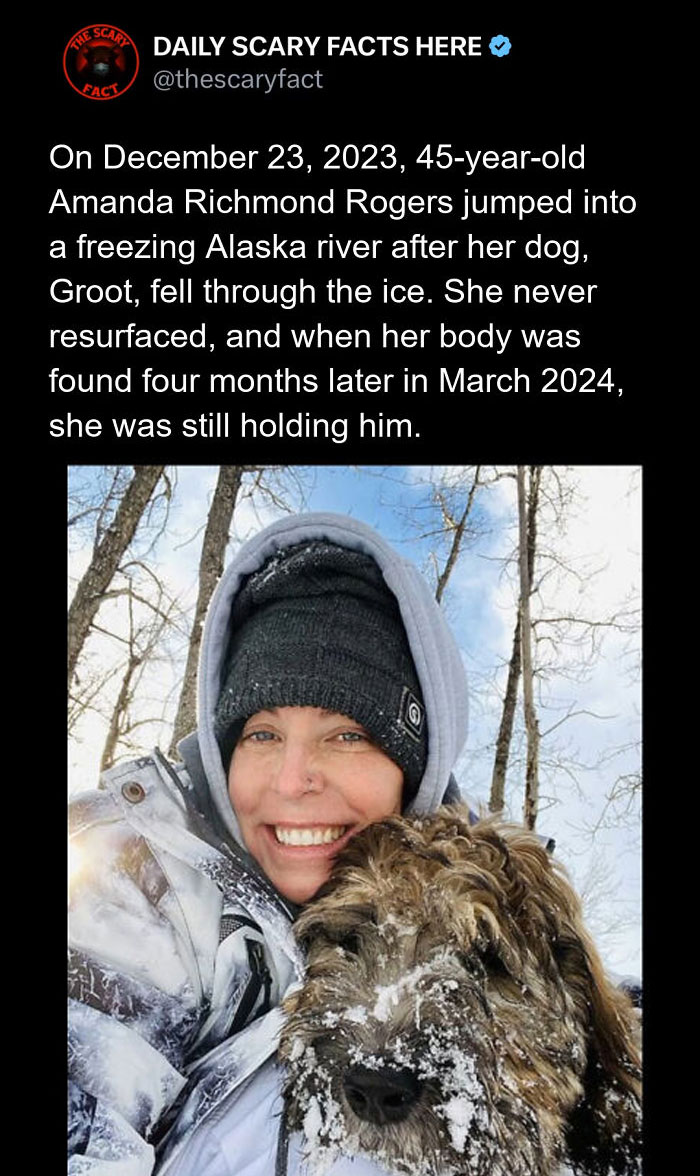
Image source: thescaryfact
#12
This is an intact human nervous system dissected by two medical students in 1925, a process that took them more than 1,500 hours to complete. The result looks almost unreal, like a ghostly network pulled out of the body and suspended in space. It is both scientific and deeply unsettling, because it exposes the fragile wiring that silently controls everything we do.
There are only 4 of these in the world, which makes it even more haunting to look at. Stripped of skin, muscle, and bone, the human body becomes something almost alien. It is a reminder that beneath every face and every movement is a delicate system so intricate that seeing it fully revealed feels almost wrong.
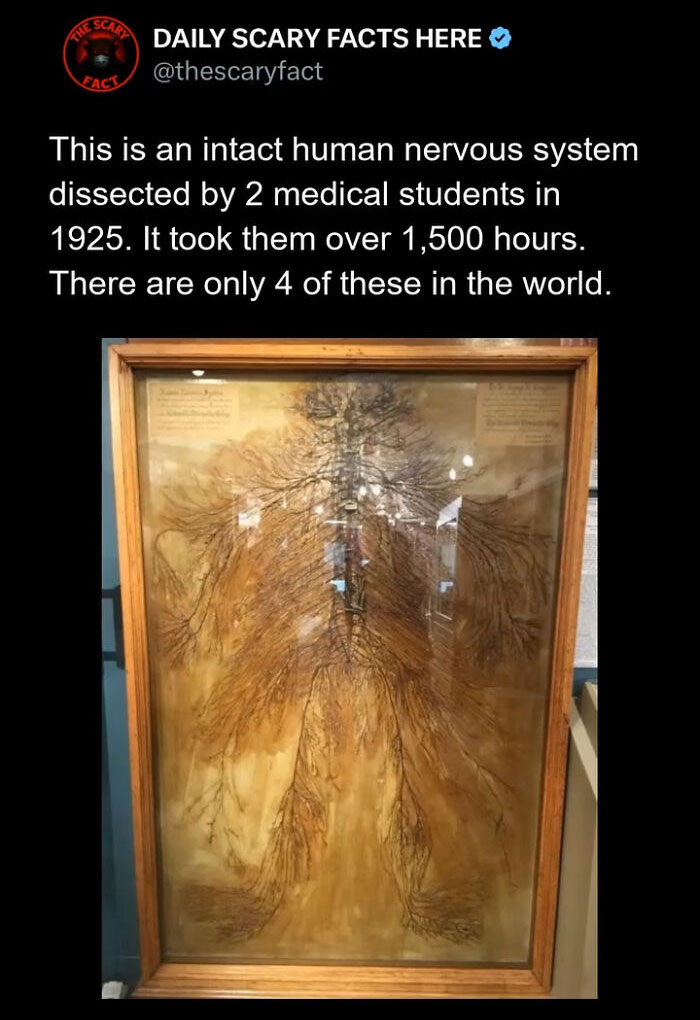
Image source: thescaryfact
A survey of younger readers found that up to 56% read horror and 65% read mystery/thriller genres.
Studies also show that if your interest in scary stuff started when you were a child, chances are you still can’t get enough.
At least 60% of Americans said that watching your first scary movie at a slumber party is a rite of passage.
#13
In 2014, a 14-year-old injected himself with mercury at least 3 times because he believed it could turn his bones into metal after watching Wolverine. He also intentionally let spiders bite him on multiple occasions because he wanted to become Spider-Man. What makes the story so disturbing is how fantasy completely overpowered reality in a way that put his body in serious danger.
There is something especially chilling about seeing fiction taken so literally that it leads to self-destruction. Superpowers that exist only on screen became an obsession strong enough to push him into poisoning and harming himself in real life. It is a dark reminder of how fragile the line can be between imagination and dangerous belief.
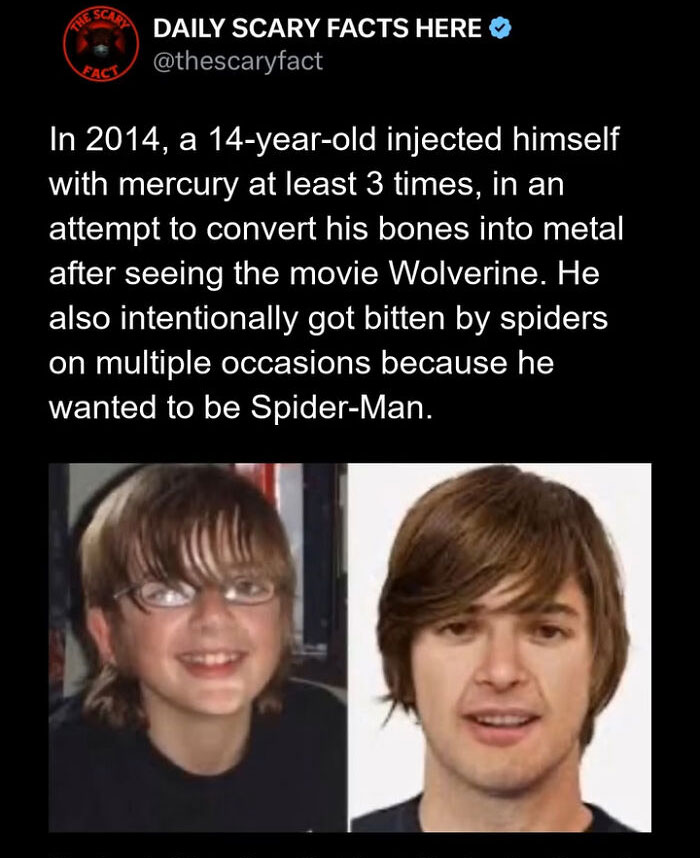
Image source: thescaryfact
Several experts believe that watching and reading scary stories can actually train our brains to handle fear. It can even help forge resilience, especially in kids.
“The world can be a scary place – children will get into situations where they’re told off by teachers, or fall out with friends. Knowing how to confront fear is a good thing,” psychologist Emma Kenny told The Guardian.
“Risk and fear are something we need in childhood. We know that people who take risks, in the long term, do better than those who don’t … And how can you feel safe and secure until you know what it’s like to be afraid? Anything that gives you a wide range of emotions in a safe and controlled environment is great,” Kenny added.
#14
Houston police officers stand outside the house in Clear Lake City where Andrea Yates drowned her 5 children. Images like this are haunting because the horror is hidden behind something so ordinary. From the outside, it is just a house, the kind people pass without a second thought, yet inside it became the setting for one of the most devastating family tragedies imaginable.
What makes the scene even darker is the silence that surrounds it. There is no visible chaos left, only officers standing outside a home forever marked by what happened within its walls. It is the kind of image that forces the mind to confront how unimaginable acts can take place in the most familiar spaces.
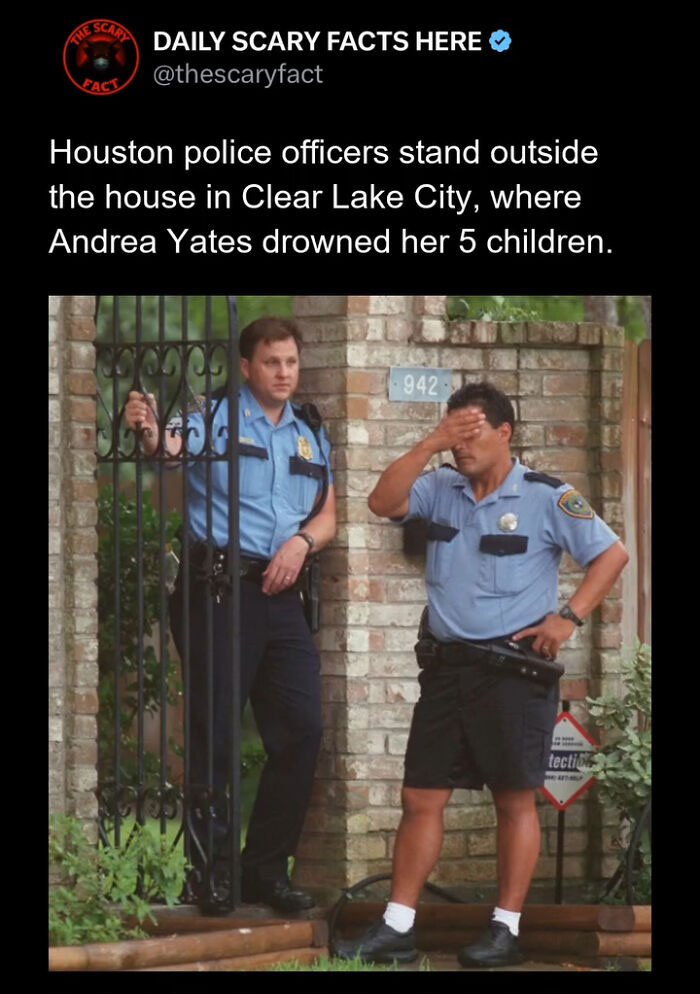
Image source: thescaryfact
#15
In 1997, in Russia, a poacher sh0t and wounded a tiger, then stole part of its recent ki!!. What followed feels less like an animal encounter and more like a calculated act of revenge. The tiger later tracked down the cabin where the man was living, as if it had remembered exactly who had harmed it and what had been taken.
It then waited at least 12 entire hours for the poacher to return home. When he finally came back, the tiger ki!!ed and ate him. The story is so disturbing because it suggests patience, memory, and something almost human in its vengeance, turning the predator into what felt like an avenger in the dark.
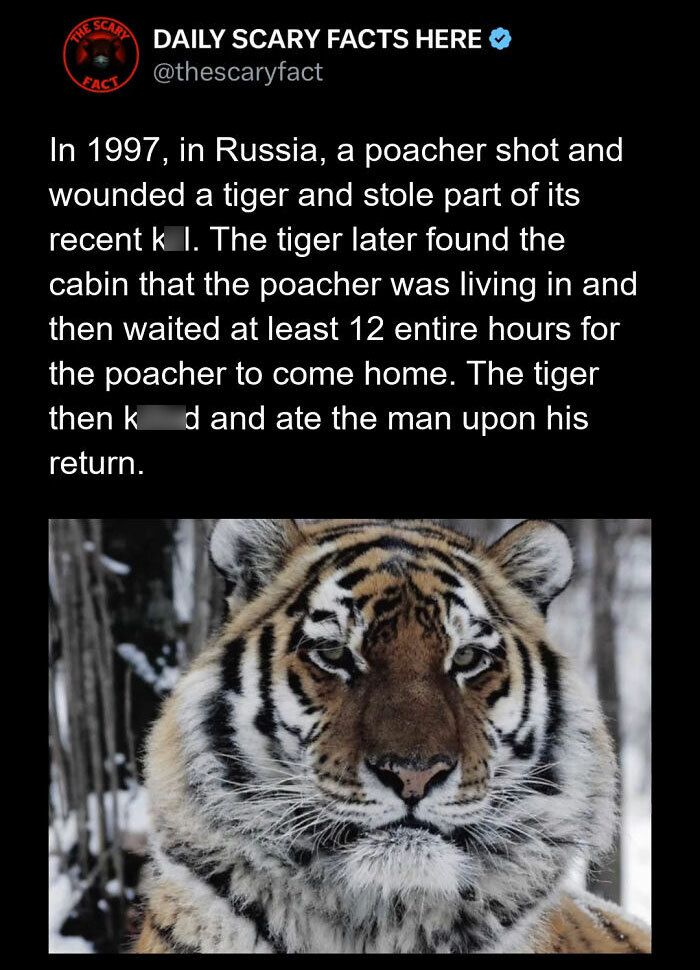
Image source: thescaryfact
Did you know that horror can also help soothe your anxiety?
Experts say that anxiety can make people blow threats out of proportion or doubt their own ability to handle them. Watching or reading scary stuff, though, can help put things back in perspective.
People who seek this thrill as a way to deal with real life have been dubbed “dark copers” by researchers.
“Dark copers use horror as an instrument with which to navigate a world that they perceive to be scary. As humans, we’re constantly forecasting. In a sense, horror is just like a formalized worst-case scenario that’s a very natural product of the way we cope,” says Mathias Clasen, co-founder of the Recreational Fear Lab at Aarhus University in Denmark.
According to the lab’s findings, many people derive great enjoyment, self-discovery, and personal growth from this genre.
A study also found that fans of horror films showed greater resilience at the height of the Covid-19 pandemic.
#16
Footage from 2019 shows 18-year-old Leonid Greyser trying to escape from court after confessing to ki!!ing his sister. Courtrooms are supposed to be controlled spaces where everything slows down into procedure, which is exactly why moments like this feel so disturbing. Panic and desperation suddenly tear through a place built around order.
What makes the clip even darker is the confession behind it. He was not running from suspicion, but from the crushing reality of what he had already admitted to doing. That turns the escape attempt into something more than chaos. It becomes a final, frantic reaction to a crime that had already shattered a family beyond repair.
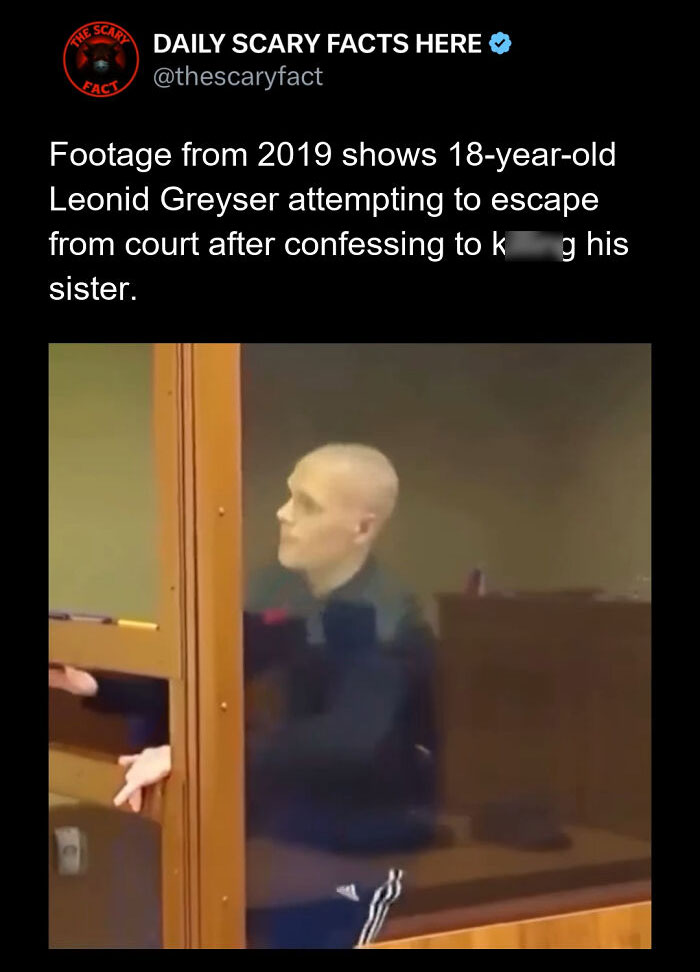
Image source: thescaryfact
#17
In the 2015 HBO documentary “The Jinx,” Robert Durst accidentally confessed to being a ki!!er after leaving his mic on while using the restroom. What makes the moment so disturbing is how unguarded it was. It was not a dramatic courtroom outburst or a forced admission, but a private slip caught in the middle of an ordinary pause.
That is exactly why the scene became so infamous. A man tied to years of suspicion appeared to reveal himself when he thought no one was listening. The fact that it happened so casually, in such an unexpected setting, gives the footage an eerie weight that feels far darker than any planned confession ever could.
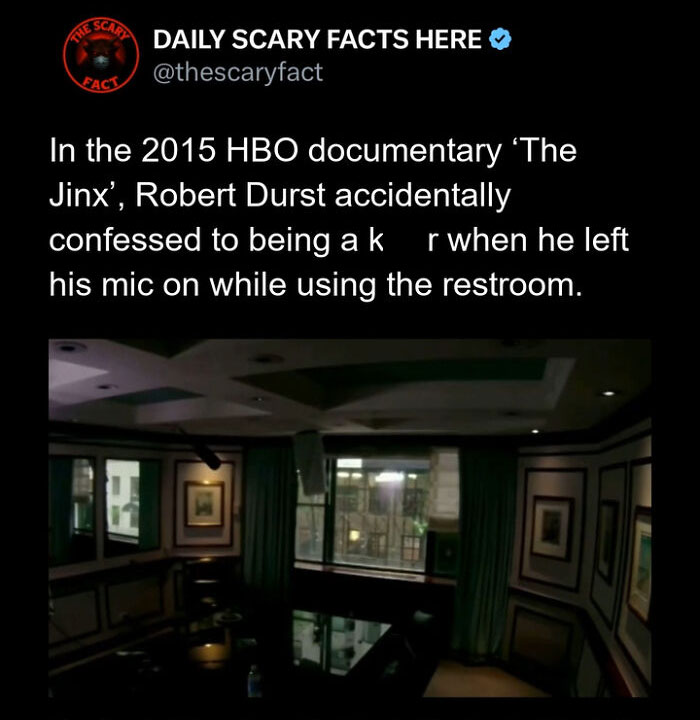
Image source: thescaryfact
#18
On June 11, 2021, commercial lobster diver Michael Packàrd was swallowed by a humpback whale near Provincetown, Massachusetts. For over 30 seconds, his crewmates feared they had just watched him vanish into something impossible, with no way of knowing whether he would ever come back up.
After about 40 seconds, the whale resurfaced and spat him out. He survived with bruising and a dislocated knee. What makes the story so unreal is how it sounds like something from a nightmare or an old legend, yet it happened in open water to a man who lived through being trapped inside the mouth of something massive enough to erase him in an instant.
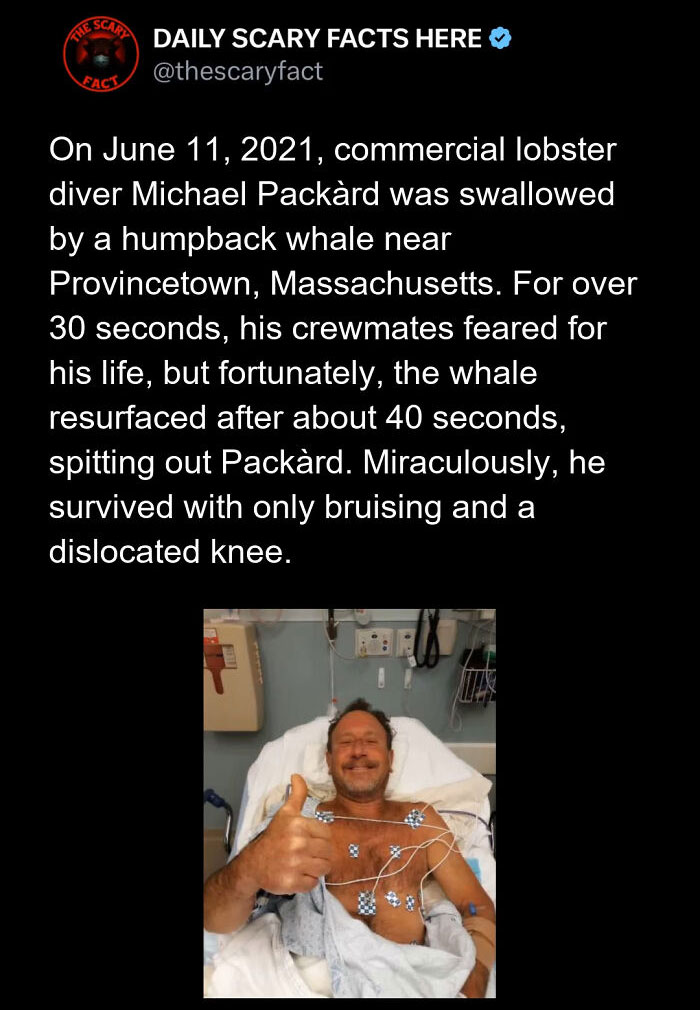
Image source: thescaryfact
It’s not just the dark copers; experts have divided horror fans into two other categories as well.
There are your adrenaline junkies, the ones who thrive on the heart-pounding rush. Jump scares or sounds, and even suspenseful moments, make them feel alive.
Then there are white knucklers. They don’t love being scared while it’s happening, but they love the feeling of conquering that fear.
Making it through a haunted house or finishing a scary book gives them a sense of accomplishment and even a little insight about themselves.
#19
Before tragically taking her own life in 2025, 10-year-old Liberty Hall wrote this note expressing love and apologizing to her mother. That alone is enough to make the image unbearable, because a child’s handwriting is supposed to hold ordinary things, not the weight of pain far too heavy for someone so young to carry.
What makes the note even more heartbreaking is its tenderness. Instead of anger, it carried love and apology, turning it into a final message no parent could ever be prepared to read. It stands as a deeply haunting reminder that even the smallest voices can be hiding unimaginable sadness behind words that seem gentle and simple.
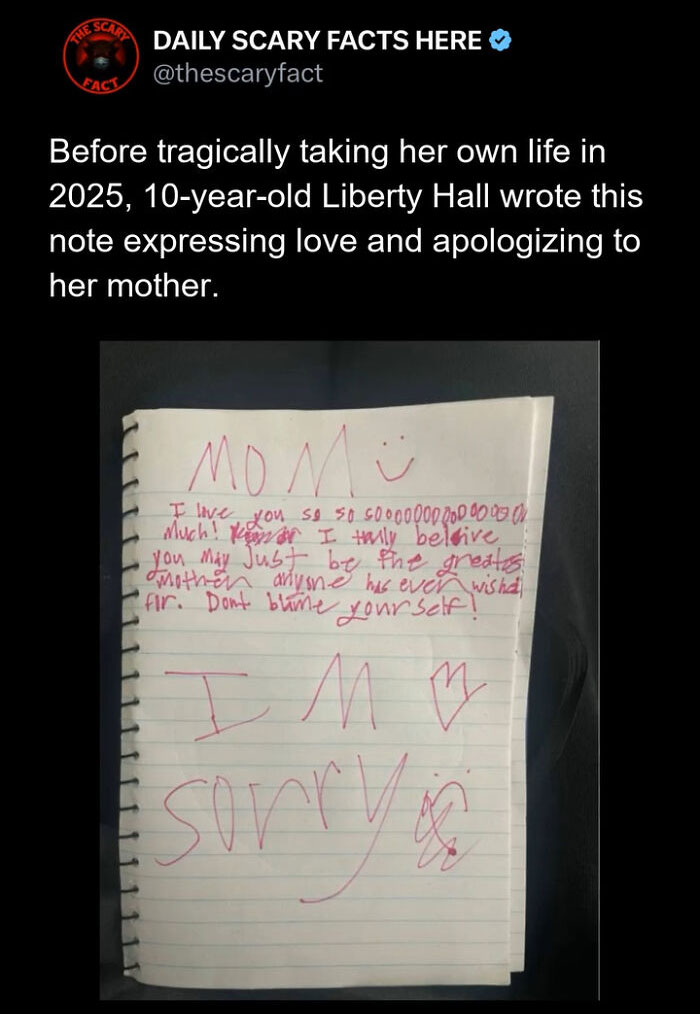
Image source: thescaryfact
#20
In 2013, Geraldine Largay stepped off the Appalachian Trail, became lost, and sent desperate texts to her husband that never went through because she had no signal. Somewhere in the wilderness, help stayed just out of reach while a massive search looked for her, never realizing how close and how far she truly was at the same time.
In October 2015, her body was found less than 3,000 feet from the trail. Her journal showed she had survived for weeks, and one of her final notes asked that her husband George and daughter Kerry be told where she was found. That detail makes the story even more devastating, because even near the end, she was still thinking of the people waiting for her.
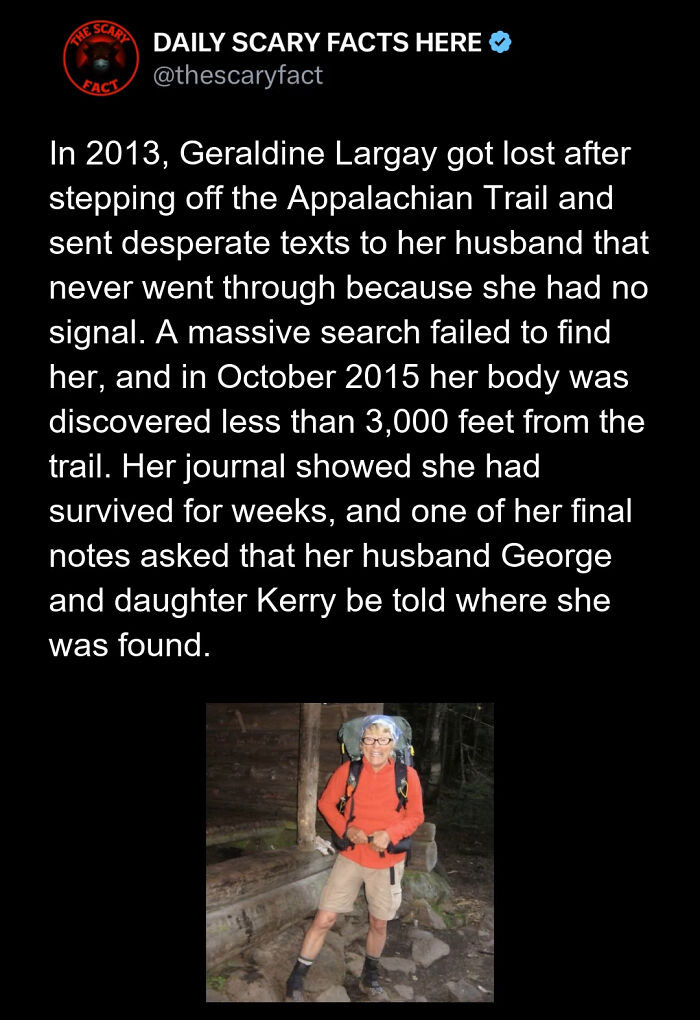
Image source: thescaryfact
Since you’ve made it this far through the list, it’s pretty obvious you’re into horror, whether it’s the stories or creepy vibes. But it’s also important to remember that not everyone is.
Plenty of people have given the genre a fair shot and still decided that it’s just not for them.
Research suggests that not everyone’s brain rewards fear in the same way.
Those who dislike horror may stay in the fear phase and never get that relief high like the fans of horror do. It can actually give some people more anxiety.
Surveys show horror has way more haters than other genres. About 22% of Americans say they hate horror, which is three times the share that hate other genres like Westerns or sci‑fi.
Watching or listening to scary tales, reading disturbing books, or even visiting haunted houses can affect sleep, especially for people with vivid imaginations or past trauma.
Some people genuinely dislike scary content because of how their brains and emotions react to fear, not just preference or lack of courage. And respecting that is part of enjoying and learning from these stories responsibly.
#21
Paul Alexander passed away at 78 after spending 70 years confined to an iron lung, a machine that had kept him alive since he contracted polio at age six. Few lives have ever been so closely tied to a single machine, with every year becoming a reminder of how survival for him depended on metal, pressure, and constant endurance.
What makes his story so haunting is the sheer length of time he lived this way. Decade after decade passed while the iron lung remained his world, turning childhood illness into a lifetime of confinement. His death marked the end of an existence that felt almost impossible, yet he carried it for longer than most people can even imagine.
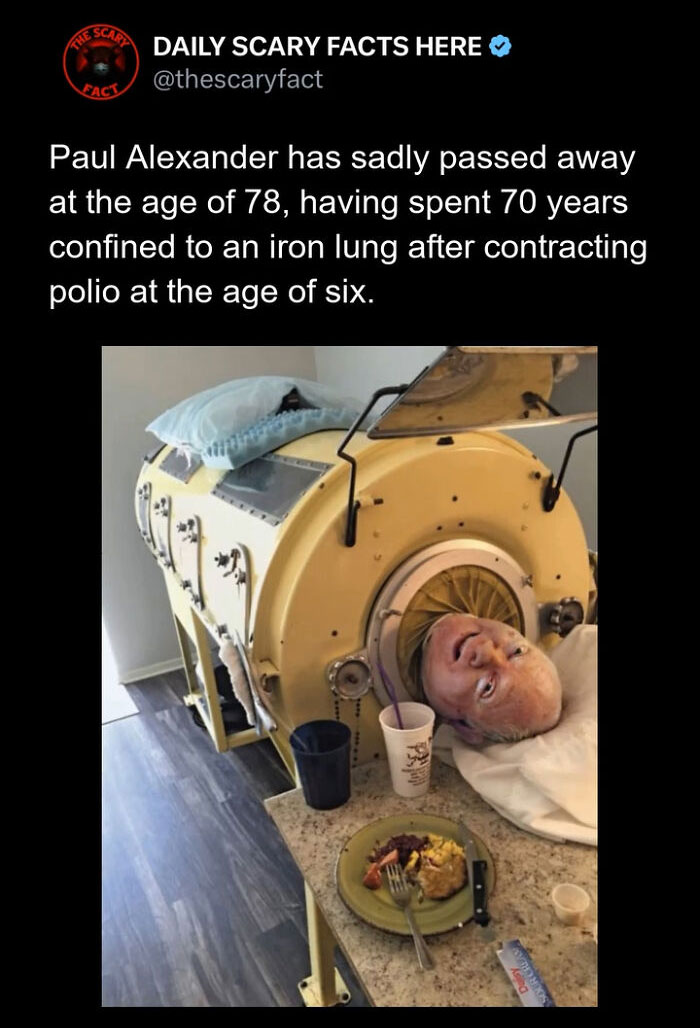
Image source: thescaryfact
#22
In 2014, 3-year-old Karina Chikitova survived 11 days alone in the Siberian wilderness with only her dog beside her. The idea of a child that young enduring endless isolation, cold, and hunger in such a vast and unforgiving place feels almost impossible to believe. Every hour she remained alive was a quiet fight against nature itself.
She survived on wild berries and river water, and stayed warm by curling up with the dog until it returned to the village and led rescuers to her. That is what makes the story so powerful. In the middle of overwhelming wilderness, loyalty, instinct, and sheer endurance kept a small child alive against nearly impossible odds.
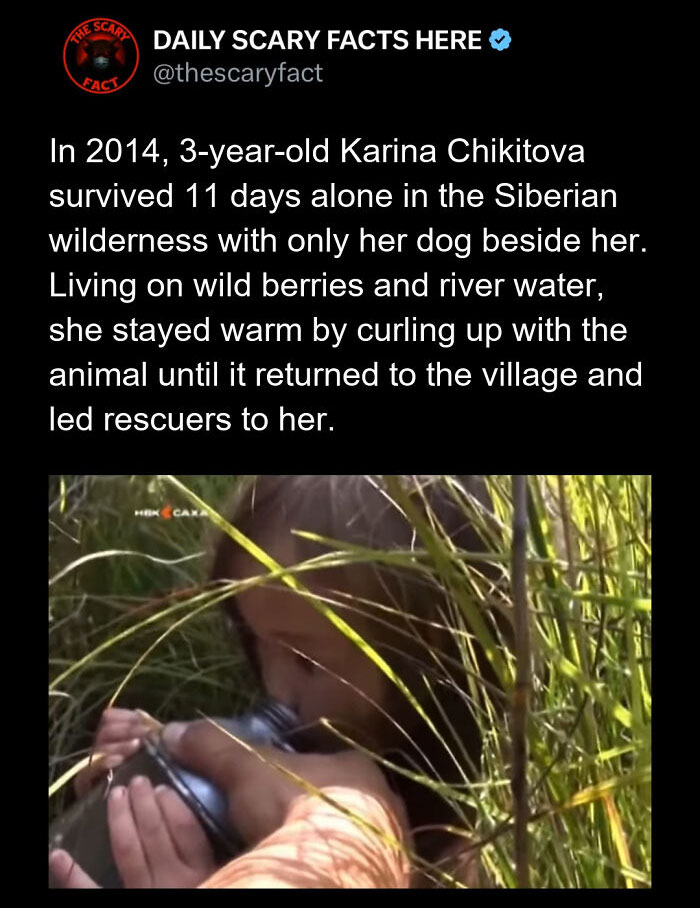
Image source: thescaryfact
#23
This harrowing X-ray shows a man’s arm and hand after a horrific meat grinder accident. Images like this are disturbing because they strip away everything external and reveal the damage in the most clinical, unforgiving way possible. What should be a normal human hand instead looks twisted, broken, and almost unrecognizable beneath the skin.
There is something especially unsettling about injuries caused by machines, because they feel cold, mechanical, and brutally final. An X-ray like this captures the aftermath in total silence, showing just how badly a single moment can destroy bone, structure, and movement in ways that are impossible to forget once seen.
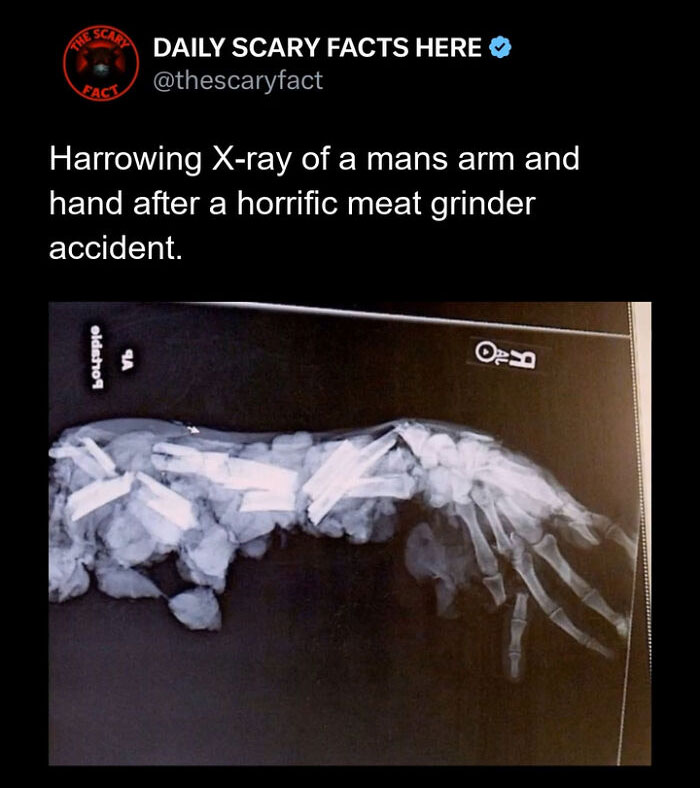
Image source: thescaryfact
#24
Robbie Middleton was just eight years old when he was tied to a tree, covered in gasoline, and set on fire by a 13-year-old neighbor in Splendora, Texas. The cruelty of what happened is almost impossible to process, especially because of how young both boys were. It was a level of violence so extreme that it turned a child’s life into years of agony.
Although he survived the attack, Robbie suffered burns over 99% of his body and endured years of medical treatment before he passed away at age 20. That is what makes his story so devastating. He lived for years after the attack, carrying pain that never truly ended, making the horror last far beyond the day it first happened.
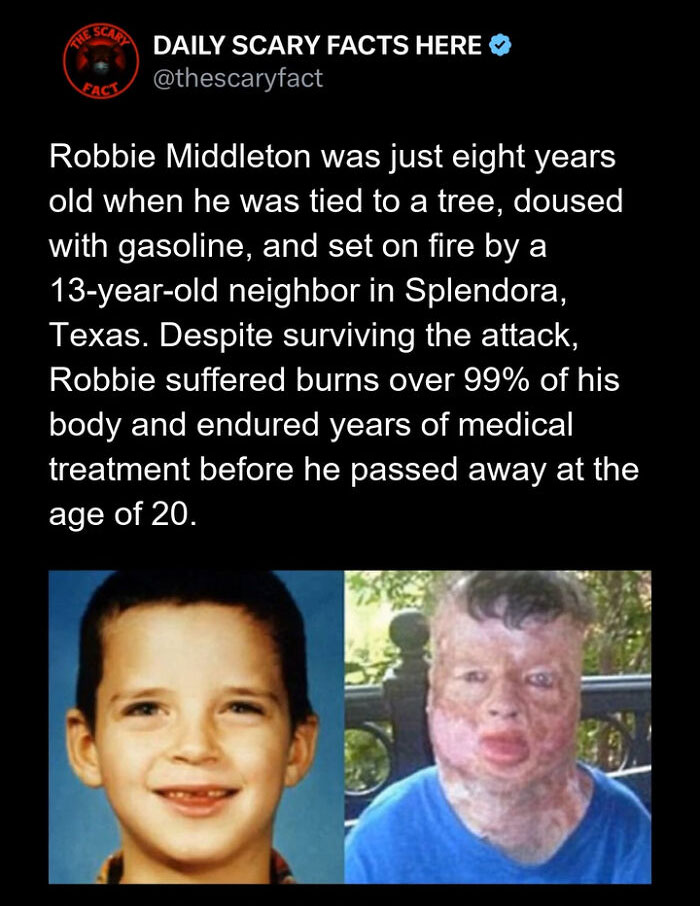
Image source: thescaryfact
#25
In 2009, Sgt. Dakota Meyer ignored a direct order to pull back and instead moved toward a nearby firefight where wounded soldiers were trapped. What makes his actions so intense is not just the danger, but the choice itself. While others were being told to retreat, he drove straight back into chaos where every return trip could have easily been his last.
He went back five times, personally evacuating 12 wounded soldiers and providing cover for another 24. When asked why he did it, he simply said, “That’s what you do for a brother.” The line hits so hard because it strips away everything except loyalty, courage, and the willingness to face almost certain death for the people beside you.
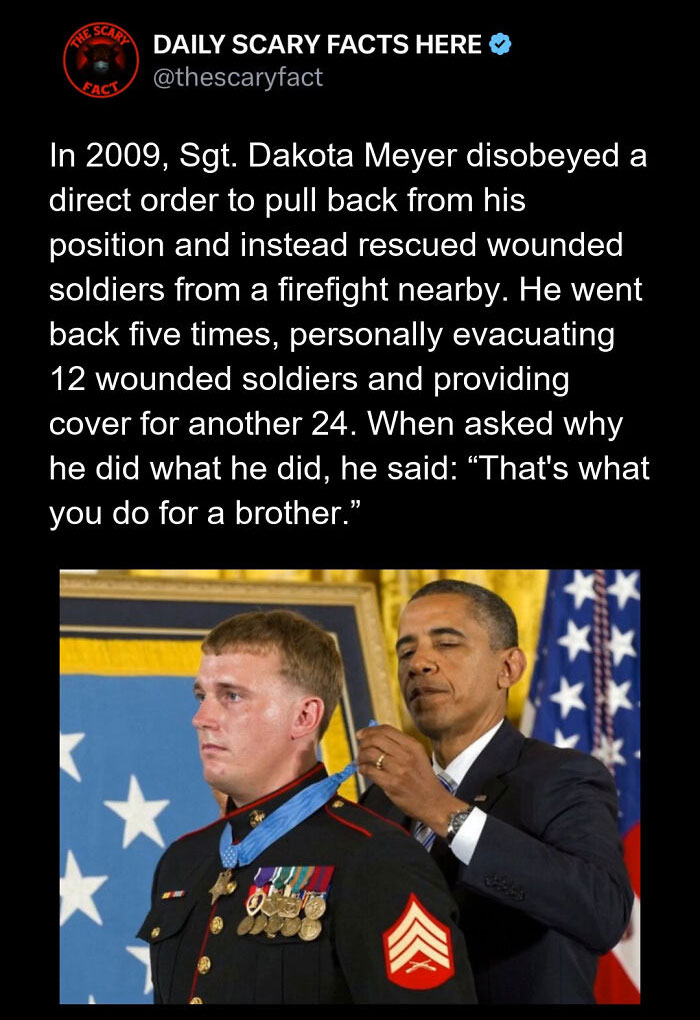
Image source: thescaryfact
#26
In 1989, a teacher in Miyakoji, Japan, noticed a black shoe in a toilet and made a discovery that turned an ordinary school day into something grotesque and unforgettable. Outside, inside the septic tank, was the body of 26-year-old Naoyuki Kanno. The image alone was bizarre enough to make the case feel unreal, like something pulled from a nightmare no one could explain at first.
Investigators believed he had crawled in to peep through the toilet and later d!ed of hypothermia. That theory only made the story more infamous, because the circumstances were so strange, claustrophobic, and deeply disturbing. It remains one of those cases that feels impossible to forget simply because of how absurd and horrifying the scene was.
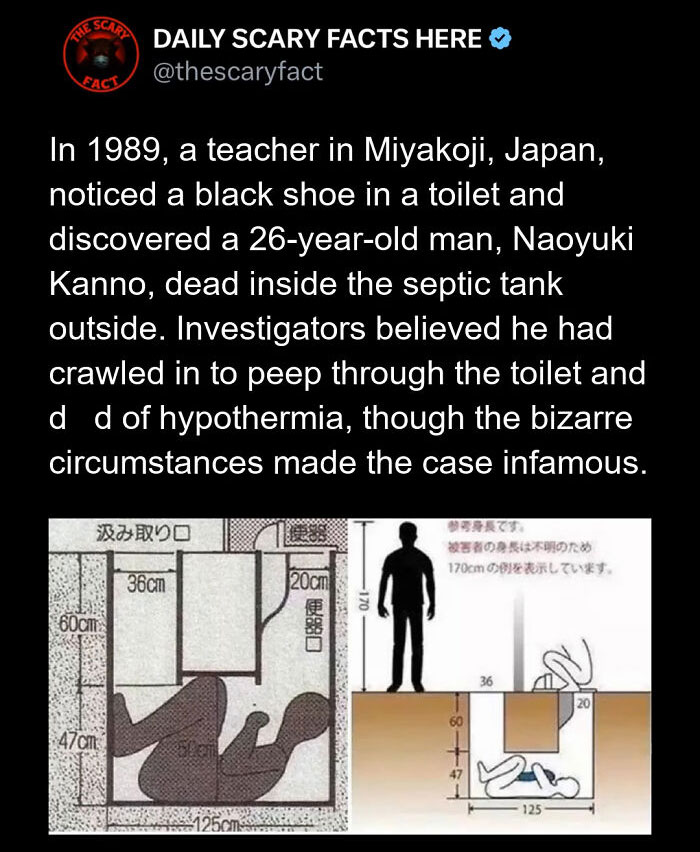
Image source: thescaryfact
#27
On November 25th, 2011, a man passed away while sitting on a bench at the Shanxi Taiyuan train station in China. In a place built for movement, noise, and constant departures, death arrived in complete stillness. What makes the scene so haunting is how ordinary everything must have looked at first, until people realized he was gone.
A Buddhist monk who happened to be at the station noticed what had happened, took the man’s hand, and began praying for him. That single act turned an otherwise lonely passing into something deeply human. In the middle of a crowded station, where strangers usually keep moving, someone stopped to offer comfort at the very end.
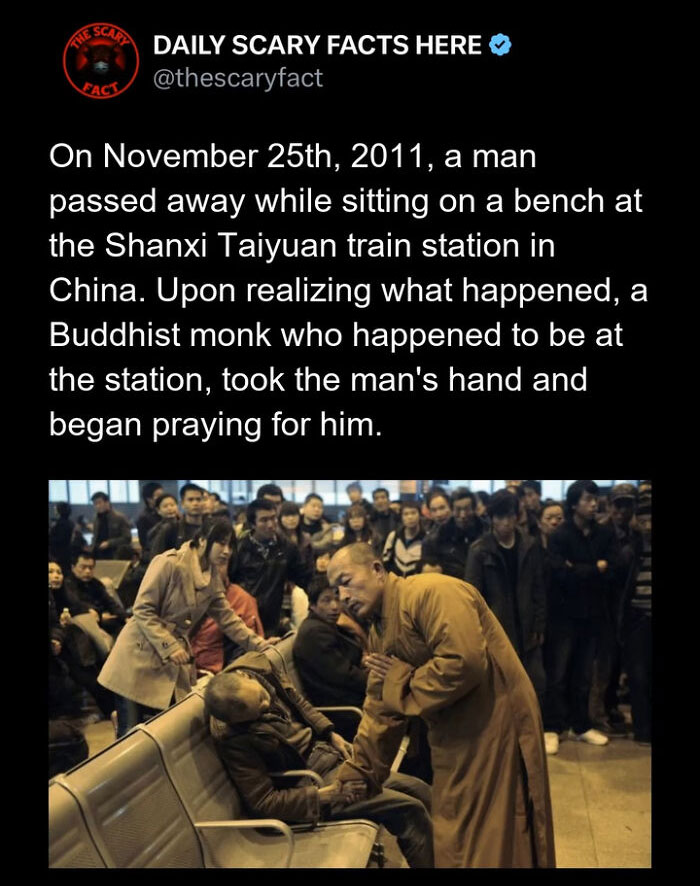
Image source: thescaryfact
#28
In 2015, Florida woman Cheryl Treadway was being held hostage by her boyfriend, but she found a way to ask for help without alerting him. Instead of making a call or trying to escape directly, she used something as ordinary as a pizza order, hiding a desperate message inside the special request section of the Pizza Hut app.
She wrote, “Please help. Get 911 to me. 911 hostage help!” Police arrived at the location and she was released. What makes the story so chilling is how close danger was the entire time, and how a routine order became the thin line between captivity and survival in a moment where one wrong move could have changed everything.
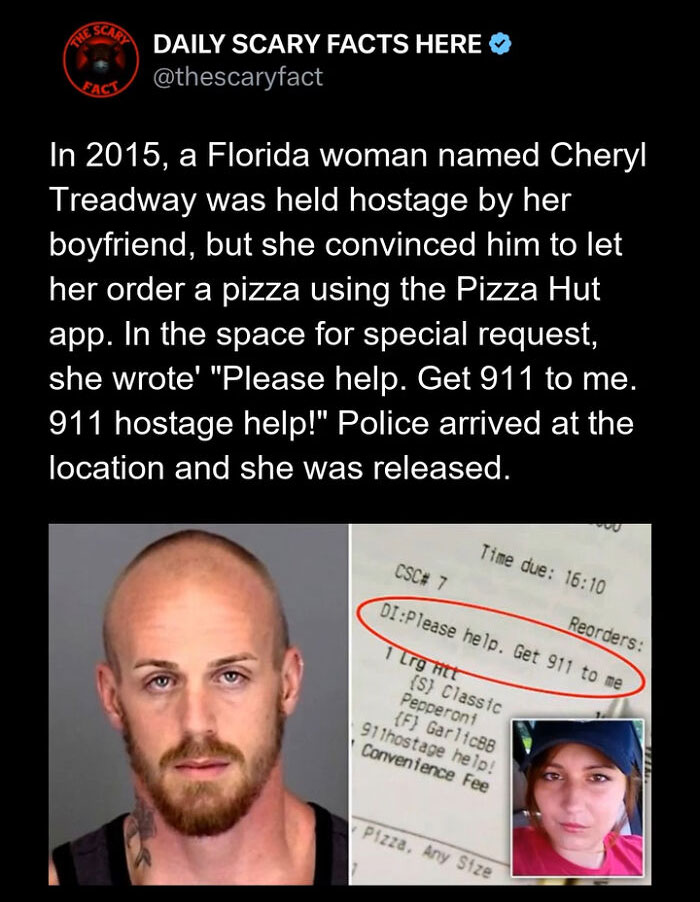
Image source: thescaryfact
#29
The film “Cannibal Holocaust” became so infamous for its extreme violence and disturbing realism that people believed what they were seeing had actually happened. The imagery was so brutal and convincing that the line between fiction and reality seemed to vanish, turning the movie into something far more alarming than ordinary horror.
The controversy grew so serious that the director faced arrest and MU#D3R charges tied to the actors. To clear his name, he had to present the special effects in court and prove the scenes were staged. That alone shows how convincing the film was, transforming a movie into a legal nightmare that looked horrifyingly real.
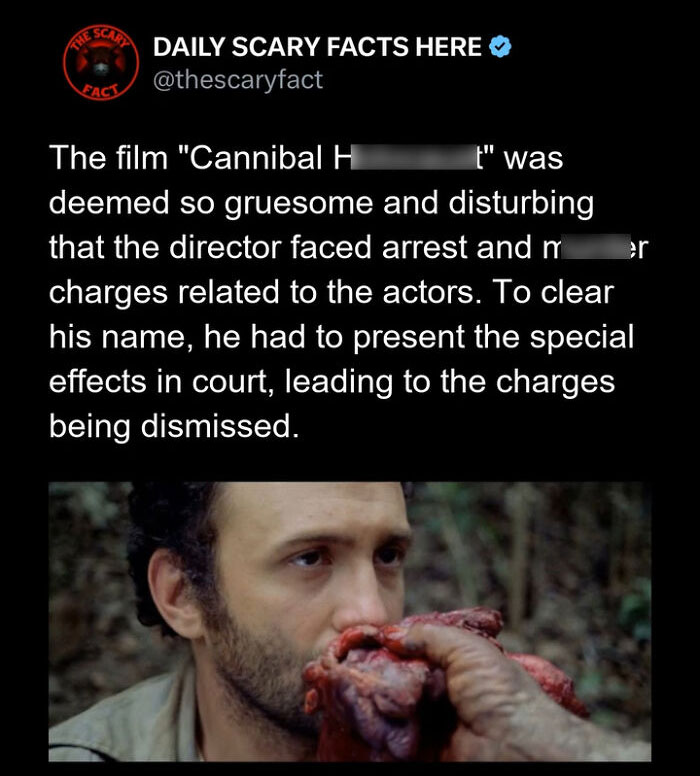
Image source: thescaryfact
#30
One of the last known images of Tim Bergling, also known as Avicii, was taken shortly before he ended his own life. He was 28 years old. There is something deeply unsettling about final photos like this. They look so normal at first glance, yet they hold a kind of silence that becomes unbearable once you know what came next.
One of his final journal entries read, “The shedding of the soul is the last attachment, before it restarts!” Those words feel even darker knowing they were written near the end. They read like a mind drifting somewhere distant, leaving behind a final thought that now feels less like a sentence and more like an echo.
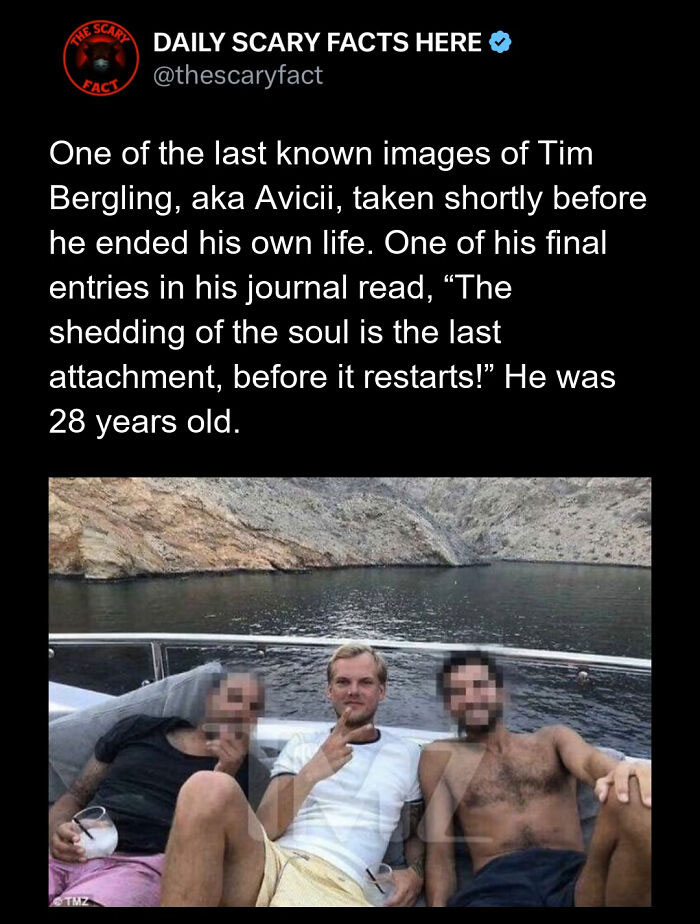
Image source: thescaryfact
#31
Costa Rican fisherman Chito Shedden rescued a wounded crocodile named Pocho in 1989, and after releasing him, the animal kept returning. Over time, the two formed an extraordinary bond that seemed almost impossible, sharing the water, playing together, and building a connection that defied everything most people believe about wild predators.
What makes their story so haunting and fascinating is the sheer unpredictability of it. A creature associated with raw instinct and danger became part of a friendship that lasted more than 20 years. The image of a man calmly beside a crocodile is powerful because it feels like nature briefly allowed something it normally never would.
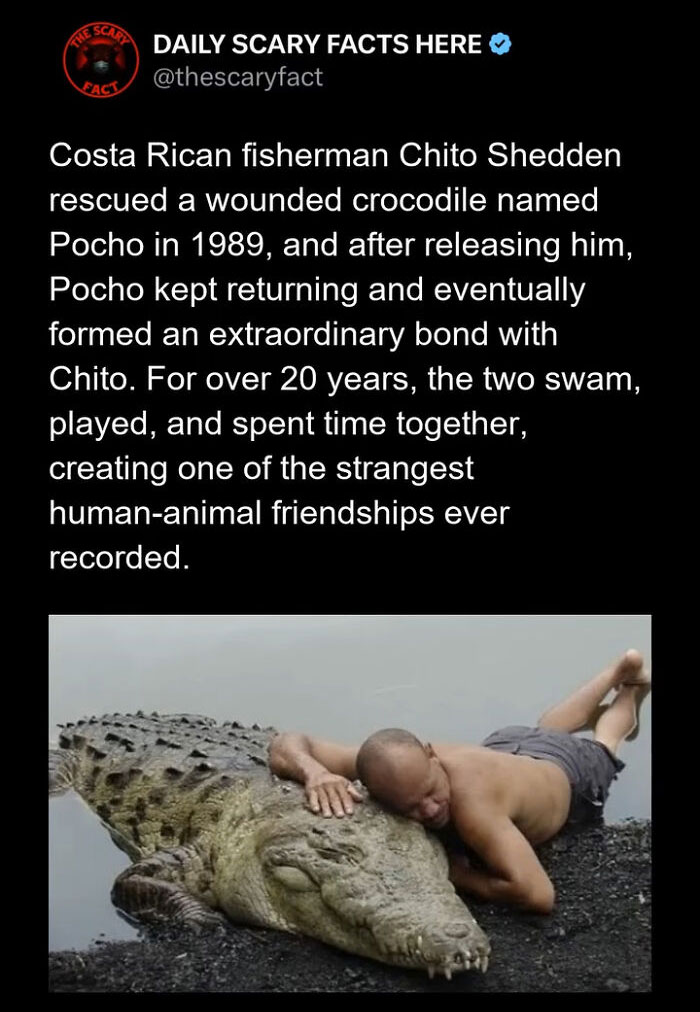
Image source: thescaryfact
#32
In 2017, this Rohingya Muslim man carried his immobile parents for nearly 100 miles to escape Burma’s d3@th squads. For seven days, he kept moving forward under a burden that was physical, emotional, and almost unimaginable, driven only by the need to get his family out alive.
What makes the image so powerful is the sheer weight of love and desperation inside it. This was not just a journey. It was an act of endurance against terror, where every step meant choosing not to abandon the people who had once carried him. By the time he reached Bangladesh, the photograph had already become a symbol of sacrifice and survival.
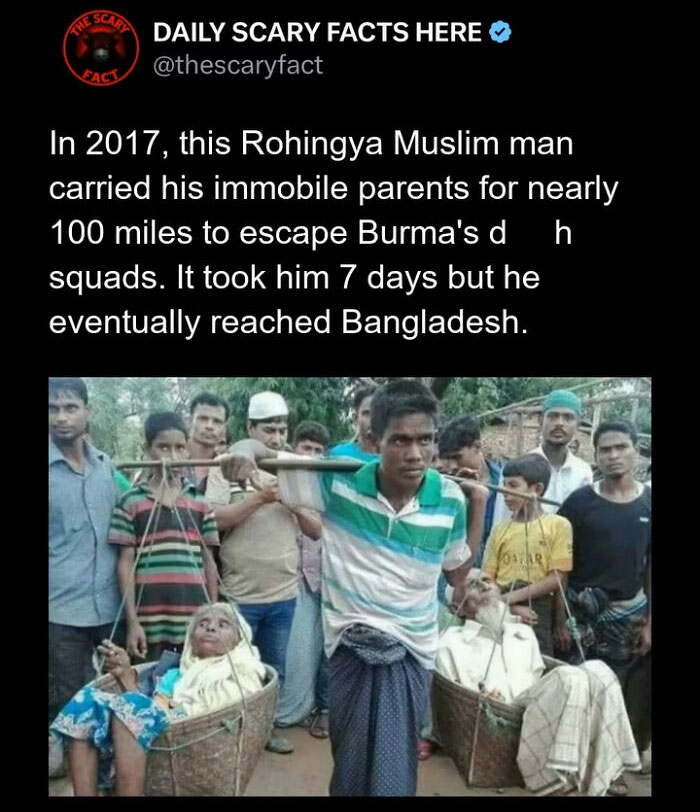
Image source: thescaryfact
#33
In 2008 reporting around the Pride of Britain Awards, 9-year-old Nathan Thomson was described as hearing a disturbance at home, finding an intruder threatening his mother, and stepping in despite being badly injured. Pride of Britain’s published profile says he intervened when the attacker confronted his mother with a knife, and that Nathan’s actions helped stop the assault and get help.
The part about him being recommended for a bravery award by a senior Scottish law officer is consistent with the same Pride of Britain account and contemporary UK coverage (often referencing Scotland’s senior legal figures in connection with bravery recognition). The core facts—child intervenes, mother seriously injured, bravery recognition—are well supported, even though some minute details vary between retellings.
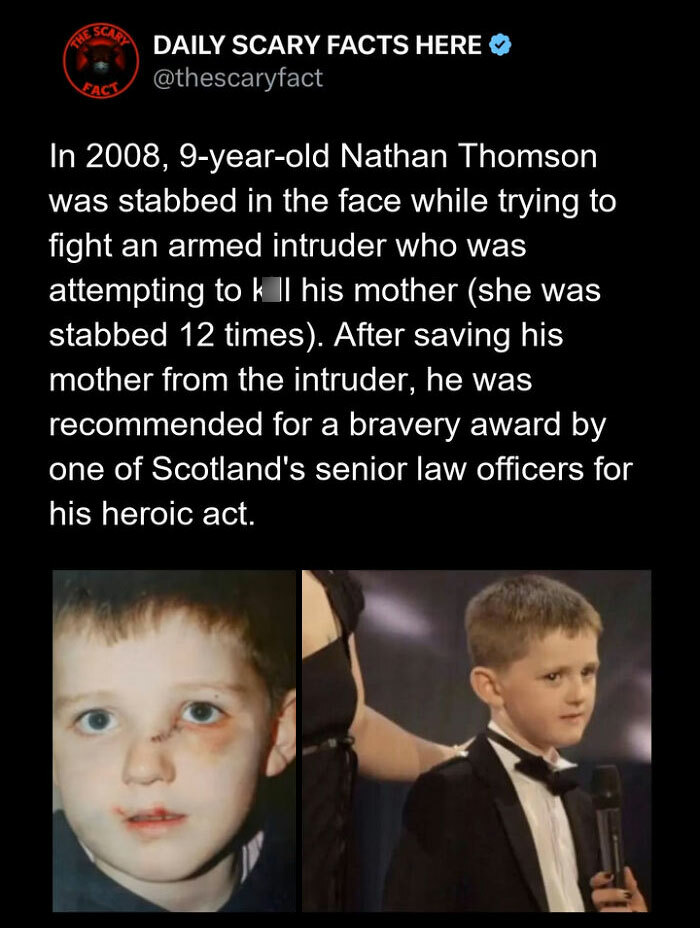
Image source: thescaryfact
#34
Image source: thescaryfact
#35
fish-skin xenografts are used as advanced wound dressings for burns and chronic wounds like diabetic foot ulcers. The best-known commercial example is intact cod fish skin (often discussed under the brand Kerecis), which is processed to keep much of its natural structure so it can act like a scaffold over the wound bed, supporting healing as the body rebuilds tissue. Peer-reviewed medical literature describes fish-skin xenografts being used across acute and chronic wound settings, including burns and diabetic wounds.
The “recruits the body’s own cells and is ultimately converted into living tissue” line is a commonly used description in clinical-facing materials about intact fish-skin grafts, and the underlying idea matches what clinicians mean by a biologic scaffold: your tissue grows into and replaces it over time as healing progresses. That said, outcomes depend on wound type, infection control, blood flow, and diabetes management—this isn’t magic, but it is a real tool in modern wound care.
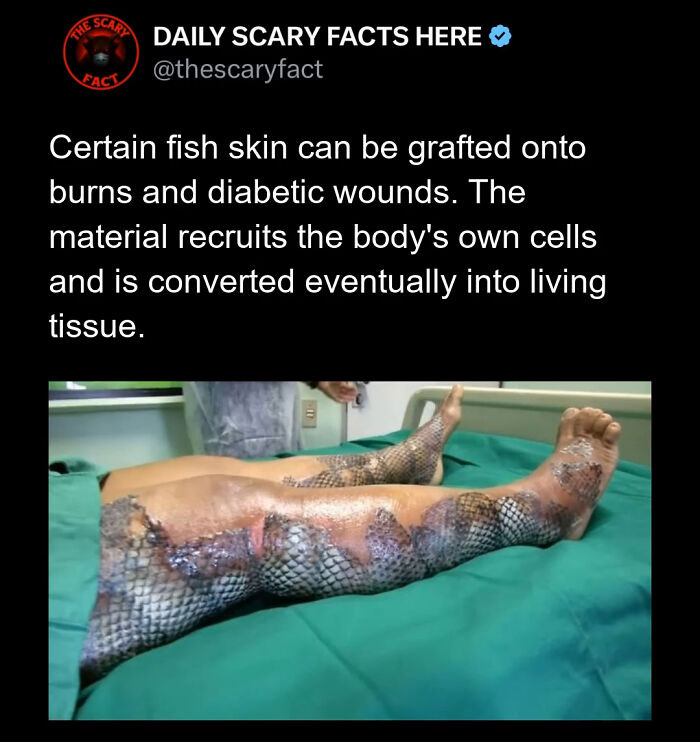
Image source: thescaryfact
#36
On the morning of December 14, 2012, Jesse Lewis (age 6) wrote “I love you” and drew hearts in frost on his mom’s car—something his mother has publicly documented and shared in remembrance of him. Later that day, he was k**led in the Sandy Hook Elementary sh00ting, and his mother went on to found the Jesse Lewis Choose Love Movement in his honor.
One important fact-check: the claim that he “saved 11 lives” is not consistently supported by the strongest accounts. What is widely repeated is that Jesse shouted for classmates to run during a pause/reload moment, helping multiple children escape—some sources specifically say nine, while other accounts describe six making it out in that moment. So the heroic action is credible, but the exact number varies by source and should be phrased carefully.
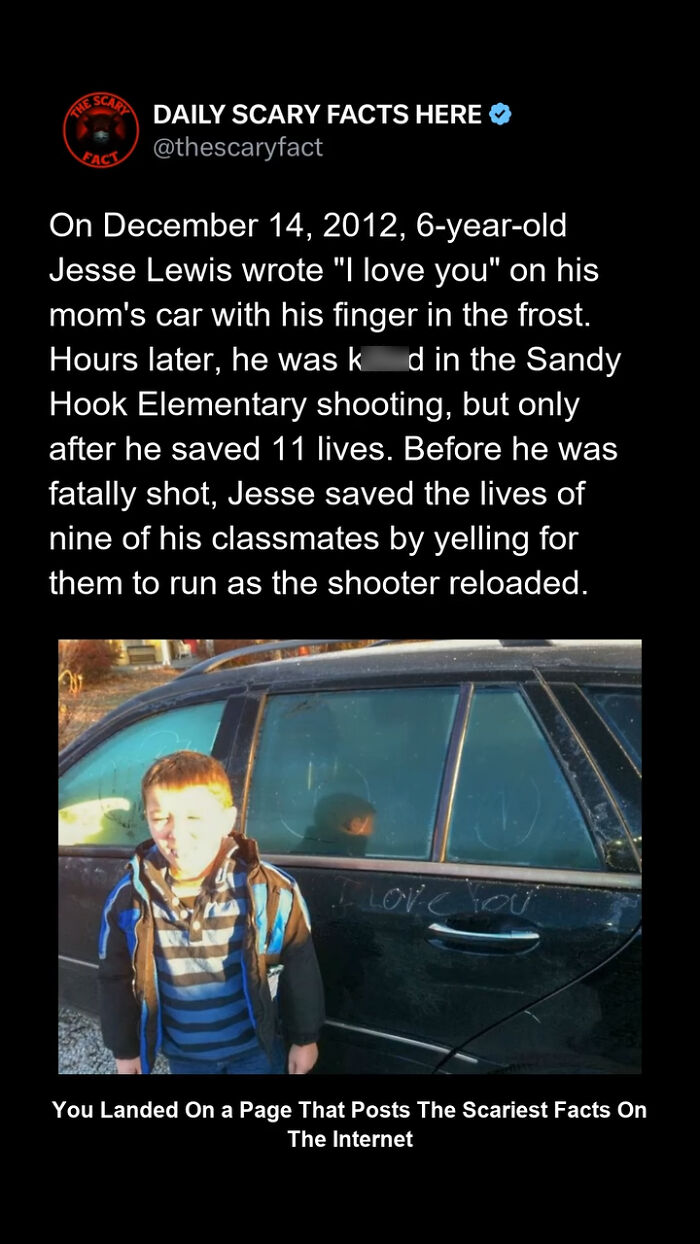
Image source: thescaryfact
#37

Image source: thescaryfact
#38
Stefan Zoleik lived for about a decade with a massive facial growth linked to Madelung disease (multiple symmetric lipomatosis), which can cause large fatty tumors around the neck/upper body and, in rare cases, the face. In 2014, surgeons removed a tumor reported around 13 pounds (6 kg), dramatically changing his ability to function and be seen in public again.
The condition itself isn’t usually cancer, but the growth can become disabling—causing pain, breathing issues, and severe disfigurement. His case went viral because it shows how a “benign” disorder can still destroy someone’s life until surgery becomes the only way forward.
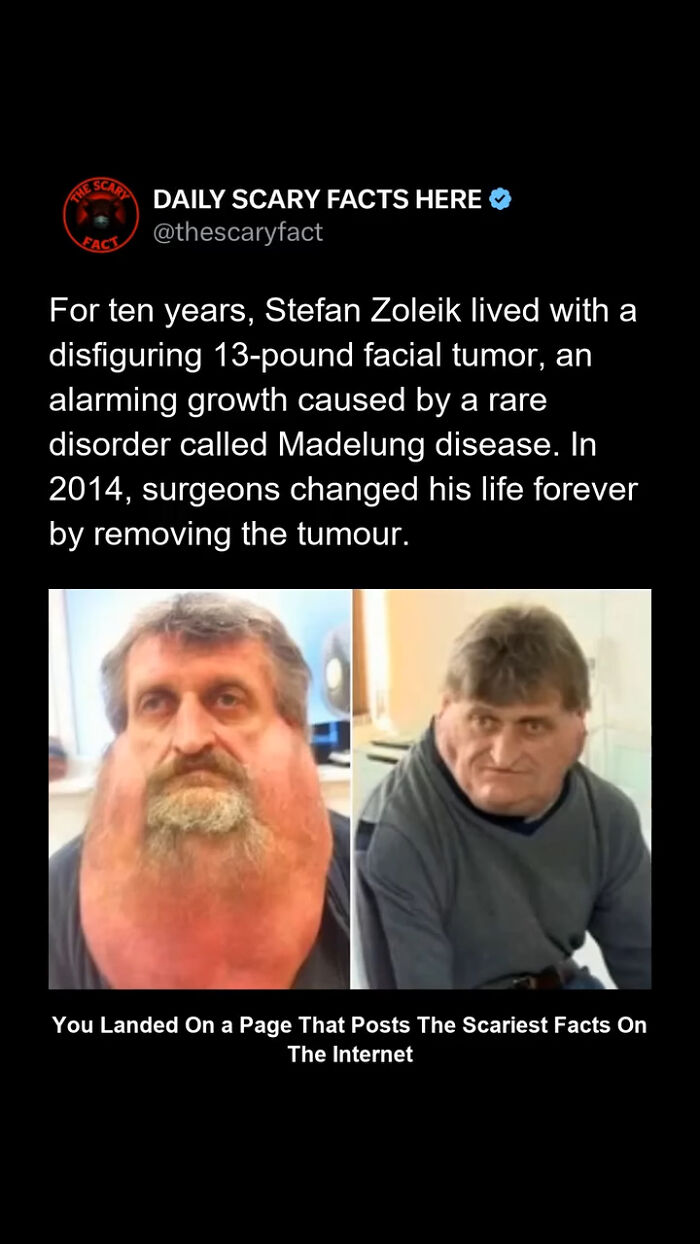
Image source: thescaryfact
#39
The story of Margorie (Marjorie) McCall of Lurgan is one of Ireland’s most famous “buried alive” legends: she’s said to have been mistakenly declared dead after a fever, buried with a valuable ring, and then awakened when grave robbers tried to cut the ring off her finger.
Historians and local records don’t fully confirm the details (and even the year varies in retellings), but the tale became a tourist fixture: Shankill cemetery has an undated headstone popularly tied to the legend, and the story is part of a broader European folklore motif (“Lady with the Ring”).
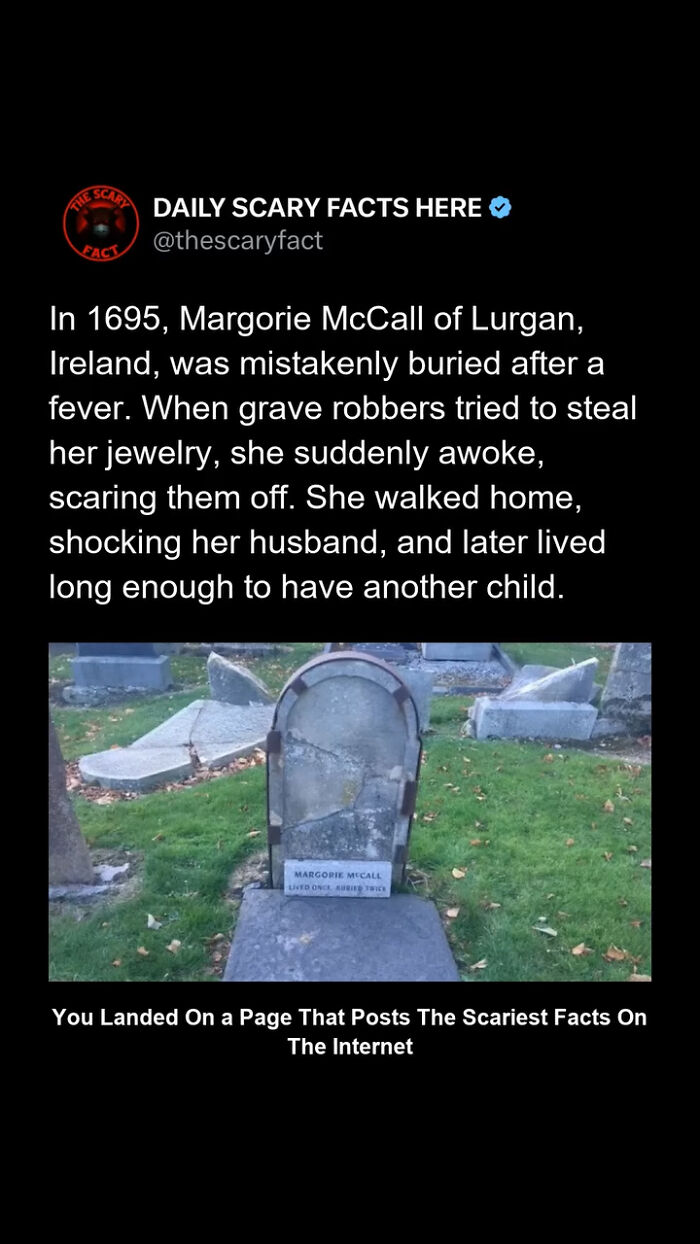
Image source: thescaryfact
#40
Gráinne Kealy suffered catastrophic facial injuries after riding with her feet on the dashboard—when the airbag deployed, it drove her knees into her face, breaking many bones and causing severe trauma.
A key detail that often gets misunderstood: the car wasn’t necessarily flying at “120 mph.” Some reporting describes the vehicle losing control (e.g., black ice) at relatively low speed—but the airbag deploys explosively, which is why the injuries were so extreme. She described living without a forehead for about two years during reconstruction.
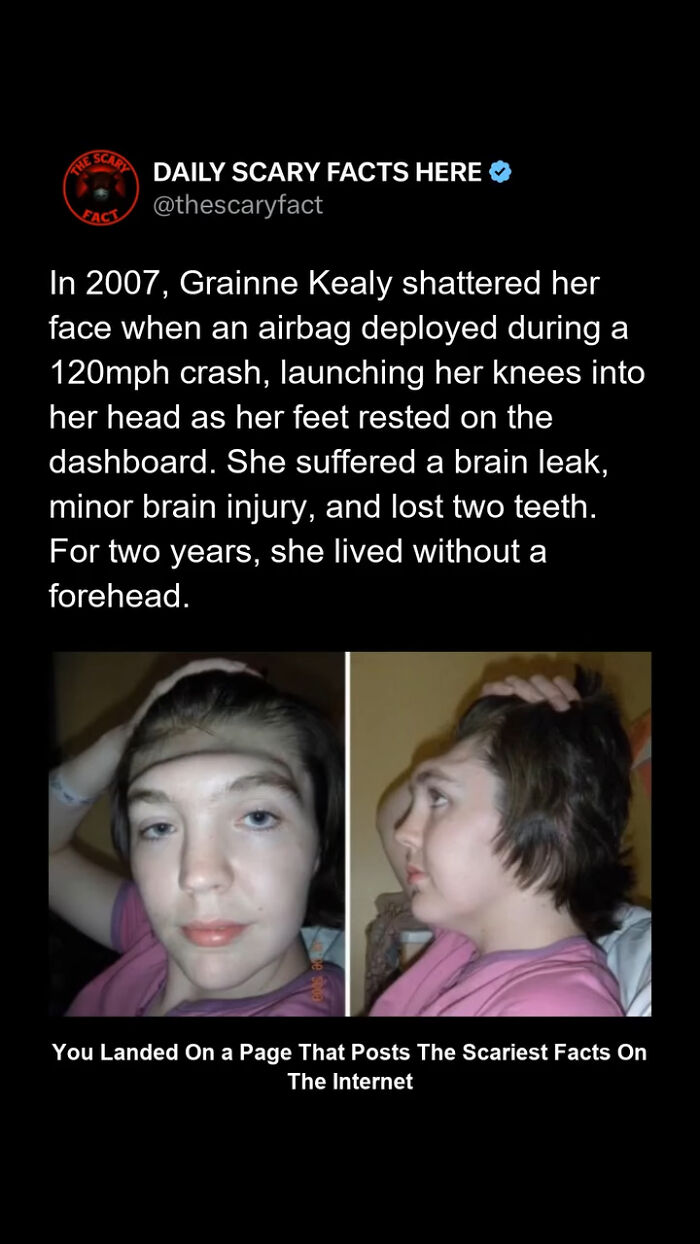
Image source: thescaryfact
#41
In 2016, during an Easter egg hunt near London, children noticed a police helicopter circling overhead while officers searched for burglary suspects. Spotting two men running across a nearby field, the kids quickly improvised.
They formed a giant human arrow on the ground, pointing toward the fleeing suspects — guiding the helicopter’s camera to the right direction. Police later confirmed the children’s quick thinking helped locate the suspects.
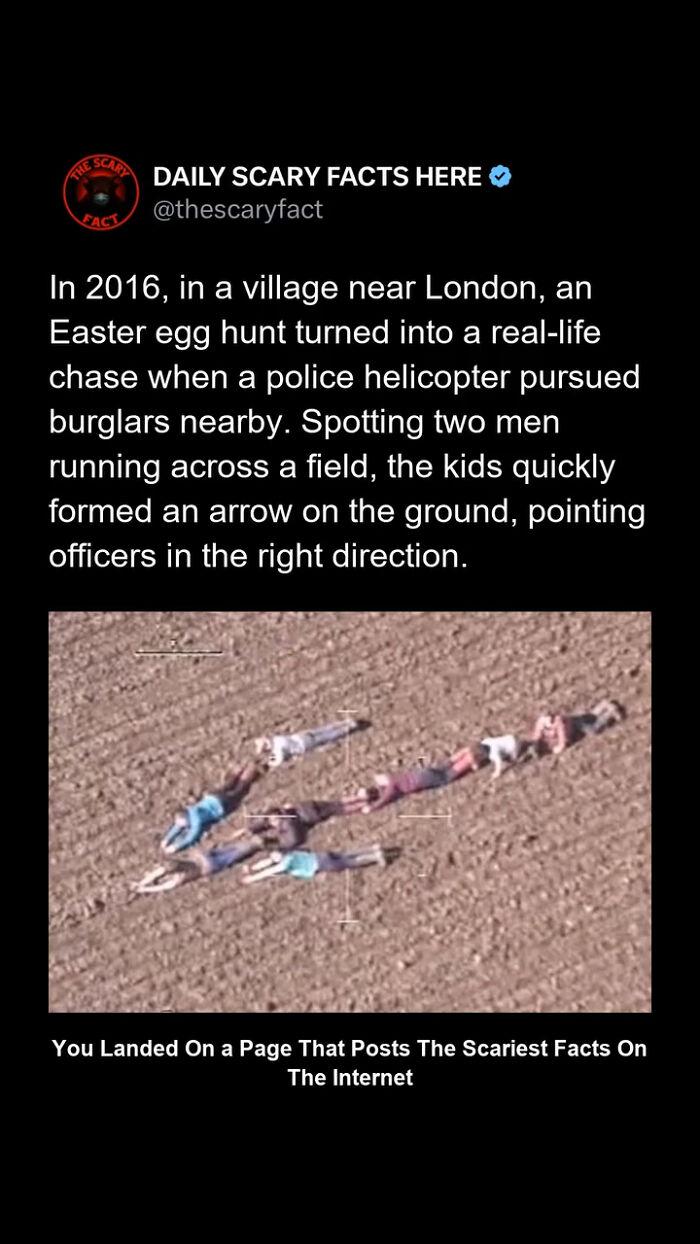
Image source: thescaryfact
#42
London-area accountant Darren Carvill stole money from his employer and later said workplace bullying pushed him to “go out with a bang.” Prosecutors said he took over £260,000 total, with about £170,000 spent in one weekend on cocaine and sex workers.
He was sentenced to prison in 2019 for the fraud, and the story became notorious in the UK because of how fast he burned through the money—and how close it came to financially crippling the business.
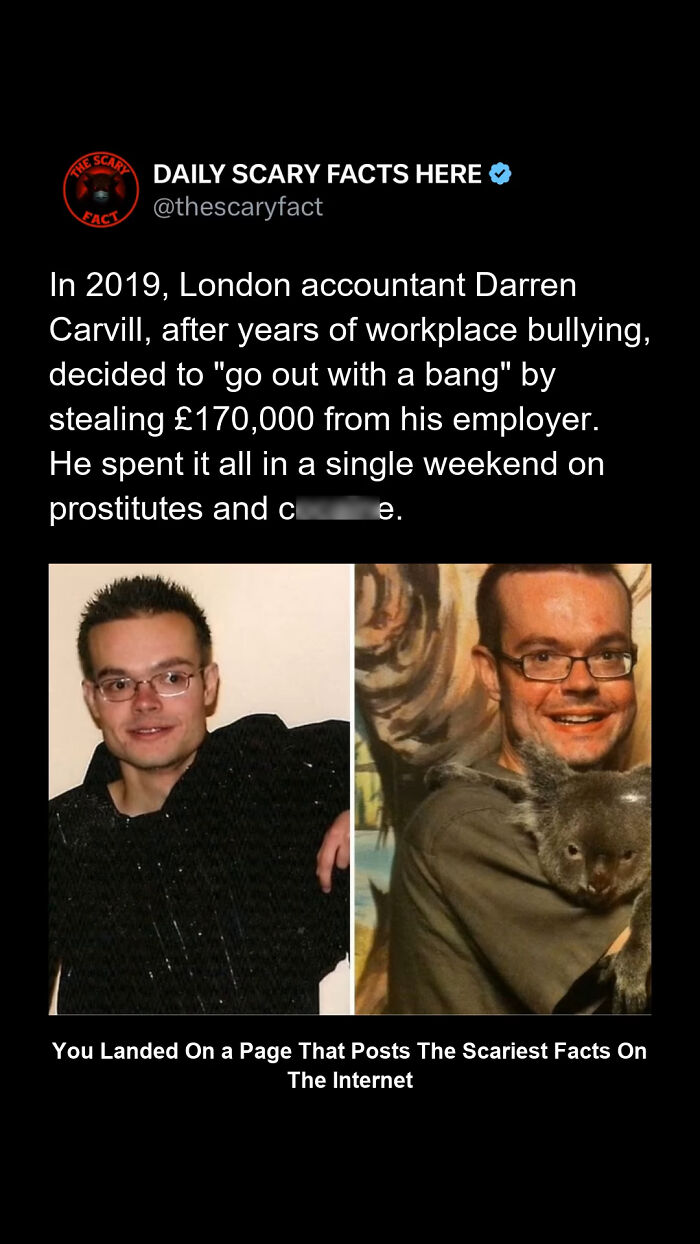
Image source: thescaryfact
#43
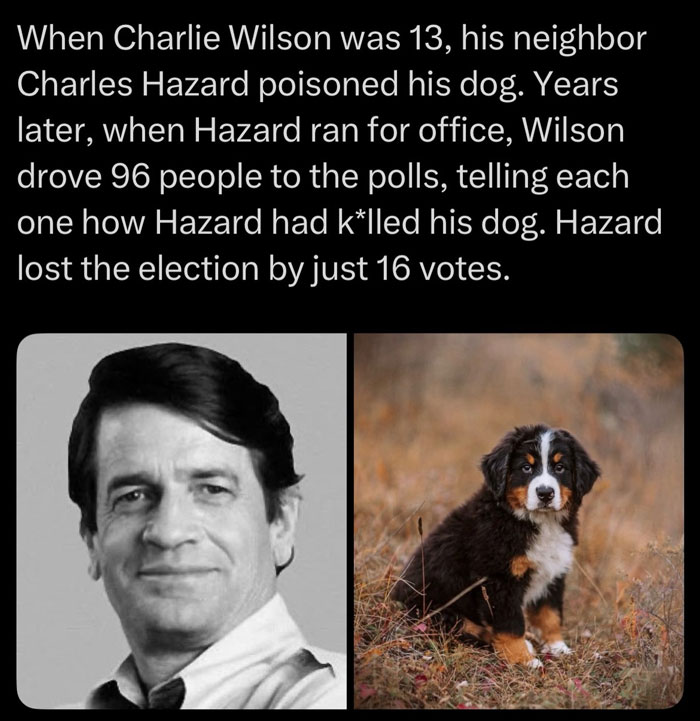
Image source: thescaryfact
#44
“Johatsu,” which translates to “evaporation,” refers to the phenomenon in Japan where individuals disappear to escape societal pressures, such as failed marriages, debt, or job loss. These people choose to leave their past lives behind and live anonymously, often in urban areas where they can blend in without attracting attention.
Specialized companies known as “night movers” provide discreet services to help these individuals vanish. These companies assist in relocating clients secretly, often under the cover of night, to ensure their departure goes unnoticed. The “night movers” handle the logistics, including finding new accommodations, changing identities, and ensuring that the person’s trail is difficult to follow.
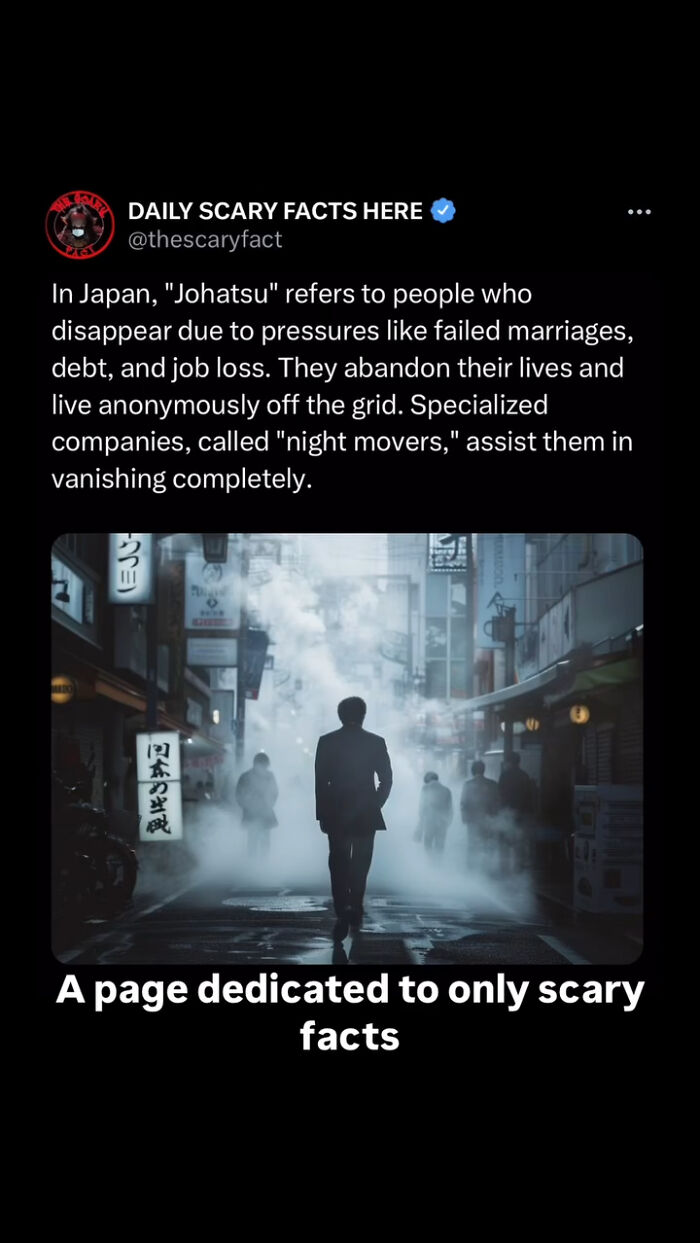
Image source: thescaryfact
#45
A Vietnamese teenager is seen buttoning up her mother’s blouse after she was s3xu@lly @ss@u!ted by American GIs during the My Lai Massacre on March 16, 1968. The image is devastating because it captures a tiny act of care in the middle of unspeakable horror, with a daughter trying to restore a shred of dignity in a moment that had already gone far beyond cruelty.
What makes the photo even more haunting is what came immediately after. They were sh0t moments later. That turns the image into more than a record of suffering. It becomes one of the final seconds of human tenderness before violence erased everything, freezing grief, fear, and helplessness into a single unforgettable frame.

#46
In 2021, a Russian father named Vyacheslav Matrosov forced his best friend to dig his own grave and end his own life after discovering he had been s3xu@lly bu$ing his daughter. The case feels especially dark because it was driven by betrayal at the deepest level, turning friendship into vengeance and ending in a punishment carried out far outside the law.
Vyacheslav was sentenced to 18 months in jail but left after 6 months following a public appeal for his release. That outcome made the story even more unsettling, because it showed how strongly people reacted to what had been uncovered. The case remains disturbing not only for what happened, but for how many saw the aftermath through a very different moral lens.
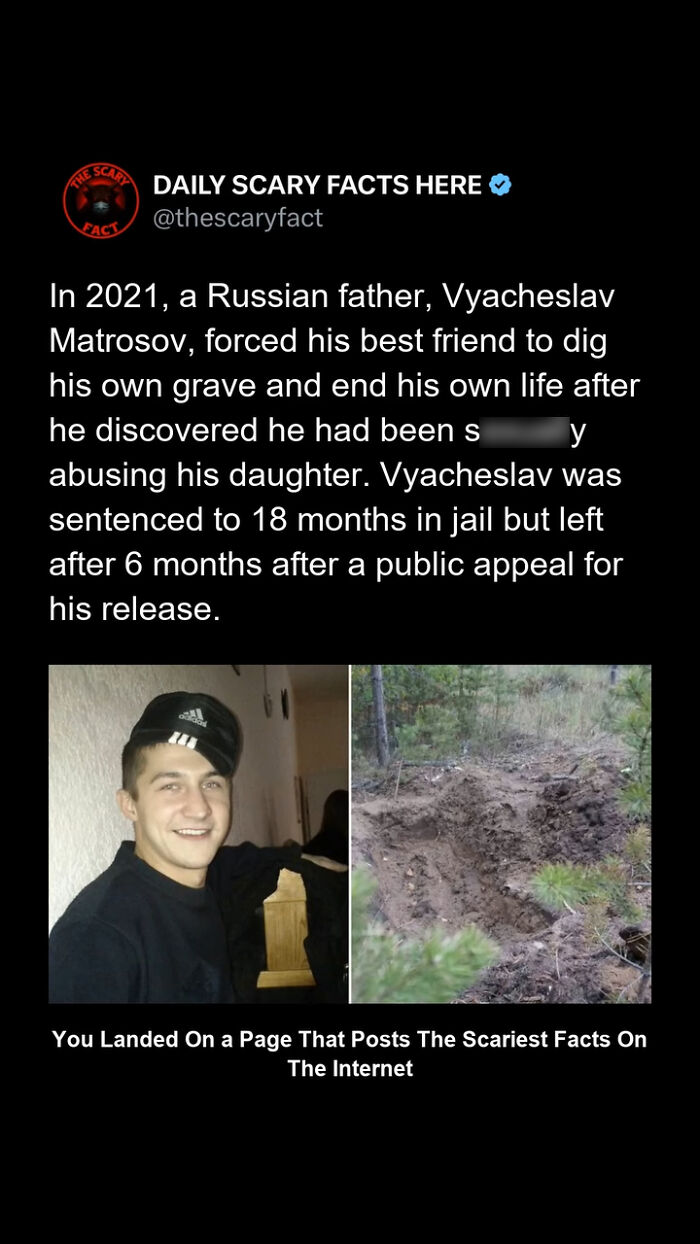
Image source: thescaryfact
#47
The grandfather of child actress Renee Shin-Yi Chen broke down at her funeral in 1982, creating an image of grief that feels almost unbearable to look at. There is something especially haunting about funerals for children, where the sorrow on an adult’s face says more than words ever could. It captures a kind of pain that looks too heavy for anyone to survive.
Renee passed away after a devastating accident on the set of “The Twilight Zone: The Movie.” She was decapitated after being hit by the rotor blade of a helicopter while filming an action scene. The fact that it happened during a movie shoot makes it even more horrifying, because a place meant for make-believe suddenly became the site of something brutally real.

Image source: thescaryfact
#48
Photos of Gareth Weeks before and after a liver transplant show a transformation that feels almost unreal. Chronic liver disease had visibly drained him, leaving behind the kind of damage that can be seen in the face, the skin, and the body long before words can explain how serious it really is.
The after image carries a completely different weight. It is not just a medical result, but a visual divide between decline and survival. Seeing both side by side makes the reality of severe illness impossible to ignore, because it shows how much a body can change when it is slowly failing and what it can look like when given another chance.
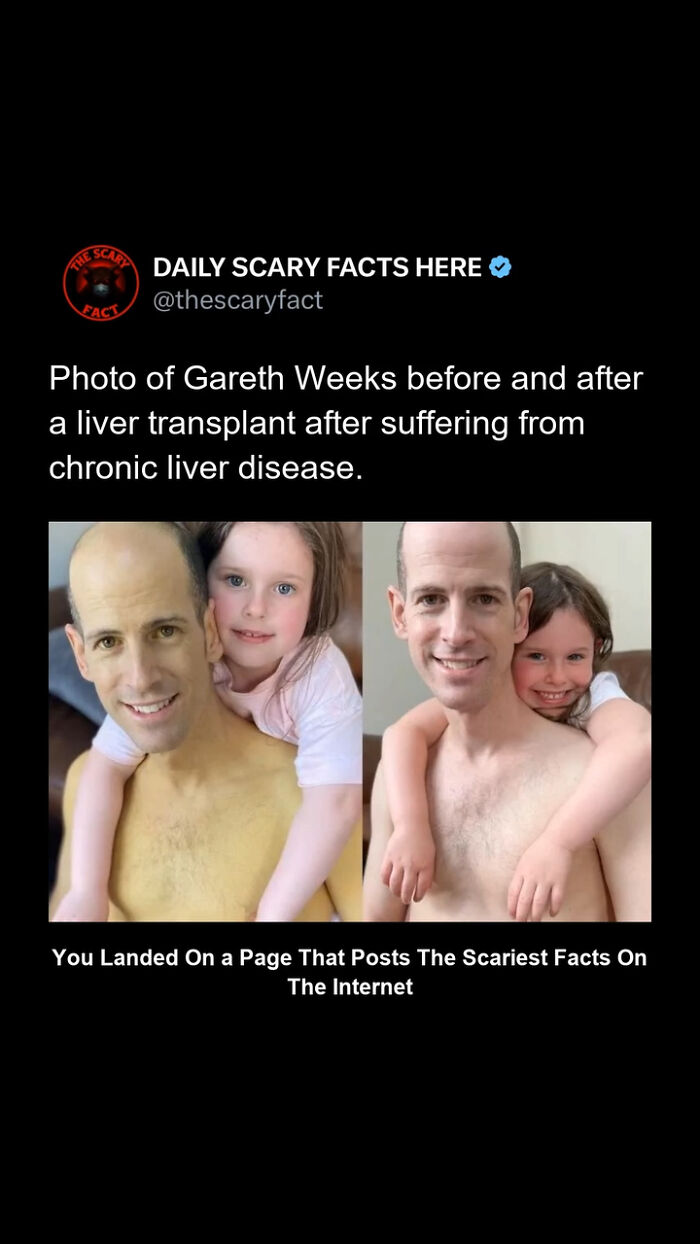
Image source: thescaryfact
#49
Real human skeletons were used in the pool scene of Poltergeist (1982) because they were cheaper than creating realistic prop skeletons at the time. That detail alone gives the scene a completely different feeling. What looked like ordinary horror movie set design was actually something far more unsettling, hidden in plain sight during filming.
JoBeth Williams later said she believed the skeletons were fake while shooting the scene and only learned afterward that they were real. That revelation makes the moment even darker. It means the fear on screen was surrounded by something genuinely human, turning a fictional horror sequence into one with a disturbing layer of reality underneath it.
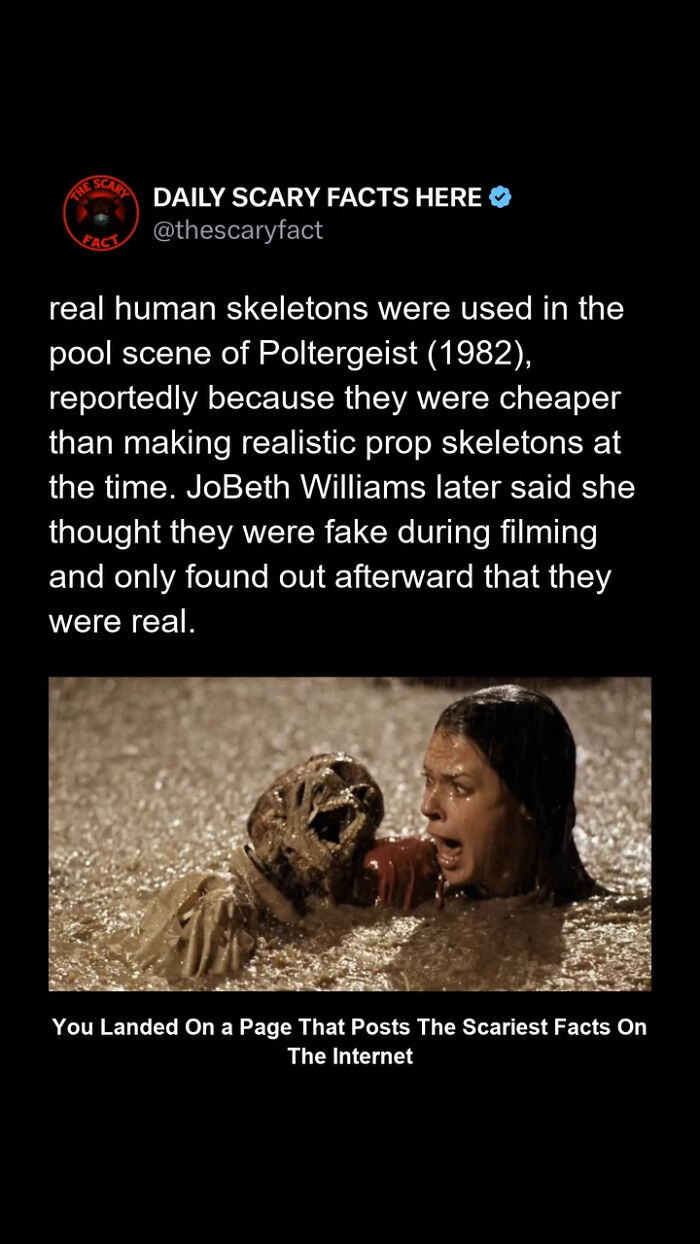
Image source: thescaryfact
#50
This photograph is believed to show Edna Cintron, circled in red, waving from the impact hole created by Flight 11 striking the World Trade Center on September 11, 2001. The image is almost unbearable because it captures a single human figure still visible within a wound torn into a massive building, surrounded by smoke, fire, and destruction far beyond anything one person could survive for long.
What makes the image so haunting is how personal it makes the disaster. A tragedy involving thousands is suddenly reduced to one visible person, one gesture, one impossible moment high above the ground. That tiny figure in the opening turns overwhelming catastrophe into something intimate, immediate, and deeply painful to witness.

Image source: thescaryfact
#51
In 2019, a thief in Brazil tried to rob professional MMA fighter Polyana Viana with a cardboard g%n, expecting an easy target. Instead, the situation flipped instantly. She fought back with punches and a kick, dropping him before keeping him under control in a choke until police arrived.
What makes this story so shocking is how quickly the threat collapsed. A moment meant to create fear turned into a brutal lesson in miscalculation. The man chose the wrong victim, and within seconds, the person he tried to intimidate had completely overpowered him and ended the encounter on her terms.
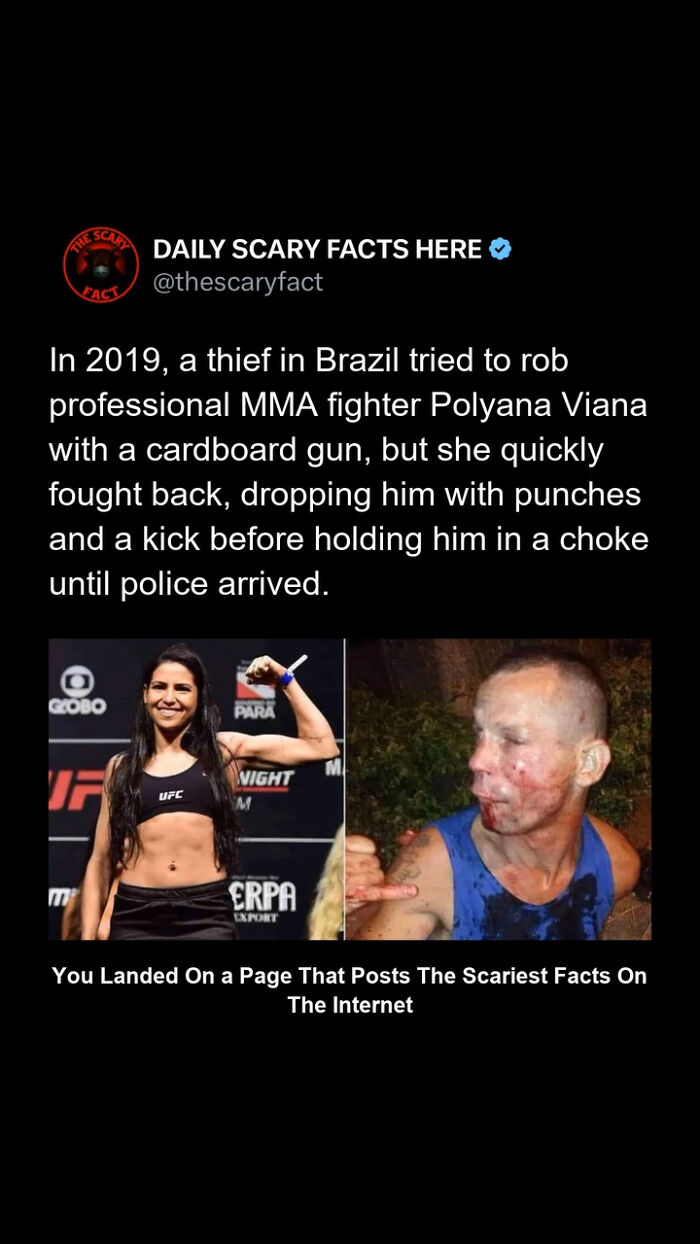
Image source: thescaryfact
#52
Kevin Hines did survive a jump from the Golden Gate Bridge in 2000 at age 19, and he has consistently said a sea lion helped keep him above the water until the Coast Guard reached him. The broad outline is well supported, but some dramatic injury details that circulate online are described inconsistently across retellings, so it is safer to say he survived severe trauma from the fall rather than repeat every specific spinal claim as settled fact.
What makes the story endure is not just the survival itself, but what followed. Hines later became a public speaker, author, and mental-health advocate whose work centers on surviving a su!c!d3 attempt and urging intervention before a crisis turns fatal. That turns the fact from a miracle-at-sea story into a documented case of long-term recovery and prevention advocacy.
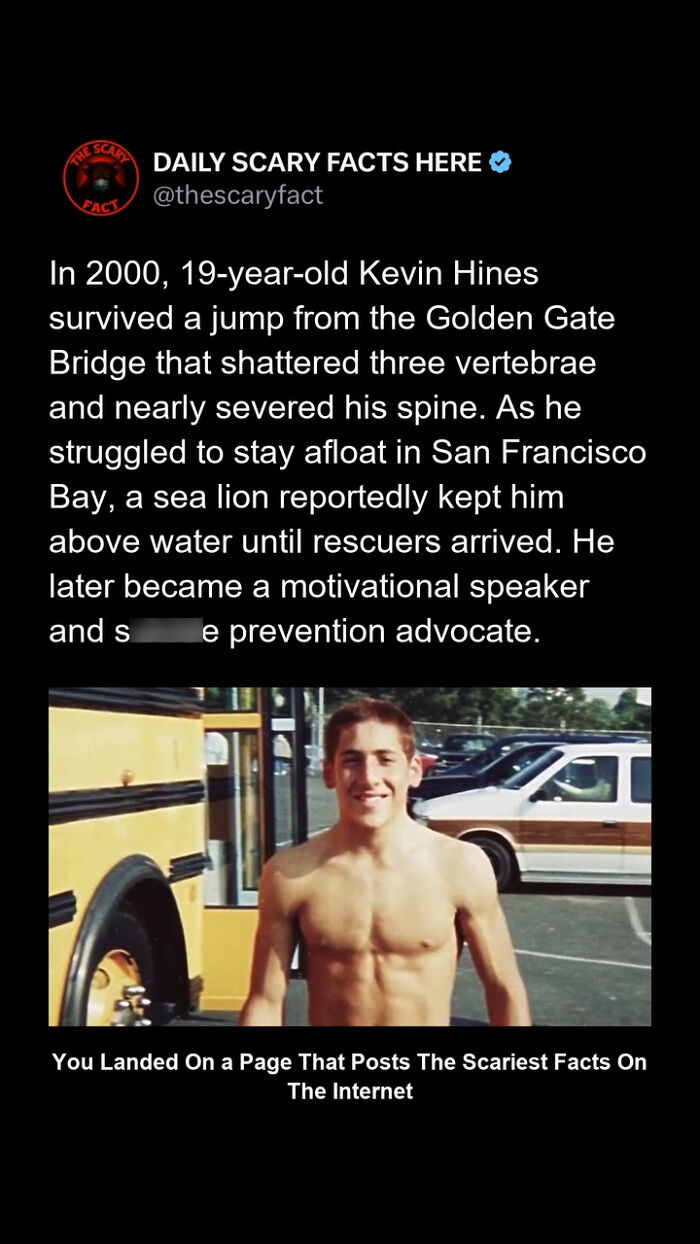
Image source: thescaryfact
#53
Richard Anthony “Richard A.” Jones was wrongfully convicted after a 1999 purse-snatching/robbery case near a Kansas City–area Walmart, based largely on eyewitness identification rather than physical evidence. He maintained his innocence for years, and while serving a 19-year sentence, he kept insisting the real suspect was someone who looked nearly identical to him.
The turning point came when inmates started confusing Jones for another prisoner, Ricky (Richard) Amos, and Jones reported that “double” to the University of Kansas School of Law’s Project for Innocence. Investigators tracked Amos down, and the case unraveled—Jones ultimately walked free in 2017 after spending nearly 17 years locked up.
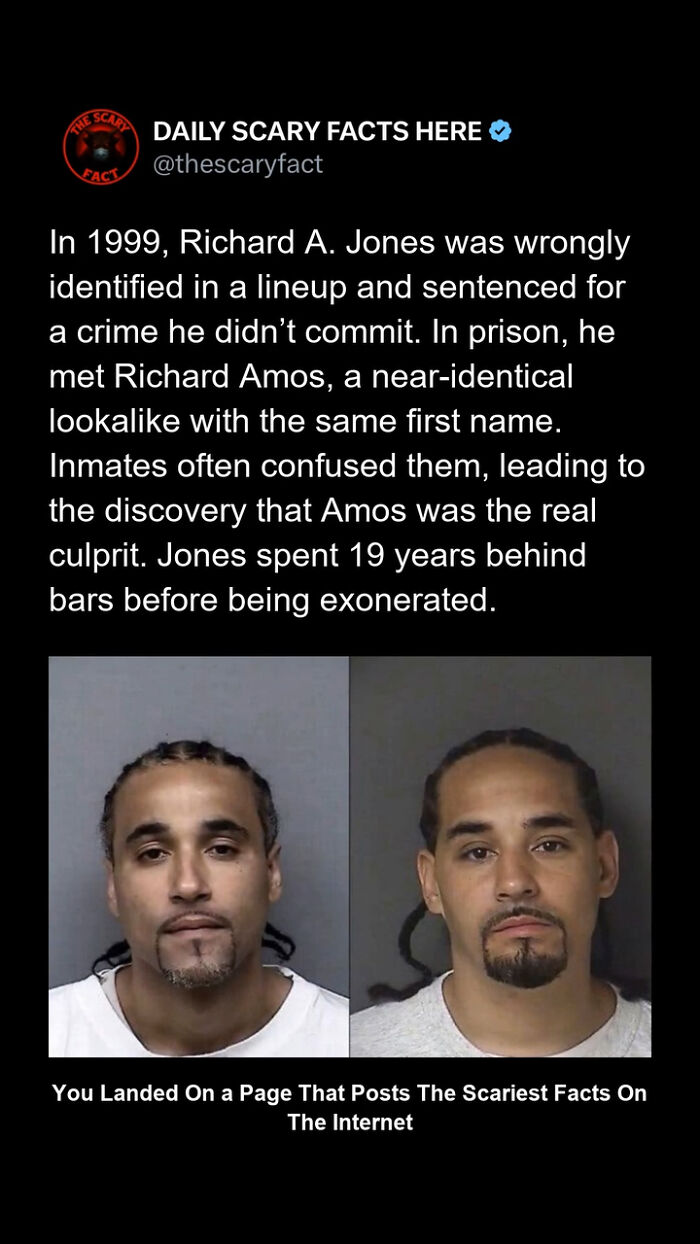
Image source: thescaryfact
#54
After her son Aless Lequio García di*d from c@nc3r in 2020, Spanish actress Ana Obregón later revealed that a baby born via surrogacy in the U.S. in 2023 was conceived using Aless’s frozen sperm and a donor egg. She publicly stated the child is biologically her granddaughter, while also being legally treated as her daughter under the paperwork path used in Spain.
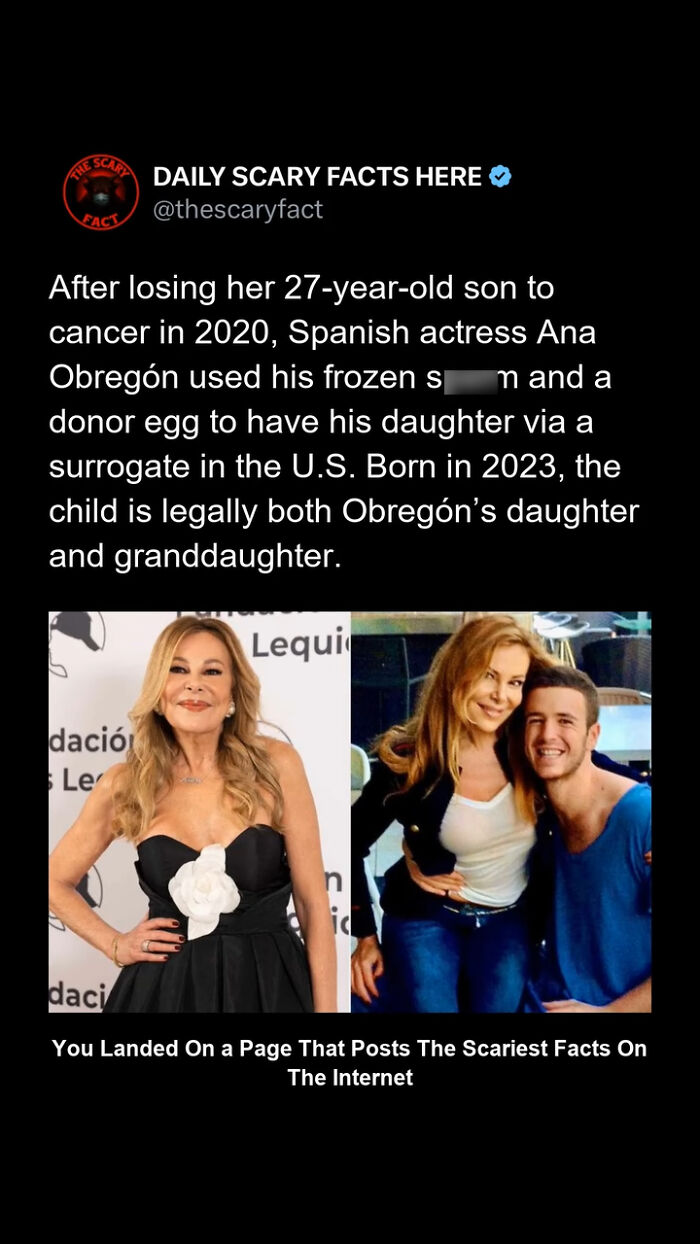
Image source: thescaryfact
#55
Dr. Judy Melinek is a forensic pathologist who has publicly described her work in New York City’s medical examiner system, including the painstaking effort to identify 9/11 victims when remains were often incomplete. She and her co-author wrote Working Stiff, which covers her training period in NYC and includes the reality of disaster victim identification—documenting how MEs rely on everything from small tissue samples to dental records and other forensic methods when full bodies aren’t recoverable.
The specific detail about being called in around August 2002 after a single foot bone was found on a rooftop about one-fifth of a mile from Ground Zero is widely repeated online and often attributed to her accounts, but it’s harder to independently verify from a strong primary publication in the sources available here—so it’s best framed as a commonly repeated anecdote tied to her 9/11 work, while her broader role and the nature of the identification work are well-supported.
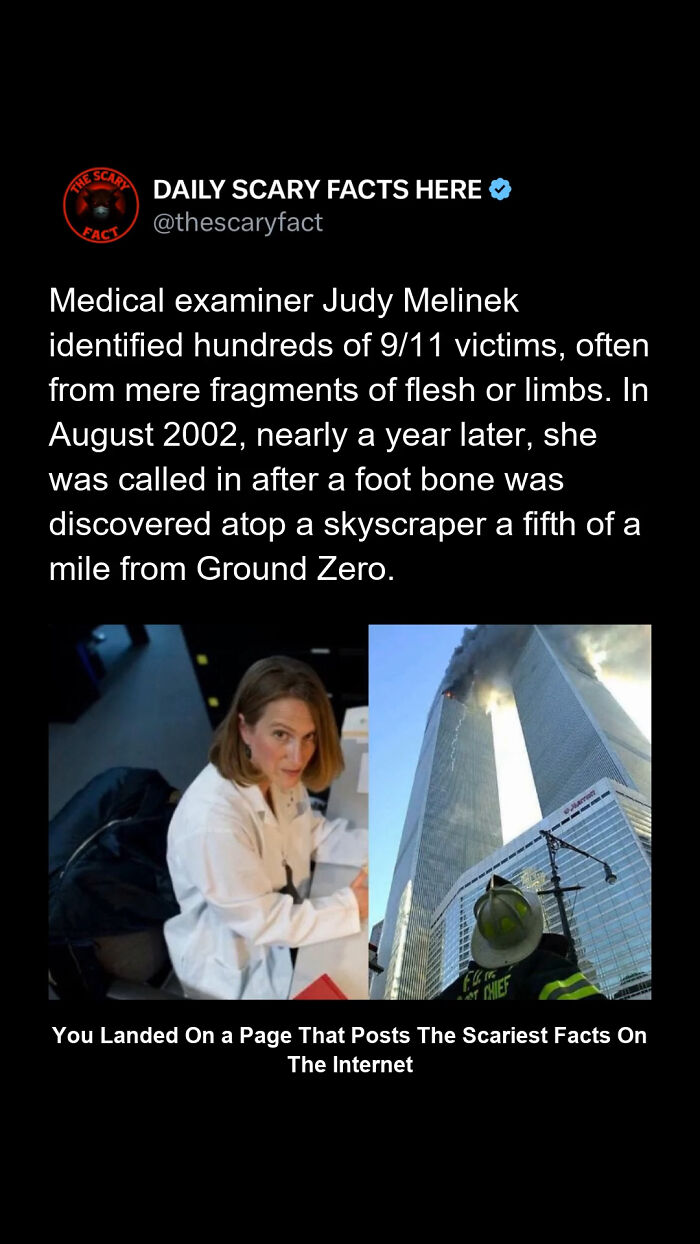
Image source: thescaryfact
#56
Iwao Hakamata’s case is one of the most infamous wrongful conviction stories in Japan: he spent decades imprisoned after being convicted for a quadruple murd** he always denied, becoming closely associated with debates around Japan’s d**th penalty and interrogation practices. A key timeline fix: a retrial was ordered in 2023, but he was acquitted in September 2024, and that acquittal became final in October 2024 when prosecutors did not appeal.
Another correction: the widely reported compensation figure—about ¥217 million (~$1.4M), roughly ¥12,500 (~$83) per day—was awarded later (reported in 2025), not in 2023. The case remains so disturbing because it’s not just about time lost—it’s about what happens to a person after decades of isolation, uncertainty, and a system insisting they’re guilty while evidence unravels
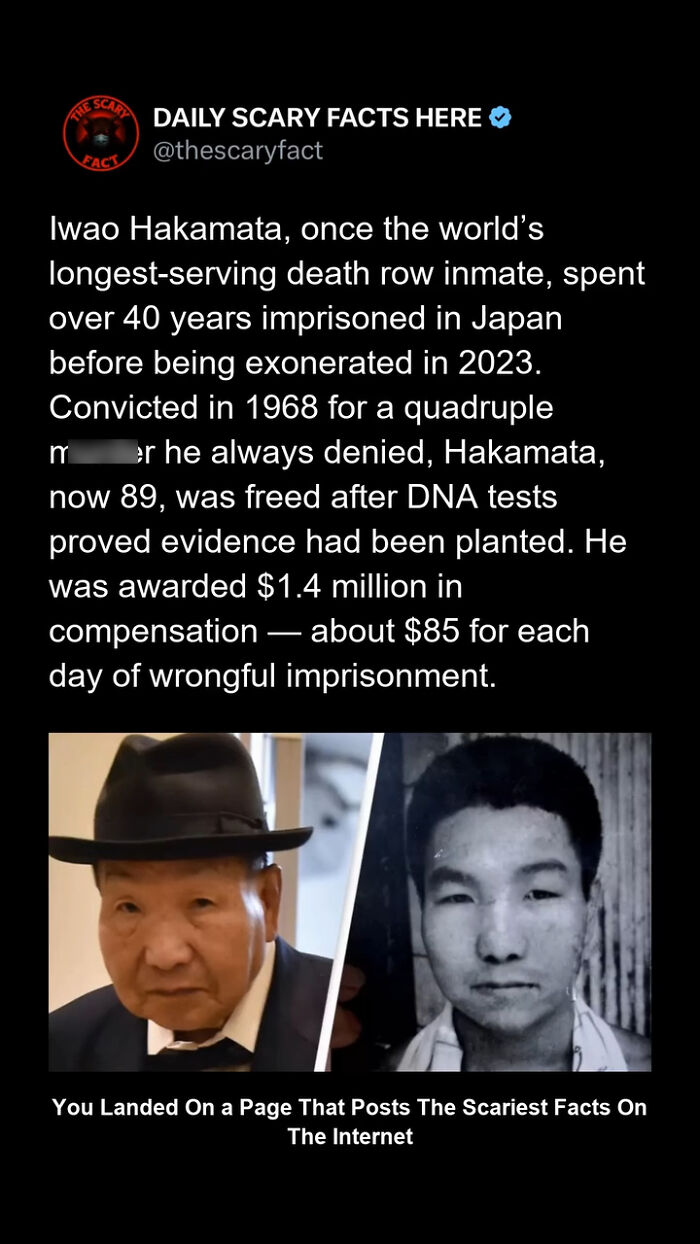
Image source: thescaryfact
#57
In 2014 in Alvin, Texas, Chelsi Camp (23) reportedly saw a dog attack her 2-year-old daughter and reacted with pure instinct: she launched herself onto the dog, bit its ear, and forced her hand into its mouth/throat area to make it release. It’s the kind of story that reads like fiction until you remember what panic and adrenaline can do—especially when a parent sees their child in danger. Reports at the time emphasized how sudden the attack was and how fast she had to move.
Her daughter survived, and the story spread because it showed a raw truth: in a real emergency, people don’t think in neat steps—they do whatever works in the next second. It’s a terrifying reminder that danger can appear without warning, but also a real example of “hero” being a decision made in the worst possible moment.
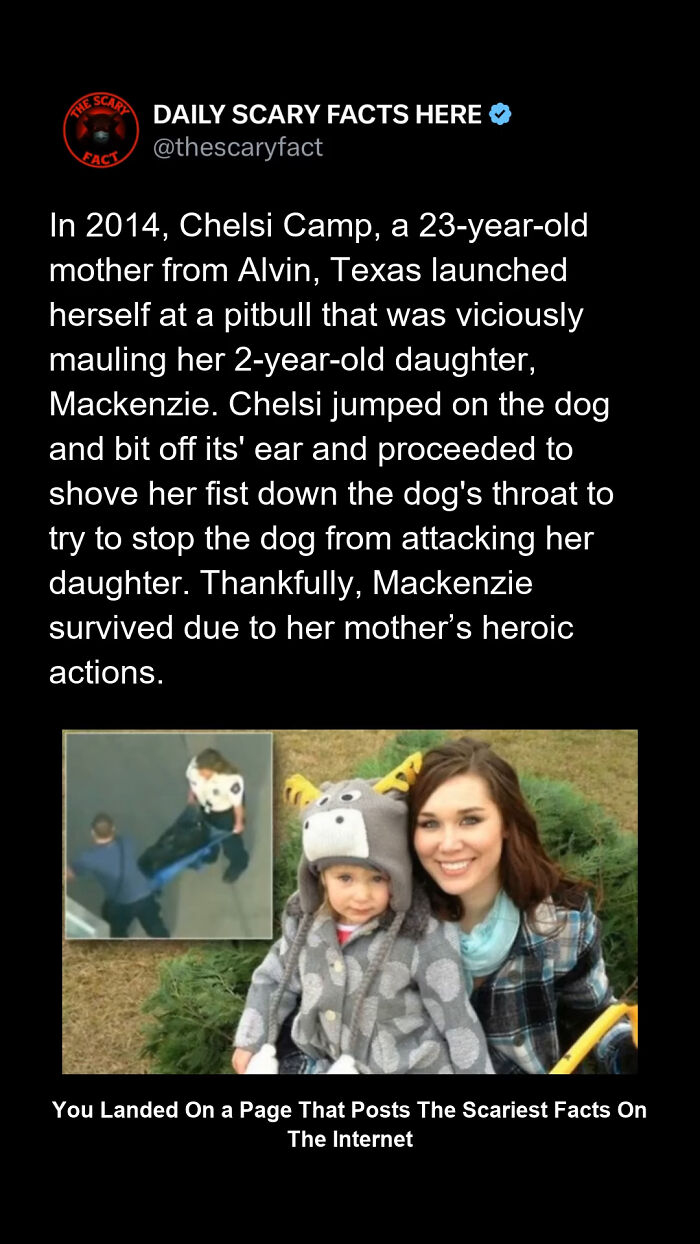
Image source: thescaryfact
#58
A medical case report described a man who ate a burger topped with ghost pepper puree in a contest, then suffered intense burning followed by violent retching/vomiting. Imaging showed air leaking around the esophagus (a sign of rupture).
Surgeons found a 2.5 cm tear in his esophagus and repaired it. He spent 23 days hospitalized and was discharged with a feeding tube while the injury healed.
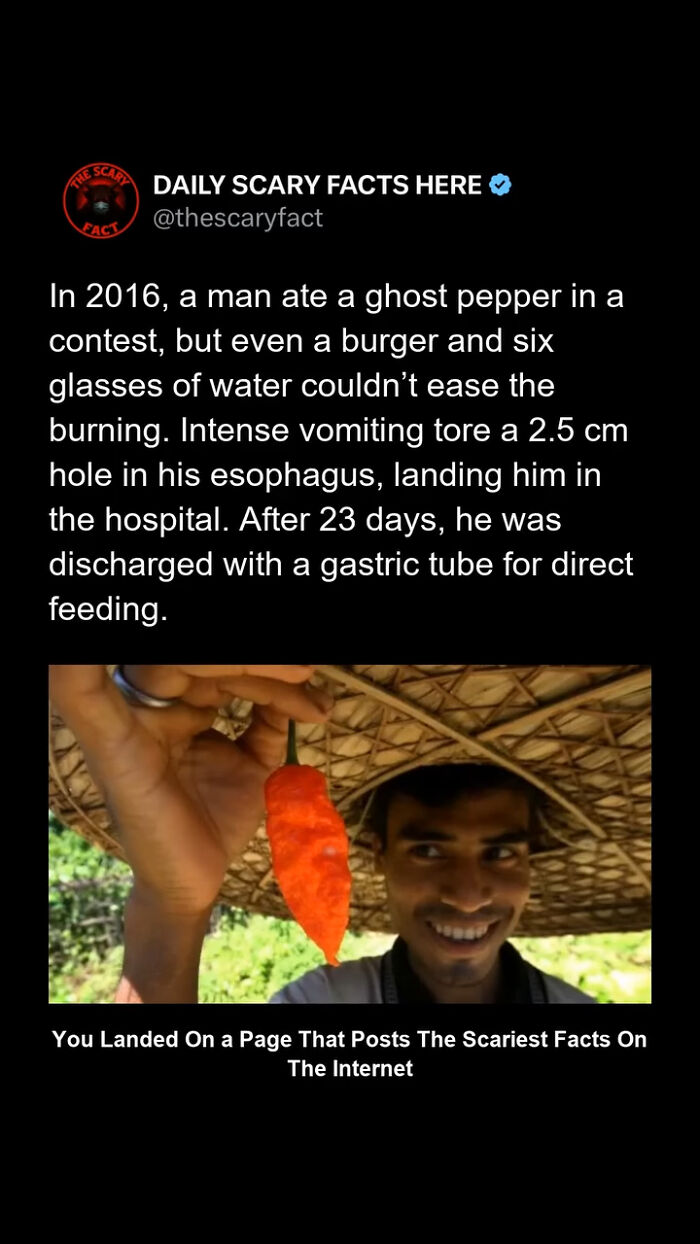
Image source: thescaryfact
#59
In Jacksonville, Florida, Jason Arrington was stopped on December 13, 2024 and told officers he was legally armed. During the stop, Officer Mindy Cardwell attempted to remove his holstered Glock .45, and the gun discharged—shooting him in the leg.
Arrington was hospitalized in stable condition, and the Jacksonville Sheriff’s Office later released details as an internal investigation led to Cardwell being fired/terminated (reports also mention an incompetence-related charge/disciplinary finding tied to the incident).
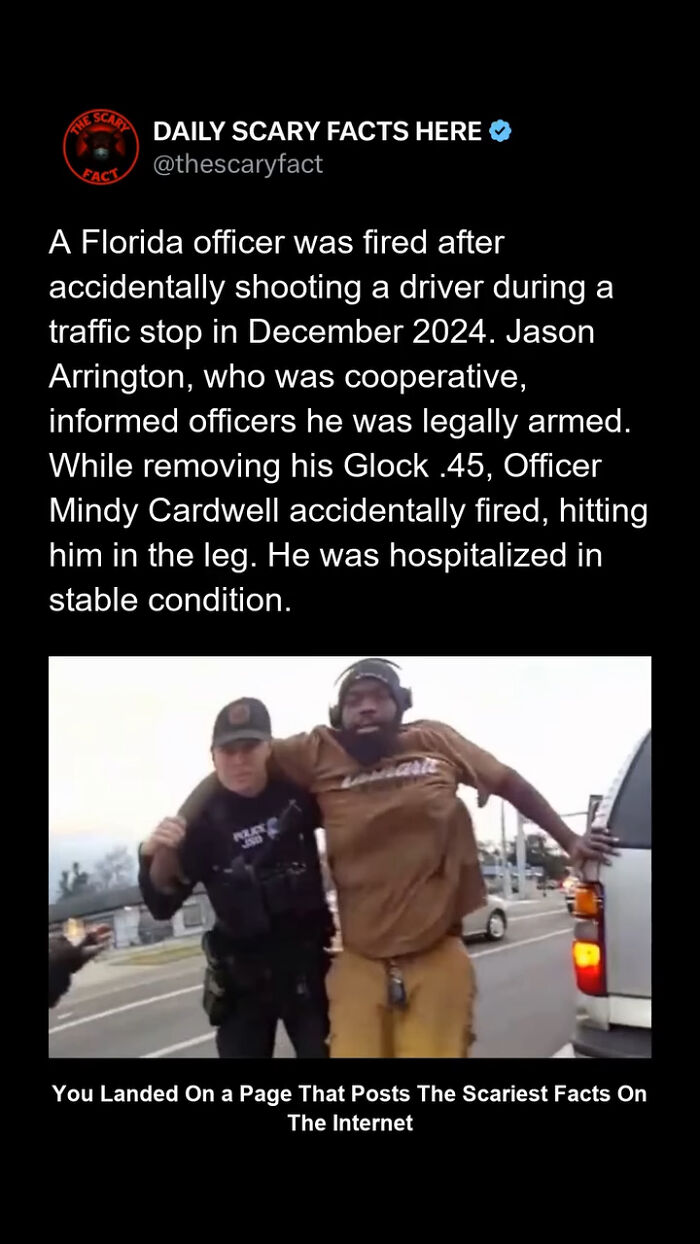
Image source: thescaryfact
#60
Image source: thescaryfact
#61
Warrick Dunn’s mother, a Baton Rouge police officer, was killed when he was a teenager—after which he helped raise his siblings while continuing school and football, eventually reaching the NFL.
He later founded Homes for the Holidays, which has provided well over 100 homes for single-parent families (often cited around ~145 in earlier reporting, and 200+ as the program expanded). The exact tally depends on the year you cite, but the impact is massive and sustained.

Image source: thescaryfact
#62
In 2024, Raj Kumar (who had lost both hands in a motorbike accident) received a bilateral hand transplant in Delhi in a roughly 12-hour surgery involving a large surgical team. Reports note he had been using prosthetics before the transplant and began early recovery/rehab soon after.
His new hands were donated by Meena Mehta, an educator declared brain-dead whose family honored her wish to donate. Coverage describes the transplant as a major step forward for complex reconstructive transplantation in India.
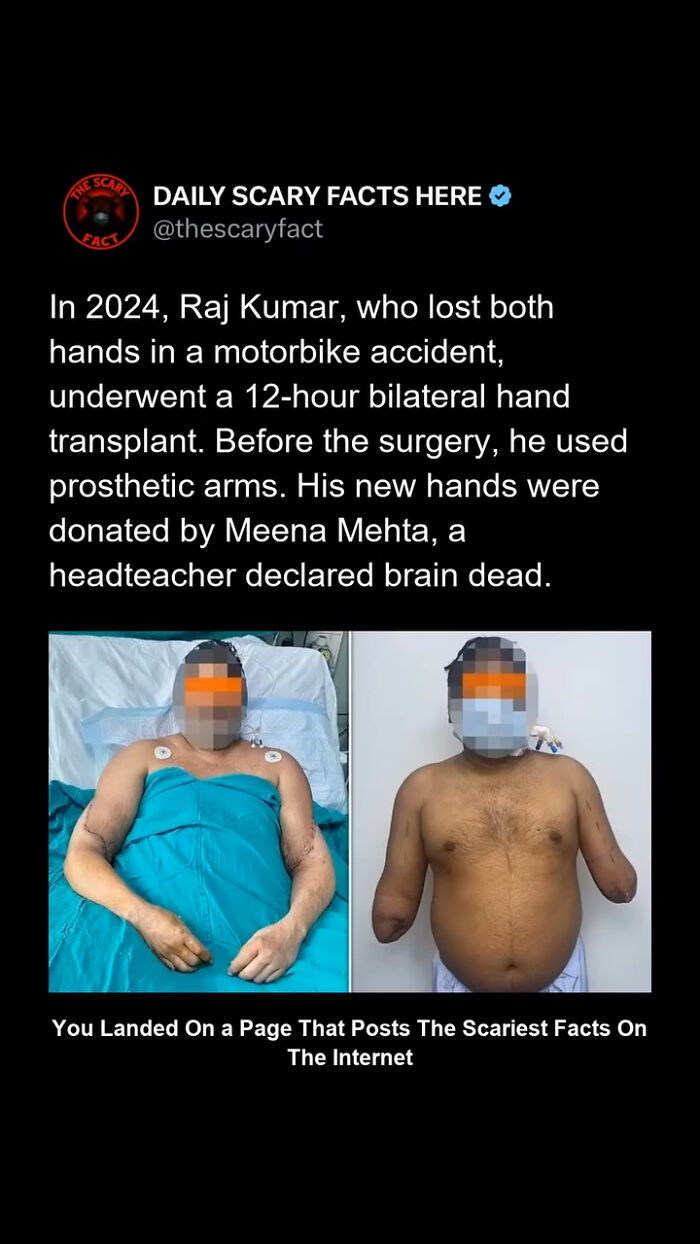
Image source: thescaryfact
#63
Outdoorsman Max Armstrong burned his thumb while cooking on a camping trip in December 2024 and initially brushed it off. According to reporting, group A strep entered through the burn, rapidly progressing to sepsis and toxic shock.
His feet developed severe tissue damage, and he ultimately chose amputation of both legs below the knee on Dec 23, 2024. He’s been recovering with prosthetics as a goal—and says he wants to hike again, even aiming for high-elevation peaks.
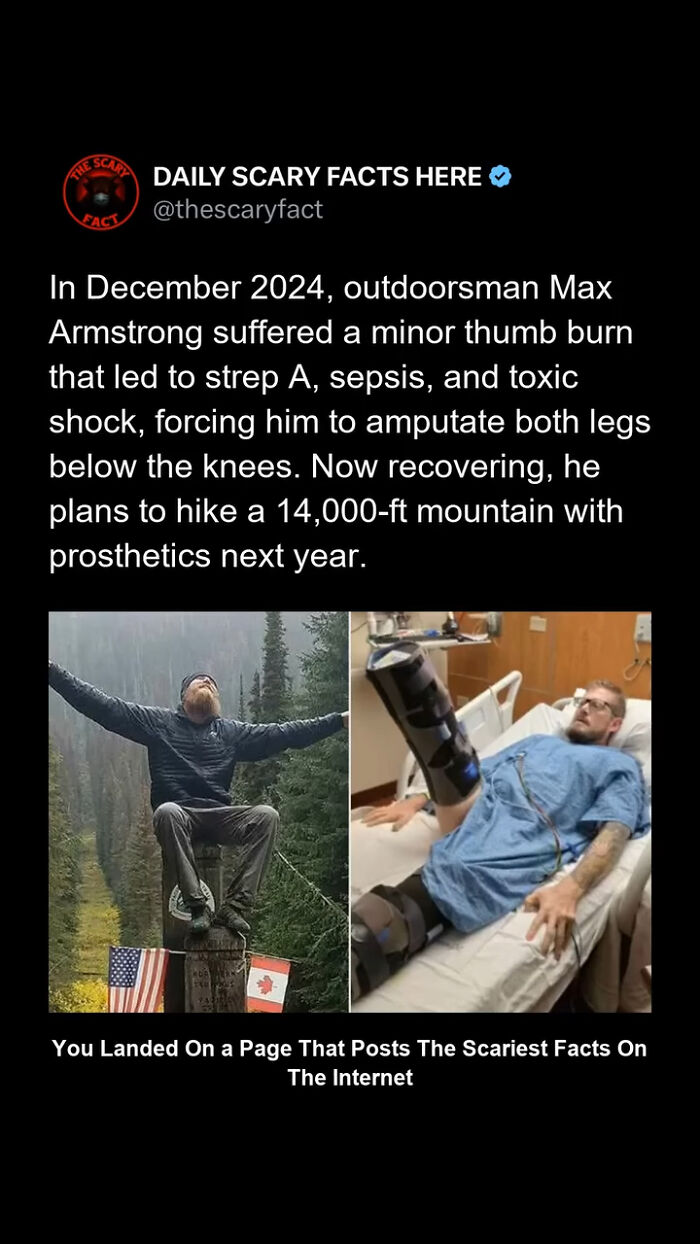
Image source: thescaryfact
#64
News reports in early 2025 said Onijah Andrew Robinson traveled to Pakistan to meet a 19-year-old she met online, but the relationship collapsed under family pressure. She was filmed giving press-style statements and reportedly remained in the airport area for days while her situation spiraled into a visa/overstay issue.
She then went viral after demanding large sums of money—famously saying she wanted $100,000 and claiming she would “rebuild” the country. The story spread widely as an example of online relationships, misinformation, and escalation in public view.

Image source: thescaryfact
#65
After a bone marrow transplant, Chris Long learned that much of his body carried his donor’s DNA. Tests showed his blood, saliva, and even semen contained genetic material from the donor — meaning he had effectively become a human chimera.
Doctors explained that bone marrow transplants replace a patient’s blood-forming cells, which can permanently change detectable DNA in bodily fluids. Over four years of testing confirmed the transformation, making his case one of the most striking modern examples of medical chimerism.
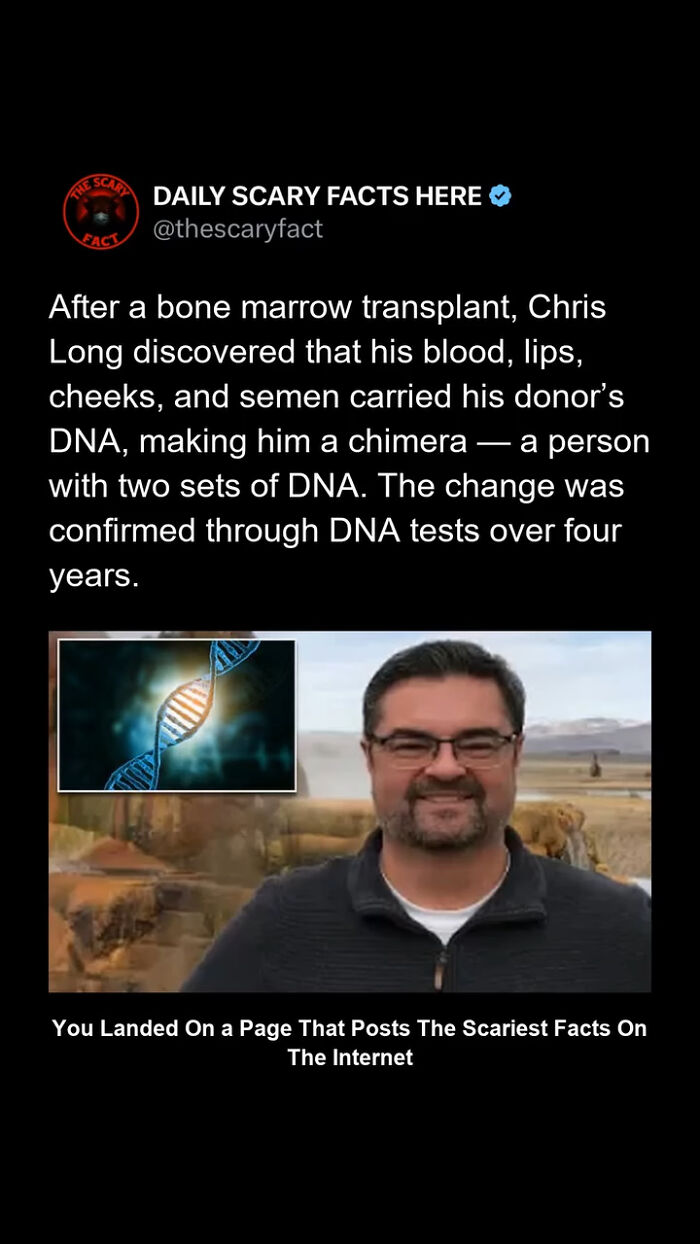
Image source: thescaryfact
#66
Japanese soldier Ishinosuke Uwano was presumed dead after World War II and officially declared deceased decades later. In reality, he had settled in Ukraine, married, and started a family.
In 2006, after more than 60 years, he returned to Japan at age 83, reuniting with surviving relatives who had believed he died in the war. His story stunned both nations.
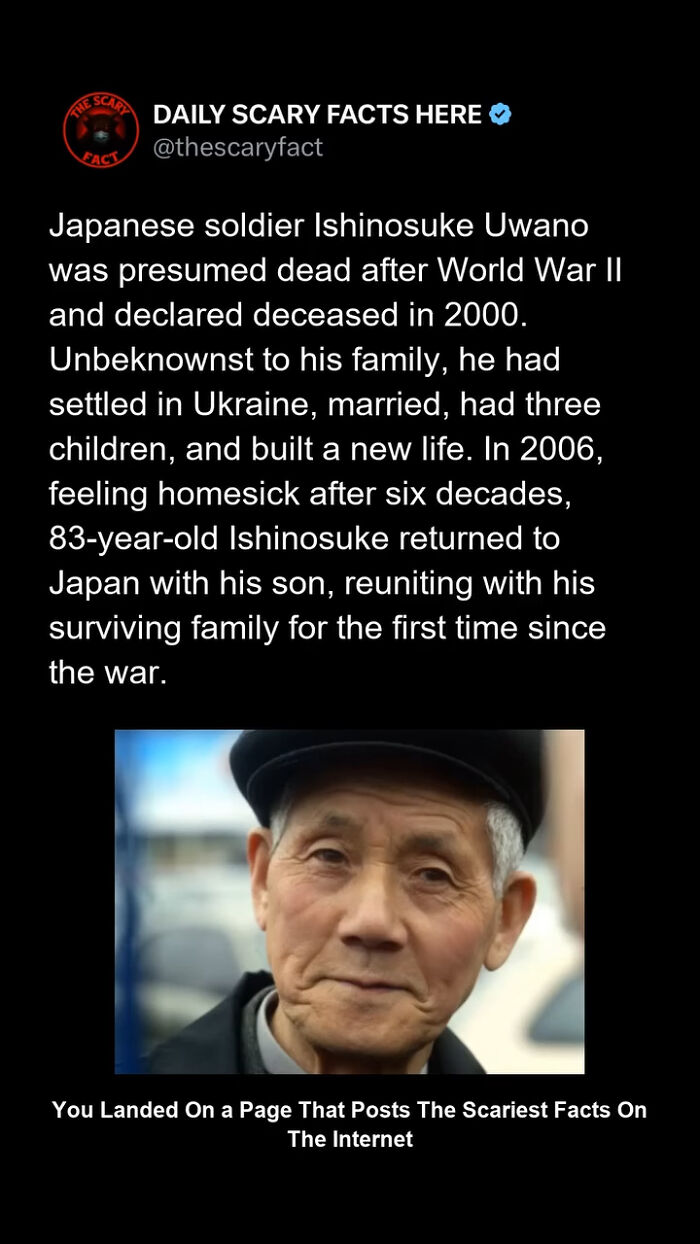
Image source: thescaryfact
#67
After a devastating car crash, 23-year-old Rachel Bailey suffered what’s known as an internal decapitation — medically called atlanto-occipital dislocation — where the skull separates from the spine but remains attached by skin and soft tissue. This injury is typically fatal because it often severs the spinal cord.
In her case, the spinal cord remained intact. Surgeons stabilized her neck with complex hardware, and through intensive rehabilitation she gradually regained speech and motor function — a survival story doctors describe as extraordinarily rare.
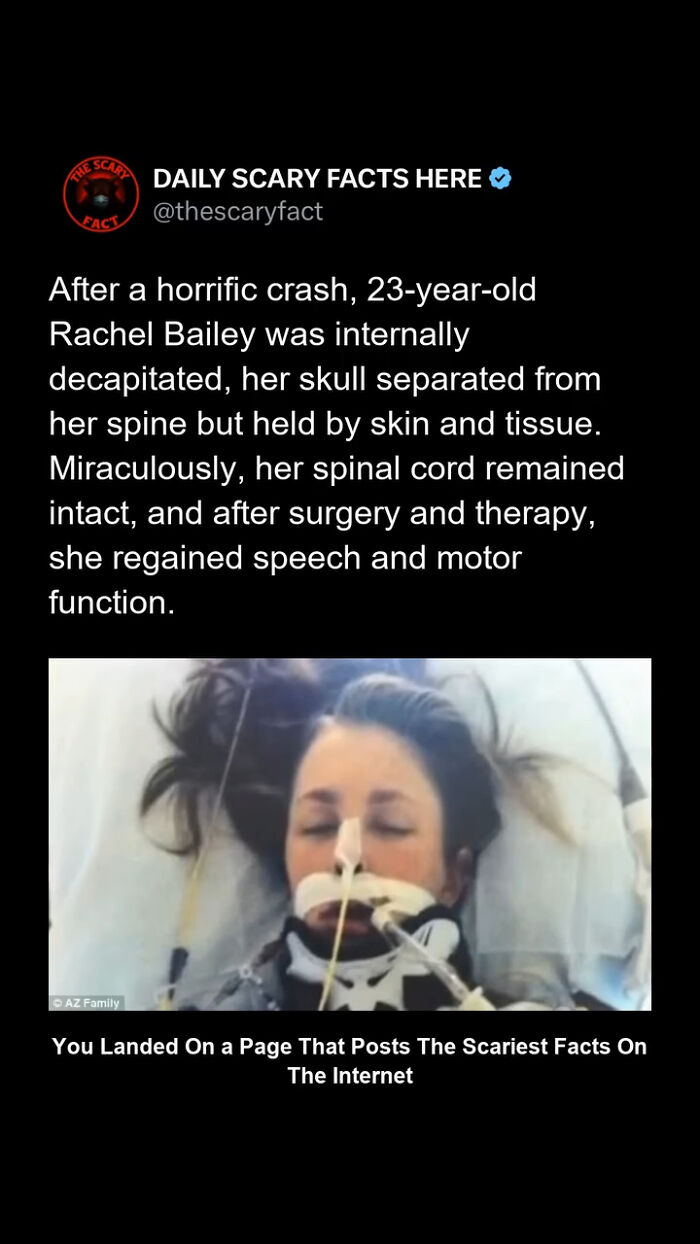
Image source: thescaryfact
#68
During the Covid-19 pandemic in São Carlos, Brazil, ICU nurses filled latex gloves with warm water and tied them off, placing them in patients’ hands. The makeshift devices simulated the warmth and pressure of human touch.
Because strict isolation rules prevented family visits, the gesture was meant to provide emotional comfort to critically ill patients. The practice symbolized compassion during one of healthcare’s darkest periods.
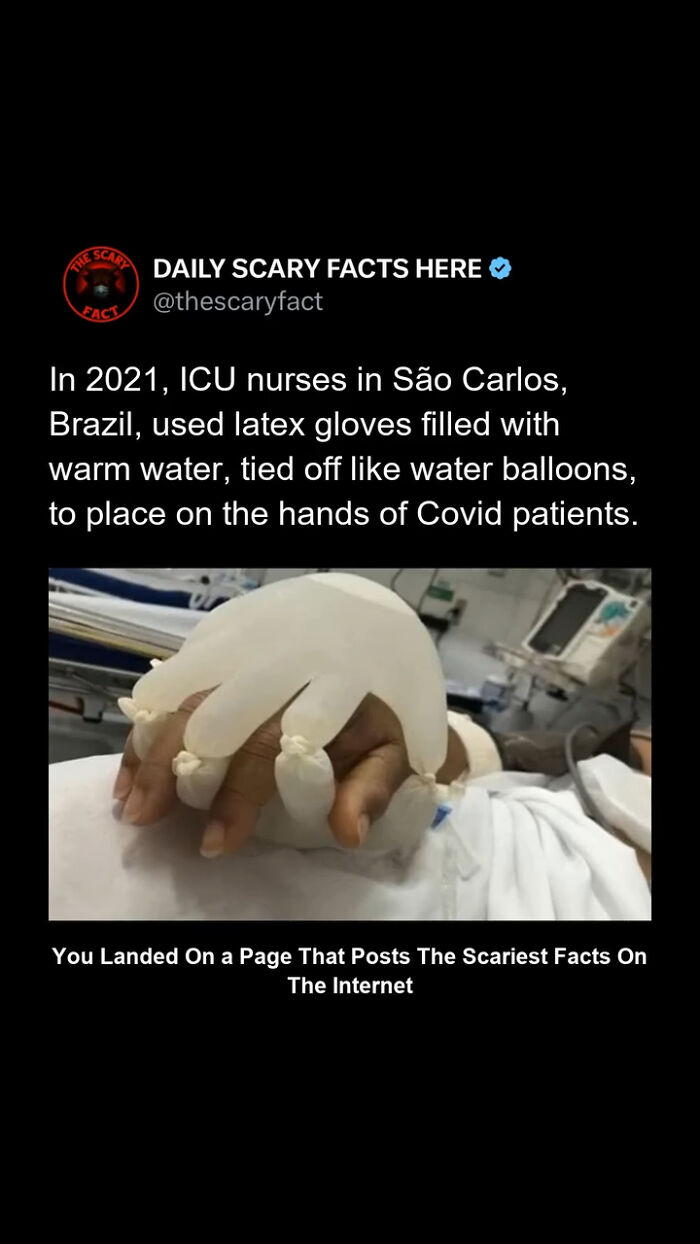
Image source: thescaryfact
#69
In 2018, Phoenix resident Jacqueline Ades was arrested after allegedly sending more than 159,000 text messages to a man she had met once on a dating site. The messages spanned 10 months and reportedly included disturbing and threatening content.
Police later found her at the man’s residence on multiple occasions. The case drew national attention for the extreme scale of digital harassment and the psychological obsession displayed.
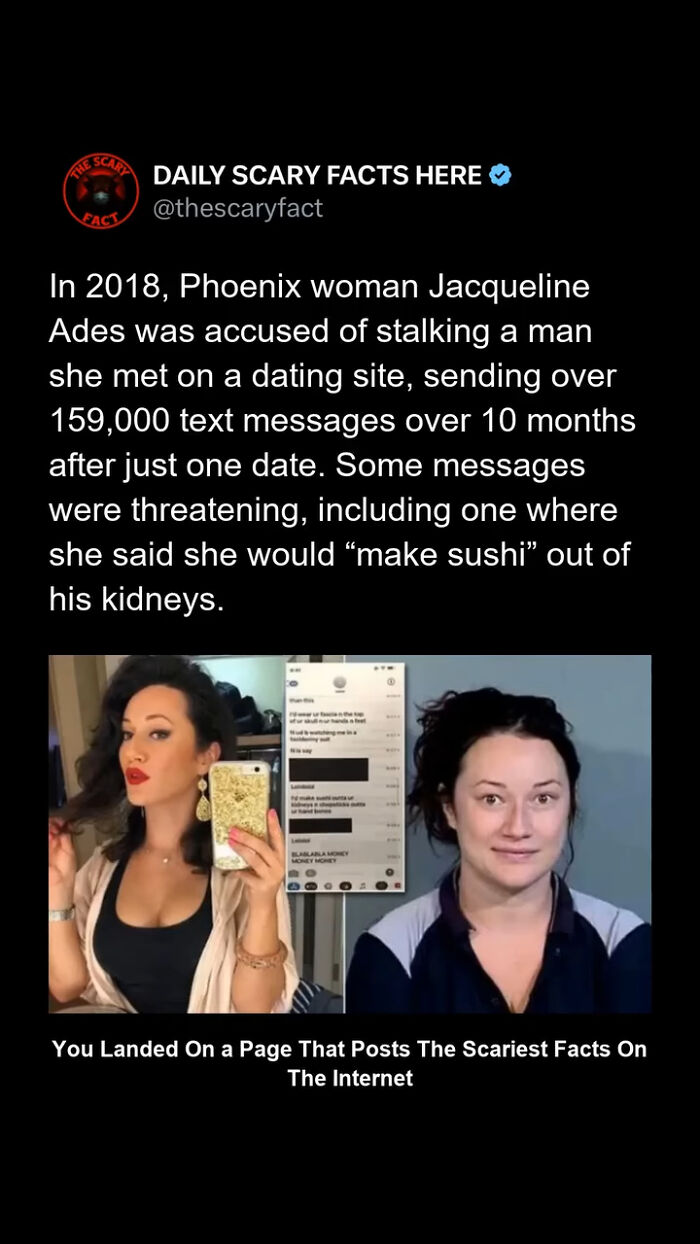
Image source: thescaryfact
#70
In 2009, Florida woman Carol Bryan received facial filler injections that were allegedly placed incorrectly, causing extreme swelling in her forehead. At one point, the swelling was so severe she reportedly taped her eyes open to see.
A botched corrective procedure worsened her condition, leaving her disfigured and socially withdrawn for years. Eventually, reconstructive surgeon Dr. Reza Jarrahy at UCLA performed complex surgery that helped restore her appearance and confidence.
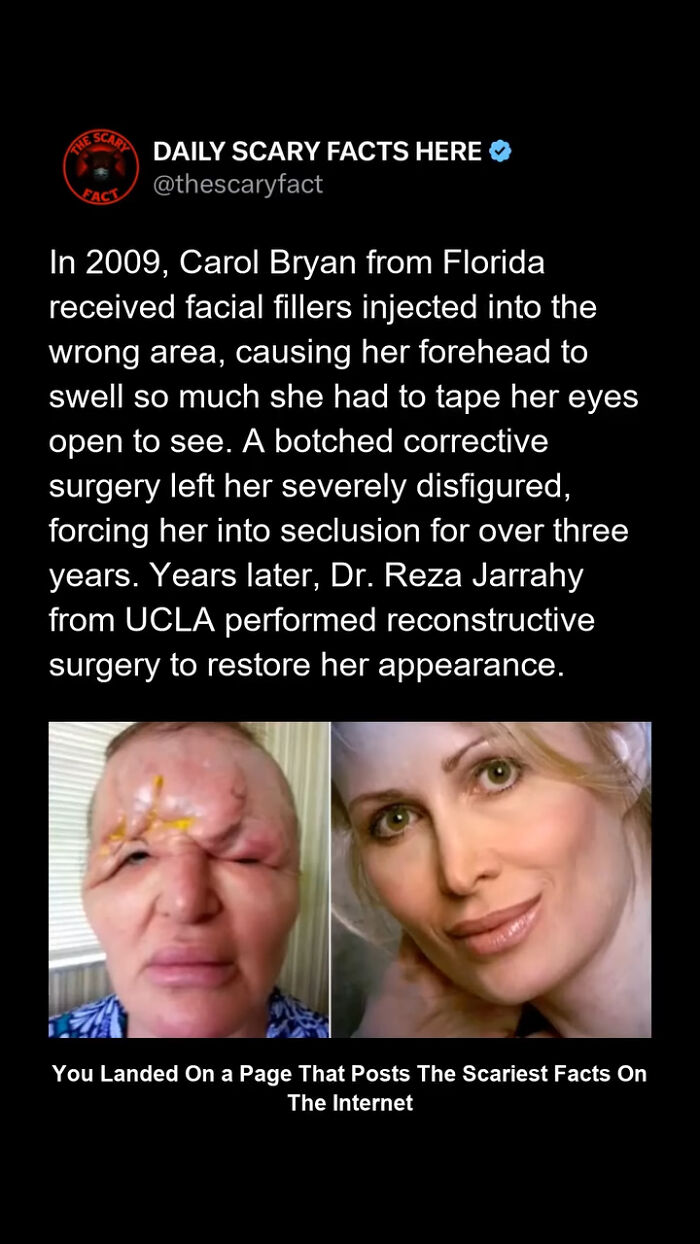
Image source: thescaryfact
#71
In 2015, Gavin Joseph, who has Asperger’s and ADHD, was assaulted by strangers who targeted him after labeling him “weird.” The attack left him injured and shaken.
Instead of pursuing harsh punishment, Gavin asked that his attackers complete community service, write about Asperger’s, and educate their families. His response drew attention not just to bullying against neurodivergent people—but to the power of restorative justice.
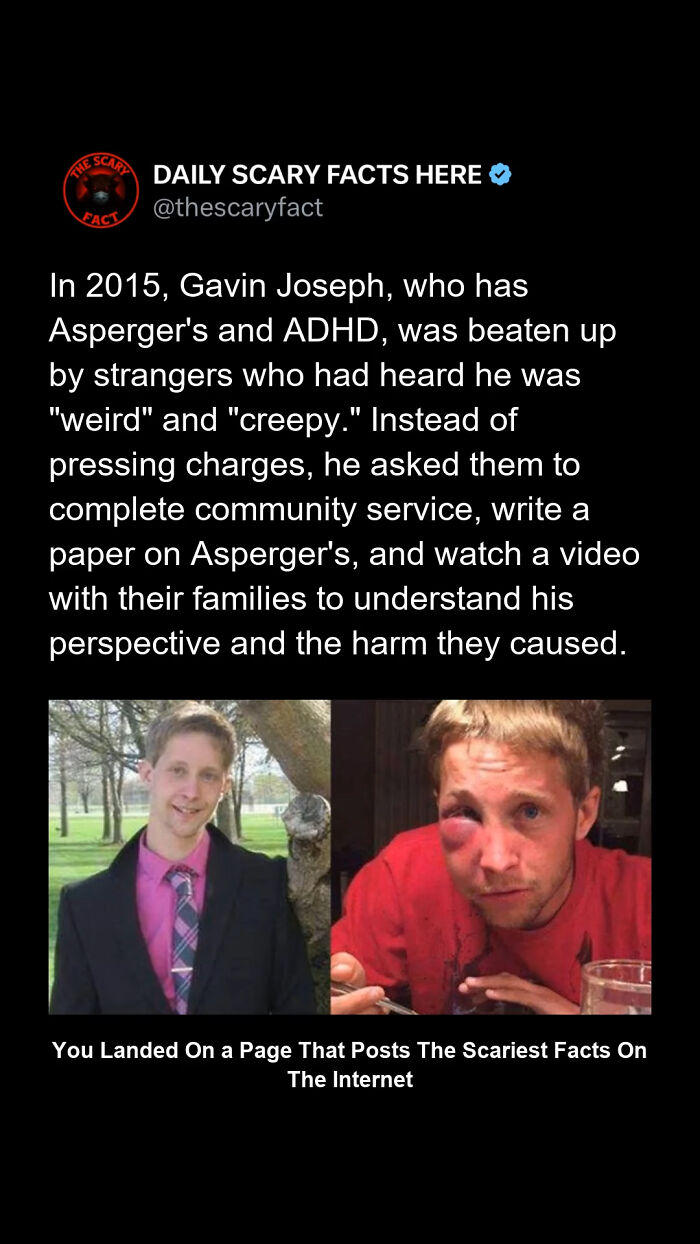
Image source: thescaryfact
#72
In 2017, Juliana Ossa, age 10, was attacked by a 9-foot alligator while swimming in Florida. The gator clamped onto her leg and attempted to drag her underwater.
Juliana pried its jaws open and stuck her fingers into its nostrils, cutting off airflow — forcing it to release her. She later said she learned the survival tip during a visit to Gatorland. She survived with injuries but avoided being pulled under.
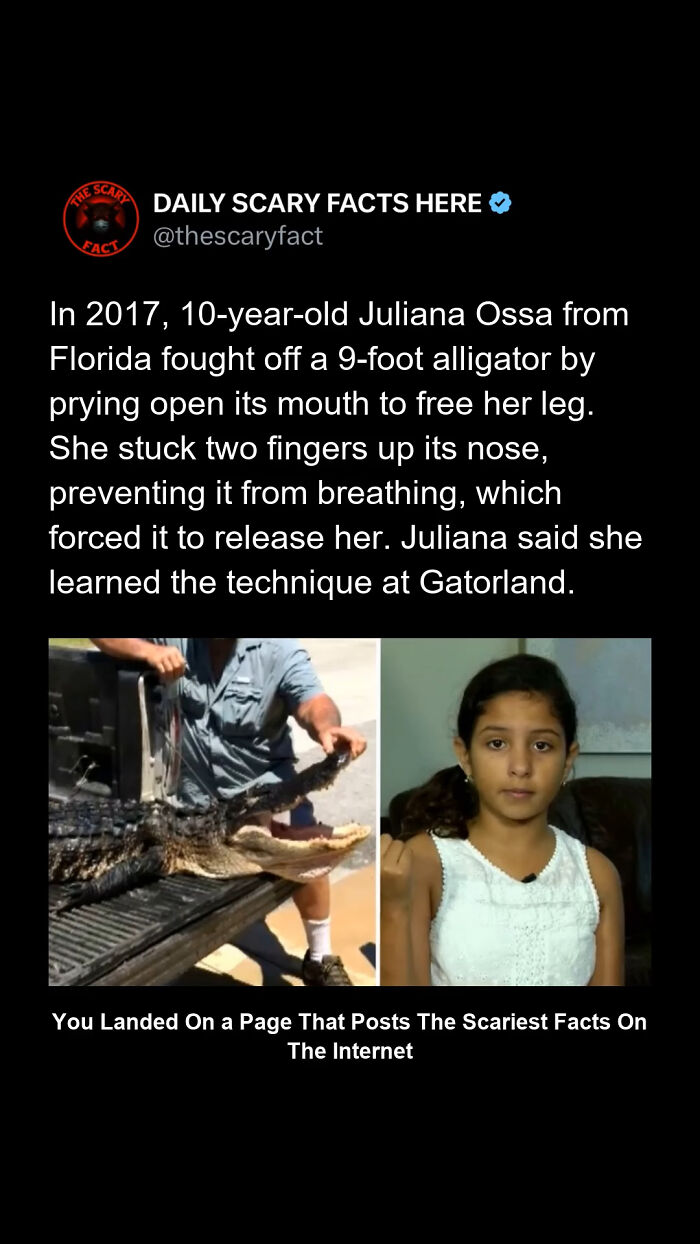
Image source: thescaryfact
#73
In 2013, Belgian woman Sabine Moreau set out to pick up a friend in Brussels — a trip under 90 miles — but blindly followed her GPS when it misdirected her. She ended up driving nearly 900 miles, crossing five countries, before reaching Croatia.
She later said she ignored road signs because she trusted the GPS instructions. Her son had already reported her missing. The story went viral as one of the most extreme examples of blind reliance on navigation tech.
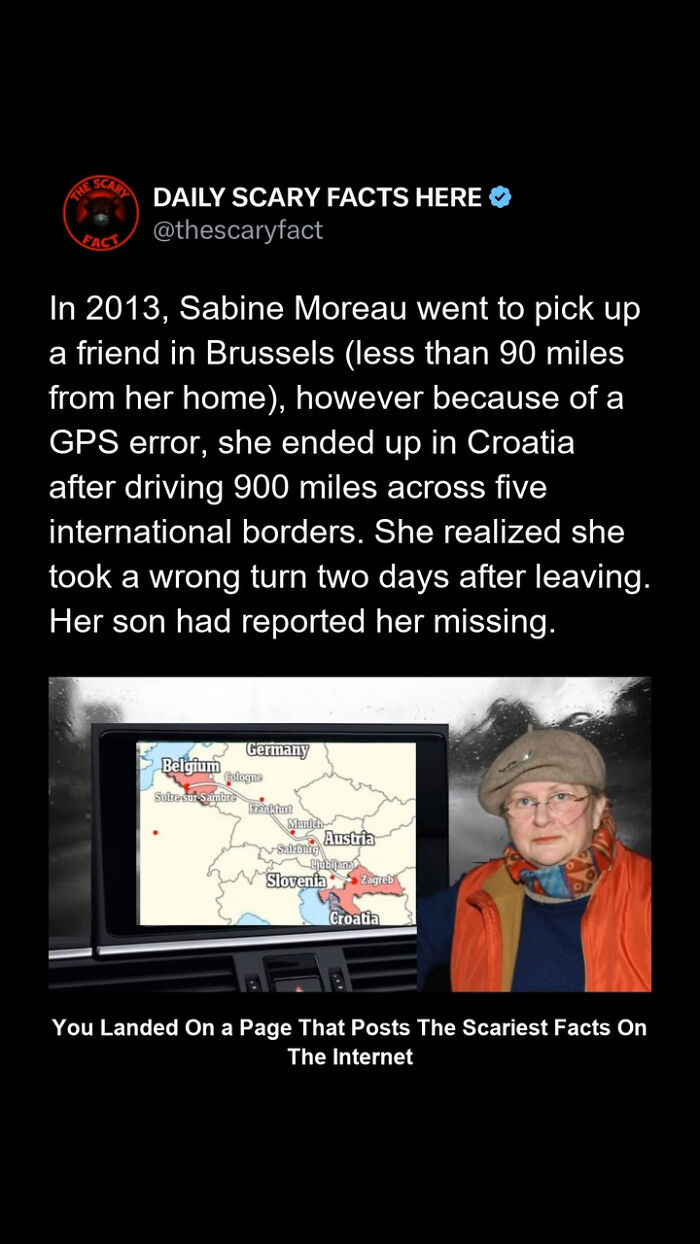
Image source: thescaryfact
#74
In 2022, Georgia college student Caitlin Jensen suffered multiple arterial dissections after a chiropractic neck manipulation. She went into cardiac arrest, had a stroke, and reportedly lost a pulse for over 10 minutes before being revived.
She survived but was left unable to speak and with limited movement. The case reignited debate about the rare but serious risks of cervical manipulations and vascular injury.
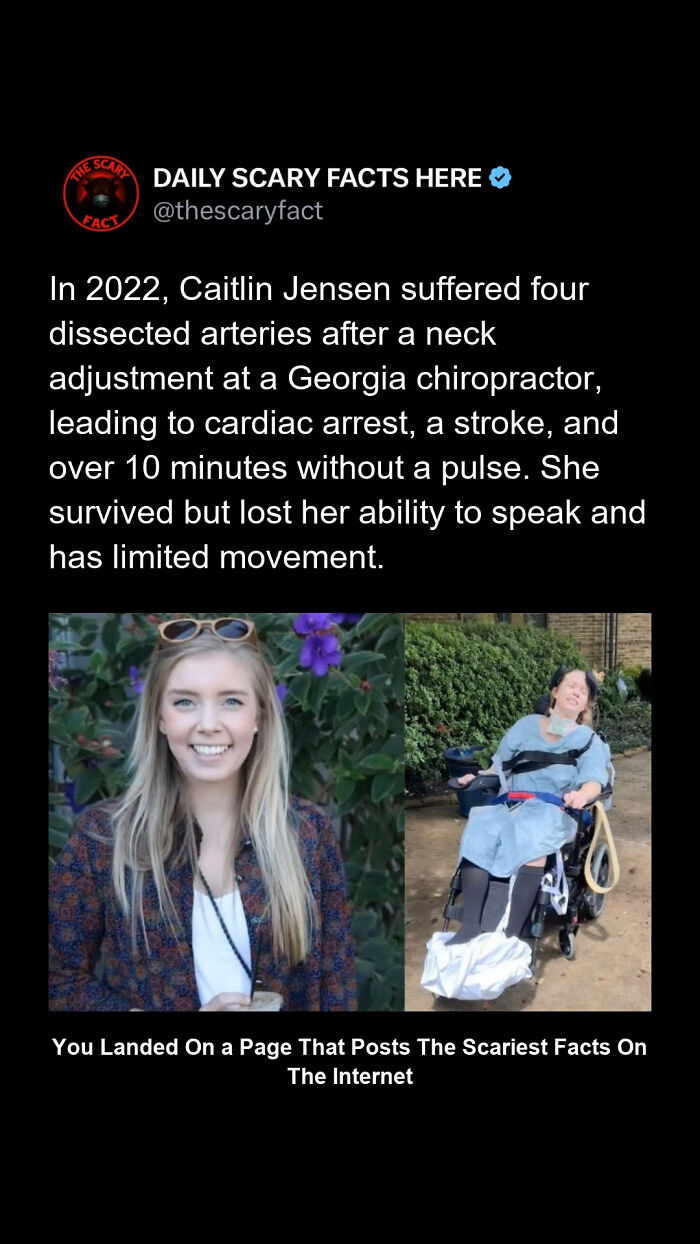
Image source: thescaryfact
#75
Image source: thescaryfact
#76
Image source: thescaryfact
#77
Image source: thescaryfact
#78
That strong “chlorine” smell at public pools isn’t actually chlorine. Pure chlorine has very little odor. The smell comes from chloramines, chemicals formed when chlorine reacts with nitrogen-based contaminants like urine, sweat, and body oils. When urea breaks down into ammonia and mixes with chlorine, chloramines are produced — and they smell strong while being far less effective at disinfection. Ironically, a properly maintained pool should smell almost neutral. A strong odor usually means the pool is dirty, not clean.

Image source: thescaryfact
#79
In 2023, an 18-year-old mother in Miami was arrested after attempting to hire a hitman to ki!! her three-year-old son using a parody website called “Rent-A-Hitman.” Believing the site was real, she submitted the child’s photo, address, and schedule, stating she wanted to “get something done once and for all.” The site’s owner, who works with law enforcement, immediately alerted authorities. The woman was arrested before any harm occurred, and the case shocked the public nationwide.

Image source: thescaryfact
#80
Abby and Brittany Hensel are among the most well-known conjoined twins in the world. Born in 1990 and joined at the torso, they share one body but have two separate heads, hearts, stomachs, and spinal cords. Despite their rare anatomy, they have lived remarkably independent lives — learning to coordinate movement, drive a car, and complete everyday tasks through constant teamwork.
When they attended college, they reportedly had to pay two separate tuition fees, reflecting their status as two individuals academically. However, as adults working as teachers, they receive one shared salary, which has sparked discussion about how workplaces and institutions handle unique medical and legal situations. Their story continues to challenge perceptions about identity, independence, and how society defines individuality.

Image source: thescaryfact
#81
In 2022, Nicholas Bostic, a 25-year-old pizza delivery driver in Indiana, noticed a house on fire and rushed inside without hesitation. He helped four children escape before learning a sixth child was still trapped.
Despite smoke and flames, he re-entered the home, found the six-year-old girl, and jumped out a window with her in his arms. He suffered injuries but saved all five children — earning national recognition for his bravery.
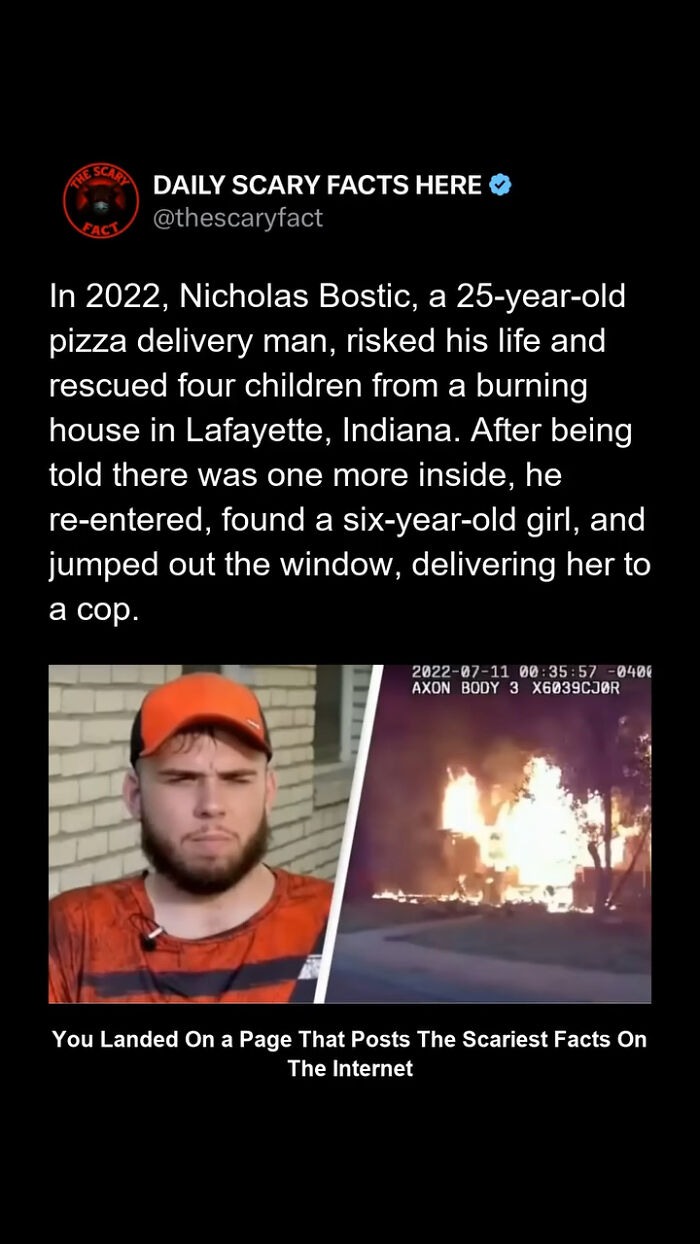
Image source: thescaryfact
#82
Some species of flatworms reproduce through a behavior known as p@nis fencing. Each flatworm has two bifurcated p@nis structures and attempts to st@b the other during mating. The worm that successfully penetrates its opponent remains male, while the loser is forced into the female role and becomes impregnated. This violent reproductive strategy evolved because producing eggs requires far more energy than producing sperm — so neither worm wants to lose. It’s one of the most aggressive mating behaviors known in the animal kingdom.
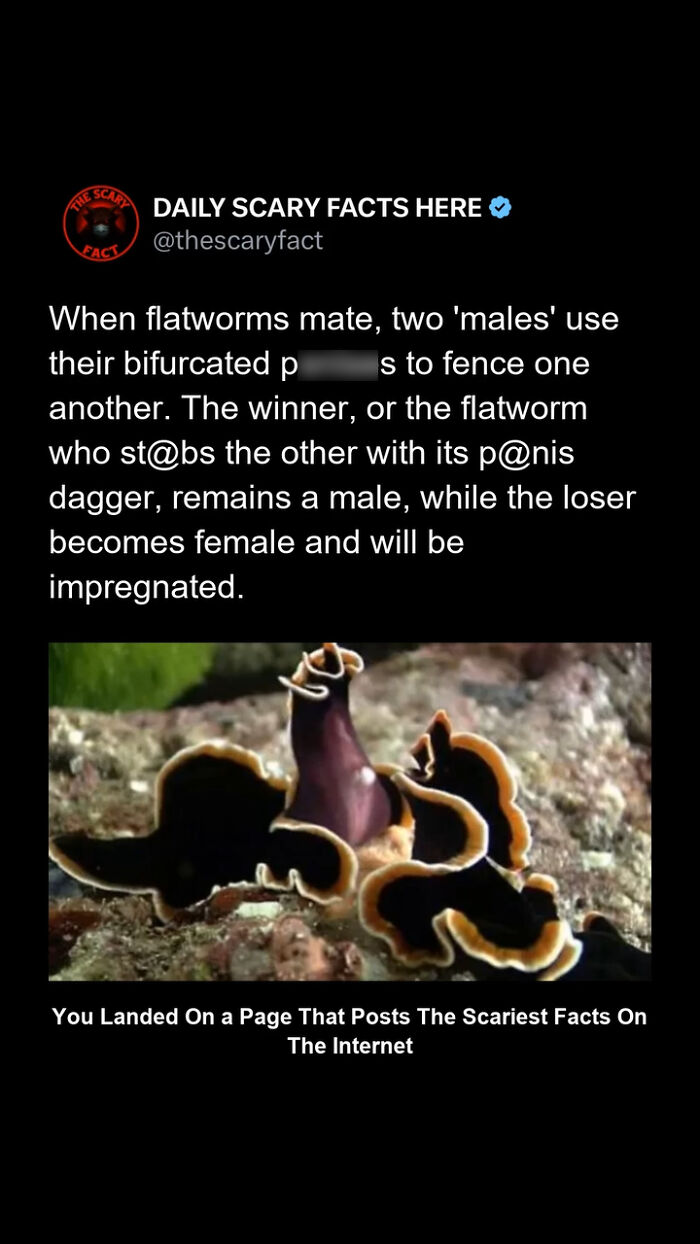
Image source: thescaryfact
#83
Kathleen Caronna was seriously injured at the 1997 Macy’s Thanksgiving Day Parade when a giant balloon (often associated with the Cat in the Hat era of parade balloons) veered in high winds and struck a lamppost; debris hit her head and she fell into a coma for nearly a month. Later coverage notes she received a settlement and bought an apartment—only for fate to swing again years later.
In 2006, a small plane piloted by Yankees pitcher Cory Lidle crashed into a Manhattan high-rise, and reporting says the plane’s engine ended up in Caronna’s bedroom—just minutes before she would have been home. Lidle and his flight instructor Tyler Stanger di*d in the crash.
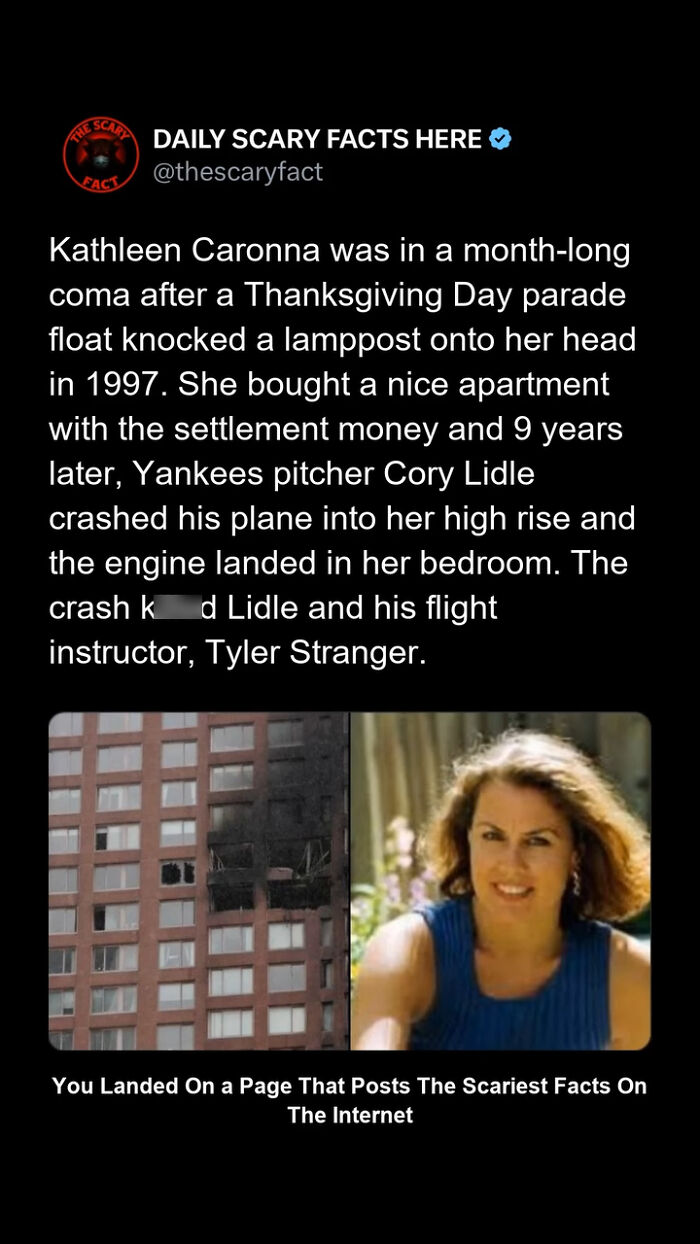
Image source: thescaryfact
 Follow Us