Dealing with one’s in-law’s homophobia is a pretty tall task, particularly around the holidays when some folks are forced to be around them. So sometimes little petty acts of revenge helps keep us all sane.
A woman asked the internet if she was wrong to purposefully ruin her mother-in-law’s Christmas pictures when she refused to let the woman be in any of them. We reached out to the daughter-in-law who made the post via private message and will update the article when she gets back to us.
Spending the holidays with annoying in-laws can be pretty taxing

Image credits: cottonbro studio / Pexels (not the actual photo)

So one woman decided to mess with her homophobic MIL


Image credits: Cedric Fauntleroy / Pexels (not the actual photo)


Image credits: Rodolfo Quirós / Pexels (not the actual photo)


Image credits: thestkeek
Humans like to hear stories of justice being served
The allure of petty revenge stories, particularly those found in online communities like the one this story is from, speaks to a deeply ingrained human desire for justice and the restoration of social equilibrium. When we read the story of the woman who married Lia and subsequently sabotaged her mother-in-law’s Christmas photos, we are not merely consuming gossip but engaging in a collective psychological exercise that validates our understanding of fairness.
This specific narrative serves as a perfect case study for why these tales are so satisfying, primarily because it touches upon the concept of “just deserts” in a low-stakes, highly relatable environment. The protagonist, who faced blatant exclusion and implied homophobia from her mother-in-law, chose a path of malicious compliance rather than open confrontation, a tactic that resonates with anyone who has ever felt powerless in the face of arbitrary authority or social snubbing.
The primary driver behind the enjoyment of this story is the activation of the brain’s reward system regarding altruistic punishment. Evolutionary psychology suggests that humans have evolved to punish social defectors, even at a personal cost, to maintain group cooperation. In this story, the mother-in-law violated the social contract by excluding the narrator under the guise of “family only” photos while simultaneously including other spouses.
This hypocrisy triggers an immediate sense of moral outrage in the reader. When the narrator decides to focus the camera on the furniture or take blurry, unflattering photos, the reader experiences a vicarious release of tension. We enjoy seeing the mother-in-law’s vanity thwarted because it feels like a proportionate response to her attempt to erase the narrator’s place in the family. The punishment fits the crime; the mother-in-law wanted a picture perfect reality that excluded her daughter’s wife, and in return, she received a reality where she is blurry, awkward, and essentially invisible.
At the same time, a good revenge story has to be “proportional”
Furthermore, the appeal of this specific petty revenge lies in its clever use of plausible deniability, often referred to as weaponized incompetence. By claiming she “didn’t know how to use a DSLR camera,” the narrator creates a shield against further aggression. This adds a layer of intellectual satisfaction for the reader. We admire the protagonist’s ability to outwit the antagonist without breaking the rules of civility that the antagonist herself claims to uphold. The mother-in-law cannot accuse the narrator of malice without admitting that her initial request was exclusionary and rude. This trap, where the antagonist is hoisted by their own petard, is a staple of successful revenge literature. It transforms the narrator from a victim of discrimination into an agent of chaos, reclaiming power in a situation designed to belittle her.
Additionally, the resolution of the story reinforces the importance of validation and alliance. A crucial element of this narrative is Lia’s reaction. Instead of being horrified by her wife’s sabotage, Lia laughs and even deletes the “decent” photos to ensure the revenge is complete. This transforms the act from a solitary moment of bitterness into a shared bonding experience. For the reader, this signals that the protagonist is safe and loved, countering the rejection from the mother-in-law. It satisfies our desire for the “underdog” to not only win the battle but to secure the loyalty of the most important person in the dynamic. The shared laughter in the dining room serves as the emotional climax, proving that the couple’s unity is stronger than the mother’s divisive tactics.
Ultimately, we gravitate toward these stories because they offer a safe simulation of conflict resolution. In the real world, confronting a bigoted in-law is fraught with anxiety and long-term consequences. In the narrative space, however, we can explore the thrill of retribution without the risk. The story of the blurry Christmas photos is a benign violation, it is funny because it is wrong, yet harmless. No one was physically hurt, and property was not destroyed, yet the social order was subverted in favor of the protagonist. It allows us to fantasize about a world where rudeness is instantly and creatively punished, providing a fleeting but potent sense of control in a chaotic world.
Most readers thought her plan was hilarious and quite justified



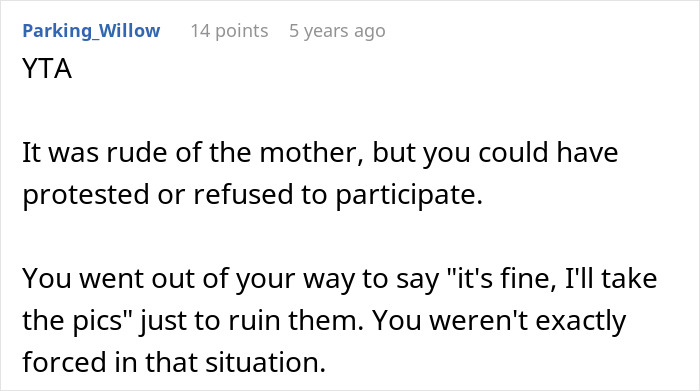
Some thought it went too far





 Follow Us