Some tattoo styles come and go, but a few subjects have stuck around for literal millennia, because they were never just decoration to begin with. Long before tattoo studios existed, ancient cultures were carving gods, dragons, and geometric patterns into temple walls, pottery, and skin, using them to represent everything from cosmic order to divine protection.
We asked our artists at Sacred Gold in London to pull together some of their favorite pieces inspired by world mythology and spiritual geometry, the kind of imagery that’s been carrying meaning for thousands of years, long before it ever touched a tattoo machine.
Scroll down and see how these ancient stories and patterns still hold up as some of the most significant tattoo work being done today.
More info: sacredgold.shop | Instagram | Facebook | tiktok.com
#1 When Gods And Warriors Share A Sleeve
The Parthenon wasn’t just an architectural flex, it was a temple dedicated to Athena, the goddess of wisdom and war. Pairing it with a charge of Spartan warriors blurs the line between myth and history, much like the way the Greeks themselves often wove the two together in their stories. Thunder overhead brings Zeus into the picture, tying the scene back to the ruler of the sky.
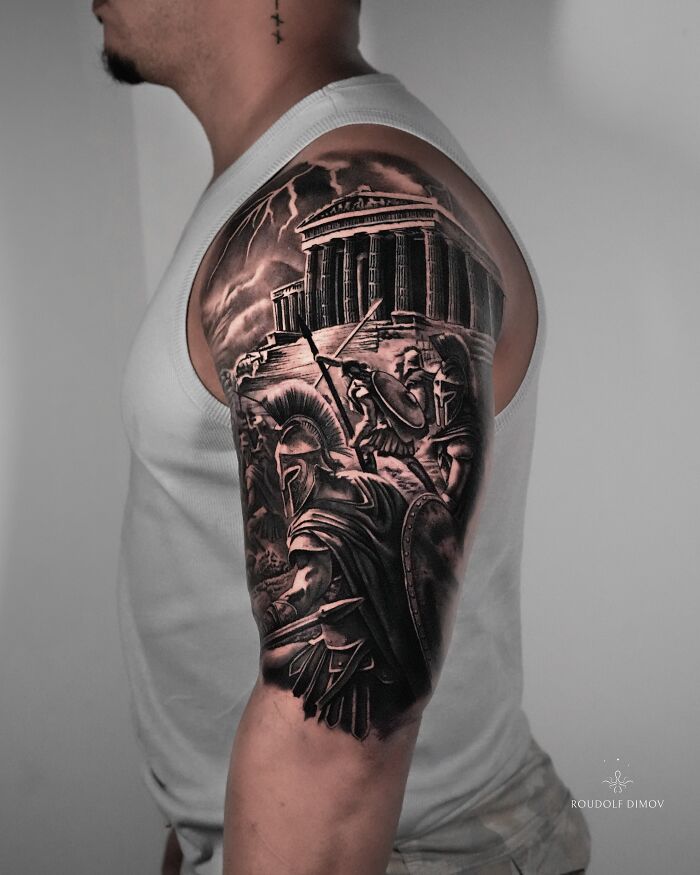
Image source: Sacred Gold Tattoo London

#2 The Pharaoh As A Living God
Closely modeled on Tutankhamun’s funerary mask, this piece is dense with symbolism. The vulture and cobra on the brow represent Nekhbet and Wadjet, the two protective goddesses associated with Upper and Lower Egypt. The crossed crook and flail are pharaonic symbols of authority, tied directly to Osiris, the god of the afterlife, whom Egyptian pharaohs were believed to become after passing.
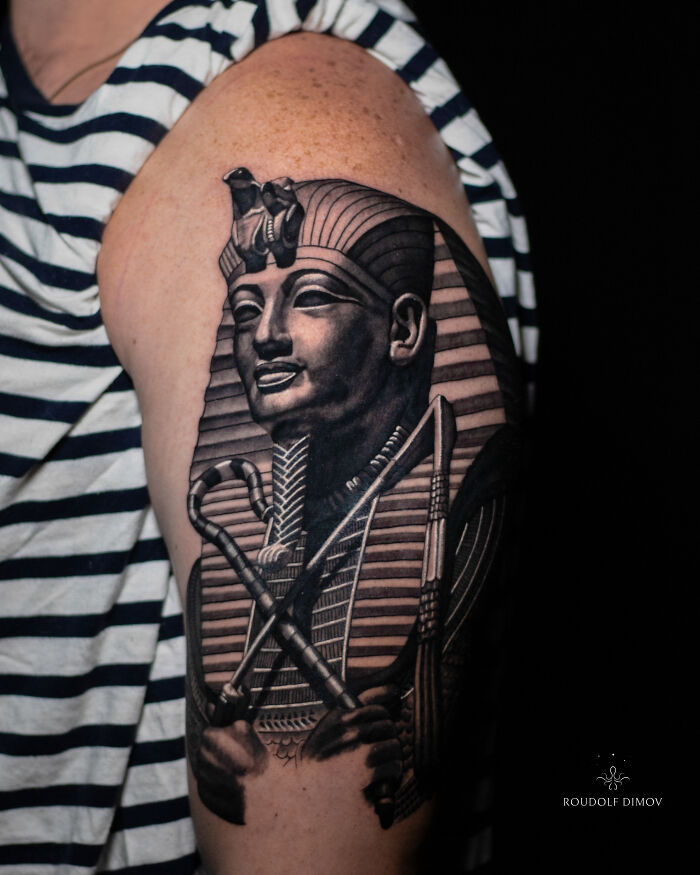
Image source: Sacred Gold Tattoo London
#3 The Serpent That Eats Itself
The Ouroboros, a serpent or dragon devouring its own tail, is one of the oldest symbolic motifs, appearing in ancient Egyptian funerary texts before making its way into Greek philosophy, Norse mythology, and later alchemical traditions. Its endless loop represents cycles of destruction and renewal, the relationship between endings and beginnings, and the idea of time as a continuous circle rather than a straight line.
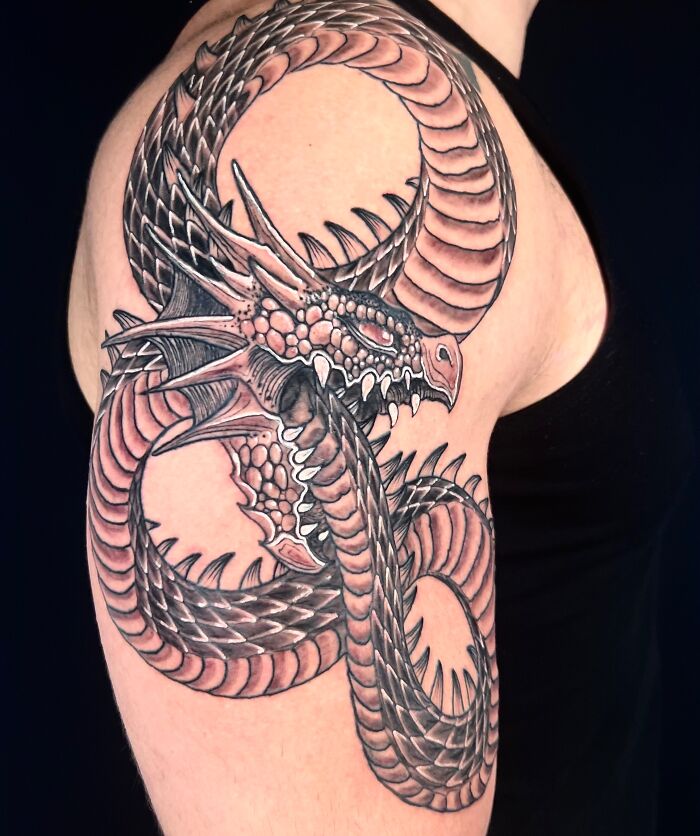
Image source: Sacred Gold Tattoo London
#4 The Guardian Who Burns Away Ignorance
Fudo Myoo may look like a villain, but he functions as a protector. One of the central wrathful deities in Japanese Buddhism, his fierce expression and surrounding flames represent the burning away of ignorance and delusion rather than destruction for its own sake. He is traditionally depicted holding a sword to cut through confusion and a rope to bind those who resist enlightenment, both of which are present here, wrapped in the flames he is known for.
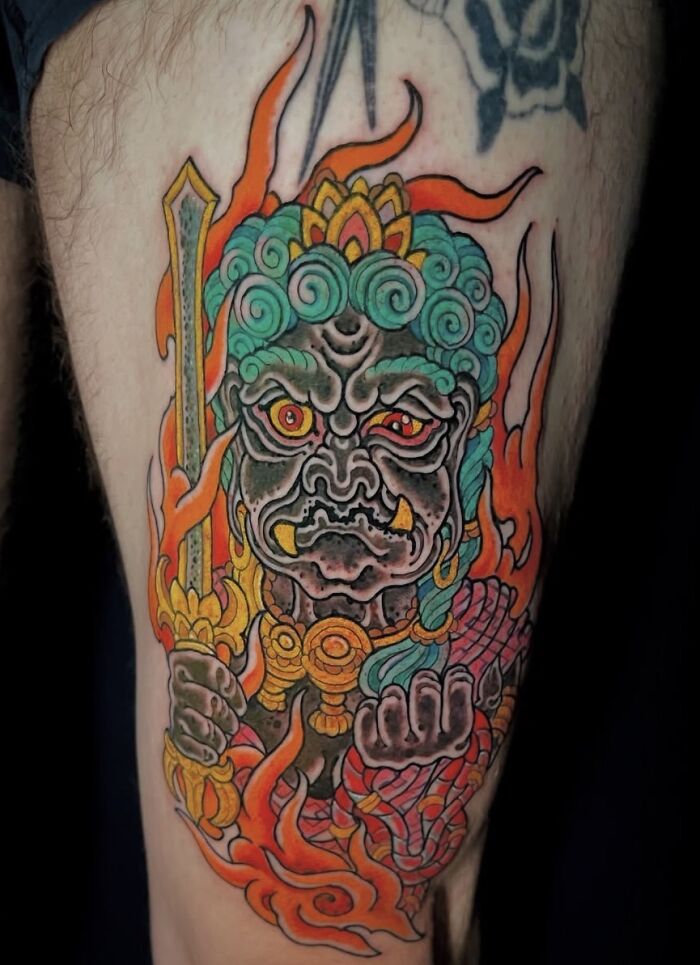
Image source: Sacred Gold Tattoo London
#5 Odin And His Watchers
Odin rarely appears alone in Norse mythology, he’s got company. The two ravens perched above him are Huginn and Muninn, “Thought” and “Memory,” who fly across the world each day and report back everything they see. The wolf lower on the arm is a nod to Geri and Freki, the wolves who stay loyally by Odin’s side. Norse gods, it turns out, kept excellent company.
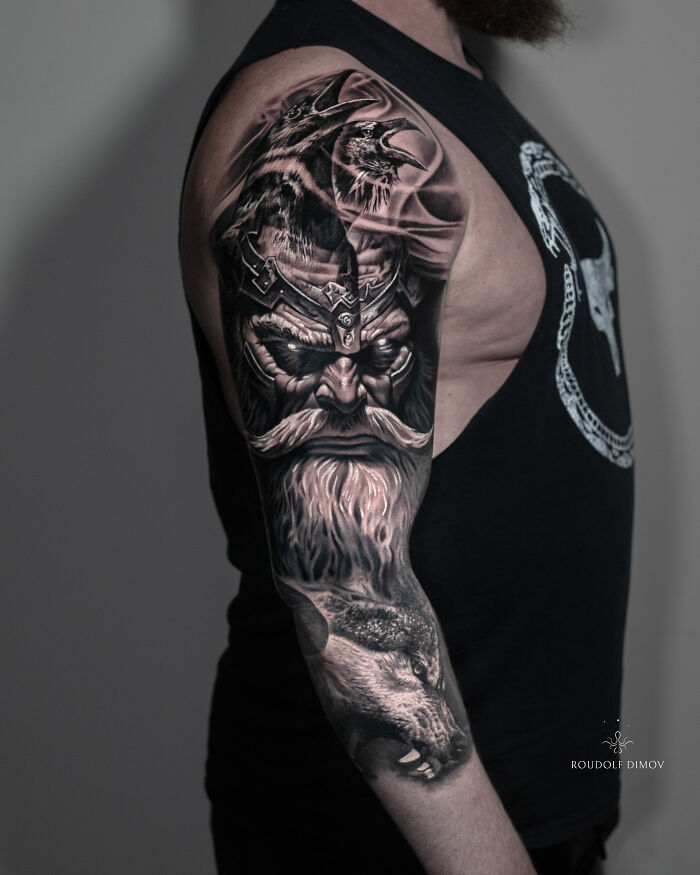
Image source: Sacred Gold Tattoo London
#6 A God From The Deep
Poseidon, the ruler of the oceans, earthquakes, and storms in Greek mythology. The creature emerging beside him only reinforces the theme, evoking the sea beasts and horses that appear repeatedly in Poseidon’s iconography.
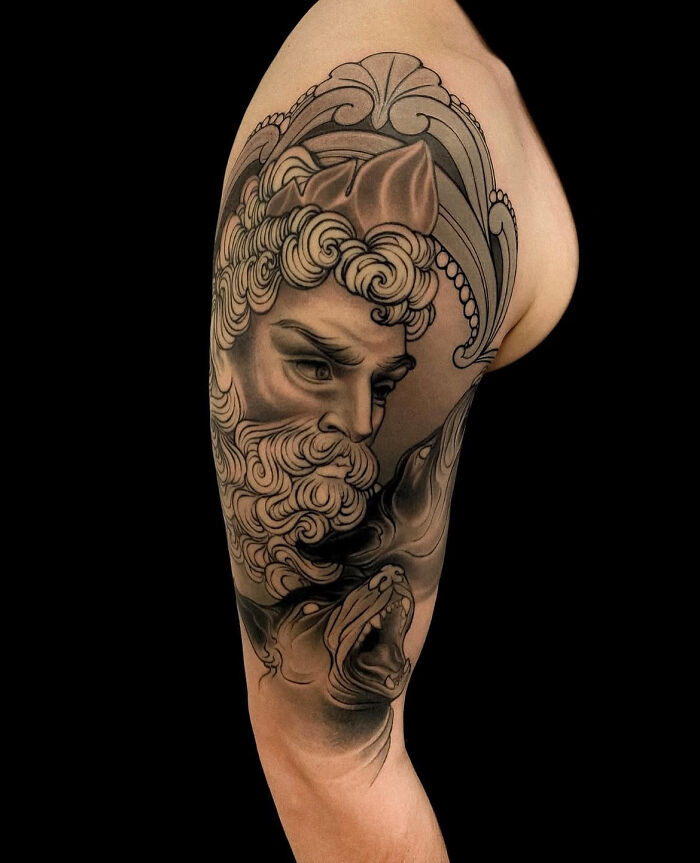
Image source: Sacred Gold Tattoo London
#7 The Spider With A Human Face
Tsuchigumo is one of the most enduring monsters in Japanese folklore, best known from centuries-old woodblock prints depicting it battling a samurai. Its defining feature is exactly what’s on display here, a spider’s body fused with a twisted, almost human face. A closely related yokai, Jorogumo, takes the idea a step further, with the ability to shapeshift into a beautiful woman before revealing its true form.
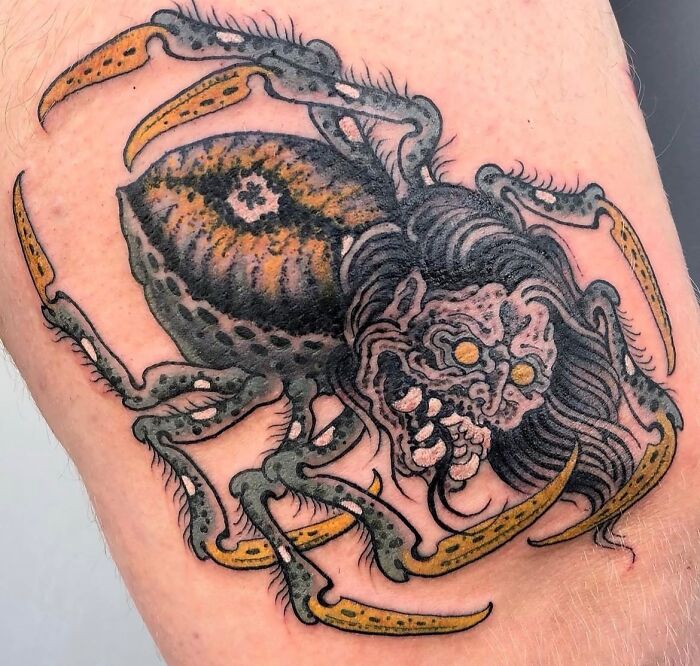
Image source: Sacred Gold Tattoo London
#8 A Skin Worth Leaving Behind
Snakes shedding their skin have symbolized renewal and rebirth across mythology for thousands of years, most famously in the Epic of Gilgamesh, where a serpent steals the plant of eternal life and then sheds its skin, offering an explanation for why the creature appears to renew itself while the hero cannot.
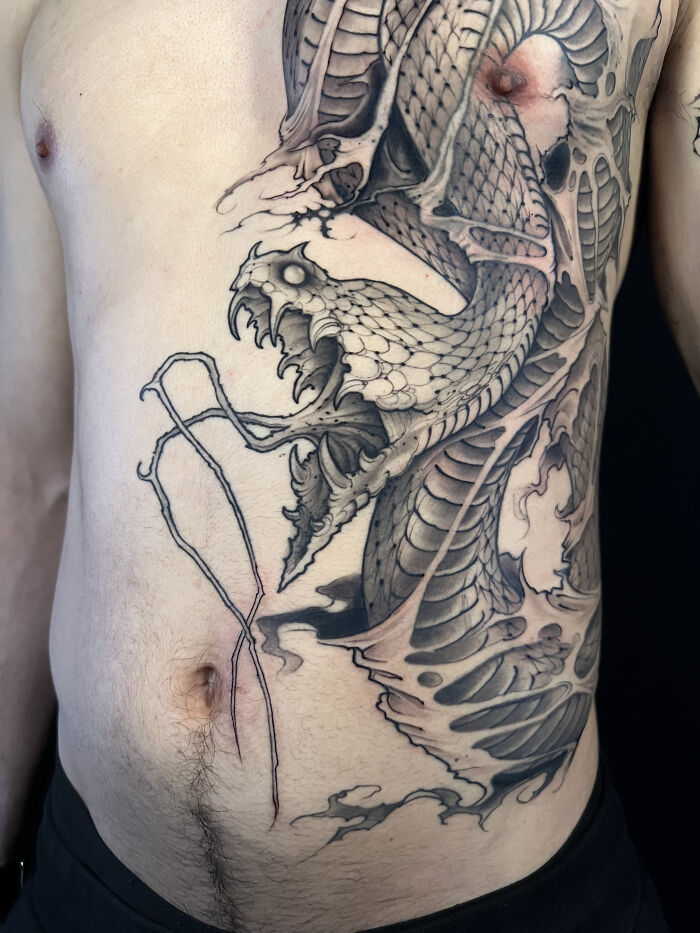
Image source: Sacred Gold Tattoo London
#9 Odin, The World Tree, And A Warrior’s Mark
This piece stacks Norse cosmology from top to bottom. The angular symbol at the top closely resembles protective symbols used in Viking-age tradition, while the tree rooted at the wrist is almost certainly Yggdrasil, the world tree said to connect all nine realms of Norse mythology. Combined with the weathered, horned figure between them, it reads less like a single character portrait and more like a fragment of an entire cosmology.
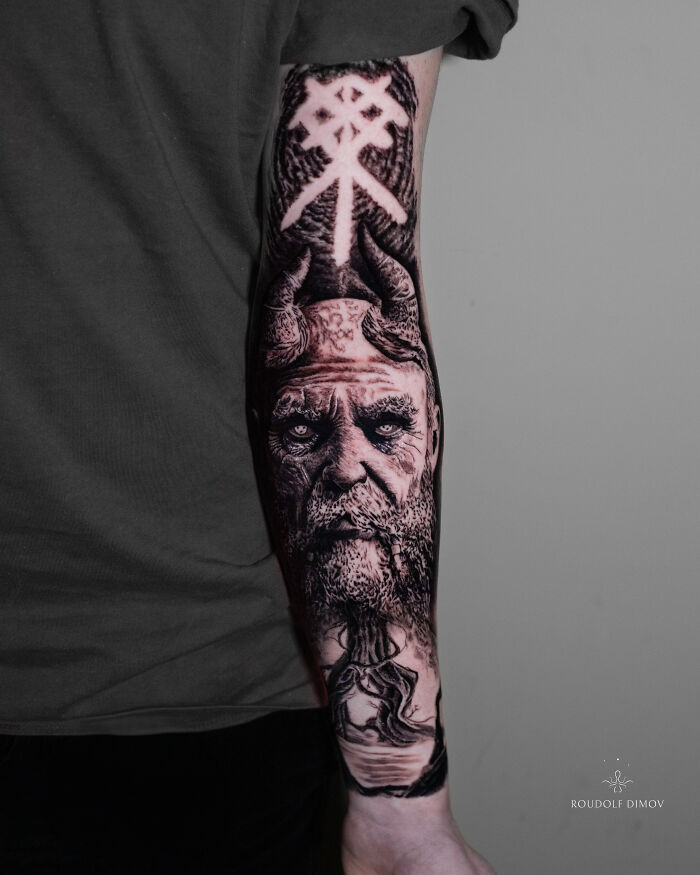
Image source: Sacred Gold Tattoo London
#10 The Flower Of Life
Sacred geometry earns its name because these aren’t just pretty patterns, they’re structures that ancient cultures believed reflected the underlying order of the universe. The Flower of Life, formed by evenly overlapping circles, appears in Egyptian temple carvings and later esoteric traditions, where it became associated with creation and the interconnectedness of all things.
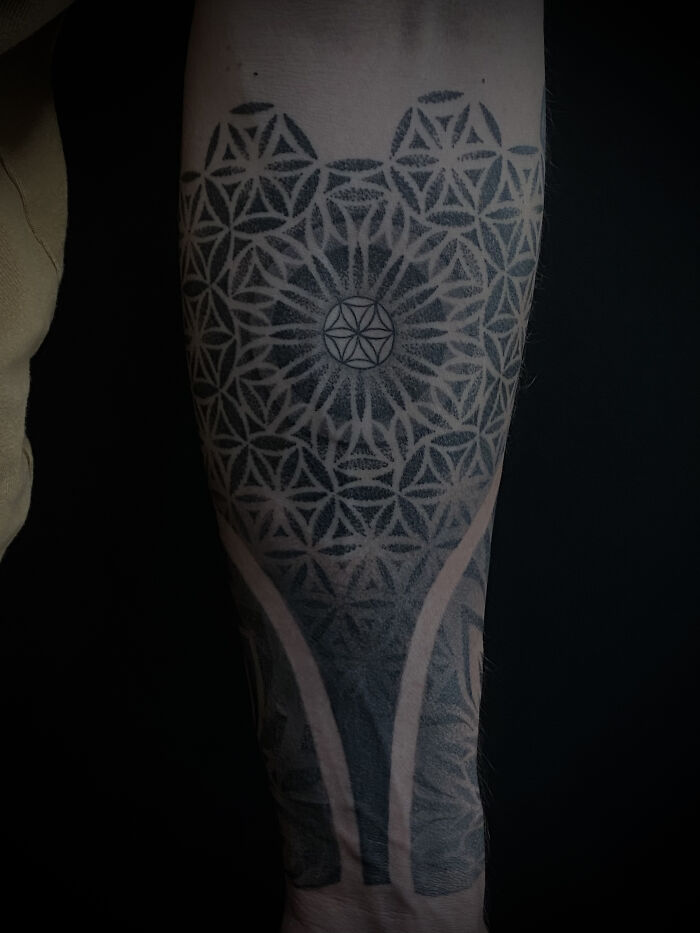
Image source: Sacred Gold Tattoo London
#11 Twin Mandalas Built On A Geometric Grid
Look closely at the base of each piece, and you’ll spot the same overlapping-circle lattice as the Flower of Life, this time forming the foundation for a full mandala bloom above it. Mandalas are a form of sacred geometry rooted in Hindu and Buddhist traditions, where their circular symmetry represents the universe and the path toward spiritual wholeness.
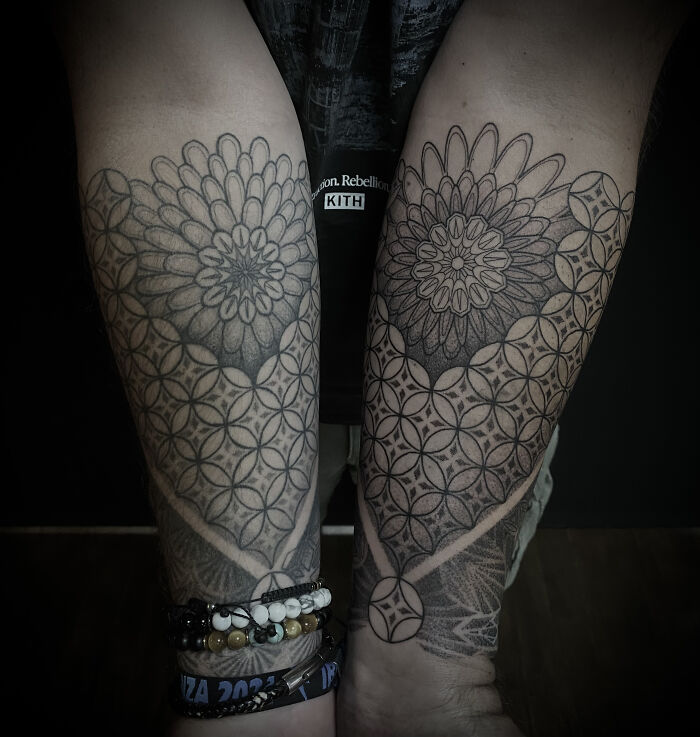
Image source: Sacred Gold Tattoo London
#12 A Sleeve Built From Star Lattices
These interlocking, multi-pointed star patterns come from the same mathematical tradition found in Islamic sacred geometry, including the intricate designs used to tile mosque walls and decorate centuries-old manuscripts. Paired with mandala medallions at the shoulder and elbow, the sleeve brings these elements together into one continuous geometric composition.
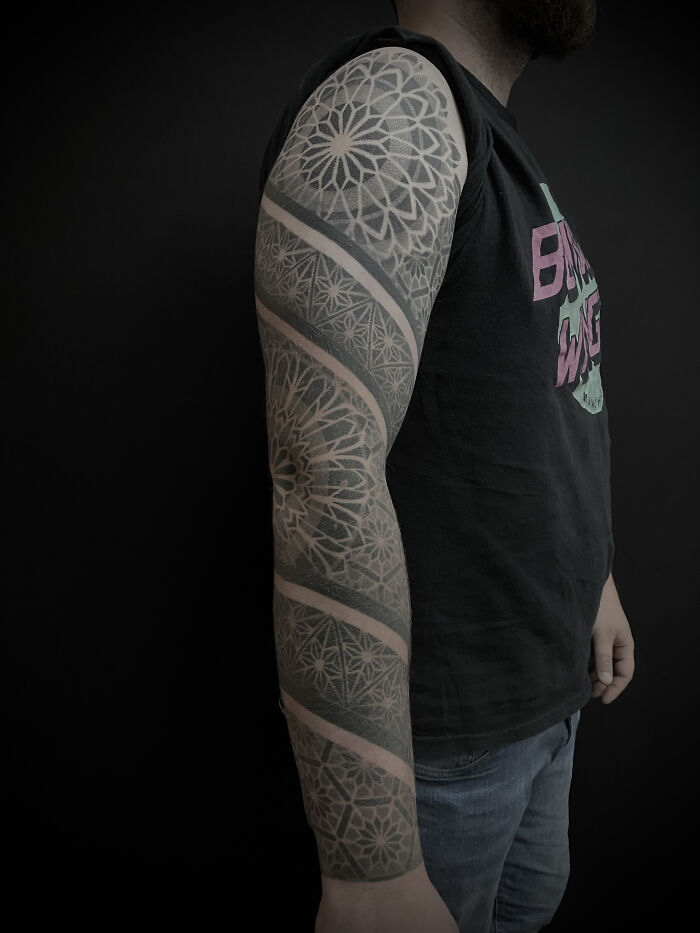
Image source: Sacred Gold Tattoo London
#13 A Mandala Built Layer By Layer
Mandalas are sacred geometry with deep roots in Hindu and Buddhist traditions, where their perfect radial symmetry is meant to mirror the structure of the universe itself, order radiating outward from a single central point. This one is built entirely from dotwork, with each layer of petals shifting in density from solid black to soft gray, creating depth without relying on a single solid line.
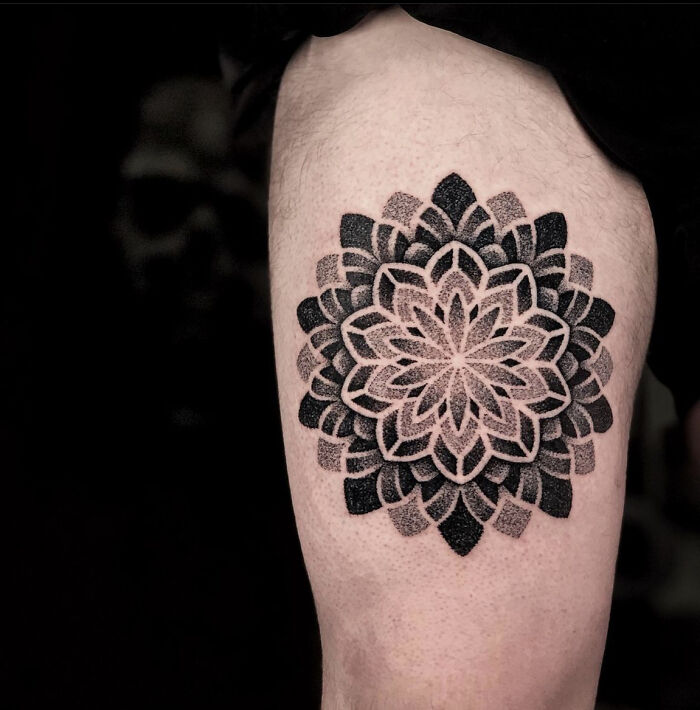
Image source: Sacred Gold Tattoo London
#14 The Guardian Of Water And Sky
In East Asian mythology, dragons couldn’t be further from the fire-breathing villains of Western folklore. They’re guardians of water, weather, and wisdom, often linked to imperial power and good fortune. The long, serpentine body and whiskered face on this piece are classic markers of the style, built to look like it’s mid-flight even while it’s standing still.
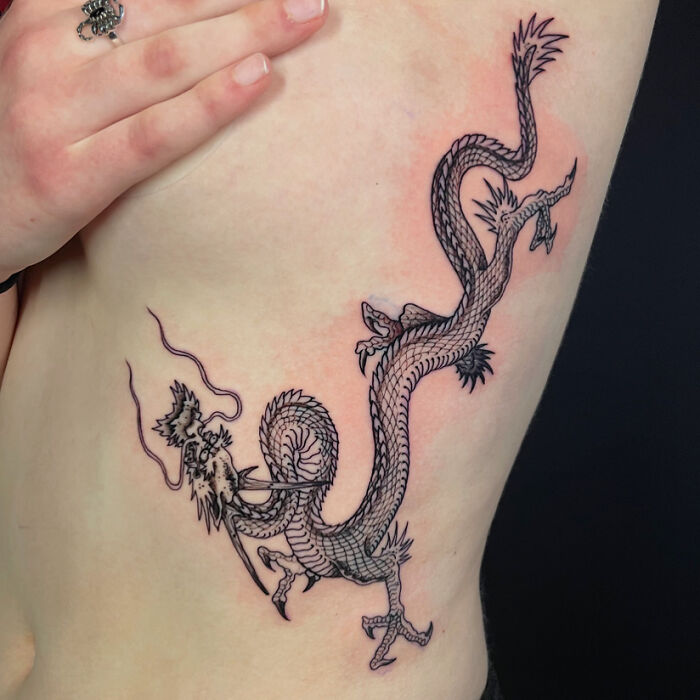
Image source: Sacred Gold Tattoo London
#15 Shiva, Lord Of Transformation
This is Shiva, one of Hinduism’s principal deities, with each element carrying its own symbolism. The third eye represents higher perception and the destruction of ignorance, while the crescent moon is associated with the cycles of time. Shiva’s closed, meditative eyes reflect his ascetic nature, while the lotus flowers at the base symbolize purity, beauty rising untouched from murky water.
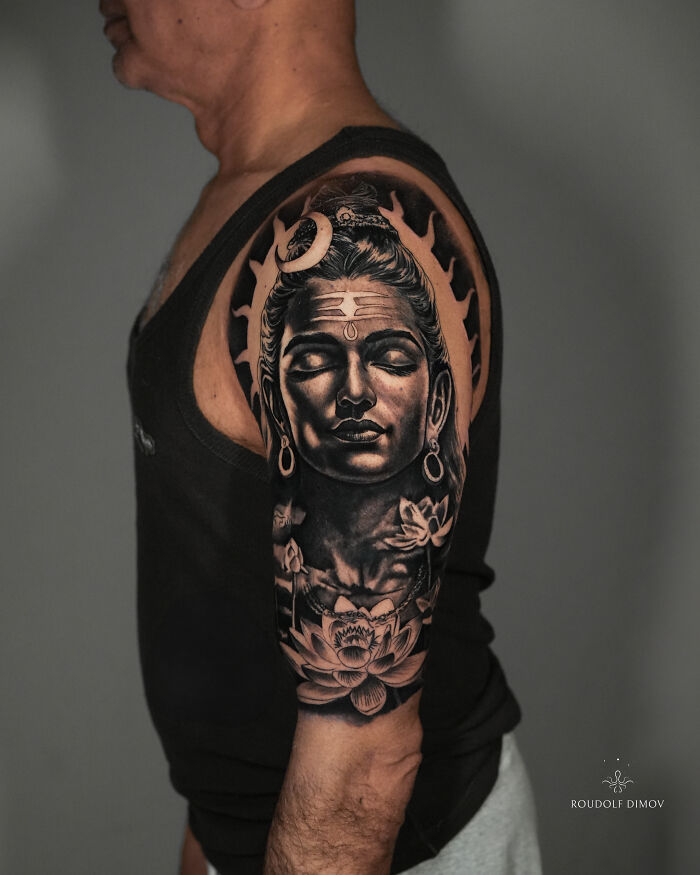
Image source: Sacred Gold Tattoo London
#16 A Dragon Carved In Waves
Rendered in the traditional Japanese Irezumi style, this dragon draws on the visual vocabulary of centuries-old woodblock prints, with sharp claws, defined scales, and swirling waves and clouds creating a sense of movement through water or sky. In Japanese mythology, dragons appear in both Shinto and Buddhist traditions, where they are associated with water, weather, and protection.
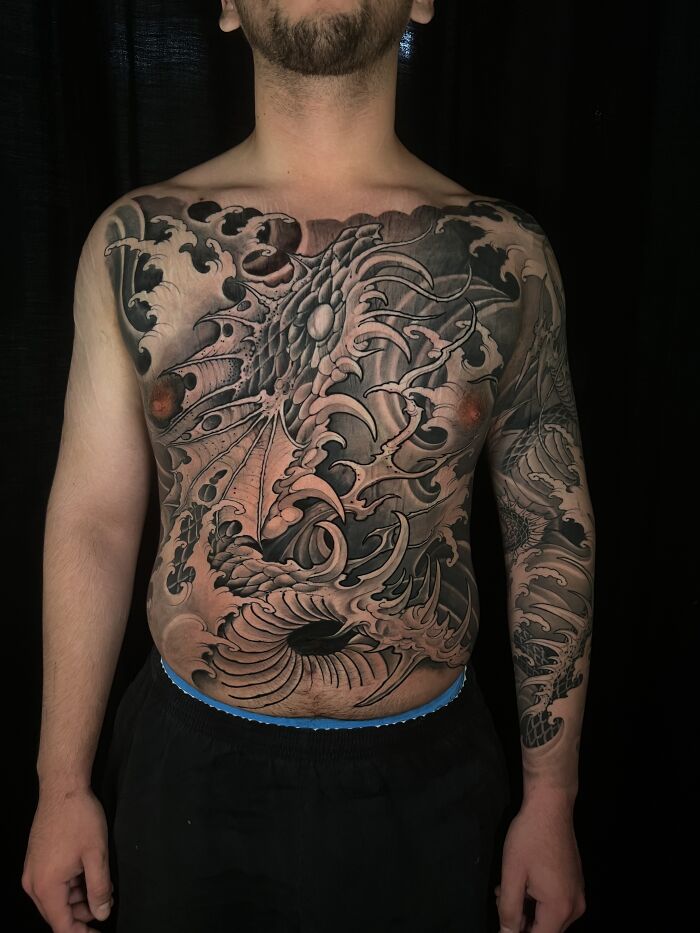
Image source: Sacred Gold Tattoo London
 Follow Us