“Karen” confrontations have become a familiar sight on social media, with many ordinary situations quickly turning into heated public showdowns.
From demanding that strangers leave public spaces to arguing over shared gym equipment, these encounters can quickly escalate.
While a sharp comeback might feel satisfying in the moment, it can also make an already tense situation much worse.
And as some of the viral incidents below show, knowing when to speak up, set a boundary, or simply walk away can make all the difference.
Bored Panda spoke to psychologists and behavioral experts about how to handle these confrontations, using real-life “Karen” encounters to explore what people can do when the situation starts getting out of hand.
From children being caught in the middle to discriminatory comments and strangers who simply refuse to back down, the experts shared 7 practical tips for navigating these situations without getting dragged into the drama.
#1 A Dad Of Color Was Asked To Prove He Belonged At A Public Pool, Experts Say Don’t Put Safety Second
What started as a family day at the pool quickly turned into a confrontation for filmmaker and author Leo Sullivan, who was visiting Chicago with his two sons.
Sullivan said a woman confronted him at the pool of the Airbnb complex where they were staying and demanded that he prove he was a resident.
According to Leo, he was the only Black family at the pool, and he alleged that the woman did not make the same demands of other visitors.
The situation escalated to the point where police were called, while Sullivan’s younger son could be heard crying and worrying that his father was going to be “put in jail.”
Sullivan said he showed proof that he was staying at the property, but the woman allegedly continued asking for his identification.
After police arrived, he said he explained the situation and was ultimately told he did not need to provide the woman with anything.
For him, however, the confrontation had already taken a toll on his children.
“This really traumatized my children. I might sue these people,” he wrote in the video’s caption, later saying that his family had experienced “so much hate and humiliation” during their stay.
Viewers were equally outraged, with one person writing, “My heart broke when his son started crying.”
Another claimed, “This is the trauma all black children go thru from an early age.”
But when a confrontation carries possible racial undertones, what should someone actually do in the moment?
“Initially, your goal should be safety. Not proving that you were right,” said Dr. Sal Raichbach, Chief Clinical Officer at The Haven Detox Group.
He recommended creating physical space, lowering your voice, and keeping the interaction brief.
Dan Auerbach, Clinical Director of Associated Counsellors & Psychologists Sydney, similarly advised taking a couple of seconds before responding.
“Taking one slow breath, keeping your hands open and visible, and stepping back can help prevent your body’s immediate stress response from taking over.”
From there, he suggested speaking more slowly and quietly than the other person.
That can be particularly important when discriminatory comments enter the picture.
Dr. Stacie McPherson, a licensed clinical psychologist and founder of Luminate Psychological Services, said people can firmly identify unacceptable behavior without getting trapped in a prolonged argument.
“If someone uses derogatory or discriminatory comments, it’s best to set a firm boundary and remove yourself immediately,” she said.
If it feels safe, that boundary can be as simple as: “That statement is racist. I will not engage further in this conversation.” Then walk away.
And if you’re a bystander witnessing someone else being targeted, the safest response may not be confronting the aggressor at all.
Auerbach suggested approaching the person being targeted instead, standing beside them and talking to them about something ordinary.
Dr. Raichbach similarly recommended asking, “Are you okay?” or “Would you like to come sit over here?”
The idea is to reduce the targeted person’s isolation without creating another confrontation.
And when children are watching, the experts agree that walking away isn’t the same as giving in.
“If you are the person being targeted, the priority is to get somewhere with other people and staff in it,” Auerbach said.
With children present, he advised putting yourself between them and the stranger, taking their hand and leaving rather than trying to finish the argument.
Dr. Raichbach offered a similar perspective: children are watching whether an adult can recognize danger, regulate themselves and choose safety over ego.
In other words, sometimes the biggest win isn’t getting the last word.
It’s getting your kids somewhere safe before the stranger gets another one.
@sheesane Make her famous.#karens #racism #chicago #blacklivesmatter #blacktok ♬ Originalton – xxxBisou

Image source: Leo Sullivan, sheesane

#2 A Woman Ordered A Window Cleaner Off Her Balcony, Experts Say Walking Away May Be The Best Response
A window-cleaning job took a hostile turn when one resident appeared to have had enough of a worker standing on her balcony.
In a viral clip, a window cleaner in safety gear can be seen working outside a high-rise apartment when the woman opened her sliding door and told him, “I’m gonna politely ask you to leave my porch.”
“Leave my f**king porch right now, please,” she added moments later, before becoming even more forceful when the worker apparently explained that he only needed another five minutes to finish the job.
“No! Leave right f**king now,” she snapped.
The worker, who appeared to speak limited English, simply replied, “Okay,” and began packing up his equipment.
He even moved the resident’s chairs back into place before quietly apologizing and leaving.
That response only seemed to make the contrast more striking for viewers, who were quick to condemn the woman’s behavior.
“She said it politely, and then before he could even process what she said, she immediately starts dropping the F-b**b,” one person commented.
“If that’s her definition of polite, I’d hate to see her being rude.”
Another viewer wrote, “After that distasteful comment she made, the property should make sure to let the workers know she’ll be cleaning her own windows.”
Some viewers questioned whether the worker’s ethnicity may have played a role in the encounter, while others debated whether the woman’s behavior had a racial motivation.
There is no clear evidence in the footage explaining why the woman reacted that way.
And that uncertainty is precisely why Dr. McPherson recommends resisting the urge to immediately turn a confrontation into a battle of opposing assumptions.
“Ask questions instead of making confrontational statements back towards the other person,” McPherson said.
“Seek to understand their point of view. You do not have to agree with them, but merely see what they are saying and why.”
That doesn’t mean someone should tolerate a**sive behavior or stay in an interaction that feels unsafe.
It simply creates an opportunity to determine whether the problem is actually what it appears to be before emotions take over.
In a situation like this, that could mean establishing the practical issue first: Was the resident notified? Is the worker authorized to be there? Does the building have a procedure for balcony access?
Dr. McPherson also points out that not every disagreement needs a winner.
“Many people come at confrontation as an argument to win; however, there are never any winners in an argument,” she said.
Instead, she recommends approaching conflict as an opportunity to understand why the other person is upset, even when you ultimately disagree with them.
That distinction matters because the goal isn’t to convince a stranger that they are a terrible person.
It’s to resolve the immediate problem without allowing it to become something much bigger.
Dr. Raichbach said people don’t need to turn themselves into amateur negotiators in an attempt to change someone else’s mind.
“You don’t have to put yourself in danger to defend against discrimination,” he explained.
If it feels safe, a brief statement can establish where you stand.
But if the interaction is escalating, the more useful move may simply be to support the person being targeted or get help rather than trying to win a debate with the aggressor.
The worker ultimately chose the simplest way to end the confrontation: Rather than provoke the woman further, he quietly packed up his equipment and left.
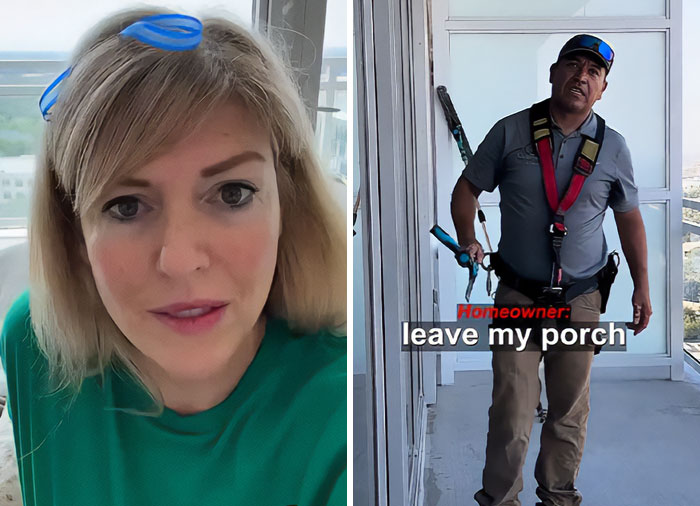
Image source: Ximena_Noir, chicanosworldwide
#3 A $20,000 Dispute Turned Into “Revenge,” Experts Explain Why It’s Better To Take The High Road
Not every confrontation is worth winning in the moment, and a dispute over a $20,000 landscaping project is a pretty good example of why.
A viral video showed a landscaper and homeowner locked in a heated disagreement after the woman allegedly refused to pay the remaining balance for a completed flagstone patio.
According to the contractor, she had previously approved the stone but later objected to its color once the work was finished.
The exact payment arrangement remains unclear, as does whether the parties had a written contract covering the materials, approvals, and final payment.
The contractor appeared to take matters into his own hands, telling his crew to start breaking apart the patio and remove landscaping from the property.
“I mean, this is like $20,000 in materials alone,” he said in the clip.
The homeowner could reportedly be heard responding, “I’m not paying the rest of it.”
One commenter wrote, “She could have inspected the pavers at any time during installation and decided she didn’t like it. Instead, she waited until completion. She’s scamming him.”
Another simply declared, “I’d tear it out. Yep, it’s outrageous. If I were them I’d pull it all out right in front of her.”
But experts suggest that even when you feel completely justified, escalating the confrontation can create an entirely new problem.
Dr. McPherson recommends resisting the urge to turn a disagreement into a battle of wills.
“Many people come at confrontation as an argument to win; however, there are never any winners in an argument,” she explained.
Instead, she suggested approaching the disagreement with curiosity and asking questions rather than immediately becoming defensive.
That does not mean allowing someone to take advantage of you.
It means separating getting what you are legally or contractually owed from getting emotional satisfaction in front of an audience.
Auerbach similarly cautioned that the moment an exchange stops being productive, walking away can be the smarter move.
“In our clinical experience, people generally know within about fifteen seconds that a confrontation is not going to resolve, and then spend the next several minutes hoping they were wrong,” he said.
In a dispute like this, that could mean stopping the back-and-forth and moving the disagreement into a more appropriate setting, whether that means consulting the contract, documenting the work, communicating in writing, or seeking legal advice.
And there was another reason not to let frustration take over: removing or destroying completed work can potentially create legal problems of its own, depending on the jurisdiction and the terms of the agreement.
One viewer even warned, “Karen committed a civil infraction. The contractor is about to commit a criminal one.”
When money is involved, revenge may feel satisfying for a few seconds, but proper dispute resolution is usually much safer.
As Auerbach put it, the goal in a “confrontation should be to get out of it intact rather than prove a point.”

Image source: LeahRain77
#4 Moms Shamed A Working Father Into Leaving His Table, Experts Say You Don’t Have To Take The Bait
A quiet work call turned into a very public argument after two mothers reportedly confronted a man who was sitting near their children.
The man, later identified as Ryan Hamilton, had apparently been sitting at a public table for nearly an hour, listening to music and taking work-related calls.
According to creator Tori Wigington, who filmed the encounter, the women arrived with several children and chose to sit beside Hamilton despite other tables being available.
The older woman then reportedly approached him and told him he was being “so rude,” apparently objecting to his phone conversation taking place near the children.
Rather than argue about whether he had the right to use his phone in a public space, Ryan simply told the person on the other end of the call that he needed to go and began gathering his belongings.
Wigington, meanwhile, was having none of it.
“The entitlement is literally insane,” she told the women. “It’s not a good example… in front of kids is crazy.”
Hamilton later explained that he had deliberately been sitting outside because he did not want to bother anyone.
“Wasn’t trying to bother anyone which is why I was outside to begin with,” he wrote, adding that he was simply “a dad trying to make a living for his family.”
The internet largely sided with him.
“He wasn’t bothering anyone. The entitlement is insane. Call it out every time plz,” one viewer wrote.
Another argued, “Then sit ELSEWHERE!! He was already sitting there and on the phone. No one told them to sit next to him when there were other EMPTY tables.”
Others expressed, “You were way over the top nice. Unfortunately, she was rewarded for her rudeness by you leaving.”
But according to Auerbach, “Being confronted in public carries a sting of exposure, and the mind reaches for a way to restore standing in front of whoever is watching.”
His advice is to ask yourself a simple question: Will I care about this person’s opinion of me in a week?
If the answer is no, “there may be little value in spending the next 10 minutes proving your point to a stranger.”
Dr. McPherson recommends approaching these situations with curiosity rather than immediately becoming defensive.
Asking questions can sometimes reveal whether there is an actual misunderstanding or simply a disagreement that isn’t going anywhere.
And if the other person continues escalating despite your attempts to communicate calmly, she said it’s perfectly reasonable to end the interaction.
That is essentially what the man in the viral video did.
He didn’t need to convince the women that he wasn’t being rude.
And he didn’t need to stay just because leaving might look like they had “won.”
Experts agree that his quiet exit may have done more to keep the situation from becoming a full-blown spectacle than any comeback could have.

Image source: heyitstwig25
#5 A Gym “Karen” Wanted The Shared Machine Mid-Workout, Experts Say A Calm Boundary Can Go A Long Way
Gym etiquette can be complicated, especially when everyone is trying to squeeze a full workout into a limited amount of time.
But one viral confrontation showed how quickly a simple disagreement over a machine can become a battle of wills.
A viral clip showed a younger woman using a workout machine when an older gym-goer approached and asked whether she was finished.
The younger woman calmly explained that she had only just started and still had two sets remaining.
“I’ve been watching you for 10 minutes,” the older woman replied.
She then complained that “kids” spend too much time on gym equipment and explained that she was in a hurry because she wanted to get home.
Rather than snapping back, the younger woman tried to find a middle ground.
She offered to let the woman “work in,” meaning they could alternate sets on the same machine.
But the offer was reportedly rejected.
Instead, the older woman wanted the younger gym-goer to give up the machine entirely so she could use it first.
The younger woman remained polite but stood her ground, explaining that she also wanted to finish her workout and had no idea how long she would have to wait if she surrendered the machine.
That approach is particularly relevant to Dr. McPherson’s advice on handling confrontations: “stay calm, keep emotions out of the exchange and stick to the facts.”
“If you need to set a firm boundary with an angry stranger, again remain calm,” McPherson explained. “Speak as if you are in a business meeting and keep your emotions out of the conversation.”
In this case, the younger woman offered a reasonable compromise before making it clear that she intended to finish what she had started.
“People are impossible today. Go**amn lady, use another machine and quit bothering people. Let the girl finish her workout,” one person wrote.
Another commenter praised the younger woman’s demeanor, saying, “That young lady was very respectful.”
Of course, not everyone thought the older woman was completely unreasonable.
Some gym-goers pointed out that people who sit on machines for extended periods while scrolling through their phones can make it difficult for others to get their workouts done.
One commenter wrote, “A lot of young people sit at the machines for a long time using their phones between sets. It is frustrating.”
Another agreed, saying, “This is a constant problem at my gym. People get on a machine, do a set, then spend 10 minutes on their phone until their next set.”
For Dr. McPherson, the bigger lesson is that disagreements do not have to become personal simply because two people want different things.
“Be curious instead of defensive,” she advised. “Ask questions instead of making confrontational statements back towards the other person.”
And if neither person is willing to compromise, psychologist Auerbach said there is a point when you have to recognize that an interaction is no longer going anywhere.
“If you answer their question and they repeat the same accusation, or they escalate regardless of what you offer, the conversation has stopped being a conversation,” he explained.
Sometimes the most effective way to handle a demanding stranger is to calmly explain your position, offer a fair alternative, and then let the other person decide whether they want to accept it.

Image source: jenna.fitness, jenna.fitness
#6 A Cyclist Accused A Pedestrian Of Racism, Experts Say Sometimes The Best Move Is To Stop Engaging
In a viral video, a female cyclist follows a man walking two dogs on a sidewalk and confronts him after allegedly asking him to move aside.
“I asked you nicely,” she told him. “You don’t get to take the whole sidewalk, bro.”
The man reportedly told her to ride in the bike lane, prompting her to argue that it did not matter whether one was available.
She then accused him of racism and continued berating him as he walked away with his dogs.
At one point, the man allegedly responded with an offensive gesture and a slur before eventually stepping aside with his dogs to let her pass.
But even after she was able to get through, the argument continued, with both parties exchanging insults before the cyclist finally rode away.
“If you don’t want to ride your bicycle on the road and obey traffic laws, then cycling is not for you,” one viewer reacted.
Another added, “On the sidewalk, a PEDESTRIAN has the right of way, not you.”
Others argued that the pedestrian could simply have moved aside, while some questioned whether the entire encounter had been staged.
Regardless of who was technically in the right, the exchange illustrates a bigger problem: once an argument stops being about the original issue, continuing to engage rarely makes anyone safer or more convincing.
Auerbach said one of the clearest signs that it is time to disengage is when the other person stops responding to what you are actually saying.
“If you answer their question and they repeat the same accusation, or they escalate regardless of what you offer, the conversation has stopped being a conversation,” he explained.
That appears particularly relevant here. The dispute began with an argument over space on the sidewalk, but quickly expanded into accusations, insults, and personal attacks.
Dr. McPherson similarly advised people to recognize when their attempts to de-escalate are simply not working.
“If using validation and a calm demeanor don’t seem to de-escalate the person, you may need to disengage rather than try to diffuse the situation,” she said.
Auerbach further advised, “Leaving early is not weakness. It is usually the accurate read.”
In this case, once the cyclist and pedestrian had exchanged accusations and insults, neither appeared to be getting any closer to resolving the original disagreement.
Walking away sooner might not have settled who was right, but it could have prevented a sidewalk dispute from becoming an even bigger spectacle.
As Dr. Raichbach explained, “Your safety is the most important. If someone refuses to de-escalate or the situation begins to feel unsafe, seek help rather than continuing to engage.”
Because sometimes, the smartest way to win a “Karen” confrontation is to simply walk away.

Image source: KimKatieUSA
#7 A Dad Was Berated For Taking His Daughters To A Women’s Restroom, Experts Say Protecting Kids Beats Winning An Argument
Tyler Brodsky was traveling from Florida to Oklahoma with his two young daughters when he stopped at a QuikTrip in Alabama for a bathroom break.
After knocking and announcing that he was entering the women’s restroom with his daughters, Tyler said the bathroom was empty when they went inside.
But moments later, another customer reportedly entered and began yelling at him, insisting that he should have taken the girls into the men’s restroom instead.
“He came in screaming and hollering,” Brodsky recalled.
The confrontation quickly escalated, with the man reportedly calling police while continuing to berate Tyler.
One of his daughters could be heard crying as he helped her wash her hands.
Instead of getting drawn into the argument, he focused on his daughters.
“He kept escalating it. He kept yelling at us,” the father said, explaining that he began recording the incident because he wanted to document what was happening “for my safety, my kids’ safety.”
That decision to stay focused on the children rather than the argument is exactly what psychologist Auerbach recommends when a confrontation happens around kids.
“With children present, your job changes from resolving the situation to ending it,” Auerbach said. “Winning the exchange is worth nothing next to your child watching you handle it safely.”
In other words, there is a time to explain yourself, and a time to simply get your kids away from the situation.
Dr. McPherson advised parents to create as much distance as possible between their children and an escalating confrontation.
“First and foremost, make sure the children are as far away from the situation as possible,” she said.
If another trusted adult is available, she recommends having the children stay with them while the situation is addressed.
That was not necessarily an option for Tyler, who was alone with his daughters.
Instead, he kept helping them at the sink and tried to reassure them while the stranger continued shouting.
“I’m with my girls, and they were already scared … I wanted to be there for them and let them know that nothing is going to happen,” he said.
Auerbach explained that children pick up on tone and body language long before they understand the details of an argument.
“Children pattern themselves on what the adults around them do,” he said, adding that calmly walking away can itself become a lesson in handling conflict.
Eventually, the customer left, and a QuikTrip employee apologized to Brodsky before police arrived.
Officers spoke with the family and reassured the girls that they were safe.
Tyler later said he was glad the officers took the time to make sure his daughters understood there was no danger.
For parents caught in a similar situation, the experts’ advice is less about delivering the perfect comeback and more about recognizing what actually matters in the moment.

Image source: tylerbrodsky2
 Follow Us