In 1848, the crew of the HMS Daedalus spotted something in the waters between the Cape of Good Hope and St. Helena that they could not explain. It was enormous. It was dark on top with a light underbelly. It was approximately 60 feet long (18 meters). It slid past within 100 yards of the ship and kept going, apparently unbothered by the presence of a Royal Navy vessel. Rude.
Captain Peter M’Quhae filed his report, and the British press ran the story with breathless enthusiasm. The established scientific community responded exactly how you’d expect, with profound condescension. The notoriously cantankerous anatomist Richard Owen announced that the crew had almost certainly seen a very large seal and suggested that men had “been deceived by a cursory view of a partly submerged and rapidly moving animal.”
M’Quhae fired back; he was, after all, a man who had spent months at sea and was not about to be told he couldn’t identify a seal. “I deny the existence of excitement, or the possibility of optical illusion,” he wrote. Two men were at each other’s throats, and somewhere beneath the Atlantic, the actual answer was carrying on with its day entirely indifferent to both of them.
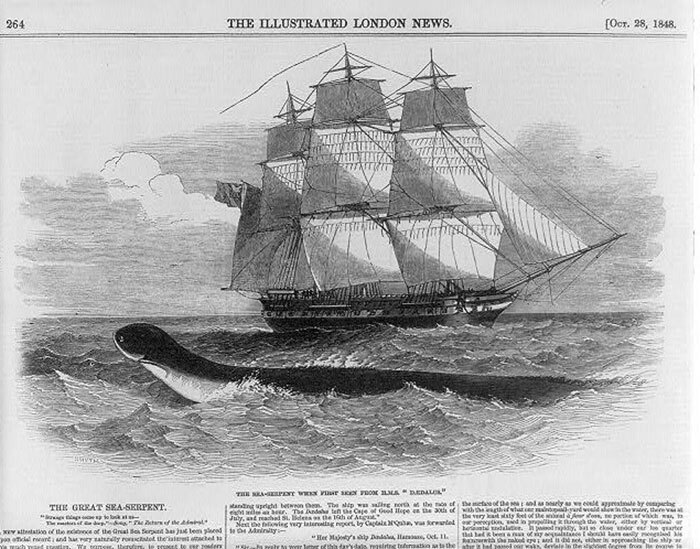
Image credits: The Illustrated London News, 1848 Oct. 28 / Library of Congress
The Monster We Spent Centuries Refusing To Believe In
The history of humanity’s relationship with Architeuthis dux (or giant squid if you are a zoology pleb) is complicated, because there is a considerable knowledge gap between what we think we know and what it actually is.
Giant squid sightings go back to antiquity. Homer’s many-tentacled monster Scylla in The Odyssey almost certainly drew on real encounters, and Scandinavian sailors described the Kraken for centuries before science got involved. The scientific community’s response to all of this was, for a remarkably long time, to politely suggest that sailors were either drunk, confused, or both.
Then the bodies started washing up.
In 1857, Danish zoologist Japetus Steenstrup combined centuries of sea monster reports, accounts of many-tentacled creatures stranded on European beaches, and one very large squid beak to formally establish that the giant squid was real. His physical evidence at the time consisted entirely of the beak, which he had collected from a stranded specimen.
The French warship Alecton encountered a dying giant squid near the Canary Islands in 1861, fired at it repeatedly, and managed to retrieve only the back half after accidentally separating it from the tentacled front. They filed a report with the French Academy of Sciences. The Academy, apparently satisfied that half a squid was sufficient evidence, accepted that something considerable was out there.
Then came Newfoundland. A chapter in the story that changed everything.

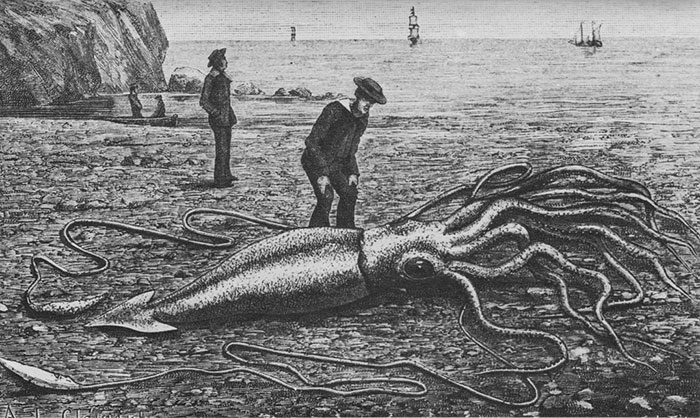
Image credits: Unknown / Wikimedia
The Place Where The Monster Was Actually Real
No coastline on Earth has a more comprehensively documented history of genuine giant squid encounters than the waters off Newfoundland’s Grand Banks, and this is not mythology. This is taxonomy.
In October 1873, two fishermen named Daniel Squires and Theophilus Picot (no, these are not adventure novel heroes; they were real people with the coolest names ever) were working waters near Bell Island when something they described as a “Devil Fish” attacked their boat. Daniel Squires was just a boy when he responded to this crisis by severing one of its tentacles with a hatchet.
The severed tentacle, measuring 19 feet (5.7 meters), was delivered to amateur naturalist Reverend Moses Harvey, who documented it, photographed a subsequent full carcass that washed ashore, and in doing so effectively dragged the giant squid from maritime legend into the zoological record. He then received a letter from P.T. Barnum requesting a pair of giant squid for his collection. This order was, regrettably, never filled, and thus never made it into “The Greatest Showman.”
By 1878, the stakes had escalated considerably. Fishermen near Thimble Tickle on Newfoundland’s northeast coast hauled a live giant squid from shallow water that measured 55 feet (16.7 meters) from tentacle tip to tail. This was an animal so extreme in its dimensions that the Guinness Book of Records later confirmed it as the most extraordinary specimen on record.
The question, by that point, was no longer whether something enormous lived in those waters. The question was only what it was doing when it wasn’t washing ashore. A question which, to be absolutely clear, remains unanswered.
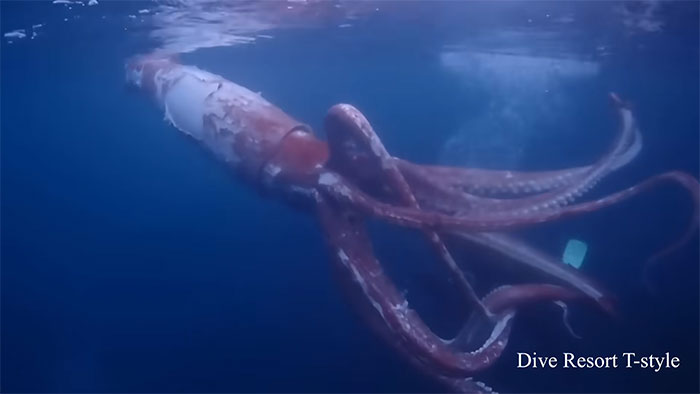
Image credits: AFP News Agency / YouTube
What We Actually Know, Which Is Embarrassingly Little
Humanity’s scientific knowledge of the largest invertebrate ever to have lived on Earth is not something we should be proud of, because it is barely anything. Scientists estimate the species may reach 66 feet (20 meters) based on beak sizes found in sperm whale stomachs. We are essentially reconstructing the dimensions of a creature from its leftovers.
Giant squid live at depths of between 1,000 and 3,300 feet (1005 meters) below the surface, where sunlight does not reach. They have eight arms and two longer feeding tentacles equipped with tooth-ringed suction cups that can shoot out to grasp prey before dragging it back toward a beak made of hard chitin, the same material as insect exoskeletons. Its beak edges are sharp enough to slice through flesh efficiently, so they eat deep-sea fish and other squid. They are, by any reasonable measure, spectacular and formidable animals.
They have been filmed alive in their natural habitat exactly twice. Once, in 2004, when Japanese marine biologists Tsunemi Kubodera and Kyoichi Mori managed to photograph a live giant squid off the coast of Japan, the first time in recorded history this had been achieved. And once more in 2012, when the first actual video footage was captured.
The first footage of a giant squid in U.S. waters came in 2019, in the Gulf of Mexico. In the entire span of human existence, across centuries of maritime activity, with all the technology of the modern era at our disposal, we have managed to capture this animal in its natural environment on three occasions. It is not trying very hard to be found, and it is winning.
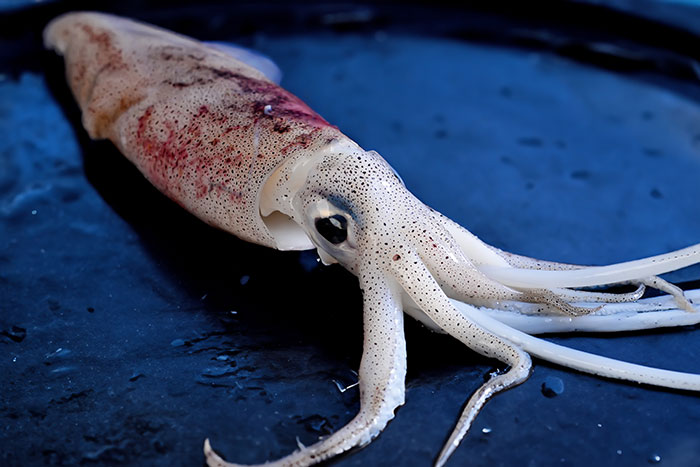
Image credits: bangmunce / Magnific (not the actual photo)
The Eyes Have It
Perhaps the most unsettling single fact about the giant squid is this: its eyes measure about 11 inches across, roughly the size of a dinner plate, or a basketball, making them the largest eyes in the entire animal kingdom. This is truly a horrifying image, but the biology behind it is simultaneously more elegant and more alarming than pure horror.
Giant squid did not evolve basketball-sized eyes to see in the dark. They evolved them to spot sperm whales. Sperm whales are the giant squid’s primary predator, and they are bioluminescent, creating faint light in the water as they move. In the absolute darkness of the deep ocean, the giant squid’s enormous eyes are calibrated specifically to detect that faint glow from a sufficient distance to hatch an escape plan.
The squid is not using its extraordinary visual apparatus to hunt. It is using it to not be eaten. The largest eyes in the animal kingdom exist because something large enough to swallow a giant squid whole is out there in the dark, and the squid needs to see it coming. So maybe the sperm whale is what we should actually be scared of? Someone call Stephen Spielberg!
Image credits: Benjamindancer / Wikimedia
The Deep Makes Things Bigger. Much Bigger.
The giant squid is extraordinary. But the colossal squid, Mesonychoteuthis hamiltoni, would like a word. Reaching an estimated 46 feet (14 meters) and equipped with swiveling hooks on its tentacle clubs, the colossal squid is the giant squid’s larger and considerably more aggressive cousin. In March 2025, researchers from the Schmidt Ocean Institute filmed a colossal squid alive at depth for the very first time, at 1,968 feet (600 meters) below the surface. It was only 30cm big, so footage of a full-sized one is yet to be seen. Lord help us.
This is what the deep ocean does. It takes already large things and makes them larger, through a phenomenon called deep-sea gigantism, or, for those who prefer their science with extra drama, abyssal gigantism. The mechanism is through near-freezing temperatures at depth that reduce metabolic rates and allow organisms to redirect energy toward growth.
Food scarcity favours larger body mass as a caloric buffer. And less pressure from predators also removes the usual evolutionary constraint on maximum size. The result is a zone of the planet where the pill bug’s close relative grows to the size of a football, the world’s longest bony fish reaches 36 feet (11 meters), and squid develop rotating hooks on their tentacles as a matter of routine biological business.
The abyssal plain, where these conditions are most extreme, covers more than half the surface of the Earth. We have explored approximately 5% of the ocean. The mathematics of what might be down there, extrapolated from what we know about what abyssal gigantism produces, is not for the faint of heart.
Netflix Noticed
It should surprise no one that the entertainment industry, which has been mining the giant squid for material since Jules Verne sent his squid after the Nautilus in 1869, has arrived at this moment with a new offering. Netflix’s ‘Below’, premiering October 8, 2026, with Josh Hartnett, Mackenzie Davis, and Charlie Heaton, sets a creature thriller in Newfoundland. A coastal community is being terrorized by something gigantic, and it would probably taste good battered, fried, and served with fries.
The show’s creator reportedly described Newfoundland as “a great place for something big and something kind of epic”. “Rugged, dangerous, isolated, scary.” He is not wrong. It’s not because Newfoundland is atmospheric shorthand for remote and ominous. It is the one place where the maritime world’s most persistent monster claim turned out, repeatedly and documentably, to be a real animal. The creepy coast is just a bonus.
The show layers its creature threat on top of a historical wound that needs no fictional amplification. On July 2, 1992, the Canadian government imposed a moratorium on commercial cod fishing off Newfoundland after northern cod spawning biomass had declined 93% in thirty years, driven by decades of industrial overfishing. Thirty thousand fishing and processing workers lost their livelihoods overnight. Coastal communities whose architecture, dialect, and entire social identity had been built around the Grand Banks fishery for nearly five hundred years watched the economic foundation beneath them disappear.
The moratorium, originally projected to last two years, remained in place for thirty-two. Calvin Penney is not simply a man fighting a monster. He is a man in a community that the real ocean has been crushing for three decades before the fictional one sends anything additional to deal another blow.
Whether the show is any good remains to be seen. What is not in doubt is that it has found the right location for its premise. Newfoundland is the place where the monster was real. The ocean beneath the Grand Banks is the place where science cannot yet say with certainty what is and is not down there. And given that every expedition to the deep continues to return with new species, the show’s non-supernatural framing is not a creative choice so much as a statement of documented scientific fact.
Watch the trailer for Below here:
The Monster That Won
There are very few genuine mysteries left on the surface of this planet. We have mapped it, charted it, photographed it from orbit, and planted flags in most of its remaining inconvenient corners. The far-flung areas once marked “Here Be Dragons” have been surveyed, and what was found in them turned out to be, largely, neither dragons nor anything else requiring urgent revision of the known order of things.
The ocean kept its secrets. The giant squid kept its secrets within the ocean’s secrets, nested like a Russian doll of things we cannot find and cannot explain and cannot stop being fascinated by. The sailors of the HMS Daedalus saw something in 1848 that they could not explain. It is still down there. We still barely know what it does. And somewhere beneath the Grand Banks, something with basketball-sized eyes and a beak like a parrot is watching the faint glow of whatever is coming toward it, and waiting.
Sleep well.
 Follow Us