Group projects have a way of revealing everyone’s true personality, because some become organizers, some quietly carry the workload, and then there are those who are convinced they’re better off doing absolutely everything themselves. It’s a strategy that sounds bold, right up until reality hands out grades instead of participation trophies.
That was exactly the situation today’s Original Poster (OP) found themselves dealing with after a Computer Science student refused to collaborate with classmates on a programming assignment. Apparently, they didn’t understand that teamwork and communication are regarded as just as important as technical ability.
More info: Reddit
Everyone has met someone who believes teamwork is just a slower way of letting other people get in the way

Image credits: freepik / Magnific (not the actual photo)

A Computer Science student refused to participate in his assigned group programming project and insisted on completing the work alone despite repeated warnings

Image credits: William Fortunato / Pexels (not the actual photo)
The author, a lecturer allowed him to work independently but documented that he could lose marks for ignoring the required teamwork component

Image credits: vh-studio / Magnific (not the actual photo)
The student then submitted the project and it failed to meet the brief and struggled to explain his own code during a viva assessment
Image credits: Tubist61
He received a failing grade for the module and now has to repeat the course, which the author saw coming
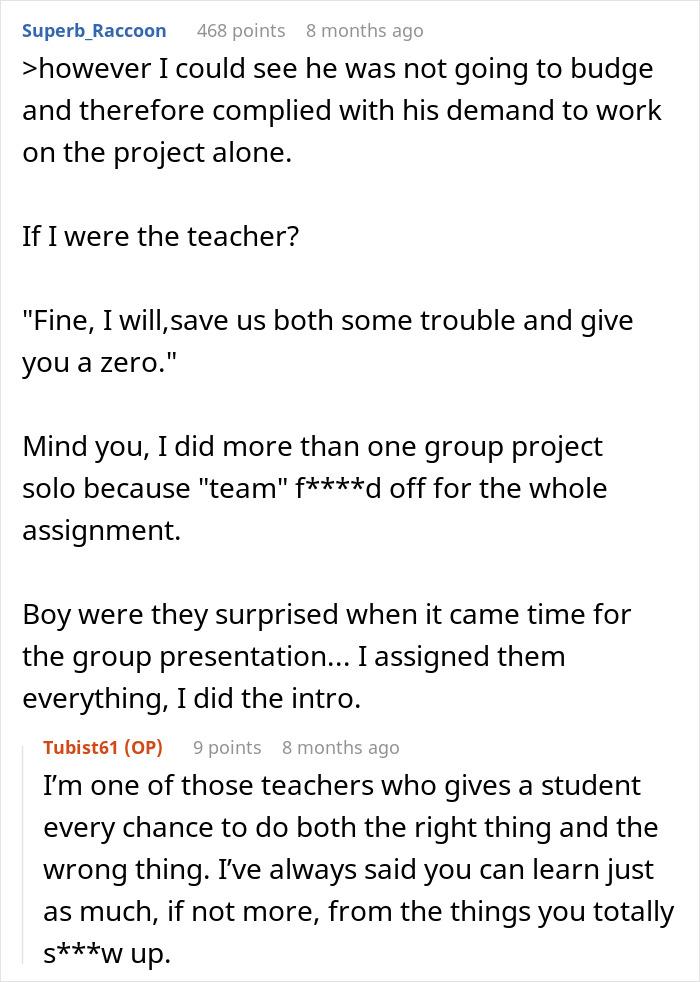
The OP, a lecturer, explained that one module required students to complete a programming project as part of a team, helping them build skills commonly expected in the IT industry. One particular student, however, had already gained a reputation for relying heavily on generative AI when completing coursework.
Although he often defended his submissions, he struggled whenever he was asked to explain how his own code actually worked. When the group project began, the student declared that he simply could not work with the other members of his assigned team. The OP clarified that the assessment included marks specifically tied to collaboration, meaning participation in the group was a required part of the assignment.
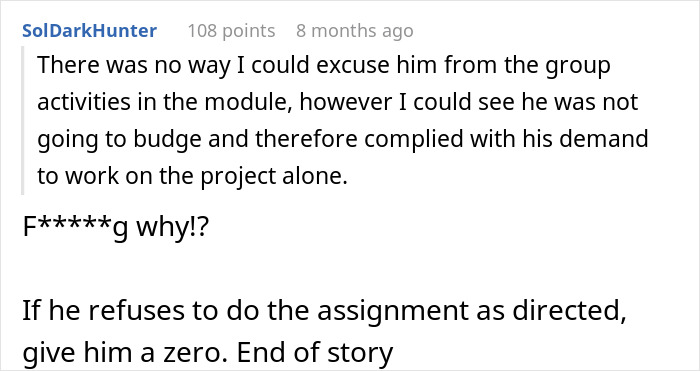
Despite repeated explanations, the student refused to change his mind, leaving the OP with little choice but to allow him to complete his technical work independently while continuing to warn him about the academic consequences. When submissions were finally assessed, the student’s project reflected only his own work and contained none of the required group contribution.
That immediately affected his grade because the assignment specifically awarded marks for teamwork. On top of that, the software itself failed to meet the original specification, meaning it did not accomplish what the project brief required. As if that weren’t enough, the student also struggled to defend his work which ultimately led to him failing the class completely.

Image credits: Wavebreak Media / Magnific (not the actual photo)
The OP’s insistence that the student participate in the group project wasn’t simply a personal preference, it reflects how Computer Science programs are designed to prepare students for the realities of the software industry. Dynelink notes that they mirror professional development environments, where programmers collaborate on shared codebases, review one another’s work, and coordinate tasks as a team.
The student’s apparent reliance on generative AI also highlights a challenge many universities are now facing. EdTech Magazine reports that while higher education institutions increasingly accept AI as a learning aid when used responsibly, they also expect students to demonstrate that they genuinely understand the work they submit.
That’s where oral assessments, such as the viva voce mentioned in the story, come into play. Mind The Graph states that these examinations have become an effective way for educators to verify both authorship and understanding. Instead of grading only the final submission, instructors ask students to explain how they approached the task, justify their coding decisions, and walk through their reasoning.
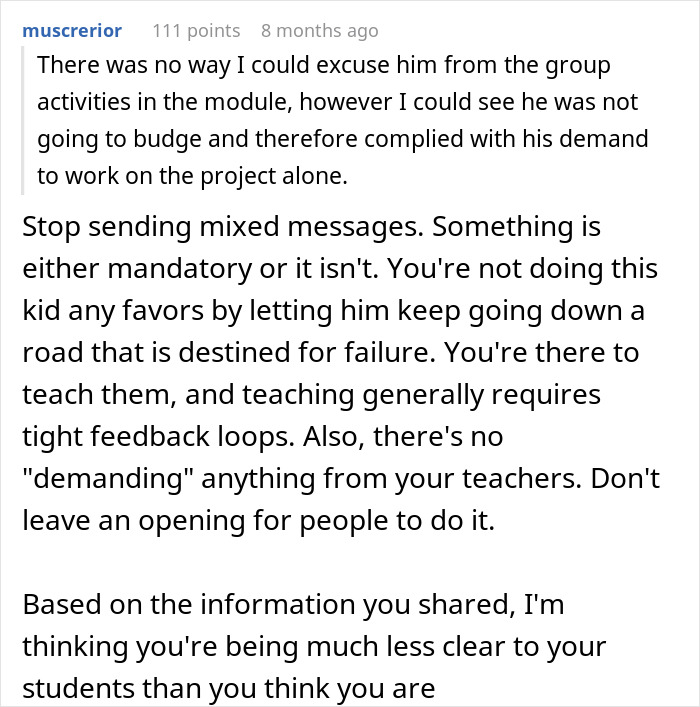
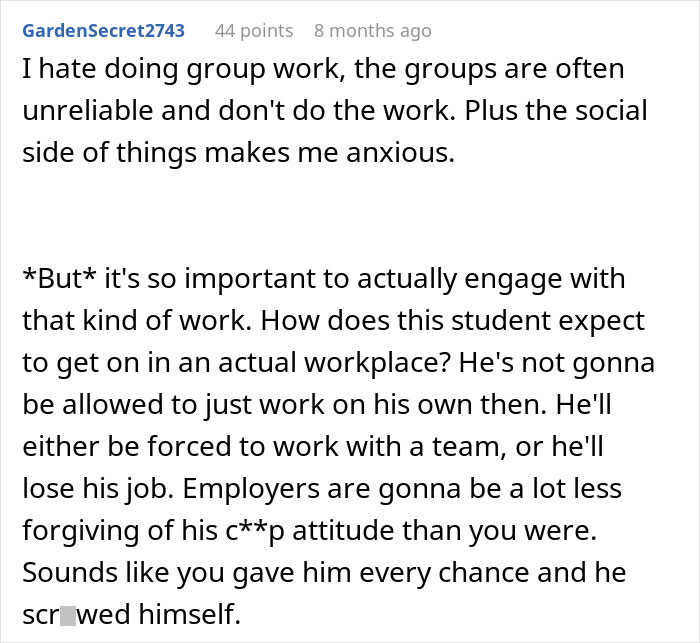
Netizens felt the student’s failing grade was fully justified, arguing that the biggest issue wasn’t working alone but his inability to explain the code he submitted. What do you think about this situation? Was failing the student a fair outcome, or do you think the university should have handled the situation differently? We would love to know your thoughts!
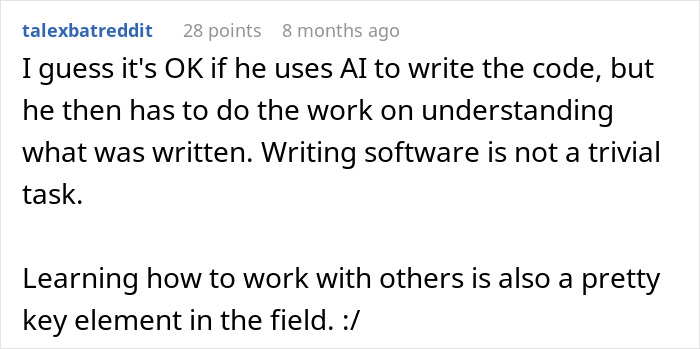
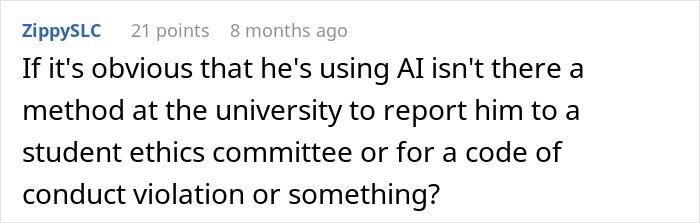
While some netizens suggested the student should have been reported for possible misconduct, others noted that AI isn’t necessarily the problem if he genuinely understood the output



 Follow Us