While there is nothing wrong with treating someone to lunch (or being treated), it’s pretty poor form to spring the fact that one can’t pay at the last minute. However, some folks think that just because they are “family,” normal rules don’t apply.
A woman shared her story of absurdly entitled relatives who managed to ruin everyone’s Christmas day when they invited people out to eat a Christmas day lunch, only to reveal at the very end that, as it turns out, they had no money on them. Readers debated how to handle familial entitlement and some shared similar stories.
Having a Christmas Day meal with one’s family is a lovely idea

Image credits: stockking / freepik (not the actual photo)
But one woman ended up realizing that her entitled relatives were perfectly happy make her husband foot the bill


Image credits: freepik (not the actual photo)


Image credits: DC Studio / freepik (not the actual photo)


Image credits: pls_pass_the_sarcasm
It’s good to know how to identify entitlement
Dealing with entitled relatives is like navigating a minefield where the explosives are wrapped in guilt trips and family obligations. The Great Dim Sum Incident (presumably, the only one this woman’s gone through) perfectly captures how these situations can blindside even the most well-intentioned people, and it offers valuable lessons for anyone who’s ever been stuck footing a bill they never agreed to pay.
The first red flag in this story is the invitation itself. When someone suggests going out to eat, there’s typically an unspoken social contract about payment expectations. Unless someone explicitly says they’re treating, the default assumption is that everyone pays their own way. The brother and his wife knew this, which is why they orchestrated the entire situation to corner their victims in a crowded public space where making a scene would be uncomfortable.
This brings us to the most important lesson when dealing with entitled relatives: recognize the setup before you’re trapped in it. Guilt tripping is a form of emotional blackmail that is intended to manipulate a person by preying on their feelings of guilt or responsibility, and entitled people often create scenarios where saying no or pushing back makes you look like the villain. They invite you somewhere nice, bring their kids along for emotional leverage, and wait until you’re committed before revealing they expect you to pay. By then, any objection makes you appear cheap or uncaring, especially in front of others who can witness your selfishness.
The husband’s response, while understandable in the moment, actually reinforced the bad behavior. Manipulators are experts at twisting guilt to their advantage, recognizing and using emotions to make others bend to their will. The sister-in-law and mother-in-law jumping in with accusations of ruining Christmas for the children was pure manipulation, and it worked. They correctly calculated that the discomfort of making a scene outweighed the cost of the meal.
Every relationship needs boundaries
So what should you do when caught in a similar situation? First, understand that you’re not responsible for other adults’ poor planning or deliberate manipulation. Setting boundaries for what you consider acceptable conduct is vital to your mental and personal health. If someone invites you out without discussing payment and then claims they can’t pay, that’s their problem to solve, not yours. You can offer to loan them money with clear repayment terms, or you can suggest they work something out with the restaurant. What you shouldn’t do is reward the behavior by simply covering the cost.
Second, don’t let the presence of children or holidays be used as emotional blackmail. Family based guilt is often used by parents or relatives to pressure someone into actions based on duty. The kids aren’t being harmed by their parents’ embarrassment over financial irresponsibility. In fact, rescuing entitled parents from consequences actually harms the children in the long run by modeling manipulation and irresponsibility as acceptable behavior.
Third, establish clear boundaries and stick to them consistently. A 2020 survey revealed that 25 percent of respondents limited communication with their family for the sake of mental health. After this incident, the couple wisely stopped accepting invitations from these relatives. This is crucial because entitled people interpret any give as a sign they can take more. The pattern will only escalate if you keep engaging with it.
When you do set boundaries, expect pushback. A toxic family will fight your boundaries, so standing strong without arguing is essential. Entitled relatives will often recruit flying monkeys, other family members who pressure you to give in for the sake of family harmony. They’ll frame you as the problem for not being more understanding or generous. Stand firm anyway. Real family harmony doesn’t require you to be a doormat.
It’s also worth having explicit conversations before agreeing to plans. Identifying your needs and boundaries in advance and communicating them clearly and kindly is essential. Ask directly who’s paying for what. Yes, it might feel awkward to discuss money so openly, but that momentary discomfort is nothing compared to being ambushed with an unexpected bill. Entitled people count on social niceties preventing these direct conversations.

Image credits: Getty Images / Unsplash (not the actual photo)
Sometimes it’s better to just not be around folks willing to manipulate you
Guilt tripping is a form of emotional blackmail where the guilt tripper feels entitled and innocent of any misdeed, creating an oppressive intangible force that confusingly intrudes into personal space. Research shows that individuals with clear personal boundaries are less likely to burn out, experience psychological distress, and are more capable of managing interpersonal conflicts.
Finally, consider whether maintaining these relationships is worth the ongoing stress and manipulation. Many people struggling with boundaries come from families where their identity is defined by how well they meet others’ needs, making any act of self prioritization feel like betrayal. Some people argue that family is family and you have to tolerate bad behavior for the sake of connection. But relationships should add value to your life, not drain it. If someone consistently treats you as an ATM rather than a person, limiting contact or cutting ties entirely might be the healthiest choice.
The Great Dim Sum Incident (one assumes there have been more than one, but the record remains silent) wasn’t really about eighty dollars. It was about respect, boundaries, and whether you’ll allow yourself to be manipulated by people who should care about you. Sometimes the best gift you can give entitled relatives is the consequence of their own actions, even if that means spending holidays apart.
Readers wanted more info


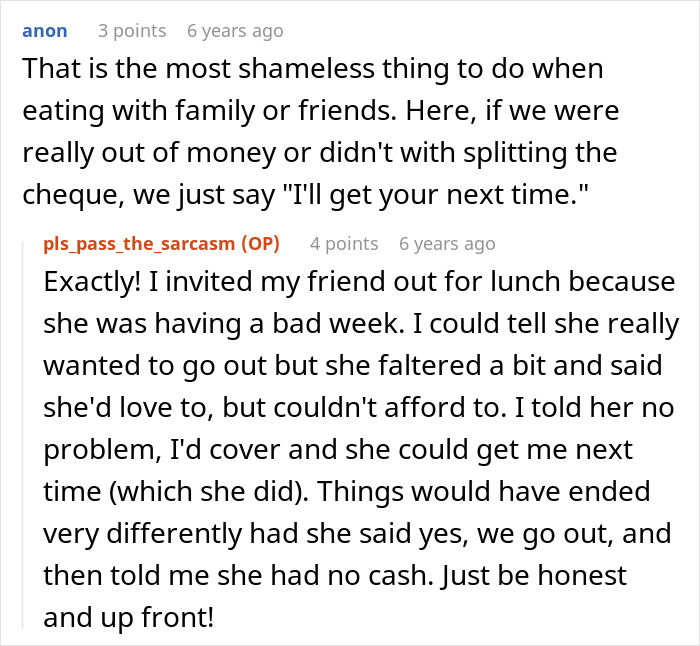

People thought her relatives were just downright manipulative and knew what they were doing


Some shared similar stories


 Follow Us